OGD Hyundai Elantra GT 2016 User Guide
[x] Cancel search | Manufacturer: HYUNDAI, Model Year: 2016, Model line: Elantra GT, Model: Hyundai Elantra GT 2016Pages: 546, PDF Size: 14.04 MB
Page 28 of 546
39
Safety features of your vehicle
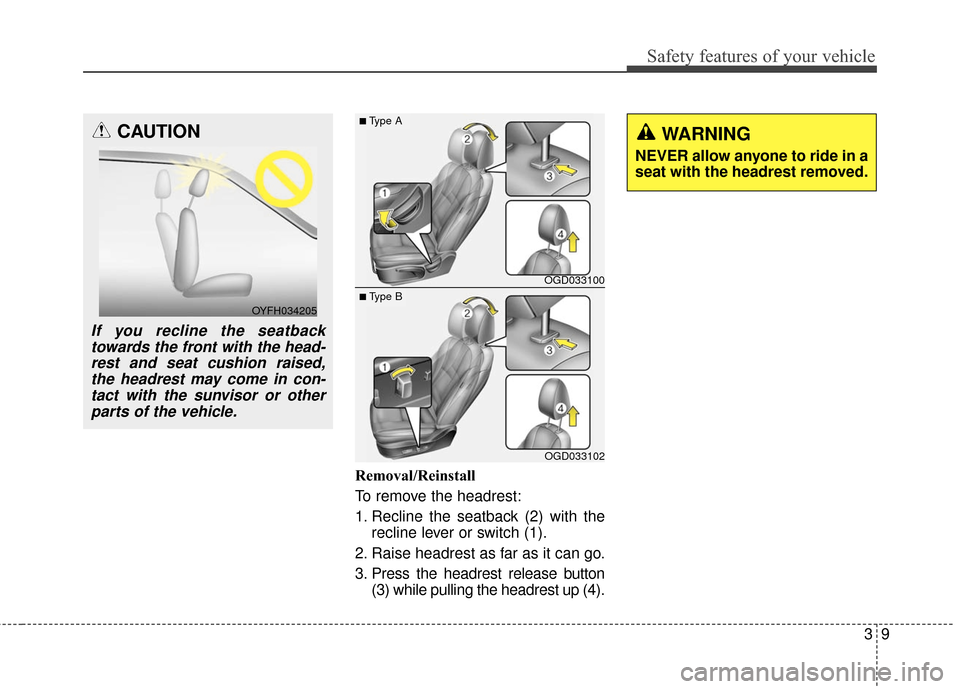
Removal/Reinstall
To remove the headrest:
1. Recline the seatback (2) with therecline lever or switch (1).
2. Raise headrest as far as it can go.
3. Press the headrest release button (3) while pulling the headrest up (4).
OGD033100
OGD033102
■Type A
■ Type B
WARNING
NEVER allow anyone to ride in a
seat with the headrest removed.
CAUTION
If you recline the seatbacktowards the front with the head-rest and seat cushion raised,the headrest may come in con-tact with the sunvisor or otherparts of the vehicle.
OYFH034205
Page 29 of 546
Safety features of your vehicle
10
3
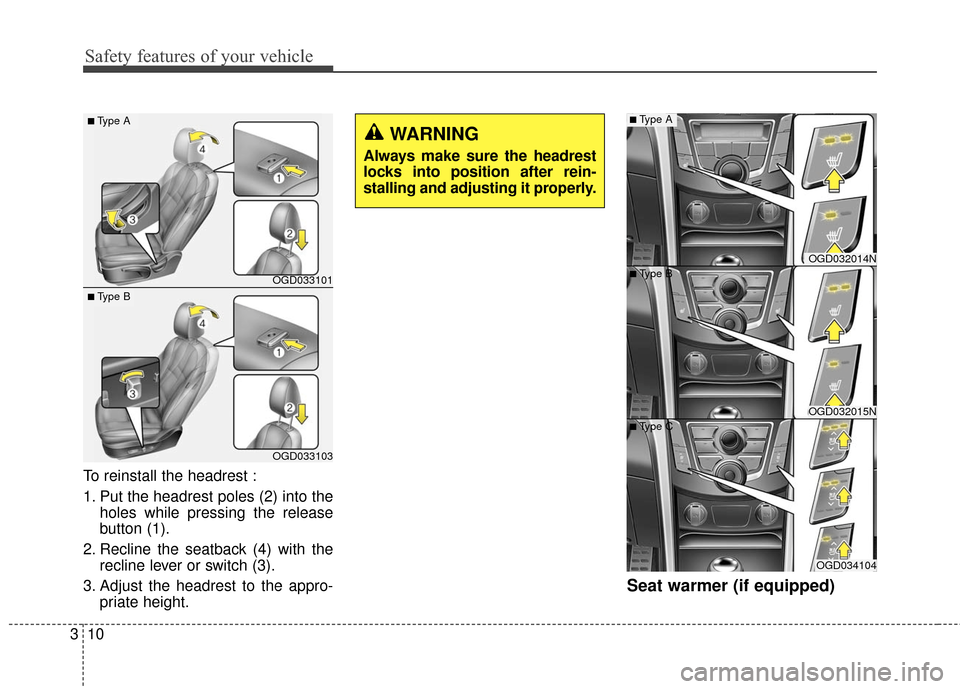
To reinstall the headrest :
1. Put the headrest poles (2) into the
holes while pressing the release
button (1).
2. Recline the seatback (4) with the recline lever or switch (3).
3. Adjust the headrest to the appro- priate height.
Seat warmer (if equipped)
WARNING
Always make sure the headrest
locks into position after rein-
stalling and adjusting it properly.
OGD033101
OGD033103
■Type A
■ Type B
OGD032014N
OGD032015N
OGD034104
■Type B
■Type A
■Type C
Page 31 of 546
Safety features of your vehicle
12
3
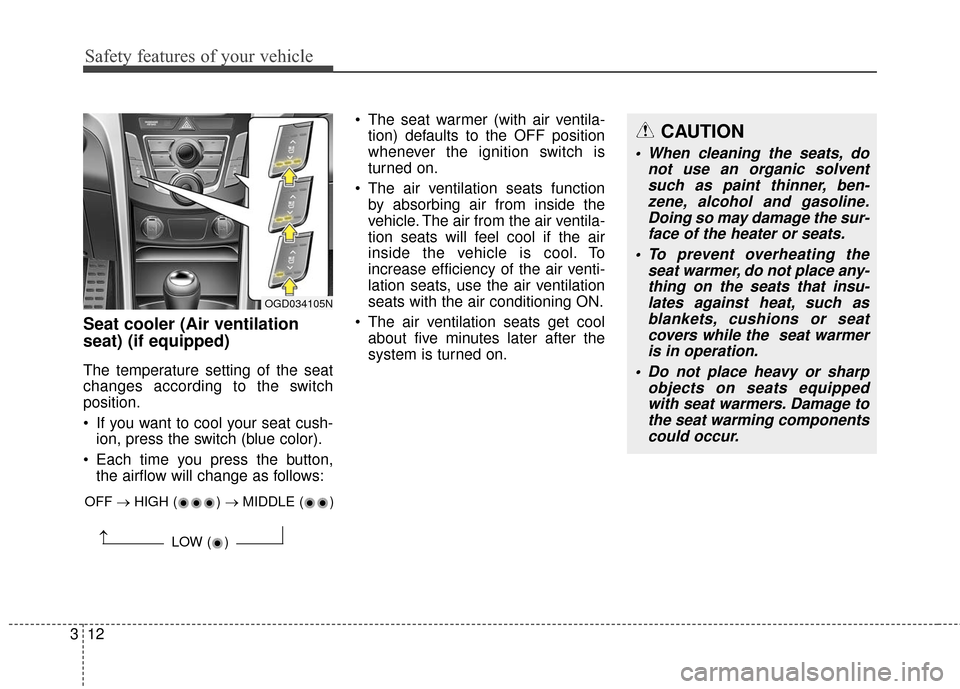
Seat cooler (Air ventilation
seat) (if equipped)
The temperature setting of the seat
changes according to the switch
position.
If you want to cool your seat cush-
ion, press the switch (blue color).
Each time you press the button, the airflow will change as follows: The seat warmer (with air ventila-
tion) defaults to the OFF position
whenever the ignition switch is
turned on.
The air ventilation seats function by absorbing air from inside the
vehicle. The air from the air ventila-
tion seats will feel cool if the air
inside the vehicle is cool. To
increase efficiency of the air venti-
lation seats, use the air ventilation
seats with the air conditioning ON.
The air ventilation seats get cool about five minutes later after the
system is turned on.
OGD034105N
CAUTION
When cleaning the seats, do not use an organic solventsuch as paint thinner, ben-zene, alcohol and gasoline.Doing so may damage the sur-face of the heater or seats.
To prevent overheating the seat warmer, do not place any-thing on the seats that insu-lates against heat, such asblankets, cushions or seatcovers while the seat warmeris in operation.
Do not place heavy or sharp objects on seats equippedwith seat warmers. Damage tothe seat warming componentscould occur.
OFF → HIGH ( ) → MIDDLE ( )
LOW ( )
→
Page 34 of 546
315
Safety features of your vehicle
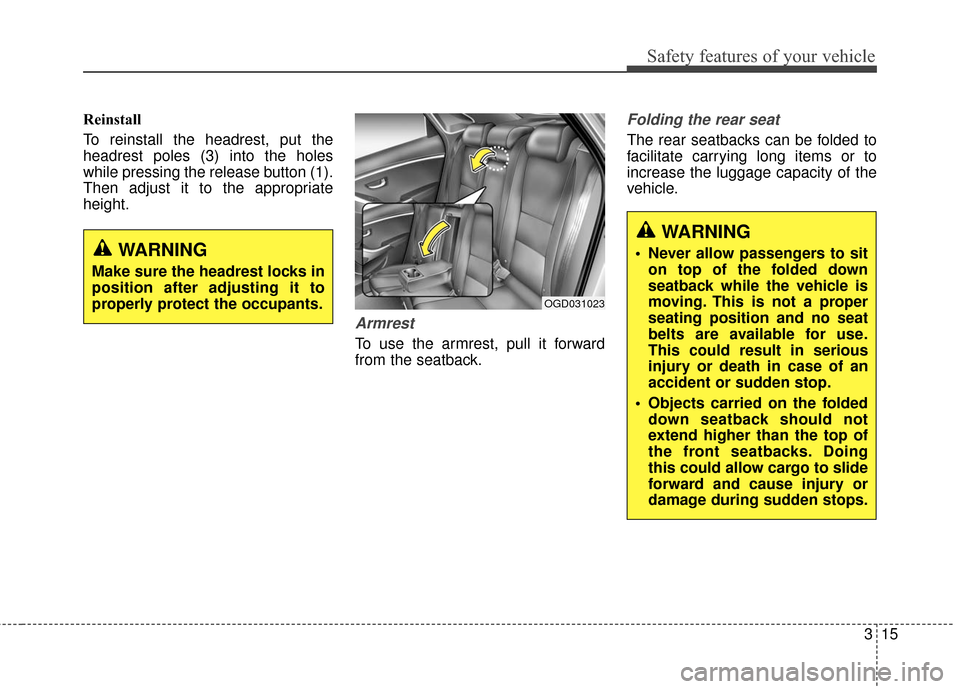
Reinstall
To reinstall the headrest, put the
headrest poles (3) into the holes
while pressing the release button (1).
Then adjust it to the appropriate
height.
Armrest
To use the armrest, pull it forward
from the seatback.
Folding the rear seat
The rear seatbacks can be folded to
facilitate carrying long items or to
increase the luggage capacity of the
vehicle.
OGD031023
WARNING
Never allow passengers to siton top of the folded down
seatback while the vehicle is
moving. This is not a proper
seating position and no seat
belts are available for use.
This could result in serious
injury or death in case of an
accident or sudden stop.
Objects carried on the folded down seatback should not
extend higher than the top of
the front seatbacks. Doing
this could allow cargo to slide
forward and cause injury or
damage during sudden stops.WARNING
Make sure the headrest locks in
position after adjusting it to
properly protect the occupants.
Page 35 of 546
Safety features of your vehicle
16
3
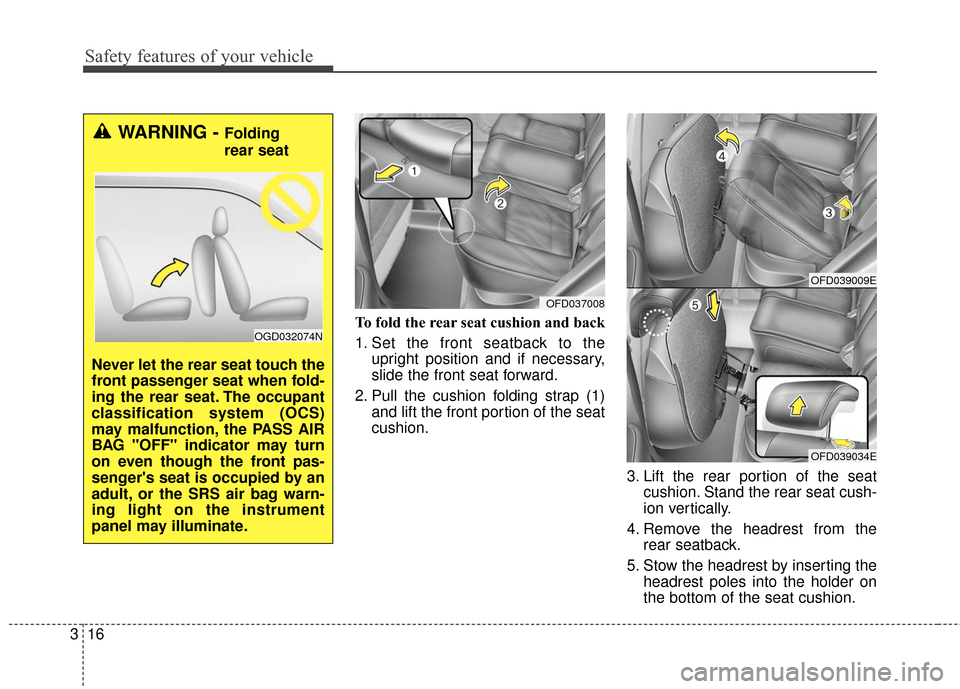
To fold the rear seat cushion and back
1. Set the front seatback to the
upright position and if necessary,
slide the front seat forward.
2. Pull the cushion folding strap (1) and lift the front portion of the seat
cushion.
3. Lift the rear portion of the seatcushion. Stand the rear seat cush-
ion vertically.
4. Remove the headrest from the rear seatback.
5. Stow the headrest by inserting the headrest poles into the holder on
the bottom of the seat cushion.
OFD039009E
OFD039034E
OFD037008
WARNING - Folding
rear seat
Never let the rear seat touch the
front passenger seat when fold-
ing the rear seat. The occupant
classification system (OCS)
may malfunction, the PASS AIR
BAG "OFF" indicator may turn
on even though the front pas-
senger's seat is occupied by an
adult, or the SRS air bag warn-
ing light on the instrument
panel may illuminate.
OGD032074N
Page 36 of 546
317
Safety features of your vehicle
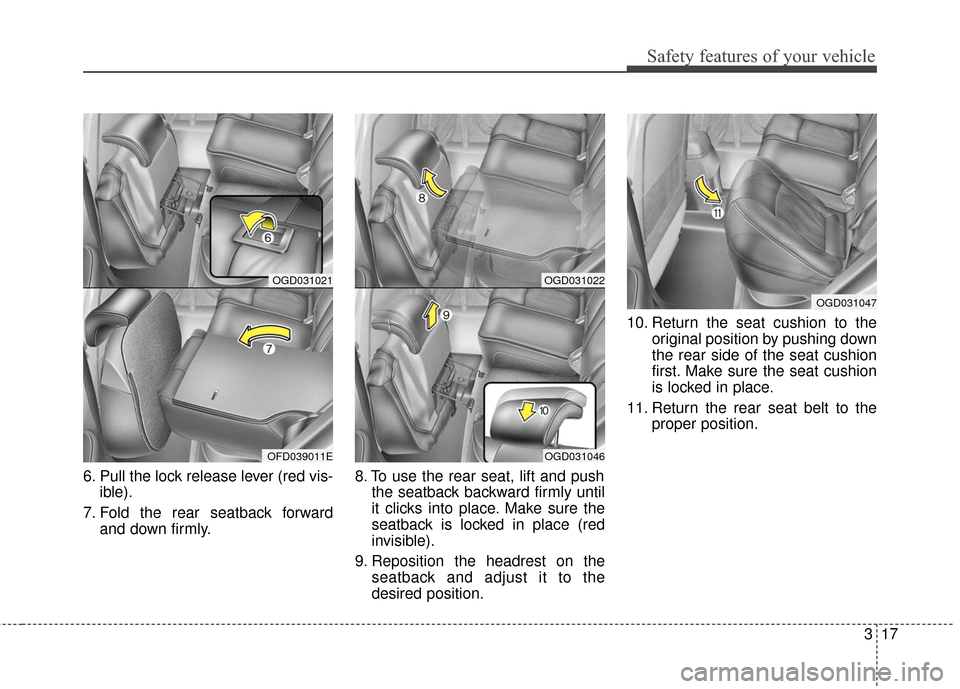
6. Pull the lock release lever (red vis-ible).
7. Fold the rear seatback forward and down firmly. 8. To use the rear seat, lift and push
the seatback backward firmly until
it clicks into place. Make sure the
seatback is locked in place (red
invisible).
9. Reposition the headrest on the seatback and adjust it to the
desired position. 10. Return the seat cushion to the
original position by pushing down
the rear side of the seat cushion
first. Make sure the seat cushion
is locked in place.
11. Return the rear seat belt to the proper position.
OGD031047
OGD031022
OGD031046
OGD031021
OFD039011E
Page 55 of 546
Safety features of your vehicle
36
3
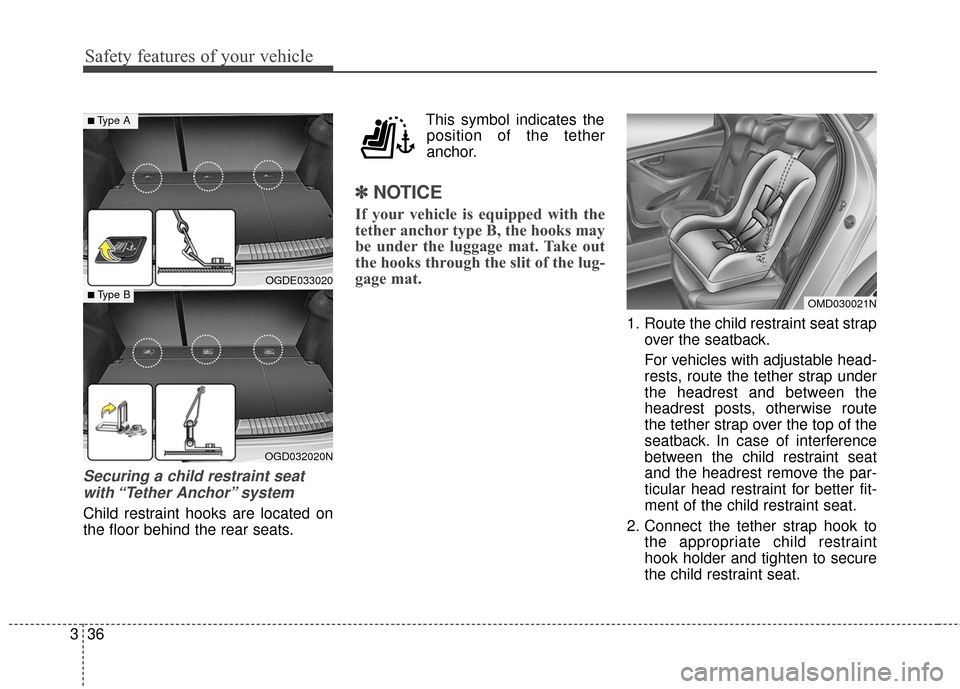
Securing a child restraint seat
with “Tether Anchor” system
Child restraint hooks are located on
the floor behind the rear seats. This symbol indicates the
position of the tether
anchor.
✽ ✽ NOTICE
If your vehicle is equipped with the
tether anchor type B, the hooks may
be under the luggage mat. Take out
the hooks through the slit of the lug-
gage mat.
1. Route the child restraint seat strap
over the seatback.
For vehicles with adjustable head-
rests, route the tether strap under
the headrest and between the
headrest posts, otherwise route
the tether strap over the top of the
seatback. In case of interference
between the child restraint seat
and the headrest remove the par-
ticular head restraint for better fit-
ment of the child restraint seat.
2. Connect the tether strap hook to the appropriate child restraint
hook holder and tighten to secure
the child restraint seat.
OGDE033020
OGD032020N
■Type A
■ Type BOMD030021N
Page 57 of 546
Safety features of your vehicle
38
3
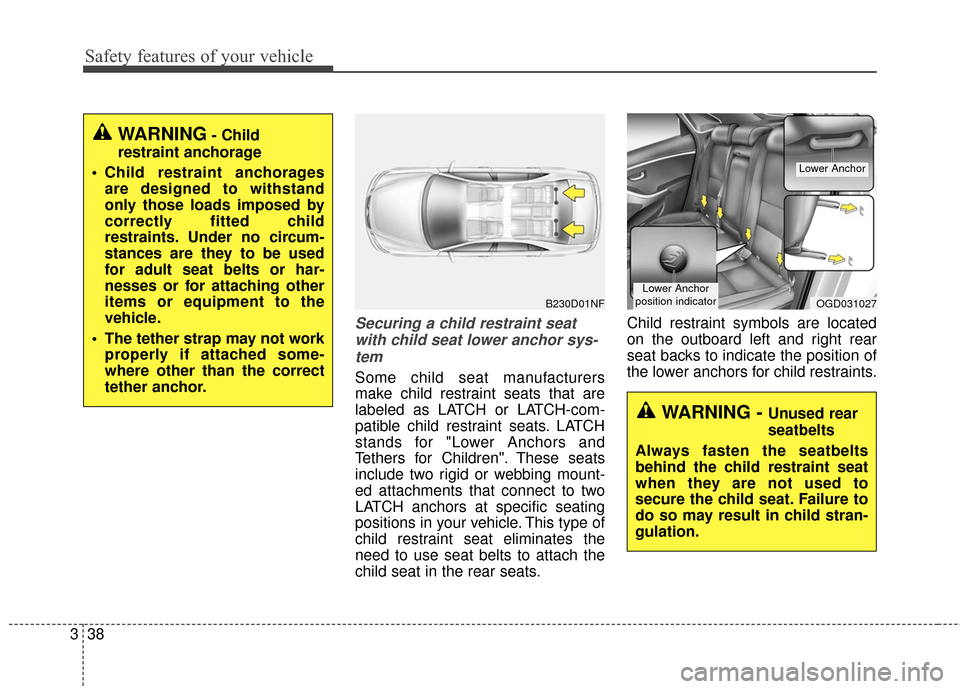
Securing a child restraint seat
with child seat lower anchor sys-tem
Some child seat manufacturers
make child restraint seats that are
labeled as LATCH or LATCH-com-
patible child restraint seats. LATCH
stands for "Lower Anchors and
Tethers for Children". These seats
include two rigid or webbing mount-
ed attachments that connect to two
LATCH anchors at specific seating
positions in your vehicle. This type of
child restraint seat eliminates the
need to use seat belts to attach the
child seat in the rear seats. Child restraint symbols are located
on the outboard left and right rear
seat backs to indicate the position of
the lower anchors for child restraints.
B230D01NFOGD031027
Lower Anchor
position indicator
Lower Anchor
WARNING- Child
restraint anchorage
Child restraint anchorages are designed to withstand
only those loads imposed by
correctly fitted child
restraints. Under no circum-
stances are they to be used
for adult seat belts or har-
nesses or for attaching other
items or equipment to the
vehicle.
The tether strap may not work properly if attached some-
where other than the correct
tether anchor.
WARNING - Unused rear
seatbelts
Always fasten the seatbelts
behind the child restraint seat
when they are not used to
secure the child seat. Failure to
do so may result in child stran-
gulation.
Page 59 of 546
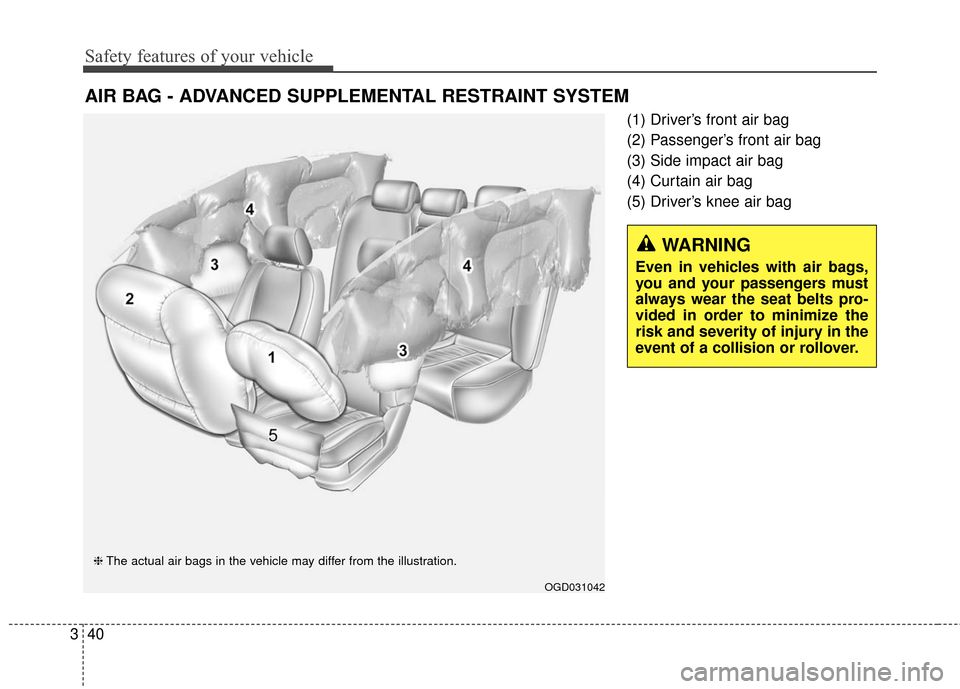
Safety features of your vehicle
40
3
(1) Driver’s front air bag
(2) Passenger’s front air bag
(3) Side impact air bag
(4) Curtain air bag
(5) Driver’s knee air bag
AIR BAG - ADVANCED SUPPLEMENTAL RESTRAINT SYSTEM
WARNING
Even in vehicles with air bags,
you and your passengers must
always wear the seat belts pro-
vided in order to minimize the
risk and severity of injury in the
event of a collision or rollover.
OGD031042
❈ The actual air bags in the vehicle may differ from the illustration.
Page 63 of 546

Safety features of your vehicle
44
3
SRS components and functions
The SRS consists of the following
components:
1. Driver's front air bag module
2. Passenger's front air bag module
3. Side impact air bag modules
4. Curtain air bag modules
5. Retractor pre-tensioner assemblies
6. Air bag warning light
7. SRS control module (SRSCM)
8. Front impact sensors
9. Side impact sensors
10. PASS AIR BAG “OFF” indicator
(Front passenger’s seat only) 11. Occupant classification system
(Front passenger’s seat only)
12. Driver’s and front passenger’s seat belt buckle sensors
13. Emergency fastening device (EFD)
14. Driver’s knee air bag module
15. Side pressure impact sensor
The SRSCM continually monitors all
SRS components while the ignition
switch is ON to determine if a crash
impact is severe enough to require
air bag deployment or pre-tensioner
seat belt deployment. The SRS air bag warning light " "
on the instrument panel will illumi-
nate for about 6 seconds after the
ignition switch is turned to the ON
position, after which the SRS air bag
warning light " " should go out.
W7-147OGDE035105