warning Hyundai Elantra GT 2017 Owner's Manual
[x] Cancel search | Manufacturer: HYUNDAI, Model Year: 2017, Model line: Elantra GT, Model: Hyundai Elantra GT 2017Pages: 493, PDF Size: 11.53 MB
Page 381 of 493
75
Maintenance
Owner maintenance precau-
tions
Improper or incomplete service may
result in problems. This section gives
instructions only for the maintenance
items that are easy to perform.
As explained earlier in this section,
several procedures can be done only
by an authorized HYUNDAI dealer
with special tools.
✽ ✽NOTICE
Improper owner maintenance dur-
ing the warranty period may affect
warranty coverage. For details, read
the separate Owner’s Handbook &
Warranty Information booklet pro-
vided with the vehicle. If you're
unsure about any servicing or main-
tenance procedure, have it done by
an authorized HYUNDAI dealer.
WARNING - Maintenance
work
Performing maintenance work on a vehicle can be danger-
ous. You can be seriously
injured while performing some
maintenance procedures. If
you lack sufficient knowledge
and experience or the proper
tools and equipment to do the
work, have it done by an
authorized HYUNDAI dealer.
Working under the hood with the engine running is danger-
ous. It becomes even more
dangerous when you wear jew-
elry or loose clothing. These
can become entangled in mov-
ing parts and result in injury.
Therefore, if you must run the
engine while working under the
hood, make certain that you
remove all jewelry (especially
rings, bracelets, watches, and
necklaces) and all neckties,
scarves, and similar loose
clothing before getting near the
engine or cooling fans.
Page 382 of 493
Maintenance
67
OWNER MAINTENANCE
The following lists are vehicle checks
and inspections that should be per-
formed by the owner or an authorized
HYUNDAI dealer at the frequencies
indicated to help ensure safe,
dependable operation of your vehicle.
Any adverse conditions should be
brought to the attention of your dealer
as soon as possible.
These Owner Maintenance Checks
are generally not covered by war-
ranties and you may be charged for
labor, parts and lubricants used.Owner maintenance schedule
When you stop for fuel:
Check the engine oil level.
Check coolant level in coolantreservoir.
Check the windshield washer fluid level.
Look for low or under-inflated tires.
While operating your vehicle:
Note any changes in the sound of the exhaust or any smell of
exhaust fumes in the vehicle.
Check for vibrations in the steering wheel. Notice any increased steer-
ing effort or looseness in the steer-
ing wheel, or change in its straight-
ahead position.
Notice if your vehicle constantly turns slightly or “pulls” to one side
when traveling on a smooth, level
road.
When stopping, listen and check for unusual sounds, pulling to one
side, increased brake pedal travel
or “hard-to-push” brake pedal.
If any slipping or changes in the operation of your transaxle occurs,
check the transaxle fluid level.
Check automatic transaxle P (Park) function.
Check parking brake.
Check for fluid leaks under your vehicle (water dripping from the air
conditioning system during or after
use is normal).
WARNING
Be careful when checking your
engine coolant level when the
engine is hot. Scalding hot
coolant and steam may blow
out under pressure. This could
cause burns or other serious
injury.
Page 383 of 493
77
Maintenance
At least monthly:
Check coolant level in the enginecoolant reservoir.
Check the operation of all exterior lights, including the stoplights, turn
signals and hazard warning flash-
ers.
Check the cold inflation pressures of all tires including the spare.
At least twice a year
(i.e., every Spring and Fall):
Check radiator, heater and air con- ditioning hoses for leaks or dam-
age.
Check windshield washer spray and wiper operation. Clean wiper
blades with clean cloth dampened
with washer fluid.
Check headlight alignment.
Check muffler, exhaust pipes, shields and clamps.
Check the lap/shoulder belts for wear and function.
Check for worn tires and loose wheel lug nuts.
At least once a year:
Clean body and door drain holes.
Lubricate door hinges and checks,and hood hinges.
Lubricate door and hood locks and latches.
Lubricate door rubber weather- strips.
Check the air conditioning system.
Inspect and lubricate automatic transaxle linkage and controls.
Clean battery and terminals.
Check the brake fluid level.
Page 403 of 493
727
Maintenance
ENGINE OIL
Checking the engine oil level
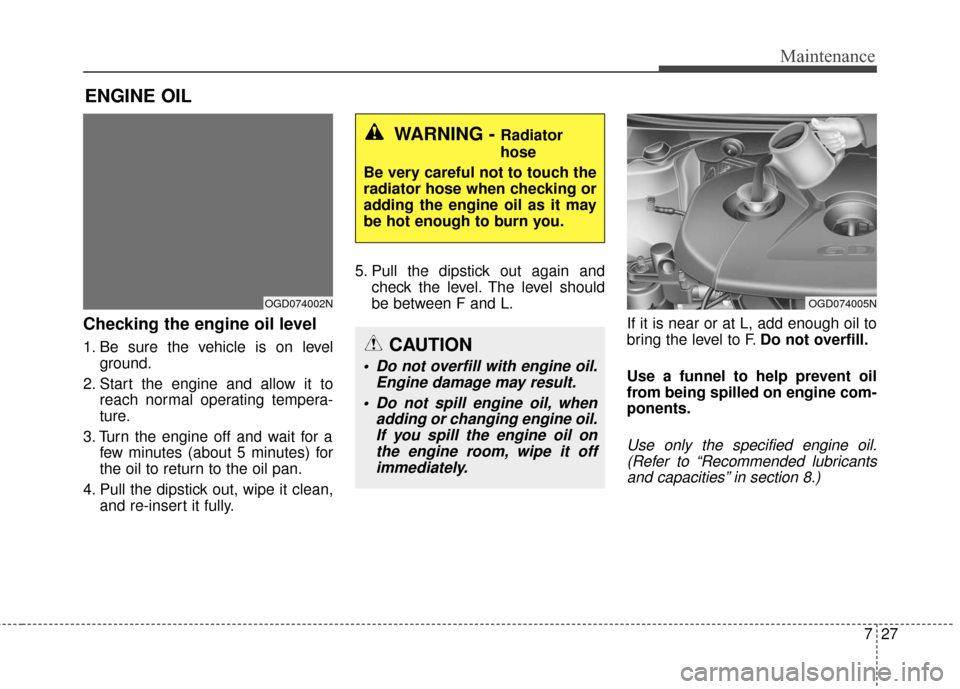
1. Be sure the vehicle is on levelground.
2. Start the engine and allow it to reach normal operating tempera-
ture.
3. Turn the engine off and wait for a few minutes (about 5 minutes) for
the oil to return to the oil pan.
4. Pull the dipstick out, wipe it clean, and re-insert it fully. 5. Pull the dipstick out again and
check the level. The level should
be between F and L.
If it is near or at L, add enough oil to
bring the level to F.Do not overfill.
Use a funnel to help prevent oil
from being spilled on engine com-
ponents.
Use only the specified engine oil. (Refer to “Recommended lubricantsand capacities” in section 8.)
WARNING - Radiator
hose
Be very careful not to touch the
radiator hose when checking or
adding the engine oil as it may
be hot enough to burn you.
CAUTION
Do not overfill with engine oil. Engine damage may result.
Do not spill engine oil, when adding or changing engine oil.If you spill the engine oil onthe engine room, wipe it offimmediately.
OGD074002NOGD074005N
Page 404 of 493
Maintenance
28
7
Changing the engine oil and
filter
Have engine oil and filter changed by
an authorized HYUNDAI dealer
according to the Maintenance
Schedule at the beginning of this
section.
CALIFORNIA PROPO-
SITION 65 WARNING
Engine oil contains chemicals
known to the State of California
to cause cancer, birth defects,
and reproductive harm.
Used engine oil may cause irri-
tation or cancer of the skin if
left in contact with the skin for
prolonged periods of time. Used
engine oil contains chemicals
that have caused cancer in lab-
oratory animals. Always protect
your skin by washing your
hands thoroughly with soap
and warm water as soon as pos-
sible after handling used oil.
Page 405 of 493
729
Maintenance
ENGINE COOLANT
The high-pressure cooling system
has a reservoir filled with year-round
antifreeze coolant. The reservoir is
filled at the factory.
Check the antifreeze protection and
coolant level at least once a year, at
the beginning of the winter season,
and before traveling to a colder cli-
mate.
Checking the coolant level
(Continued)
Turn the engine off and waituntil it cools down. Use
extreme care when removing
the radiator cap. Wrap a thick
towel around it, and turn it
counterclockwise slowly to
the first stop. Step back while
the pressure is released from
the cooling system. When you
are sure all the pressure has
been released, press down on
the cap, using a thick towel,
and continue turning counter-
clockwise to remove it.
Even if the engine is not oper- ating, do not remove the radia-
tor cap or the drain plug while
the engine and radiator are
hot. Hot coolant and steam
may still blow out under pres-
sure, causing serious injury.WARNING
The electric motor
(cooling fan) is con-
trolled by engine
coolant temperature,
refrigerant pressure
and vehicle speed. It may some-
times operate even when the
engine is not running. Use
extreme caution when working
near the blades of the cooling
fan so that you are not injured
by a rotating fan blades. As the
engine coolant temperature
decreases, the electric motor
will automatically shut off. This
is a normal condition.
WARNING
Removing radiator
cap
Never attempt to remove the radiator cap while the engine
is operating or hot. Doing so
might lead to cooling system
and engine damage and could
result in serious personal
injury from escaping hot
coolant or steam.
(Continued)
Page 407 of 493
731
Maintenance
Changing the coolant
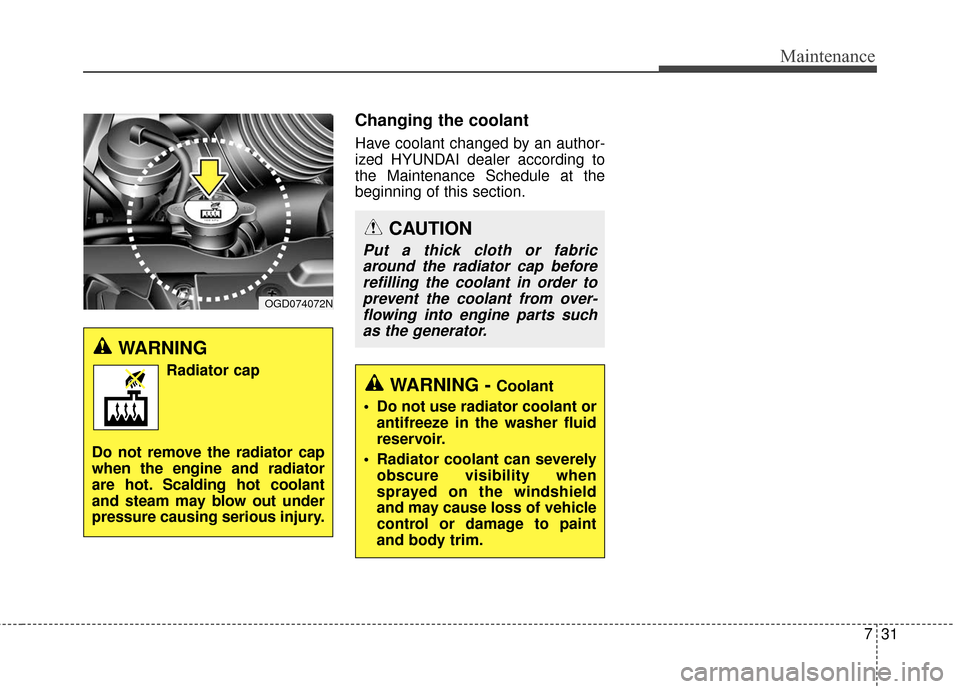
Have coolant changed by an author-
ized HYUNDAI dealer according to
the Maintenance Schedule at the
beginning of this section.
WARNING
Radiator cap
Do not remove the radiator cap
when the engine and radiator
are hot. Scalding hot coolant
and steam may blow out under
pressure causing serious injury.
WARNING - Coolant
Do not use radiator coolant or antifreeze in the washer fluid
reservoir.
Radiator coolant can severely obscure visibility when
sprayed on the windshield
and may cause loss of vehicle
control or damage to paint
and body trim.
OGD074072N
CAUTION
Put a thick cloth or fabricaround the radiator cap beforerefilling the coolant in order toprevent the coolant from over-flowing into engine parts suchas the generator.
Page 408 of 493
Maintenance
32
7
BRAKE/CLUTCH FLUID
Checking the brake/clutch
fluid level
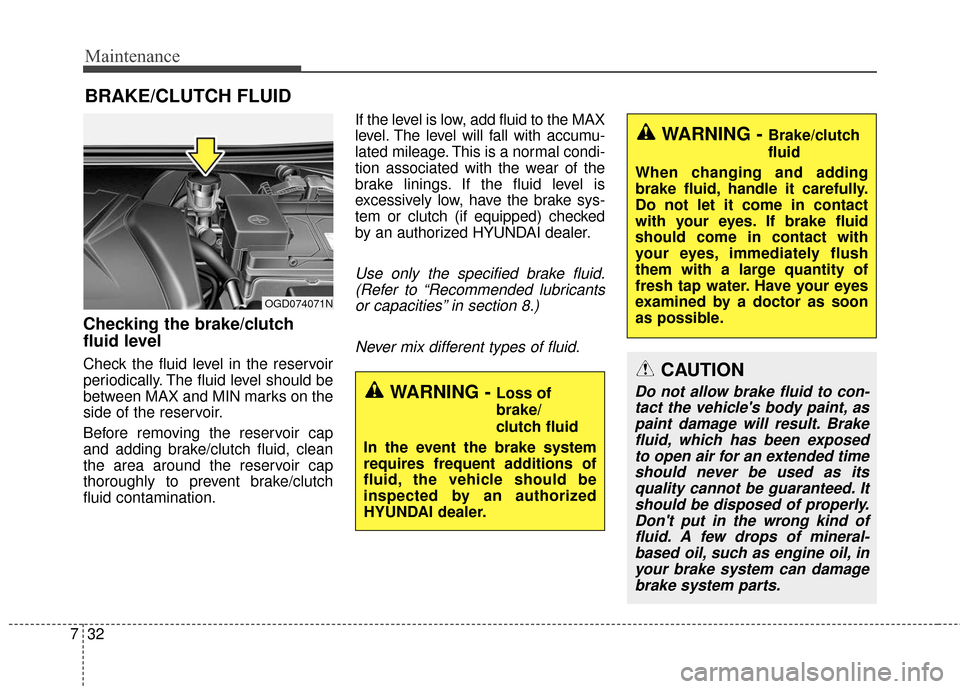
Check the fluid level in the reservoir
periodically. The fluid level should be
between MAX and MIN marks on the
side of the reservoir.
Before removing the reservoir cap
and adding brake/clutch fluid, clean
the area around the reservoir cap
thoroughly to prevent brake/clutch
fluid contamination. If the level is low, add fluid to the MAX
level. The level will fall with accumu-
lated mileage. This is a normal condi-
tion associated with the wear of the
brake linings. If the fluid level is
excessively low, have the brake sys-
tem or clutch (if equipped) checked
by an authorized HYUNDAI dealer.
Use only the specified brake fluid.
(Refer to “Recommended lubricantsor capacities” in section 8.)
Never mix different types of fluid.
WARNING - Brake/clutch
fluid
When changing and adding
brake fluid, handle it carefully.
Do not let it come in contact
with your eyes. If brake fluid
should come in contact with
your eyes, immediately flush
them with a large quantity of
fresh tap water. Have your eyes
examined by a doctor as soon
as possible.
WARNING - Loss of
brake/
clutch fluid
In the event the brake system
requires frequent additions of
fluid, the vehicle should be
inspected by an authorized
HYUNDAI dealer.
CAUTION
Do not allow brake fluid to con- tact the vehicle's body paint, aspaint damage will result. Brakefluid, which has been exposedto open air for an extended timeshould never be used as itsquality cannot be guaranteed. Itshould be disposed of properly.Don't put in the wrong kind offluid. A few drops of mineral-based oil, such as engine oil, inyour brake system can damagebrake system parts.
OGD074071N
Page 409 of 493
733
Maintenance
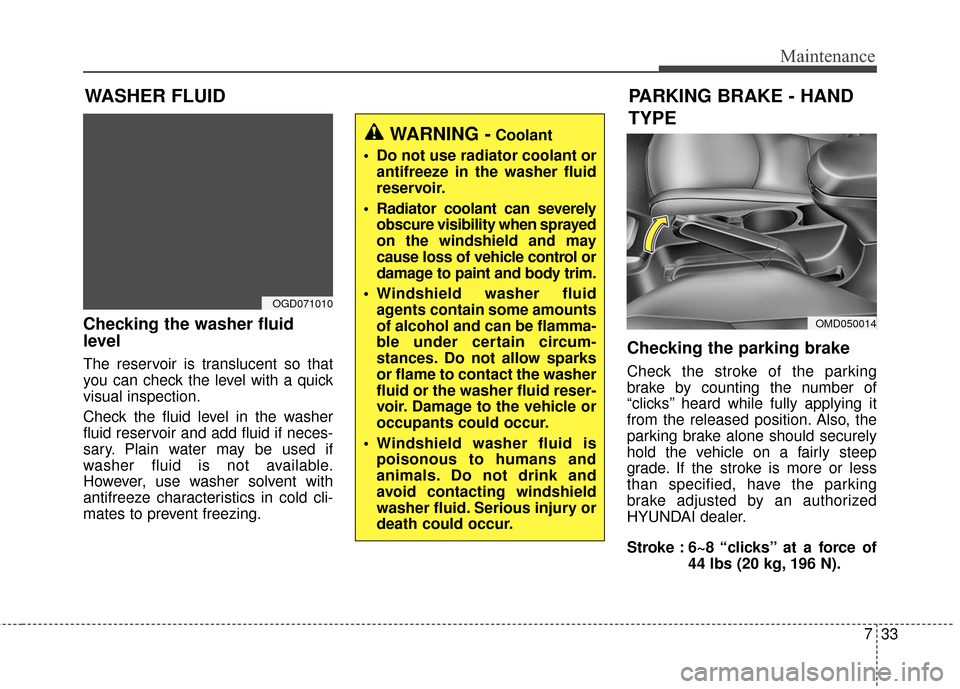
Checking the washer fluid
level
The reservoir is translucent so that
you can check the level with a quick
visual inspection.
Check the fluid level in the washer
fluid reservoir and add fluid if neces-
sary. Plain water may be used if
washer fluid is not available.
However, use washer solvent with
antifreeze characteristics in cold cli-
mates to prevent freezing.
Checking the parking brake
Check the stroke of the parking
brake by counting the number of
“clicks’’ heard while fully applying it
from the released position. Also, the
parking brake alone should securely
hold the vehicle on a fairly steep
grade. If the stroke is more or less
than specified, have the parking
brake adjusted by an authorized
HYUNDAI dealer.
Stroke : 6~8 “clicks’’ at a force of 44 lbs (20 kg, 196 N).
WASHER FLUID
WARNING -Coolant
Do not use radiator coolant or antifreeze in the washer fluid
reservoir.
Radiator coolant can severely obscure visibility when sprayed
on the windshield and may
cause loss of vehicle control or
damage to paint and body trim.
Windshield washer fluid agents contain some amounts
of alcohol and can be flamma-
ble under certain circum-
stances. Do not allow sparks
or flame to contact the washer
fluid or the washer fluid reser-
voir. Damage to the vehicle or
occupants could occur.
Windshield washer fluid is poisonous to humans and
animals. Do not drink and
avoid contacting windshield
washer fluid. Serious injury or
death could occur.
OGD071010
OMD050014
PARKING BRAKE - HAND
TYPE
Page 417 of 493
741
Maintenance
BATTERY
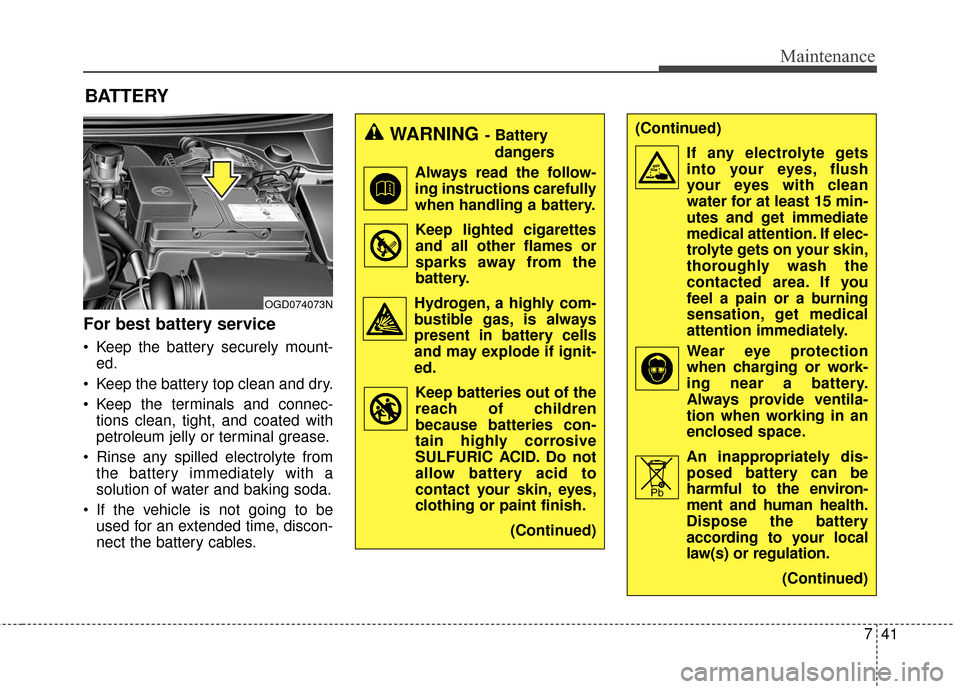
For best battery service
Keep the battery securely mount-ed.
Keep the battery top clean and dry.
Keep the terminals and connec- tions clean, tight, and coated with
petroleum jelly or terminal grease.
Rinse any spilled electrolyte from the battery immediately with a
solution of water and baking soda.
If the vehicle is not going to be used for an extended time, discon-
nect the battery cables.
OGD074073N
WARNING- Battery
dangers
Always read the follow-
ing instructions carefully
when handling a battery.
Keep lighted cigarettesand all other flames or
sparks away from the
battery.
Hydrogen, a highly com- bustible gas, is always
present in battery cells
and may explode if ignit-
ed.
Keep batteries out of the
reach of children
because batteries con-
tain highly corrosive
SULFURIC ACID. Do not
allow battery acid to
contact your skin, eyes,
clothing or paint finish. (Continued)(Continued)If any electrolyte gets
into your eyes, flush
your eyes with clean
water for at least 15 min-
utes and get immediate
medical attention. If elec-
trolyte gets on your skin,
thoroughly wash the
contacted area. If you
feel a pain or a burning
sensation, get medical
attention immediately.
Wear eye protectionwhen charging or work-
ing near a battery.
Always provide ventila-
tion when working in an
enclosed space.
An inappropriately dis- posed battery can be
harmful to the environ-
ment and human health.
Dispose the battery
according to your local
law(s) or regulation.
(Continued)
Pb