cooling Hyundai Elantra GT 2017 User Guide
[x] Cancel search | Manufacturer: HYUNDAI, Model Year: 2017, Model line: Elantra GT, Model: Hyundai Elantra GT 2017Pages: 493, PDF Size: 11.53 MB
Page 344 of 493
Driving your vehicle
52
5
To keep locks from freezing
To keep the locks from freezing,
squirt an approved de-icer fluid or
glycerine into the key opening. If a
lock is covered with ice, squirt it with
an approved de-icing fluid to remove
the ice. If the lock is frozen internally,
you may be able to thaw it out by
using a heated key. Handle the heat-
ed key with care to avoid injury.
Use approved window washer
anti-freeze in system
To keep the water in the window
washer system from freezing, add an
approved window washer anti-freeze
solution in accordance with instruc-
tions on the container. Window wash-
er anti-freeze is available from an
authorized HYUNDAI dealer and
most auto parts outlets. Do not use
engine coolant or other types of anti-
freeze as these may damage the
paint finish.
Don't let your parking brake
freeze
Under some conditions your parking
brake can freeze in the engaged posi-
tion. This is most likely to happen
when there is an accumulation of
snow or ice around or near the rear
brakes or if the brakes are wet. If there
is a risk of the parking brake freezing,
apply it only temporarily while you put
the shift lever in P (automatic
transaxle) or in first or reverse gear
(manual transaxle) and block the rear
wheels so the vehicle cannot roll.
Then release the parking brake.
Don't let ice and snow accu-
mulate underneath
Under some conditions, snow and
ice can build up under the fenders
and interfere with the steering. When
driving in severe winter conditions
where this may happen, you should
periodically check underneath the
car to be sure the movement of the
front wheels and the steering com-
ponents is not obstructed.
Carry emergency equipment
Depending on the severity of the
weather where you drive your car,
you should carry appropriate emer-
gency equipment. Some of the items
you may want to carry include tire
chains, tow straps or chains, flash-
light, emergency flares, sand, a
shovel, jumper cables, a window
scraper, gloves, ground cloth, cover-
alls, a blanket, etc.
Don't place foreign objects or
materials in the engine com-
partment
Placement of foreign objects or
materials which prevent cooling of
the engine, in the engine compart-
ment, may cause a failure or com-
bustion. The manufacturer is not
responsible for the damage caused
by such placement.
Page 359 of 493
What to do in an emergency
86
IF THE ENGINE OVERHEATS
If your temperature gauge indicates
overheating, you experience a loss
of power, or hear loud pinging or
knocking, the engine is probably too
hot. If this happens, you should:
1. Pull off the road and stop as soonas it is safe to do so.
2. Place the shift lever in P (automat- ic transaxle) or neutral (manual
transaxle) and set the parking
brake. If the air conditioning is on,
turn it off.
3. If engine coolant is running out under the car or steam is coming
out from the hood, stop the
engine. Do not open the hood until
the coolant has stopped running
or the steaming has stopped. If
there is no visible loss of engine
coolant and no steam, leave the
engine running and check to be
sure the engine cooling fan is
operating. If the fan is not running,
turn the engine off. 4. Check to see if the water pump
drive belt is missing. If it is not
missing, check to see that it is
tight. If the drive belt seems to be
satisfactory, check for coolant
leaking from the radiator, hoses or
under the car. (If the air condition-
ing had been in use, it is normal
for cold water to be draining from it
when you stop.)
5. If the water pump drive belt is bro- ken or engine coolant is leaking
out, stop the engine immediately
and call the nearest authorized
HYUNDAI dealer for assistance. 6. If you cannot find the cause of the
overheating, wait until the engine
temperature has returned to nor-
mal. Then, if coolant has been lost,
carefully add coolant to the reser-
voir to bring the fluid level in the
reservoir up to the halfway mark.
7. Proceed with caution, keeping alert for further signs of overheat-
ing. If overheating happens again,
call an authorized HYUNDAI deal-
er for assistance.
WARNING
While the engine is running,
keep hair, hands and clothing
away from moving parts such
as the fan and drive belts to pre-
vent injury.
CAUTION
Serious loss of coolant indi-cates there is a leak in the cool-ing system and this should bechecked as soon as possible byan authorized HYUNDAI dealer.
WARNING
Do not remove the radiator cap
when the engine is hot. This
may result in coolant being
blown out of the opening and
cause serious burns.
Page 381 of 493
75
Maintenance
Owner maintenance precau-
tions
Improper or incomplete service may
result in problems. This section gives
instructions only for the maintenance
items that are easy to perform.
As explained earlier in this section,
several procedures can be done only
by an authorized HYUNDAI dealer
with special tools.
✽ ✽NOTICE
Improper owner maintenance dur-
ing the warranty period may affect
warranty coverage. For details, read
the separate Owner’s Handbook &
Warranty Information booklet pro-
vided with the vehicle. If you're
unsure about any servicing or main-
tenance procedure, have it done by
an authorized HYUNDAI dealer.
WARNING - Maintenance
work
Performing maintenance work on a vehicle can be danger-
ous. You can be seriously
injured while performing some
maintenance procedures. If
you lack sufficient knowledge
and experience or the proper
tools and equipment to do the
work, have it done by an
authorized HYUNDAI dealer.
Working under the hood with the engine running is danger-
ous. It becomes even more
dangerous when you wear jew-
elry or loose clothing. These
can become entangled in mov-
ing parts and result in injury.
Therefore, if you must run the
engine while working under the
hood, make certain that you
remove all jewelry (especially
rings, bracelets, watches, and
necklaces) and all neckties,
scarves, and similar loose
clothing before getting near the
engine or cooling fans.
Page 400 of 493
Maintenance
24
7
Vacuum crankcase ventilation
hoses
Inspect the surface of hoses for evi-
dence of heat and/or mechanical
damage. Hard and brittle rubber,
cracking, tears, cuts, abrasions, and
excessive swelling indicate deterio-
ration. Particular attention should be
paid to examine those hose surfaces
nearest to high heat sources, such
as the exhaust manifold.
Inspect the hose routing to assure
that the hoses do not come in con-
tact with any heat source, sharp
edges or moving component which
might cause heat damage or
mechanical wear. Inspect all hose
connections, such as clamps and
couplings, to make sure they are
secure, and that no leaks are pres-
ent. Hoses should be replaced
immediately if there is any evidence
of deterioration or damage.
Air cleaner filter
A Genuine HYUNDAI air cleaner fil-
ter is recommended when the filter is
replaced.
Spark plugs
Make sure to install new spark plugs
of the correct heat range.
Cooling system
Check cooling system components,
such as radiator, coolant reservoir,
hoses and connections for leakage
and damage. Replace any damaged
parts.
Coolant
The coolant should be changed at
the intervals specified in the mainte-
nance schedule.
Automatic transaxle fluid
(if equipped)
Automatic transaxle fluid should not
be checked under normal usage
conditions.
But in severe conditions, the fluid
should be changed at an authorized
HYUNDAI dealer in accordance with
the scheduled maintenance at the
beginning of this chapter.
✽ ✽
NOTICE
Automatic transaxle fluid color is
basically red.
As the vehicle is driven, the auto-
matic transaxle fluid will begin to
look darker.
This is a normal condition and you
should not judge the need to replace
the fluid based upon the changed
color.
Page 405 of 493
729
Maintenance
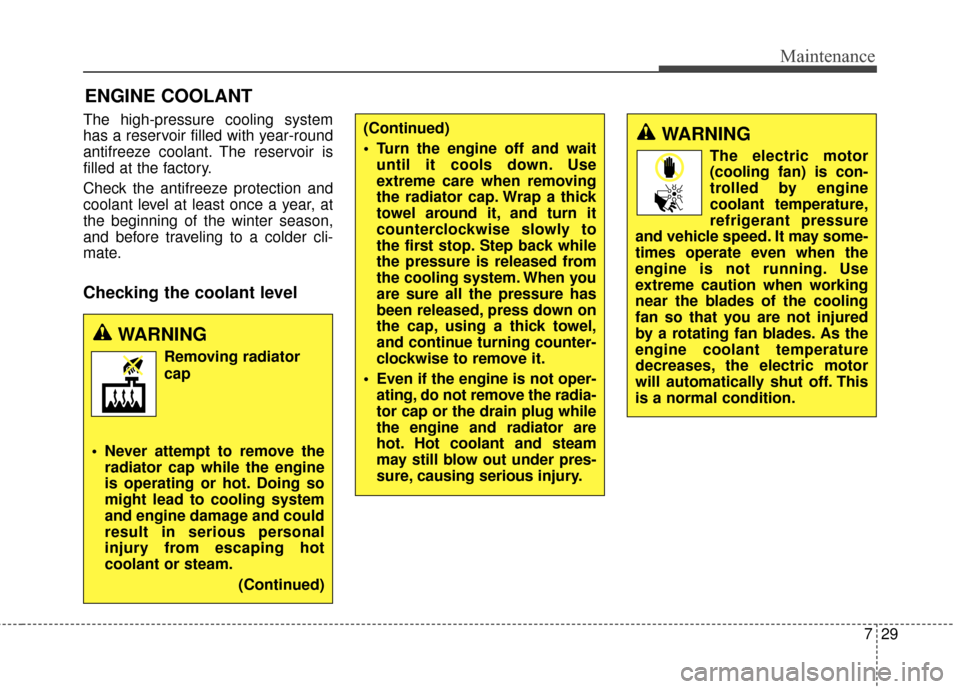
ENGINE COOLANT
The high-pressure cooling system
has a reservoir filled with year-round
antifreeze coolant. The reservoir is
filled at the factory.
Check the antifreeze protection and
coolant level at least once a year, at
the beginning of the winter season,
and before traveling to a colder cli-
mate.
Checking the coolant level
(Continued)
Turn the engine off and waituntil it cools down. Use
extreme care when removing
the radiator cap. Wrap a thick
towel around it, and turn it
counterclockwise slowly to
the first stop. Step back while
the pressure is released from
the cooling system. When you
are sure all the pressure has
been released, press down on
the cap, using a thick towel,
and continue turning counter-
clockwise to remove it.
Even if the engine is not oper- ating, do not remove the radia-
tor cap or the drain plug while
the engine and radiator are
hot. Hot coolant and steam
may still blow out under pres-
sure, causing serious injury.WARNING
The electric motor
(cooling fan) is con-
trolled by engine
coolant temperature,
refrigerant pressure
and vehicle speed. It may some-
times operate even when the
engine is not running. Use
extreme caution when working
near the blades of the cooling
fan so that you are not injured
by a rotating fan blades. As the
engine coolant temperature
decreases, the electric motor
will automatically shut off. This
is a normal condition.
WARNING
Removing radiator
cap
Never attempt to remove the radiator cap while the engine
is operating or hot. Doing so
might lead to cooling system
and engine damage and could
result in serious personal
injury from escaping hot
coolant or steam.
(Continued)
Page 406 of 493
Maintenance
30
7
Check the condition and connections
of all cooling system hoses and
heater hoses. Replace any swollen
or deteriorated hoses.
The coolant level should be filled
between F and L marks on the side
of the coolant reservoir when the
engine is cool.
If the coolant level is low, add enough
distilled (deionized) water. Bring the
level to F, but do not overfill. If fre-
quent additions are required, see an
authorized HYUNDAI dealer for a
cooling system inspection.
Recommended engine coolant
When adding coolant, use only
deionized water or soft water for
your vehicle and never mix hard
water in the coolant filled at the fac-
tory. An improper coolant mixture
can result in serious malfunction or
engine damage.
The engine in your vehicle has alu- minum engine parts and must be
protected by an ethylene-glycol
with phosphate based coolant to
prevent corrosion and freezing.
DO NOT USE alcohol or methanol coolant or mix them with the spec-
ified coolant.
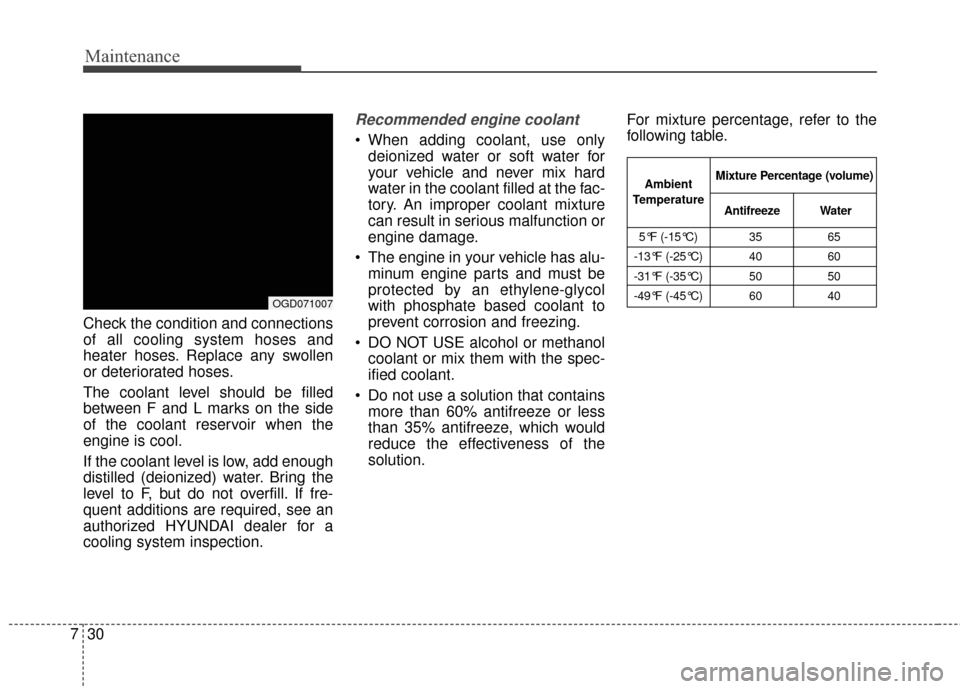
Do not use a solution that contains more than 60% antifreeze or less
than 35% antifreeze, which would
reduce the effectiveness of the
solution. For mixture percentage, refer to the
following table.
OGD071007
5°F (-15°C) 35
65
-13°F (-25°C) 40 60
-31°F (-35°C) 50 50
-49°F (-45°C) 60 40
Ambient
Temperature Mixture Percentage (volume)
Antifreeze Water
Page 444 of 493
Maintenance
68
7
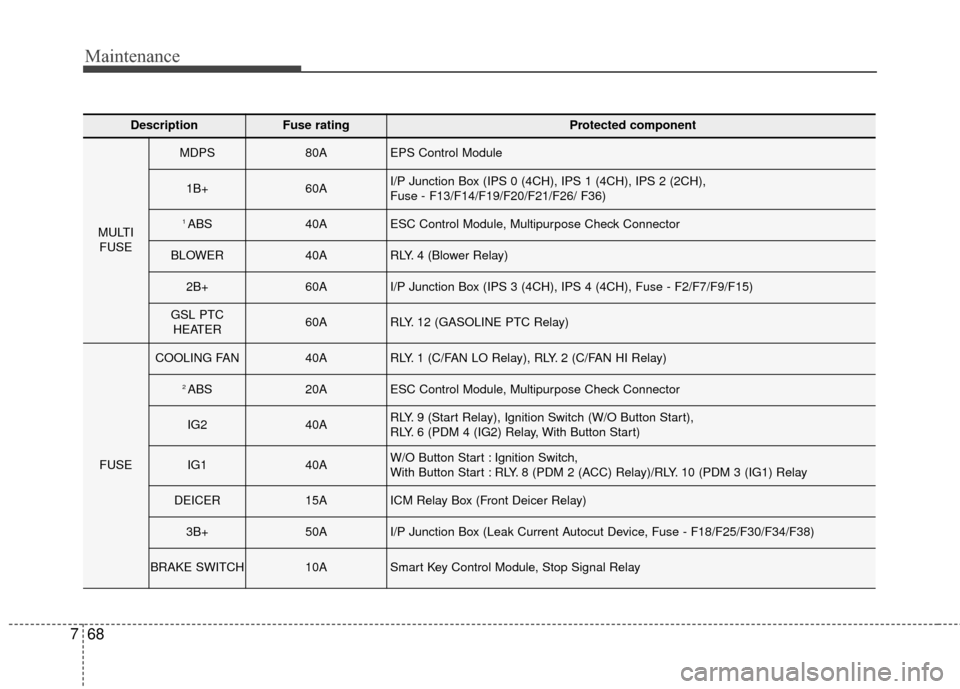
DescriptionFuse ratingProtected component
MULTI
FUSE
MDPS80AEPS Control Module
1B+60AI/P Junction Box (IPS 0 (4CH), IPS 1 (4CH), IPS 2 (2CH),
Fuse - F13/F14/F19/F20/F21/F26/ F36)
1 ABS40AESC Control Module, Multipurpose Check Connector
BLOWER40ARLY. 4 (Blower Relay)
2B+60AI/P Junction Box (IPS 3 (4CH), IPS 4 (4CH), Fuse - F2/F7/F9/F15)
GSL PTC HEATER60ARLY. 12 (GASOLINE PTC Relay)
FUSE
COOLING FAN40ARLY. 1 (C/FAN LO Relay), RLY. 2 (C/FAN HI Relay)
2 ABS20AESC Control Module, Multipurpose Check Connector
IG240ARLY. 9 (Start Relay), Ignition Switch (W/O Button Start),
RLY. 6 (PDM 4 (IG2) Relay, With Button Start)
IG140AW/O Button Start : Ignition Switch,
With Button Start : RLY. 8 (PDM 2 (ACC) Relay)/RLY. 10 (PDM 3 (IG1) Relay
DEICER15AICM Relay Box (Front Deicer Relay)
3B+50AI/P Junction Box (Leak Current Autocut Device, Fuse - F18/F25/F30/F34/F38)
BRAKE SWITCH10ASmart Key Control Module, Stop Signal Relay
Page 446 of 493
Maintenance
70
7
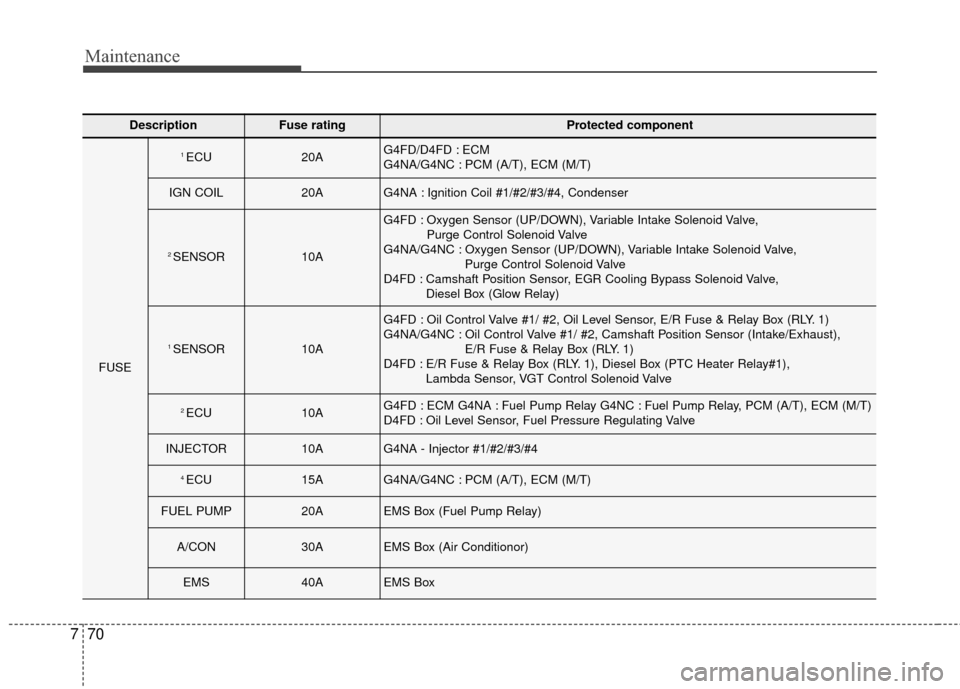
DescriptionFuse ratingProtected component
FUSE
1 ECU20AG4FD/D4FD : ECM
G4NA/G4NC : PCM (A/T), ECM (M/T)
IGN COIL20AG4NA : Ignition Coil #1/#2/#3/#4, Condenser
2 SENSOR10A
G4FD : Oxygen Sensor (UP/DOWN), Variable Intake Solenoid Valve,
Purge Control Solenoid Valve
G4NA/G4NC : Oxygen Sensor (UP/DOWN), Variable Intake Solenoid Valve, Purge Control Solenoid Valve
D4FD : Camshaft Position Sensor, EGR Cooling Bypass Solenoid Valve, Diesel Box (Glow Relay)
1 SENSOR10A
G4FD : Oil Control Valve #1/ #2, Oil Level Sensor, E/R Fuse & Relay Box (RLY. 1)
G4NA/G4NC : Oil Control Valve #1/ #2, Camshaft Position Sensor (Intake/Exhaust), E/R Fuse & Relay Box (RLY. 1)
D4FD : E/R Fuse & Relay Box (RLY. 1), Diesel Box (PTC Heater Relay#1), Lambda Sensor, VGT Control Solenoid Valve
2 ECU10AG4FD : ECM G4NA : Fuel Pump Relay G4NC : Fuel Pump Relay, PCM (A/T), ECM (M/T)
D4FD : Oil Level Sensor, Fuel Pressure Regulating Valve
INJECTOR10AG4NA - Injector #1/#2/#3/#4
4 ECU15AG4NA/G4NC : PCM (A/T), ECM (M/T)
FUEL PUMP20AEMS Box (Fuel Pump Relay)
A/CON30AEMS Box (Air Conditionor)
EMS40AEMS Box
Page 447 of 493
771
Maintenance
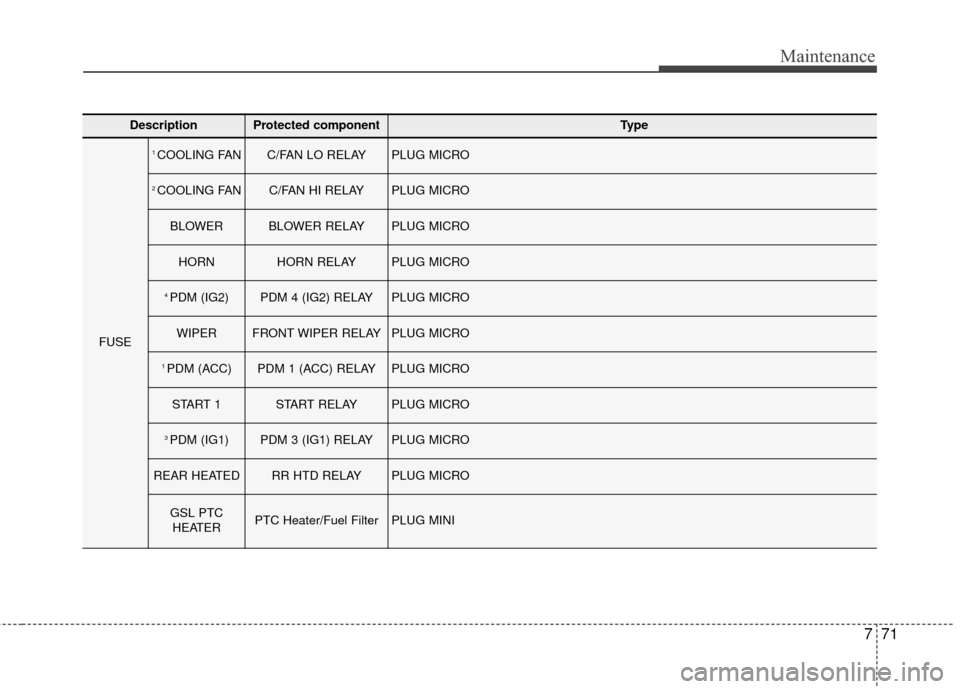
DescriptionProtected componentType
FUSE
1 COOLING FANC/FAN LO RELAY PLUG MICRO
2 COOLING FANC/FAN HI RELAY PLUG MICRO
BLOWERBLOWER RELAY PLUG MICRO
HORNHORN RELAY PLUG MICRO
4 PDM (IG2)PDM 4 (IG2) RELAY PLUG MICRO
WIPERFRONT WIPER RELAY PLUG MICRO
1 PDM (ACC)PDM 1 (ACC) RELAY PLUG MICRO
START 1START RELAY PLUG MICRO
3 PDM (IG1)PDM 3 (IG1) RELAY PLUG MICRO
REAR HEATEDRR HTD RELAY PLUG MICRO
GSL PTCHEATERPTC Heater/Fuel FilterPLUG MINI
Page 486 of 493
I3
Index
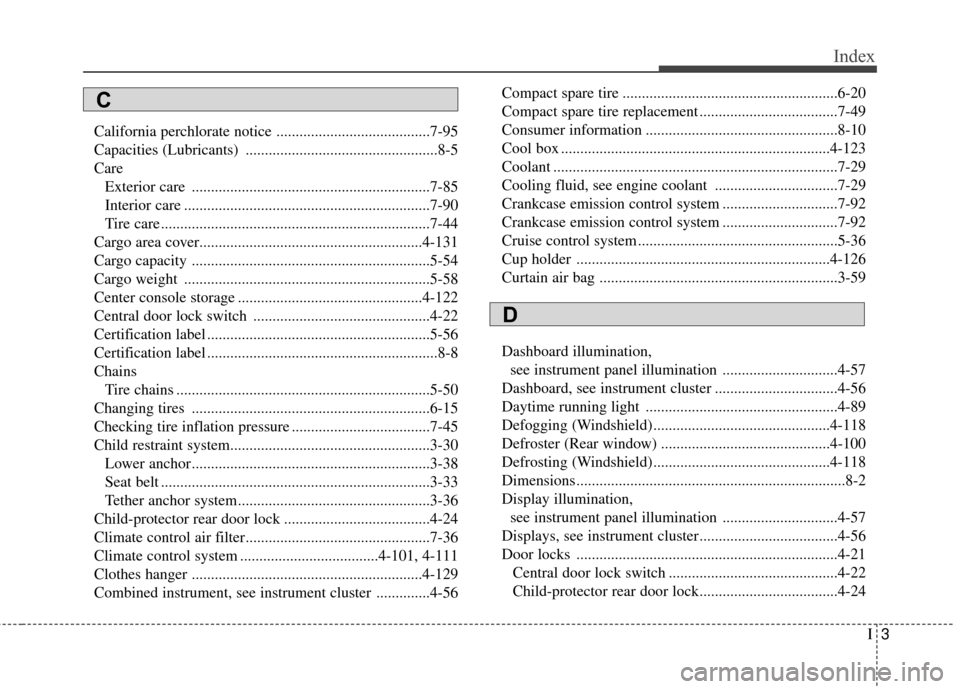
California perchlorate notice ........................................7-95
Capacities (Lubricants) ..................................................8-5
CareExterior care ..............................................................7-85
Interior care ................................................................7-90
Tire care ......................................................................7-\
44
Cargo area cover..........................................................4-131
Cargo capacity ..............................................................5-54
Cargo weight ................................................................5-58
Center console storage ................................................4-122
Central door lock switch ..............................................4-22
Certification label ..........................................................5-56
Certification label ............................................................8-8
Chains Tire chains ..................................................................5-50
Changing tires ..............................................................6-15
Checking tire inflation pressure ....................................7-45
Child restraint system....................................................3-30 Lower anchor..............................................................3-38
Seat belt ......................................................................3-\
33
Tether anchor system..................................................3-36
Child-protector rear door lock ......................................4-24
Climate control air filter................................................7-36
Climate control system ....................................4-101, 4-111
Clothes hanger ............................................................4-129
Combined instrument, see instrument cluster ..............4-56 Compact spare tire ........................................................6-20
Compact spare tire replacement ....................................7-49
Consumer information ..................................................8-10
Cool box ......................................................................4-\
123
Coolant ........................................................................\
..7-29
Cooling fluid, see engine coolant ................................7-29
Crankcase emission control system ..............................7-92
Crankcase emission control system ..............................7-92
Cruise control system ....................................................5-36
Cup holder ..................................................................4-126
Curtain air bag ..............................................................3-59
Dashboard illumination,
see instrument panel illumination ..............................4-57
Dashboard, see instrument cluster ................................4-56
Daytime running light ..................................................4-89
Defogging (Windshield)..............................................4-118
Defroster (Rear window) ............................................4-100
Defrosting (Windshield)..............................................4-118
Dimensions ......................................................................8-\
2
Display illumination, see instrument panel illumination ..............................4-57
Displays, see instrument cluster....................................4-56
Door locks ....................................................................4-21\
Central door lock switch ............................................4-22
Child-protector rear door lock....................................4-24
C
D