ECU Hyundai Elantra GT 2017 Service Manual
[x] Cancel search | Manufacturer: HYUNDAI, Model Year: 2017, Model line: Elantra GT, Model: Hyundai Elantra GT 2017Pages: 493, PDF Size: 11.53 MB
Page 370 of 493
619
What to do in an emergency
To prevent the jack, jack handle,
wheel lug nut wrench and spare tire
from rattling while the vehicle is in
motion, store them properly.
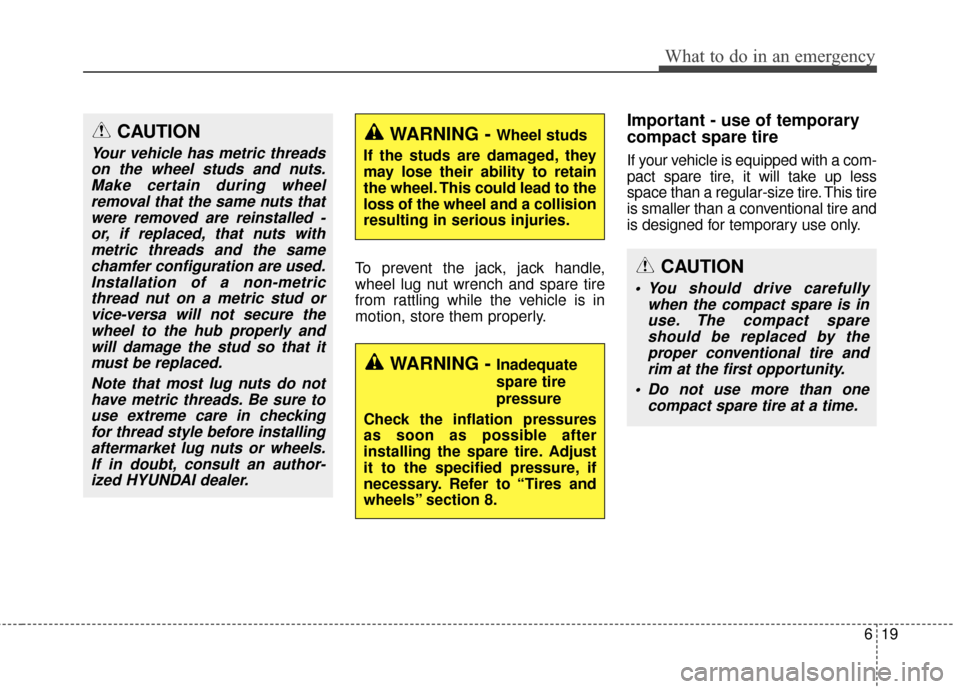
Important - use of temporary
compact spare tire
If your vehicle is equipped with a com-
pact spare tire, it will take up less
space than a regular-size tire. This tire
is smaller than a conventional tire and
is designed for temporary use only.
CAUTION
Your vehicle has metric threadson the wheel studs and nuts.Make certain during wheelremoval that the same nuts thatwere removed are reinstalled -or, if replaced, that nuts withmetric threads and the samechamfer configuration are used.Installation of a non-metricthread nut on a metric stud orvice-versa will not secure thewheel to the hub properly andwill damage the stud so that itmust be replaced.
Note that most lug nuts do nothave metric threads. Be sure touse extreme care in checkingfor thread style before installingaftermarket lug nuts or wheels.If in doubt, consult an author-ized HYUNDAI dealer.
WARNING - Wheel studs
If the studs are damaged, they
may lose their ability to retain
the wheel. This could lead to the
loss of the wheel and a collision
resulting in serious injuries.
WARNING - Inadequate
spare tire
pressure
Check the inflation pressures
as soon as possible after
installing the spare tire. Adjust
it to the specified pressure, if
necessary. Refer to “Tires and
wheels” section 8.
CAUTION
You should drive carefully when the compact spare is inuse. The compact spareshould be replaced by theproper conventional tire andrim at the first opportunity.
Do not use more than one compact spare tire at a time.
Page 374 of 493
623
What to do in an emergency
When towing your vehicle in an
emergency without wheel dollies :
1. Set the ignition switch in the ACCposition.
2. Place the shift lever in N (Neutral).
3. Release the parking brake.
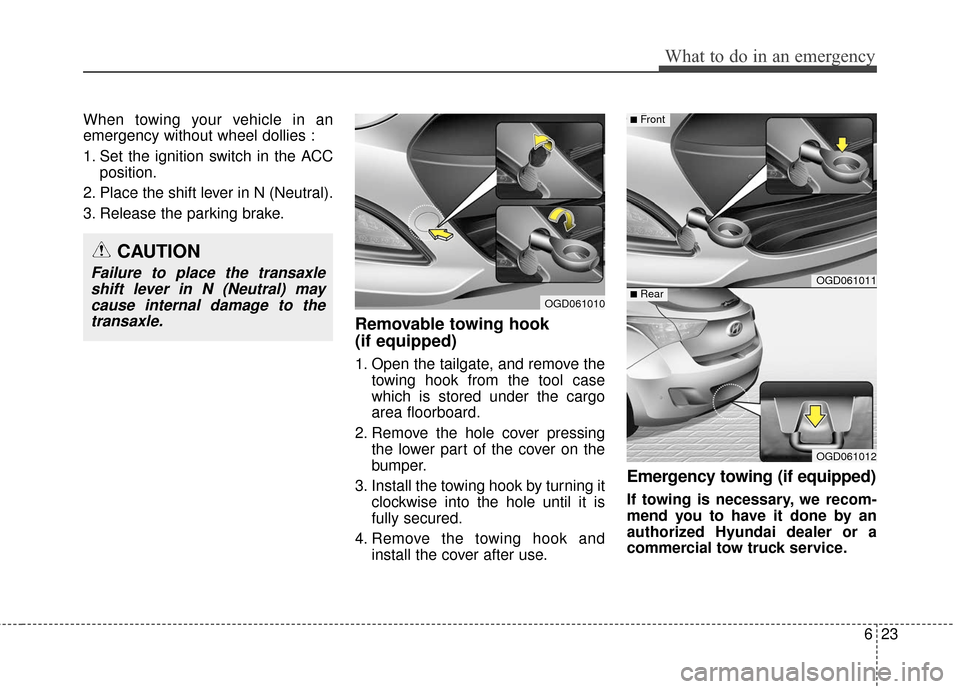
Removable towing hook
(if equipped)
1. Open the tailgate, and remove the towing hook from the tool case
which is stored under the cargo
area floorboard.
2. Remove the hole cover pressing the lower part of the cover on the
bumper.
3. Install the towing hook by turning it clockwise into the hole until it is
fully secured.
4. Remove the towing hook and install the cover after use.
Emergency towing (if equipped)
If towing is necessary, we recom-
mend you to have it done by an
authorized Hyundai dealer or a
commercial tow truck service.
CAUTION
Failure to place the transaxleshift lever in N (Neutral) maycause internal damage to thetransaxle.
OGD061010
OGD061011
OGD061012
■Rear
■Front
Page 375 of 493
What to do in an emergency
24
6
If towing service is not available in an
emergency, your vehicle may be
temporarily towed using a cable or
chain secured to the emergency tow-
ing hook attached to the front (or
under the rear) of the vehicle.
Use extreme caution when towing the
vehicle. A driver must be in the vehi-
cle to steer it and operate the brakes.
Towing in this manner may be done
only on hard-surfaced roads for a
short distance and at low speeds.
Also, the wheels, axles, power train,
steering and brakes must all be in
good condition.
Do not use the tow hooks to pull a
vehicle out of mud, sand or other
conditions from which the vehicle
cannot be driven out under its own
power.
Avoid towing a vehicle heavier than the vehicle doing the towing.
The drivers of both vehicles should communicate with each other fre-
quently. Before emergency towing, check
that the hook is not broken or dam-
aged.
Fasten the towing cable or chain securely to the hook.
Do not jerk the hook. Apply steady and even force.
To avoid damaging the hook, do not pull from the side or at a vertical
angle. Always pull straight ahead.CAUTION
Attach a towing strap to the tow hook.
Using a portion of the vehicle other than the tow hooks fortowing may damage the bodyof your vehicle.
Use only a cable or chain specifically intended for usein towing vehicles. Securelyfasten the cable or chain tothe towing hook provided.
WARNING
Use extreme caution when tow-
ing the vehicle.
Avoid sudden starts or erratic driving maneuvers which
would place excessive stress
on the emergency towing hook
and towing cable or chain. The
hook and towing cable or
chain may break and cause
serious injury or damage.
If the disabled vehicle cannot be moved, do not forcibly con-
tinue the towing. Contact an
authorized Hyundai dealer or
a commercial tow truck serv-
ice for assistance.
Tow the vehicle as straight ahead as possible.
Keep away from the vehicle during towing.
Page 400 of 493
Maintenance
24
7
Vacuum crankcase ventilation
hoses
Inspect the surface of hoses for evi-
dence of heat and/or mechanical
damage. Hard and brittle rubber,
cracking, tears, cuts, abrasions, and
excessive swelling indicate deterio-
ration. Particular attention should be
paid to examine those hose surfaces
nearest to high heat sources, such
as the exhaust manifold.
Inspect the hose routing to assure
that the hoses do not come in con-
tact with any heat source, sharp
edges or moving component which
might cause heat damage or
mechanical wear. Inspect all hose
connections, such as clamps and
couplings, to make sure they are
secure, and that no leaks are pres-
ent. Hoses should be replaced
immediately if there is any evidence
of deterioration or damage.
Air cleaner filter
A Genuine HYUNDAI air cleaner fil-
ter is recommended when the filter is
replaced.
Spark plugs
Make sure to install new spark plugs
of the correct heat range.
Cooling system
Check cooling system components,
such as radiator, coolant reservoir,
hoses and connections for leakage
and damage. Replace any damaged
parts.
Coolant
The coolant should be changed at
the intervals specified in the mainte-
nance schedule.
Automatic transaxle fluid
(if equipped)
Automatic transaxle fluid should not
be checked under normal usage
conditions.
But in severe conditions, the fluid
should be changed at an authorized
HYUNDAI dealer in accordance with
the scheduled maintenance at the
beginning of this chapter.
✽ ✽
NOTICE
Automatic transaxle fluid color is
basically red.
As the vehicle is driven, the auto-
matic transaxle fluid will begin to
look darker.
This is a normal condition and you
should not judge the need to replace
the fluid based upon the changed
color.
Page 409 of 493
733
Maintenance
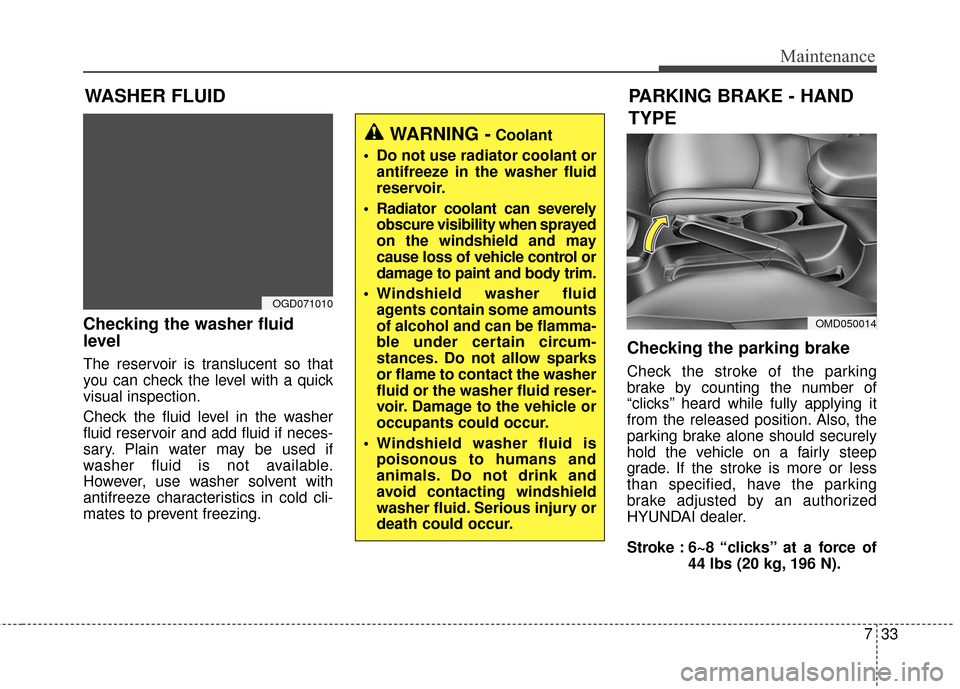
Checking the washer fluid
level
The reservoir is translucent so that
you can check the level with a quick
visual inspection.
Check the fluid level in the washer
fluid reservoir and add fluid if neces-
sary. Plain water may be used if
washer fluid is not available.
However, use washer solvent with
antifreeze characteristics in cold cli-
mates to prevent freezing.
Checking the parking brake
Check the stroke of the parking
brake by counting the number of
“clicks’’ heard while fully applying it
from the released position. Also, the
parking brake alone should securely
hold the vehicle on a fairly steep
grade. If the stroke is more or less
than specified, have the parking
brake adjusted by an authorized
HYUNDAI dealer.
Stroke : 6~8 “clicks’’ at a force of 44 lbs (20 kg, 196 N).
WASHER FLUID
WARNING -Coolant
Do not use radiator coolant or antifreeze in the washer fluid
reservoir.
Radiator coolant can severely obscure visibility when sprayed
on the windshield and may
cause loss of vehicle control or
damage to paint and body trim.
Windshield washer fluid agents contain some amounts
of alcohol and can be flamma-
ble under certain circum-
stances. Do not allow sparks
or flame to contact the washer
fluid or the washer fluid reser-
voir. Damage to the vehicle or
occupants could occur.
Windshield washer fluid is poisonous to humans and
animals. Do not drink and
avoid contacting windshield
washer fluid. Serious injury or
death could occur.
OGD071010
OMD050014
PARKING BRAKE - HAND
TYPE
Page 417 of 493
741
Maintenance
BATTERY
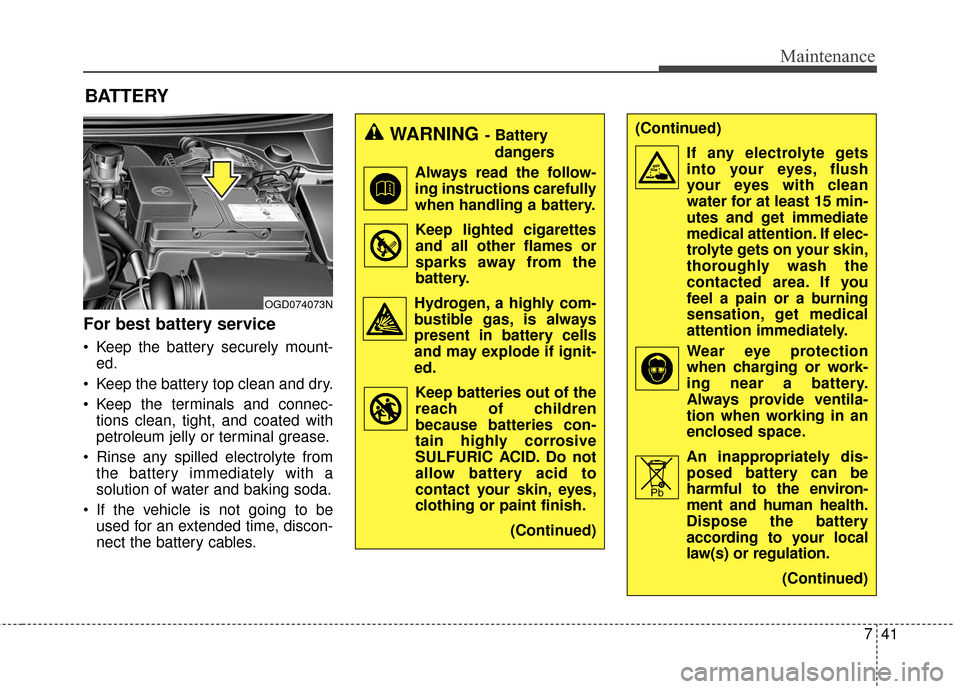
For best battery service
Keep the battery securely mount-ed.
Keep the battery top clean and dry.
Keep the terminals and connec- tions clean, tight, and coated with
petroleum jelly or terminal grease.
Rinse any spilled electrolyte from the battery immediately with a
solution of water and baking soda.
If the vehicle is not going to be used for an extended time, discon-
nect the battery cables.
OGD074073N
WARNING- Battery
dangers
Always read the follow-
ing instructions carefully
when handling a battery.
Keep lighted cigarettesand all other flames or
sparks away from the
battery.
Hydrogen, a highly com- bustible gas, is always
present in battery cells
and may explode if ignit-
ed.
Keep batteries out of the
reach of children
because batteries con-
tain highly corrosive
SULFURIC ACID. Do not
allow battery acid to
contact your skin, eyes,
clothing or paint finish. (Continued)(Continued)If any electrolyte gets
into your eyes, flush
your eyes with clean
water for at least 15 min-
utes and get immediate
medical attention. If elec-
trolyte gets on your skin,
thoroughly wash the
contacted area. If you
feel a pain or a burning
sensation, get medical
attention immediately.
Wear eye protectionwhen charging or work-
ing near a battery.
Always provide ventila-
tion when working in an
enclosed space.
An inappropriately dis- posed battery can be
harmful to the environ-
ment and human health.
Dispose the battery
according to your local
law(s) or regulation.
(Continued)
Pb
Page 438 of 493
Maintenance
62
7
Engine compartment fuse
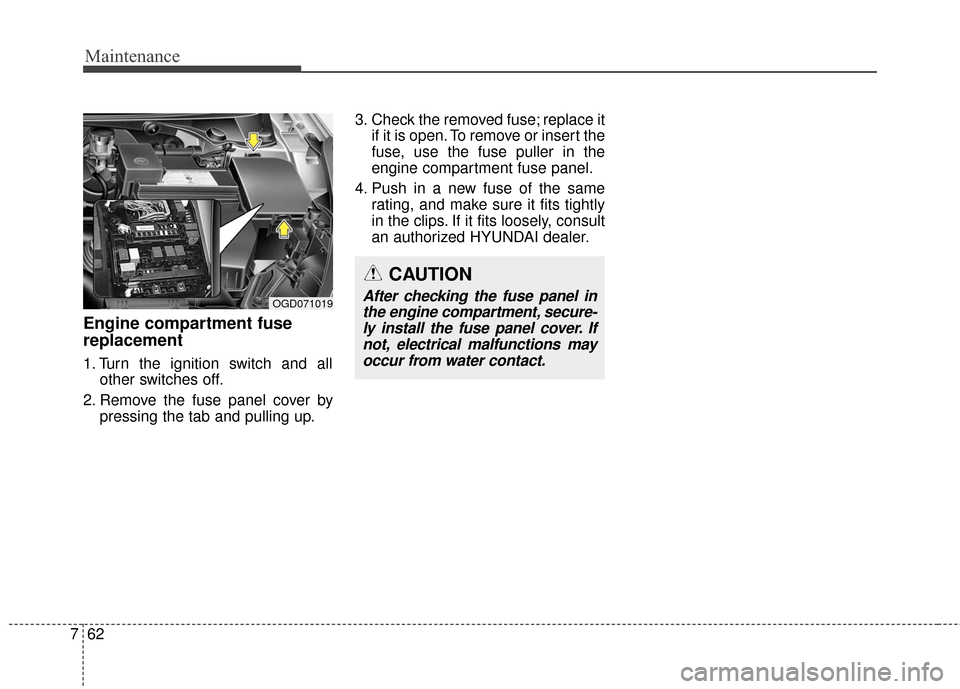
replacement
1. Turn the ignition switch and all
other switches off.
2. Remove the fuse panel cover by pressing the tab and pulling up. 3. Check the removed fuse; replace it
if it is open. To remove or insert the
fuse, use the fuse puller in the
engine compartment fuse panel.
4. Push in a new fuse of the same rating, and make sure it fits tightly
in the clips. If it fits loosely, consult
an authorized HYUNDAI dealer.
OGD071019
CAUTION
After checking the fuse panel inthe engine compartment, secure-ly install the fuse panel cover. Ifnot, electrical malfunctions mayoccur from water contact.
Page 440 of 493
Maintenance
64
7
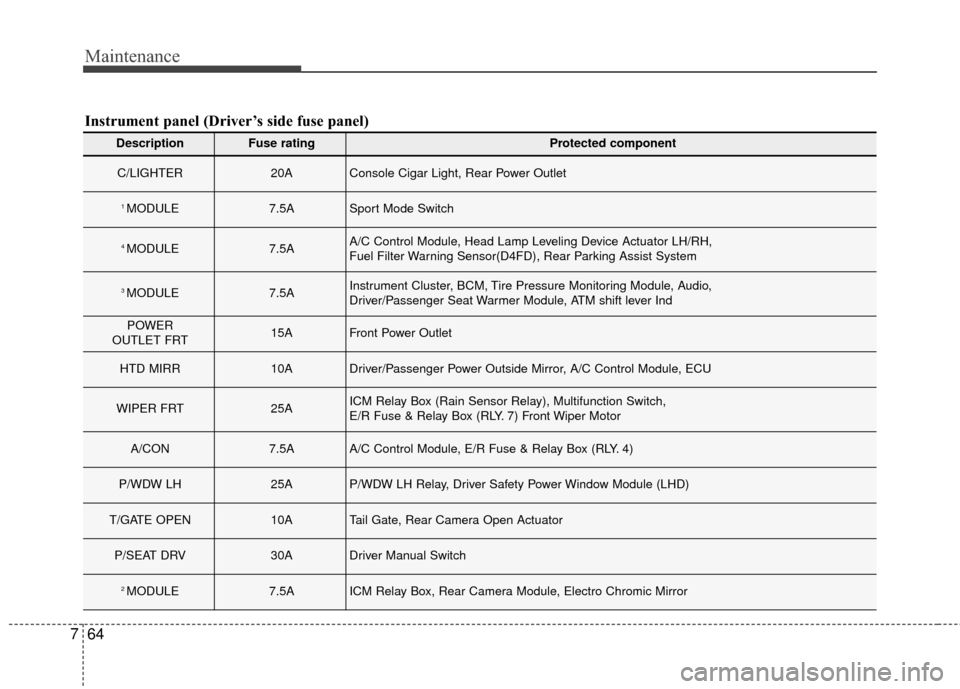
Instrument panel (Driver’s side fuse panel)
DescriptionFuse ratingProtected component
C/LIGHTER20AConsole Cigar Light, Rear Power Outlet
1 MODULE7.5ASport Mode Switch
4 MODULE 7.5AA/C Control Module, Head Lamp Leveling Device Actuator LH/RH,
Fuel Filter Warning Sensor(D4FD), Rear Parking Assist System
3 MODULE7.5AInstrument Cluster, BCM, Tire Pressure Monitoring Module, Audio,
Driver/Passenger Seat Warmer Module, ATM shift lever Ind
POWER
OUTLET FRT15AFront Power Outlet
HTD MIRR10ADriver/Passenger Power Outside Mirror, A/C Control Module, ECU
WIPER FRT25AICM Relay Box (Rain Sensor Relay), Multifunction Switch,
E/R Fuse & Relay Box (RLY. 7) Front Wiper Motor
A/CON7.5AA/C Control Module, E/R Fuse & Relay Box (RLY. 4)
P/WDW LH25AP/WDW LH Relay, Driver Safety Power Window Module (LHD)
T/GATE OPEN10ATail Gate, Rear Camera Open Actuator
P/SEAT DRV30ADriver Manual Switch
2 MODULE7.5AICM Relay Box, Rear Camera Module, Electro Chromic Mirror
Page 445 of 493
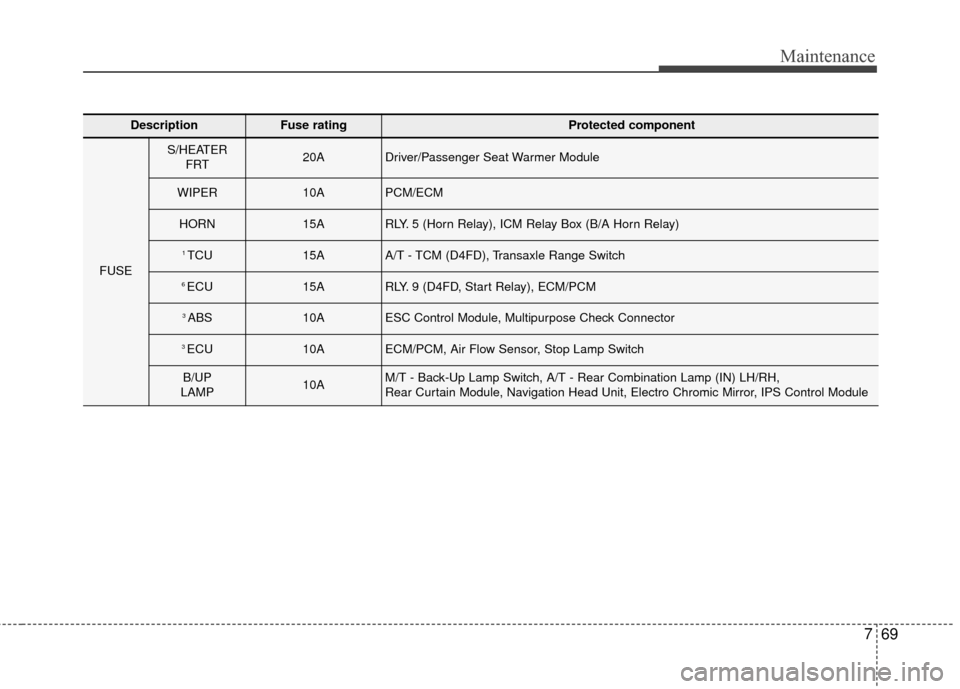
769
Maintenance
DescriptionFuse ratingProtected component
FUSE
S/HEATER FRT20ADriver/Passenger Seat Warmer Module
WIPER10APCM/ECM
HORN15ARLY. 5 (Horn Relay), ICM Relay Box (B/A Horn Relay)
1 TCU15AA/T - TCM (D4FD), Transaxle Range Switch
6 ECU15ARLY. 9 (D4FD, Start Relay), ECM/PCM
3 ABS10AESC Control Module, Multipurpose Check Connector
3 ECU10AECM/PCM, Air Flow Sensor, Stop Lamp Switch
B/UP
LAMP10AM/T - Back-Up Lamp Switch, A/T - Rear Combination Lamp (IN) LH/RH,
Rear Curtain Module, Navigation Head Unit, Electro Chromic Mirror, IPS Control Module
Page 446 of 493
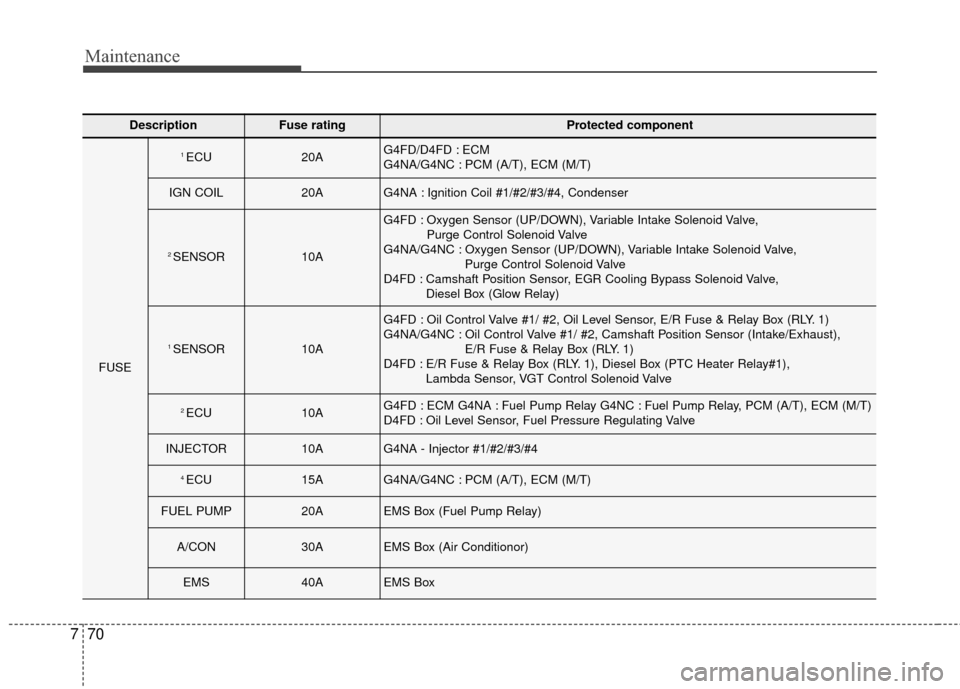
Maintenance
70
7
DescriptionFuse ratingProtected component
FUSE
1 ECU20AG4FD/D4FD : ECM
G4NA/G4NC : PCM (A/T), ECM (M/T)
IGN COIL20AG4NA : Ignition Coil #1/#2/#3/#4, Condenser
2 SENSOR10A
G4FD : Oxygen Sensor (UP/DOWN), Variable Intake Solenoid Valve,
Purge Control Solenoid Valve
G4NA/G4NC : Oxygen Sensor (UP/DOWN), Variable Intake Solenoid Valve, Purge Control Solenoid Valve
D4FD : Camshaft Position Sensor, EGR Cooling Bypass Solenoid Valve, Diesel Box (Glow Relay)
1 SENSOR10A
G4FD : Oil Control Valve #1/ #2, Oil Level Sensor, E/R Fuse & Relay Box (RLY. 1)
G4NA/G4NC : Oil Control Valve #1/ #2, Camshaft Position Sensor (Intake/Exhaust), E/R Fuse & Relay Box (RLY. 1)
D4FD : E/R Fuse & Relay Box (RLY. 1), Diesel Box (PTC Heater Relay#1), Lambda Sensor, VGT Control Solenoid Valve
2 ECU10AG4FD : ECM G4NA : Fuel Pump Relay G4NC : Fuel Pump Relay, PCM (A/T), ECM (M/T)
D4FD : Oil Level Sensor, Fuel Pressure Regulating Valve
INJECTOR10AG4NA - Injector #1/#2/#3/#4
4 ECU15AG4NA/G4NC : PCM (A/T), ECM (M/T)
FUEL PUMP20AEMS Box (Fuel Pump Relay)
A/CON30AEMS Box (Air Conditionor)
EMS40AEMS Box