belt Hyundai Elantra GT 2017 Repair Manual
[x] Cancel search | Manufacturer: HYUNDAI, Model Year: 2017, Model line: Elantra GT, Model: Hyundai Elantra GT 2017Pages: 493, PDF Size: 11.53 MB
Page 395 of 493
719
Maintenance
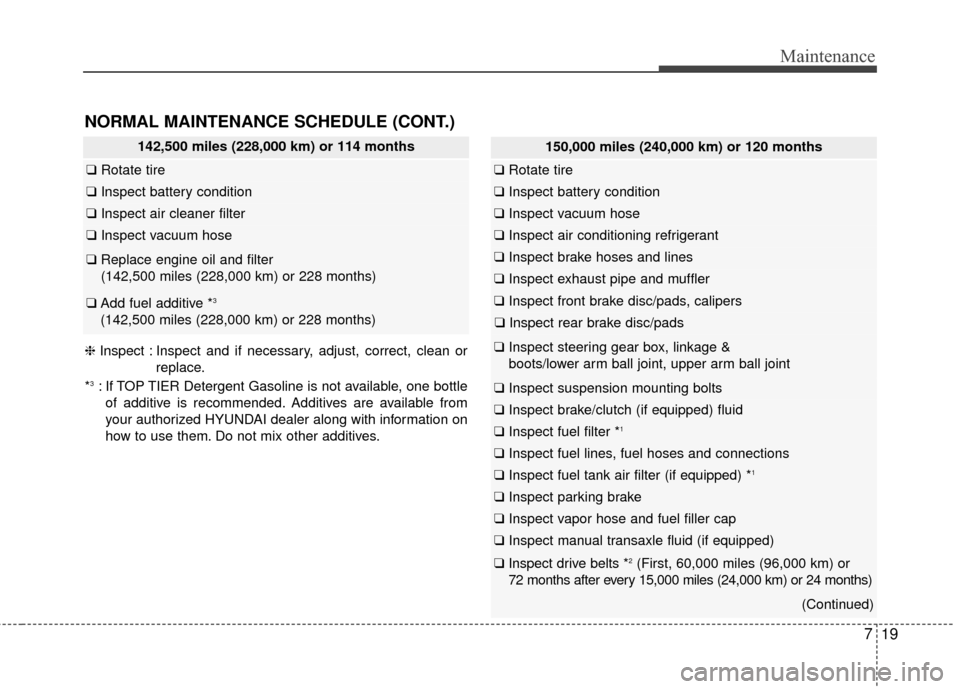
142,500 miles (228,000 km) or 114 months
❑Rotate tire
❑Inspect battery condition
❑Inspect air cleaner filter
❑Inspect vacuum hose
❑Replace engine oil and filter
(142,500 miles (228,000 km) or 228 months)
❑Add fuel additive *3
(142,500 miles (228,000 km) or 228 months)
NORMAL MAINTENANCE SCHEDULE (CONT.)
150,000 miles (240,000 km) or 120 months
❑ Rotate tire
❑Inspect battery condition
❑Inspect vacuum hose
❑Inspect air conditioning refrigerant
❑Inspect brake hoses and lines
❑Inspect exhaust pipe and muffler
❑Inspect front brake disc/pads, calipers
❑Inspect rear brake disc/pads
❑Inspect steering gear box, linkage &
boots/lower arm ball joint, upper arm ball joint
❑ Inspect suspension mounting bolts
❑Inspect brake/clutch (if equipped) fluid
❑Inspect fuel filter *1
❑Inspect fuel lines, fuel hoses and connections
❑Inspect fuel tank air filter (if equipped) *1
❑Inspect parking brake
❑Inspect vapor hose and fuel filler cap
❑Inspect manual transaxle fluid (if equipped)
❑Inspect drive belts *2(First, 60,000 miles (96,000 km) or
72 months after every 15,000 miles (24,000 km) or 24 months)
(Continued)
❈ Inspect : Inspect and if necessary, adjust, correct, clean or
replace.
*
3: If TOP TIER Detergent Gasoline is not available, one bottle of additive is recommended. Additives are available from
your authorized HYUNDAI dealer along with information on
how to use them. Do not mix other additives.
Page 396 of 493
Maintenance
20
7
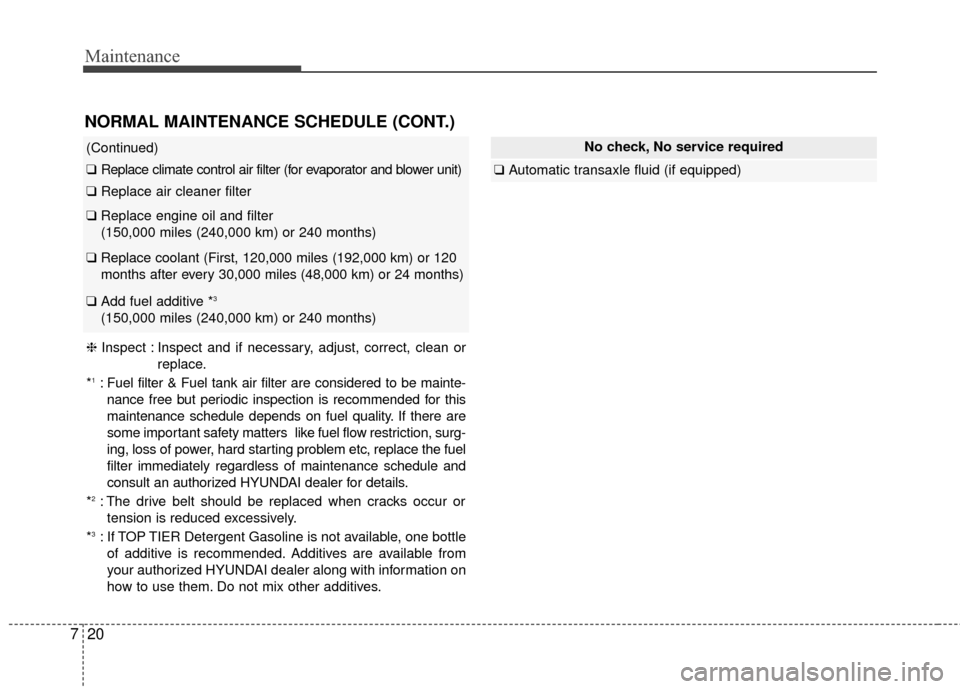
NORMAL MAINTENANCE SCHEDULE (CONT.)
❈ Inspect : Inspect and if necessary, adjust, correct, clean or
replace.
*
1: Fuel filter & Fuel tank air filter are considered to be mainte- nance free but periodic inspection is recommended for this
maintenance schedule depends on fuel quality. If there are
some important safety matters like fuel flow restriction, surg-
ing, loss of power, hard starting problem etc, replace the fuel
filter immediately regardless of maintenance schedule and
consult an authorized HYUNDAI dealer for details.
*
2: The drive belt should be replaced when cracks occur or tension is reduced excessively.
*
3: If TOP TIER Detergent Gasoline is not available, one bottle of additive is recommended. Additives are available from
your authorized HYUNDAI dealer along with information on
how to use them. Do not mix other additives.
(Continued)
❑ Replace climate control air filter (for evaporator and blower unit)
❑Replace air cleaner filter
❑Replace engine oil and filter
(150,000 miles (240,000 km) or 240 months)
❑Replace coolant (First, 120,000 miles (192,000 km) or 120
months after every 30,000 miles (48,000 km) or 24 months)
❑Add fuel additive *3
(150,000 miles (240,000 km) or 240 months)
No check, No service required
❑ Automatic transaxle fluid (if equipped)
Page 399 of 493
723
Maintenance
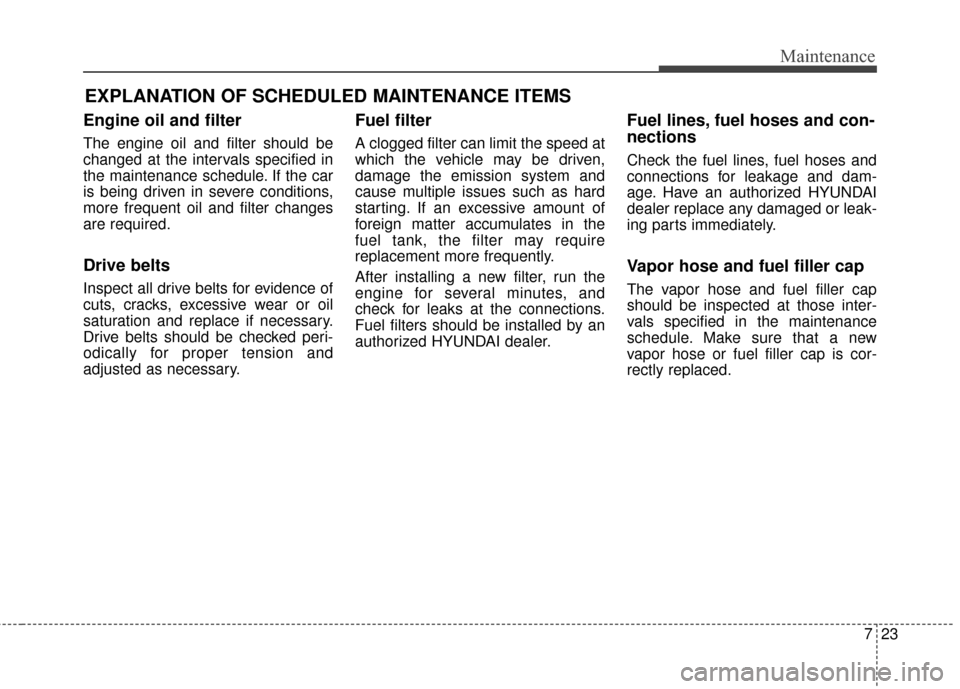
EXPLANATION OF SCHEDULED MAINTENANCE ITEMS
Engine oil and filter
The engine oil and filter should be
changed at the intervals specified in
the maintenance schedule. If the car
is being driven in severe conditions,
more frequent oil and filter changes
are required.
Drive belts
Inspect all drive belts for evidence of
cuts, cracks, excessive wear or oil
saturation and replace if necessary.
Drive belts should be checked peri-
odically for proper tension and
adjusted as necessary.
Fuel filter
A clogged filter can limit the speed at
which the vehicle may be driven,
damage the emission system and
cause multiple issues such as hard
starting. If an excessive amount of
foreign matter accumulates in the
fuel tank, the filter may require
replacement more frequently.
After installing a new filter, run the
engine for several minutes, and
check for leaks at the connections.
Fuel filters should be installed by an
authorized HYUNDAI dealer.
Fuel lines, fuel hoses and con-
nections
Check the fuel lines, fuel hoses and
connections for leakage and dam-
age. Have an authorized HYUNDAI
dealer replace any damaged or leak-
ing parts immediately.
Vapor hose and fuel filler cap
The vapor hose and fuel filler cap
should be inspected at those inter-
vals specified in the maintenance
schedule. Make sure that a new
vapor hose or fuel filler cap is cor-
rectly replaced.
Page 428 of 493
Maintenance
52
7
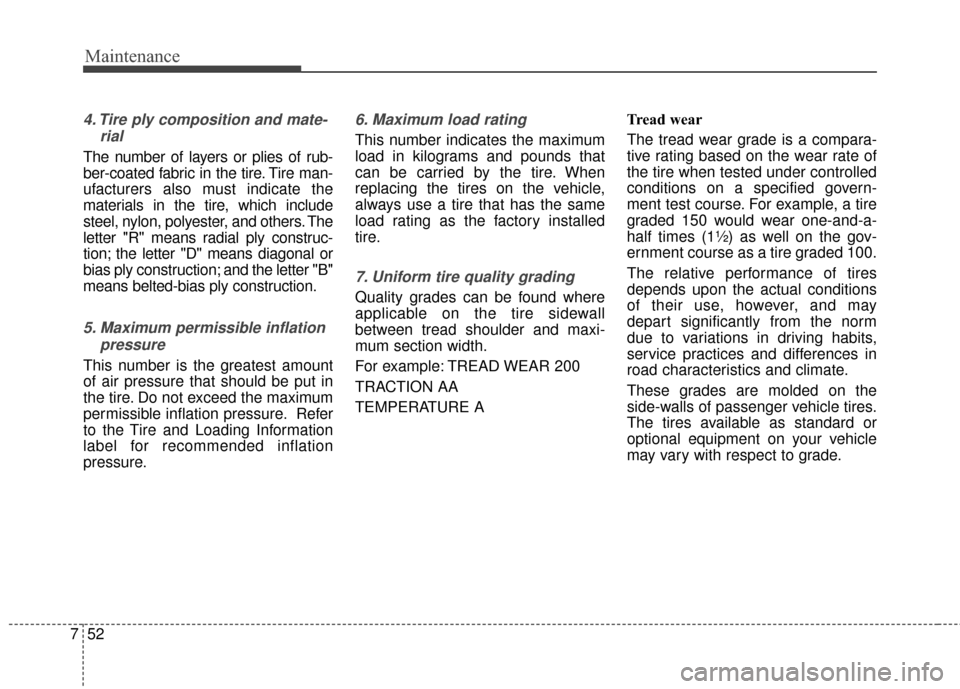
4. Tire ply composition and mate-
rial
The number of layers or plies of rub-
ber-coated fabric in the tire. Tire man-
ufacturers also must indicate the
materials in the tire, which include
steel, nylon, polyester, and others. The
letter "R" means radial ply construc-
tion; the letter "D" means diagonal or
bias ply construction; and the letter "B"
means belted-bias ply construction.
5. Maximum permissible inflationpressure
This number is the greatest amount
of air pressure that should be put in
the tire. Do not exceed the maximum
permissible inflation pressure. Refer
to the Tire and Loading Information
label for recommended inflation
pressure.
6. Maximum load rating
This number indicates the maximum
load in kilograms and pounds that
can be carried by the tire. When
replacing the tires on the vehicle,
always use a tire that has the same
load rating as the factory installed
tire.
7. Uniform tire quality grading
Quality grades can be found where
applicable on the tire sidewall
between tread shoulder and maxi-
mum section width.
For example: TREAD WEAR 200
TRACTION AA
TEMPERATURE A Tread wear
The tread wear grade is a compara-
tive rating based on the wear rate of
the tire when tested under controlled
conditions on a specified govern-
ment test course. For example, a tire
graded 150 would wear one-and-a-
half times (1½) as well on the gov-
ernment course as a tire graded 100.
The relative performance of tires
depends upon the actual conditions
of their use, however, and may
depart significantly from the norm
due to variations in driving habits,
service practices and differences in
road characteristics and climate.
These grades are molded on the
side-walls of passenger vehicle tires.
The tires available as standard or
optional equipment on your vehicle
may vary with respect to grade.
Page 430 of 493
Maintenance
54
7
Tire terminology and defini-
tions
Air Pressure: The amount of air
inside the tire pressing outward on
the tire. Air pressure is expressed in
pounds per square inch (psi) or kilo-
pascal (kPa).
Accessory Weight: This means the
combined weight of optional acces-
sories. Some examples of optional
accessories are, automatic transaxle,
power seats, and air conditioning.
Aspect Ratio: The relationship of a
tire's height to its width.
Belt: A rubber coated layer of cords
that is located between the plies and
the tread. Cords may be made from
steel or other reinforcing materials.
Bead: The tire bead contains steel
wires wrapped by steel cords that
hold the tire onto the rim.
Bias Ply Tire: A pneumatic tire in
which the plies are laid at alternate
angles less than 90 degrees to the
centerline of the tread. Cold Tire Pressure:
The amount of
air pressure in a tire, measured in
pounds per square inch (psi) or kilo-
pascals (kPa) before a tire has built
up heat from driving.
Curb Weight: This means the weight
of a motor vehicle with standard and
optional equipment including the
maximum capacity of fuel, oil and
coolant, but without passengers and
cargo.
DOT Markings: A code molded into
the sidewall of a tire signifying that
the tire is in compliance with the U.S.
Department of Transportation motor
vehicle safety standards. The DOT
code includes the Tire Identification
Number (TIN), an alphanumeric des-
ignator which can also identify the
tire manufacturer, production plant,
brand and date of production.
GVWR: Gross Vehicle Weight Rating
GAWR FRT: Gross Axle Weight
Rating for the Front Axle.
GAWR RR: Gross Axle Weight
Rating for the Rear axle. Intended Outboard Sidewall:
The
side of an asymmetrical tire, that
must always face outward when
mounted on a vehicle.
Kilopascal (kPa): The metric unit for
air pressure.
Light truck (LT) tire: A tire designat-
ed by its manufacturer as primarily
intended for use on lightweight trucks
or multipurpose passenger vehicles.
Load ratings: The maximum load
that a tire is rated to carry for a given
inflation pressure.
Load Index: An assigned number
ranging from 1 to 279 that corre-
sponds to the load carrying capacity
of a tire.
Maximum Inflation Pressure: The
maximum air pressure to which a
cold tire may be inflated. The maxi-
mum air pressure is molded onto the
sidewall.
Maximum Load Rating: The load
rating for a tire at the maximum per-
missible inflation pressure for that
tire.
Page 433 of 493
757
Maintenance
Tire chains
Tire chains, if necessary, should be
installed on the front wheels.
Be sure that the chains are installed
in accordance with the manufactur-
er's instructions.
To minimize tire and chain wear, do
not continue to use tire chains when
they are no longer needed.
Radial-ply tires
Radial-ply tires provide improved
tread life, road hazard resistance and
smoother high speed ride. The radi-
al-ply tires used on this vehicle are of
belted construction, and are selected
to complement the ride and handling
characteristics of your vehicle.
Radial-ply tires have the same load
carrying capacity, as bias-ply or bias
belted tires of the same size, and use
the same recommended inflation
pressure. Mixing of radial-ply tires
with bias-ply or bias belted tires is
not recommended. Any combina-
tions of radial-ply and bias-ply or bias
belted tires when used on the same
vehicle will seriously deteriorate
vehicle handling. The best rule to fol-
low is: Identical radial-ply tires should
always be used as a set of four.
Longer wearing tires can be more
susceptible to irregular tread wear. It
is very important to follow the tire
rotation interval shown in this section
to achieve the tread life potential of
these tires. Cuts and punctures in
radial-ply tires are repairable only in
the tread area, because of sidewall
flexing. Consult your tire dealer for
radial-ply tire repairs.WARNING - Snow or ice
When driving on roads cov- ered with snow or ice, drive at
less than 20 mph (30 km/h).
Use the SAE “S” class or wire chains.
If you hear noise caused by chains contacting the body,
retighten the chain to avoid
contact with the vehicle body.
To prevent body damage, retighten the chains after driv-
ing 0.3~0.6 miles (0.5~1.0 km).
Do not use tire chains on vehicles equipped with alu-
minum wheels. In unavoidable
circumstance, use a wire type
chain.
Use wire chains less than 0.59 inches (15 mm) to prevent
damage to the chain’s con-
nection.
CAUTION
Since the sidewalls of radialtires are thinner, they can bedamaged by mounting sometypes of snow chains on them.Therefore, the use of snow tiresis recommended instead ofsnow chains.
Page 467 of 493
791
Maintenance
Caring for the leather seats- Vacuum the seat periodically toremove dust and sand on the
seat. It will prevent abrasion or
damage of the leather and main-
tain its quality.
- Wipe the natural leather seat cover often with dry or soft cloth.
- Use of a proper leather protective may prevent abrasion of the
cover and helps maintain the
color. Be sure to read the instruc-
tions and consult a specialist
when using leather coating or
protective agents. - Light colored (beige, cream
beige) leather is easily contami-
nated and the stain is noticeable.
Clean the seats frequently.
- Avoid wiping with wet cloth. It may cause the surface to crack.
Cleaning the leather seats - Remove all contaminationsinstantly. Refer to instructions
below for removal of each con-
taminant.
- Cosmetic products (sunscreen, foundation, etc.)
Apply cleansing cream on a cloth
and wipe the contaminated spot.
Wipe off the cream with a wet
cloth and remove water with a dry
cloth.
- Beverages(coffee, soft drink, etc.) Apply a small amount of neutral
detergent and wipe until contami-
nations do not smear.
- Oil Remove oil instantly with
absorbable cloth and wipe with
stain remover used only for natu-
ral leather. - Chewing gum
Harden the gum with ice and
remove gradually.
Cleaning the lap/shoulder beltwebbing
Clean the belt webbing with any mild
soap solution recommended for
cleaning upholstery or carpet. Follow
the instructions provided with the
soap. Do not bleach or re-dye the
webbing because this may weaken it.
Cleaning the interior windowglass
If the interior glass surfaces of the
vehicle become fogged (that is, cov-
ered with an oily, greasy or waxy
film), they should be cleaned with
glass cleaner. Follow the directions
on the glass cleaner container.
(Continued)
Belts with metallic acces- sories, zippers or keys insidethe back pocket may damagethe seat fabric.
Make sure not to wet the seat. It may change the nature ofnatural leather.
Jeans or clothes which could bleach may contaminate thesurface of the seat coveringfabric.
CAUTION
Do not scrape or scratch theinside of the rear window. Thismay result in damage to the rearwindow defroster grid.
Page 471 of 493
795
Maintenance
Your vehicle is equipped with a cat-
alytic converter emission control
device.
Therefore, the following precautions
must be observed:
Use only UNLEADED FUEL forgasoline engines.
Do not operate the vehicle when there are signs of engine malfunc-
tion, such as misfire or a noticeable
loss of performance.
Do not misuse or abuse the engine. Examples of misuse are
coasting with the ignition off and
descending steep grades in gear
with the ignition off.
Do not operate the engine at high idle speed for extended periods (5
minutes or more).
Do not modify or tamper with any part of the engine or emission con-
trol system. All inspections and
adjustments must be made by an
authorized HYUNDAI dealer. Avoid driving with a extremely low
fuel level. Running out of fuel could
cause the engine to misfire, dam-
aging the catalytic converter.
Failure to observe these precautions
could result in damage to the catalyt-
ic converter and to your vehicle.
Additionally, such actions could void
your warranties. Perchlorate Material-special handling
may apply, See www.dtsc.ca.gov/haz-
ardouswaste/perchlorate.
Notice to California Vehicle
Dismantlers: Perchlorate containing
materials, such as air bag inflators,
seatbelt pretensioners and keyless
remote entry batteries, must be dis-
posed of according to Title 22
California Code of Regulations
Section 67384.10 (a).
CALIFORNIA PERCHLO-
RATE NOTICE
Page 481 of 493
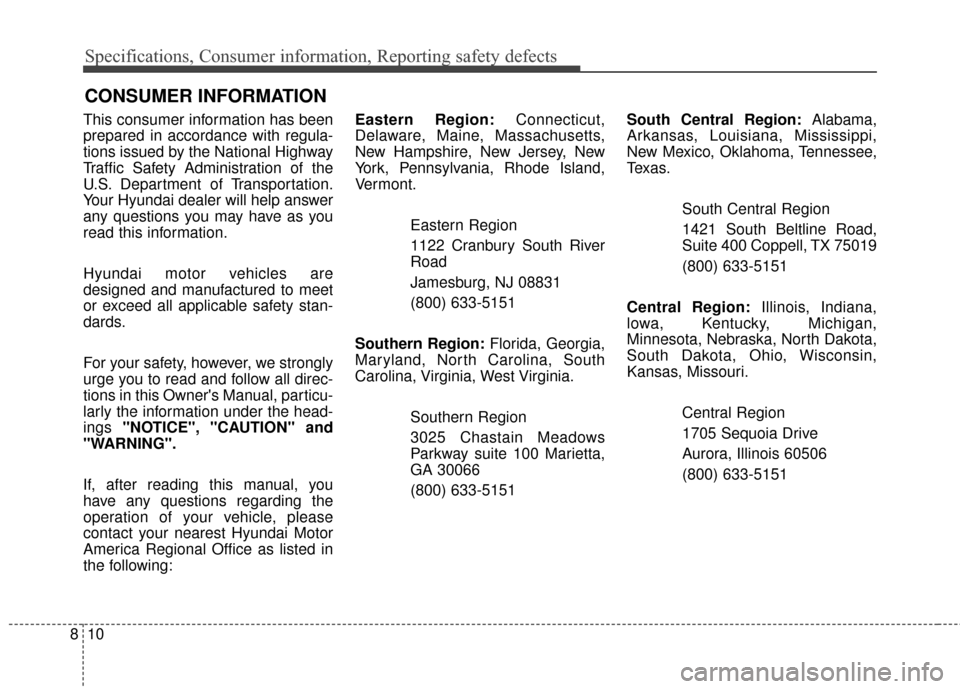
Specifications, Consumer information, Reporting safety defects
10
8
This consumer information has been
prepared in accordance with regula-
tions issued by the National Highway
Traffic Safety Administration of the
U.S. Department of Transportation.
Your Hyundai dealer will help answer
any questions you may have as you
read this information.
Hyundai motor vehicles are
designed and manufactured to meet
or exceed all applicable safety stan-
dards.
For your safety, however, we strongly
urge you to read and follow all direc-
tions in this Owner's Manual, particu-
larly the information under the head-
ings "NOTICE", "CAUTION" and
"WARNING".
If, after reading this manual, you
have any questions regarding the
operation of your vehicle, please
contact your nearest Hyundai Motor
America Regional Office as listed in
the following: Eastern Region:
Connecticut,
Delaware, Maine, Massachusetts,
New Hampshire, New Jersey, New
York, Pennsylvania, Rhode Island,
Vermont.
Eastern Region
1122 Cranbury South River
Road
Jamesburg, NJ 08831
(800) 633-5151
Southern Region: Florida, Georgia,
Maryland, North Carolina, South
Carolina, Virginia, West Virginia.
Southern Region
3025 Chastain Meadows
Parkway suite 100 Marietta,
GA 30066
(800) 633-5151 South Central Region:
Alabama,
Arkansas, Louisiana, Mississippi,
New Mexico, Oklahoma, Tennessee,
Texas.
South Central Region
1421 South Beltline Road,
Suite 400 Coppell, TX 75019
(800) 633-5151
Central Region: Illinois, Indiana,
lowa, Kentucky, Michigan,
Minnesota, Nebraska, North Dakota,
South Dakota, Ohio, Wisconsin,
Kansas, Missouri.
Central Region
1705 Sequoia Drive
Aurora, Illinois 60506
(800) 633-5151
CONSUMER INFORMATION
Page 486 of 493
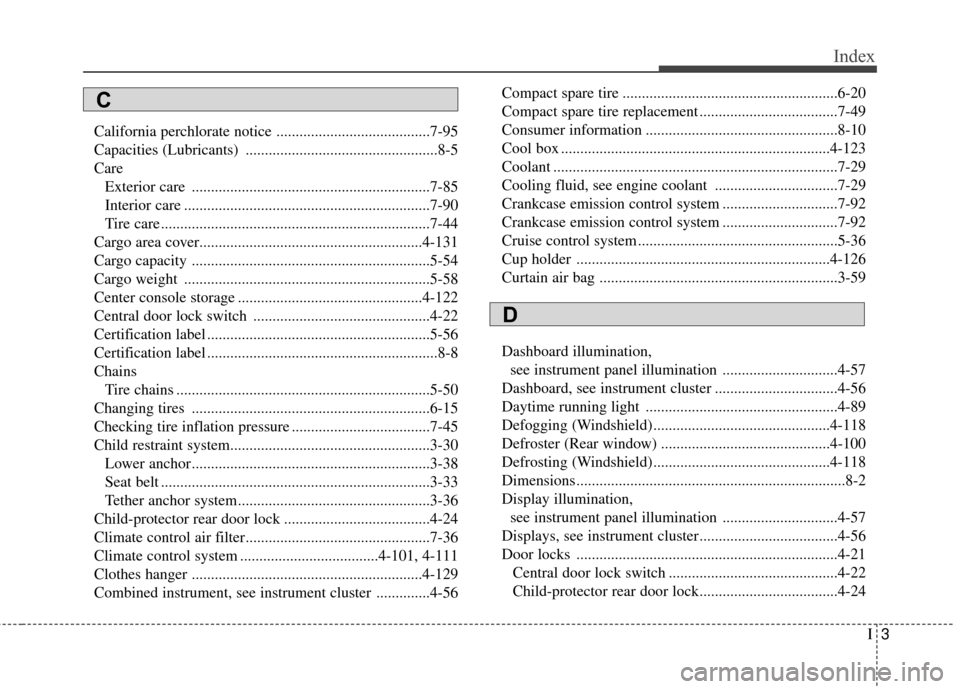
I3
Index
California perchlorate notice ........................................7-95
Capacities (Lubricants) ..................................................8-5
CareExterior care ..............................................................7-85
Interior care ................................................................7-90
Tire care ......................................................................7-\
44
Cargo area cover..........................................................4-131
Cargo capacity ..............................................................5-54
Cargo weight ................................................................5-58
Center console storage ................................................4-122
Central door lock switch ..............................................4-22
Certification label ..........................................................5-56
Certification label ............................................................8-8
Chains Tire chains ..................................................................5-50
Changing tires ..............................................................6-15
Checking tire inflation pressure ....................................7-45
Child restraint system....................................................3-30 Lower anchor..............................................................3-38
Seat belt ......................................................................3-\
33
Tether anchor system..................................................3-36
Child-protector rear door lock ......................................4-24
Climate control air filter................................................7-36
Climate control system ....................................4-101, 4-111
Clothes hanger ............................................................4-129
Combined instrument, see instrument cluster ..............4-56 Compact spare tire ........................................................6-20
Compact spare tire replacement ....................................7-49
Consumer information ..................................................8-10
Cool box ......................................................................4-\
123
Coolant ........................................................................\
..7-29
Cooling fluid, see engine coolant ................................7-29
Crankcase emission control system ..............................7-92
Crankcase emission control system ..............................7-92
Cruise control system ....................................................5-36
Cup holder ..................................................................4-126
Curtain air bag ..............................................................3-59
Dashboard illumination,
see instrument panel illumination ..............................4-57
Dashboard, see instrument cluster ................................4-56
Daytime running light ..................................................4-89
Defogging (Windshield)..............................................4-118
Defroster (Rear window) ............................................4-100
Defrosting (Windshield)..............................................4-118
Dimensions ......................................................................8-\
2
Display illumination, see instrument panel illumination ..............................4-57
Displays, see instrument cluster....................................4-56
Door locks ....................................................................4-21\
Central door lock switch ............................................4-22
Child-protector rear door lock....................................4-24
C
D