towing Hyundai Elantra GT 2017 Owner's Manual
[x] Cancel search | Manufacturer: HYUNDAI, Model Year: 2017, Model line: Elantra GT, Model: Hyundai Elantra GT 2017Pages: 493, PDF Size: 11.53 MB
Page 7 of 493

1
2
3
4
5
6
7
8I
IntroductionHow to use this manual / Fuel requirements / Vehicle break-in process / Vehicle data collection and event data recorders / Indicator symbols on t\
he instrument cluster
Your vehicle at a glance
Exterior overview / Interior overview / Instrument panel overview / Engi\
ne compartment
Safety features of your vehicle
Seats / Seat belts / Child restraint system / Air bag
Features of your vehicleKeys / Door locks / Tailgate / Windows / Hood / Fuel filler lid / Panorama sunroof / Steering wheel / Mirrors /
Instrument cluster / Lighting / Wipers & Washers / Climate control system / Multimedia system / Etc.
Driving your vehicleBefore driving / Engine start/stop button / Transaxle / Brake system / Cruise control system /
Active ECO system / Winter driving / Vehicle load limit / Etc.
What to do in an emergencyRoad warning / Emergency while driving / Emergency starting / Engine overheat / TPMS / Flat tire / Towing / Etc.
MaintenanceEngine compartment / Maintenance service / Engine oil / Engine coolant /\
Brake fluid / Washer fluid /
Parking brake / Air cleaner / Wiper blades / Battery / Tire and wheels / Fuses / Light bulbs / Etc.
Specifications, Consumer information and Reporting safety defects
Index
table of contents
Page 15 of 493
Your vehicle at a glance
22
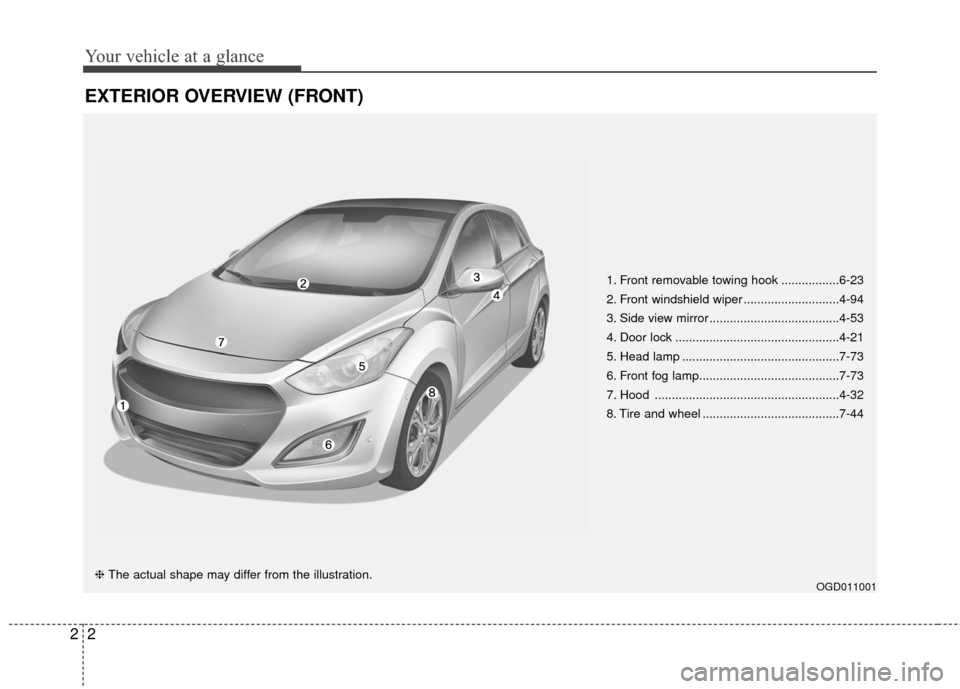
EXTERIOR OVERVIEW (FRONT)
1. Front removable towing hook .................6-23
2. Front windshield wiper ............................4-94
3. Side view mirror ......................................4-53
4. Door lock ................................................4-21
5. Head lamp ..............................................7-73
6. Front fog lamp.........................................7-73
7. Hood ......................................................4-32
8. Tire and wheel ........................................7-44
OGD011001❈ The actual shape may differ from the illustration.
Page 16 of 493
23
Your vehicle at a glance
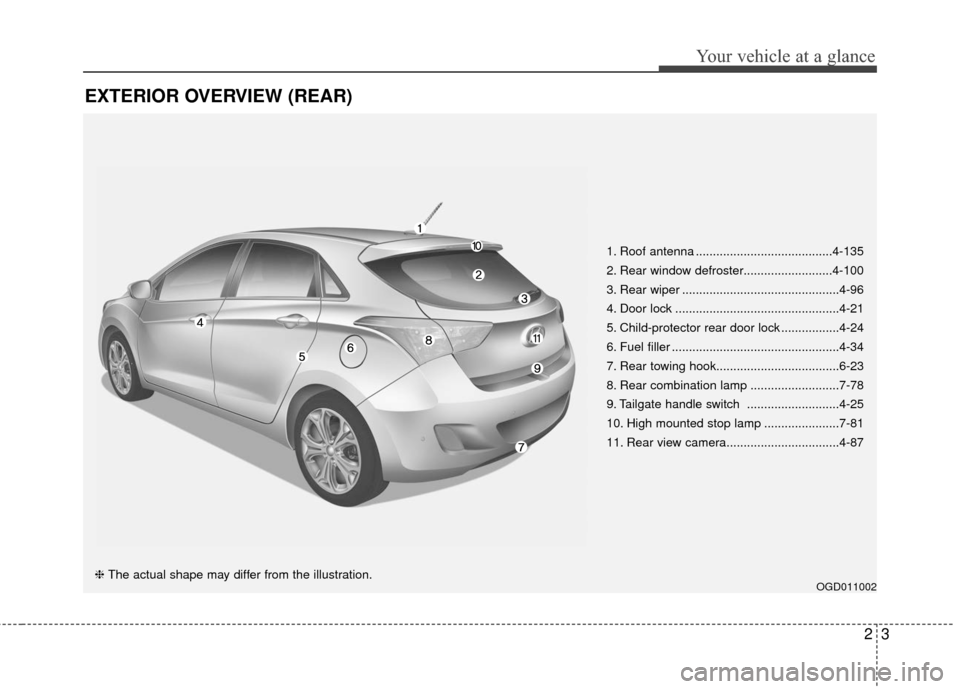
EXTERIOR OVERVIEW (REAR)
1. Roof antenna ........................................4-135
2. Rear window defroster..........................4-100
3. Rear wiper ..............................................4-96
4. Door lock ................................................4-21
5. Child-protector rear door lock .................4-24
6. Fuel filler .................................................4-34
7. Rear towing hook....................................6-23
8. Rear combination lamp ..........................7-78
9. Tailgate handle switch ...........................4-25
10. High mounted stop lamp ......................7-81
11. Rear view camera.................................4-87
OGD011002❈ The actual shape may differ from the illustration.
Page 294 of 493
Winter driving . . . . . . . . . . . . . . . . . . . . . . . . . . . . 5-49
. . . . . . . . . . . . . . . . . . . . . . . 5-49
. . . . . . . . . . 5-51
. . . . . . . . . . . . . . . . . . . . . . 5-51
. . . . . . . 5-51
. . . . . . . . . . . . . . . . . . . . 5-52
in system . . . . . . . . . . . . . . . . . . . . . . . . . . . . . . . . . . 5-52\
. . . . . . . . . . . . . 5-52
. . . . 5-52
. . . . . . . . . . . . . . . . . . . 5-52
engine compartment . . . . . . . . . . . . . . . . . . . . . . . . 5-52
Vehicle load limit . . . . . . . . . . . . . . . . . . . . . . . . . . 5-53
. . . . . . . . . . . . . . 5-53
. . . . . . . . . . . . . . . . . . . . . . . . . . . . 5-56
Vehicle weight . . . . . . . . . . . . . . . . . . . . . . . . . . . . . 5-58
Trailer towing . . . . . . . . . . . . . . . . . . . . . . . . . . . . . 5-59
5
Page 346 of 493
Driving your vehicle
54
5
Towing capacity:
We do not recommend using this
vehicle for trailer towing.
Cargo capacity:
The cargo capacity of your vehicle
will increase or decrease depending
on the weight and the number of
occupants.
Steps For Determining Correct
Load Limit -
1. Locate the statement "The com- bined weight of occupants and cargo
should never exceed XXX kg or XXX
lbs.'' on your vehicle's placard.
2. Determine the combined weight of the driver and passengers that will
be riding in your vehicle.
3. Subtract the combined weight of the driver and passengers from
XXX kg or XXX lbs.
4. The resulting figure equals the available amount of cargo and lug-
gage load capacity. For example, if
the "XXX" amount equals 1400
lbs. and there will be five 150 lb
passengers in your vehicle, the
amount of available cargo and lug-
gage load capacity is 650 lbs.
(1400-750 (5 x 150) = 650 lbs.) 5. Determine the combined weight of
luggage and cargo being loaded
on the vehicle. That weight may
not safely exceed the available
cargo and luggage load capacity
calculated in Step 4.
6. If your vehicle will be towing a trailer, load from your trailer will be trans-
ferred to your vehicle. Consult this
manual to determine how this
reduces the available cargo and lug-
gage load capacity of your vehicle.
✽ ✽NOTICE
We do not recommend using this
vehicle for trailer towing.
Page 351 of 493
559
Driving your vehicle
We do not recommend using this
vehicle for trailer towing.
TRAILER TOWING
Page 352 of 493
What to do in an emergency
Road warning . . . . . . . . . . . . . . . . . . . . . . . . . . . . . . 6-2
• Hazard warning flasher . . . . . . . . . . . . . . . . . . . . . . . . 6-2
In case of an emergency while driving . . . . . . . . . . 6-3
. . . . . . . . . . . . . . . 6-3
. . . . . . . . . . . . . . . . . . . . 6-3
If the engine does not start . . . . . . . . . . . . . . . . . . . 6-4
. . . . 6-4
. . . . 6-4
Emergency starting . . . . . . . . . . . . . . . . . . . . . . . . . 6-5
. . . . . . . . . . . . . . . . . . . . . . . . . . . . . . . . . 6-5
. . . . . . . . . . . . . . . . . . . . . . . . . . . . . . . . . 6-7
If the engine overheats . . . . . . . . . . . . . . . . . . . . . . . 6-8
Tire Pressure Monitoring System (TPMS) . . . . . . 6-9
If you have a flat tire . . . . . . . . . . . . . . . . . . . . . . . 6-14
. . . . . . . . . . . . . . . . . . . . . . . . . . . . . . . 6-14
. . . . . . . . . . . . . 6-15
. . . . . . . . . . . . . . . . . . . . . . . . . . . . . . . 6-15
. . . . . . . . . . . . . . . . . . . . . . . . . . . . . . . . . . . 6-\
21
Towing . . . . . . . . . . . . . . . . . . . . . . . . . . . . . . . . . . . 6-\
22
. . . . . . . . . . . . . . . . . . . . . . . . . . . . . . . 6-22
. . . . . . . . . . . . . . . . . . . . . . . 6-23
. . . . . . . . . . . . . . . . . . . . . . . . . . . . 6-23
6
Page 356 of 493
65
What to do in an emergency
EMERGENCY STARTING
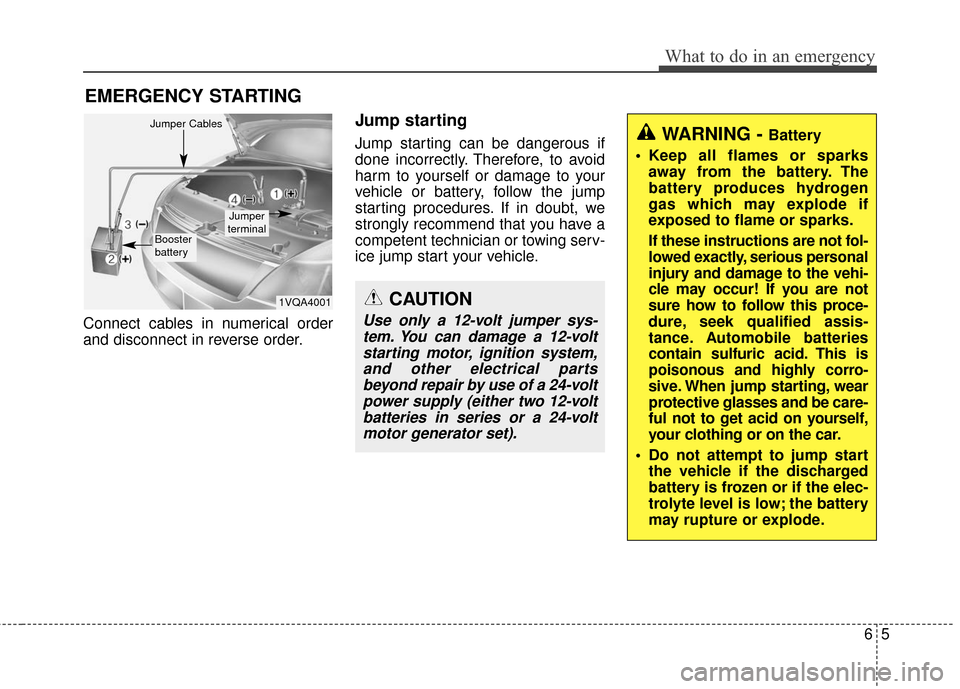
Connect cables in numerical order
and disconnect in reverse order.
Jump starting
Jump starting can be dangerous if
done incorrectly. Therefore, to avoid
harm to yourself or damage to your
vehicle or battery, follow the jump
starting procedures. If in doubt, we
strongly recommend that you have a
competent technician or towing serv-
ice jump start your vehicle.
CAUTION
Use only a 12-volt jumper sys-tem. You can damage a 12-voltstarting motor, ignition system,and other electrical partsbeyond repair by use of a 24-voltpower supply (either two 12-voltbatteries in series or a 24-voltmotor generator set).
WARNING - Battery
• Keep all flames or sparks away from the battery. The
battery produces hydrogen
gas which may explode if
exposed to flame or sparks.
If these instructions are not fol-
lowed exactly, serious personal
injury and damage to the vehi-
cle may occur! If you are not
sure how to follow this proce-
dure, seek qualified assis-
tance. Automobile batteries
contain sulfuric acid. This is
poisonous and highly corro-
sive. When jump starting, wear
protective glasses and be care-
ful not to get acid on yourself,
your clothing or on the car.
Do not attempt to jump start the vehicle if the discharged
battery is frozen or if the elec-
trolyte level is low; the battery
may rupture or explode.
1VQA4001
Jumper Cables
Booster
battery
Jumper
terminal
Page 373 of 493
What to do in an emergency
22
6
TOWING
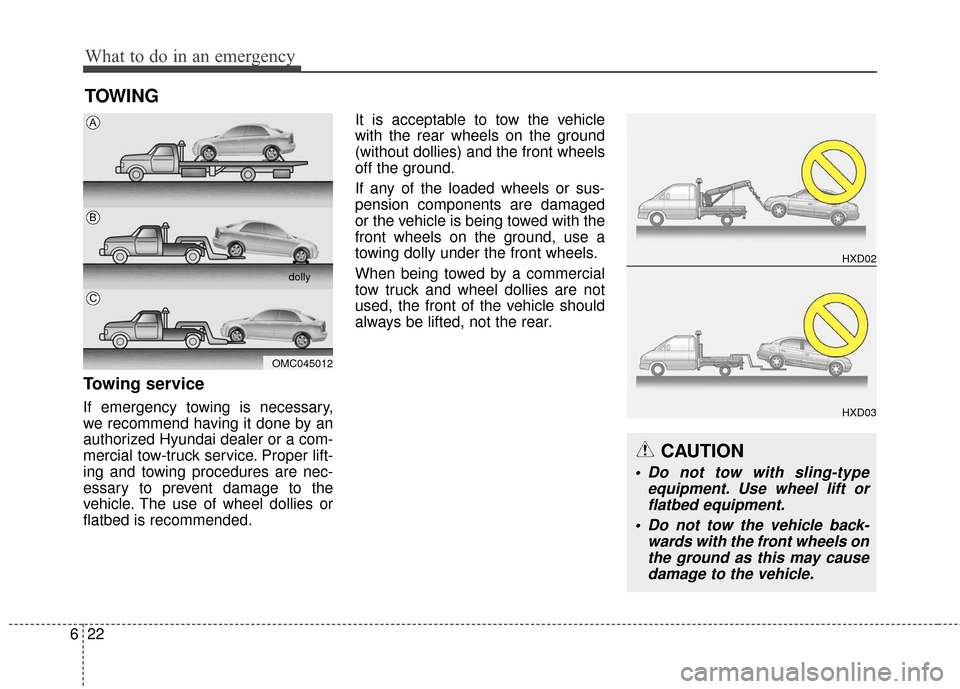
Towing service
If emergency towing is necessary,
we recommend having it done by an
authorized Hyundai dealer or a com-
mercial tow-truck service. Proper lift-
ing and towing procedures are nec-
essary to prevent damage to the
vehicle. The use of wheel dollies or
flatbed is recommended. It is acceptable to tow the vehicle
with the rear wheels on the ground
(without dollies) and the front wheels
off the ground.
If any of the loaded wheels or sus-
pension components are damaged
or the vehicle is being towed with the
front wheels on the ground, use a
towing dolly under the front wheels.
When being towed by a commercial
tow truck and wheel dollies are not
used, the front of the vehicle should
always be lifted, not the rear.
OMC045012
dolly
A
B
C
CAUTION
Do not tow with sling-type
equipment. Use wheel lift orflatbed equipment.
Do not tow the vehicle back- wards with the front wheels onthe ground as this may causedamage to the vehicle.
HXD02
HXD03
Page 374 of 493
623
What to do in an emergency
When towing your vehicle in an
emergency without wheel dollies :
1. Set the ignition switch in the ACCposition.
2. Place the shift lever in N (Neutral).
3. Release the parking brake.
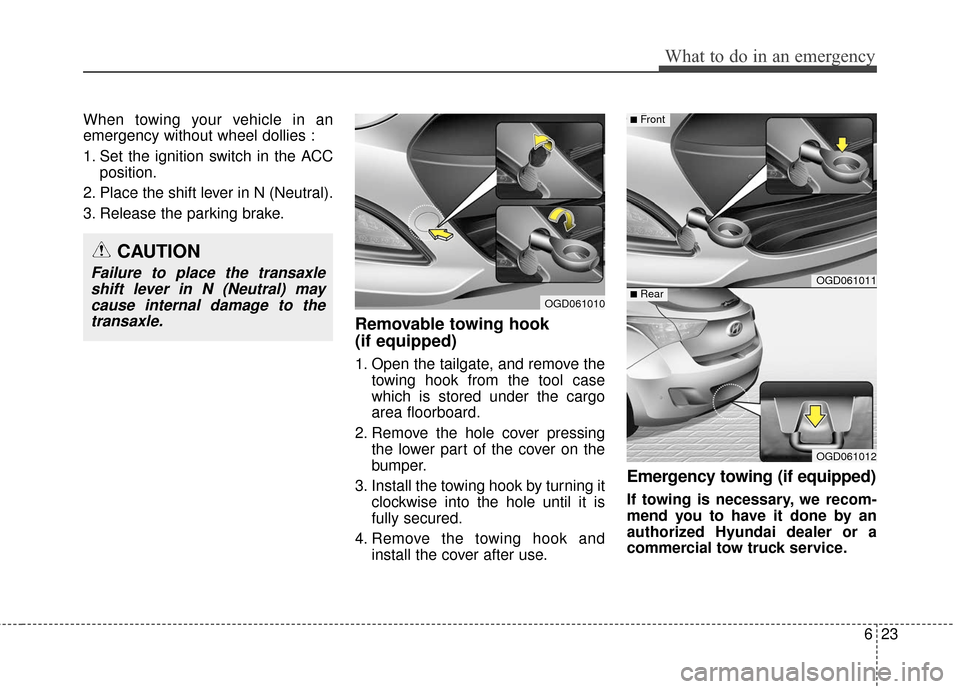
Removable towing hook
(if equipped)
1. Open the tailgate, and remove the towing hook from the tool case
which is stored under the cargo
area floorboard.
2. Remove the hole cover pressing the lower part of the cover on the
bumper.
3. Install the towing hook by turning it clockwise into the hole until it is
fully secured.
4. Remove the towing hook and install the cover after use.
Emergency towing (if equipped)
If towing is necessary, we recom-
mend you to have it done by an
authorized Hyundai dealer or a
commercial tow truck service.
CAUTION
Failure to place the transaxleshift lever in N (Neutral) maycause internal damage to thetransaxle.
OGD061010
OGD061011
OGD061012
■Rear
■Front