ABS HYUNDAI ELANTRA GT 2019 User Guide
[x] Cancel search | Manufacturer: HYUNDAI, Model Year: 2019, Model line: ELANTRA GT, Model: HYUNDAI ELANTRA GT 2019Pages: 486, PDF Size: 78.59 MB
Page 324 of 486
5-103
Driving your vehicle
5
Smart Cruise Control set speedwill be temporarily canceled
when:
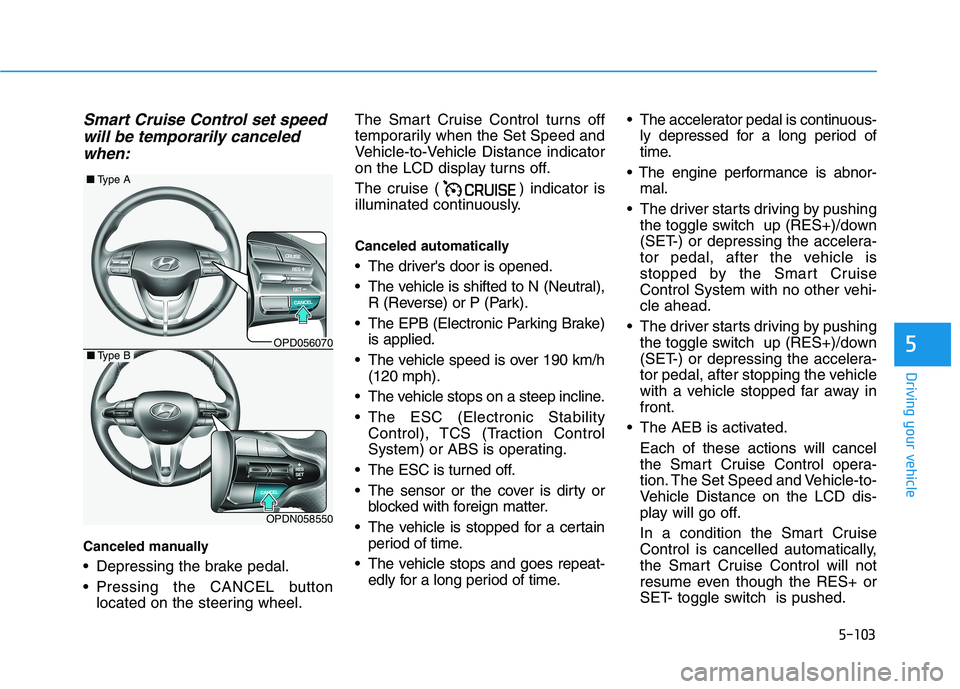
Canceled manually
Depressing the brake pedal.
Pressing the CANCEL button located on the steering wheel. The Smart Cruise Control turns off
temporarily when the Set Speed and
Vehicle-to-Vehicle Distance indicator
on the LCD display turns off.
The cruise ( ) indicator is
illuminated continuously.
Canceled automatically
The driver's door is opened.
The vehicle is shifted to N (Neutral),
R (Reverse) or P (Park).
The EPB (Electronic Parking Brake) is applied.
The vehicle speed is over 190 km/h (120 mph).
The vehicle stops on a steep incline.
The ESC (Electronic Stability Control), TCS (Traction Control
System) or ABS is operating.
The ESC is turned off.
The sensor or the cover is dirty or blocked with foreign matter.
The vehicle is stopped for a certain period of time.
The vehicle stops and goes repeat- edly for a long period of time. The accelerator pedal is continuous-
ly depressed for a long period of
time.
mal.
The driver starts driving by pushing the toggle switch up (RES+)/down
(SET-) or depressing the accelera-
tor pedal, after the vehicle is
stopped by the Smart Cruise
Control System with no other vehi-cle ahead.
The driver starts driving by pushing the toggle switch up (RES+)/down
(SET-) or depressing the accelera-
tor pedal, after stopping the vehicle
with a vehicle stopped far away infront.
The AEB is activated. Each of these actions will cancel
the Smart Cruise Control opera-
tion. The Set Speed and Vehicle-to-
Vehicle Distance on the LCD dis-
play will go off.
In a condition the Smart Cruise Control is cancelled automatically,
the Smart Cruise Control will not
resume even though the RES+ or
SET- toggle switch is pushed.
OPD056070
■ Type A
OPDN058550
■Type B
Page 408 of 486
7-35
7
Maintenance
TTIIRR EESS AA NN DD WW HHEEEELLSS
Tire Care
For proper maintenance, safety, and
maximum fuel economy, you must
always maintain recommended tire
inflation pressures and stay within
the load limits and weight distribution
recommended for your vehicle.
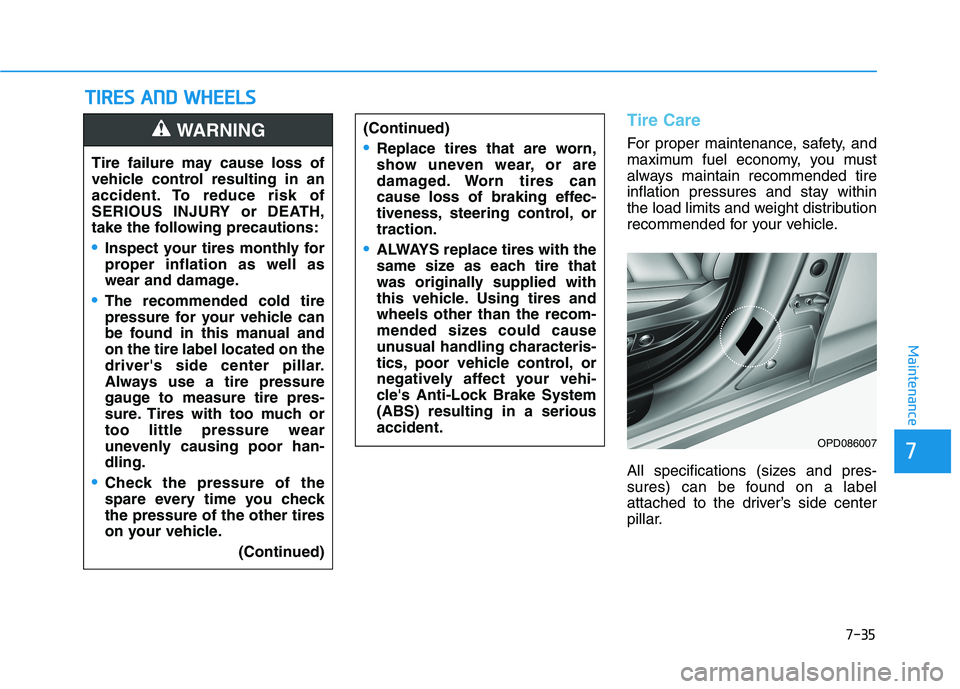
All specifications (sizes and pres-
sures) can be found on a label
attached to the driver’s side center
pillar.
(Continued)Replace tires that are worn,
show uneven wear, or are
damaged. Worn tires can
cause loss of braking effec-
tiveness, steering control, ortraction.
ALWAYS replace tires with the
same size as each tire that
was originally supplied with
this vehicle. Using tires andwheels other than the recom-
mended sizes could cause
unusual handling characteris-
tics, poor vehicle control, or
negatively affect your vehi-
cle's Anti-Lock Brake System(ABS) resulting in a seriousaccident.
Tire failure may cause loss of
vehicle control resulting in an
accident. To reduce risk of
SERIOUS INJURY or DEATH,
take the following precautions:
Inspect your tires monthly for
proper inflation as well as
wear and damage.
The recommended cold tire
pressure for your vehicle can
be found in this manual andon the tire label located on the
driver's side center pillar.
Always use a tire pressure
gauge to measure tire pres-
sure. Tires with too much ortoo little pressure wear
unevenly causing poor han-dling.
Check the pressure of the
spare every time you checkthe pressure of the other tires
on your vehicle.
(Continued)
WARNING
OPD086007
Page 412 of 486
7-39
7
Maintenance
Tire Replacement
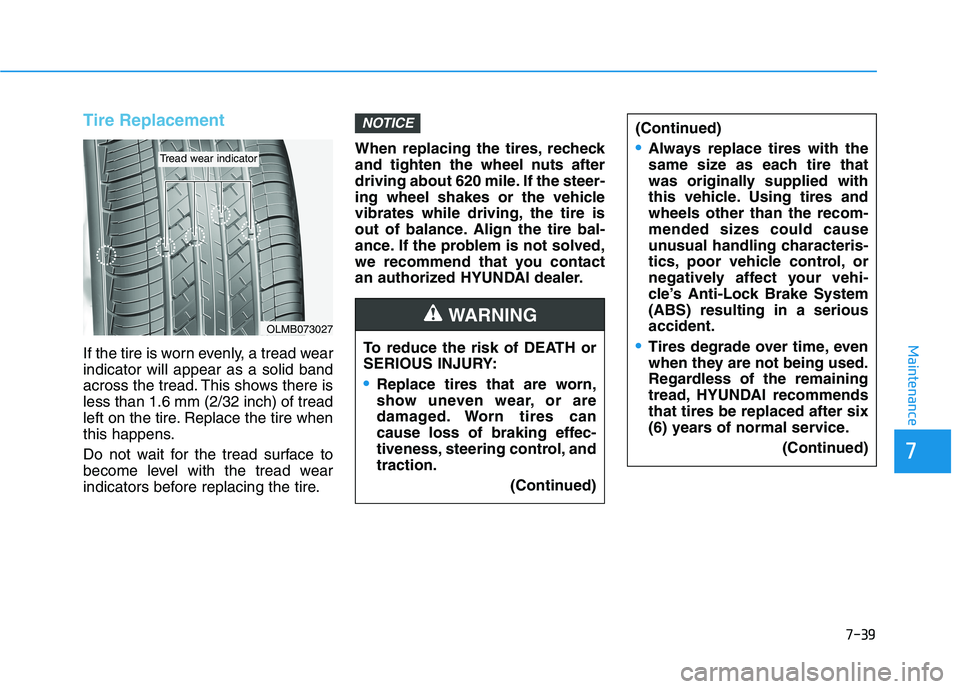
If the tire is worn evenly, a tread wear indicator will appear as a solid band
across the tread. This shows there isless than 1.6 mm (2/32 inch) of tread
left on the tire. Replace the tire when
this happens.
Do not wait for the tread surface to
become level with the tread wear
indicators before replacing the tire.When replacing the tires, recheck
and tighten the wheel nuts after
driving about 620 mile. If the steer-
ing wheel shakes or the vehicle
vibrates while driving, the tire is
out of balance. Align the tire bal-
ance. If the problem is not solved,
we recommend that you contact
an authorized HYUNDAI dealer.
NOTICE
OLMB073027
Tread wear indicator
To reduce the risk of DEATH or
SERIOUS INJURY:
Replace tires that are worn,
show uneven wear, or are
damaged. Worn tires can
cause loss of braking effec-
tiveness, steering control, andtraction.(Continued)
WARNING
(Continued)
Always replace tires with the
same size as each tire that
was originally supplied with
this vehicle. Using tires andwheels other than the recom-
mended sizes could cause
unusual handling characteris-
tics, poor vehicle control, or
negatively affect your vehi-
cle’s Anti-Lock Brake System(ABS) resulting in a seriousaccident.
Tires degrade over time, even
when they are not being used.
Regardless of the remaining
tread, HYUNDAI recommendsthat tires be replaced after six
(6) years of normal service.(Continued)
Page 413 of 486
7-40
Maintenance
(Continued)
When replacing tires (or
wheels), it is recommended to
replace the two front or two
rear tires (or wheels) as a pair.Replacing just one tire can
seriously affect your vehicle's
handling. If only replacing one
pair of tires, it is recommend-
ed to install the pair of new
tires on the rear axle.
Heat caused by hot climates or frequent high loading con-ditions can accelerate the
aging process. Failure to fol-
low this warning may cause
sudden tire failure, which
could lead to a loss of vehicle
control resulting in an acci-dent.
Replacing tires
Driving on worn-out tires is
very hazardous and will
reduce braking effectiveness,
steering accuracy, and trac-tion.
Your vehicle is equipped with
tires designed to provide for
safe ride and handling capa-
bility. Do not use a size andtype of tire and wheel that is
different form the one that is
originally installed on your
vehicle. It can affect the safety
and performance of your vehi-
cle, which could lead to han-
dling failure or rollover and
serious injury. When replacing
the tires, be sure to equipped
all four tires with the tire and
wheel of the same size, type,
tread, brand and load-carrying
capability.(Continued)
(Continued)
The use of any other tire size
or type may seriously affect
ride, handling, ground clear-
ance, stopping distance, body
to tire clearance, snow tire
clearance, and speedometer
reliability.
It is best to replace all four
tires at the same time. If that
is not possible, or necessary,
then replace the two front or
two rear tires as a pair.Replacing just one tire can
seriously affect your vehicle'shandling.
The ABS works by comparing
the speed of the wheels. Tire
size can affect wheel speed.
When replacing tires, all 4
tires must use the same size
originally supplied with the
vehicle. Using tires of a differ-
ent size can cause the ABS
(Anti-lock Brake System) and
ESC (Electronic Stability
Control)(if equipped) to work
irregularly.
(Continued)
WARNING
Page 432 of 486
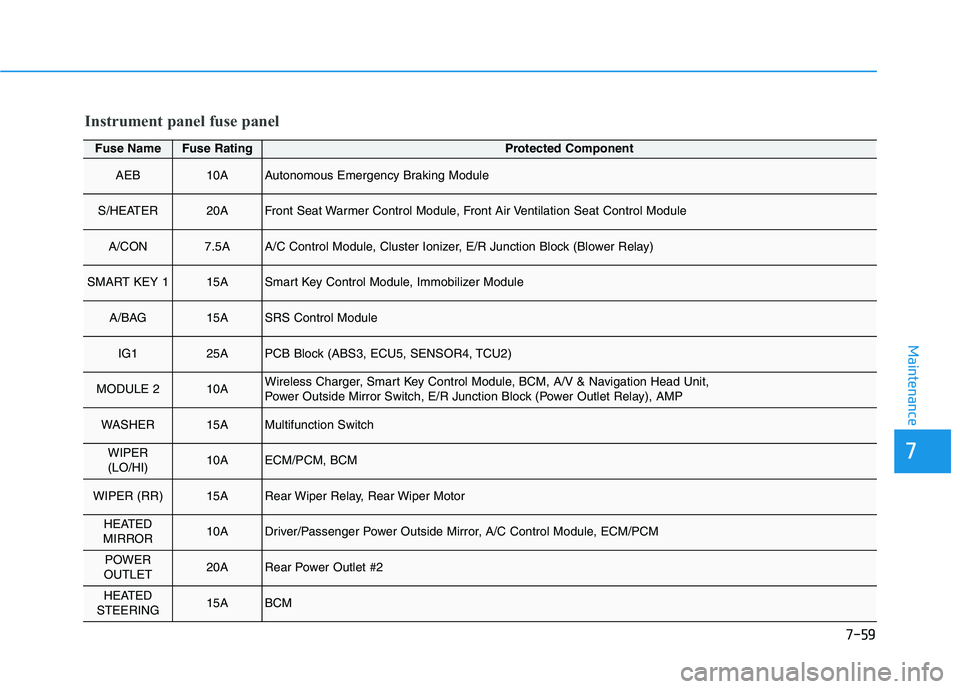
7-59
7
Maintenance
Fuse NameFuse RatingProtected Component
AEB10AAutonomous Emergency Braking Module
S/HEATER20AFront Seat Warmer Control Module, Front Air Ventilation Seat Control Module
A/CON7.5AA/C Control Module, Cluster Ionizer, E/R Junction Block (Blower Relay)
SMART KEY 115ASmart Key Control Module, Immobilizer Module
A/BAG15ASRS Control Module
IG125APCB Block (ABS3, ECU5, SENSOR4, TCU2)
MODULE 210AWireless Charger, Smart Key Control Module, BCM, A/V & Navigation Head Unit,
Power Outside Mirror Switch, E/R Junction Block (Power Outlet Relay), AMP
WASHER15AMultifunction Switch
WIPER(LO/HI)10AECM/PCM, BCM
WIPER (RR)15ARear Wiper Relay, Rear Wiper Motor
HEATED
MIRROR10ADriver/Passenger Power Outside Mirror, A/C Control Module, ECM/PCM
POWER
OUTLET20ARear Power Outlet #2
HEATED
STEERING15ABCM
Instrument panel fuse panel
Page 434 of 486
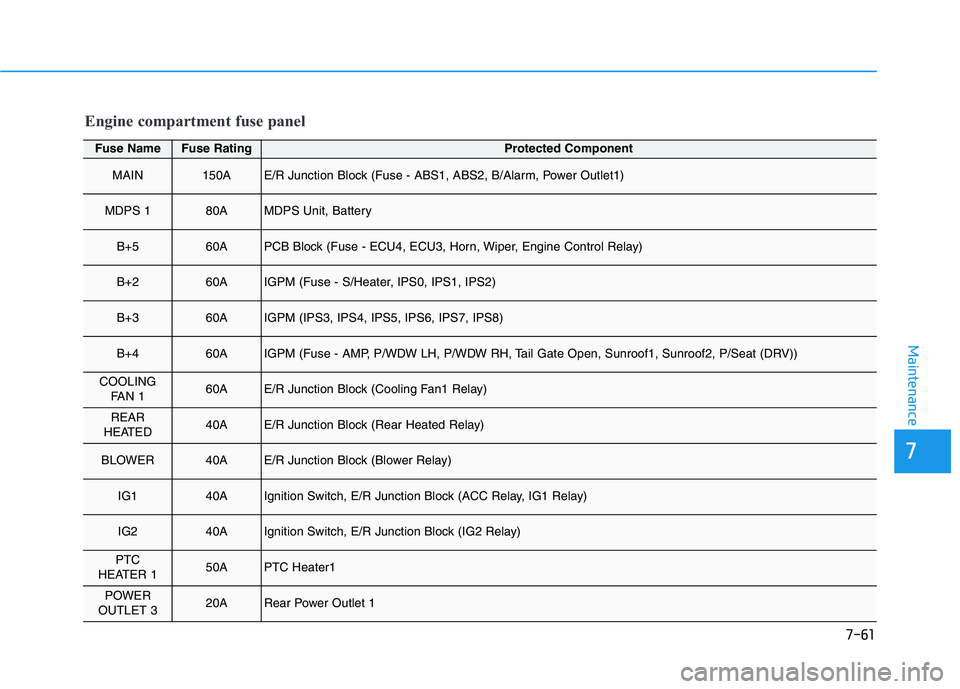
7-61
7
Maintenance
Engine compartment fuse panel
Fuse NameFuse RatingProtected Component
MAIN150AE/R Junction Block (Fuse - ABS1, ABS2, B/Alarm, Power Outlet1)
MDPS 180AMDPS Unit, Battery
B+560APCB Block (Fuse - ECU4, ECU3, Horn, Wiper, Engine Control Relay)
B+260AIGPM (Fuse - S/Heater, IPS0, IPS1, IPS2)
B+360AIGPM (IPS3, IPS4, IPS5, IPS6, IPS7, IPS8)
B+460AIGPM (Fuse - AMP, P/WDW LH, P/WDW RH, Tail Gate Open, Sunroof1, Sunroof2, P/Seat (DRV))
COOLINGFAN 160AE/R Junction Block (Cooling Fan1 Relay)
REAR
HEATED40AE/R Junction Block (Rear Heated Relay)
BLOWER40AE/R Junction Block (Blower Relay)
IG140AIgnition Switch, E/R Junction Block (ACC Relay, IG1 Relay)
IG240AIgnition Switch, E/R Junction Block (IG2 Relay)
PTC
HEATER 150APTC Heater1
POWER
OUTLET 320ARear Power Outlet 1
Page 435 of 486
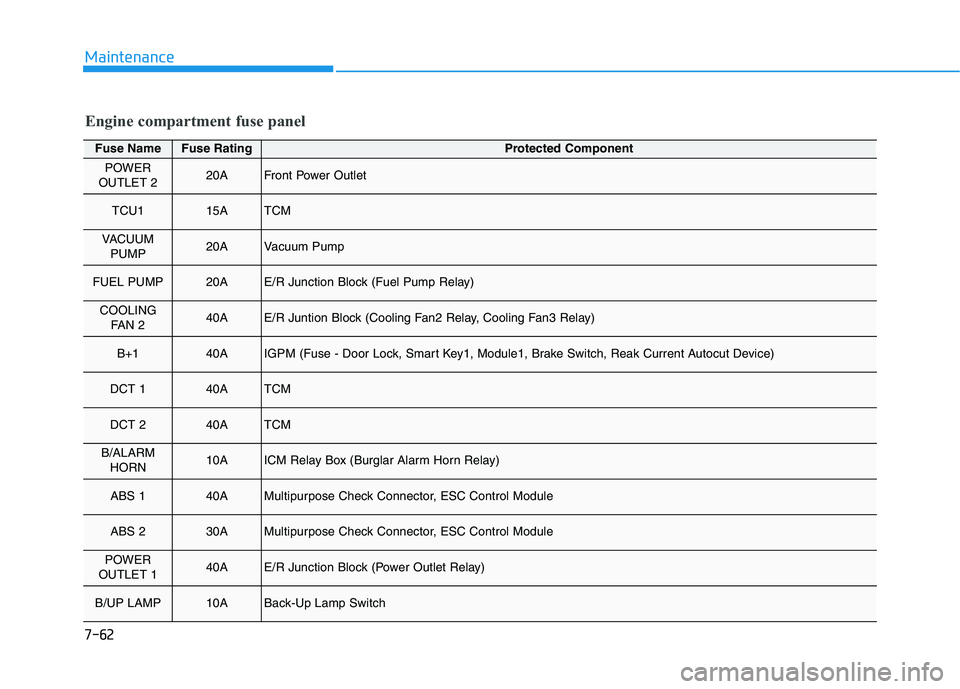
7-62
Maintenance
Engine compartment fuse panel
Fuse NameFuse RatingProtected Component
POWER
OUTLET 220AFront Power Outlet
TCU115ATCM
VACUUM PUMP20AVacuum Pump
FUEL PUMP20AE/R Junction Block (Fuel Pump Relay)
COOLING FAN 240AE/R Juntion Block (Cooling Fan2 Relay, Cooling Fan3 Relay)
B+140AIGPM (Fuse - Door Lock, Smart Key1, Module1, Brake Switch, Reak Current Autocut Device)
DCT 140ATCM
DCT 240ATCM
B/ALARMHORN10AICM Relay Box (Burglar Alarm Horn Relay)
ABS 140AMultipurpose Check Connector, ESC Control Module
ABS 230AMultipurpose Check Connector, ESC Control Module
POWER
OUTLET 140AE/R Junction Block (Power Outlet Relay)
B/UP LAMP10ABack-Up Lamp Switch
Page 436 of 486
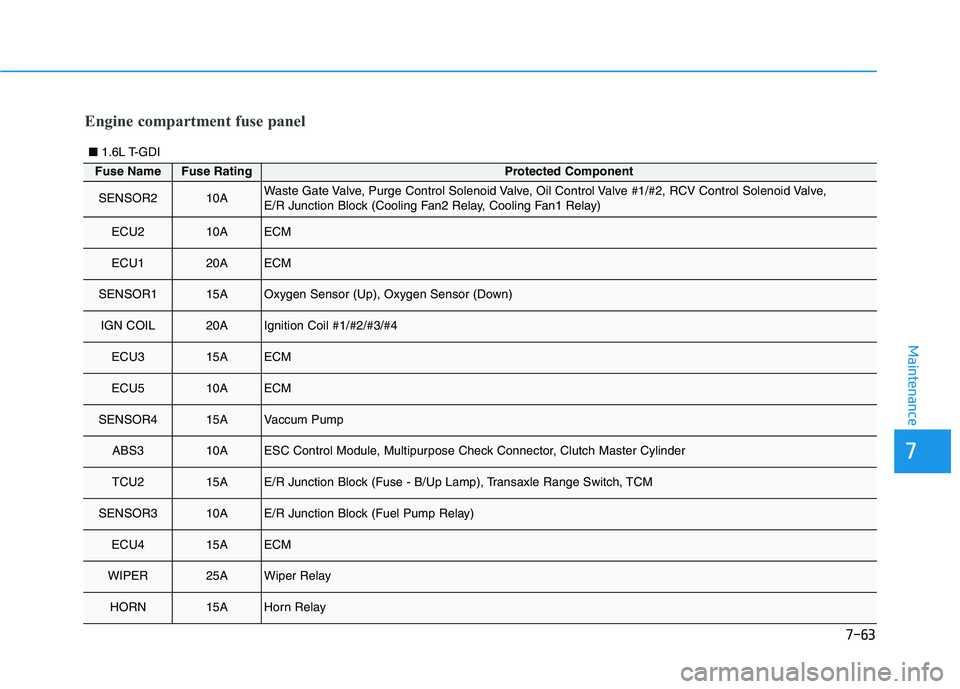
7-63
7
Maintenance
Fuse NameFuse RatingProtected Component
SENSOR210AWaste Gate Valve, Purge Control Solenoid Valve, Oil Control Valve #1/#2, RCV Control Solenoid Valve,
E/R Junction Block (Cooling Fan2 Relay, Cooling Fan1 Relay)
ECU210AECM
ECU120AECM
SENSOR115AOxygen Sensor (Up), Oxygen Sensor (Down)
IGN COIL20AIgnition Coil #1/#2/#3/#4
ECU315AECM
ECU510AECM
SENSOR415AVaccum Pump
ABS310AESC Control Module, Multipurpose Check Connector, Clutch Master Cylinder
TCU215AE/R Junction Block (Fuse - B/Up Lamp), Transaxle Range Switch, TCM
SENSOR310AE/R Junction Block (Fuel Pump Relay)
ECU415AECM
WIPER25AWiper Relay
HORN15AHorn Relay
■ 1.6L T-GDI
Engine compartment fuse panel
Page 437 of 486
7-64
Maintenance
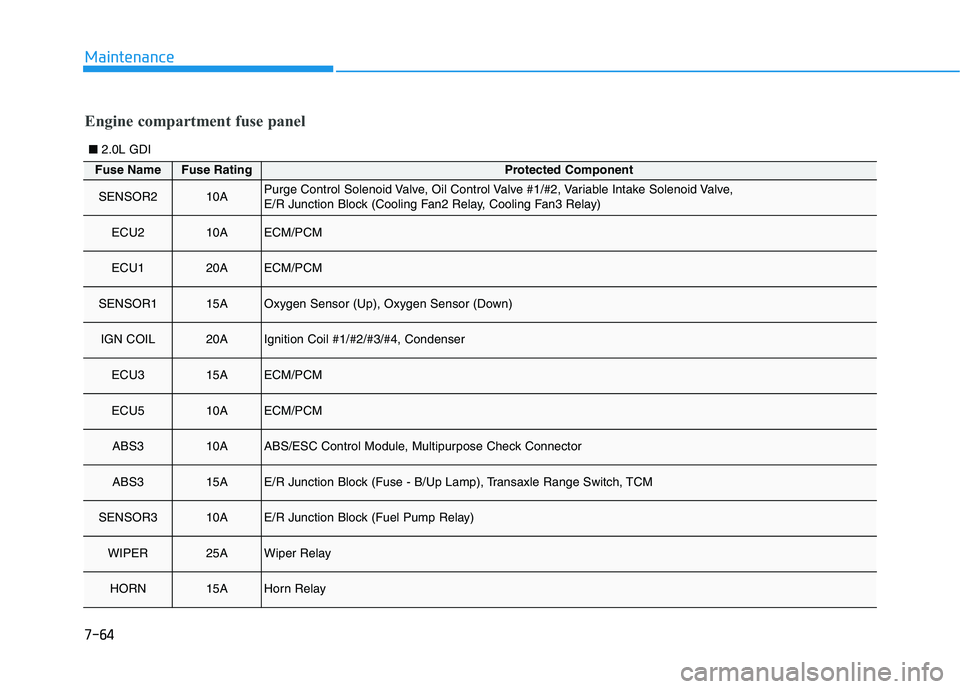
■2.0L GDI
Fuse NameFuse RatingProtected Component
SENSOR210APurge Control Solenoid Valve, Oil Control Valve #1/#2, Variable Intake Solenoid Valve,
E/R Junction Block (Cooling Fan2 Relay, Cooling Fan3 Relay)
ECU210AECM/PCM
ECU120AECM/PCM
SENSOR115AOxygen Sensor (Up), Oxygen Sensor (Down)
IGN COIL20AIgnition Coil #1/#2/#3/#4, Condenser
ECU315AECM/PCM
ECU510AECM/PCM
ABS310AABS/ESC Control Module, Multipurpose Check Connector
ABS315AE/R Junction Block (Fuse - B/Up Lamp), Transaxle Range Switch, TCM
SENSOR310AE/R Junction Block (Fuel Pump Relay)
WIPER25AWiper Relay
HORN15AHorn Relay
Engine compartment fuse panel
Page 441 of 486
7-68
Maintenance
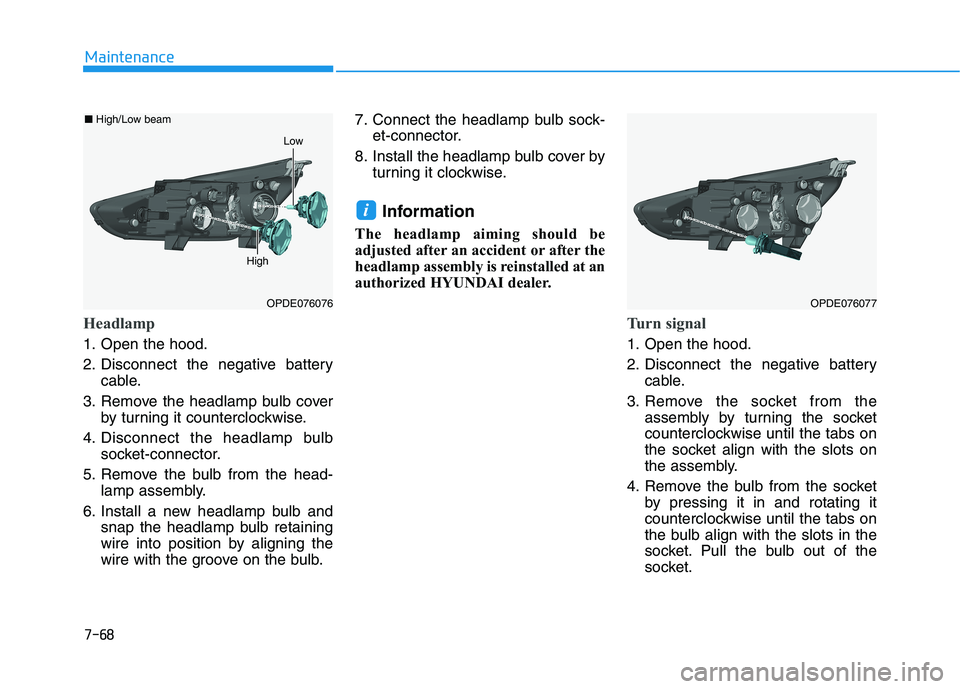
Headlamp
1. Open the hood.
2. Disconnect the negative batterycable.
3. Remove the headlamp bulb cover by turning it counterclockwise.
4. Disconnect the headlamp bulb socket-connector.
5. Remove the bulb from the head- lamp assembly.
6. Install a new headlamp bulb and snap the headlamp bulb retaining
wire into position by aligning the
wire with the groove on the bulb. 7. Connect the headlamp bulb sock-
et-connector.
8. Install the headlamp bulb cover by turning it clockwise.
Information
The headlamp aiming should be
adjusted after an accident or after the
headlamp assembly is reinstalled at an
authorized HYUNDAI dealer.
Turn signal
1. Open the hood.
2. Disconnect the negative battery cable.
3. Remove the socket from the assembly by turning the socket
counterclockwise until the tabs on
the socket align with the slots on
the assembly.
4. Remove the bulb from the socket by pressing it in and rotating it
counterclockwise until the tabs on
the bulb align with the slots in the
socket. Pull the bulb out of the
socket.
i
OPDE076077OPDE076076
■High/Low beam
High
Low