heating HYUNDAI ELANTRA GT 2019 Owner's Manual
[x] Cancel search | Manufacturer: HYUNDAI, Model Year: 2019, Model line: ELANTRA GT, Model: HYUNDAI ELANTRA GT 2019Pages: 486, PDF Size: 78.59 MB
Page 338 of 486
5-117
Driving your vehicle
5
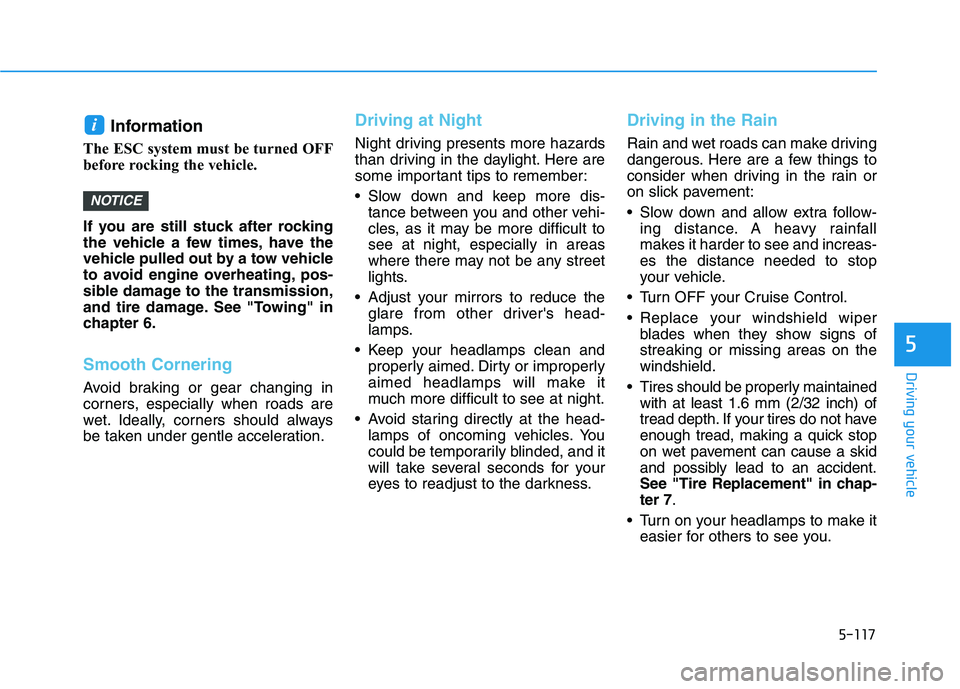
Information
The ESC system must be turned OFF
before rocking the vehicle.
If you are still stuck after rocking
the vehicle a few times, have the
vehicle pulled out by a tow vehicle
to avoid engine overheating, pos-
sible damage to the transmission,
and tire damage. See "Towing" in
chapter 6.
Smooth Cornering
Avoid braking or gear changing in
corners, especially when roads are
wet. Ideally, corners should always
be taken under gentle acceleration.
Driving at Night
Night driving presents more hazards
than driving in the daylight. Here are
some important tips to remember:
Slow down and keep more dis- tance between you and other vehi-
cles, as it may be more difficult tosee at night, especially in areas
where there may not be any street
lights.
Adjust your mirrors to reduce the glare from other driver's head-
lamps.
Keep your headlamps clean and properly aimed. Dirty or improperly
aimed headlamps will make it
much more difficult to see at night.
Avoid staring directly at the head- lamps of oncoming vehicles. You
could be temporarily blinded, and it
will take several seconds for your
eyes to readjust to the darkness.
Driving in the Rain
Rain and wet roads can make driving
dangerous. Here are a few things to
consider when driving in the rain or
on slick pavement:
Slow down and allow extra follow-ing distance. A heavy rainfall
makes it harder to see and increas-es the distance needed to stop
your vehicle.
Turn OFF your Cruise Control.
Replace your windshield wiper blades when they show signs of streaking or missing areas on thewindshield.
Tires should be properly maintained with at least 1.6 mm (2/32 inch) of
tread depth. If your tires do not have
enough tread, making a quick stop
on wet pavement can cause a skid
and possibly lead to an accident.
See "Tire Replacement" in chap-ter 7 .
Turn on your headlamps to make it easier for others to see you.
NOTICE
i
Page 354 of 486
6-6
What to do in an emergency
7. Connect the other end of the sec-ond jumper cable to the black,
negative (-) chassis ground of
your vehicle (4).
Do not allow the jumper cables to
contact anything except the cor-
rect battery or jumper terminals or
the correct ground. Do not lean
over the battery when making
connections.
8. Start the engine of the assisting vehicle and let it run at approxi-
mately 2,000 rpm for a few min-
utes. Then start your vehicle.
If your vehicle will not start after a
few attempts, it probably requires
servicing. In this event please seek
qualified assistance. If the cause of
your battery discharging is not
apparent, have your vehicle checked
by an authorized HYUNDAI dealer. Disconnect the jumper cables in the
exact reverse order you connectedthem:
1. Disconnect the jumper cable from
the black, negative (-) chassis
ground of your vehicle (4).
2. Disconnect the other end of the jumper cable from the black, neg-
ative (-) battery/chassis ground of
the assisting vehicle (3).
3. Disconnect the second jumper cable from the red, positive (+)
battery/jumper terminal of the
assisting vehicle (2).
4. Disconnect the other end of the jumper cable from the red, positive
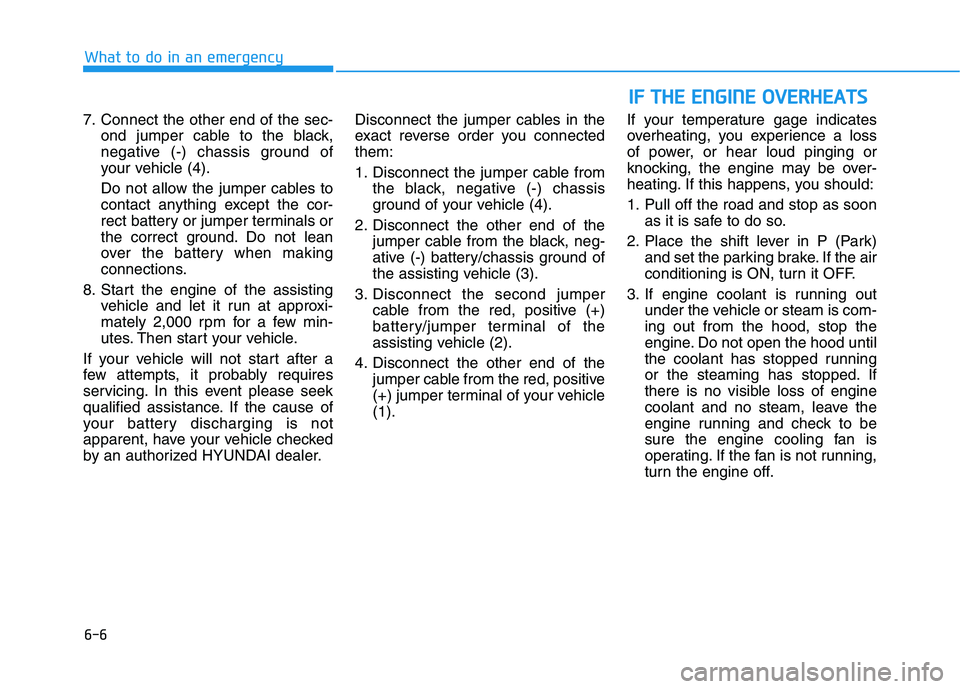
(+) jumper terminal of your vehicle(1). If your temperature gage indicates
overheating, you experience a loss
of power, or hear loud pinging or
knocking, the engine may be over-
heating. If this happens, you should:
1. Pull off the road and stop as soon
as it is safe to do so.
2. Place the shift lever in P (Park) and set the parking brake. If the air
conditioning is ON, turn it OFF.
3. If engine coolant is running out under the vehicle or steam is com-ing out from the hood, stop the
engine. Do not open the hood until
the coolant has stopped running
or the steaming has stopped. If
there is no visible loss of engine
coolant and no steam, leave the
engine running and check to be
sure the engine cooling fan is
operating. If the fan is not running,
turn the engine off.
IIFF TT HH EE EE NN GGIINN EE OO VVEERR HH EEAA TTSS
Page 355 of 486
6-7
What to do in an emergency
6
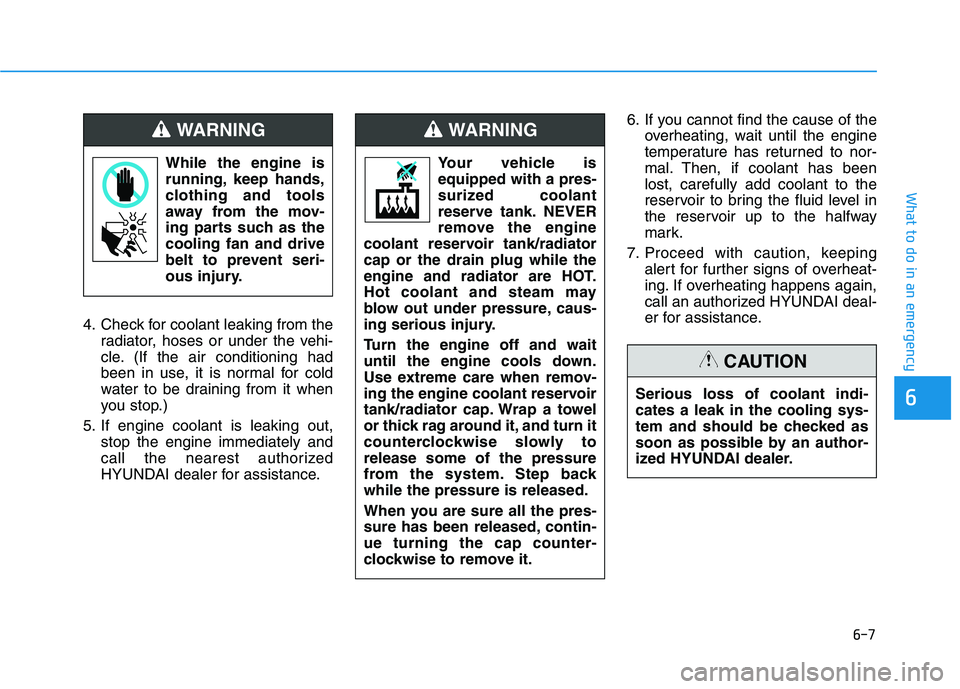
4. Check for coolant leaking from theradiator, hoses or under the vehi-
cle. (If the air conditioning had
been in use, it is normal for cold
water to be draining from it when
you stop.)
5. If engine coolant is leaking out, stop the engine immediately and
call the nearest authorized
HYUNDAI dealer for assistance. 6. If you cannot find the cause of the
overheating, wait until the engine
temperature has returned to nor-
mal. Then, if coolant has beenlost, carefully add coolant to the
reservoir to bring the fluid level in
the reservoir up to the halfway
mark.
7. Proceed with caution, keeping alert for further signs of overheat-
ing. If overheating happens again,
call an authorized HYUNDAI deal-
er for assistance.
While the engine is
running, keep hands,
clothing and tools
away from the mov-
ing parts such as thecooling fan and drive
belt to prevent seri-
ous injury.
WARNING
Serious loss of coolant indi- cates a leak in the cooling sys-
tem and should be checked as
soon as possible by an author-
ized HYUNDAI dealer.
CAUTION
Your vehicle is equipped with a pres-
surized coolant
reserve tank. NEVER
remove the engine
coolant reservoir tank/radiatorcap or the drain plug while the
engine and radiator are HOT.
Hot coolant and steam may
blow out under pressure, caus-
ing serious injury.
Turn the engine off and wait
until the engine cools down.
Use extreme care when remov-
ing the engine coolant reservoir
tank/radiator cap. Wrap a towel
or thick rag around it, and turn it
counterclockwise slowly torelease some of the pressure
from the system. Step backwhile the pressure is released.
When you are sure all the pres-
sure has been released, contin-ue turning the cap counter-
clockwise to remove it.
WARNING
Page 372 of 486
6-24
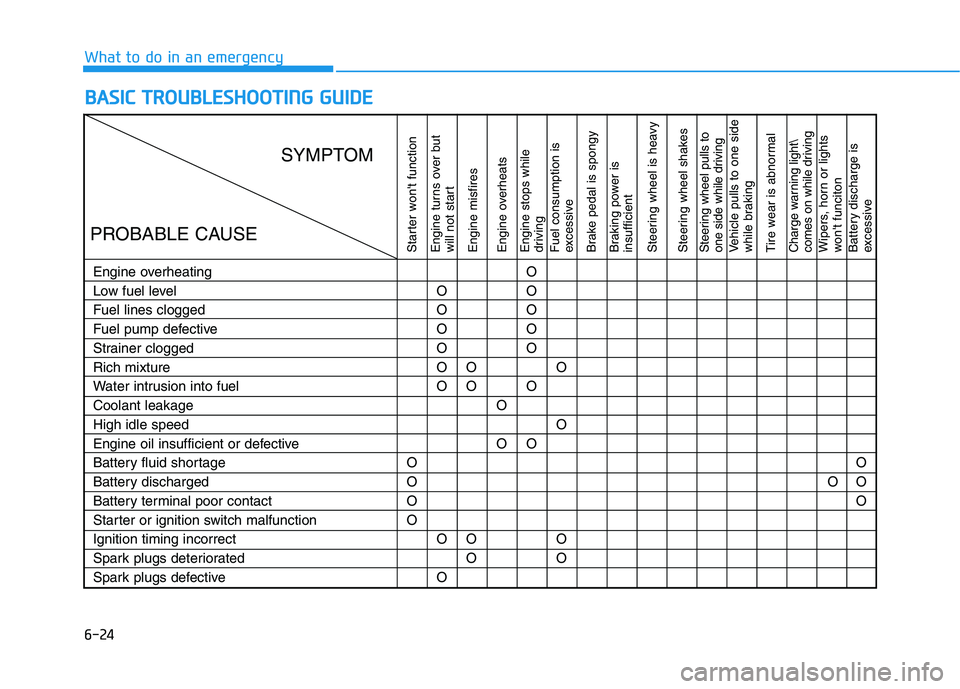
BBAA SSIICC TT RR OO UUBBLLEE SSHH OO OOTTIINN GG GG UU IIDD EE
What to do in an emergency
Starter won't function
Engine turns over but
will not start Engine misfires
Engine overheats Engine stops while
driving Fuel consumption is
excessive
Brake pedal is spongy
Braking power is insufficient
Steering wheel is heavy
Steering wheel shakesSteering wheel pulls to
one side while drivingVehicle pulls to one side
while braking
Tire wear is abnormalCharge warning light\
comes on while drivingWipers, horn or lights
won't funciton
Battery discharge is
excessive
Engine overheating
Low fuel levelFuel lines clogged
Fuel pump defective
Strainer cloggedRich mixture
Water intrusion into fuelCoolant leakageHigh idle speed
Engine oil insufficient or defective
Battery fluid shortage
Battery discharged
Battery terminal poor contact
Starter or ignition switch malfunctionIgnition timing incorrect
Spark plugs deteriorated
Spark plugs defective OOOOOOOOOO O O
O O O O
O OO OOOO O O
OO O O
O
OOO
SYMPTOM
PROBABLE CAUSE
Page 473 of 486
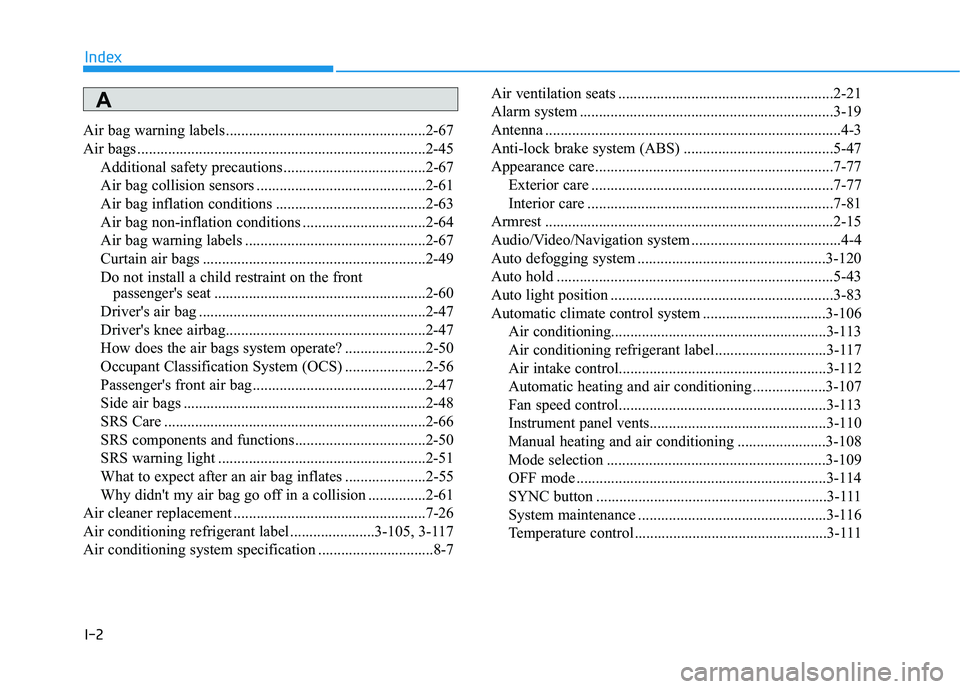
I-2
Air bag warning labels ....................................................2-67
Air bags ...........................................................................2-45
Additional safety precautions .....................................2-67
Air bag collision sensors ............................................2-61
Air bag inflation conditions .......................................2-63
Air bag non-inflation conditions ................................2-64
Air bag warning labels ...............................................2-67
Curtain air bags ..........................................................2-49
Do not install a child restraint on the front passenger's seat .......................................................2-60
Driver's air bag ...........................................................2-47
Driver's knee airbag....................................................2-47
How does the air bags system operate? .....................2-50
Occupant Classification System (OCS) .....................2-56
Passenger's front air bag.............................................2-47
Side air bags ...............................................................2-48
SRS Care ....................................................................2-66
SRS components and functions..................................2-50
SRS warning light ......................................................2-51
What to expect after an air bag inflates .....................2-55
Why didn't my air bag go off in a collision ...............2-61
Air cleaner replacement ..................................................7-26
Air conditioning refrigerant label ......................3-105, 3-117
Air conditioning system specification ..............................8-7 Air ventilation seats ........................................................2-21
Alarm system ..................................................................3-19
Antenna .............................................................................4-3
Anti-lock brake system (ABS) .......................................5-47
Appearance care..............................................................7-77
Exterior care ...............................................................7-77
Interior care ................................................................7-81
Armrest ...........................................................................2-15
Audio/Video/Navigation system .......................................4-4
Auto defogging system .................................................3-120
Auto hold ........................................................................5-43
Auto light position ..........................................................3-83
Automatic climate control system ................................3-106 Air conditioning........................................................3-113
Air conditioning refrigerant label.............................3-117
Air intake control......................................................3-112
Automatic heating and air conditioning ...................3-107
Fan speed control......................................................3-113
Instrument panel vents..............................................3-110
Manual heating and air conditioning .......................3-108
Mode selection .........................................................3-109
OFF mode .................................................................3-114
SYNC button ............................................................3-111
System maintenance .................................................3-116
Temperature control ..................................................3-111
Index
A
Page 480 of 486
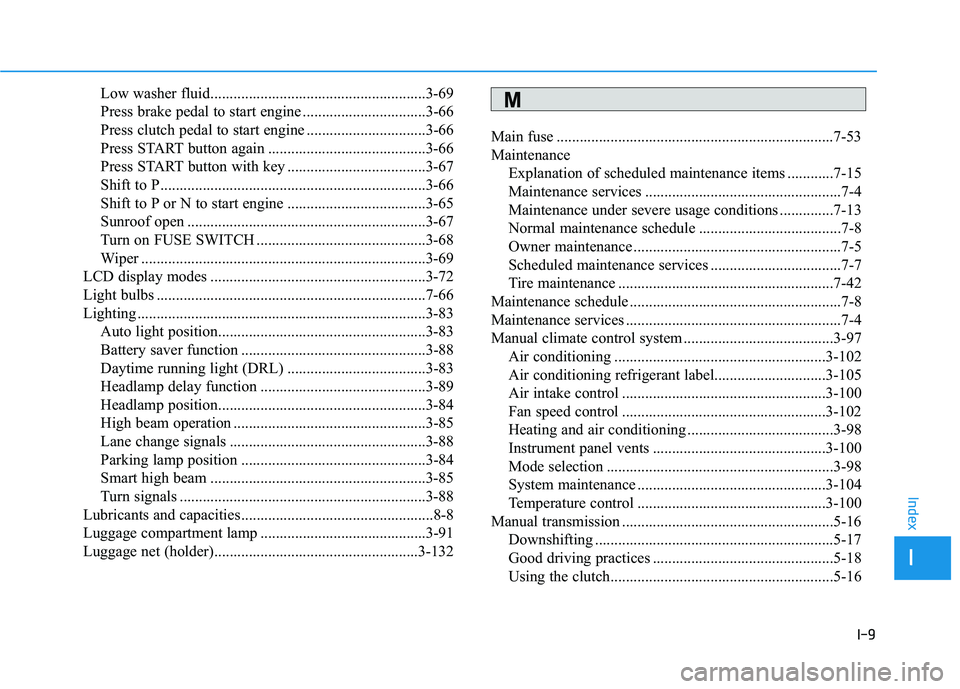
I-9
Low washer fluid........................................................3-69
Press brake pedal to start engine ................................3-66
Press clutch pedal to start engine ...............................3-66
Press START button again .........................................3-66
Press START button with key ....................................3-67
Shift to P.....................................................................3-66
Shift to P or N to start engine ....................................3-65
Sunroof open ..............................................................3-67
Turn on FUSE SWITCH ............................................3-68
Wiper ..........................................................................3-69
LCD display modes ........................................................3-72
Light bulbs ......................................................................7-66
Lighting ...........................................................................3-83
Auto light position......................................................3-83
Battery saver function ................................................3-88
Daytime running light (DRL) ....................................3-83
Headlamp delay function ...........................................3-89
Headlamp position......................................................3-84
High beam operation ..................................................3-85
Lane change signals ...................................................3-88
Parking lamp position ................................................3-84
Smart high beam ........................................................3-85
Turn signals ................................................................3-88
Lubricants and capacities..................................................8-8
Luggage compartment lamp ...........................................3-91
Luggage net (holder).....................................................3-132 Main fuse ........................................................................7-53
Maintenance
Explanation of scheduled maintenance items ............7-15
Maintenance services ...................................................7-4
Maintenance under severe usage conditions ..............7-13
Normal maintenance schedule .....................................7-8
Owner maintenance ......................................................7-5
Scheduled maintenance services ..................................7-7
Tire maintenance ........................................................7-42
Maintenance schedule .......................................................7-8
Maintenance services ........................................................7-4
Manual climate control system .......................................3-97
Air conditioning .......................................................3-102
Air conditioning refrigerant label.............................3-105
Air intake control .....................................................3-100
Fan speed control .....................................................3-102
Heating and air conditioning ......................................3-98
Instrument panel vents .............................................3-100
Mode selection ...........................................................3-98
System maintenance .................................................3-104
Temperature control .................................................3-100
Manual transmission .......................................................5-16
Downshifting ..............................................................5-17
Good driving practices ...............................................5-18
Using the clutch..........................................................5-16
I
Index
M