tire pressure HYUNDAI ELANTRA GT 2020 Owner's Guide
[x] Cancel search | Manufacturer: HYUNDAI, Model Year: 2020, Model line: ELANTRA GT, Model: HYUNDAI ELANTRA GT 2020Pages: 495, PDF Size: 15.22 MB
Page 424 of 495
7-50
Maintenance
DOT Markings
A code molded into the sidewall of a
tire signifying that the tire is in com-
pliance with the U.S. Department of
Transportation motor vehicle safety
standards. The DOT code includes
the Tire Identification Number (TIN),
an alphanumeric designator which
can also identify the tire manufactur-
er, production plant, brand and date
of production.
GVWR
Gross Vehicle Weight Rating
GAWR FRT
Gross Axle Weight Rating for the
Front Axle.
GAWR RR
Gross Axle Weight Rating for the
Rear axle.
Intended Outboard Sidewall
The side of an asymmetrical tire, that
must always face outward when
mounted on a vehicle.
Kilopascal (kPa)
The metric unit for air pressure.
Light truck(LT) tire
A tire designated by its manufacturer
as primarily intended for use on light-
weight trucks or multipurpose pas-
senger vehicles.
Load ratings
The maximum load that a tire is rated
to carry for a given inflation pressure.
Load Index
An assigned number ranging from 1
to 279 that corresponds to the load
carrying capacity of a tire.
Maximum Inflation Pressure
The maximum air pressure to which
a cold tire may be inflated. The max-
imum air pressure is molded onto the
sidewall.
Maximum Load Rating
The load rating for a tire at the maxi-
mum permissible inflation pressure
for that tire.
Maximum Loaded VehicleWeight
The sum of curb weight; accessory
weight; vehicle capacity weight; and
production options weight.
Normal Occupant Weight
The number of occupants a vehicle
is designed to seat multiplied by 150
pounds (68 kg).
Occupant Distribution
Designated seating positions.
Outward Facing Sidewall
An asymmetrical tire has a particular
side that faces outward when mount-
ed on a vehicle. The outward facing
sidewall bears white lettering or
bears manufacturer, brand, and/or
model name molding that is higher or
deeper than the same moldings on
the inner facing sidewall.
Page 425 of 495
7-51
7
Maintenance
Passenger (P-Metric) tire
A tire used on passenger cars and
some light duty trucks and multipur-
pose vehicles.
Ply
A layer of rubber-coated parallel
cords.
Pneumatic tire
A mechanical device made of rubber,
chemicals, fabric and steel or other
materials, that, when mounted on an
automotive wheel provides the trac-
tion and contains the gas or fluid that
sustains the load.
Pneumatic options weight
The combined weight of installed
regular production options weighing
over 5 lb. (2.3 kg) in excess of the
standard items which they replace,
not previously considered in curb
weight or accessory weight, includ-
ing heavy duty breaks, ride levelers,
roof rack, heavy duty battery, and
special trim.
Recommended InflationPressure
Vehicle manufacturer's recommend-
ed tire inflation pressure as shown
on the tire placard.
Radial Ply Tire
A pneumatic tire in which the ply
cords that extend to the beads are
laid at 90 degrees to the centerline of
the tread.
Rim
A metal support for a tire and upon
which the tire beads are seated.
Sidewall
The portion of a tire between the
tread and the bead.
Speed Rating
An alphanumeric code assigned to a
tire indicating the maximum speed at
which a tire can operate.
Traction
The friction between the tire and the
road surface. The amount of grip pro-
vided.
Tread
The portion of a tire that comes into
contact with the road.
Treadwear Indicators
Narrow bands, sometimes called
"wear bars", that show across the
tread of a tire when only 1/16 inch of
tread remains.
UTQGS
Uniform Tire Quality Grading
Standards is a tire information sys-
tem that provides consumers with
ratings for a tire's traction, tempera-
ture and treadwear. Ratings are
determined by tire manufacturers
using government testing proce-
dures. The ratings are molded into
the sidewall of the tire.
Page 426 of 495
7-52
Maintenance
Vehicle Capacity Weight
The number of designated seating
positions multiplied by 150 lbs. (68
kg) plus the rated cargo and luggage
load.
Vehicle Maximum Load on theTire
Load on an individual tire due to curb
and accessory weight plus maximum
occupant and cargo weight.
Vehicle Normal Load on the Tire
Load on an individual tire that is
determined by distributing to each
axle its share of the curb weight,
accessory weight, and normal occu-
pant weight and dividing by 2.
Vehicle Placard
A label permanently attached to a
vehicle showing the original equip-
ment tire size and recommended
inflation pressure.
All Season Tires
HYUNDAI specifies all season tires
on some models to provide good
performance for use all year round,
including snowy and icy road condi-
tions. All season tires are identified
by ALL SEASON and/or M+S (Mud
and Snow) on the tire sidewall. Snow
tires have better snow traction than
all season tires and may be more
appropriate in some areas.
Summer Tires
HYUNDAI specifies summer tires on
some models to provide superior
performance on dry roads. Summer
tire performance is substantially
reduced in snow and ice. Summer
tires do not have the tire traction rat-
ing M+S (Mud and Snow) on the tire
side wall. If you plan to operate your
vehicle in snowy or icy conditions,
HYUNDAI recommends the use of
snow tires or all season tires on all
four wheels.
Snow Tires
If you equip your car with snow tires,
they should be the same size and
have the same load capacity as the
original tires. Snow tires should be
installed on all four wheels; other-
wise, poor handling may result. Snow
tires should carry 4 psi (28 kPa)
more air pressure than the pressure
recommended for the standard tires
on the tire label on the driver’s side of
the center pillar, or up to the maxi-
mum pressure shown on the tire
sidewall, whichever is less. Do not
drive faster than 75 mph (120 km/h)
when your vehicle is equipped with
snow tires.
Radial-Ply Tires
Radial-ply tires provide improved
tread life, road hazard resistance and
smoother high speed ride. The radi-
al-ply tires used on this vehicle are of
belted construction, and are selected
to complement the ride and handling
characteristics of your vehicle.
Page 427 of 495
7-53
7
Maintenance
Radial-ply tires have the same load
carrying capacity, as bias-ply or bias
belted tires of the same size, and use
the same recommended inflation
pressure. Mixing of radial-ply tires
with bias-ply or bias belted tires is
not recommended. Any combina-
tions of radial-ply and bias-ply or bias
belted tires when used on the same
vehicle will seriously deteriorate
vehicle handling. The best rule to fol-
low is: Identical pairs of radial-ply
tires should always be used as a set
for the front tires and a set for the
rear tires.
Longer wearing tires can be more
susceptible to irregular tread wear. It
is very important to follow the tire
rotation interval in this chapter to
achieve the tread life potential of
these tires. Cuts and punctures in
radial-ply tires are repairable only in
the tread area, because of sidewall
flexing. Consult your tire dealer for
radial-ply tire repairs.Low Aspect Ratio Tires
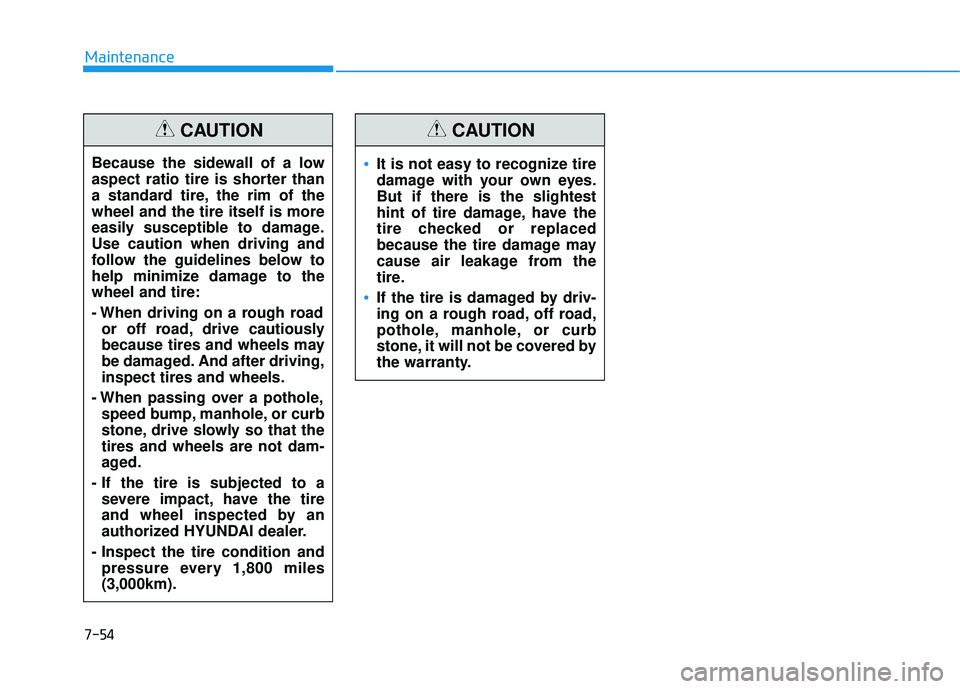
The aspect ratio is lower than 50 on
low aspect ratio tires.
Because low aspect ratio tires are
optimized for handling and braking,
their sidewall is a little stiffer than a
standard tire. Also low aspect ratio
tires tend to be wider and conse-
quently have a greater contact patch
with the road surface. In some
instances they may generate more
road noise compared with standard
tires.
Do not mix bias ply and radial
ply tires under any circum-
stances. This may cause unusu-
al handling characteristics that
may cause loss of vehicle con-
trol resulting in an accident.WARNING
Page 428 of 495
7-54
MaintenanceBecause the sidewall of a low
aspect ratio tire is shorter than
a standard tire, the rim of the
wheel and the tire itself is more
easily susceptible to damage.
Use caution when driving and
follow the guidelines below to
help minimize damage to the
wheel and tire:
- When driving on a rough road or off road, drive cautiously
because tires and wheels may
be damaged. And after driving,
inspect tires and wheels.
- When passing over a pothole, speed bump, manhole, or curb
stone, drive slowly so that the
tires and wheels are not dam-
aged.
- If the tire is subjected to a severe impact, have the tire
and wheel inspected by an
authorized HYUNDAI dealer.
- Inspect the tire condition and pressure every 1,800 miles
(3,000km).
CAUTION
It is not easy to recognize tire
damage with your own eyes.
But if there is the slightest
hint of tire damage, have the
tire checked or replaced
because the tire damage may
cause air leakage from the
tire.
If the tire is damaged by driv-
ing on a rough road, off road,
pothole, manhole, or curb
stone, it will not be covered by
the warranty.
CAUTION
Page 467 of 495
888
Specifications & Consumer information
8
Specifications, Consumer information and Reporting safety defects
8
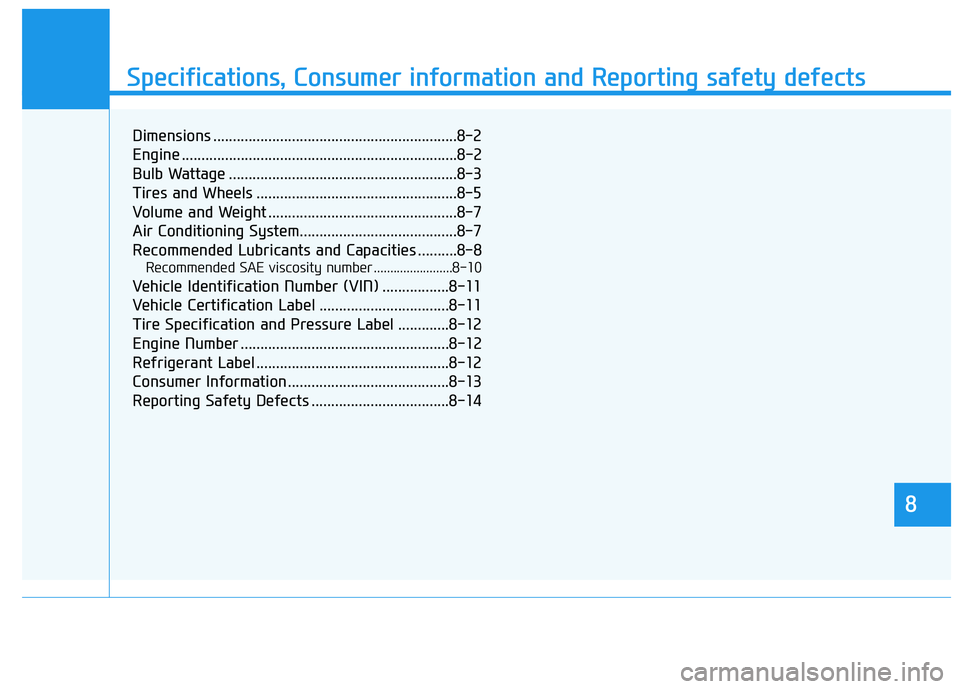
Dimensions ..............................................................8-2
Engine ......................................................................8-\
2
Bulb Wattage ..........................................................8-3
Tires and Wheels ...................................................8-5
Volume and Weight ................................................8-7
Air Conditioning System........................................8-7
Recommended Lubricants and Capacities ..........8-8
Recommended SAE viscosity number ........................8-10
Vehicle Identification Number (VIN) .................8-11
Vehicle Certification Label .................................8-11
Tire Specification and Pressure Label .............8-12
Engine Number .....................................................8-12
Refrigerant Label .................................................8-12
Consumer Information .........................................8-13
Reporting Safety Defects ...................................8-14
Page 471 of 495
T
TI
IR
R E
ES
S
A
A N
N D
D
W
W H
HE
EE
EL
LS
S
8-5
88
Specifications, Consumer information and Reporting safety defects
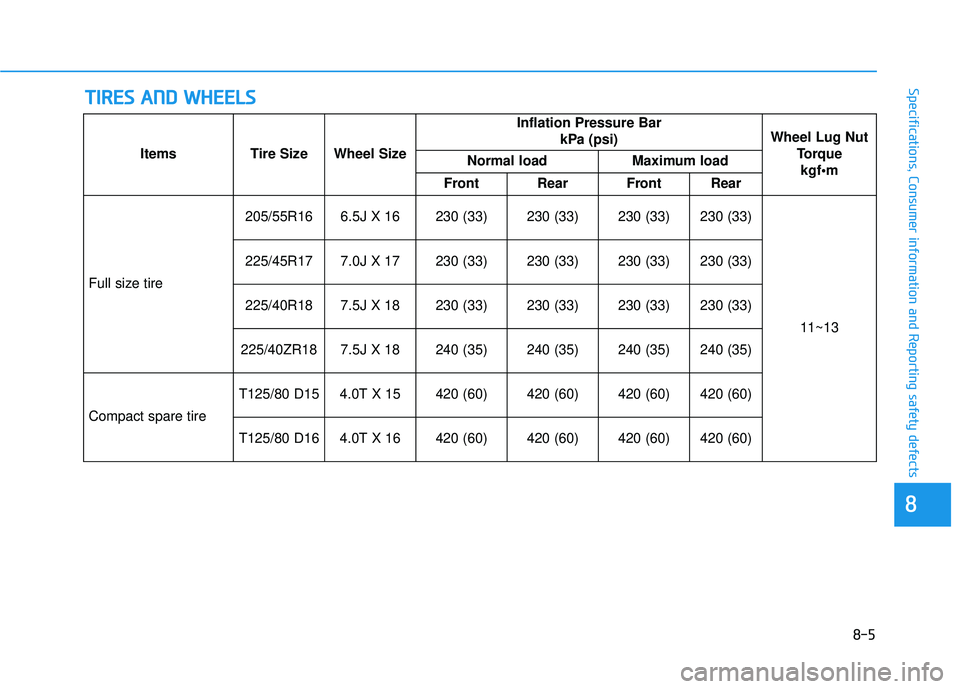
Items Tire SizeWheel Size
Inflation Pressure Bar
kPa (psi)Wheel Lug NutTorque kgf•m
Normal loadMaximum load
FrontRearFrontRear
Full size tire
205/55R166.5J X 16230 (33)230 (33)230 (33)230 (33)
11~13
225/45R177.0J X 17230 (33)230 (33)230 (33)230 (33)
225/40R187.5J X 18230 (33)230 (33)230 (33)230 (33)
225/40ZR187.5J X 18240 (35)240 (35)240 (35)240 (35)
Compact spare tire
T125/80 D154.0T X 15420 (60)420 (60)420 (60)420 (60)
T125/80 D164.0T X 16420 (60)420 (60)420 (60)420 (60)
Page 472 of 495
8-6
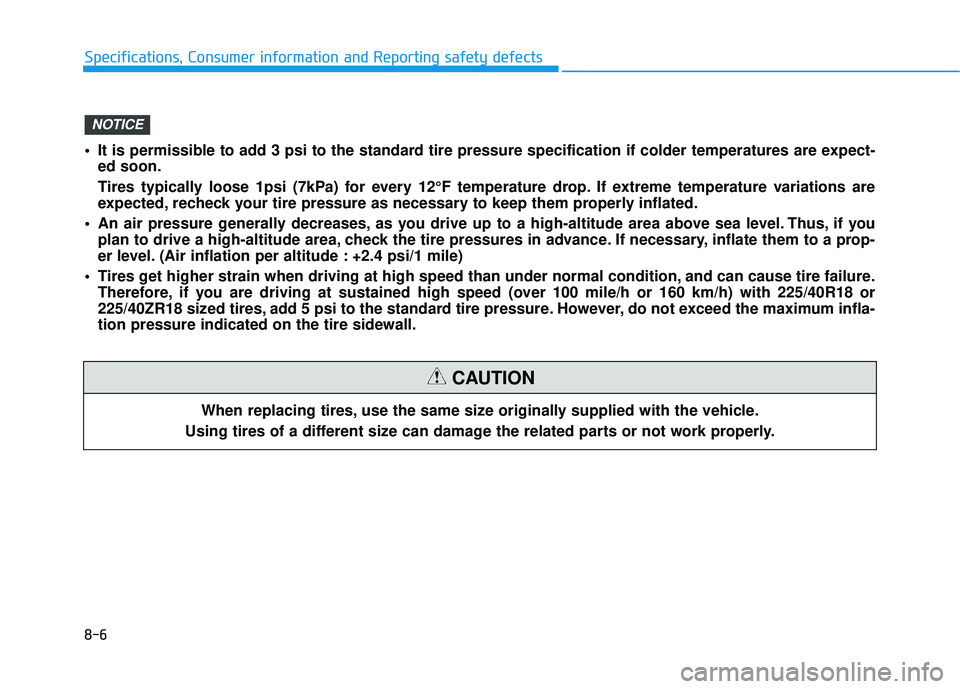
Specifications, Consumer information and Reporting safety defectsWhen replacing tires, use the same size originally supplied with the vehicle.
Using tires of a different size can damage the related parts or not work properly.
CAUTION
It is permissible to add 3 psi to the standard tire pressure specification if colder temperatures are expect- ed soon.
Tires typically loose 1psi (7kPa) for every 12°F temperature drop. If extreme temperature variations are
expected, recheck your tire pressure as necessary to keep them properly inflated.
An air pressure generally decreases, as you drive up to a high-altitude area above sea level. Thus, if you plan to drive a high-altitude area, check the tire pressures in advance. If necessary, inflate them to a prop-
er level. (Air inflation per altitude : +2.4 psi/1 mile)
Tires get higher strain when driving at high speed than under normal condition,\
and can cause tire failure. Therefore, if you are driving at sustained high speed (over 100 mile/h or 160 km/h) with 225/40R18 or
225/40ZR18 sized tires, add 5 psi to the standard tire pressure. However, do not exceed the maximum infla-
tion pressure indicated on the tire sidewall.
NOTICE
Page 484 of 495
I-4
California perchlorate notice ..........................................7-92
Camera (Rear view) ........................................................3-98
Capacities (Lubricants) .....................................................8-8
CareExterior care ...............................................................7-80
Interior care ................................................................7-85
Tire care ......................................................................7-\
38
Cargo area cover ...........................................................3-134
Cartridge type fuse..........................................................7-57
Cellular phone holder ...................................................3-130
Center console storage ..................................................3-125
Central door lock switch .................................................3-14
Certification label............................................................8-11
Chains Tire chains ................................................................5-119
Check tire inflation pressure ...........................................7-40
Child restraint system (CRS) ..........................................2-34 Booster seats...............................................................2-37
Forward-facing child restraints ..................................2-37
Installing a child restraint system (CRS) ...................2-37
Lower anchors and tether for children .......................2-38
Rear-facing child seats ...............................................2-36
Securing a child restraint system seat with "Tether Anchor" system ..........................................2-41
Securing a child restraint system with a lap/ shoulder belt ............................................................2-42 Securing a child restraint system with LATCH
anchors system ........................................................2-40
Selecting a child restraint system (CRS) ...................2-35
Child-protector rear door lock ........................................3-16
Climate control air filter replacement.............................7-30
Climate control system Automatic climate control system............................3-108
Manual climate control system ..................................3-99
Clock ........................................................................\
.....3-132
Clothes hanger ..............................................................3-132
Cluster ionizer ...............................................................3-124
Combined instrument, see instrument cluster ................3-49
Compact spare tire replacement .....................................7-45
Consumer information ....................................................8-13
Coolant ........................................................................\
....7-23
Cooling fluid, see engine coolant ...................................7-23
Crankcase emission control system ................................7-87
Cruise control system .....................................................5-91
Cup holder.....................................................................3-1\
27
Curtain air bags ...............................................................2-49
Dashboard illumination, see instrument panel illumination..................................................................3-50
Dashboard, see instrument cluster ..................................3-49
Day/night rearview mirror ..............................................3-20
Daytime running light (DRL) .........................................3-85
Defogging (Windshield)................................................3-119
Index
D
C
Page 488 of 495

I-8
Interior lamp AUTO cut..................................................3-91
Interior lights...................................................................3-91Front lamps.................................................................3-92
Interior lamp AUTO cut .............................................3-91
Luggage compartment lamp .......................................3-93
Rear lamp ...................................................................3-93
Vanity mirror lamp .....................................................3-93
Interior overview...............................................................1-4
Jump starting .....................................................................6-4\
Label Refrigerant label .........................................................8-12
Tire loading information label..................................5-124
Tire sidewall labeling .................................................7-43
Tire specification and pressure label ..........................8-12
Vehicle certification label ...........................................8-11
Lane change signals ........................................................3-90
Lane Keeping Assist (LKA) system ...............................5-80
Lap/shoulder belt ............................................................2-24 LCD display
LCD display modes ....................................................3-74
Assist mode ................................................................3-76
Quick guide help ........................................................3-75
Trip computer mode ...................................................3-75
Turn By Turn (TBT) mode.........................................3-76
User settings mode .....................................................3-77
Warning mode ............................................................3-77
LCD display messages Check AEB system .....................................................3-72
Check BRAKE SWITCH fuse ...................................3-69
Check BCW System ...................................................3-72
Check driver attention alert system............................3-72
Check headlamp FAN ................................................3-72
Check headlamp LED ................................................3-72
Check headlight ..........................................................3-71
Check LKA ................................................................3-72
Check high beam assist system ..................................3-72
Door, Hood, Liftgate open .........................................3-69
Engine has overheated................................................3-71
Key not detected .........................................................3-68
Key not in vehicle ......................................................3-68
Lights mode ................................................................3-70
Low fuel .....................................................................3-7\
1
Low Key Battery ........................................................3-68
Low pressure ..............................................................3-70
Index
J
L