engine coolant HYUNDAI ELANTRA HYBRID 2022 User Guide
[x] Cancel search | Manufacturer: HYUNDAI, Model Year: 2022, Model line: ELANTRA HYBRID, Model: HYUNDAI ELANTRA HYBRID 2022Pages: 529, PDF Size: 38.79 MB
Page 448 of 529

08
8-27
BasiC troUBlesHooting gUide
SYMPTOM
PROBABLE CAUSE
Starter won’t function
Engine turns over but will not start
Engine misfires
Engine overheats
Engine stops while driving driving
Fuel consumption is excessive
Brake pedal is spongy
Braking power is insufficient
Steering wheel is heavy
Steering wheel shakes
Steering wheel pulls to one side while driving
Vehicle pulls to one side while braking
Tire wear is abnormal
Charge warning light comes on while driving
Wipers, horn or lights won’t funciton
Battery discharge is excessive
Engine overheating O
Low fuel level O O
Fuel lines clogged O O
Fuel pump defective O O
Strainer clogged O O
Rich mixture O O O Water intrusion into fuel O O O
Coolant leakage OHigh idle speed O
Engine oil insufficient or defective O O
Battery fluid shortage O O
Battery discharged O O O
Battery terminal poor contact O O
Starter or ignition switch malfunction O
Ignition timing incorrect O O O Spark plugs deteriorated O O Spark plugs defective O
Page 450 of 529

Engine Compartment .................................................................................... 9-3
Maintenance Services ...................................................................................9-4Owner’s Responsibility ............................................................................................ 9-4
Owner Maintenance Precautions ............................................................................ 9-4
Owner Maintenance ...................................................................................... 9-5 Owner Maintenance Schedule ................................................................................ 9-5
Scheduled Maintenance Schedule ............................................................... 9-7 Normal Maintenance Schedule ............................................................................... 9-7
Explanation of Scheduled Maintenance Items ........................................... 9-11 HSG (Hybrid Starter & Generator) Belt ................................................................. 9-11
Dual Clutch Transmission Fluid ............................................................................. 9-12
Engine Oil ......................................................................................................9-13 Checking the Engine Oil Level ................................................................................9-13
Checking the Engine Oil and Filter ........................................................................9-14
Engine Coolant/Inverter Coolant .................................................................9-15 Checking the Coolant Level.................................................................................... 9-15
Changing Engine Coolant .......................................................................................9-18
Hybrid Starter & Generator (HSG) Belt ....................................................... 9-19 Checking the Hybrid Starter & Generator (HSG) Belt ...........................................9-19
Brake/Clutch Fluid ....................................................................................... 9-20 Checking the Brake/Clutch Fluid Level ................................................................ 9-20
Washer Fluid ..................................................................................................9-21 Checking the Washer Fluid Level ........................................................................... 9-21
Air Cleaner .................................................................................................... 9-22 Filter Replacement ................................................................................................. 9-22
Cabin Air Filter .............................................................................................. 9-24 Filter Inspection...................................................................................................... 9-24
Filter Replacement ................................................................................................. 9-24
Wiper Blades ................................................................................................ 9-25 Blade Inspection .................................................................................................... 9-25
Blade Replacement ................................................................................................ 9-25
Battery .......................................................................................................... 9-27 For Best Battery Service ........................................................................................ 9-27
Battery Recharging ................................................................................................ 9-28
Reset Features ........................................................................................................ 9-28
9. Maintenance
9
Page 452 of 529
9-3
09
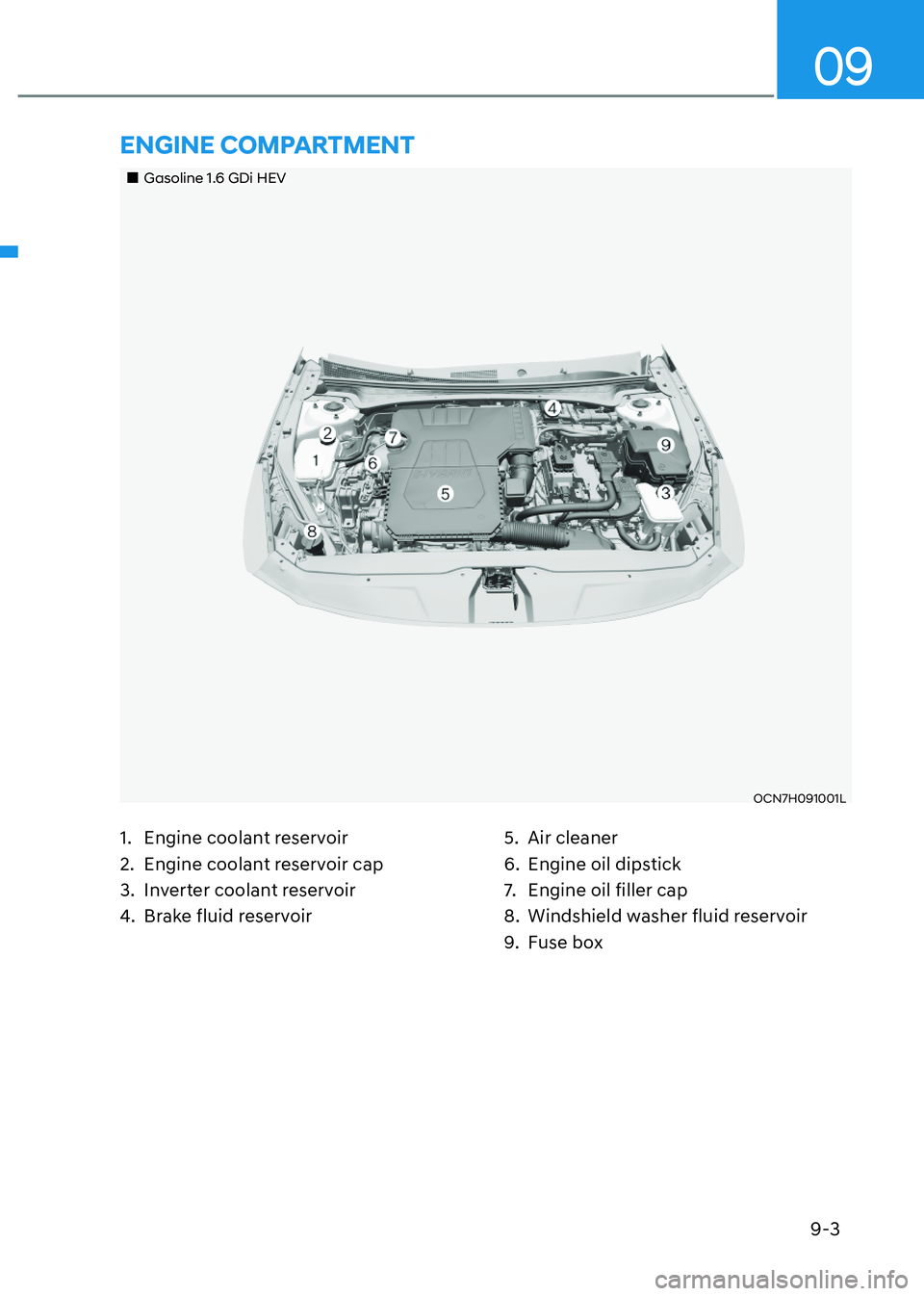
1. Engine coolant reservoir
2. Engine coolant reservoir cap
3. Inverter coolant reservoir
4. Brake fluid reservoir5. Air cleaner
6. Engine oil dipstick
7. Engine oil filler cap
8. Windshield washer fluid reservoir
9. Fuse box
ENGINE COMPARTMENT
Gasoline 1.6 GDi HEVGasoline 1.6 GDi HEV
OCN7H091001LOCN7H091001L
Page 457 of 529

Maintenance
9-8
Normal Maintenance Schedule (CONT.)R : Replace or change. I : Inspect and if necessary, adjust, correct, clean or replace.
MAINTENANCE INTERVALS
MAINTENANCE ITEM Km X 1000
8 16 24 32 40 48 56 64 72 80 88 96 104 112 120 128 136 144 152 160
Months 6 12 18 24 30 36 42 48 54 60 66 72 78 84 90 96 102 108 114 120
Vacuum hose I I I I I I I I I I I I I I I I I I I I
Engine Coolant/Inverter coolant * 5
First, replace 192,000 km or 120 months.
After that, replace every 48,000 km or 24 months *6
Brake pedal I I I I I I I I I I I I I I I I I I I I
Engine clutch actuator hoses and lines IIII I I I I I I
Brake hose/Lines and Connections IIII I I I I I I
*5 : When adding coolant, use only deionized water or soft water for your vehicle and never mix hard water in the coolant filled at the
factory.
*6 : For your convenience, it can be replaced prior to it’s interval when you do maintenance of other items.
Page 460 of 529
09
9-11
Engine Oil and Filter
The engine oil and filter should be
changed at the intervals specified in the
maintenance schedule.
Drive Belts
Inspect all drive belts for evidence
of cuts, cracks, excessive wear or oil
saturation and replace if necessary. Drive
belts should be checked periodically
for proper tension and adjusted as
necessary.
Information
When you are inspecting the belt, turn the engine off.
Fuel Lines, Fuel Hoses and Connections
Check the fuel lines, fuel hoses and
connections for leakage and damage.
Have an authorized HYUNDAI dealer
replace any damaged or leaking parts
immediately.
HSG (Hybrid Starter & Generator) Belt
The HSG belt should be changed at the
intervals specified in the maintenance schedule.
Fuel Filter
A clogged-up fuel filter may limit the
vehicle driving speed, damage the
emission system, and cause the hard
starting. When a considerable amount
of foreign substances are accumulated
in the fuel tank, the fuel filter should be
replaced.
Upon installing a new fuel filter, operate
the engine for several minutes, and
check the connections for any leakages.
Fuel filters should be installed by an
authorized HYUNDAI dealer.
Vapor Hose and Fuel Filler Cap
The vapor hose and fuel filler cap should
be inspected at those intervals specified
in the maintenance schedule. Make sure
a new vapor hose or fuel filler cap is
correctly replaced.
Air Cleaner Filter
A genuine HYUNDAI air cleaner filter
is recommended when the filter is
replaced.
Spark Plugs
Make sure to install new spark plugs of
the correct heat range.
Cooling System
Check cooling system components, such
as radiator, coolant reservoir, hoses and
connections for leakage and damage.
Replace any damaged parts.
EXPLANATION OF SCHEDULED MAINTENANCE ITEMS
Page 461 of 529

Maintenance
9-12
Engine Coolant/Inverter Coolant
The coolant should be changed at the
intervals specified in the maintenance schedule.
Dual Clutch Transmission Fluid
Dual clutch transmission fluid should
not be checked under normal usage conditions.
Have the Intelligent variable transmission
fluid is changed by an authorized
HYUNDAI dealer according to the
maintenance schedule.
Brake Hoses and Lines
Visually check for proper installation,
chafing, cracks, deterioration and any
leakage. Replace any deteriorated or
damaged parts immediately.
Brake Fluid
Check the brake fluid level in the brake
fluid reservoir. The level should be
between the MIN and the MAX marks
on the side of the reservoir. Use only
hydraulic brake fluid conforming to DOT
4 specification.
Brake Discs, Pads, Calipers and
Rotors
Check the pads for excessive wear, discs
for run out and wear, and calipers for
fluid leakage.
Suspension Mounting Bolts
Check the suspension connections for
looseness or damage. Retighten to the
specified torque.
Steering Gear Box, Linkage &
Boots/Lower Arm Ball Joint
With the vehicle stopped and the engine
off, check for excessive freeplay in the
steering wheel. Check the linkage for
bends or damage. Check the dust boots
and ball joints for deterioration, cracks, or damage.
Replace any damaged parts.
Drive Shafts and Boots
Check the drive shafts, boots and clamps
for cracks, deterioration, or damage.
Replace any damaged parts and, if
necessary, repack the grease.
Air Conditioning Refrigerant
Check the air conditioning lines and
connections for leakage and damage.
Page 462 of 529
09
9-13
Checking the Engine Oil Level
Engine oil is used for lubricating,
cooling, and operating various hydraulic
components in the engine. Engine oil
consumption while driving is normal,
and it is necessary to check and refill the
engine oil regularly. Also, check and refill
the oil level within the recommended
maintenance schedule to prevent
deterioration of oil performance.
Check the engine oil following the below
procedure.
1. Follow all of the oil manufacturer’s precautions.
2. Be sure the vehicle is on the level ground in P (Park) with the parking
brake set. If possible, block the wheels.
3. Turn the engine on and warm the engine up until the coolant
temperature reaches a constant
normal temperature.
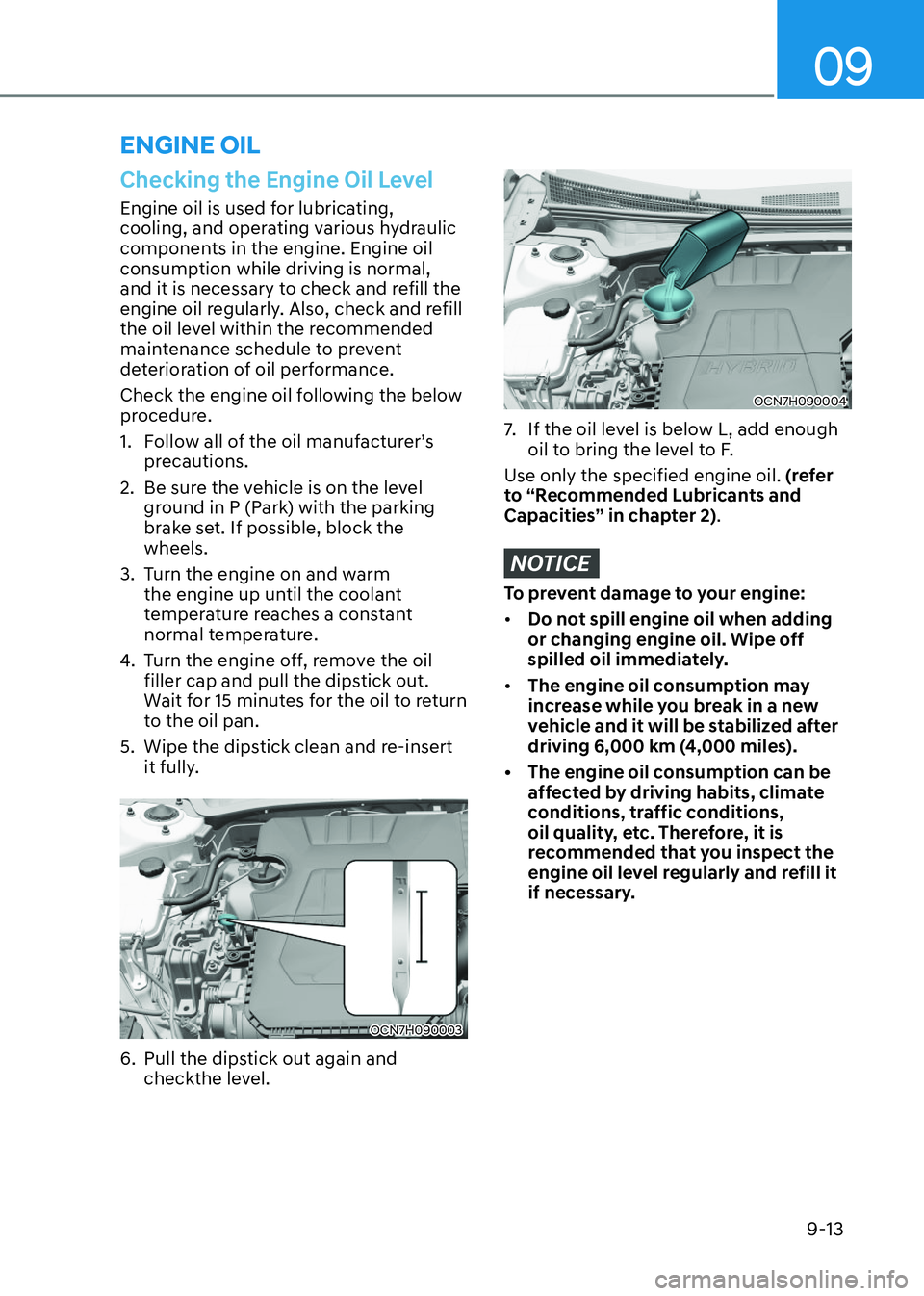
4. Turn the engine off, remove the oil filler cap and pull the dipstick out.
Wait for 15 minutes for the oil to return
to the oil pan.
5. Wipe the dipstick clean and re-insert it fully.
OCN7H090003OCN7H090003
6. Pull the dipstick out again and checkthe level.
OCN7H090004OCN7H090004
7. If the oil level is below L, add enough oil to bring the level to F.
Use only the specified engine oil. (refer
to “Recommended Lubricants and
Capacities” in chapter 2) .
NOTICE
To prevent damage to your engine:
Page 465 of 529

Maintenance
9-16
WARNING
OCN7H090007OCN7H090007
Engine coolant capEngine coolant cap
OCN7H090008OCN7H090008
Inverter coolant capInverter coolant cap
1. Check if the radiator cap label is straight In front.
2. Make sure that the tiny protrusions inside the radiator cap should be
securely interlocked.
WARNING
Never remove the engine
coolant cap and/or inverter
coolant cap or the drain plug
while the engine and radiator
are hot. Hot coolant and steam
may blow out under pressure,
causing serious injury. Turn the vehicle off and wait until
the engine cools down. Use extreme
care when removing the engine
coolant cap and/or inverter coolant
cap. Wrap a thick towel around it,
and turn it counterclockwise slowly
while the pressure is released from
the cooling system. When you are sure
all the pressure has been released,
using a thick towel, continue turning
counterclockwise to remove it.
Information
The engine coolant and/or inverter coolant level is influenced by the hybrid system
temperature. Before checking or refilling
the engine coolant and/or inverter coolant, turn the hybrid vehicle off.
WARNING
The electric motor for the
cooling fan may continue to
operate or start up when the
engine is not running and can
cause serious injury. Keep
hands, clothing and tools away
from the rotating fan blades of
the cooling fan.
Keep hands, clothing and tools away
from the rotating fan blades of the
cooling fan.
Always turn off the vehicle unless the
vehicle has to be inspected with the engine on. Be cautious as the cooling
fan may operate if the negative (-)
battery terminal is not disconnected.
Page 466 of 529

09
9-17
WARNING
Make sure the coolant cap is properly
closed after refilling coolant. Otherwise
the engine could be overheated while driving.
Engine compartment front viewEngine compartment front view
OOSH089010LOOSH089010L
1. Check if the coolant cap label is straight In front.
Engine compartment rear viewEngine compartment rear view
OCN7H090009OCN7H090009
2. Make sure that the tiny protrusions inside the coolant cap is securely
interlocked. Recommended engine coolant
Page 467 of 529

Maintenance
9-18
WARNING
The electric motor for the
cooling fan may continue to
operate or start up when the
engine is not running and can
cause serious injury. Keep
hands, clothing and tools away
from the rotating fan blades of
the cooling fan.
The electric motor for the cooling
fan is controlled by engine coolant
temperature, refrigerant pressure and
vehicle speed. As the engine coolant
temperature decreases, the electric
motor will automatically shut off. This is a normal condition.
Changing Engine Coolant
Have coolant changed by an authorized
HYUNDAI dealer according to the
Maintenance Schedule at the beginning
of this chapter.
WARNING
Do not use engine coolant or antifreeze
in the washer fluid reservoir.
Engine coolant can severely obscure
visibility when sprayed on the
windshield and may cause loss of
vehicle control resulting in an accident.
Engine coolant may also cause damage
to paint and body trim.
NOTICE
To prevent damage to engine parts, put
a thick towel around the radiator cap
before refilling the coolant to prevent
the coolant from overflowing into
engine parts, such as the alternator.