coolant HYUNDAI ELANTRA LIMITED 2017 Owner's Manual
[x] Cancel search | Manufacturer: HYUNDAI, Model Year: 2017, Model line: ELANTRA LIMITED, Model: HYUNDAI ELANTRA LIMITED 2017Pages: 586, PDF Size: 15.29 MB
Page 492 of 586
7-32
Maintenance
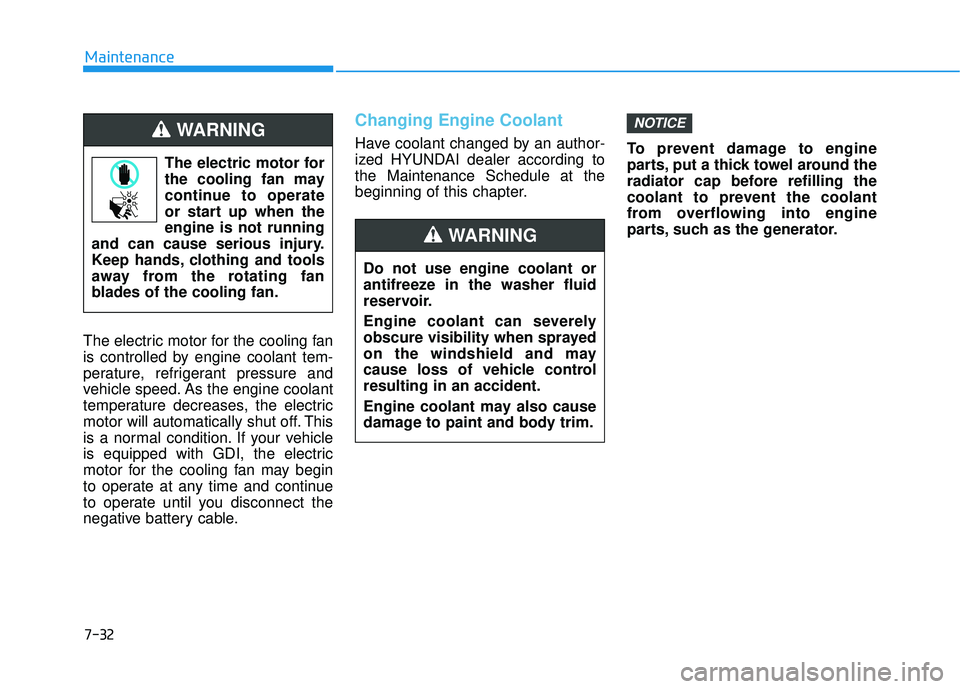
The electric motor for the cooling fan
is controlled by engine coolant tem-
perature, refrigerant pressure and
vehicle speed. As the engine coolant
temperature decreases, the electric
motor will automatically shut off. This
is a normal condition. If your vehicle
is equipped with GDI, the electric
motor for the cooling fan may begin
to operate at any time and continue
to operate until you disconnect the
negative battery cable.
Changing Engine Coolant
Have coolant changed by an author-
ized HYUNDAI dealer according to
the Maintenance Schedule at the
beginning of this chapter. To prevent damage to engine
parts, put a thick towel around the
radiator cap before refilling the
coolant to prevent the coolant
from overflowing into engine
parts, such as the generator.
NOTICE
Do not use engine coolant or
antifreeze in the washer fluid
reservoir.
Engine coolant can severely
obscure visibility when sprayed
on the windshield and may
cause loss of vehicle control
resulting in an accident.
Engine coolant may also cause
damage to paint and body trim.
WARNING
The electric motor for
the cooling fan may
continue to operate
or start up when the
engine is not running
and can cause serious injury.
Keep hands, clothing and tools
away from the rotating fan
blades of the cooling fan.
WARNING
Page 494 of 586
7-34
Maintenance
W
WA
AS
SH
H E
ER
R
F
F L
LU
U I
ID
D
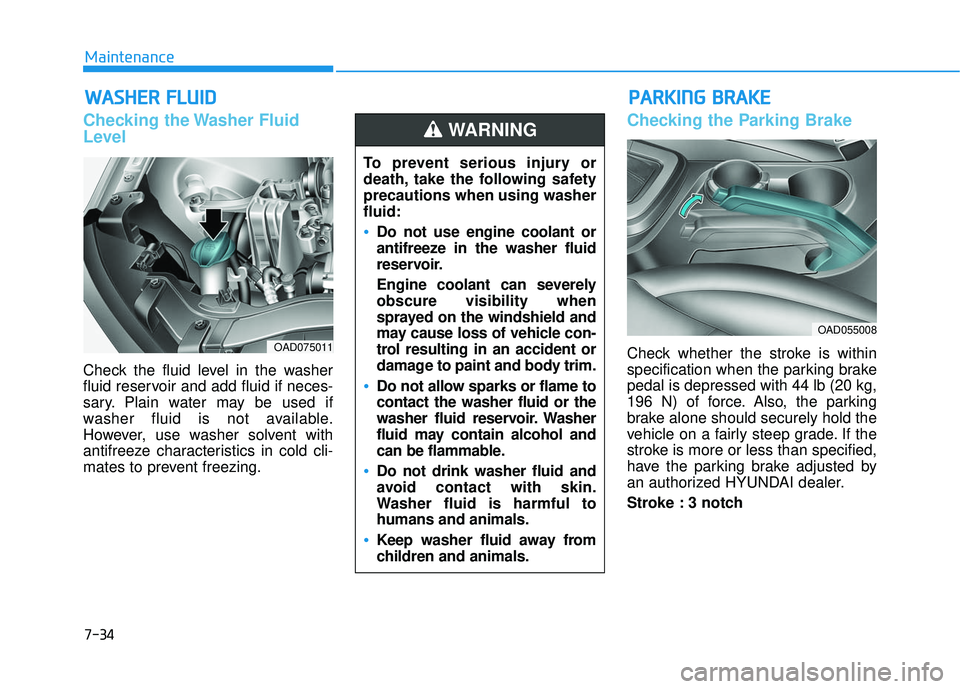
Checking the Washer Fluid
Level
Check the fluid level in the washer
fluid reservoir and add fluid if neces-
sary. Plain water may be used if
washer fluid is not available.
However, use washer solvent with
antifreeze characteristics in cold cli-
mates to prevent freezing.
Checking the Parking Brake
Check whether the stroke is within
specification when the parking brake
pedal is depressed with 44 lb (20 kg,
196 N) of force. Also, the parking
brake alone should securely hold the
vehicle on a fairly steep grade. If the
stroke is more or less than specified,
have the parking brake adjusted by
an authorized HYUNDAI dealer.
Stroke : 3 notchOAD075011
OAD055008
P
P A
A R
RK
K I
IN
N G
G
B
B R
RA
A K
KE
E
To prevent serious injury or
death, take the following safety
precautions when using washer
fluid:
Do not use engine coolant or
antifreeze in the washer fluid
reservoir.
Engine coolant can severely
obscure visibility when
sprayed on the windshield and
may cause loss of vehicle con-
trol resulting in an accident or
damage to paint and body trim.
Do not allow sparks or flame to
contact the washer fluid or the
washer fluid reservoir. Washer
fluid may contain alcohol and
can be flammable.
Do not drink washer fluid and
avoid contact with skin.
Washer fluid is harmful to
humans and animals.
Keep washer fluid away from
children and animals.
WARNING
Page 514 of 586
7-54
Maintenance
Tire Terminology and
Definitions
Air Pressure
The amount of air inside the tire
pressing outward on the tire. Air
pressure is expressed in pounds per
square inch (psi) or kilopascal (kPa).
Accessory Weight
This means the combined weight of
optional accessories. Some exam-
ples of optional accessories are
automatic transmission, power
seats, and air conditioning.
Aspect Ratio
The relationship of a tire's height to
its width.
Belt
A rubber coated layer of cords that is
located between the plies and the
tread. Cords may be made from steel
or other reinforcing materials.
Bead
The tire bead contains steel wires
wrapped by steel cords that hold the
tire onto the rim.
Bias Ply Tire
A pneumatic tire in which the plies
are laid at alternate angles less than
90 degrees to the centerline of the
tread.
Cold Tire Pressure
The amount of air pressure in a tire,
measured in pounds per square inch
(psi) or kilopascals (kPa) before a tire
has built up heat from driving.
Curb Weight
This means the weight of a motor
vehicle with standard and optional
equipment including the maximum
capacity of fuel, oil and coolant, but
without passengers and cargo.
DOT Markings
A code molded into the sidewall of a
tire signifying that the tire is in com-
pliance with the U.S. Department of
Transportation motor vehicle safety
standards. The DOT code includes
the Tire Identification Number (TIN),
an alphanumeric designator which
can also identify the tire manufactur-
er, production plant, brand and date
of production.
Page 557 of 586
7-97
7
Maintenance
Canister
Fuel vapors generated inside the fuel
tank are absorbed and stored in the
onboard canister. When the engine is
running, the fuel vapors absorbed in
the canister are drawn into the surge
tank through the purge control sole-
noid valve.
Purge Control Solenoid Valve(PCSV)
The purge control solenoid valve is
controlled by the Engine Control
Module (ECM); when the engine
coolant temperature is low during
idling, the PCSV closes so that evap-
orated fuel is not taken into the
engine. After the engine warms-up
during ordinary driving, the PCSV
opens to introduce evaporated fuel to
the engine.
3. Exhaust Emission Control System
The Exhaust Emission Control
System is a highly effective system
which controls exhaust emissions
while maintaining good vehicle per-
formance.
When the engine starts or fails to
start, excessive attempts to restart
the engine may cause damage to the
emission system.
Engine exhaust (carbon monox-
ide) precautions
Carbon monoxide can be present
with other exhaust fumes. If you
smell exhaust fumes of any kind in
your vehicle, drive with all the win-
dows fully open. Have your vehicle
checked and repaired immediately.
Engine exhaust gases contain
carbon monoxide (CO). Though
colorless and odorless, it is
dangerous and could be lethal if
inhaled. Follow the instructions
on this page to avoid CO poi-
soning.
WARNING
Page 568 of 586
8-8
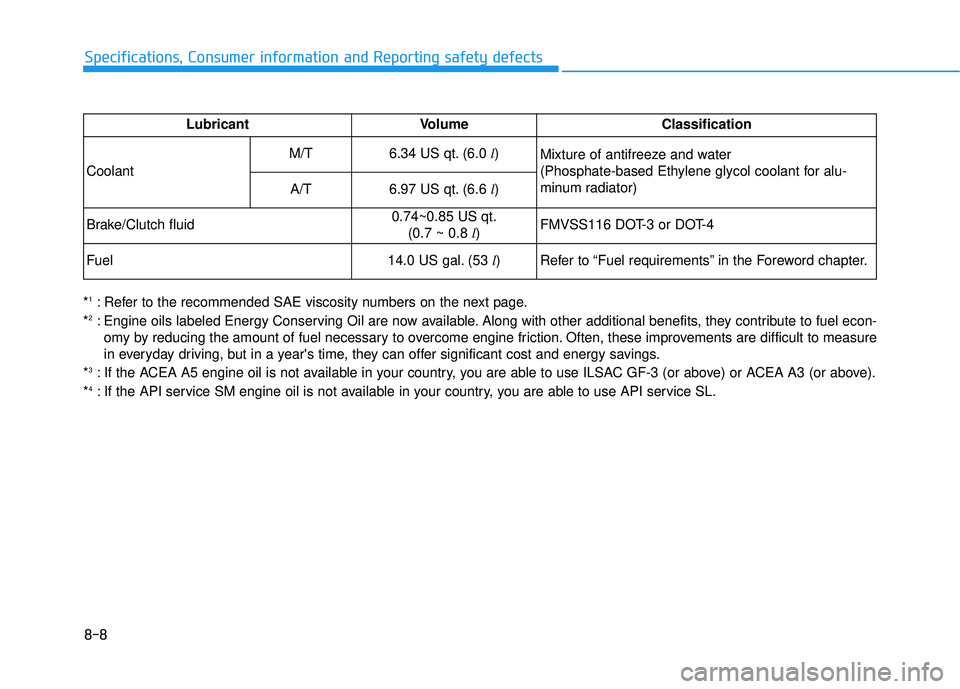
Specifications, Consumer information and Reporting safety defects
*1: Refer to the recommended SAE viscosity numbers on the next page.
*2: Engine oils labeled Energy Conserving Oil are now available. Along with other additional benefits, they contribute to fuel econ -
omy by reducing the amount of fuel necessary to overcome engine friction. Often, these improvements are difficult to measure
in everyday driving, but in a year's time, they can offer significant cost and energy savings.
*
3: If the ACEA A5 engine oil is not available in your country, you are able to use ILSAC GF-3 (or above) or ACEA A3 (or above).
*4: If the API service SM engine oil is not available in your country, you are able to use API service SL. Lubricant
Volume
Classification
Coolant M/T
6.34 US qt. (6.0
l)
Mixture of antifreeze and water
(Phosphate-based Ethylene glycol coolant for alu-
minum radiator)
A/T
6.97 US qt. (6.6 l)
Brake/Clutch fluid
0.74~0.85 US qt. (0.7 ~ 0.8 l) FMVSS116 DOT-3 or DOT-4
Fuel14.0 US gal. (53 l)Refer to “Fuel requirements” in the Foreword chapter.
Page 577 of 586
I-4
Bulb replacementFront parking lamp .....................................................7-73
Front turn signal lamp ................................................7-73
Headlamp....................................................................7-73\
High mounted stop lamp ............................................7-86
Interior light bulb .......................................................7-88
License plate light bulb ..............................................7-87
Rear combination light bulb .......................................7-82
Side marker lamp .......................................................7-73
Side repeater lamp ......................................................7-82
Bulb wattage .....................................................................8-3\
Button start/stop, see engine start/stop button ..................5-9
Capacities (Lubricants) .....................................................3-6
Care Exterior care ...............................................................7-89
Interior care ................................................................7-95
Tire care ......................................................................7-\
44
Cartridge type fuse..........................................................7-65
Center console storage ..................................................3-150
Central door lock switch .................................................3-16
Certification label ...........................................................8-10
Chains Tire chains ..................................................................5-96
Changing a Tire with TPMS ...........................................6-14
Checking tire inflation pressure ......................................7-46 Child restraint system (CRS) ..........................................2-35
Booster seats...............................................................2-38
Children always in the rear ........................................2-35
Forward-facing child restraint system........................2-38
Installing a child restraint system (CRS) ...................2-38
Lower anchors and tether for children (LATCH system) .....................................................2-38
Rearward-facing child restraint system......................2-37
Securing a child restraint seat with "Tether Anchor" system......................................................................2-\
42
Securing a child restraint system with the LATCH anchors system ........................................................2-41
Securing a child restraint with a lap/shoulder belt.....2-43
Selecting a child restraint system (CRS) ...................2-36
Child-protector rear door locks.......................................3-19
Climate control air filter .................................................7-37
Clock ........................................................................\
.....3-156
Clothes hanger ..............................................................3-157
Combined instrument, see instrument cluster ................3-61
Compact spare tire replacement .....................................7-49
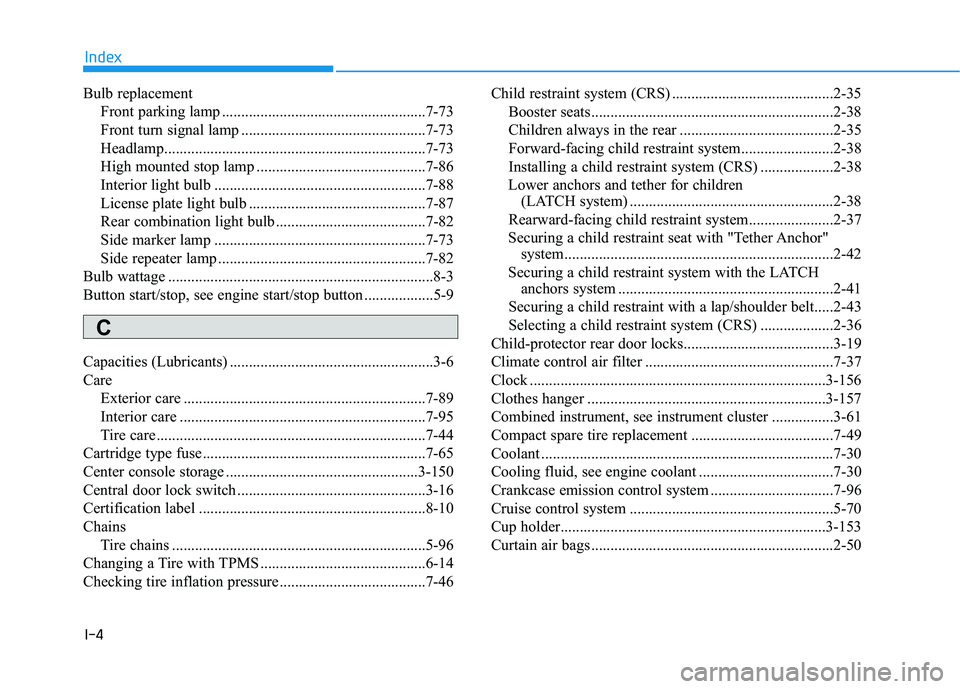
Coolant ........................................................................\
....7-30
Cooling fluid, see engine coolant ...................................7-30
Crankcase emission control system ................................7-96
Cruise control system .....................................................5-70
Cup holder.....................................................................3-1\
53
Curtain air bags ...............................................................2-50
Index
C
Page 578 of 586
I-5
Dashboard illumination, see instrument panel illumination..................................................................3-63
Dashboard, see instrument cluster ..................................3-61
Day/night rearview mirror ..............................................3-25
Daytime running light (DRL) .......................................3-108
Defogging (Windshield) ...............................................3-145
Defroster (Rear window) ..............................................3-122
Defrosting (Windshield) ...............................................3-145
Dimensions .......................................................................8\
-2
Display illumination, see instrument panel illumination..................................................................3-63
Displays, see instrument cluster .....................................3-61
Door locks .......................................................................3\
-14 Auto door lock/unlock features ..................................3-17
Central door lock switch ............................................3-16
Child-protector rear door locks ..................................3-18
Door lock button ........................................................3-15
Remote key.................................................................3-14
Smart key....................................................................3-15\
Drinks holders, see cup holders ....................................3-153
Drive mode integrated control system ............................5-39
Driver assist system Rear view camera .....................................................3-121
Driver position memory system .....................................3-20
Driver's air bag................................................................2-48
Driver's knee airbag ........................................................2-48 Driving at night ...............................................................5-93
Driving in flooded areas .................................................5-94
Driving in the rain...........................................................5-94
Dymamic bending light, see AFLS
(Adaptive Front Lighting System).............................3-114
Electric chromic mirror (ECM) with HomeLink
®system,
compass and Blue Link®.............................................3-25
Electric power steering (EPS).........................................3-22
Electronic stability control (ESC)...................................5-33
Emergency towing ..........................................................6-34
Emission control system .................................................7-96 Crankcase emission control system ...........................7-96
Evaporative emission control System includinding onboard refueling vapor recovery (ORVR) ............7-96
Exhaust emission control system ...............................7-97
Engine compartment..................................................2-6, 7-3
Engine compartment panel fuse replacement .................7-63
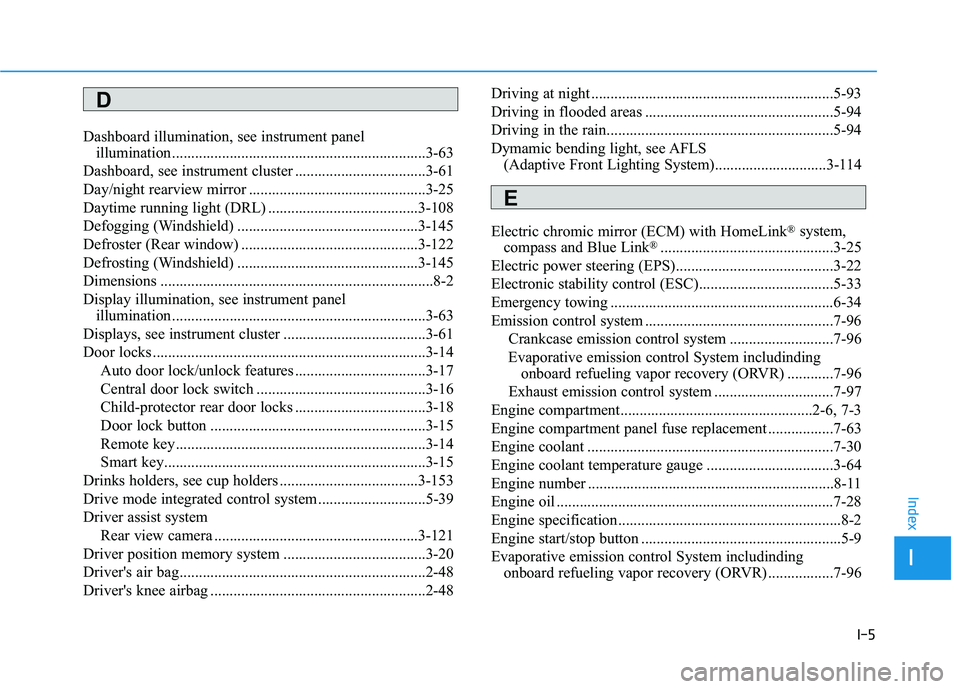
Engine coolant ................................................................7-30
Engine coolant temperature gauge .................................3-64
Engine number ................................................................8-11
Engine oil ........................................................................\
7-28
Engine specification..........................................................8-2
Engine start/stop button ....................................................5-9
Evaporative emission control System includinding onboard refueling vapor recovery (ORVR) .................7-96
I
Index
D
E