weight HYUNDAI ELANTRA LIMITED 2017 Owner's Manual
[x] Cancel search | Manufacturer: HYUNDAI, Model Year: 2017, Model line: ELANTRA LIMITED, Model: HYUNDAI ELANTRA LIMITED 2017Pages: 586, PDF Size: 15.29 MB
Page 515 of 586
7-55
7
Maintenance
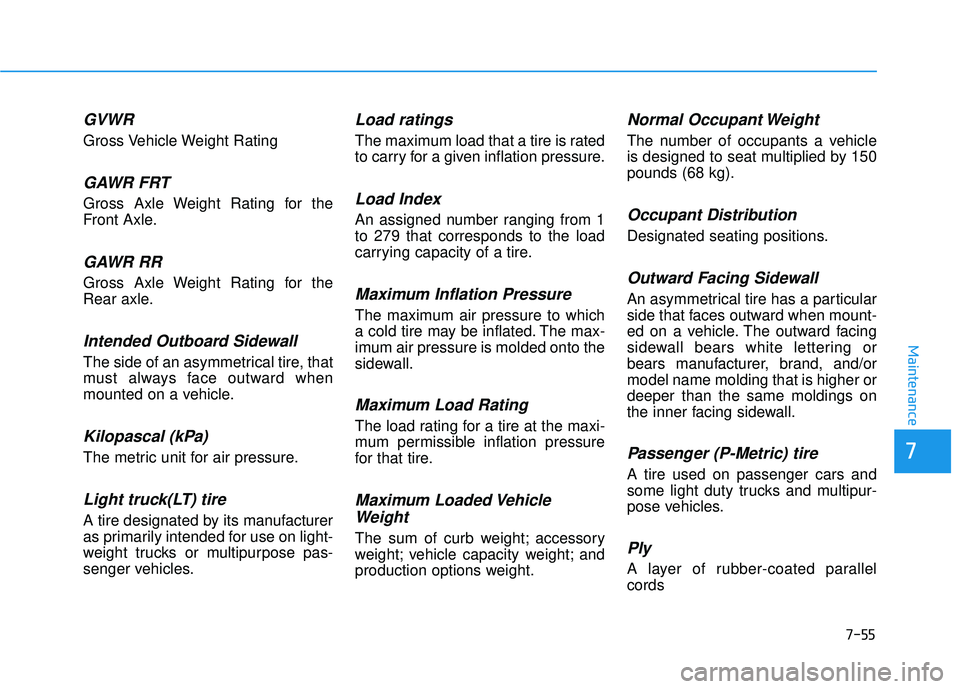
GVWR
Gross Vehicle Weight Rating
GAWR FRT
Gross Axle Weight Rating for the
Front Axle.
GAWR RR
Gross Axle Weight Rating for the
Rear axle.
Intended Outboard Sidewall
The side of an asymmetrical tire, that
must always face outward when
mounted on a vehicle.
Kilopascal (kPa)
The metric unit for air pressure.
Light truck(LT) tire
A tire designated by its manufacturer
as primarily intended for use on light-
weight trucks or multipurpose pas-
senger vehicles.
Load ratings
The maximum load that a tire is rated
to carry for a given inflation pressure.
Load Index
An assigned number ranging from 1
to 279 that corresponds to the load
carrying capacity of a tire.
Maximum Inflation Pressure
The maximum air pressure to which
a cold tire may be inflated. The max-
imum air pressure is molded onto the
sidewall.
Maximum Load Rating
The load rating for a tire at the maxi-
mum permissible inflation pressure
for that tire.
Maximum Loaded VehicleWeight
The sum of curb weight; accessory
weight; vehicle capacity weight; and
production options weight.
Normal Occupant Weight
The number of occupants a vehicle
is designed to seat multiplied by 150
pounds (68 kg).
Occupant Distribution
Designated seating positions.
Outward Facing Sidewall
An asymmetrical tire has a particular
side that faces outward when mount-
ed on a vehicle. The outward facing
sidewall bears white lettering or
bears manufacturer, brand, and/or
model name molding that is higher or
deeper than the same moldings on
the inner facing sidewall.
Passenger (P-Metric) tire
A tire used on passenger cars and
some light duty trucks and multipur-
pose vehicles.
Ply
A layer of rubber-coated parallel
cords
Page 516 of 586
7-56
Maintenance
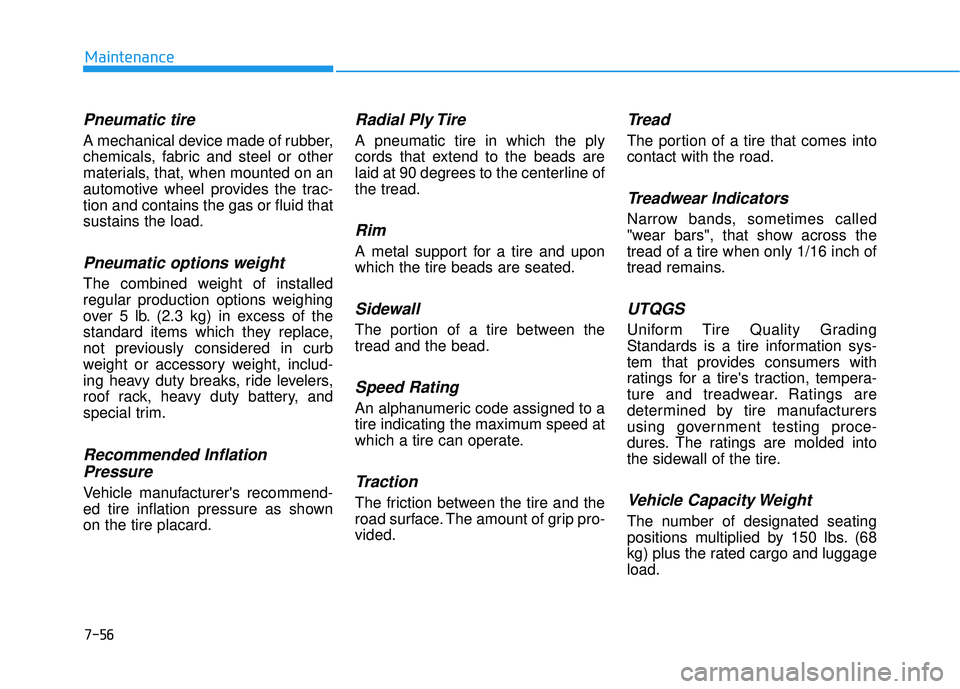
Pneumatic tire
A mechanical device made of rubber,
chemicals, fabric and steel or other
materials, that, when mounted on an
automotive wheel provides the trac-
tion and contains the gas or fluid that
sustains the load.
Pneumatic options weight
The combined weight of installed
regular production options weighing
over 5 lb. (2.3 kg) in excess of the
standard items which they replace,
not previously considered in curb
weight or accessory weight, includ-
ing heavy duty breaks, ride levelers,
roof rack, heavy duty battery, and
special trim.
Recommended InflationPressure
Vehicle manufacturer's recommend-
ed tire inflation pressure as shown
on the tire placard.
Radial Ply Tire
A pneumatic tire in which the ply
cords that extend to the beads are
laid at 90 degrees to the centerline of
the tread.
Rim
A metal support for a tire and upon
which the tire beads are seated.
Sidewall
The portion of a tire between the
tread and the bead.
Speed Rating
An alphanumeric code assigned to a
tire indicating the maximum speed at
which a tire can operate.
Traction
The friction between the tire and the
road surface. The amount of grip pro-
vided.
Tread
The portion of a tire that comes into
contact with the road.
Treadwear Indicators
Narrow bands, sometimes called
"wear bars", that show across the
tread of a tire when only 1/16 inch of
tread remains.
UTQGS
Uniform Tire Quality Grading
Standards is a tire information sys-
tem that provides consumers with
ratings for a tire's traction, tempera-
ture and treadwear. Ratings are
determined by tire manufacturers
using government testing proce-
dures. The ratings are molded into
the sidewall of the tire.
Vehicle Capacity Weight
The number of designated seating
positions multiplied by 150 lbs. (68
kg) plus the rated cargo and luggage
load.
Page 517 of 586
7-57
7
Maintenance
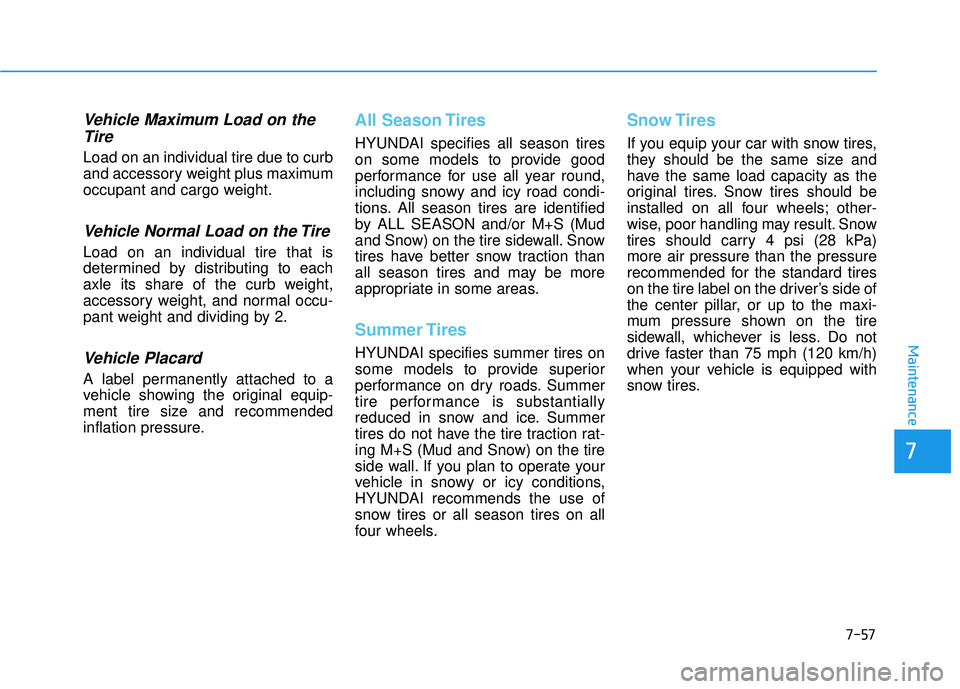
Vehicle Maximum Load on theTire
Load on an individual tire due to curb
and accessory weight plus maximum
occupant and cargo weight.
Vehicle Normal Load on the Tire
Load on an individual tire that is
determined by distributing to each
axle its share of the curb weight,
accessory weight, and normal occu-
pant weight and dividing by 2.
Vehicle Placard
A label permanently attached to a
vehicle showing the original equip-
ment tire size and recommended
inflation pressure.
All Season Tires
HYUNDAI specifies all season tires
on some models to provide good
performance for use all year round,
including snowy and icy road condi-
tions. All season tires are identified
by ALL SEASON and/or M+S (Mud
and Snow) on the tire sidewall. Snow
tires have better snow traction than
all season tires and may be more
appropriate in some areas.
Summer Tires
HYUNDAI specifies summer tires on
some models to provide superior
performance on dry roads. Summer
tire performance is substantially
reduced in snow and ice. Summer
tires do not have the tire traction rat-
ing M+S (Mud and Snow) on the tire
side wall. If you plan to operate your
vehicle in snowy or icy conditions,
HYUNDAI recommends the use of
snow tires or all season tires on all
four wheels.
Snow Tires
If you equip your car with snow tires,
they should be the same size and
have the same load capacity as the
original tires. Snow tires should be
installed on all four wheels; other-
wise, poor handling may result. Snow
tires should carry 4 psi (28 kPa)
more air pressure than the pressure
recommended for the standard tires
on the tire label on the driver’s side of
the center pillar, or up to the maxi-
mum pressure shown on the tire
sidewall, whichever is less. Do not
drive faster than 75 mph (120 km/h)
when your vehicle is equipped with
snow tires.
Page 561 of 586
888
Specifications & Consumer information
8
Specifications, Consumer information and Reporting safety defects
8
Dimensions ..............................................................8-2
Engine ......................................................................8-\
2
Bulb Wattage ..........................................................8-3
Tires and Wheels ...................................................8-5
Volume and Weight ................................................8-6
Air Conditioning System........................................8-6
Recommended Lubricants and Capacities ..........8-7
Recommended SAE Viscosity Number .........................8-9
Vehicle Identification Number (VIN) .................8-10
Vehicle Certification Label .................................8-10
Tire Specification and Pressure Label .............8-11
Engine Number .....................................................8-11
Refrigerant Label .................................................8-11
Consumer Information .........................................8-12
Reporting Safety Defects ...................................8-13
Page 566 of 586
8-6
Specifications, Consumer information and Reporting safety defects
V
VO
O L
LU
U M
M E
E
A
A N
N D
D
W
W E
EI
IG
G H
H T
T
A
A I
IR
R
C
C O
O N
ND
DI
IT
T I
IO
O N
NI
IN
N G
G
S
S Y
Y S
ST
T E
EM
M
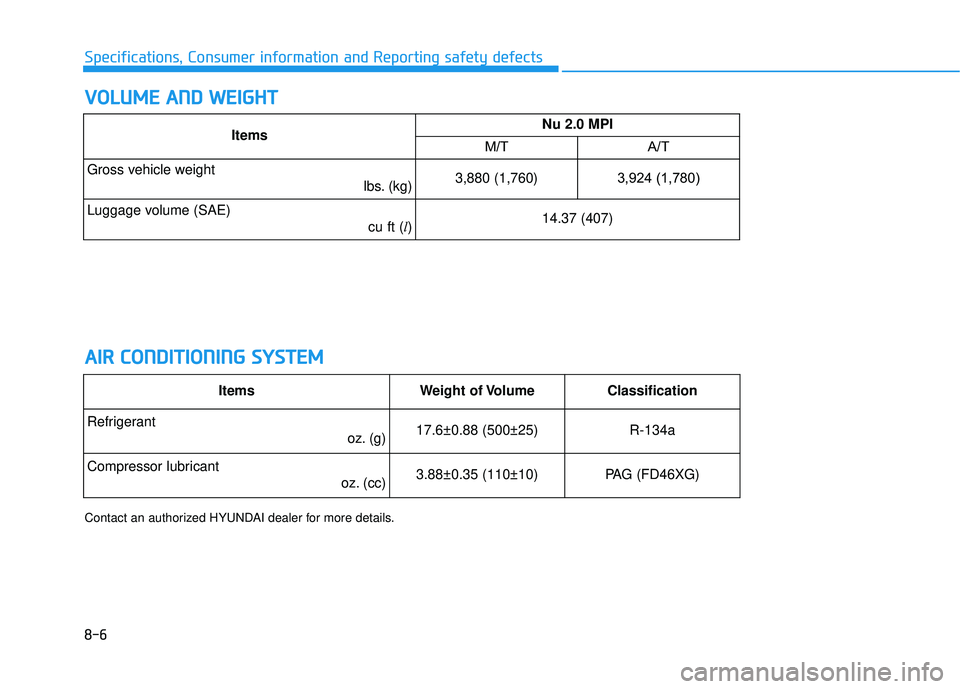
Contact an authorized HYUNDAI dealer for more details.
ItemsNu 2.0 MPI
M/TA/T
Gross vehicle weight
lbs. (kg)3,880 (1,760)3,924 (1,780)
Luggage volume (SAE) cu ft (l)14.37 (407)
ItemsWeight of VolumeClassification
Refrigerant oz. (g) 17.6±0.88 (500±25)R-134a
Compressor lubricantoz. (cc) 3.88±0.35 (110±10)PAG (FD46XG)
Page 585 of 586
I-12
Tires and wheels .............................................................7-44All season tires ...........................................................7-57
Checking tire inflation pressure .................................7-46
Compact spare tire replacement .................................7-49
Low aspect ratio tires .................................................7-58
Radial-ply tires ...........................................................7-58
Recommended cold tire inflation pressures ...............7-45
Snow tires ...................................................................5-57
Summer tires ..............................................................7-57
Tire care ......................................................................7-\
44
Tire maintenance ........................................................7-50
Tire replacement .........................................................7-48
Tire rotation ................................................................7-47
Tire sidewall labeling .................................................7-50
Tire terminology and definitions ................................7-54
Tire traction ................................................................7-49
Wheel alignment and tire balance ..............................7-48
Wheel replacement .....................................................7-49
Towing ........................................................................\
....6-32
Trailer towing................................................................5-105
Transmission shift indicator............................................3-67
Trip computer Conventional cluster...................................................3-98
Supervision cluster ...................................................3-102
Trunk ........................................................................\
.......3-52 Emergency trunk safety release .................................3-54
Smart trunk .................................................................3-55 Trunk room lamp ..........................................................3-116
Turn signals ...................................................................3-112
USB charger ..................................................................3-156
User settings mode..........................................................3-93
Vanity mirror lamp ........................................................3-117
Vehicle break-in process ...................................................F-9
Vehicle certification label ...............................................8-10
Vehicle data collection and event data recorders ...........F-10
Vehicle identification number (VIN) ..............................8-10
Vehicle load limit ..........................................................5-100
Tire loading information label..................................5-101
Vehicle modifications .......................................................F-9
Vehicle stability management (VSM).............................5-36
Volume and weight ...........................................................8-6
Index
U
V