ECO mode HYUNDAI ELANTRA LIMITED 2017 Workshop Manual
[x] Cancel search | Manufacturer: HYUNDAI, Model Year: 2017, Model line: ELANTRA LIMITED, Model: HYUNDAI ELANTRA LIMITED 2017Pages: 586, PDF Size: 15.29 MB
Page 351 of 586
5-31
Driving your vehicle
5
ABS is an electronic braking system
that helps prevent a braking skid.
ABS allows the driver to steer and
brake at the same time.
Using ABS
To obtain the maximum benefit from
your ABS in an emergency situation,
do not attempt to modulate your
brake pressure and do not try to
pump your brakes. Depress your
brake pedal as hard as possible.
When you apply your brakes under
conditions which may lock the
wheels, you may hear sounds from
the brakes, or feel a corresponding
sensation in the brake pedal. This is
normal and it means your ABS is
active.
ABS does not reduce the time or dis-
tance it takes to stop the vehicle.
Always maintain a safe distance from
the vehicle in front of you.
ABS will not prevent a skid that
results from sudden changes in
direction, such as trying to take a
corner too fast or making a sudden
lane change. Always drive at a safe
speed for the road and weather con-
ditions.ABS cannot prevent a loss of stabili-
ty. Always steer moderately when
braking hard. Severe or sharp steer-
ing wheel movement can still cause
your vehicle to veer into oncoming
traffic or off the road.
On loose or uneven road surfaces,
operation of the anti-lock brake sys-
tem may result in a longer stopping
distance than for vehicles equipped
with a conventional brake system.
The ABS warning light ( ) will stay
on for several seconds after the igni-
tion switch is in the ON position.
During that time, the ABS will go
through self-diagnosis and the light
will go off if everything is normal. If
the light stays on, you may have a
problem with your ABS. Contact an
authorized HYUNDAI dealer as soon
as possible(Continued)
Drive your vehicle at reduced
speeds during the following
conditions:
Rough, gravel or snow-cov-
ered roads.
On roads where the road sur-
face is pitted or has different
surface height.
Tire chains are installed on
your vehicle.
The safety features of an ABS
or ESC equipped vehicle should
not be tested by high speed
driving or cornering. This could
endanger the safety of yourself
or others.
Page 359 of 586
5-39
Driving your vehicle
5
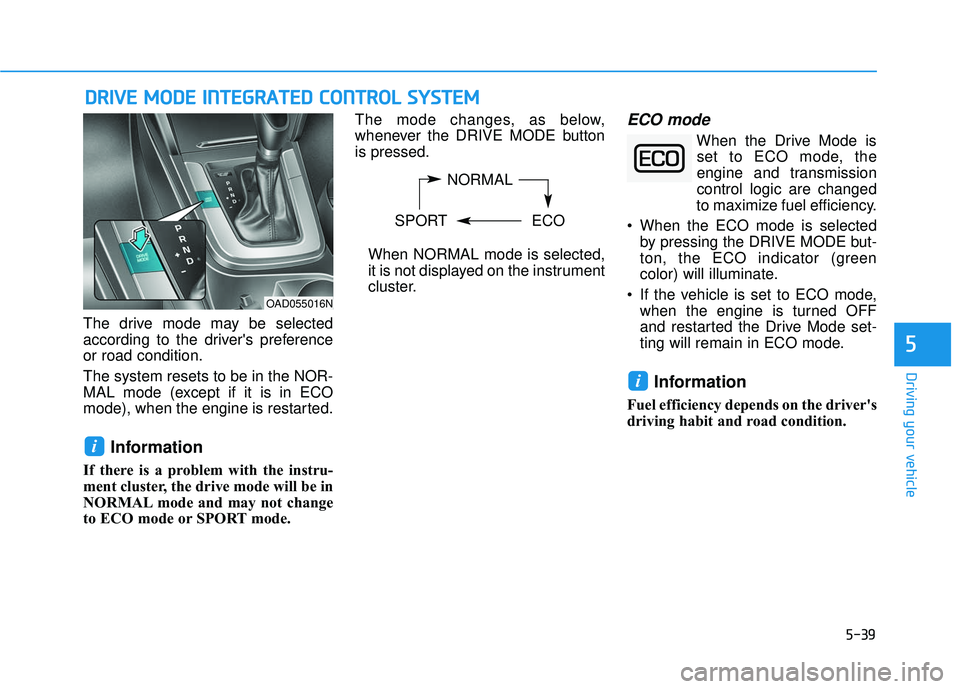
The drive mode may be selected
according to the driver's preference
or road condition.
The system resets to be in the NOR-
MAL mode (except if it is in ECO
mode), when the engine is restarted.
Information
If there is a problem with the instru-
ment cluster, the drive mode will be in
NORMAL mode and may not change
to ECO mode or SPORT mode. The mode changes, as below,
whenever the DRIVE MODE button
is pressed.
When NORMAL mode is selected,
it is not displayed on the instrument
cluster.
ECO mode
When the Drive Mode is set to ECO mode, the
engine and transmission
control logic are changed
to maximize fuel efficiency.
When the ECO mode is selected by pressing the DRIVE MODE but-
ton, the ECO indicator (green
color) will illuminate.
If the vehicle is set to ECO mode, when the engine is turned OFF
and restarted the Drive Mode set-
ting will remain in ECO mode.
Information
Fuel efficiency depends on the driver's
driving habit and road condition.
i
i
D DR
RI
IV
V E
E
M
M O
OD
DE
E
I
IN
N T
TE
EG
G R
RA
A T
TE
ED
D
C
C O
O N
NT
TR
R O
O L
L
S
S Y
Y S
ST
T E
EM
M
NORMAL
SPORT ECO
OAD055016N
Page 360 of 586
5-40
Driving your vehicle
When the ECO mode is activated:
The acceleration response may be slightly reduced if the accelerator
pedal is depressed moderately.
The air conditioner performance may be limited.
The shift pattern of the automatic transmission may change.
The engine noise may get louder.
The above situations are normal
conditions when the ECO mode is
activated to improve fuel efficiency. Limitation of the ECO mode oper-
ation:
If the following conditions occur while
the ECO mode is operating, the sys-
tem operation is limited even though
there is no change in the ECO indi-
cator.
When the coolant temperature is
low:
The system will be limited until
engine performance becomes nor-
mal.
When driving up a hill: The system will be limited to gain
power when driving uphill because
engine torque is restricted.
When driving the vehicle with the automatic transmission gear shift
lever in manual shift mode.
The system will be limited accord-
ing to the shift location.
SPORT mode
SPORT mode manages
the driving dynamics by
automatically adjusting the
steering effort, and the
engine and transmission control
logic for enhanced driver perform-
ance.
When SPORT mode is selected by pressing the DRIVE MODE button,
the SPORT indicator (orange
color) will illuminate.
Whenever the engine is restarted, the Drive Mode will revert back to
NORMAL mode. If SPORT mode is
desired, re-select SPORT mode
from the DRIVE MODE button.
When SPORT mode is activated: - The engine rpm will tend toremain raised over a certain
length of time even after releas-
ing the accelerator
- Upshifts are delayed when accel- erating
Information
In SPORT mode, the fuel efficiency
may decrease.
i
Page 397 of 586
5-77
Driving your vehicle
5
To Convert to Cruise Control
Mode
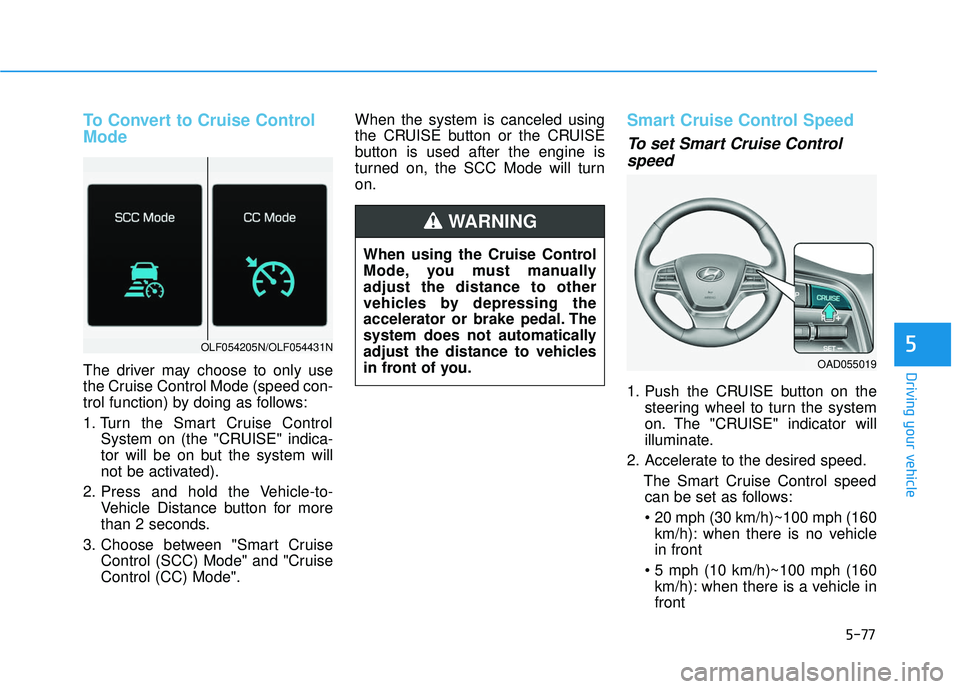
The driver may choose to only use
the Cruise Control Mode (speed con-
trol function) by doing as follows:
1. Turn the Smart Cruise ControlSystem on (the "CRUISE" indica-
tor will be on but the system will
not be activated).
2. Press and hold the Vehicle-to- Vehicle Distance button for more
than 2 seconds.
3. Choose between "Smart Cruise Control (SCC) Mode" and "Cruise
Control (CC) Mode". When the system is canceled using
the CRUISE button or the CRUISE
button is used after the engine is
turned on, the SCC Mode will turn
on.
Smart Cruise Control Speed
To set Smart Cruise Control
speed
1. Push the CRUISE button on the
steering wheel to turn the system
on. The "CRUISE" indicator will
illuminate.
2. Accelerate to the desired speed. The Smart Cruise Control speedcan be set as follows:
km/h): when there is no vehicle
in front
km/h): when there is a vehicle in
front
OLF054205N/OLF054431N
When using the Cruise Control
Mode, you must manually
adjust the distance to other
vehicles by depressing the
accelerator or brake pedal. The
system does not automatically
adjust the distance to vehicles
in front of you.
WARNING
OAD055019
Page 517 of 586
7-57
7
Maintenance
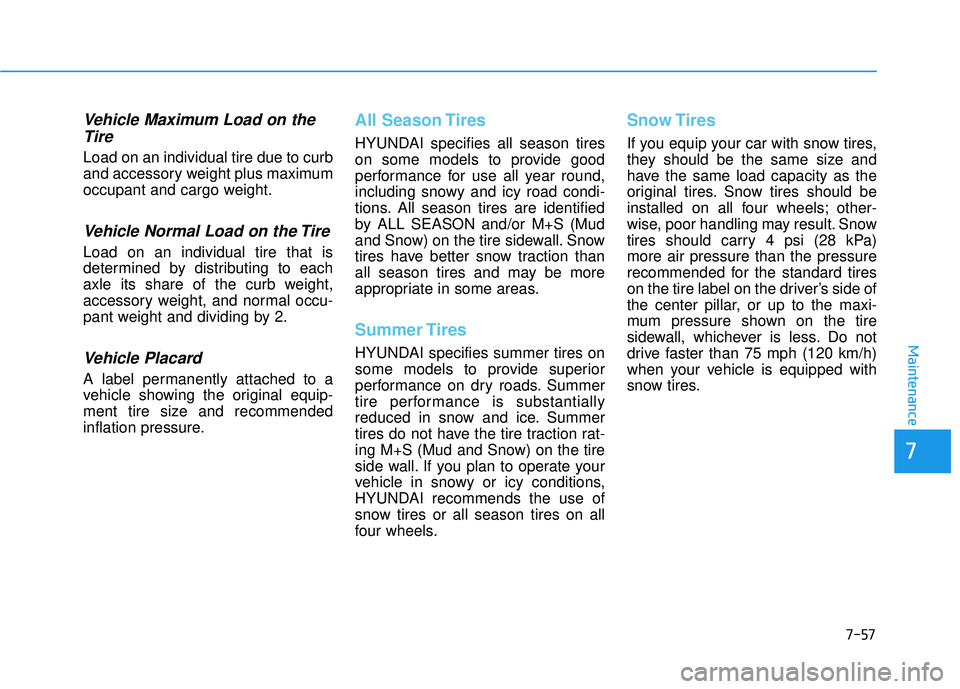
Vehicle Maximum Load on theTire
Load on an individual tire due to curb
and accessory weight plus maximum
occupant and cargo weight.
Vehicle Normal Load on the Tire
Load on an individual tire that is
determined by distributing to each
axle its share of the curb weight,
accessory weight, and normal occu-
pant weight and dividing by 2.
Vehicle Placard
A label permanently attached to a
vehicle showing the original equip-
ment tire size and recommended
inflation pressure.
All Season Tires
HYUNDAI specifies all season tires
on some models to provide good
performance for use all year round,
including snowy and icy road condi-
tions. All season tires are identified
by ALL SEASON and/or M+S (Mud
and Snow) on the tire sidewall. Snow
tires have better snow traction than
all season tires and may be more
appropriate in some areas.
Summer Tires
HYUNDAI specifies summer tires on
some models to provide superior
performance on dry roads. Summer
tire performance is substantially
reduced in snow and ice. Summer
tires do not have the tire traction rat-
ing M+S (Mud and Snow) on the tire
side wall. If you plan to operate your
vehicle in snowy or icy conditions,
HYUNDAI recommends the use of
snow tires or all season tires on all
four wheels.
Snow Tires
If you equip your car with snow tires,
they should be the same size and
have the same load capacity as the
original tires. Snow tires should be
installed on all four wheels; other-
wise, poor handling may result. Snow
tires should carry 4 psi (28 kPa)
more air pressure than the pressure
recommended for the standard tires
on the tire label on the driver’s side of
the center pillar, or up to the maxi-
mum pressure shown on the tire
sidewall, whichever is less. Do not
drive faster than 75 mph (120 km/h)
when your vehicle is equipped with
snow tires.
Page 578 of 586
I-5
Dashboard illumination, see instrument panel illumination..................................................................3-63
Dashboard, see instrument cluster ..................................3-61
Day/night rearview mirror ..............................................3-25
Daytime running light (DRL) .......................................3-108
Defogging (Windshield) ...............................................3-145
Defroster (Rear window) ..............................................3-122
Defrosting (Windshield) ...............................................3-145
Dimensions .......................................................................8\
-2
Display illumination, see instrument panel illumination..................................................................3-63
Displays, see instrument cluster .....................................3-61
Door locks .......................................................................3\
-14 Auto door lock/unlock features ..................................3-17
Central door lock switch ............................................3-16
Child-protector rear door locks ..................................3-18
Door lock button ........................................................3-15
Remote key.................................................................3-14
Smart key....................................................................3-15\
Drinks holders, see cup holders ....................................3-153
Drive mode integrated control system ............................5-39
Driver assist system Rear view camera .....................................................3-121
Driver position memory system .....................................3-20
Driver's air bag................................................................2-48
Driver's knee airbag ........................................................2-48 Driving at night ...............................................................5-93
Driving in flooded areas .................................................5-94
Driving in the rain...........................................................5-94
Dymamic bending light, see AFLS
(Adaptive Front Lighting System).............................3-114
Electric chromic mirror (ECM) with HomeLink
®system,
compass and Blue Link®.............................................3-25
Electric power steering (EPS).........................................3-22
Electronic stability control (ESC)...................................5-33
Emergency towing ..........................................................6-34
Emission control system .................................................7-96 Crankcase emission control system ...........................7-96
Evaporative emission control System includinding onboard refueling vapor recovery (ORVR) ............7-96
Exhaust emission control system ...............................7-97
Engine compartment..................................................2-6, 7-3
Engine compartment panel fuse replacement .................7-63
Engine coolant ................................................................7-30
Engine coolant temperature gauge .................................3-64
Engine number ................................................................8-11
Engine oil ........................................................................\
7-28
Engine specification..........................................................8-2
Engine start/stop button ....................................................5-9
Evaporative emission control System includinding onboard refueling vapor recovery (ORVR) .................7-96
I
Index
D
E
Page 585 of 586
I-12
Tires and wheels .............................................................7-44All season tires ...........................................................7-57
Checking tire inflation pressure .................................7-46
Compact spare tire replacement .................................7-49
Low aspect ratio tires .................................................7-58
Radial-ply tires ...........................................................7-58
Recommended cold tire inflation pressures ...............7-45
Snow tires ...................................................................5-57
Summer tires ..............................................................7-57
Tire care ......................................................................7-\
44
Tire maintenance ........................................................7-50
Tire replacement .........................................................7-48
Tire rotation ................................................................7-47
Tire sidewall labeling .................................................7-50
Tire terminology and definitions ................................7-54
Tire traction ................................................................7-49
Wheel alignment and tire balance ..............................7-48
Wheel replacement .....................................................7-49
Towing ........................................................................\
....6-32
Trailer towing................................................................5-105
Transmission shift indicator............................................3-67
Trip computer Conventional cluster...................................................3-98
Supervision cluster ...................................................3-102
Trunk ........................................................................\
.......3-52 Emergency trunk safety release .................................3-54
Smart trunk .................................................................3-55 Trunk room lamp ..........................................................3-116
Turn signals ...................................................................3-112
USB charger ..................................................................3-156
User settings mode..........................................................3-93
Vanity mirror lamp ........................................................3-117
Vehicle break-in process ...................................................F-9
Vehicle certification label ...............................................8-10
Vehicle data collection and event data recorders ...........F-10
Vehicle identification number (VIN) ..............................8-10
Vehicle load limit ..........................................................5-100
Tire loading information label..................................5-101
Vehicle modifications .......................................................F-9
Vehicle stability management (VSM).............................5-36
Volume and weight ...........................................................8-6
Index
U
V