Eco HYUNDAI ELANTRA SE 2017 Owners Manual
[x] Cancel search | Manufacturer: HYUNDAI, Model Year: 2017, Model line: ELANTRA SE, Model: HYUNDAI ELANTRA SE 2017Pages: 586, PDF Size: 15.29 MB
Page 555 of 586
7-95
7
Maintenance
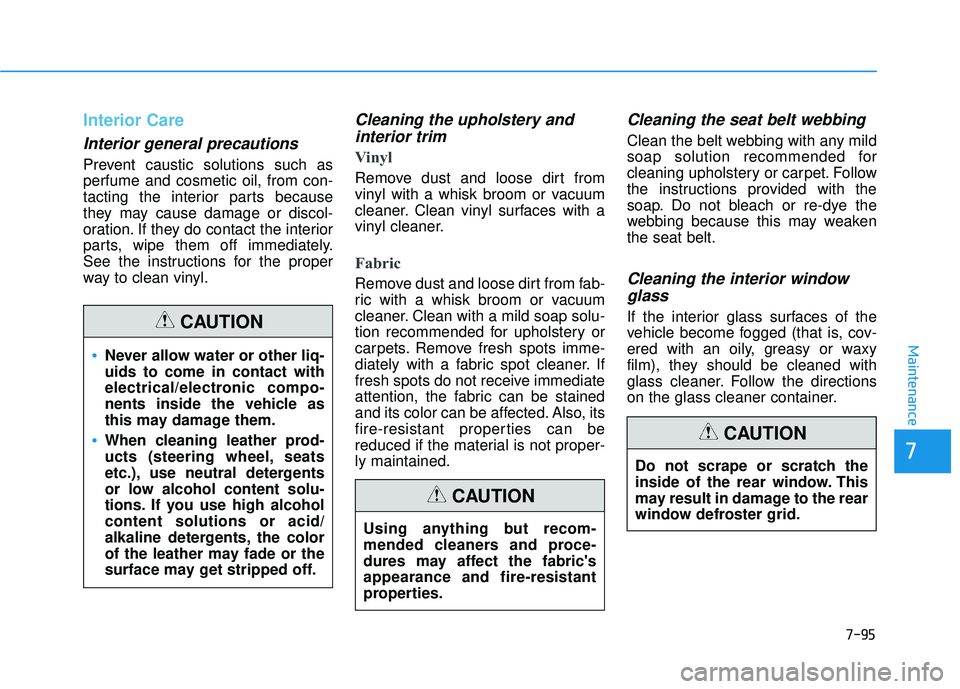
Interior Care
Interior general precautions
Prevent caustic solutions such as
perfume and cosmetic oil, from con-
tacting the interior parts because
they may cause damage or discol-
oration. If they do contact the interior
parts, wipe them off immediately.
See the instructions for the proper
way to clean vinyl.
Cleaning the upholstery andinterior trim
Vinyl
Remove dust and loose dirt from
vinyl with a whisk broom or vacuum
cleaner. Clean vinyl surfaces with a
vinyl cleaner.
Fabric
Remove dust and loose dirt from fab-
ric with a whisk broom or vacuum
cleaner. Clean with a mild soap solu-
tion recommended for upholstery or
carpets. Remove fresh spots imme-
diately with a fabric spot cleaner. If
fresh spots do not receive immediate
attention, the fabric can be stained
and its color can be affected. Also, its
fire-resistant properties can be
reduced if the material is not proper-
ly maintained.
Cleaning the seat belt webbing
Clean the belt webbing with any mild
soap solution recommended for
cleaning upholstery or carpet. Follow
the instructions provided with the
soap. Do not bleach or re-dye the
webbing because this may weaken
the seat belt.
Cleaning the interior windowglass
If the interior glass surfaces of the
vehicle become fogged (that is, cov-
ered with an oily, greasy or waxy
film), they should be cleaned with
glass cleaner. Follow the directions
on the glass cleaner container.
Using anything but recom-
mended cleaners and proce-
dures may affect the fabric's
appearance and fire-resistant
properties.
CAUTION
Do not scrape or scratch the
inside of the rear window. This
may result in damage to the rear
window defroster grid.
CAUTION
Never allow water or other liq-
uids to come in contact with
electrical/electronic compo-
nents inside the vehicle as
this may damage them.
When cleaning leather prod-
ucts (steering wheel, seats
etc.), use neutral detergents
or low alcohol content solu-
tions. If you use high alcohol
content solutions or acid/
alkaline detergents, the color
of the leather may fade or the
surface may get stripped off.
CAUTION
Page 556 of 586
7-96
Maintenance
E
EM
M I
IS
S S
SI
IO
O N
N
C
C O
O N
NT
TR
R O
O L
L
S
S Y
Y S
ST
T E
EM
M
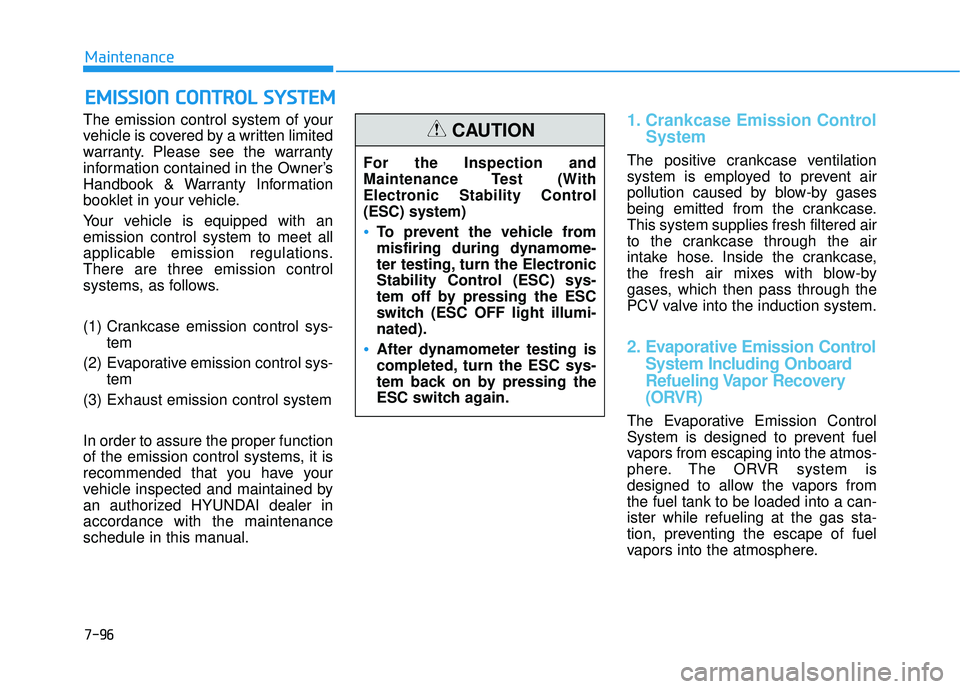
The emission control system of your
vehicle is covered by a written limited
warranty. Please see the warranty
information contained in the Owner’s
Handbook & Warranty Information
booklet in your vehicle.
Your vehicle is equipped with an
emission control system to meet all
applicable emission regulations.
There are three emission control
systems, as follows.
(1) Crankcase emission control sys-
tem
(2) Evaporative emission control sys- tem
(3) Exhaust emission control system
In order to assure the proper function
of the emission control systems, it is
recommended that you have your
vehicle inspected and maintained by
an authorized HYUNDAI dealer in
accordance with the maintenance
schedule in this manual.1. Crankcase Emission Control System
The positive crankcase ventilation
system is employed to prevent air
pollution caused by blow-by gases
being emitted from the crankcase.
This system supplies fresh filtered air
to the crankcase through the air
intake hose. Inside the crankcase,
the fresh air mixes with blow-by
gases, which then pass through the
PCV valve into the induction system.
2. Evaporative Emission ControlSystem Including Onboard
Refueling Vapor Recovery
(ORVR)
The Evaporative Emission Control
System is designed to prevent fuel
vapors from escaping into the atmos-
phere. The ORVR system is
designed to allow the vapors from
the fuel tank to be loaded into a can-
ister while refueling at the gas sta-
tion, preventing the escape of fuel
vapors into the atmosphere.
For the Inspection and
Maintenance Test (With
Electronic Stability Control
(ESC) system)
To prevent the vehicle from
misfiring during dynamome-
ter testing, turn the Electronic
Stability Control (ESC) sys-
tem off by pressing the ESC
switch (ESC OFF light illumi-
nated).
After dynamometer testing is
completed, turn the ESC sys-
tem back on by pressing the
ESC switch again.
CAUTION
Page 561 of 586
888
Specifications & Consumer information
8
Specifications, Consumer information and Reporting safety defects
8
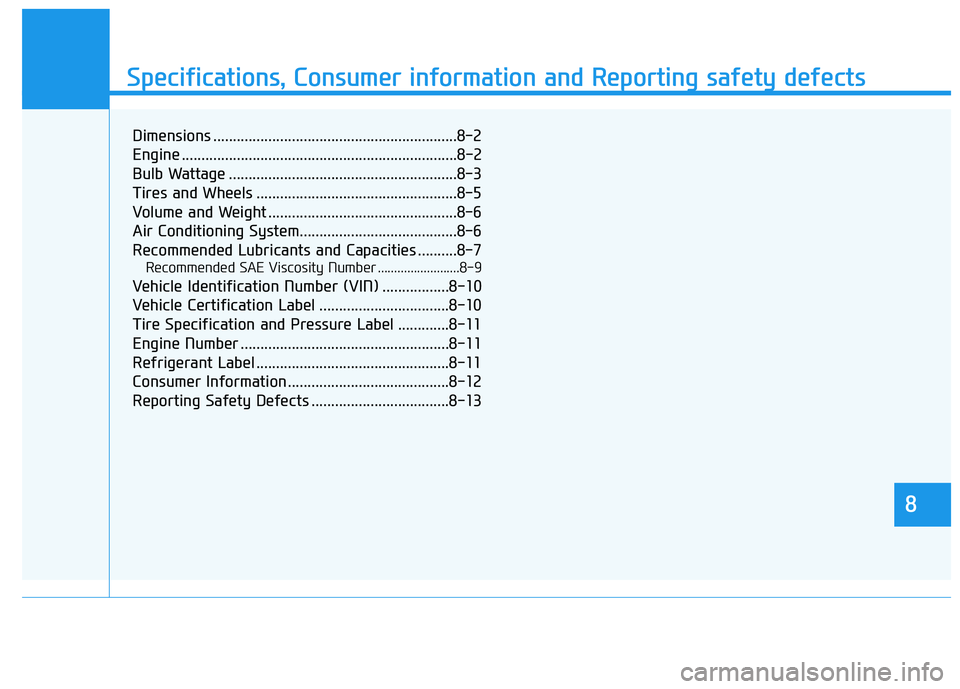
Dimensions ..............................................................8-2
Engine ......................................................................8-\
2
Bulb Wattage ..........................................................8-3
Tires and Wheels ...................................................8-5
Volume and Weight ................................................8-6
Air Conditioning System........................................8-6
Recommended Lubricants and Capacities ..........8-7
Recommended SAE Viscosity Number .........................8-9
Vehicle Identification Number (VIN) .................8-10
Vehicle Certification Label .................................8-10
Tire Specification and Pressure Label .............8-11
Engine Number .....................................................8-11
Refrigerant Label .................................................8-11
Consumer Information .........................................8-12
Reporting Safety Defects ...................................8-13
Page 567 of 586
8-7
88
Specifications, Consumer information and Reporting safety defects
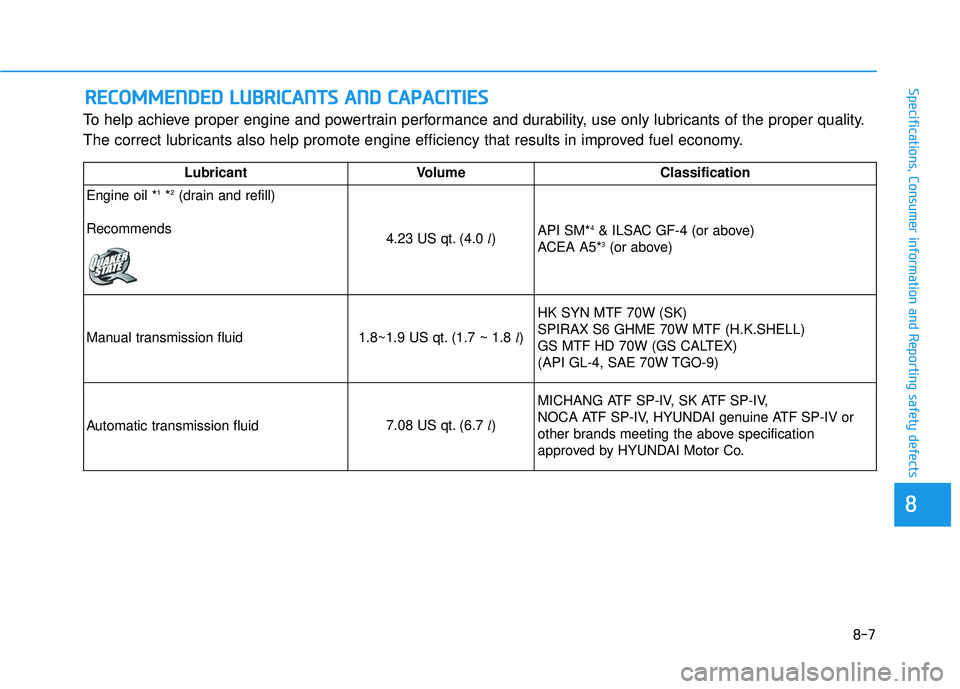
To help achieve proper engine and powertrain performance and durability, use only lubricants of the proper quality.
The correct lubricants also help promote engine efficiency that results in improved fuel economy.
R RE
EC
CO
O M
M M
ME
EN
N D
DE
ED
D
L
L U
U B
BR
RI
IC
C A
A N
N T
TS
S
A
A N
N D
D
C
C A
A P
PA
A C
CI
IT
T I
IE
E S
S
LubricantVolume Classification
Engine oil *
1*2(drain and refill)
Recommends
4.23 US qt. (4.0 l)API SM*4& ILSAC GF-4 (or above)
ACEA A5*3(or above)
Manual transmission fluid
1.8~1.9 US qt. (1.7 ~ 1.8 l)HK SYN MTF 70W (SK)
SPIRAX S6 GHME 70W MTF (H.K.SHELL)
GS MTF HD 70W (GS CALTEX)
(API GL-4, SAE 70W TGO-9)
Automatic transmission fluid7.08 US qt. (6.7
l)
MICHANG ATF SP-IV, SK ATF SP-IV,
NOCA ATF SP-IV, HYUNDAI genuine ATF SP-IV or
other brands meeting the above specification
approved by HYUNDAI Motor Co.
Page 568 of 586
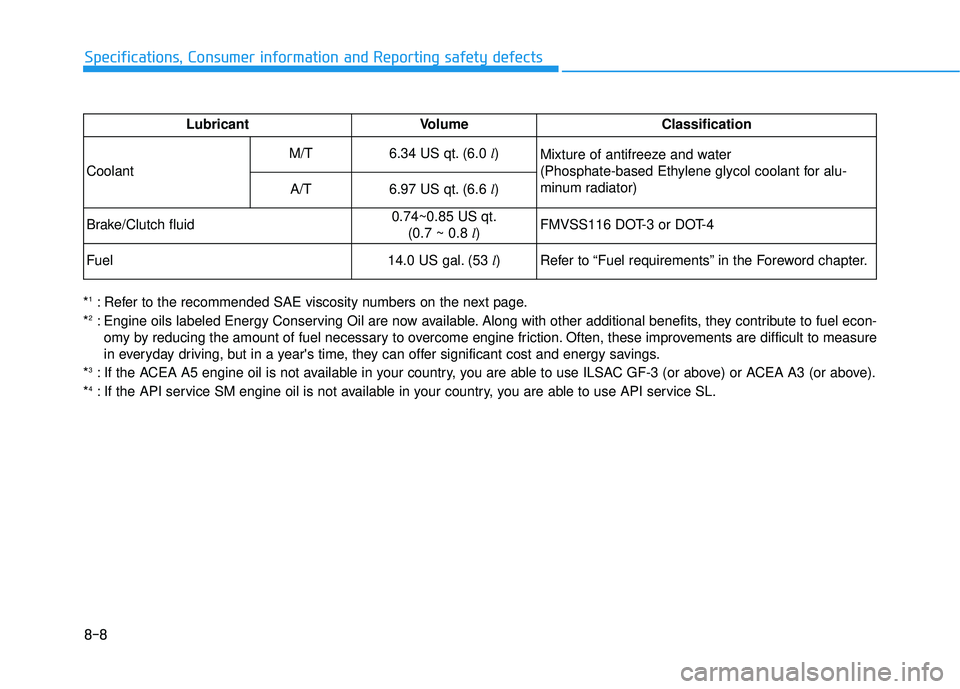
8-8
Specifications, Consumer information and Reporting safety defects
*1: Refer to the recommended SAE viscosity numbers on the next page.
*2: Engine oils labeled Energy Conserving Oil are now available. Along with other additional benefits, they contribute to fuel econ -
omy by reducing the amount of fuel necessary to overcome engine friction. Often, these improvements are difficult to measure
in everyday driving, but in a year's time, they can offer significant cost and energy savings.
*
3: If the ACEA A5 engine oil is not available in your country, you are able to use ILSAC GF-3 (or above) or ACEA A3 (or above).
*4: If the API service SM engine oil is not available in your country, you are able to use API service SL. Lubricant
Volume
Classification
Coolant M/T
6.34 US qt. (6.0
l)
Mixture of antifreeze and water
(Phosphate-based Ethylene glycol coolant for alu-
minum radiator)
A/T
6.97 US qt. (6.6 l)
Brake/Clutch fluid
0.74~0.85 US qt. (0.7 ~ 0.8 l) FMVSS116 DOT-3 or DOT-4
Fuel14.0 US gal. (53 l)Refer to “Fuel requirements” in the Foreword chapter.
Page 569 of 586
8-9
88
Specifications, Consumer information and Reporting safety defects
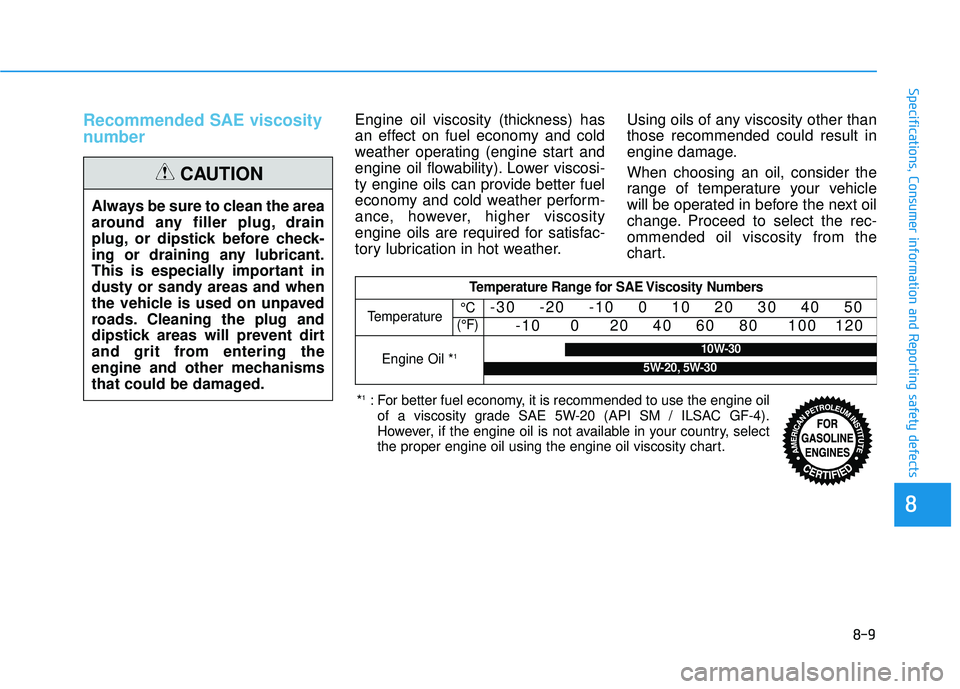
Recommended SAE viscosity
number Engine oil viscosity (thickness) has
an effect on fuel economy and cold
weather operating (engine start and
engine oil flowability). Lower viscosi-
ty engine oils can provide better fuel
economy and cold weather perform-
ance, however, higher viscosity
engine oils are required for satisfac-
tory lubrication in hot weather.Using oils of any viscosity other than
those recommended could result in
engine damage.
When choosing an oil, consider the
range of temperature your vehicle
will be operated in before the next oil
change. Proceed to select the rec-
ommended oil viscosity from the
chart.
Always be sure to clean the area
around any filler plug, drain
plug, or dipstick before check-
ing or draining any lubricant.
This is especially important in
dusty or sandy areas and when
the vehicle is used on unpaved
roads. Cleaning the plug and
dipstick areas will prevent dirt
and grit from entering the
engine and other mechanisms
that could be damaged.
CAUTION
Temperature Range for SAE Viscosity Numbers
Temperature -30 -20 -10 0 10 20 30 40 50
-10 0 20 40 60 80 100 120
Engine Oil *110W-30
5W-20, 5W-30
°C
(°F)
*1: For better fuel economy, it is recommended to use the engine oil of a viscosity grade SAE 5W-20 (API SM / ILSAC GF-4).
However, if the engine oil is not available in your country, select
the proper engine oil using the engine oil viscosity chart.
Page 571 of 586
8-11
88
Specifications, Consumer information and Reporting safety defects
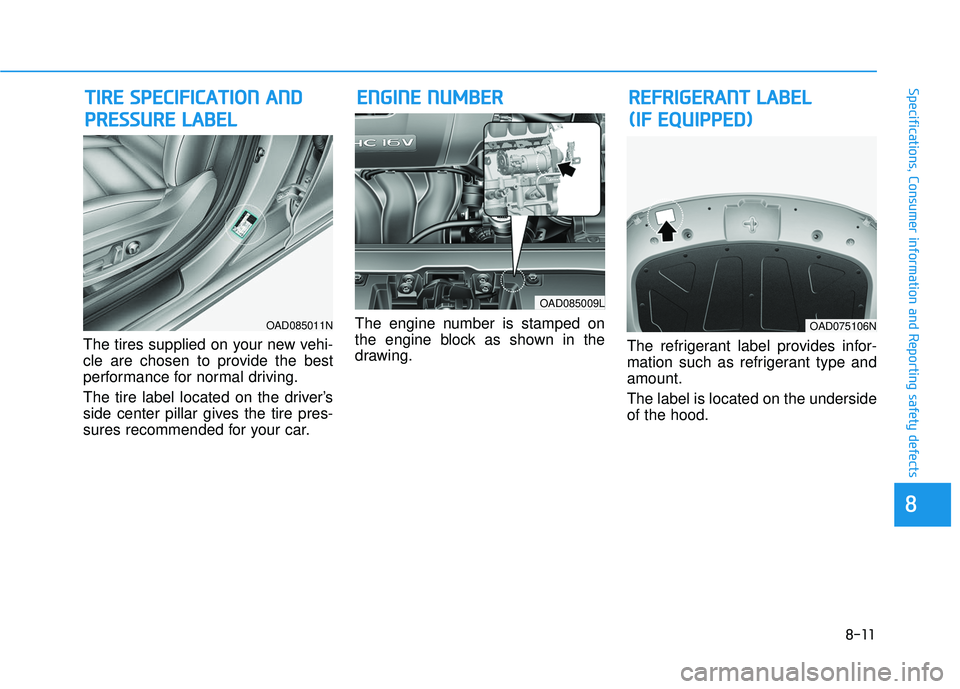
The tires supplied on your new vehi-
cle are chosen to provide the best
performance for normal driving.
The tire label located on the driver’s
side center pillar gives the tire pres-
sures recommended for your car.The engine number is stamped on
the engine block as shown in the
drawing.
The refrigerant label provides infor-
mation such as refrigerant type and
amount.
The label is located on the underside
of the hood.
E E
N
N G
GI
IN
N E
E
N
N U
U M
M B
BE
ER
R R
RE
EF
FR
R I
IG
G E
ER
R A
A N
N T
T
L
L A
A B
BE
EL
L
(
( I
IF
F
E
E Q
Q U
UI
IP
P P
PE
ED
D )
)
T
T
I
IR
R E
E
S
S P
P E
EC
CI
IF
F I
IC
C A
A T
TI
IO
O N
N
A
A N
N D
D
P
P R
R E
ES
SS
SU
U R
RE
E
L
L A
A B
BE
EL
L
OAD085011NOAD075106N
OAD085009L
Page 573 of 586
8-13
88
Specifications, Consumer information and Reporting safety defects
If you believe that your vehicle has a defect which could cause a crash or could cause injury or death, you should
immediately inform the National Highway Traffic Safety Administration (NHTSA) in addition to notifying HYUNDAI
MOTOR AMERICA.
If NHTSA receives similar complaints, it may open an investigation, and if it finds that a safety defect exists in a group
of vehicles, it may order a recall and remedy campaign. However, NHTSA cannot become involved in individual prob-
lems between you, your dealer, or HYUNDAI MOTOR AMERICA.
To contact NHTSA, you may call the Vehicle Safety Hotline toll-free at 1-888- 327-4236 (TTY: 1-800-424-9153);
go to http://www.safercar.gov;
or write to: Administrator, NHTSA 1200 New Jersey Ave, SE,
West Building Washington, D.C. 20590.
You can also obtain other information about motor vehicle safety from http://www.safercar.gov.
R R E
EP
P O
O R
RT
TI
IN
N G
G
S
S A
A F
FE
E T
T Y
Y
D
D E
EF
FE
E C
CT
T S
S
Page 578 of 586
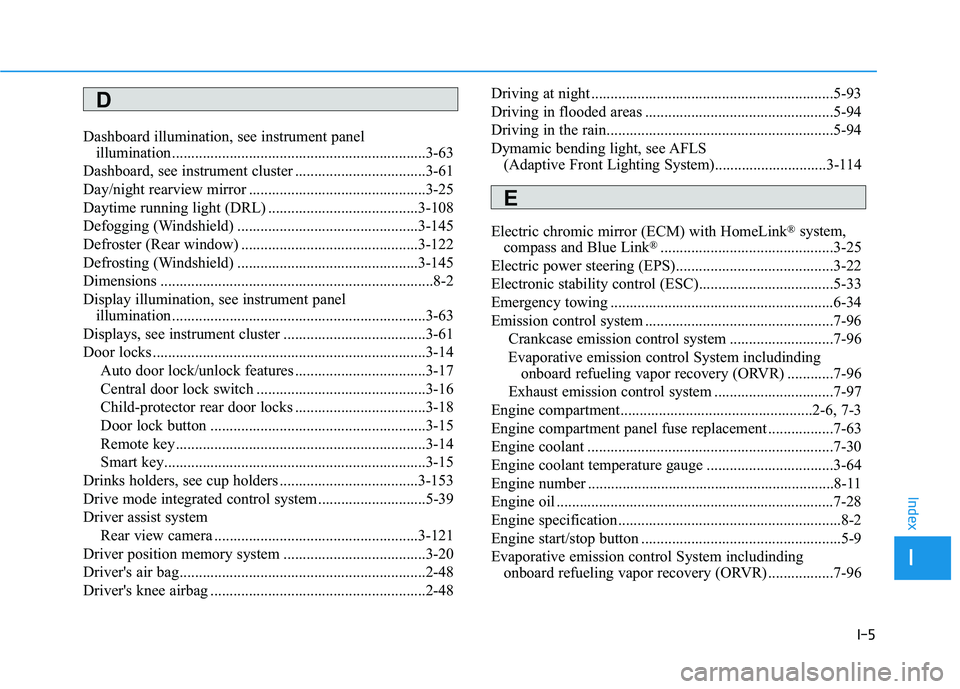
I-5
Dashboard illumination, see instrument panel illumination..................................................................3-63
Dashboard, see instrument cluster ..................................3-61
Day/night rearview mirror ..............................................3-25
Daytime running light (DRL) .......................................3-108
Defogging (Windshield) ...............................................3-145
Defroster (Rear window) ..............................................3-122
Defrosting (Windshield) ...............................................3-145
Dimensions .......................................................................8\
-2
Display illumination, see instrument panel illumination..................................................................3-63
Displays, see instrument cluster .....................................3-61
Door locks .......................................................................3\
-14 Auto door lock/unlock features ..................................3-17
Central door lock switch ............................................3-16
Child-protector rear door locks ..................................3-18
Door lock button ........................................................3-15
Remote key.................................................................3-14
Smart key....................................................................3-15\
Drinks holders, see cup holders ....................................3-153
Drive mode integrated control system ............................5-39
Driver assist system Rear view camera .....................................................3-121
Driver position memory system .....................................3-20
Driver's air bag................................................................2-48
Driver's knee airbag ........................................................2-48 Driving at night ...............................................................5-93
Driving in flooded areas .................................................5-94
Driving in the rain...........................................................5-94
Dymamic bending light, see AFLS
(Adaptive Front Lighting System).............................3-114
Electric chromic mirror (ECM) with HomeLink
®system,
compass and Blue Link®.............................................3-25
Electric power steering (EPS).........................................3-22
Electronic stability control (ESC)...................................5-33
Emergency towing ..........................................................6-34
Emission control system .................................................7-96 Crankcase emission control system ...........................7-96
Evaporative emission control System includinding onboard refueling vapor recovery (ORVR) ............7-96
Exhaust emission control system ...............................7-97
Engine compartment..................................................2-6, 7-3
Engine compartment panel fuse replacement .................7-63
Engine coolant ................................................................7-30
Engine coolant temperature gauge .................................3-64
Engine number ................................................................8-11
Engine oil ........................................................................\
7-28
Engine specification..........................................................8-2
Engine start/stop button ....................................................5-9
Evaporative emission control System includinding onboard refueling vapor recovery (ORVR) .................7-96
I
Index
D
E
Page 583 of 586

I-10
Rear center seatbelt .........................................................2-30
Rear seats ........................................................................\
2-12Folding the rear seat ...................................................2-12
Recommended cold tire inflation pressures ...................7-45
Recommended lubricants and capacities ..........................8-7 Recommended SAE viscosity number .........................8-9
Remote key Battery replacement......................................................3-7
Removable towing hook .................................................6-33
Replacement light bulb ...................................................7-72
Reverse Parking Aid Function ........................................3-42
Rocking the vehicle ........................................................5-92
Room lamp ....................................................................3-115
Rotation (Tire) ................................................................7-47
Safety messages ................................................................F-6
Scheduled maintenance services.......................................7-7
Seat belt warning light ....................................................2-23
Seat belts ........................................................................\
.2-22 3-point system with convertible locking retractor (Rear passenger's side) ............................................2-25
3-point system with emergency locking retractor (Driver's side) ..........................................................2-25
Additional seat belt safety precautions ......................2-31
Care of seat belts ........................................................2-34 Do not lie down ..........................................................2-33
Height adjustment ......................................................2-25
Keep belts clean and dry ............................................2-34
One person per belt ....................................................2-33
Periodic inspection .....................................................2-34
Pre-tensioner seat belt ................................................2-28
Rear center seatbelt ....................................................2-30
Seat belt restraint system............................................2-25
Seat belt safety precautions ........................................2-22
Seat belt use and children...........................................2-3\
1
Seat belt use during pregnancy ..................................2-31
Seat belt warning light ...............................................2-23
Transporting an injured person ..................................2-33
When to replace seat belts..........................................2-34
Seat warmers ...................................................................2-19
Seatback pocket ..............................................................2-12
Seats ........................................................................\
..........2-4 Armrest (Rear seats) ...................................................2-14
Head restraints ............................................................2-15
Manual adjustment (Front seats) ..................................2-7
Power adjustment (Front seats) ....................................2-9
Rear seats....................................................................2-12\
Safety precautions ........................................................2-5
Seat warmers ..............................................................2-19
Seatback pocket ..........................................................2-12
Shift lever auto door lock ...............................................3-17
Shift lock system.............................................................5-24
Shift-lock release ............................................................5-24
Index
R
S