cooling HYUNDAI ELANTRA SEL 2021 User Guide
[x] Cancel search | Manufacturer: HYUNDAI, Model Year: 2021, Model line: ELANTRA SEL, Model: HYUNDAI ELANTRA SEL 2021Pages: 570, PDF Size: 52.21 MB
Page 469 of 570
Emergency Situations
8-6
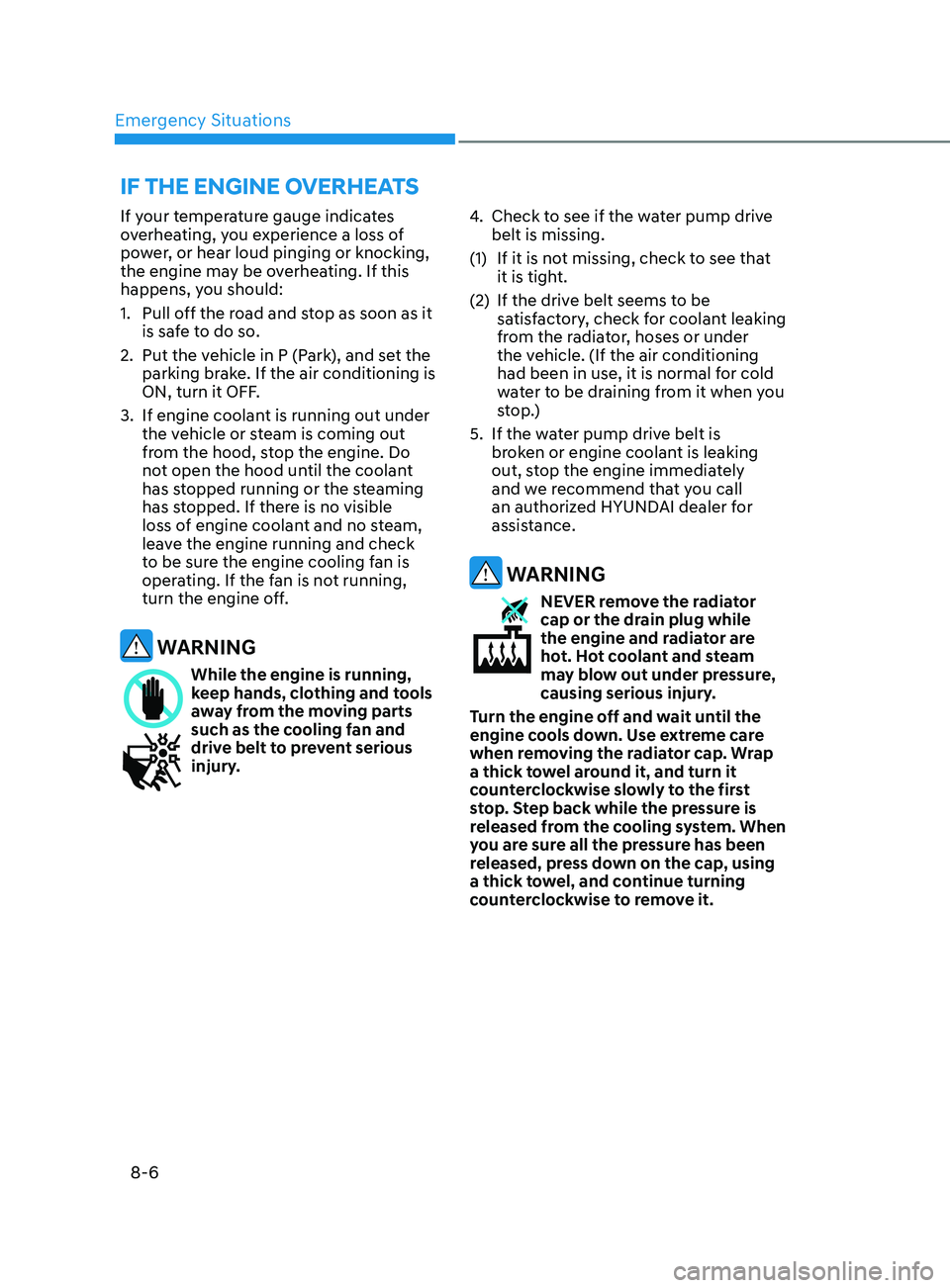
If your temperature gauge indicates
overheating, you experience a loss of
power, or hear loud pinging or knocking,
the engine may be overheating. If this
happens, you should:
1.
Pull off the r
oad and stop as soon as it
is safe to do so.
2.
Put the vehicle in P (P
ark), and set the
parking brake. If the air conditioning is
ON, turn it OFF.
3.
If engine coolant is running out under
the v
ehicle or steam is coming out
from the hood, stop the engine. Do
not open the hood until the coolant
has stopped running or the steaming
has stopped. If there is no visible
loss of engine coolant and no steam,
leave the engine running and check
to be sure the engine cooling fan is
operating. If the fan is not running,
turn the engine off.
WARNING
While the engine is running,
keep hands, clothing and tools
away from the moving parts
such as the cooling fan and
drive belt to prevent serious
injury. 4.
Check to see if the w
ater pump drive
belt is missing.
(1)
If it is not missing, check t
o see that
it is tight.
(2)
If the drive belt seems t
o be
satisfactory, check for coolant leaking
from the radiator, hoses or under
the vehicle. (If the air conditioning
had been in use, it is normal for cold
water to be draining from it when you
stop.)
5.
If the wa
ter pump drive belt is
broken or engine coolant is leaking
out, stop the engine immediately
and we recommend that you call
an authorized HYUNDAI dealer for
assistance.
WARNING
NEVER remove the radiator
cap or the drain plug while
the engine and radiator are
hot. Hot coolant and steam
may blow out under pressure,
causing serious injury.
Turn the engine off and wait until the
engine cools down. Use extreme care
when removing the radiator cap. Wrap
a thick towel around it, and turn it
counterclockwise slowly to the first
stop. Step back while the pressure is
released from the cooling system. When
you are sure all the pressure has been
released, press down on the cap, using
a thick towel, and continue turning
counterclockwise to remove it.
If the engIne overheats
Page 470 of 570
08
8 -7
6. If you cannot find the cause of the
overheating, wait until the engine
temperature has returned to normal.
Then, if coolant has been lost,
carefully add coolant to the reservoir
to bring the fluid level in the reservoir
up to the halfway mark.
7.
Proceed with caution, k
eeping alert
for further signs of overheating.
If overheating happens again,
we recommend that you call an
authorized HYUNDAI dealer for
assistance.NOTICE
• Serious loss of coolant indicates a
leak in the cooling system and we
recommend the system be checked
by an authorized HYUNDAI dealer.
• When the engine overheats from
low engine coolant, suddenly adding
engine coolant may cause cracks
in the engine. To prevent damage,
add engine coolant slowly in small
quantities.
Page 499 of 570

09
9-13
Engine Oil and Filter
The engine oil and filter should be
changed at the intervals specified in the
maintenance schedule. If the vehicle
is being driven in severe conditions,
more frequent oil and filter changes are
required.
Drive Belts
Inspect all drive belts for evidence
of cuts, cracks, excessive wear or oil
saturation and replace if necessary. Drive
belts should be checked periodically
for proper tension and adjusted as
necessary.
Fuel Filter
A clogged-up fuel filter may limit the
vehicle driving speed, damage the
emission system, and cause the hard
starting. When a considerable amount
of foreign substances are accumulated
in the fuel tank, the fuel filter should be
replaced.
Upon installing a new fuel filter, operate
the engine for several minutes, and
check the connections for any leakages.
Fuel filters should be installed by an
authorized HYUNDAI dealer.
Fuel Lines, Fuel Hoses and
Connections
Check the fuel lines, fuel hoses and
connections for leakage and damage.
Have an authorized HYUNDAI dealer
replace any damaged or leaking parts
immediately.
Vapor Hose and Fuel Filler Cap
The vapor hose and fuel filler cap should
be inspected at those intervals specified
in the maintenance schedule. Make sure
a new vapor hose or fuel filler cap is
correctly replaced.
Air Cleaner Filter
A genuine HYUNDAI air cleaner filter
is recommended when the filter is
replaced.
Spark Plugs
Make sure to install new spark plugs of
the correct heat range.
Cooling System
Check cooling system components, such
as radiator, coolant reservoir, hoses and
connections for leakage and damage.
Replace any damaged parts.
Explanation of SChEdulEd maintEnanCE itEmS
Page 502 of 570
Maintenance
9-16
The high-pressure cooling system has a
reservoir filled with year-round antifreeze
coolant. The reservoir is filled at the
factory.
Check the antifreeze protection and
coolant level at least once a year, at
the beginning of the winter season and
before traveling to a colder climate.
NOTICE
• When the engine overheats from
low engine coolant, suddenly adding
engine coolant may cause cracks
in the engine. To prevent damage,
add engine coolant slowly in small
quantities.
• Do not drive with no engine coolant.
It may cause water pump failure and
engine seizure, etc.
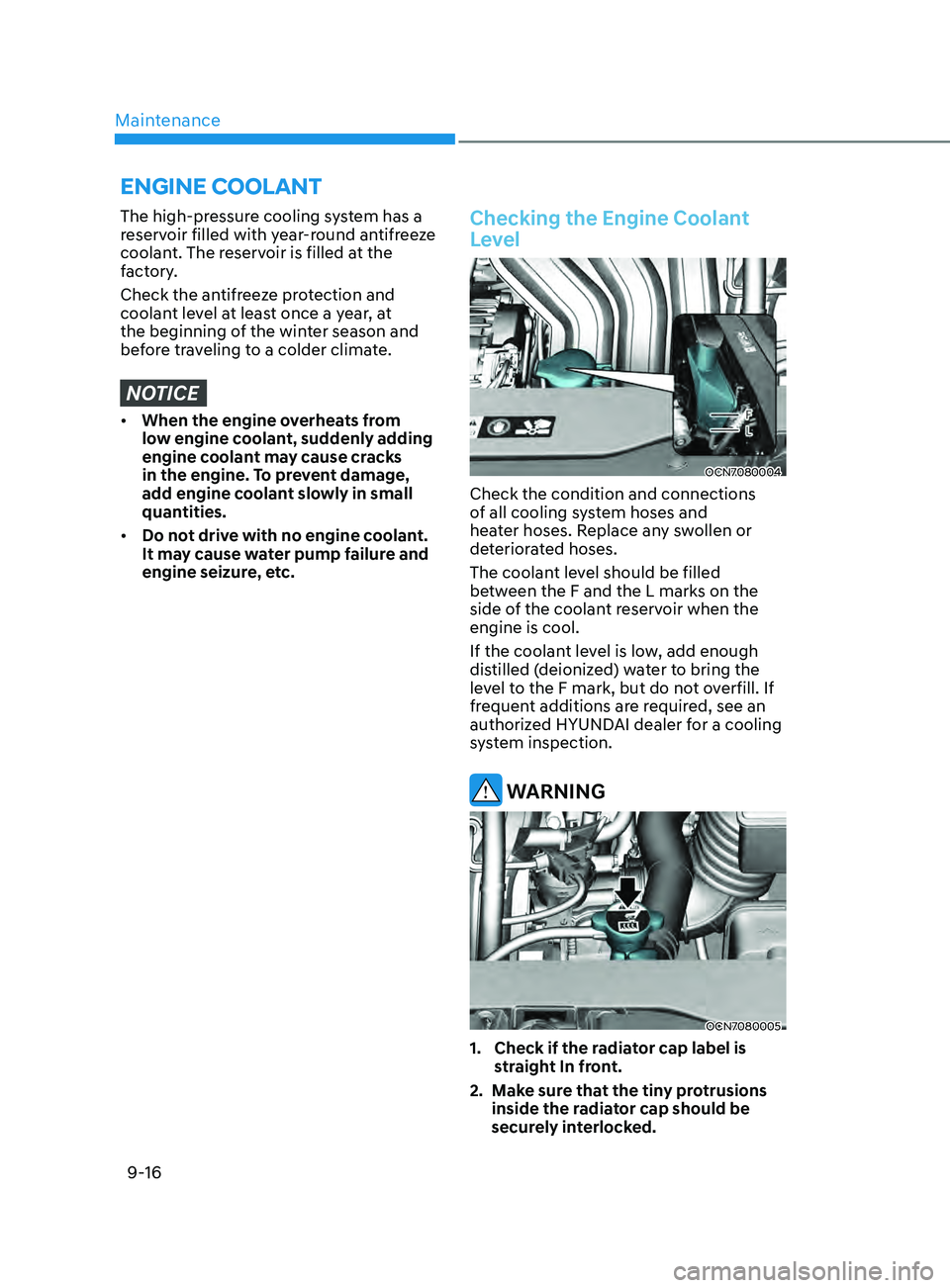
Checking the Engine Coolant
Level
OCN7080004
Check the condition and connections
of all cooling system hoses and
heater hoses. Replace any swollen or
deteriorated hoses.
The coolant level should be filled
between the F and the L marks on the
side of the coolant reservoir when the
engine is cool.
If the coolant level is low, add enough
distilled (deionized) water to bring the
level to the F mark, but do not overfill. If
frequent additions are required, see an
authorized HYUNDAI dealer for a cooling
system inspection.
WARNING
OCN7080005
1. Check if the radia tor cap label is
straight In front.
2.
Mak
e sure that the tiny protrusions
inside the radiator cap should be
securely interlocked.
EnginE Coolant
Page 503 of 570
09
9-17
Recommended engine coolant
• When adding coolant, use only
distilled (deionized) water for your
vehicle and never mix hard water in
the coolant filled at the factory.
• An improper coolant mixture can
result in severe malfunction or engine
damage.
• The engine in your vehicle has
aluminum engine parts and must be
protected by an ethylene-glycol with
phosphate based coolant to prevent
corrosion and freezing.
• Do not use alcohol or methanol
coolant or mix them with the specified
coolant.
• Do not use a solution that contains
more than 60% antifreeze or less than
35% antifreeze, which would reduce
the effectiveness of the solution.
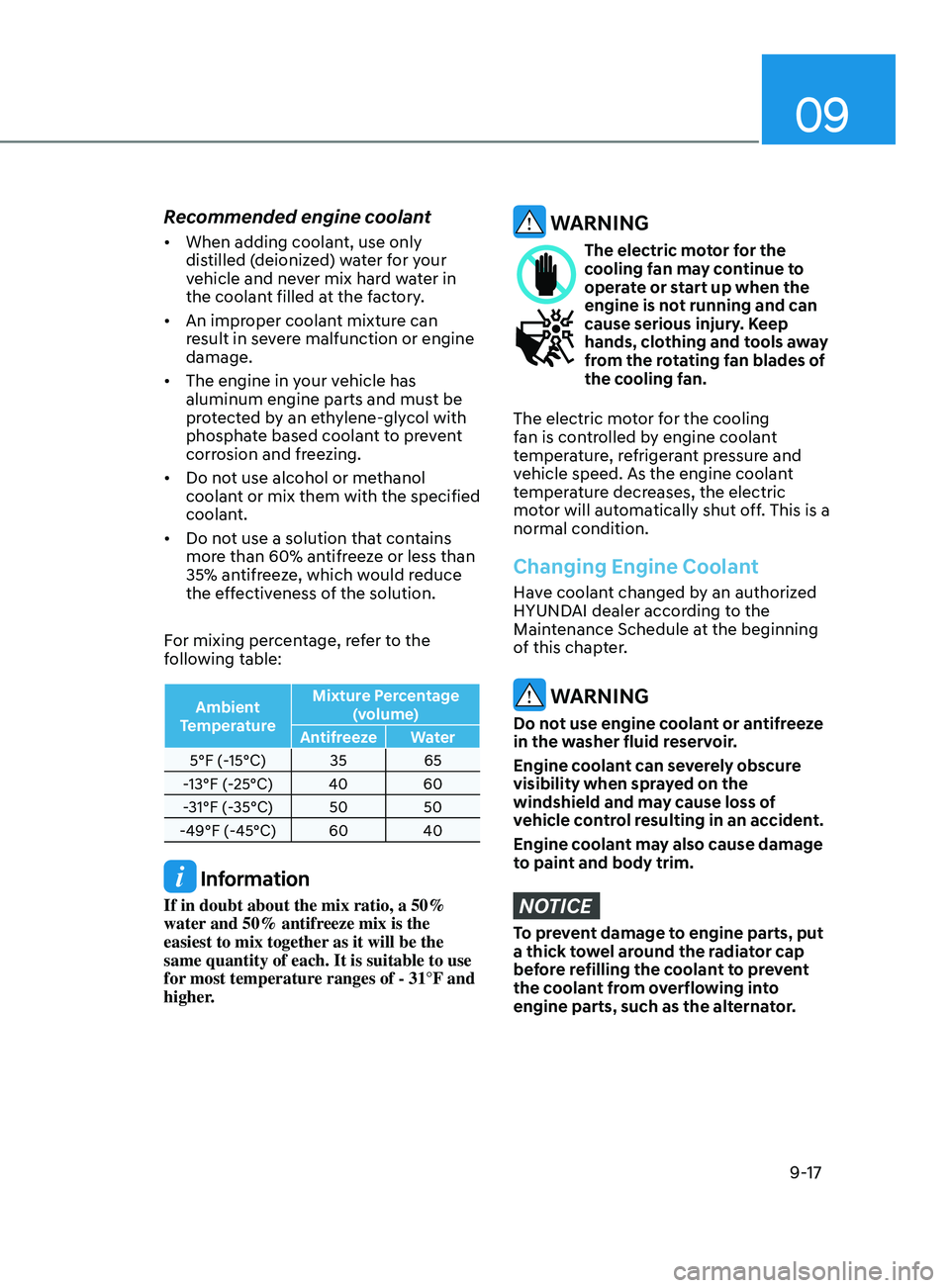
For mixing percentage, refer to the
following table:
Ambient
Temperature Mixture Percentage
(volume)
Antifreeze Water
5°F (-15°C) 35 65
-13°F (-25°C) 40 60
-31°F (-35°C) 50 50
-49°F (-45°C) 60 40
Information
If in doubt about the mix ratio, a 50%
water and 50% antifreeze mix is the
easiest to mix together as it will be the
same quantity of each. It is suitable to use
for most temperature ranges of - 31°F and
higher.
WARNING
The electric motor for the
cooling fan may continue to
operate or start up when the
engine is not running and can
cause serious injury. Keep
hands, clothing and tools away
from the rotating fan blades of
the cooling fan.
The electric motor for the cooling
fan is controlled by engine coolant
temperature, refrigerant pressure and
vehicle speed. As the engine coolant
temperature decreases, the electric
motor will automatically shut off. This is a
normal condition.
Changing Engine Coolant
Have coolant changed by an authorized
HYUNDAI dealer according to the
Maintenance Schedule at the beginning
of this chapter.
WARNING
Do not use engine coolant or antifreeze
in the washer fluid reservoir.
Engine coolant can severely obscure
visibility when sprayed on the
windshield and may cause loss of
vehicle control resulting in an accident.
Engine coolant may also cause damage
to paint and body trim.
NOTICE
To prevent damage to engine parts, put
a thick towel around the radiator cap
before refilling the coolant to prevent
the coolant from overflowing into
engine parts, such as the alternator.
Page 534 of 570
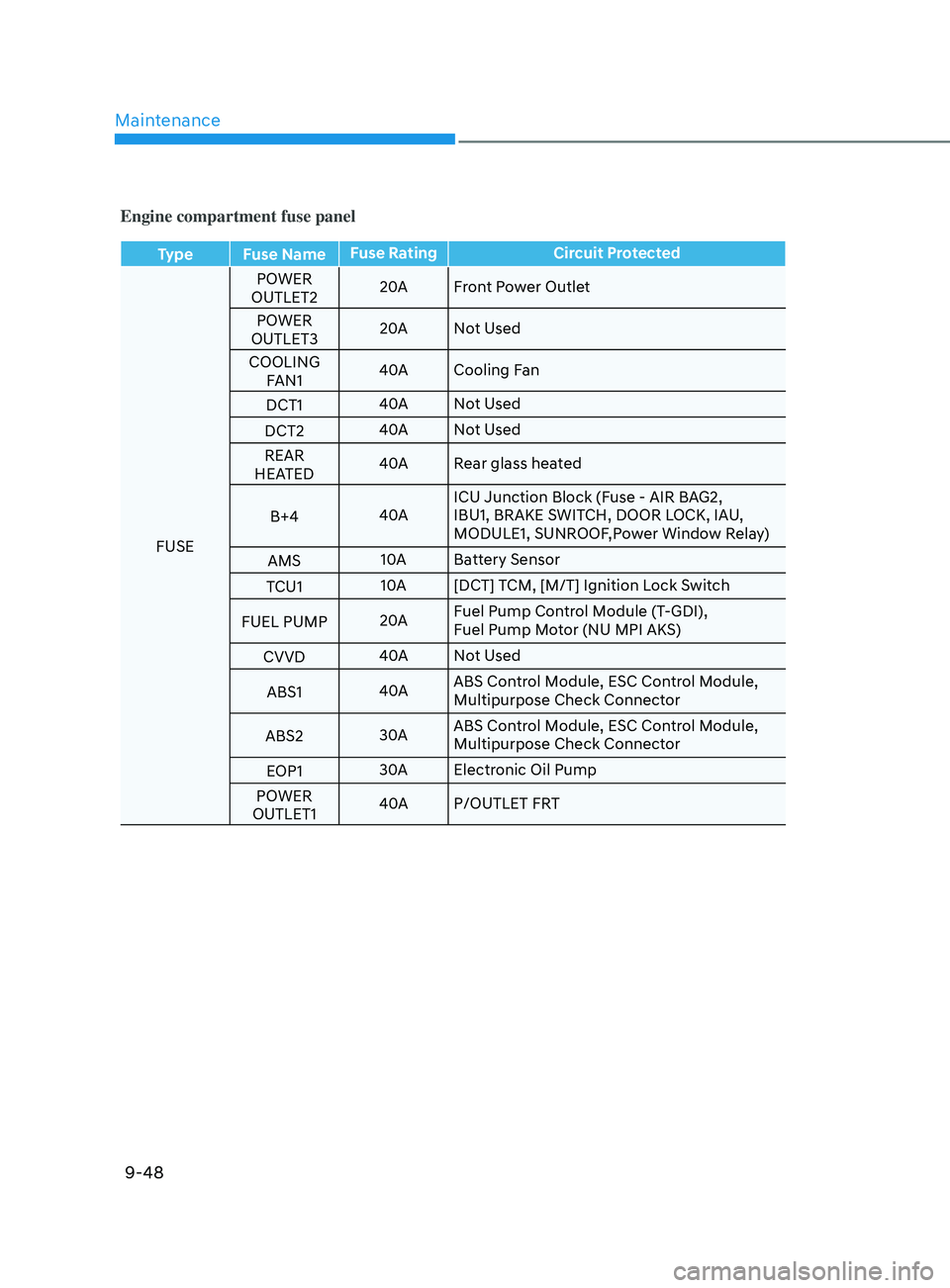
Maintenance
9-48
Engine compartment fuse panel
Type Fuse NameFuse Rating
Circuit Protected
FUSE POWER
OUTLET2 20A
Front Power Outlet
POWER
OUTLET3 20A
Not Used
COOLING FAN1 40A
Cooling Fan
DCT1 40A
Not Used
DCT2 40A
Not Used
REAR
HEATED 40A
Rear glass heated
B+4 40AICU Junction Block (Fuse - AIR BAG2,
IBU1, BRAKE SWITCH, DOOR LOCK, IAU,
MODULE1, SUNROOF,Power Window Relay)
AMS 10A
Battery Sensor
TCU1 10A
[DCT] TCM, [M/T] Ignition Lock Switch
FUEL PUMP 20AFuel Pump Control Module (T-GDI),
Fuel Pump Motor (NU MPI AKS)
CVVD 40A
Not Used
ABS1 40AABS Control Module, ESC Control Module,
Multipurpose Check Connector
ABS2 30AABS Control Module, ESC Control Module,
Multipurpose Check Connector
EOP1 30A
Electronic Oil Pump
POWER
OUTLET1 40A
P/OUTLET FRT
Page 535 of 570
![HYUNDAI ELANTRA SEL 2021 User Guide 09
9-49
Engine compartment fuse panel
Fuse NameFuse Rating
Circuit Protected
WIPER 25A Wiper Motor
ECU4 15A PCM/ECM
A/C 10A
[G4FM] A/C Compressor
HORN 15A Horn
IGN COIL 20A
Ignition Coil #1~#4
ECU3 15](/img/35/56089/w960_56089-534.png "HYUNDAI ELANTRA SEL 2021 User Guide 09
9-49
Engine compartment fuse panel
Fuse NameFuse Rating
Circuit Protected
WIPER 25A Wiper Motor
ECU4 15A PCM/ECM
A/C 10A
[G4FM] A/C Compressor
HORN 15A Horn
IGN COIL 20A
Ignition Coil #1~#4
ECU3 15")
09
9-49
Engine compartment fuse panel
Fuse NameFuse Rating
Circuit Protected
WIPER 25A Wiper Motor
ECU4 15A PCM/ECM
A/C 10A
[G4FM] A/C Compressor
HORN 15A Horn
IGN COIL 20A
Ignition Coil #1~#4
ECU3 15A PCM/ECM
SENSOR3 10A
E/R Junction Block (Fuel Pump Relay)
ECU2 10A
Not Used
SENSOR2 10A[G4NS] Variable Intake Solenoid Valve, Oil Pump
Solenoid Valve, Oil Control Valve #1/#2, Canister Close
Valve, Purge Control Solenoid Valve,
PCB Block (A/C Relay), E/R Junction Block (Cooling
Fan1/2 Relay)
ECU5 10A
ECM/PCM, [MT] Ignition Lock Switch
SENSOR1 15A Oxygen Sensor (UP/DOWN)
ABS3 10A
ABS Control Module, ESC Control Module
INJECTOR 15A [G4FM/G4FG/G4NA] Injector #1~#4
ECU1 20A
PCM/ECM
TCU2 15A Transaxle Range Switch