towing HYUNDAI ELANTRA SEL 2021 User Guide
[x] Cancel search | Manufacturer: HYUNDAI, Model Year: 2021, Model line: ELANTRA SEL, Model: HYUNDAI ELANTRA SEL 2021Pages: 570, PDF Size: 52.21 MB
Page 370 of 570
07
7-57
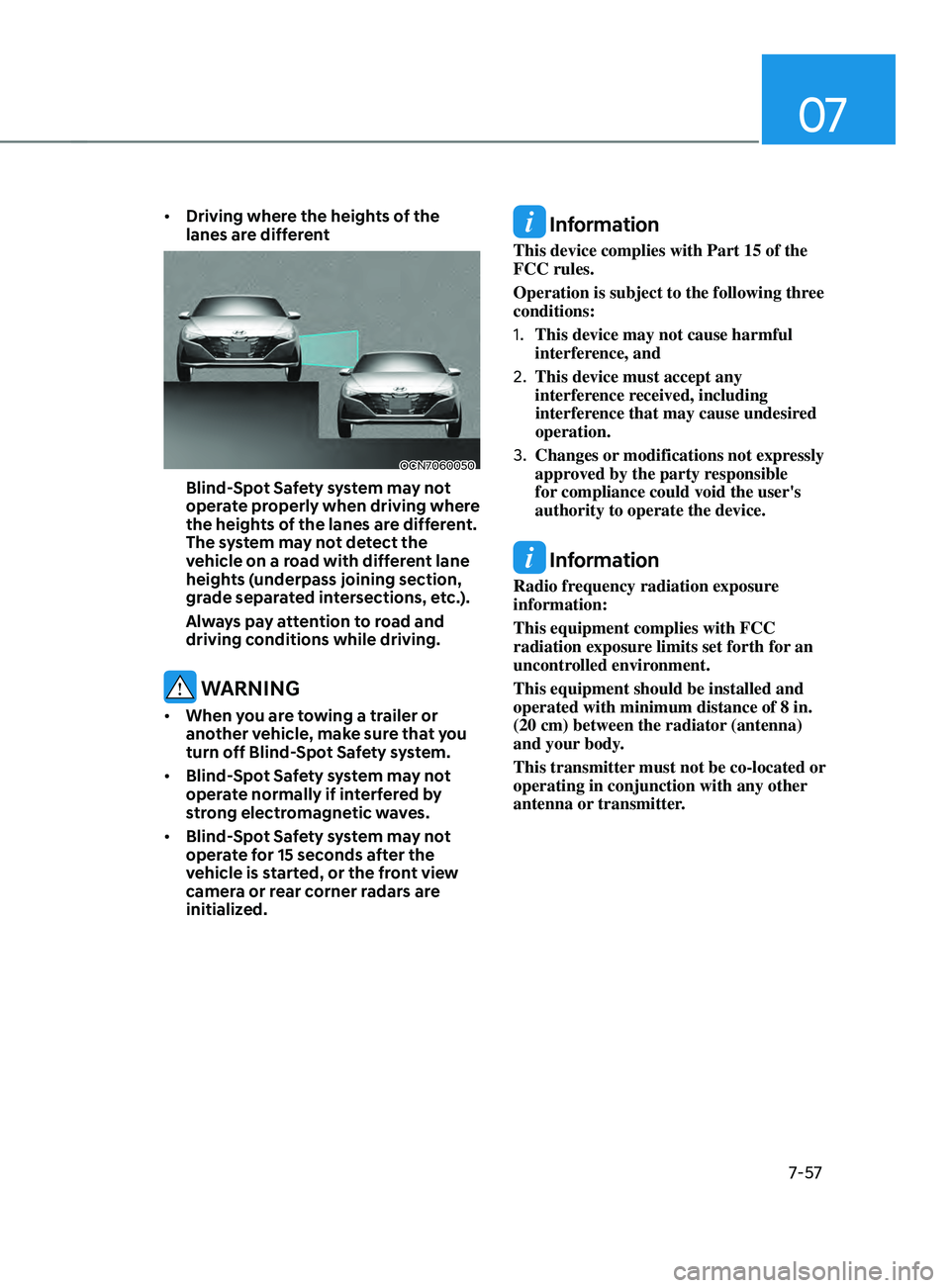
• Driving where the heights of the
lanes are different
OCN7060050
Blind-Spot Safety system may not
operate properly when driving where
the heights of the lanes are different.
The system may not detect the
vehicle on a road with different lane
heights (underpass joining section,
grade separated intersections, etc.).
Always pay attention to road and
driving conditions while driving.
WARNING
• When you are towing a trailer or
another vehicle, make sure that you
turn off Blind-Spot Safety system.
• Blind-Spot Safety system may not
operate normally if interfered by
strong electromagnetic waves.
• Blind-Spot Safety system may not
operate for 15 seconds after the
vehicle is started, or the front view
camera or rear corner radars are
initialized.
Information
This device complies with Part 15 of the
FCC rules.
Operation is subject to the following three
conditions:
1.
This device may not cause harmful
interference, and
2.
This device must accept any
interference r
eceived, including
interference that may cause undesired
operation.
3.
Changes or modifications not expr
essly
approved by the party responsible
for compliance could void the user's
authority to operate the device.
Information
Radio frequency radiation exposure
information:
This equipment complies with FCC
radiation exposure limits set forth for an
uncontrolled environment.
This equipment should be installed and
operated with minimum distance of 8 in.
(20 cm) between the radiator (antenna)
and your body.
This transmitter must not be co-located or
operating in conjunction with any other
antenna or transmitter.
Page 404 of 570
07
7-91
• When you are towing a trailer or
another vehicle, we recommend that
Smart Cruise Control is turned off
due to safety reasons.
• Turn off Smart Cruise Control when
your vehicle is being towed.
• Smart Cruise Control may not
operate normally if interfered by
strong electromagnetic waves.
• Smart Cruise Control may not
detect an obstacle in front and lead
to a collision. Always look ahead
cautiously to prevent unexpected
and sudden situations from
occurring.
• Vehicles moving in front of you with
a frequent lane change may cause
a delay in the system's reaction or
may cause the system to react to a
vehicle actually in an adjacent lane.
Always drive cautiously to prevent
unexpected and sudden situations
from occurring.
• Always be aware of the surroundings
and drive safely, even though a
warning message does not appear or
an audible warning does not sound.
• If any other system’s warning
message is displayed or warning
sound is generated, Smart Cruise
Control warning message may not
be displayed and warning sound may
not be generated.
• You may not hear the warning sound
of Forward Collision-Avoidance
Assist if the surrounding is noisy.
• The vehicle manufacturer is not
responsible for any traffic violation
or accidents caused by the driver.
• Always set the vehicle speed to the
speed limit in your country. Information
• Smart Cruise Control may not operate
for 15 seconds after the vehicle is
started or the front view camera or
front radar is initialized.
• You may hear a sound when the brake
is controlled by Smart Cruise Control.
Function malfunction and
limitations
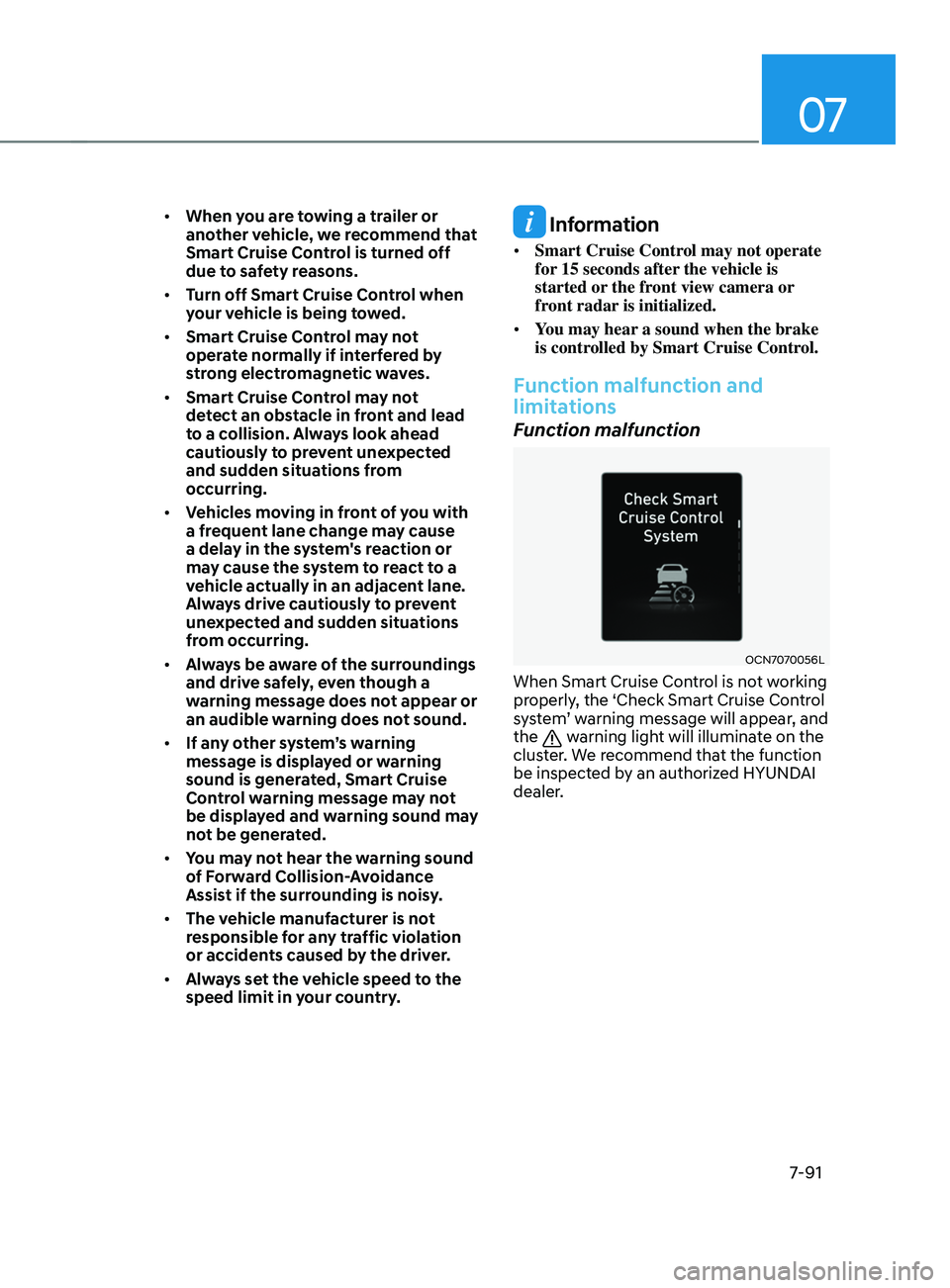
Function malfunction
OCN7070056L
When Smart Cruise Control is not working
properly, the ‘Check Smart Cruise Control
system’ warning message will appear, and
the
warning light will illuminate on the
cluster. We recommend that the function
be inspected by an authorized HYUNDAI
dealer.
Page 416 of 570
![HYUNDAI ELANTRA SEL 2021 User Guide 07
7-103
OCN7070109N[1] : Driving route, [2] : Branch line,
[3] : Curved road section, [4] : Main road
• If there is no destination set on the
navigation, Highway Curve Zone Auto
Slowdown functio](/img/35/56089/w960_56089-415.png "HYUNDAI ELANTRA SEL 2021 User Guide 07
7-103
OCN7070109N[1] : Driving route, [2] : Branch line,
[3] : Curved road section, [4] : Main road
• If there is no destination set on the
navigation, Highway Curve Zone Auto
Slowdown functio")
07
7-103
OCN7070109N[1] : Driving route, [2] : Branch line,
[3] : Curved road section, [4] : Main road
• If there is no destination set on the
navigation, Highway Curve Zone Auto
Slowdown function will operate based
on the curve information on the main
road.
• Even if you depart from the main road,
Highway Curve Zone Auto Slowdown
function may temporarily operate
due to navigation information of the
highway curve section.
WARNING
• Navigation-based Smart Cruise
Control is not a substitute for safe
driving practices, but a convenience
function. Always have your eyes on
the road, and it is the responsibility
of the driver to avoid violating traffic
laws.
• The navigation’s speed limit
information may differ from the
actual speed limit information on the
road. It is the driver's responsibility
to check the speed limit on the
actual driving road or lane.
• Navigation-based Smart Cruise
Control will automatically be
cancelled when you leave the
highway (or motorway) main road.
Always pay attention to road and
driving conditions while driving.
• Navigation-based Smart Cruise
Control may not operate due to the
existence of leading vehicles and
the driving conditions of the vehicle.
Always pay attention to road and
driving conditions while driving.
• When you are towing a trailer or
another vehicle, we recommend
that Navigation-based Smart Cruise
Control is turned off due to safety
reasons.
Page 427 of 570
Driver assistance system
7-114
• Highway Driving Assist may
inadvertently operate or turn off
depending on road conditions
(navigation information) and
surroundings.
• Lane Following Assist function may
be temporarily disabled when the
front view camera cannot detect
lanes properly or the hands-off
warning is on.
• You may not hear the warning sound
of Highway Driving Assist if the
surrounding is noisy.
• If the vehicle is driven at high speed
above a certain speed at a curve,
your vehicle may drive to one side or
may depart from the driving lane.
• When you are towing a trailer or
another vehicle, we recommend that
Highway Driving Assist is turned off
due to safety reasons.
• The hands–off warning message
may appear early or late depending
on how the steering wheel is held or
road conditions. Always have your
hands on the steering wheel while
driving.
• For your safety, please read the
owner's manual before using the
Highway Driving Assist.
• Highway Driving Assist will not
operate when the engine is started,
or when the detecting sensors or
navigation is being initialized.Limitations of the function
Highway Driving Assist may not operate
normally, or may not operate under the
following circumstances:
• The map information and the
actual road is different because the
navigation is not updated
• The map information and the actual
road is different because of real-time
GPS data or map information error
• The infotainment system is overloaded
by simultaneously performing
functions such as route search, video
playback, voice recognition, etc.
• GPS signals are blocked in areas such
as a tunnel
• The driver goes off course or the
route to the destination is changed or
canceled by resetting the navigation
• The vehicle enters a service station or
rest area
• Android Auto or Car Play is operating
• The navigation cannot detect the
current vehicle position (ex: elevated
roads including overpass adjacent to
general roads or nearby roads exist in
a parallel way)
• White single dotted lane line or road
edge cannot be detected
• The road is temporarily controlled due
to construction, etc.
• There is no structure, such as a
medium strip, guardrails, etc., on the
road
• There is a changeable lane in the
direction of lane change
For more details on the limitations of
the front view camera, front radar, front
corner radar and rear corner radar, refer
to “Forward Collision-Avoidance Assist
(FCA)” section in chapter 7.
Page 450 of 570
![HYUNDAI ELANTRA SEL 2021 User Guide 07
7-137
• Pulling into the parking space where
there is a structure
OHY059022[A] : Structure, [B] :Wall
Rear Cross-Traffic Safety system
may detect vehicles passing by
in front of you when park](/img/35/56089/w960_56089-449.png "HYUNDAI ELANTRA SEL 2021 User Guide 07
7-137
• Pulling into the parking space where
there is a structure
OHY059022[A] : Structure, [B] :Wall
Rear Cross-Traffic Safety system
may detect vehicles passing by
in front of you when park")
07
7-137
• Pulling into the parking space where
there is a structure
OHY059022[A] : Structure, [B] :Wall
Rear Cross-Traffic Safety system
may detect vehicles passing by
in front of you when parking in
reverse into a parking space with a
wall or structure in the rear or side
area. If this occurs, the system may
unnecessarily warn the driver and
control the brake.
Always check your surroundings
while backing up. •
When the vehicle is parked rearward
OHY059020
Rear Cross-Traffic Safety system may
detect vehicles passing by behind
you when parking in reverse into
a parking space. If this occurs, the
system may unnecessarily warn the
driver and control the brake.
Always check your surroundings
while backing up.
WARNING
• When you are towing a trailer or
another vehicle, we recommend that
Rear Cross-Traffic Safety system is
turned off due to safety reasons.
• Rear Cross-Traffic Safety system may
not operate normally if interfered by
strong electromagnetic waves.
• Rear Cross-Traffic Safety system may
not operate for 15 seconds after the
vehicle is started, or the rear corner
radars are initialized.
Page 464 of 570

Emergency Situations
Hazard Warning Flasher ........................................................................\
........8-2
In Case o f an Emergency While Driving
....................................................... 8
-2
If the Engine Stalls While Driving ........................................................................\
....8-2
If the E ngine Stalls at a Crossroad or Crossing ...................................................... 8
-2
If you Have a Flat Tire While Driving
....................................................................... 8-3
If the Engine Will not Start ........................................................................\
.... 8-3If the Engine Doesn’t Turn Over or Turns Over Slowly ...........................................8-3
If the E ngine Turns Over Normally but Doesn’t Start ............................................. 8
-3
Jump Starting ........................................................................\
........................8-4
If the engine ov erheats
........................................................................\
.......... 8-6
Tir
e Pressure Monitoring System (TPMS)
.................................................... 8-8
Check tire pressure ........................................................................\
.......................... 8-8
Tire pr essure monitoring system ........................................................................\
..... 8-9
Lo
w tire pressure telltale
........................................................................\
...............
8-10
Low tire pressure position and tire pressure telltale
............................................ 8-
10
TPMS (Tire Pressure Monitoring System) malfunction indicator
......................... 8-
12
Changing a tire with TPMS
........................................................................\
............. 8-
12
If you Have a Flat Tire (With spare tire) ......................................................8-14Jack and Tools ........................................................................\
................................. 8-14
Changing Tir es ........................................................................\
................................. 8-
15
Towing ........................................................................\
..................................8-20Towing Service ........................................................................\
...............................8-20
E mergency Towing ........................................................................\
......................... 8-
21
Removable towing hook
........................................................................\
................. 8-
21
Emergency towing
........................................................................\
......................... 8-
22
8. Emergency Situations
8
Page 467 of 570
Emergency Situations
8-4
Jump starting can be dangerous if done
incorrectly. Follow the jump starting
procedure in this section to avoid serious
injury or damage to your vehicle. If in
doubt about how to properly jump start
your vehicle, we strongly recommend
that you have a service technician or
towing service do it for you.
WARNING
To prevent SERIOUS INJURY or DEATH
to you or bystanders, always follow
these precautions when working near
or handling the battery:
Always read and follow
instructions carefully when
handling a battery.
Wear eye protection designed
to protect the eyes from acid
splashes.
Keep all flames, sparks, or
smoking materials away from
the battery.
Hydrogen is always present
in battery cells, is highly
combustible, and may explode
if ignited.
Keep batteries out of reach of
children.
Batteries contain sulfuric acid
which is highly corrosive. Do
not allow acid to contact your
eyes, skin or clothing.
If acid gets into your eyes, flush your
eyes with clean water for at least 15
minutes and get immediate medical
attention. If acid gets on your skin,
thoroughly wash the area. If you feel
pain or a burning sensation, get medical
attention immediately.
• When lifting a plastic-cased battery,
excessive pressure on the case may
cause battery acid to leak. Lift with a
battery carrier or with your hands on
opposite corners.
• Do not attempt to jump start your
vehicle if your battery is frozen.
• NEVER attempt to recharge the
battery when the vehicle’s battery
cables are connected to the battery.
• The electrical ignition system works
with high voltage. NEVER touch
these components with the engine
running or when the ignition switch
is in the ON position.
Information
An inappropriately disposed
battery can be harmful to
the environment and human
health. Dispose of the battery
according to your local law(s) or
regulations.
NOTICE
To prevent damage to your vehicle:
• Only use a 12-volt power supply
(battery or jumper system) to jump
start your vehicle.
• Do not attempt to jump start your
vehicle by push-starting.
Jump startIng
Page 478 of 570
08
8-15
Changing Tires
WARNING
A vehicle can slip or roll off of a jack
causing serious injury or death to you or
those nearby. Take the following safety
precautions:
• Never place any portion of your body
under a vehicle that is supported by
a jack.
• NEVER attempt to change a tire in
the lane of traffic. ALWAYS move the
vehicle completely off the road on
level, firm ground away from traffic
before trying to change a tire. If you
cannot find a level, firm place off
the road, call a towing service for
assistance.
• Be sure to use the jack provided with
the vehicle.
• ALWAYS place the jack on the
designated jacking positions on the
vehicle and NEVER on the bumpers
or any other part of the vehicle for
jacking support.
• Do not start or run the engine while
the vehicle is on the jack.
• Do not allow anyone to remain in the
vehicle while it is on the jack.
• Keep children away from the road
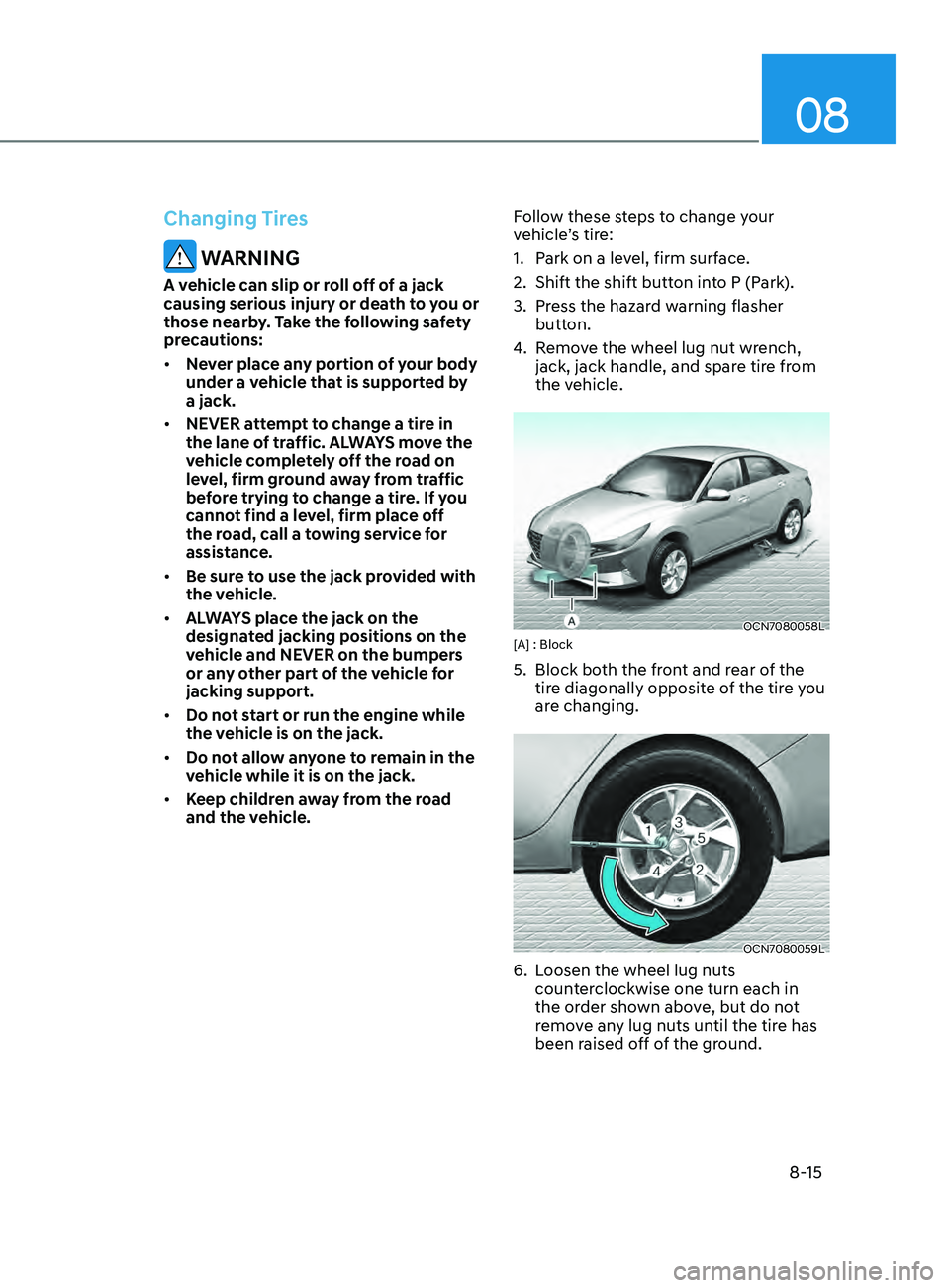
and the vehicle. Follow these steps to change your
vehicle’s tire:
1.
Park on a le
vel, firm surface.
2. Shift the shift button in to P (Park).
3.
Press the hazar
d warning flasher
button.
4.
Remo
ve the wheel lug nut wrench,
jack, jack handle, and spare tire from
the vehicle.
OCN7080058L[A] : Block
5. Block both the fr ont and rear of the
tire diagonally opposite of the tire you
are changing.
OCN7080059L
6. Loosen the wheel lug nuts
coun terclockwise one turn each in
the order shown above, but do not
remove any lug nuts until the tire has
been raised off of the ground.
Page 483 of 570
Emergency Situations
8-20
toWIng
Towing Service
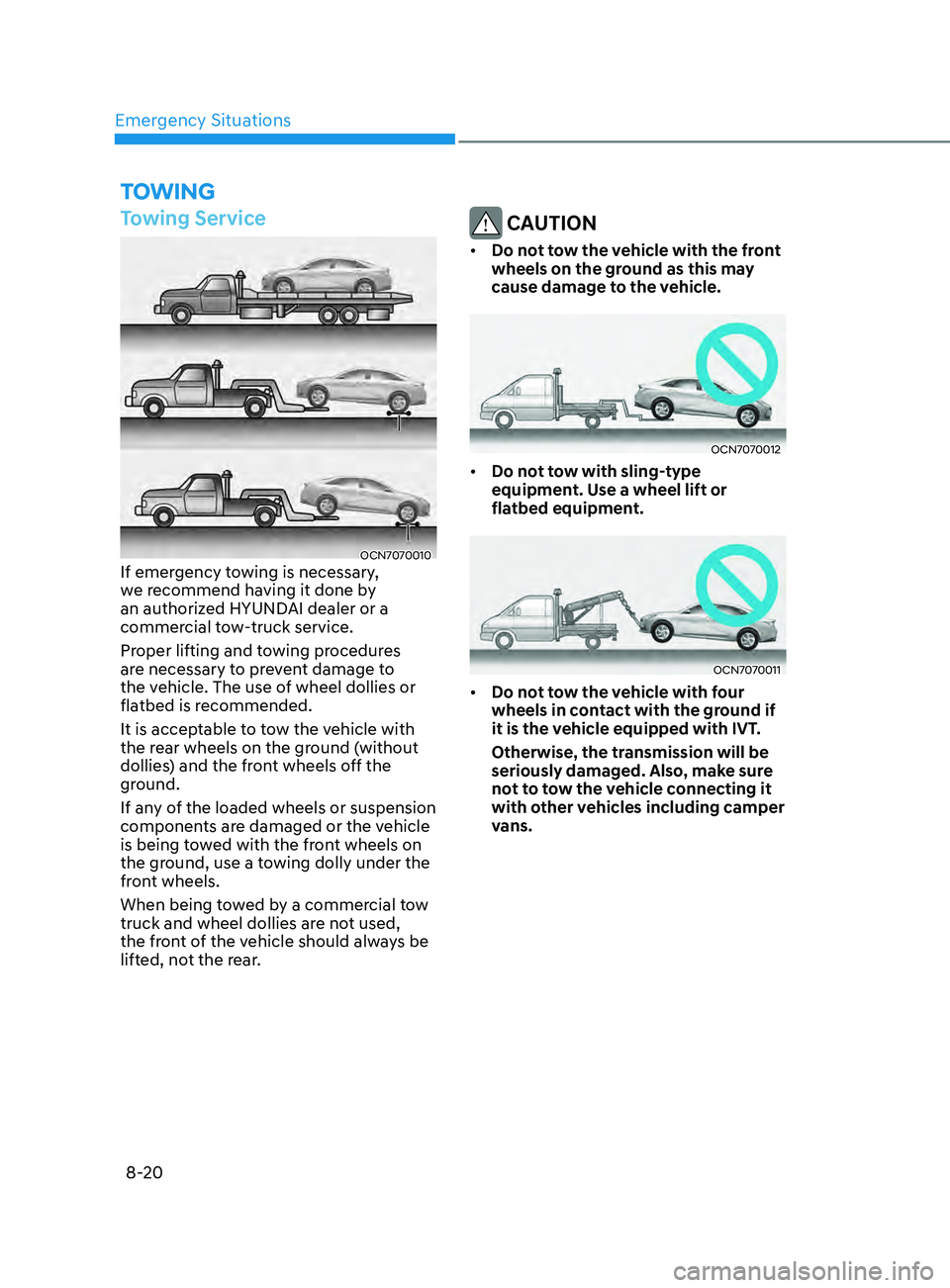
OCN7070010If emergency towing is necessary,
we recommend having it done by
an authorized HYUNDAI dealer or a
commercial tow-truck service.
Proper lifting and towing procedures
are necessary to prevent damage to
the vehicle. The use of wheel dollies or
flatbed is recommended.
It is acceptable to tow the vehicle with
the rear wheels on the ground (without
dollies) and the front wheels off the
ground.
If any of the loaded wheels or suspension
components are damaged or the vehicle
is being towed with the front wheels on
the ground, use a towing dolly under the
front wheels.
When being towed by a commercial tow
truck and wheel dollies are not used,
the front of the vehicle should always be
lifted, not the rear.
CAUTION
• Do not tow the vehicle with the front
wheels on the ground as this may
cause damage to the vehicle.
OCN7070012
• Do not tow with sling-type
equipment. Use a wheel lift or
flatbed equipment.
OCN7070011
• Do not tow the vehicle with four
wheels in contact with the ground if
it is the vehicle equipped with IVT.
Otherwise, the transmission will be
seriously damaged. Also, make sure
not to tow the vehicle connecting it
with other vehicles including camper
vans.
Page 484 of 570
08
8-21
WARNING
If your vehicle is equipped with a
rollover sensor, place the ignition
switch in the LOCK/OFF or ACC position
when the vehicle is being towed.
The side impact and curtain air bag
may deploy if the sensor detects the
situation as a rollover.
OCN7070095L
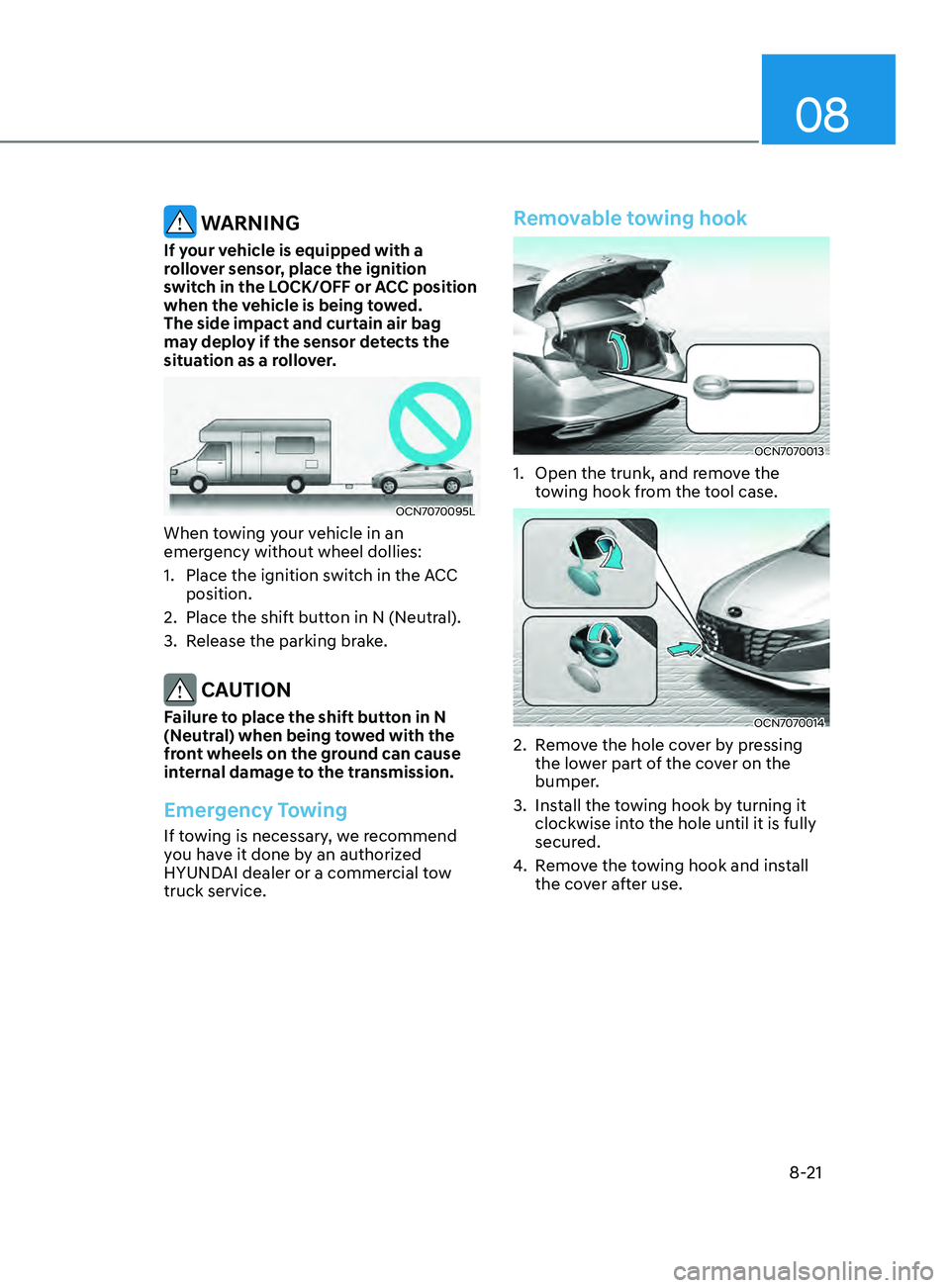
When towing your vehicle in an
emergency without wheel dollies:
1.
Place the ignition swit
ch in the ACC
position.
2.
Place the shift button in N (N
eutral).
3.
Release the parking br
ake.
CAUTION
Failure to place the shift button in N
(Neutral) when being towed with the
front wheels on the ground can cause
internal damage to the transmission.
Emergency Towing
If towing is necessary, we recommend
you have it done by an authorized
HYUNDAI dealer or a commercial tow
truck service.
Removable towing hook
OCN7070013
1. Open the trunk, and remo ve the
towing hook from the tool case.
OCN7070014
2. Remove the hole cover by pressing
the lo wer part of the cover on the
bumper.
3.
Install the t
owing hook by turning it
clockwise into the hole until it is fully
secured.
4.
Remo
ve the towing hook and install
the cover after use.