ABS HYUNDAI ELANTRA SEL 2021 Owner's Manual
[x] Cancel search | Manufacturer: HYUNDAI, Model Year: 2021, Model line: ELANTRA SEL, Model: HYUNDAI ELANTRA SEL 2021Pages: 570, PDF Size: 52.21 MB
Page 534 of 570
Maintenance
9-48
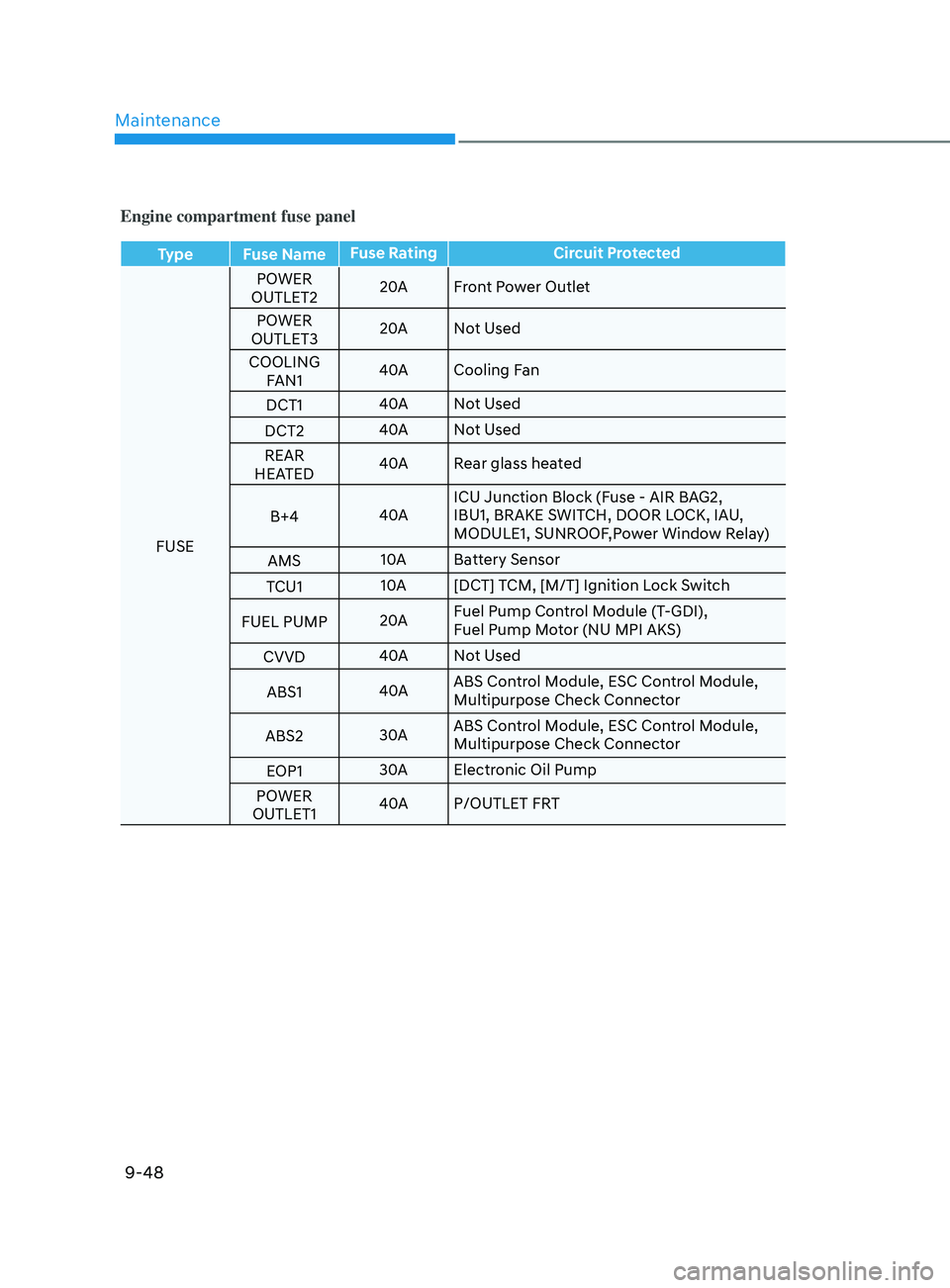
Engine compartment fuse panel
Type Fuse NameFuse Rating
Circuit Protected
FUSE POWER
OUTLET2 20A
Front Power Outlet
POWER
OUTLET3 20A
Not Used
COOLING FAN1 40A
Cooling Fan
DCT1 40A
Not Used
DCT2 40A
Not Used
REAR
HEATED 40A
Rear glass heated
B+4 40AICU Junction Block (Fuse - AIR BAG2,
IBU1, BRAKE SWITCH, DOOR LOCK, IAU,
MODULE1, SUNROOF,Power Window Relay)
AMS 10A
Battery Sensor
TCU1 10A
[DCT] TCM, [M/T] Ignition Lock Switch
FUEL PUMP 20AFuel Pump Control Module (T-GDI),
Fuel Pump Motor (NU MPI AKS)
CVVD 40A
Not Used
ABS1 40AABS Control Module, ESC Control Module,
Multipurpose Check Connector
ABS2 30AABS Control Module, ESC Control Module,
Multipurpose Check Connector
EOP1 30A
Electronic Oil Pump
POWER
OUTLET1 40A
P/OUTLET FRT
Page 535 of 570
![HYUNDAI ELANTRA SEL 2021 Owners Manual 09
9-49
Engine compartment fuse panel
Fuse NameFuse Rating
Circuit Protected
WIPER 25A Wiper Motor
ECU4 15A PCM/ECM
A/C 10A
[G4FM] A/C Compressor
HORN 15A Horn
IGN COIL 20A
Ignition Coil #1~#4
ECU3 15](/img/35/56089/w960_56089-534.png "HYUNDAI ELANTRA SEL 2021 Owners Manual 09
9-49
Engine compartment fuse panel
Fuse NameFuse Rating
Circuit Protected
WIPER 25A Wiper Motor
ECU4 15A PCM/ECM
A/C 10A
[G4FM] A/C Compressor
HORN 15A Horn
IGN COIL 20A
Ignition Coil #1~#4
ECU3 15")
09
9-49
Engine compartment fuse panel
Fuse NameFuse Rating
Circuit Protected
WIPER 25A Wiper Motor
ECU4 15A PCM/ECM
A/C 10A
[G4FM] A/C Compressor
HORN 15A Horn
IGN COIL 20A
Ignition Coil #1~#4
ECU3 15A PCM/ECM
SENSOR3 10A
E/R Junction Block (Fuel Pump Relay)
ECU2 10A
Not Used
SENSOR2 10A[G4NS] Variable Intake Solenoid Valve, Oil Pump
Solenoid Valve, Oil Control Valve #1/#2, Canister Close
Valve, Purge Control Solenoid Valve,
PCB Block (A/C Relay), E/R Junction Block (Cooling
Fan1/2 Relay)
ECU5 10A
ECM/PCM, [MT] Ignition Lock Switch
SENSOR1 15A Oxygen Sensor (UP/DOWN)
ABS3 10A
ABS Control Module, ESC Control Module
INJECTOR 15A [G4FM/G4FG/G4NA] Injector #1~#4
ECU1 20A
PCM/ECM
TCU2 15A Transaxle Range Switch
Page 539 of 570
09
9-53
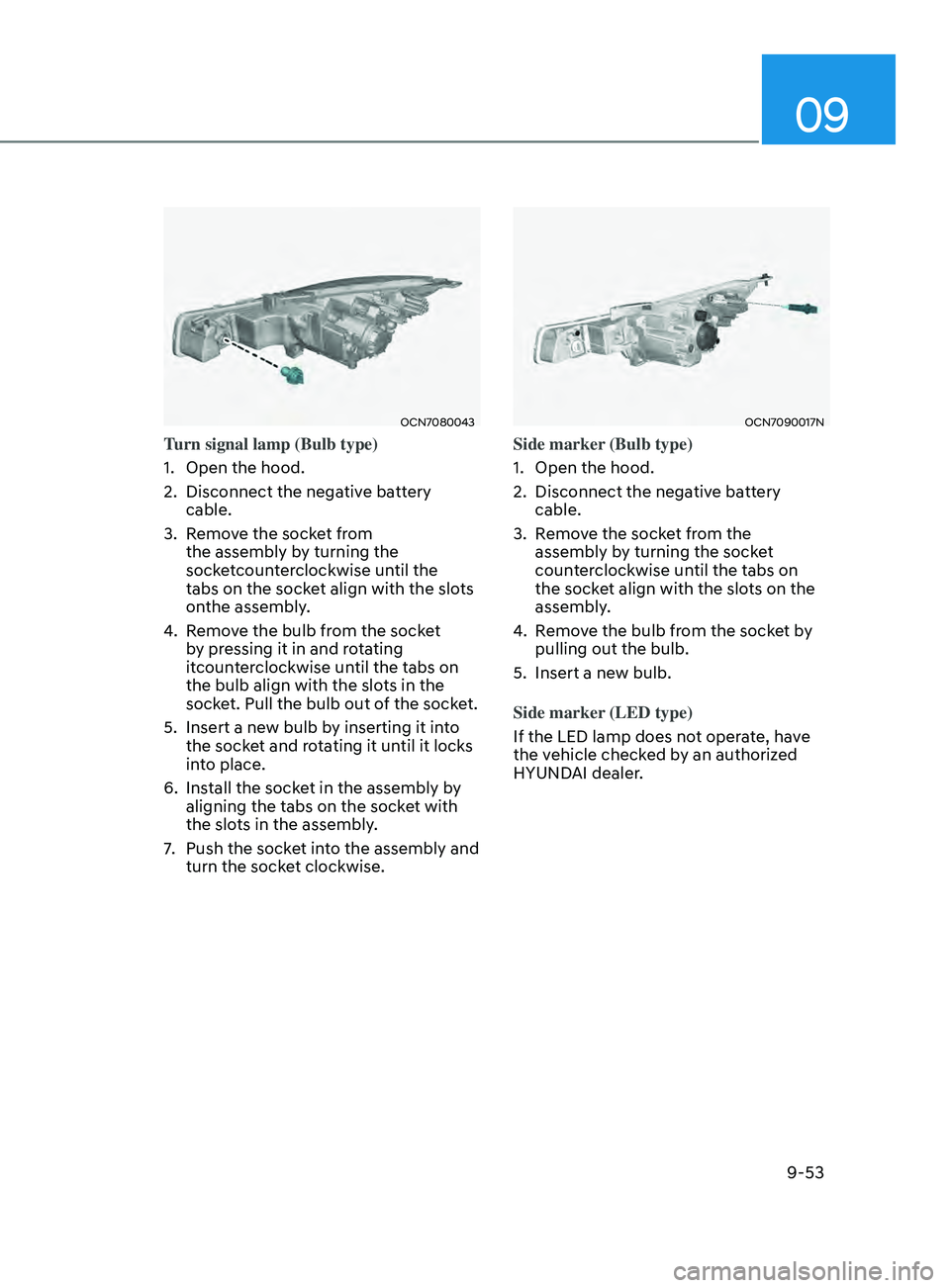
OCN7080043
Turn signal lamp (Bulb type)
1.
Open the hood.
2.
Disconnect the negativ
e battery
cable.
3.
Remo
ve the socket from
the assembly by turning the
socketcounterclockwise until the
tabs on the socket align with the slots
onthe assembly.
4.
Remo
ve the bulb from the socket
by pressing it in and rotating
itcounterclockwise until the tabs on
the bulb align with the slots in the
socket. Pull the bulb out of the socket.
5.
Insert a new bulb b
y inserting it into
the socket and rotating it until it locks
into place.
6.
Install the sock
et in the assembly by
aligning the tabs on the socket with
the slots in the assembly.
7.
Push the socke
t into the assembly and
turn the socket clockwise.
OCN7090017N
Side marker (Bulb type)
1.
Open the hood.
2.
Disconnect the negativ
e battery
cable.
3.
Remo
ve the socket from the
assembly by turning the socket
counterclockwise until the tabs on
the socket align with the slots on the
assembly.
4.
Remo
ve the bulb from the socket by
pulling out the bulb.
5.
Insert a new bulb.
Side marker
(LED type)
If the LED lamp does not operate, have
the vehicle checked by an authorized
HYUNDAI dealer.
Page 541 of 570

09
9-55
Tail/Stop lamp/Turn signal lamp/
Side marker (Outer lamp) (Bulb type)
1. Open the trunk lid.
OCN7080045
2. Remove the service cover by pulling
out the service cover.
OCN7080046
3. Loosen the assembly retaining nuts.
OCN7080047
4. Remove the rear combination light
assembly from the body of the
vehicle.
OCN7080075L
OCN7090019N
[A] : Tail/Stop lamp, [B] : Turn signal lamp,
[C] : Rear side marker
5. Remove the socket from the
assembly b y turning the socket
counterclockwise until the tabs on
the socket align with the slots on the
assembly.
6.
Remo
ve the bulb from the socket
by pressing it in and rotating it
counterclockwise until the tabs on the
bulb align with the slots in the socket.
Pull the bulb out of the socket.
7.
Insert a new bulb b
y inserting it into
the socket and rotating it until it locks
into place.
8.
Install the sock
et in the assembly by
aligning the tabs on the socket with
the slots in the assembly. Push the
socket into the assembly and turn the
socket clockwise.
Page 542 of 570

Maintenance
9-56
Tail lamp (Bulb type)
1. Open the trunk.
2.
Loosen the r
etaining screw of the
trunk lid cover and then remove the
cover.
OCN7080040
3. Remove the socket from the
assembly b y turning the socket
counterclockwise until the tabs on
the socket align with the slots on the
assembly.
4.
Remo
ve the bulb by pulling it out.
5.
Insert a new bulb b
y inserting it into
the socket.
6.
Reins
tall the trunk lid cover by
pushing in the screw.
Reverse lamp (Inner lamp)
(Bulb type)
1. Disconnect the connector and then
r emove the nuts by turning the nuts
counter clockwise.
2.
Tak
e the light assembly out.
OCN7080053
3. Remove the socket from the
assembly b y turning the socket
counterclockwise until the tabs on
the socket align with the slots on the
assembly.
4.
Remo
ve the bulb by pulling it out.
5.
Insert a new bulb b
y inserting it into
the socket.
6.
Install the ligh
t assembly to the trunk.
7.
Reins
tall the trunk lid cover by
pushing in the screw.
Stop/Tail lamp and rear side marker
(LED type)
If the LED lamp does not operate, we
recommend that you have the vehicle
checked by an authorized HYUNDAI
dealer.
Page 543 of 570
![HYUNDAI ELANTRA SEL 2021 Owners Manual 09
9-57
High mounted stop lamp
replacement
OCN7080032
OAD075042[A] : High mounted stop lamp
1. Open the trunk.
2.
Remo
ve the socket by turning it
counterclockwise until the tabs on the
socket al](/img/35/56089/w960_56089-542.png "HYUNDAI ELANTRA SEL 2021 Owners Manual 09
9-57
High mounted stop lamp
replacement
OCN7080032
OAD075042[A] : High mounted stop lamp
1. Open the trunk.
2.
Remo
ve the socket by turning it
counterclockwise until the tabs on the
socket al")
09
9-57
High mounted stop lamp
replacement
OCN7080032
OAD075042[A] : High mounted stop lamp
1. Open the trunk.
2.
Remo
ve the socket by turning it
counterclockwise until the tabs on the
socket align with the slots.
3.
Remo
ve the bulb from the socket
by pressing it in and rotating it
counterclockwise until the tabs on the
bulb align with the slots in the socket.
Pull the bulb out of the socket.
4.
Insert a new bulb b
y inserting it into
the socket and rotating it until it locks
into place.
5.
Install the sock
et in the assembly by
aligning the tabs on the socket with
the slots in the assembly.
Push the socket into the assembly and
turn the socket clockwise.
License Plate Light Bulb
Replacement
OCN7080035
1. Using a flat-blade screwdriver gently
pry the lens co ver from the lamp
housing.
2.
Remo
ve the bulb by pulling it straight
out.
3.
Install a ne
w bulb.
4.
Reins
tall in the reverse order.
Page 544 of 570

Maintenance
9-58
Interior Light Bulb Replacement
„„Sunvisor lamp
OCN7050058
„„Trunk room lamp
OCN7050059
„„Map lamp
OCN7080033
„„Room lamp
OCN7080034
1. Using a flat-blade screwdriver, gently pry the lens from the interior lamp housing.
2.
Remo
ve the bulb by pulling it straight out.
WARNING
Prior to working on the Interior Lights, ensure that the “OFF” button is depressed to
avoid burning your fingers or receiving an electric shock.
3.
Install a ne
w bulb in the socket.
4.
Align the lens tabs with the int
erior lamp housing notches and snap the lens into
place.
NOTICE
Use care not to dirty or damage lens, lens tab, and plastic housings.
Page 552 of 570
Maintenance
9-66
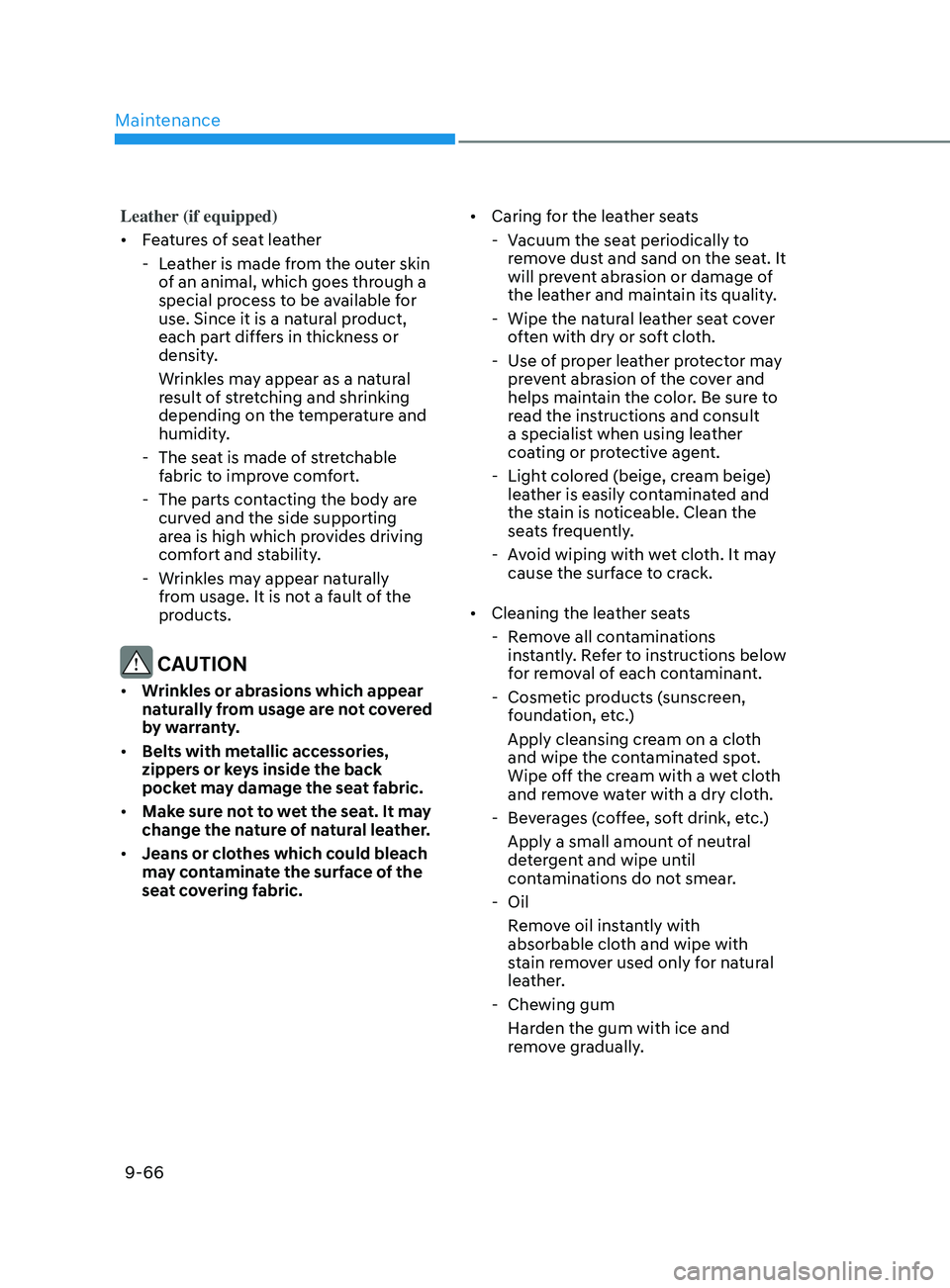
Leather (if equipped)
• Features of seat leather
- Lea
ther is made from the outer skin
of an animal, which goes through a
special process to be available for
use. Since it is a natural product,
each part differs in thickness or
density.
Wrinkles may appear as a natural
result of stretching and shrinking
depending on the temperature and
humidity.
- The seat is made o
f stretchable
fabric to improve comfort.
- The parts contacting the body ar
e
curved and the side supporting
area is high which provides driving
comfort and stability.
- Wrinkles ma
y appear naturally
from usage. It is not a fault of the
products.
CAUTION
• Wrinkles or abrasions which appear
naturally from usage are not covered
by warranty.
• Belts with metallic accessories,
zippers or keys inside the back
pocket may damage the seat fabric.
• Make sure not to wet the seat. It may
change the nature of natural leather.
• Jeans or clothes which could bleach
may contaminate the surface of the
seat covering fabric. •
Caring for the leather seats
- Vacuum the sea
t periodically to
remove dust and sand on the seat. It
will prevent abrasion or damage of
the leather and maintain its quality.
- Wipe the natur
al leather seat cover
often with dry or soft cloth.
- Use o
f proper leather protector may
prevent abrasion of the cover and
helps maintain the color. Be sure to
read the instructions and consult
a specialist when using leather
coating or protective agent.
- Light color
ed (beige, cream beige)
leather is easily contaminated and
the stain is noticeable. Clean the
seats frequently.
- Av
oid wiping with wet cloth. It may
cause the surface to crack.
• Cleaning the leather seats
- Remo
ve all contaminations
instantly. Refer to instructions below
for removal of each contaminant. - Cosmetic pr oducts (sunscreen,
foundation, etc.)
Apply cleansing cream on a cloth
and wipe the contaminated spot.
Wipe off the cream with a wet cloth
and remove water with a dry cloth.
- Bev
erages (coffee, soft drink, etc.)
Apply a small amount of neutral
detergent and wipe until
contaminations do not smear.
- Oil Remo
ve oil instantly with
absorbable cloth and wipe with
stain remover used only for natural
leather.
- Chewing gum
Har
den the gum with ice and
remove gradually.
Page 554 of 570
Maintenance
9-68
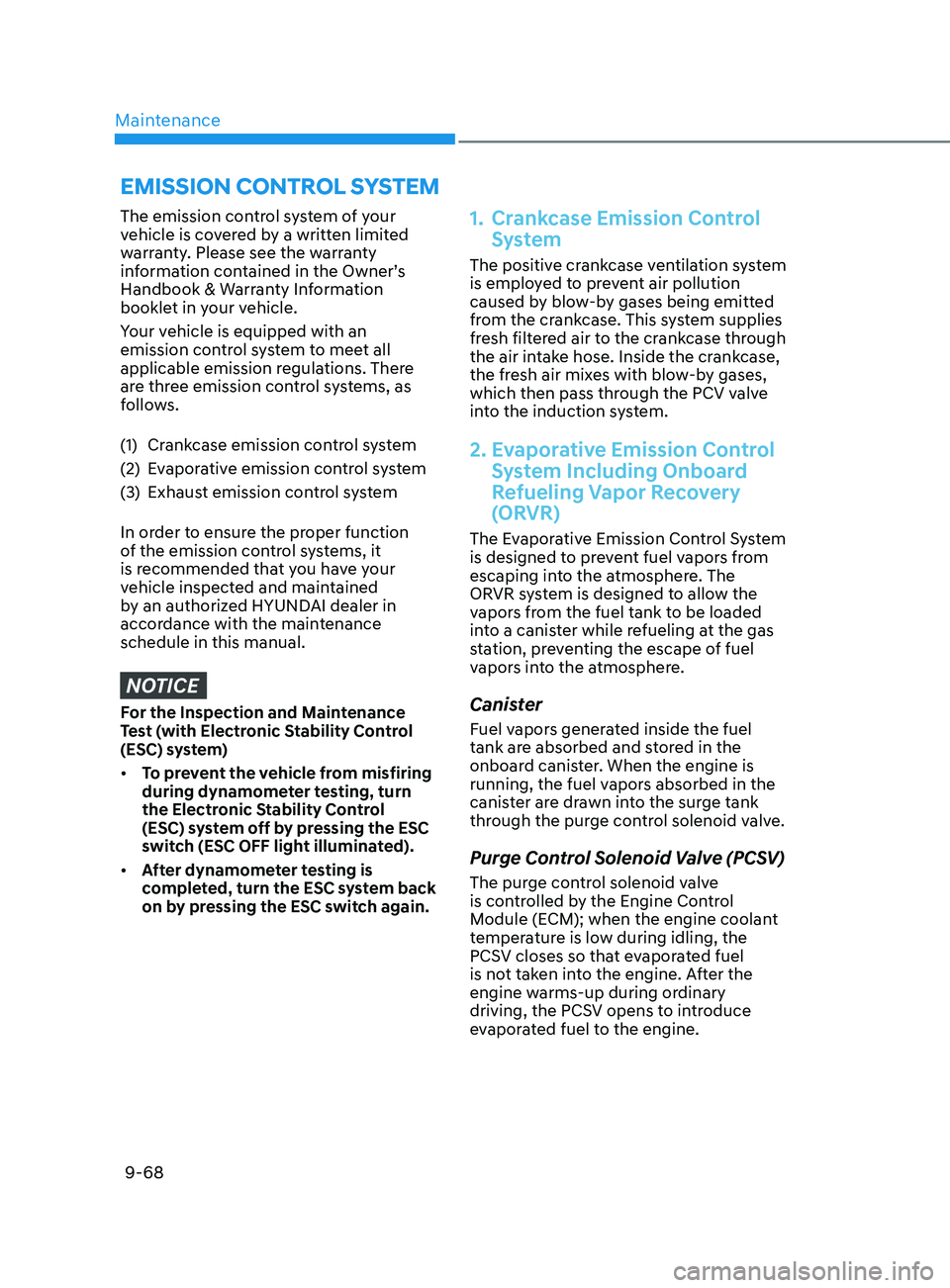
The emission control system of your
vehicle is covered by a written limited
warranty. Please see the warranty
information contained in the Owner’s
Handbook & Warranty Information
booklet in your vehicle.
Your vehicle is equipped with an
emission control system to meet all
applicable emission regulations. There
are three emission control systems, as
follows.
(1)
Crank
case emission control system
(2)
Ev
aporative emission control system
(3)
Exhaust emission con
trol system
In order to ensure the proper function
of the emission control systems, it
is recommended that you have your
vehicle inspected and maintained
by an authorized HYUNDAI dealer in
accordance with the maintenance
schedule in this manual.
NOTICE
For the Inspection and Maintenance
Test (with Electronic Stability Control
(ESC) system)
• To prevent the vehicle from misfiring
during dynamometer testing, turn
the Electronic Stability Control
(ESC) system off by pressing the ESC
switch (ESC OFF light illuminated).
• After dynamometer testing is
completed, turn the ESC system back
on by pressing the ESC switch again.
1. Crankcase Emission Control
Sy
stem
The positive crankcase ventilation system
is employed to prevent air pollution
caused by blow-by gases being emitted
from the crankcase. This system supplies
fresh filtered air to the crankcase through
the air intake hose. Inside the crankcase,
the fresh air mixes with blow-by gases,
which then pass through the PCV valve
into the induction system.
2. Evaporative Emission Control
System Including Onboard
Refueling Vapor Recovery
(ORVR)
The Evaporative Emission Control System
is designed to prevent fuel vapors from
escaping into the atmosphere. The
ORVR system is designed to allow the
vapors from the fuel tank to be loaded
into a canister while refueling at the gas
station, preventing the escape of fuel
vapors into the atmosphere.
Canister
Fuel vapors generated inside the fuel
tank are absorbed and stored in the
onboard canister. When the engine is
running, the fuel vapors absorbed in the
canister are drawn into the surge tank
through the purge control solenoid valve.
Purge Control Solenoid Valve (PCSV)
The purge control solenoid valve
is controlled by the Engine Control
Module (ECM); when the engine coolant
temperature is low during idling, the
PCSV closes so that evaporated fuel
is not taken into the engine. After the
engine warms-up during ordinary
driving, the PCSV opens to introduce
evaporated fuel to the engine.
EmiSSion Control SyStEm
Page 559 of 570

Index
I-2
A
Accessing Your Vehicle
........................................................................\
.................5-4
Automatic Door Lock and Unlock Features ....................................................5-35
Child-Protector Rear Door Locks .................................................................... 5-35
Hyundai Digital Key ........................................................................\
................ 5-15
Immobilizer System ........................................................................\
................5-14
Operating Door Locks from Inside the V
ehicle................................................ 5-33
Operating Door Locks from Outside the V
ehicle
.............................................5-31
Rear Occupant Alert (ROA) System ................................................................ 5-36
Remote Key ........................................................................\
................................ 5-4
Smart Key ........................................................................\
................................... 5-7
Air Bag -
Advanced Supplemental Restraint System
.......................................... 3-35
Additional Safety Precautions ........................................................................\
.. 3-55
Air Bag W
arning Labels
........................................................................\
........... 3-55
How Does the Air Bag System Operate? .........................................................3-40
Occupant Classification System (OCS) ........................................................... 3-44
SRS Care ........................................................................\
.................................. 3-54
What to Expect After an
Air Bag Inflates
........................................................ 3-43
Where Are
the Air Bags?
........................................................................\
.......... 3-37
Why Didn’t My
Air Bag Go Off in a Collision?
.............................................. 3-50
Air Cleaner
........................................................................\
................................... 9-20
Filter replacement ........................................................................\
..................... 9-20
Air Conditioning System
........................................................................\
............. 2-10
Anti-lock Brake System (ABS)
........................................................................\
... 6-29
Electronic Stability Control (ESC) ..................................................................6-31
Good Braking Practices ........................................................................\
............ 6-34
Hill-Start Assist Control (HAC) .......................................................................6-34
Vehicle Stability Management (VSM) ............................................................6-33
Appearance Care
........................................................................\
.......................... 9-59
Exterior Care ........................................................................\
............................ 9-59
Interior Care ........................................................................\
............................. 9-65
Automatic Climate Control System
..................................................................... 5-92
Automatic heating and air conditioning ...........................................................5-93
Manual heating and air conditioning ................................................................ 5-94
System Maintenance ........................................................................\
.............. 5-102
System operation ........................................................................\
.................... 5-100