climate control HYUNDAI ELANTRA SEL 2021 Owner's Manual
[x] Cancel search | Manufacturer: HYUNDAI, Model Year: 2021, Model line: ELANTRA SEL, Model: HYUNDAI ELANTRA SEL 2021Pages: 570, PDF Size: 52.21 MB
Page 294 of 570
06
6-35
The Idle Stop and Go (ISG) system
automatically and temporarily shuts
down the engine when the vehicle is
stopped and idling to help improve
fuel efficiency and reduce exhaust gas
emissions. (i.e. red stop light, stop sign,
and traffic jam).
The engine is automatically started upon
satisfying the starting conditions.
The ISG system is always active, when
the engine is running.
Information
When the engine is automatically started
by the ISG system, some warning
lights (i.e. ABS, ESC, ESC OFF, EPS,
and parking brake warning light) may
illuminate for a few seconds due to the
low battery voltage. However, it does
not indicate a malfunction with the ISG
system.
To Activate the ISG System
Prerequisite for activation
The ISG system operates in the following
situations.
• The driver's seatbelt is fastened
• The driver's door and hood are closed
• The brake vacuum pressure is
adequate
• The battery sensor is activated and
the battery is sufficiently charged
• Outside temperature is not too low or
too high
• The vehicle is driven over a constant
speed and stops
• The climate control system satisfies
the conditions
• The vehicle is sufficiently warmed up
• The incline is gradual
• The steering wheel is turned less than
180 degrees and then the vehicle
stops
Information
If the ISG light (white) is turned on on the
instrument cluster and does not meet the
ISG system operating conditions, the ISG
system is not activated.
When the ISG light (yellow) is on while the
ISG system meets operating conditions, we
recommend that the system be inspected
by an authorized HYUNDAI dealer.
Auto stop
To stop the engine in idle stop mode
1.
Decrease the v
ehicle speed to 0 mph.
2.
Depress the br
ake pedal with the shift
button in D (Drive) or N (Neutral).
The auto stop indicator (
) illuminates
in green on the instrument cluster, when
the engine stops.
Information
The driving speed must reach at least 3
mph (5 km/h) after an idle stop to stop the
engine in idle stop mode again.
In auto stop mode, when the driver
opens the hood, the ISG system will be
deactivated.
Isg (Idle stop and go) s ystem (If e quIpped)
Page 295 of 570
6-36
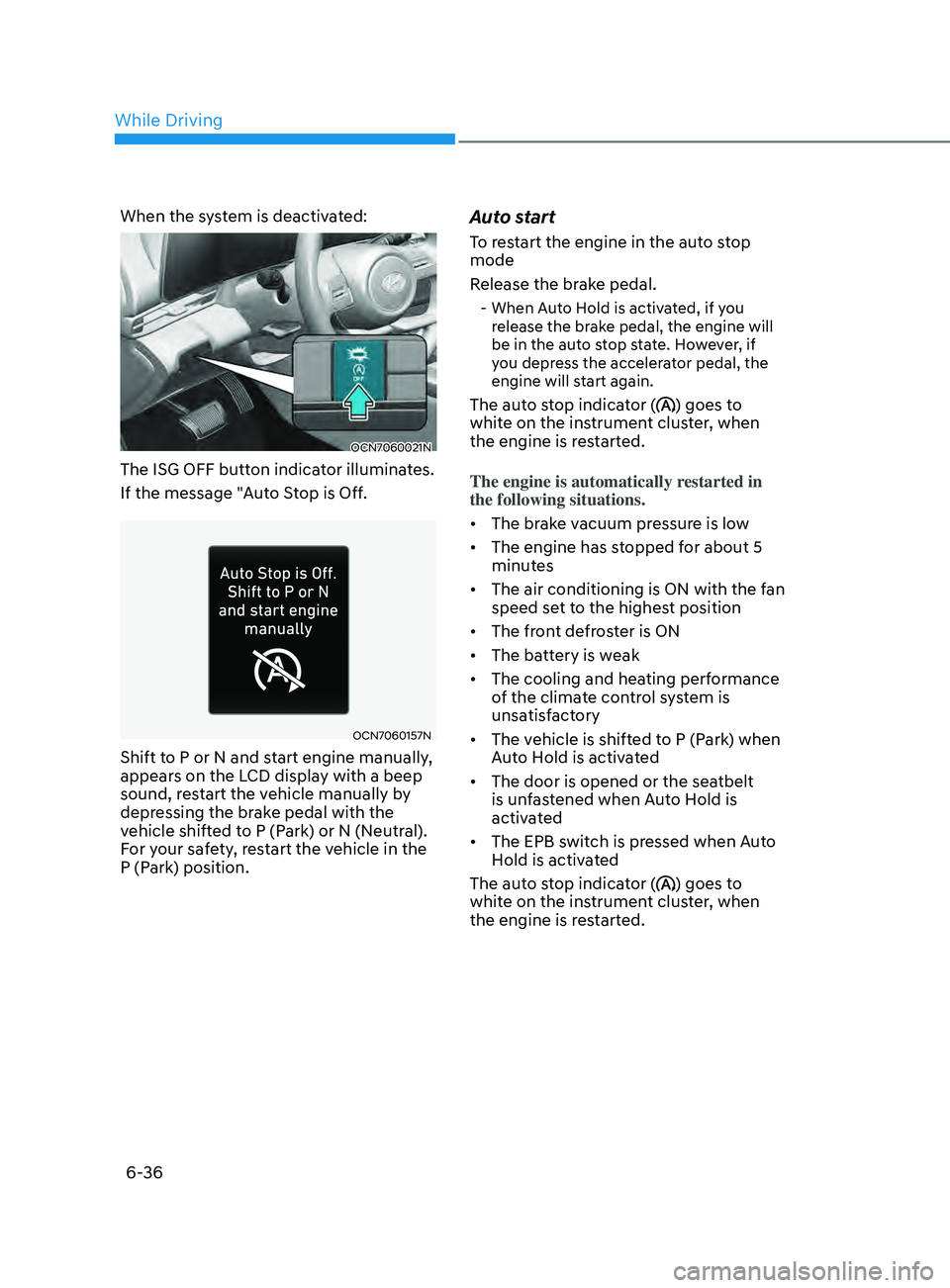
When the system is deactivated:
OCN7060021N
The ISG OFF button indicator illuminates.
If the message "Auto Stop is Off.
OCN7060157N
Shift to P or N and start engine manually,
appears on the LCD display with a beep
sound, restart the vehicle manually by
depressing the brake pedal with the
vehicle shifted to P (Park) or N (Neutral).
For your safety, restart the vehicle in the
P (Park) position.
Auto start
To restart the engine in the auto stop
mode
Release the brake pedal.
- When Auto Hold is activated, if you release the brake pedal, the engine will
be in the auto stop state. However, if
you depress the accelerator pedal, the
engine will start again.
The auto stop indicator () goes to
white on the instrument cluster, when
the engine is restarted.
The engine is automatically restarted in
the following situations.
• The brake vacuum pressure is low
• The engine has stopped for about 5
minutes
• The air conditioning is ON with the fan
speed set to the highest position
• The front defroster is ON
• The battery is weak
• The cooling and heating performance
of the climate control system is
unsatisfactory
• The vehicle is shifted to P (Park) when
Auto Hold is activated
• The door is opened or the seatbelt
is unfastened when Auto Hold is
activated
• The EPB switch is pressed when Auto
Hold is activated
The auto stop indicator (
) goes to
white on the instrument cluster, when
the engine is restarted.
While Driving
Page 505 of 570
09
9-19
parking BrakE
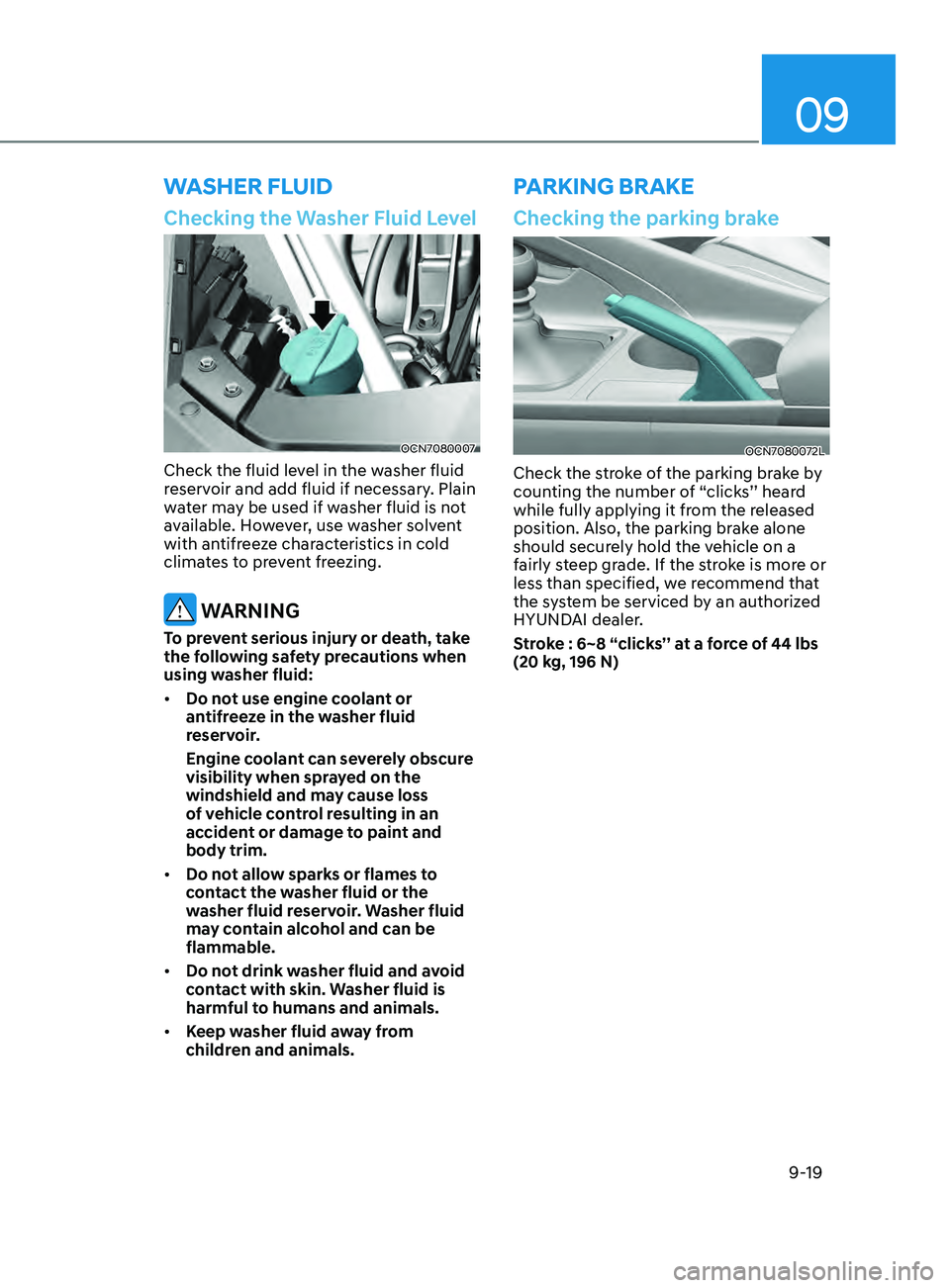
Checking the Washer Fluid Level
OCN7080007
Check the fluid level in the washer fluid
reservoir and add fluid if necessary. Plain
water may be used if washer fluid is not
available. However, use washer solvent
with antifreeze characteristics in cold
climates to prevent freezing.
WARNING
To prevent serious injury or death, take
the following safety precautions when
using washer fluid:
• Do not use engine coolant or
antifreeze in the washer fluid
reservoir.
Engine coolant can severely obscure
visibility when sprayed on the
windshield and may cause loss
of vehicle control resulting in an
accident or damage to paint and
body trim.
• Do not allow sparks or flames to
contact the washer fluid or the
washer fluid reservoir. Washer fluid
may contain alcohol and can be
flammable.
• Do not drink washer fluid and avoid
contact with skin. Washer fluid is
harmful to humans and animals.
• Keep washer fluid away from
children and animals.
waShEr fl uid
Checking the parking brake
OCN7080072L
Check the stroke of the parking brake by
counting the number of “clicks’’ heard
while fully applying it from the released
position. Also, the parking brake alone
should securely hold the vehicle on a
fairly steep grade. If the stroke is more or
less than specified, we recommend that
the system be serviced by an authorized
HYUNDAI dealer.
Stroke : 6~8 “clicks’’ at a force of 44 lbs
(20 kg, 196 N)
Page 512 of 570
Maintenance9-26
Battery Recharging
WARNING
Always follow these instructions when
recharging your vehicle’s battery to
avoid the risk of SERIOUS INJURY or
DEATH from explosions or acid burns:
• Before performing maintenance or
recharging the battery, turn off all
accessories and place the ignition
switch to the LOCK/OFF position.
• Keep all flames, sparks, or smoking
materials away from the battery.
• Always work outdoors or in an area
with plenty of ventilation.
• Wear eye protection when checking
the battery during charging.
• The battery must be removed from
the vehicle and placed in a well
ventilated area.
• Watch the battery during charging,
and stop or reduce the charging
rate if the battery cells begin boiling
violently.
• Vehicle is equipped with the
Absorbent Glass Mat (AGM) battery.
Do not charge the AGM battery with
a general charger. It may damage
or explode the AGM battery. Only
charge the AGM battery with a
charger that has AGM battery
setting.
• The negative battery cable must
be removed first and installed last
when the battery is disconnected.
Disconnect the battery charger in the
following order:
1.
Turn o
ff the battery charger main
switch.
2.
Unhook the nega
tive clamp from
the negative battery terminal.
3.
Unhook the positiv
e clamp from
the positive battery terminal.
• Always use a genuine HYUNDAI
approved battery when you replace
the battery.
NOTICE
AGM battery (if equipped)
• Absorbent Glass Matt (AGM)
batteries are maintenance-free
and we recommend that the AGM
battery be serviced by an authorized
HYUNDAI dealer. For charging
your AGM battery, use only fully
automatic battery chargers that
are specially developed for AGM
batteries.
• When replacing the AGM battery,
we recommend that you use parts
for replacement from an authorized
HYUNDAI dealer.
• Do not open or remove the cap on
top of the battery. This may cause
leaks of internal electrolyte that
could result in severe injury.
By jump starting
After a jump start from a good battery,
drive the vehicle for 20-30 minutes
before it is shutoff. The vehicle may
not restart if you shut it off before the
battery had a chance to adequately
recharge. See “Jump Starting” in chapter
7 for more information on jump starting
procedures.
Information
An inappropriately disposed
battery can be harmful to
the environment and human
health. Dispose of the battery
according to your local law(s) or
regulations.
Reset items
Items should be reset after the battery
has been discharged or the battery has
been disconnected.
• Auto up/down window (See chapter 5)
• Sunroof (See chapter 5)
• Trip computer (See chapter 4)
• Climate control system (See chapter 5)
Page 517 of 570
09
9-31
WARNING
To reduce the risk of DEATH or SERIOUS
INJURY:
• Replace tires that are worn, show
uneven wear, or are damaged.
Worn tires can cause loss of braking
effectiveness, steering control, and
traction.
• Always replace tires with the same
size as each tire that was originally
supplied with this vehicle. Using
tires and wheels other than the
recommended sizes could cause
unusual handling characteristics,
poor vehicle control, or negatively
affect your vehicle’s Anti-Lock Brake
System (ABS) resulting in a serious
accident.
• Tires degrade over time, even when
they are not being used. Regardless
of the remaining tread, HYUNDAI
recommends that tires be replaced
after six (6) years of normal service.
• When replacing tires, it is
recommended to replace the two
front or two rear tires as a pair.
Replacing just one tire can seriously
affect your vehicle’s handling. If
only replacing one pair of tires, it is
recommended to install the pair of
new tires on the rear axle.
• Heat caused by hot climates or
frequent high loading conditions can
accelerate the aging process. Failure
to follow this warning may cause
sudden tire failure, which could lead
to a loss of vehicle control resulting
in an accident.
Compact spare tire replacement
A compact spare tire has a shorter
tread life than a regular size tire.
Replace it when you can see the tread
wear indicator bars on the tire. The
replacement compact spare tire should
be the same size and design tire as the
one provided with your new vehicle
and should be mounted on the same
compact spare tire wheel. The compact
spare tire is not designed to be mounted
on a regular size wheel, and the compact
spare tire wheel is not designed for
mounting a regular size tire.
WARNING
The original tire should be repaired or
replaced as soon as possible to avoid
failure of the spare and loss of vehicle
control resulting in an accident. The
compact spare tire is for emergency
use only. Do not operate your vehicle
over 50 mph (80 km/h) when using the
compact spare tire.
Page 520 of 570
Maintenance
9-34
5. Maximum permissible inflation
pressure
This number is the greatest amount
of air pressure that should be put in
the tire. Do not exceed the maximum
permissible inflation pressure. Refer to
the Tire and Loading Information label
for recommended inflation pressure.
6. Maximum load rating
This number indicates the maximum
load in kilograms and pounds that can be
carried by the tire. When replacing the
tires on the vehicle, always use a tire that
has the same load rating as the factory
installed tire.
7. Uniform tire quality grading
Quality grades can be found where
applicable on the tire sidewall between
tread shoulder and maximum section
width.
For example:
TREAD WEAR 200
TRACTION AA
TEMPERATURE A Tread wear
The tread wear grade is a comparative
rating based on the wear rate of the tire
when tested under controlled conditions
on a specified government test course.
For example, a tire graded 150 would
wear one-and-a-half times (1½) as well
on the government course as a tire
graded 100.
The relative performance of tires
depends upon the actual conditions
of their use, however, and may depart
significantly from the norm due to
variations in driving habits, service
practices and differences in road
characteristics and climate.
These grades are molded on the
sidewalls of passenger vehicle tires. The
tires available as standard or optional
equipment on your vehicle may vary with
respect to grade.
Traction AA, A, B & C
The traction grades, from highest to
lowest, are AA, A, B and C. Those grades
represent the tire’s ability to stop on wet
pavement as measured under controlled
conditions on specified government
test surfaces of asphalt and concrete.
A tire marked C may have poor traction
performance.
WARNING
The traction grade assigned to this tire
is based on straight-ahead braking
traction tests, and does not include
acceleration, cornering, hydroplaning,
or peak traction characteristics.
Page 559 of 570

Index
I-2
A
Accessing Your Vehicle
........................................................................\
.................5-4
Automatic Door Lock and Unlock Features ....................................................5-35
Child-Protector Rear Door Locks .................................................................... 5-35
Hyundai Digital Key ........................................................................\
................ 5-15
Immobilizer System ........................................................................\
................5-14
Operating Door Locks from Inside the V
ehicle................................................ 5-33
Operating Door Locks from Outside the V
ehicle
.............................................5-31
Rear Occupant Alert (ROA) System ................................................................ 5-36
Remote Key ........................................................................\
................................ 5-4
Smart Key ........................................................................\
................................... 5-7
Air Bag -
Advanced Supplemental Restraint System
.......................................... 3-35
Additional Safety Precautions ........................................................................\
.. 3-55
Air Bag W
arning Labels
........................................................................\
........... 3-55
How Does the Air Bag System Operate? .........................................................3-40
Occupant Classification System (OCS) ........................................................... 3-44
SRS Care ........................................................................\
.................................. 3-54
What to Expect After an
Air Bag Inflates
........................................................ 3-43
Where Are
the Air Bags?
........................................................................\
.......... 3-37
Why Didn’t My
Air Bag Go Off in a Collision?
.............................................. 3-50
Air Cleaner
........................................................................\
................................... 9-20
Filter replacement ........................................................................\
..................... 9-20
Air Conditioning System
........................................................................\
............. 2-10
Anti-lock Brake System (ABS)
........................................................................\
... 6-29
Electronic Stability Control (ESC) ..................................................................6-31
Good Braking Practices ........................................................................\
............ 6-34
Hill-Start Assist Control (HAC) .......................................................................6-34
Vehicle Stability Management (VSM) ............................................................6-33
Appearance Care
........................................................................\
.......................... 9-59
Exterior Care ........................................................................\
............................ 9-59
Interior Care ........................................................................\
............................. 9-65
Automatic Climate Control System
..................................................................... 5-92
Automatic heating and air conditioning ...........................................................5-93
Manual heating and air conditioning ................................................................ 5-94
System Maintenance ........................................................................\
.............. 5-102
System operation ........................................................................\
.................... 5-100
Page 561 of 570

Index
I-4
C
Cabin Air Filter
........................................................................\
............................9-21
California Perchlorate notice
........................................................................\
....... 9-71
Child Restraint System (CRS)
........................................................................\
..... 3-26
Children Always in the Rear ........................................................................\
....3-26
Installing a Child Restraint System (CRS) .......................................................3-28
Selecting a Child Restraint System (CRS) .......................................................3-27
Climate Control
Additional Features
................................................................. 5-109
Auto comfort control (for driver’
s seat)
......................................................... 5-109
Automatic ventilation ........................................................................\
............. 5-109
Sunroof inside air recirculation ......................................................................5-109
Consumer Information
........................................................................\
................. 2-15
Cruise Control (CC)
........................................................................\
.................... 7-77
Function operation ........................................................................\
...................7-77
D
Declaration of Conformity
........................................................................\
......... 7-150
Dimensions
........................................................................\
.................................... 2-7
Drive Mode Integrated Control System
............................................................... 6-39
Drive Mode ........................................................................\
.............................. 6-39
Smart shift on trip computer ........................................................................\
.....6-42
Driver Attention
Warning (DAW)
...................................................................... 7-71
Function malfunction and limitations ..............................................................7-74
Function settings ........................................................................\
..................... 7-71
System operation ........................................................................\
...................... 7-72
E
Emission Control System
........................................................................\
............ 9-68
Engine Compartment
........................................................................\
............. 2-6/ 9-3
Engine Coolant
........................................................................\
............................ 9-16
Changing Engine Coolant ........................................................................\
........9-17
Checking the Engine Coolant Level .................................................................9-16
Engine Number
........................................................................\
............................ 2-14
Engine Oil
........................................................................\
.................................... 9-15
Checking the Engine Oil and Filter ..................................................................9-15
Checking the Engine Oil Level ........................................................................\
9-15
Engine Specification
........................................................................\
...................... 2-7
Explanation of Scheduled Maintenance Items
.................................................... 9-13
Page 566 of 570

I
I-9
Manual Climate Control System ........................................................................\
.5-81
Heating and Air Conditioning ........................................................................\
.. 5-82
System Maintenance ........................................................................\
................ 5-90
System operation ........................................................................\
...................... 5-88
Manual Speed Limit Assist (MSLA)
.................................................................. 7-63
System operation ........................................................................\
..................... 7-63
Mirrors
........................................................................\
......................................... 5-41
Inside Rearview Mirror ........................................................................\
............5-41
Side View
Mirrors
........................................................................\
.................... 5-49
N
Navigation-Based Smart Cruise Control (NSCC)
............................................... 7-98
Function operation ........................................................................\
.................... 7-99
Function settings ........................................................................\
...................... 7-98
Limitations of the function ........................................................................\
.....7-101
O
Owner Maintenance
........................................................................\
....................... 9-5
Owner Maintenance Schedule ........................................................................\
....9-5
P
Parking brake
........................................................................\
............................... 9-19
Checking the parking brake ........................................................................\
......9-19
R
Rear Cross-T
raffic Collision Warning (RCCW)
................................................ 7-120
Function malfunction and limitations ............................................................ 7-124
Function operation ........................................................................\
.................. 7-122
Function settings ........................................................................\
.................... 7-121
Rear Cross-T
raffic Collision-Avoidance Assist (RCCA)
................................. 7-128
Function malfunction and limitations ............................................................ 7-134
Function operation ........................................................................\
.................. 7-130
Function settings ........................................................................\
.................... 7-129
Rear
View Monitor (RVM)
........................................................................\
....... 7-1
16
Function malfunction and limitations ............................................................7-1
19
Function operation ........................................................................\
..................7-1
17
Function settings ........................................................................\
....................7-1
17
Page 570 of 570

I
I-13
W
Washer Fluid
........................................................................\
................................9-19
Checking the W
asher Fluid Level
.................................................................... 9-19
W
indows
........................................................................\
...................................... 5-51
Power Windows ........................................................................\
........................5-52
W
indshield Defrosting and Defogging
.............................................................. 5-104
Auto defogging system (only for automatic climate control system) ............5-107
Automatic climate control system .................................................................. 5-105
Defogging logic ........................................................................\
..................... 5-106
Defroster ........................................................................\
................................. 5-108
Manual climate control system ......................................................................5-104
W
inter Driving
........................................................................\
............................. 6-46
Snow or Icy Conditions ........................................................................\
............6-46
Winter Precautions ........................................................................\
................... 6-47
W
iper Blades
........................................................................\
................................ 9-22
Blade Inspection ........................................................................\
.......................9-22
Blade Replacement ........................................................................\
...................9-22
W
ipers and Washers
........................................................................\
..................... 5-79
Windshield
Washers
........................................................................\
................. 5-80
Windshield
Wipers
........................................................................\
................... 5-79