tire pressure HYUNDAI ELANTRA SEL 2021 Owner's Guide
[x] Cancel search | Manufacturer: HYUNDAI, Model Year: 2021, Model line: ELANTRA SEL, Model: HYUNDAI ELANTRA SEL 2021Pages: 570, PDF Size: 52.21 MB
Page 480 of 570

08
8-17
If you have a tire gauge, check the tire
pressure (see “Tires and Wheels” in
chapter 2 for tire pressure instructions.).
If the pressure is lower or higher than
recommended, drive slowly to the
nearest service station and adjust it to
the recommended pressure. Always
reinstall the valve cap after checking
or adjusting tire pressure. If the cap
is not replaced, air may leak from the
tire. If you lose a valve cap, buy another
and install it as soon as possible. After
changing tires, secure the flat tire and
return the jack and tools to their proper
storage locations. If it is hard to secure
the flat tire, put the flat tire in the
luggage compartment.
NOTICE
• Check the tire pressure as soon
as possible after installing a spare
tire. Adjust it to the recommended
pressure.
• Check and tighten the wheel lug
nuts after driving over 30 miles (50
km), after the spare tire is installed.
Recheck the tire wheel lug nuts after
driving over 620 miles (1,000 km)
after the replaced tire is reinstalled.
CAUTION
Your vehicle has metric threads on the
studs and lug nuts. Make certain during
tire changing that the same nuts that
were removed are reinstalled. If you
have to replace your lug nuts make
sure they have metric threads to avoid
damaging the studs and ensure the
wheel is properly secured to the hub.
Consult an authorized HYUNDAI dealer
for assistance.
If any of the equipment such as the jack,
lug nuts, studs, or other equipment is
damaged or in poor condition, do not
attempt to change the tire and call for
assistance.
Use of compact spare tires (if equipped)
Compact spare tires are designed for
emergency use only. Drive carefully on
the compact spare tire and always follow
the safety precautions.
WARNING
To prevent compact spare tire failure
and loss of control possibly resulting in
an accident:
• Use the compact spare tire only in an
emergency.
• NEVER operate your vehicle over 50
mph (80 km/h).
• Do not exceed the vehicle’s
maximum load rating or the load
carrying capacity shown on the
sidewall of the compact spare tire.
• Do not use the compact spare tire
continuously. Repair or replace the
original tire as soon as possible to
avoid failure of the compact spare
tire.
Page 481 of 570
Emergency Situations
8-18
When driving with the compact spare tire
mounted to your vehicle:
• Check the tire pressure after installing
the compact spare tire. The compact
spare tire should be inflated to 60 psi
(420 kPa).
• Do not take this vehicle through
an automatic car wash while the
compact spare tire is installed.
• Do not use the compact spare tire on
any other vehicle because this tire
has been designed especially for your
vehicle.
• The compact spare tire’s tread life is
shorter than a regular tire. Inspect
your compact spare tire regularly and
replace worn compact spare tires with
the same size and design, mounted on
the same wheel.
• Do not use more than one compact
spare tire at a time.
NOTICE
When the original tire and wheel are
repaired and reinstalled on the vehicle,
the lug nut torque must be set correctly.
The correct lug nut tightening torque is
79~94 lbf·ft (11~13 kgf·m).
CAUTION
To prevent damaging the compact
spare tire and your vehicle:
• Drive slowly enough for the road
conditions to avoid all hazards, such
as a potholes or debris.
• Avoid driving over obstacles. The
compact spare tire diameter is
smaller than the diameter of a
conventional tire and reduces the
ground clearance approximately 1
inch (25 mm).
• Do not use tire chains on the
compact spare tire. Because of the
smaller size, a tire chain will not fit
properly.
• Do not use the compact spare tire
on any other wheels, nor should
standard tires, snow tires, wheel
covers or trim rings be used with the
compact spare wheel.
Page 488 of 570

Tires and Wheels ........................................................................\
..................9-27Tire Care ........................................................................\
.......................................... 9-27
R ecommended Cold Tire Inflation Pressures ....................................................... 9-
27
Check Tire Inflation Pressure
........................................................................\
......... 9-
28
Tire Rotation
........................................................................\
................................... 9-
29
Wheel Alignment and Tire Balance
....................................................................... 9-30
Tir
e Replacement
........................................................................\
........................... 9-
30
Wheel Replacement
........................................................................\
....................... 9-
32
Tire Traction
........................................................................\
.................................... 9-
32
Tire Maintenance........................................................................\
............................ 9-32
Tire Sidewall Labeling
........................................................................\
.................... 9-
32
Tire Terminology and Definitions
........................................................................\
.. 9-35
All Season Tir
es
........................................................................\
............................... 9-
38
Summer Tires
........................................................................\
................................. 9-
38
Snow Tires........................................................................\
....................................... 9-38
Radial-Ply Tires
........................................................................\
............................... 9-
38
Low Aspect Ratio Tires
........................................................................\
................... 9-
39
Fuses ........................................................................\
....................................9-40Instrument Panel Fuse Replacement .....................................................................9-41
E ngine Compartment Panel Fuse Replacement .................................................. 9-42
F
use/Relay Panel Description........................................................................\
........ 9-43
Light Bulbs ........................................................................\
............................ 9-50Headlamp, Parking Lamp, Daytime Running Light, Turn Signal Lamp and
Side Marker ........................................................................\
.....................................
.9-51
Side repeater lamp replacement
........................................................................\
.. 9-54
Rear combina
tion lamp bulb replacement
.......................................................... 9-54
High moun
ted stop lamp replacement
................................................................ 9-57
License Pla
te Light Bulb Replacement
................................................................. 9-57
Int
erior Light Bulb Replacement
........................................................................\
... 9-58
Appearance Care ........................................................................\
................. 9-59Exterior Care ........................................................................\
................................... 9-59
Int erior Care ........................................................................\
.................................... 9-65
Emission Control System ........................................................................\
....9-68
California per chlorate notice
....................................................................... 9-719
Page 489 of 570

9-3
09
Tires and Wheels ........................................................................\
..................9-27Tire Care ........................................................................\
.......................................... 9-27
Recommended Cold Tire Inflation Pressures ....................................................... 9-27
Check Tire Inflation Pressure ........................................................................\
......... 9-28
Tire Rotation ........................................................................\
................................... 9-29
Wheel Alignment and Tire Balance ....................................................................... 9-30
Tire Replacement ........................................................................\
........................... 9-30
Wheel Replacement ........................................................................\
....................... 9-32
Tire Traction ........................................................................\
.................................... 9-32
Tire Maintenance........................................................................\
............................ 9-32
Tire Sidewall Labeling ........................................................................\
.................... 9-32
Tire Terminology and Definitions ........................................................................\
.. 9-35
All Season Tires ........................................................................\
............................... 9-38
Summer Tires ........................................................................\
................................. 9-38
Snow Tires........................................................................\
....................................... 9-38
Radial-Ply Tires ........................................................................\
............................... 9-38
Low Aspect Ratio Tires ........................................................................\
................... 9-39
Fuses ........................................................................\
....................................9-40Instrument Panel Fuse Replacement ..................................................................... 9-41
Engine Compartment Panel Fuse Replacement .................................................. 9-42
Fuse/Relay Panel Description........................................................................\
........ 9-43
Light Bulbs ........................................................................\
............................ 9-50Headlamp, Parking Lamp, Daytime Running Light, Turn Signal Lamp and
Side Marker ........................................................................\
...................................... 9-51
Side repeater lamp replacement ........................................................................\
.. 9-54
Rear combination lamp bulb replacement .......................................................... 9-54
High mounted stop lamp replacement ................................................................ 9-57
License Plate Light Bulb Replacement ................................................................. 9-57
Interior Light Bulb Replacement ........................................................................\
... 9-58
Appearance Care ........................................................................\
................. 9-59Exterior Care ........................................................................\
................................... 9-59
Interior Care ........................................................................\
.................................... 9-65
Emission Control System ........................................................................\
.... 9-68
California perchlorate notice ....................................................................... 9-71
1. Engine coolant reservoir
2.
Brak
e fluid reservoir
3.
Air cleaner
4.
Engine oil dips
tick
5.
Engine oil filler cap 6.
Windshield washer fluid r
eservoir
7.
Fuse bo
x
8.
Batt
ery
9.
Radiat
or cap
EnginE CompartmEnt
„„Smartstream G2.0
The actual engine compartment in the vehicle may differ from the illustration.OCN7080064L
Page 492 of 570

Maintenance
9-6
While operating your vehicle:
• Note any changes in the sound of the
exhaust or any smell of exhaust fumes
in the vehicle.
• Check for vibrations in the steering
wheel. Notice if there is any increased
steering effort or looseness in the
steering wheel, or change in its
straight-ahead position.
• Notice if your vehicle constantly turns
slightly or “pulls” to one side when
traveling on smooth, level road.
• When stopping, listen and check for
unusual sounds, pulling to one side,
increased brake pedal travel or “hard-
to-push” brake pedal.
• If any slipping or changes in the
operation of your transmission occurs,
check the transmission fluid level.
• Check the intelligent variable
transmission P (Park) function.
• Check the parking brake.
• Check for fluid leaks under your
vehicle (water dripping from the air
conditioning system during or after
use is normal).
At least monthly:
• Check coolant level in the engine
coolant reservoir.
• Check the operation of all exterior
lights, including the brake lights, turn
signals and hazard warning flashers.
• Check the inflation pressures of all
tires including the spare for tires that
are worn, show uneven wear, or are
damaged.
• Check for loose wheel lug nuts.
At least twice a year:
(i.e., every Spring and Autumn)
• Check radiator, heater and air
conditioning hoses for leaks or
damage.
• Check windshield washer spray and
wiper operation. Clean wiper blades
with a clean cloth dampened with
washer a fluid.
• Check headlamp alignment.
• Check muffler, exhaust pipes, shields
and clamps.
• Check the seat belts for wear and
function.
At least once a year:
• Clean body and door drain holes.
• Lubricate door hinges and hood
hinges.
• Lubricate door and hood locks and
latches.
• Lubricate door rubber weather strips.
• Lubricate door checker.
• Check the air conditioning system.
• Inspect and lubricate intelligent
variable transmission linkage and
controls.
• Clean the battery and terminals.
• Check the brake fluid level.
Page 513 of 570
09
9-27
WARNING
Tire failure may cause loss of vehicle
control resulting in an accident. To
reduce risk of SERIOUS INJURY or
DEATH, take the following precautions:
• Inspect your tires monthly for proper
inflation as well as wear and damage.
• The recommended cold tire pressure
for your vehicle can be found in this
manual and on the tire label located
on the driver’s side center pillar.
Always use a tire pressure gauge to
measure tire pressure. Tires with
too much or too little pressure wear
unevenly causing poor handling.
• Check the pressure of the spare
every time you check the pressure of
the other tires on your vehicle.
• Replace tires that are worn, show
uneven wear, or are damaged.
Worn tires can cause loss of braking
effectiveness, steering control, or
traction.
• ALWAYS replace tires with the same
type, size, brand, construction and
tread pattern as each tire that was
originally supplied with this vehicle.
Using tires and wheels other than
the recommended sizes could cause
unusual handling characteristics,
poor vehicle control, or negatively
affect your vehicle’s Anti-Lock Brake
System (ABS) resulting in a serious
accident.
Tire Care
For proper maintenance, safety, and
maximum fuel economy, you must
always maintain recommended tire
inflation pressures and stay within the
load limits and weight distribution
recommended for your vehicle.
OCN7010009L
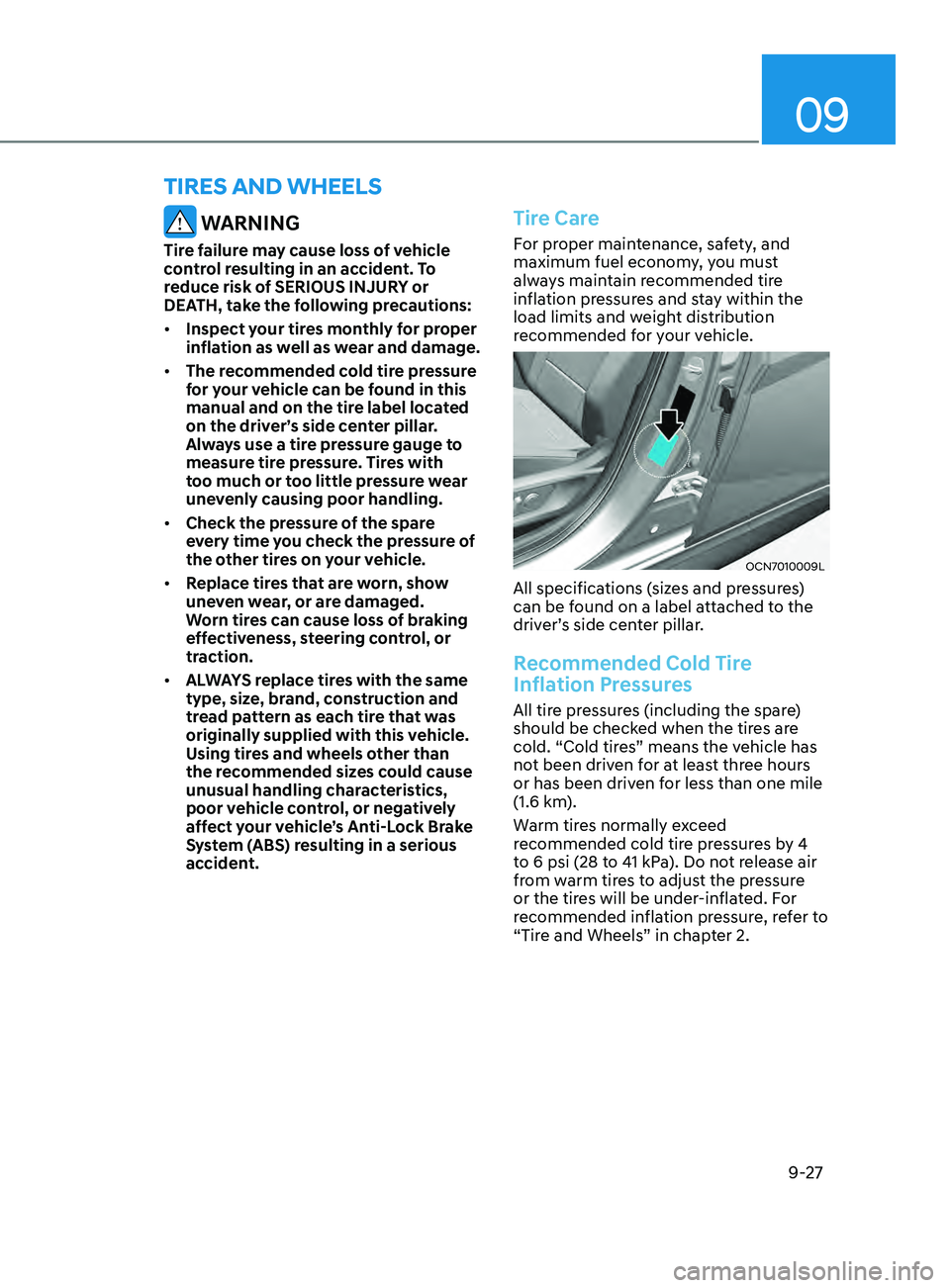
All specifications (sizes and pressures)
can be found on a label attached to the
driver’s side center pillar.
Recommended Cold Tire
Inflation Pressures
All tire pressures (including the spare)
should be checked when the tires are
cold. “Cold tires” means the vehicle has
not been driven for at least three hours
or has been driven for less than one mile
(1.6 km).
Warm tires normally exceed
recommended cold tire pressures by 4
to 6 psi (28 to 41 kPa). Do not release air
from warm tires to adjust the pressure
or the tires will be under-inflated. For
recommended inflation pressure, refer to
“Tire and Wheels” in chapter 2.
tirES and whEElS
Page 514 of 570
Maintenance
9-28
WARNING
Recommended pressures must be
maintained for the best ride, vehicle
handling, and minimum tire wear.
Over-inflation or under-inflation can
reduce tire life, adversely affect vehicle
handling, and lead to sudden tire failure
that could result in loss of vehicle
control resulting in an accident.
Severe under-inflation can lead to
severe heat build-up, causing blowouts,
tread separation and other tire failures
that can result in the loss of vehicle
control resulting in an accident. This
risk is much higher on hot days and
when driving for long periods at high
speeds.
CAUTION
• Under-inflation results in excessive
wear, poor handling and reduced
fuel economy. Wheel deformation
is also possible. Keep your tire
pressures at the proper levels. If a
tire frequently needs refilling, have it
checked by an authorized HYUNDAI
dealer.
• Over-inflation produces a harsh ride,
excessive wear at the center of the
tire tread, and a greater possibility of
damage from road hazards.
Check Tire Inflation Pressure
Check your tires, including the spare tire,
once a month or more.
How to check
Use a good quality tire pressure gauge
to check tire pressure. You can not tell
if your tires are properly inflated simply
by looking at them. Radial tires may look
properly inflated when they are under-
inflated.
Remove the valve cap from the tire valve
stem. Press the tire gauge firmly onto the
valve to get a pressure measurement.
If the cold tire inflation pressure
matches the recommended pressure
on the tire label located on the driver’s
side center pillar or in this manual. No
further adjustment is necessary. If the
pressure is low, add air until you reach
the recommended pressure. Make sure
to put the valve caps back on the valve
stems. Without the valve cap, dirt or
moisture could get into the valve core
and cause air leakage. If a valve cap is
missing, install a new one as soon as
possible.
If you overfill the tire, release air by
pushing on the metal stem in the
center of the tire valve. Recheck the tire
pressure with the tire gauge. Be sure
to put the valve caps back on the valve
stems. Without the valve cap, dirt or
moisture could get into the valve core
and cause air leakage. If a valve cap is
missing, install a new one as soon as
possible.
A cold tire means the vehicle has been
sitting for 3 hours and driven for less
than 1 mile (1.6 km) in that 3 hour period.
Allow the tire to cool before measuring
the inflation pressure. Always be sure
the tire is cold before inflating to the
recommended pressure.
Page 515 of 570
09
9-29
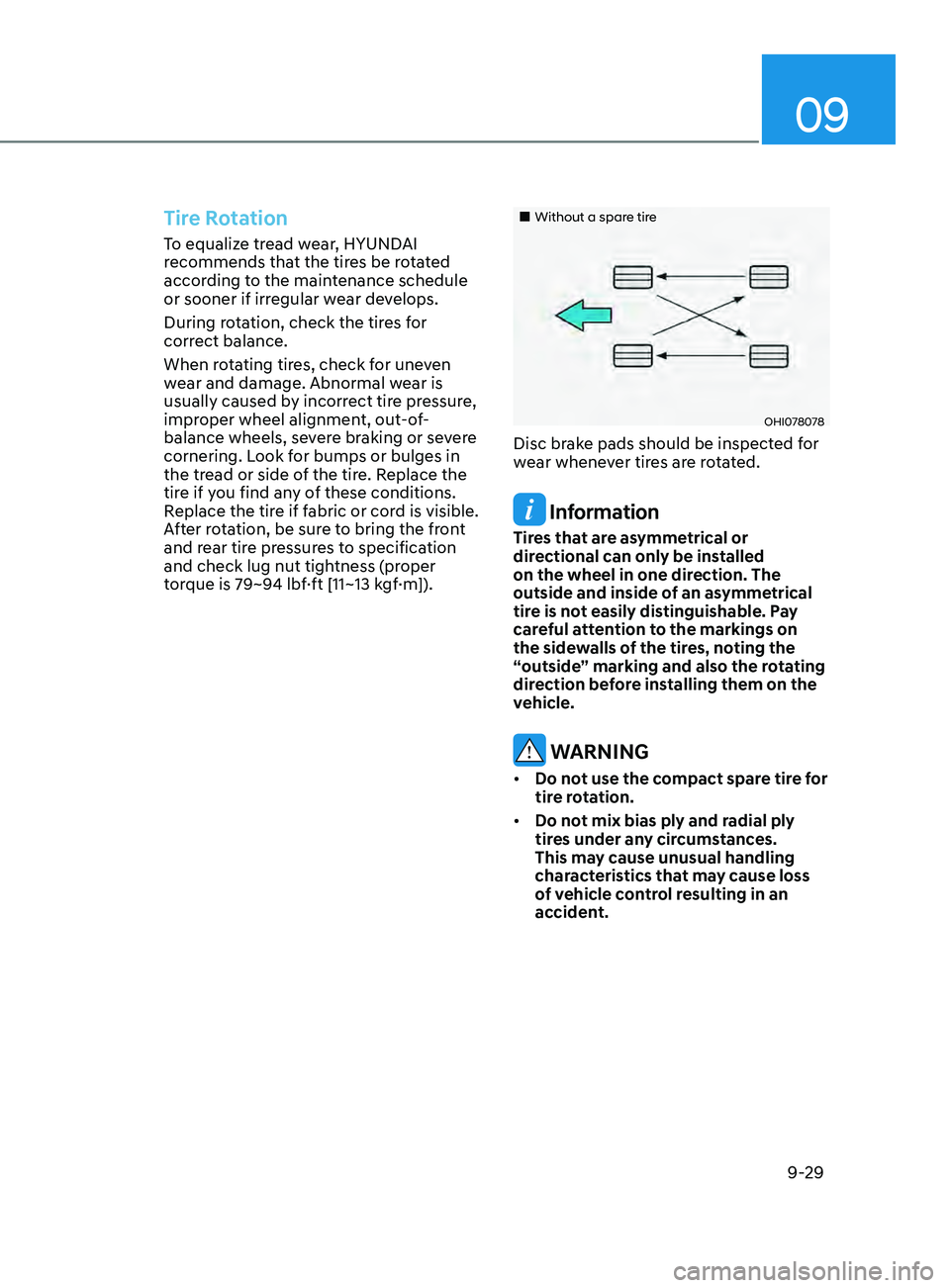
Tire Rotation
To equalize tread wear, HYUNDAI
recommends that the tires be rotated
according to the maintenance schedule
or sooner if irregular wear develops.
During rotation, check the tires for
correct balance.
When rotating tires, check for uneven
wear and damage. Abnormal wear is
usually caused by incorrect tire pressure,
improper wheel alignment, out-of-
balance wheels, severe braking or severe
cornering. Look for bumps or bulges in
the tread or side of the tire. Replace the
tire if you find any of these conditions.
Replace the tire if fabric or cord is visible.
After rotation, be sure to bring the front
and rear tire pressures to specification
and check lug nut tightness (proper
torque is 79~94 lbf·ft [11~13 kgf·m]).
„„Without a spare tire
OHI078078
Disc brake pads should be inspected for
wear whenever tires are rotated.
Information
Tires that are asymmetrical or
directional can only be installed
on the wheel in one direction. The
outside and inside of an asymmetrical
tire is not easily distinguishable. Pay
careful attention to the markings on
the sidewalls of the tires, noting the
“outside” marking and also the rotating
direction before installing them on the
vehicle.
WARNING
• Do not use the compact spare tire for
tire rotation.
• Do not mix bias ply and radial ply
tires under any circumstances.
This may cause unusual handling
characteristics that may cause loss
of vehicle control resulting in an
accident.
Page 520 of 570
Maintenance
9-34
5. Maximum permissible inflation
pressure
This number is the greatest amount
of air pressure that should be put in
the tire. Do not exceed the maximum
permissible inflation pressure. Refer to
the Tire and Loading Information label
for recommended inflation pressure.
6. Maximum load rating
This number indicates the maximum
load in kilograms and pounds that can be
carried by the tire. When replacing the
tires on the vehicle, always use a tire that
has the same load rating as the factory
installed tire.
7. Uniform tire quality grading
Quality grades can be found where
applicable on the tire sidewall between
tread shoulder and maximum section
width.
For example:
TREAD WEAR 200
TRACTION AA
TEMPERATURE A Tread wear
The tread wear grade is a comparative
rating based on the wear rate of the tire
when tested under controlled conditions
on a specified government test course.
For example, a tire graded 150 would
wear one-and-a-half times (1½) as well
on the government course as a tire
graded 100.
The relative performance of tires
depends upon the actual conditions
of their use, however, and may depart
significantly from the norm due to
variations in driving habits, service
practices and differences in road
characteristics and climate.
These grades are molded on the
sidewalls of passenger vehicle tires. The
tires available as standard or optional
equipment on your vehicle may vary with
respect to grade.
Traction AA, A, B & C
The traction grades, from highest to
lowest, are AA, A, B and C. Those grades
represent the tire’s ability to stop on wet
pavement as measured under controlled
conditions on specified government
test surfaces of asphalt and concrete.
A tire marked C may have poor traction
performance.
WARNING
The traction grade assigned to this tire
is based on straight-ahead braking
traction tests, and does not include
acceleration, cornering, hydroplaning,
or peak traction characteristics.
Page 521 of 570
09
9-35
Temperature A, B & C
The temperature grades are A (the
highest), B and C representing the tire’s
resistance to the generation of heat
and its ability to dissipate heat when
tested under controlled conditions on a
specified indoor laboratory test wheel.
Sustained high temperature can cause
the material of the tire to degenerate
and reduce tire life, and excessive
temperature can lead to sudden tire
failure. Grade C responds to a level
of performance which all passenger
car tires must meet under the Federal
Motor Vehicle Safety Standard No. 109.
Grades B and A represent higher levels
of performance on the laboratory test
wheel than the minimum required by
law.
WARNING
The temperature grade for this tire is
established for a tire that is properly
inflated and not overloaded. Excessive
speed, under-inflation, over-inflation,
or excessive loading, either separately
or in combination, can cause heat build-
up and possible sudden tire failure.
This may cause loss of vehicle control
resulting in an accident.
Tire Terminology and Definitions
Air Pressure
The amount of air inside the tire pressing
outward on the tire. Air pressure is
expressed in pounds per square inch
(psi) or kilopascal (kPa).
Accessory Weight
This means the combined weight of
optional accessories. Some examples
of optional accessories are automatic
transmission, power seats, and air
conditioning.
Aspect Ratio
The relationship of a tire’s height to its
width.
Belt
A rubber coated layer of cords that is
located between the plies and the tread.
Cords may be made from steel or other
reinforcing materials.
Bead
The tire bead contains steel wires
wrapped by steel cords that hold the tire
onto the rim.
Bias Ply Tire
A pneumatic tire in which the plies are
laid at alternate angles less than 90
degrees to the centerline of the tread.
Cold Tire Pressure
The amount of air pressure in a tire,
measured in pounds per square inch (psi)
or kilopascals (kPa) before a tire has built
up heat from driving.