Tor HYUNDAI ELANTRA SEL 2021 Owners Manual
[x] Cancel search | Manufacturer: HYUNDAI, Model Year: 2021, Model line: ELANTRA SEL, Model: HYUNDAI ELANTRA SEL 2021Pages: 570, PDF Size: 52.21 MB
Page 5 of 570
F3
Your Hyundai vehicle may be equipped with technologies and services that use
information collected, generated, recorded or stored by the vehicle. Hyundai
has created a Vehicle Owner Privacy Policy to explain how these technologies
and services collect use and share this information.
You may read our Vehicle Owner Privacy Policy on the Hyundaiusa.com website
at: https://www.hyundaiusa.com/owner-privacy-policy.aspx
If you would like to receive a hard copy of our Vehicle Owner Privacy Policy,
please contact our Customer Care Center at:Hyundai Customer Care
P.O. Box 20850
Fountain Valley, CA 92728
800-633-5151
[email protected]
Hyundai’s Customer Care Center representatives are available Monday through
Friday,
between the hours of 6:00 AM and 5:00 PM PST and Saturday between 6:30
AM and 3:00 PM PST (English).
For Customer Connect Care assistance in Spanish or Korean, representatives
are available Monday through Friday between 6:30 AM and 3:00 PM PST.
HYUNDAI VEHICLE OWNER PRIVACY POLICY
Page 8 of 570

Introduction........................................................................\
.............................1-2
Hyundai Motor America
........................................................................\
......... 1-2
Guide t
o Hyundai Genuine Parts
................................................................... 1-3
H
ow to Use This Manual
........................................................................\
.........
1-4
Safety Messages
........................................................................\
.....................
1-4
Fuel Requirements
........................................................................\
.................. 1-5
Gasoline containing alcohol or methanol .............................................................1-6
Using F uel Additives (except Detergent Fuel Additives) ...................................... 1-6
Gasoline con
taining MMT
........................................................................\
.............. 1-6
De
tergent Fuel Additives
........................................................................\
................ 1
-7
Operation in foreign countries
........................................................................\
....... 1
-7
Vehicle Modifications ........................................................................\
.............1 -7
V ehicle Break-In Process
........................................................................\
........ 1 -7
V
ehicle Data Collection and Event Data Recorders
.................................... 1-8
Foreword
1. Foreword
1
Page 9 of 570
Foreword
1-2
IntroductIon
Congratulations, and thank you for choosing HYUNDAI. We are pleased to welcome
you to the growing number of discerning people who drive HYUNDAIs. We are very
proud of the advanced engineering and high-quality construction of each HYUNDAI
we build.
Your Owner’s Manual will introduce you to the features and operation of your new
HYUNDAI. To become familiar with your new HYUNDAI, so that you can fully enjoy it,
read this Owner’s Manual carefully before driving your new vehicle.
This manual contains important safety information and instructions intended to
familiarize you with your vehicle’s controls and safety features so you can safely
operate your vehicle.
This manual also contains information on maintenance designed to enhance safe
operation of the vehicle. It is recommended that all service and maintenance on your
car be performed by an authorized HYUNDAI dealer. HYUNDAI dealers are prepared
to provide high-quality service, maintenance and any other assistance that may be
required.
This Owner’s Manual should be considered a permanent part of your vehicle, and
should be kept in the vehicle so you can refer to it at any time. The manual should stay
with the vehicle if you sell it to provide the next owner with important operating, safety
and maintenance information.
HyundaI Motor aMerIca
CAUTION
Severe engine and transmission damage may result from the use of poor quality
fuels and lubricants that do not meet HYUNDAI specifications. You must always use
high quality fuels and lubricants that meet the specifications listed on Page 2-11 in
the Vehicle Specifications section of the Owner’s Manual.
Copyright 2020 HYUNDAI Motor America. All rights reserved. No part of this
publication may be reproduced, stored in any retrieval system or transmitted in
any form or by any means without the prior written permission of HYUNDAI Motor
America.
Page 10 of 570
01
1-3
1. What are HYUNDAI Genuine Parts?
HYUNDAI Genuine Parts are the
same parts used by HYUNDAI Motor
Company to manufacture vehicles.
They are designed and tested for the
optimum safety, performance, and
reliability for our customers.2. Why Hyundai Genuine Parts?
HYUND
AI Genuine Parts are
engineered and built to meet rigid
manufacturing requirements.
Damage caused by using imitation,
counterfeit or used salvage parts is
not covered under the HYUNDAI New
Vehicle Limited Warranty or any other
HYUNDAI warranty.
In addition, any damage to or failure
of HYUNDAI Genuine Parts caused
by the installation or failure of an
imitation, counterfeit or used salvage
part is not covered by any HYUNDAI
Warranty.
3. How can you tell if you are
pur chasing HYUNDAI Genuine Parts?
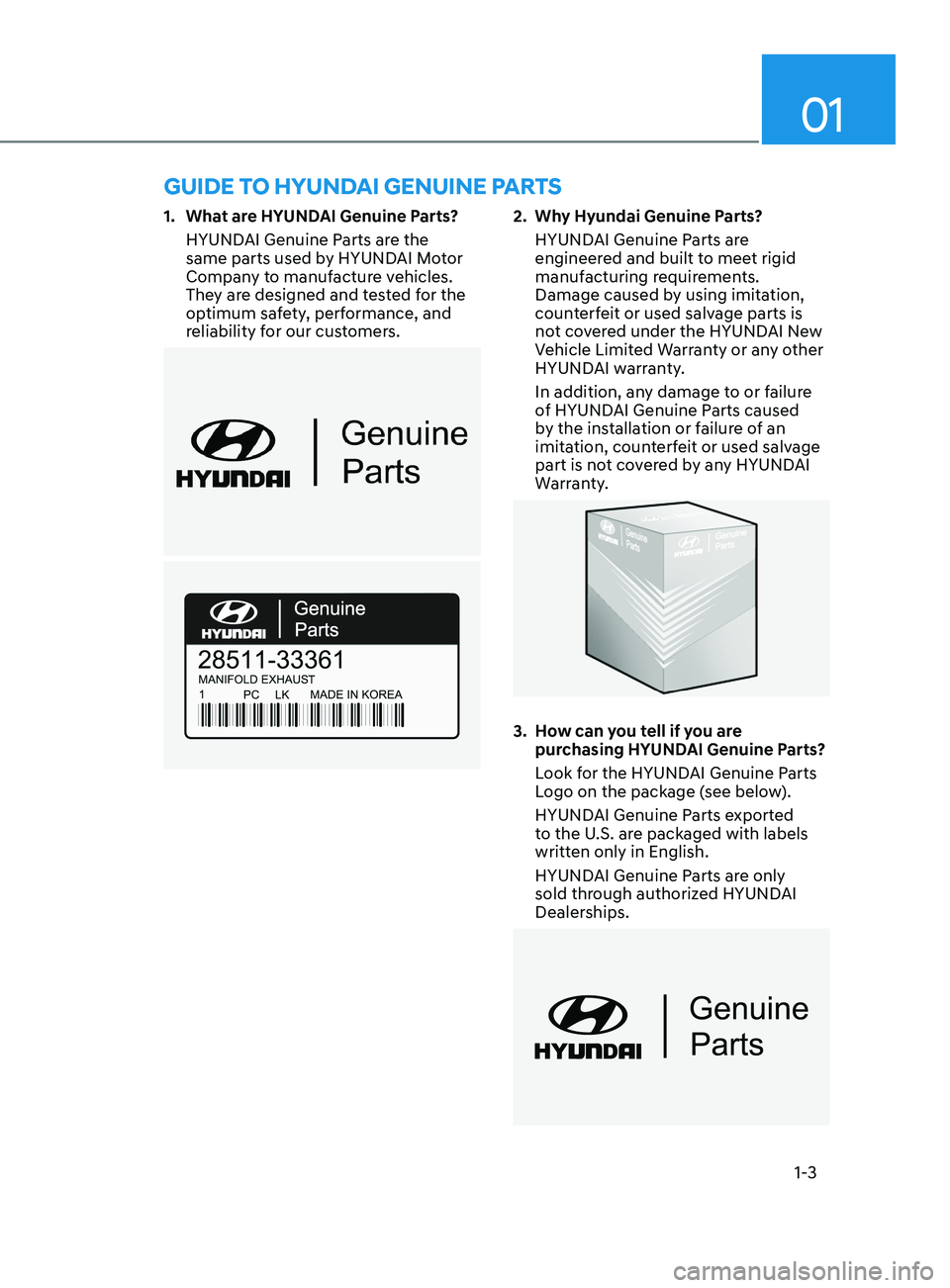
Look for the HYUNDAI Genuine Parts
Logo on the package (see below).
HYUNDAI Genuine Parts exported
to the U.S. are packaged with labels
written only in English.
HYUNDAI Genuine Parts are only
sold through authorized HYUNDAI
Dealerships.
GuIde to HyundaI GenuIne Parts
Page 13 of 570
Foreword
1-6
Gasoline containing alcohol or
methanol
Gasohol, a mixture of gasoline and
ethanol (also known as grain alcohol) are
being marketed along with or instead
of leaded or unleaded gasoline. For
example, “E15” is a gasohol comprised of
15% ethanol and 85% gasoline.
Do not use gasohol containing more than
15% ethanol, and do not use gasoline or
gasohol containing any methanol. Either
of these fuels may cause drivability
problems and damage to the fuel
system, engine control system and
emission control system.
Discontinue using gasohol of any kind if
drivability problems occur.
“E85” fuel is an alternative fuel
comprised of 85 percent ethanol and 15
percent gasoline, and is manufactured
exclusively for use in Flexible Fuel
Vehicles. “E85” is not compatible with
your vehicle. Use of “E85” may result in
poor engine performance and damage
to your vehicle’s engine and fuel system.
HYUNDAI recommends that customers
do not use fuel with an ethanol content
exceeding 15 percent.
NOTICE
To prevent damage to your vehicle’s
engine and fuel system:
• Never use gasohol which contains
methanol.
• Never use gasohol containing more
than 15% ethanol.
• Never use leaded fuel or leaded
gasohol.
• Never use “E85” fuel.
Your New Vehicle Limited Warranty
does not cover damage to the fuel
system or any performance problems
caused by the use of “E85” fuel.
Using Fuel Additives (except
Detergent Fuel Additives)
Using fuel additives such as:
- Silicone fuel additive
- Ferr
ocene (iron-based) fuel additive
- Other metallic
-based fuel additives
may result in cylinder misfire, poor
acceleration, engine stalling, damage
to the catalyst, or abnormal corrosion,
and may cause damage to the engine
resulting in a reduction in the overall life
of the powertrain.
- The Malfunction Indicat
or Lamp (MIL)
may illuminate.
NOTICE
Damage to the fuel system or
performance problem caused by the
use of these fuels or fuel additives may
not be covered by your New Vehicle
Limited Warranty.
Gasoline containing MMT
Some gasoline contains harmful
manganese-based fuel additives such
as MMT (Methylcyclopentadienyl
Manganese Tricarbonyl).
HYUNDAI does not recommend the use
of gasoline containing MMT.
This type of fuel can reduce vehicle
performance and affect your emission
control system.
The malfunction indicator lamp on the
cluster may come on.
Page 15 of 570
Foreword
1-8
VeHIcle data collectIon
and
eVent dat
a
re
corders
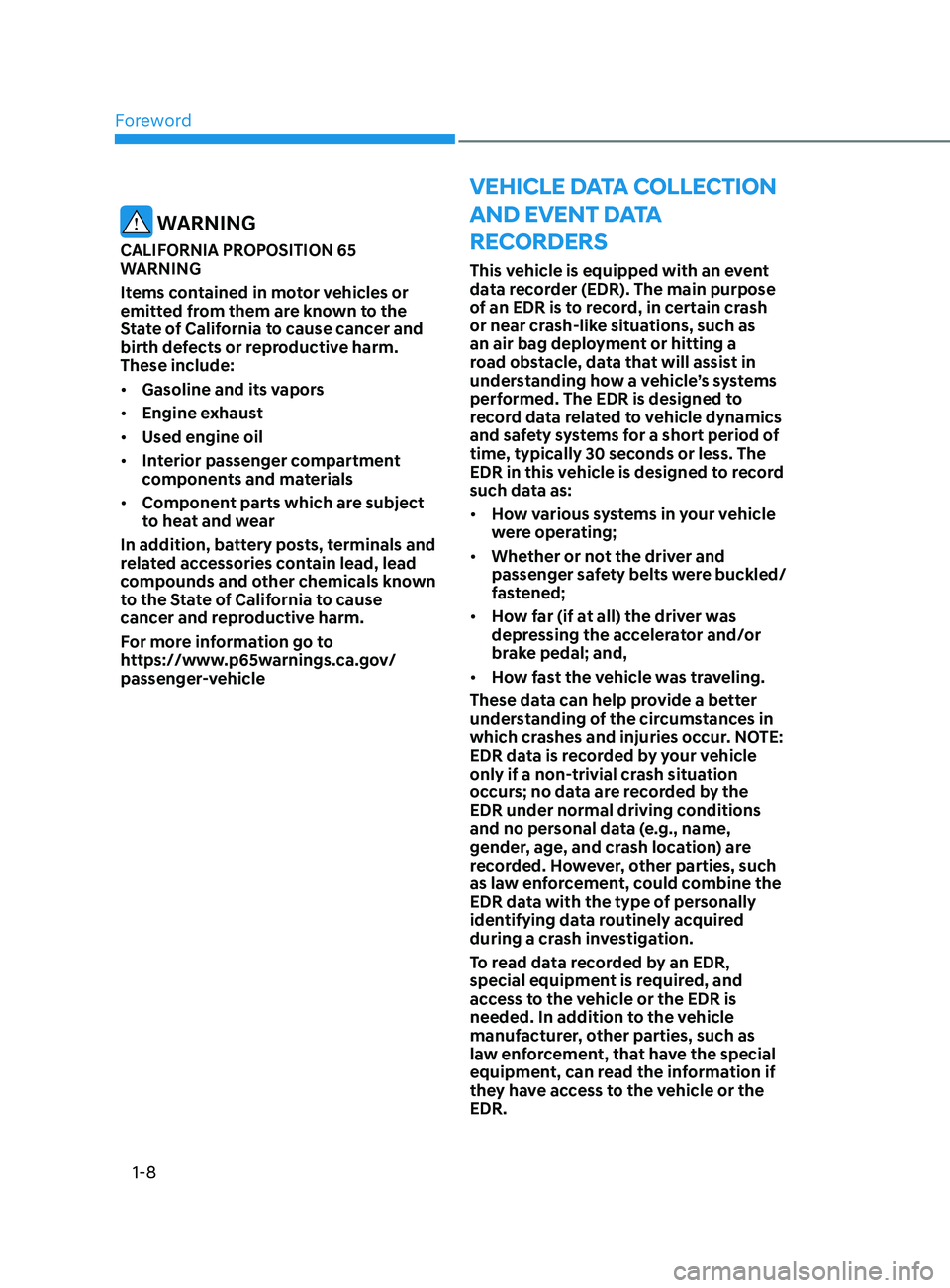
This vehicle is equipped with an event
data recorder (EDR). The main purpose
of an EDR is to record, in certain crash
or near crash-like situations, such as
an air bag deployment or hitting a
road obstacle, data that will assist in
understanding how a vehicle’s systems
performed. The EDR is designed to
record data related to vehicle dynamics
and safety systems for a short period of
time, typically 30 seconds or less. The
EDR in this vehicle is designed to record
such data as:
• How various systems in your vehicle
were operating;
• Whether or not the driver and
passenger safety belts were buckled/
fastened;
• How far (if at all) the driver was
depressing the accelerator and/or
brake pedal; and,
• How fast the vehicle was traveling.
These data can help provide a better
understanding of the circumstances in
which crashes and injuries occur. NOTE:
EDR data is recorded by your vehicle
only if a non-trivial crash situation
occurs; no data are recorded by the
EDR under normal driving conditions
and no personal data (e.g., name,
gender, age, and crash location) are
recorded. However, other parties, such
as law enforcement, could combine the
EDR data with the type of personally
identifying data routinely acquired
during a crash investigation.
To read data recorded by an EDR,
special equipment is required, and
access to the vehicle or the EDR is
needed. In addition to the vehicle
manufacturer, other parties, such as
law enforcement, that have the special
equipment, can read the information if
they have access to the vehicle or the
EDR.
WARNING
CALIFORNIA PROPOSITION 65
WARNING
Items contained in motor vehicles or
emitted from them are known to the
State of California to cause cancer and
birth defects or reproductive harm.
These include:
• Gasoline and its vapors
• Engine exhaust
• Used engine oil
• Interior passenger compartment
components and materials
• Component parts which are subject
to heat and wear
In addition, battery posts, terminals and
related accessories contain lead, lead
compounds and other chemicals known
to the State of California to cause
cancer and reproductive harm.
For more information go to
https://www.p65warnings.ca.gov/
passenger-vehicle
Page 24 of 570
02
2-9
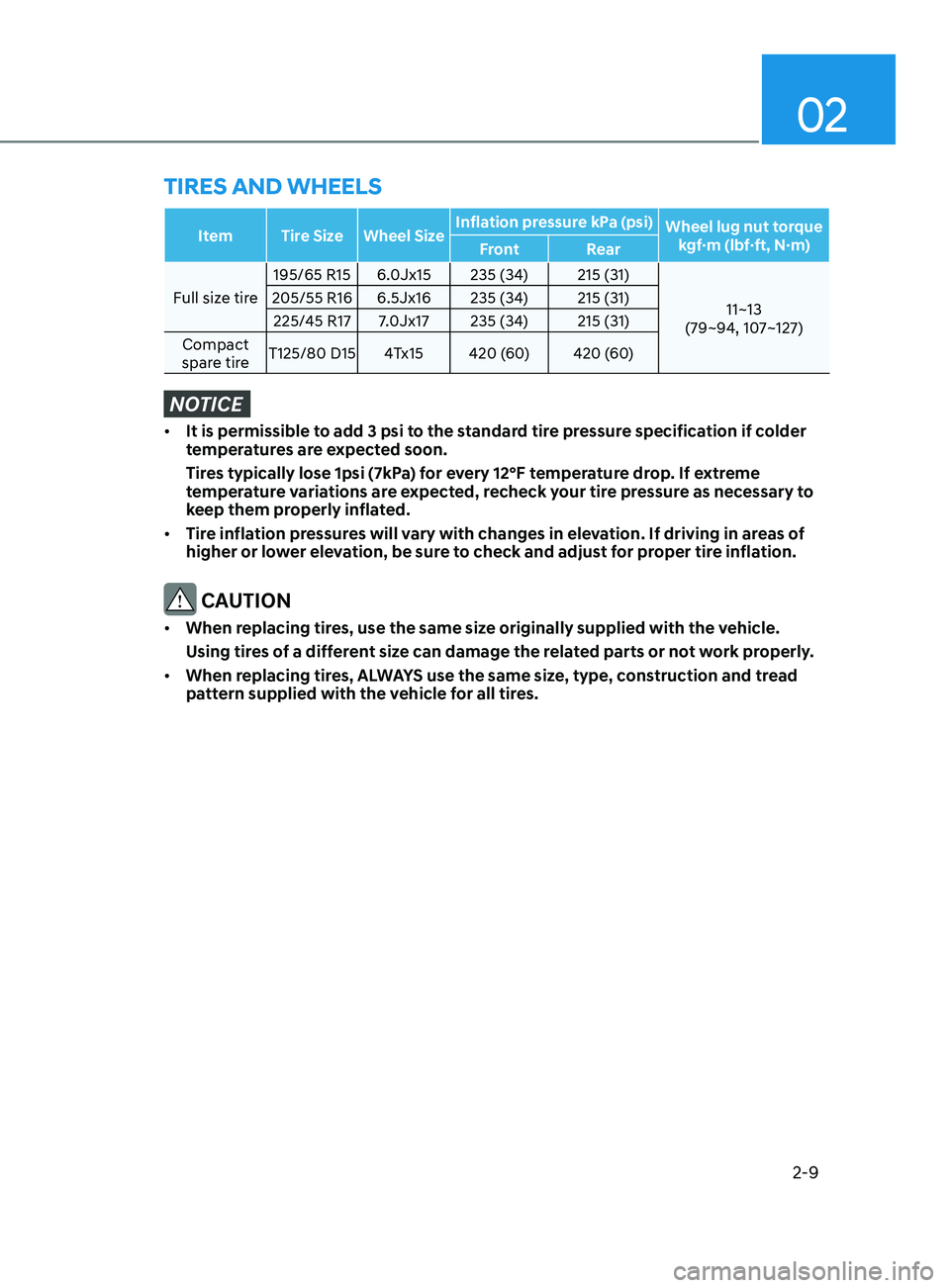
tirEs anD whEEls
Item Tire Size Wheel SizeInflation pressure kPa (psi)
Wheel lug nut torque
kgf·m (lbf·ft, N·m)
Front Rear
Full size tire 195/65 R15 6.0Jx15 235 (34) 215 (31)
11~13
(79~94, 107~127)
205/55 R16 6.5Jx16 235 (34) 215 (31)
225/45 R17 7.0Jx17 235 (34) 215 (31)
Compact
spare tire T125/80 D15 4Tx15 420 (60) 420 (60)
NOTICE
•
It is permissible to add 3 psi to the standard tire pressure specification if colder
temperatures are expected soon.
Tires typically lose 1psi (7kPa) for every 12°F temperature drop. If extreme
temperature variations are expected, recheck your tire pressure as necessary to
keep them properly inflated.
• Tire inflation pressures will vary with changes in elevation. If driving in areas of
higher or lower elevation, be sure to check and adjust for proper tire inflation.
CAUTION
•When replacing tires, use the same size originally supplied with the vehicle.
Using tires of a different size can damage the related parts or not work properly.
• When replacing tires, ALWAYS use the same size, type, construction and tread
pattern supplied with the vehicle for all tires.
Page 26 of 570
02
2-11
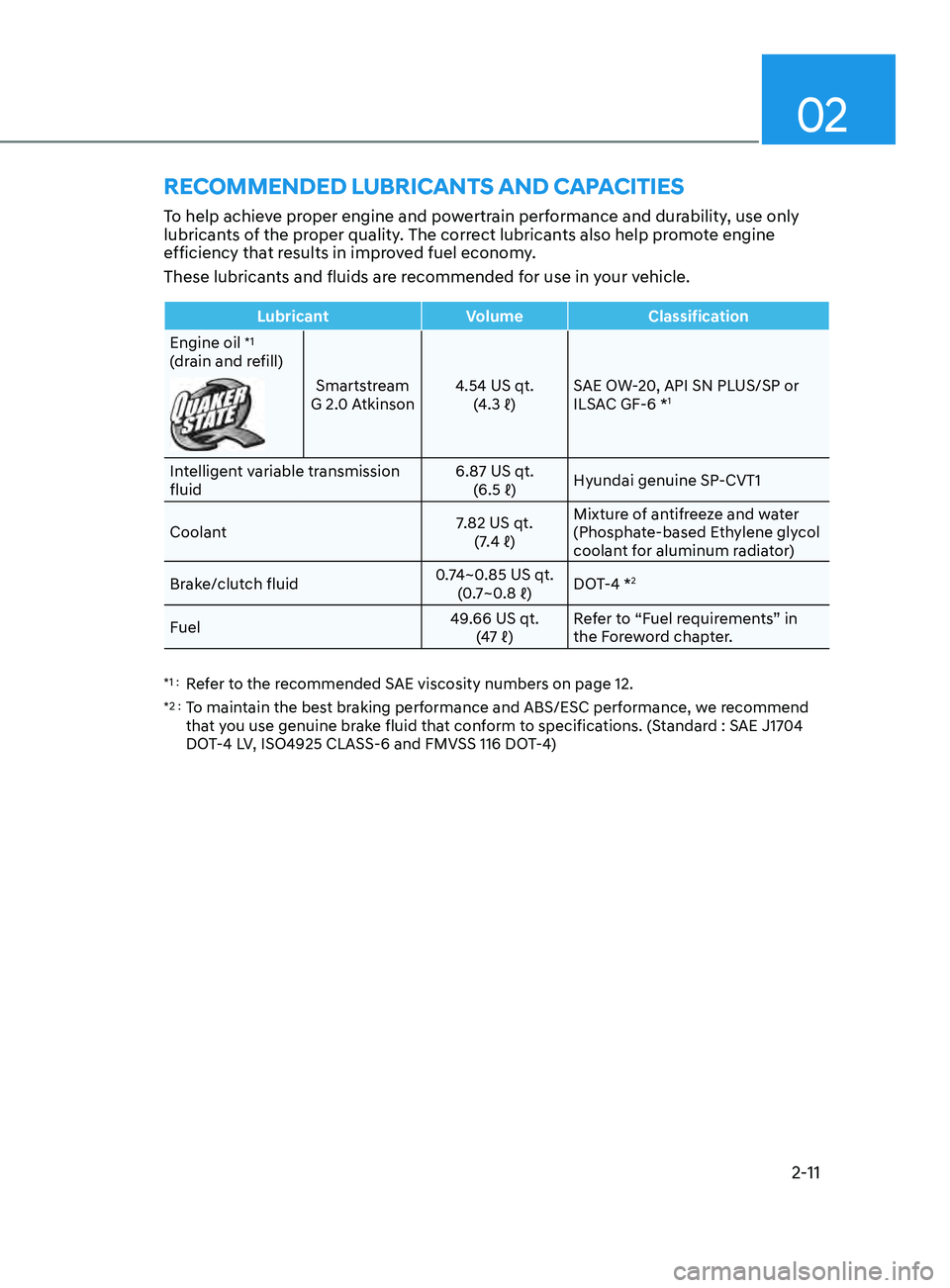
rECommEnDED luBriCants anD CaPaCitiEs
To help achieve proper engine and powertrain performance and durability, use only
lubricants of the proper quality. The correct lubricants also help promote engine
efficiency that results in improved fuel economy.
These lubricants and fluids are recommended for use in your vehicle.
LubricantVolumeClassification
Engine oil
*1
(drain and refill)
Smartstream
G 2.0 Atkinson 4.54 US qt.
(4.3
ℓ) SAE O
W-20, API SN PLUS/SP or
ILSAC GF-6 *
1
Intelligent variable transmission
fluid 6.87 US qt.
(6.5 ℓ) Hyundai genuine SP-CVT1
Coolan
t 7.82 US qt.
(7.4
ℓ)
Mixture o
f antifreeze and water
(Phosphate-based Ethylene glycol
coolant for aluminum radiator)
Brake/clutch fluid
0.
74~0.85 US qt.(0.7~0.8
ℓ) DOT
-4 *
2
Fuel 49.66 US qt.
(47
ℓ) R
efer to “Fuel requirements” in
the Foreword chapter.
*1 : Refer to the recommended SAE viscosity numbers on page 12.
*2 : To maintain the best braking performance and ABS/ESC performance, we recommend
that you use genuine brake fluid that conform to specifications. (Standard : SAE J1704
DOT-4 LV, ISO4925 CLASS-6 and FMVSS 116 DOT-4)
Page 27 of 570
Vehicle Information
2-12
Recommended SAE Viscosity
Number
CAUTION
Always be sure to clean the area around
any filler plug, drain plug, or dipstick
before checking or draining any
lubricant. This is especially important
in dusty or sandy areas and when the
vehicle is used on unpaved roads.
Cleaning the plug and dipstick areas
will prevent dirt and grit from entering
the engine and other mechanisms that
could be damaged.Engine oil viscosity (thickness) has an
effect on fuel economy and cold weather
operating (engine start and engine oil
flowability). Lower viscosity engine oils
can provide better fuel economy and
cold weather performance, however,
higher viscosity engine oils are required
for satisfactory lubrication in hot
weather.
Using oils of any viscosity other than
those recommended could result in
engine damage.
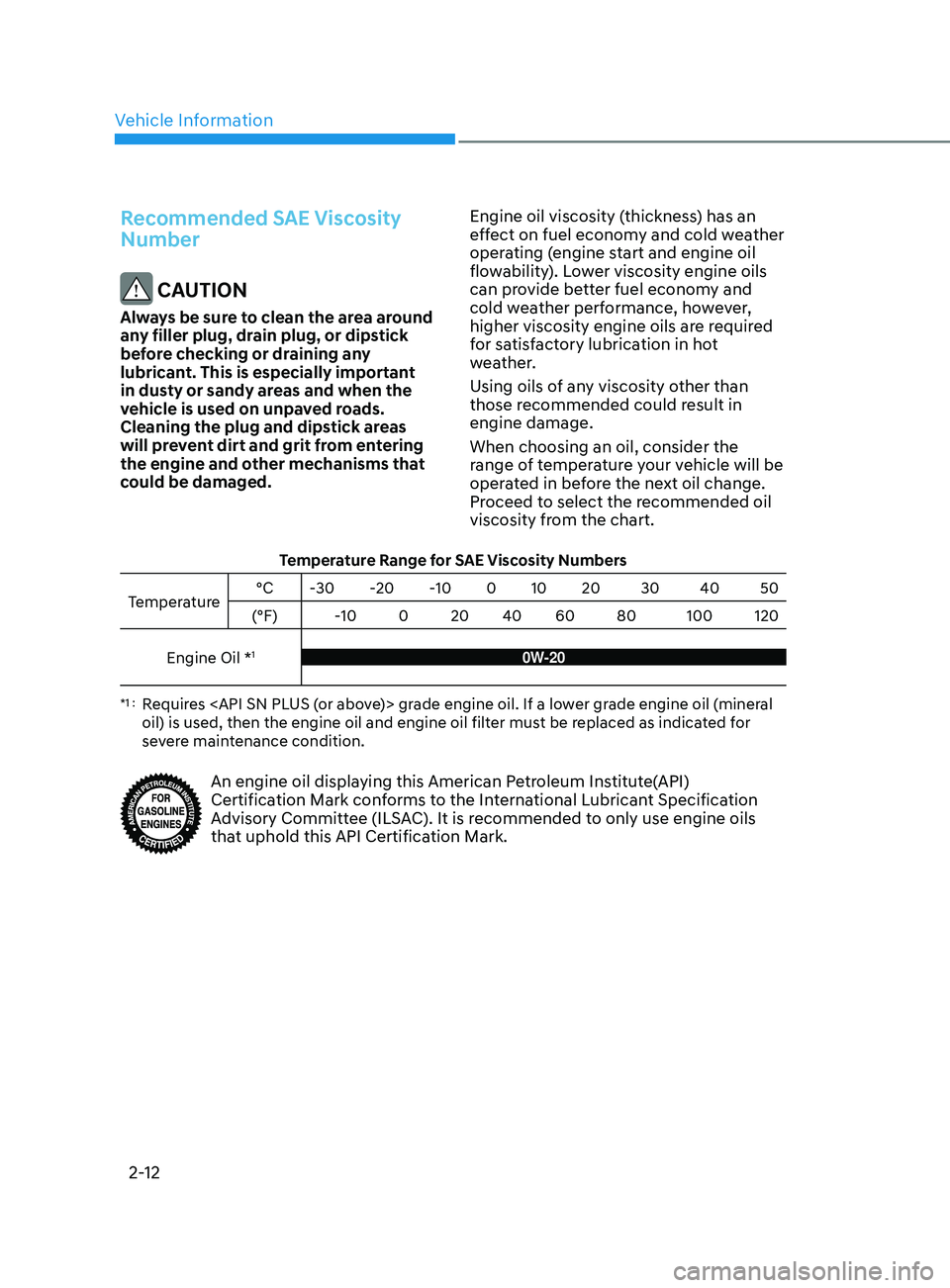
When choosing an oil, consider the
range of temperature your vehicle will be
operated in before the next oil change.
Proceed to select the recommended oil
viscosity from the chart.
Temperature Range for SAE Viscosity Numbers
Temperature °C
-30 -20 -10 0 10 20 30 40 50
(°F) -10 0 20 40 60 80 100 120
Engine Oil *
10W-20
*1 : Requires
oil) is used, then the engine oil and engine oil filter must be replaced as indicated for
severe maintenance condition.
An engine oil displaying this American Petroleum Institute(API)
Certification Mark conforms to the International Lubricant Specification
Advisory Committee (ILSAC). It is recommended to only use engine oils
that uphold this API Certification Mark.
Page 30 of 570
02
2-15
ConsumEr information
This consumer information has been prepared in accordance with regulations issued
by the National Highway Traffic Safety Administration of the U.S. Department of
Transportation.Your HYUNDAI dealer will help answer any questions you may have as
you read this information.
HYUNDAI motor vehicles are designed and manufactured to meet or exceed all
applicable safety standards.
For your safety, however, we strongly urge you to read and follow all directions in
this Owner’s Manual, particularly the information under the headings “NOTICE”,
“CAUTION” and “WARNING”.
If, after reading this manual, you have any questions regarding the operation of your
vehicle, please contact the Hyundai Customer Care Center.
Hyundai Customer Care
P.O. Box 20850
Fountain Valley, CA 92728
800-633-5151
[email protected]
Hyundai’s Customer Care Center representatives are available Monday through Friday,
between the hours of 6:00 AM and 5:00 PM PST
and Saturday between 6:30 AM and 3:00 PM PST (English).
For Customer Care Center assistance in Spanish or Korean, representatives are
available Monday through Friday between 6:30 AM and 3:00 PM PST.