oil temperature HYUNDAI ELANTRA SEL 2021 Owners Manual
[x] Cancel search | Manufacturer: HYUNDAI, Model Year: 2021, Model line: ELANTRA SEL, Model: HYUNDAI ELANTRA SEL 2021Pages: 570, PDF Size: 52.21 MB
Page 27 of 570
Vehicle Information
2-12
Recommended SAE Viscosity
Number
CAUTION
Always be sure to clean the area around
any filler plug, drain plug, or dipstick
before checking or draining any
lubricant. This is especially important
in dusty or sandy areas and when the
vehicle is used on unpaved roads.
Cleaning the plug and dipstick areas
will prevent dirt and grit from entering
the engine and other mechanisms that
could be damaged.Engine oil viscosity (thickness) has an
effect on fuel economy and cold weather
operating (engine start and engine oil
flowability). Lower viscosity engine oils
can provide better fuel economy and
cold weather performance, however,
higher viscosity engine oils are required
for satisfactory lubrication in hot
weather.
Using oils of any viscosity other than
those recommended could result in
engine damage.
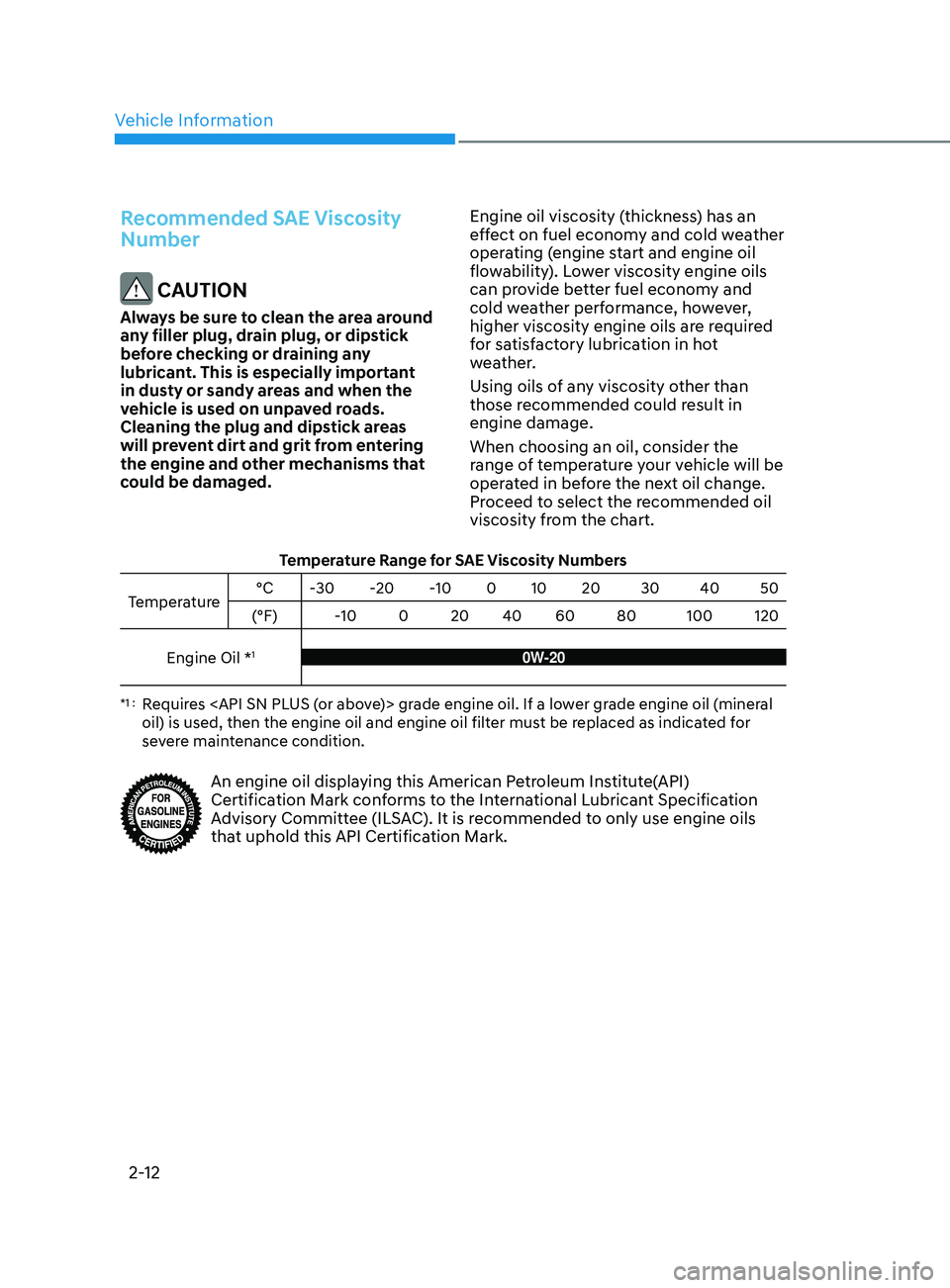
When choosing an oil, consider the
range of temperature your vehicle will be
operated in before the next oil change.
Proceed to select the recommended oil
viscosity from the chart.
Temperature Range for SAE Viscosity Numbers
Temperature °C
-30 -20 -10 0 10 20 30 40 50
(°F) -10 0 20 40 60 80 100 120
Engine Oil *
10W-20
*1 : Requires
oil) is used, then the engine oil and engine oil filter must be replaced as indicated for
severe maintenance condition.
An engine oil displaying this American Petroleum Institute(API)
Certification Mark conforms to the International Lubricant Specification
Advisory Committee (ILSAC). It is recommended to only use engine oils
that uphold this API Certification Mark.
Page 87 of 570

Instrument Cluster
4
Instrument Cluster ........................................................................\
.................4-4Instrument Cluster Control ........................................................................\
..............4-5
Adjus ting instrument cluster illumination ............................................................ 4-5
Gauges and Me
ters
........................................................................\
.......................... 4-5
Speedome
ter
........................................................................\
................................. 4-5
T
achometer
........................................................................\
.................................... 4-5
E
ngine coolant temperature gauge
...................................................................... 4-6
Fuel gauge ........................................................................\
.....................................
.4-6
Outside temperature gauge
........................................................................\
.......... 4
-7
Odometer
........................................................................\
.....................................
..4-8
Range
........................................................................\
.............................................. 4-8
T
ransmission shift indicator
........................................................................\
............. 4-9
In
telligent variable transmission shift indicator
.................................................. 4-9
W
arning and Indicator Lights
........................................................................\
.......... 4-9
Air Bag W
arning Light
........................................................................\
.................... 4-9
Sea
t Belt Warning Light
........................................................................\
................. 4-9
P
arking Brake & Brake Fluid Warning Light
........................................................ 4-
10
Anti-lock Brake System (ABS) Warning Light
...................................................... 4-
11
Electronic Brake Force Distribution (EBD) System Warning Light
.................... 4-
11
Electronic Parking Brake (EPB) Warning Light
.................................................... 4-
11
AUTO HOLD Indicator Light (if equipped)
.......................................................... 4-
12
Electric Power Steering (EPS) Warning Light
...................................................... 4-
12
Malfunction Indicator Lamp (MIL)
....................................................................... 4-12
Char
ging System Warning Light
........................................................................\
.. 4-
13
Engine Oil Pressure Warning Light
...................................................................... 4-13
L
ow Fuel Level Warning Light
........................................................................\
...... 4-
13
Master Warning Light
........................................................................\
................... 4-
14
Low Tire Pressure Warning Light
........................................................................\
. 4-
14
Electronic Stability Control (ESC) Indicator Light
.............................................. 4-
14
Electronic Stability Control (ESC) OFF Indicator Light
....................................... 4-
15
Immobilizer Indicator Light
........................................................................\
.......... 4-
15
Immobilizer Indicator Light (with smart key)
..................................................... 4-16
T
urn Signal Indicator Light
........................................................................\
........... 4-
16
Exterior Light Warning Light
........................................................................\
........ 4-
16
LED headlight warning light
........................................................................\
......... 4-
17
High Beam Indicator Light
........................................................................\
........... 4-
17
Light ON Indicator Light
........................................................................\
............... 4-
17
High Beam Assist indicator light
........................................................................\
.. 4-
17
Forward Collision-Avoidance Assist Warning Light
............................................ 4-
18
Lane Keep Assist Indicator Light........................................................................\
..4-18
4. Instrument Cluster
Page 225 of 570
05
5-89
Information
OCN7050060
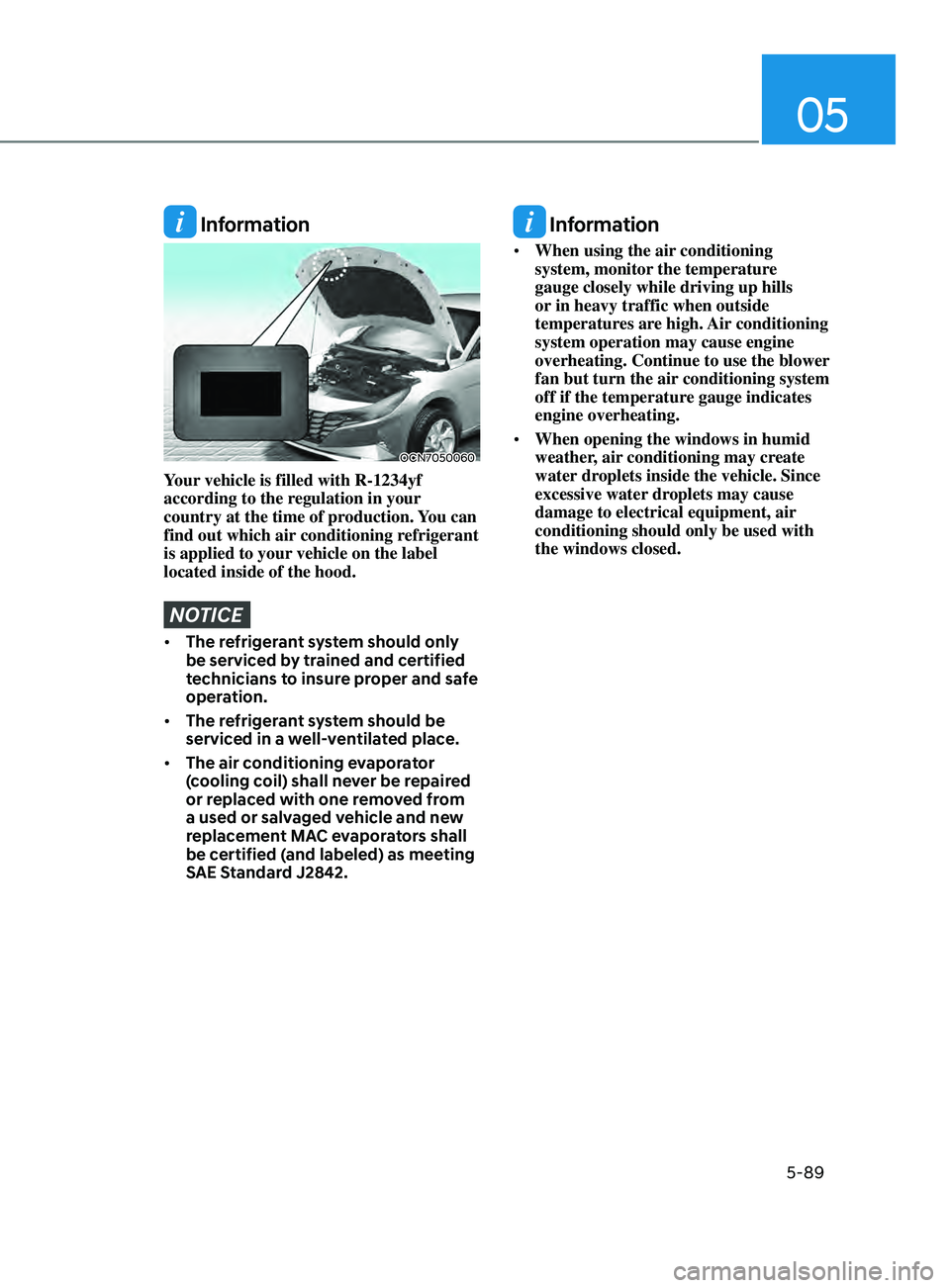
Your vehicle is filled with R-1234yf
according to the regulation in your
country at the time of production. You can
find out which air conditioning refrigerant
is applied to your vehicle on the label
located inside of the hood.
NOTICE
• The refrigerant system should only
be serviced by trained and certified
technicians to insure proper and safe
operation.
• The refrigerant system should be
serviced in a well-ventilated place.
• The air conditioning evaporator
(cooling coil) shall never be repaired
or replaced with one removed from
a used or salvaged vehicle and new
replacement MAC evaporators shall
be certified (and labeled) as meeting
SAE Standard J2842.
Information
• When using the air conditioning
system, monitor the temperature
gauge closely while driving up hills
or in heavy traffic when outside
temperatures are high. Air conditioning
system operation may cause engine
overheating. Continue to use the blower
fan but turn the air conditioning system
off if the temperature gauge indicates
engine overheating.
• When opening the windows in humid
weather, air conditioning may create
water droplets inside the vehicle. Since
excessive water droplets may cause
damage to electrical equipment, air
conditioning should only be used with
the windows closed.
Page 237 of 570
05
5-101
Air conditioning
HYUNDAI Air Conditioning Systems are
filled with R-1234yf refrigerant.
1.
Start the vehicle.
2.
Push the air conditioning button.
3.
Select the Face L
evel
mode.
4.
Set the air in
take control to
Recirculation mode temporarily to
allow the cabin to cool quickly. When
the desired temperature in the cabin
is reached, change the air intake
control back to Fresh mode.
5.
Adjus
t the fan speed control and
temperature control to maintain
maximum comfort.
Information
OCN7050060
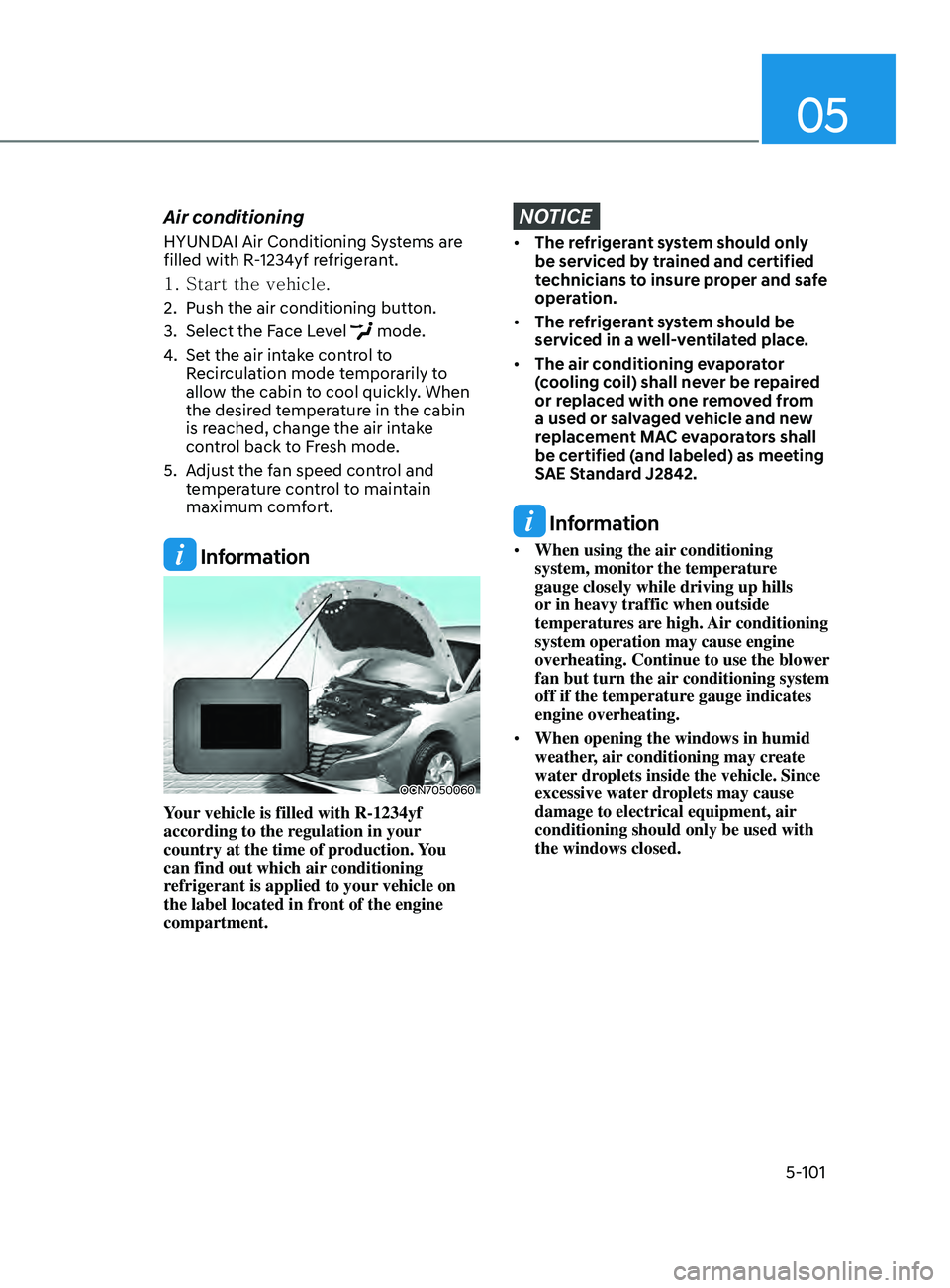
Your vehicle is filled with R-1234yf
according to the regulation in your
country at the time of production. You
can find out which air conditioning
refrigerant is applied to your vehicle on
the label located in front of the engine
compartment.
NOTICE
• The refrigerant system should only
be serviced by trained and certified
technicians to insure proper and safe
operation.
• The refrigerant system should be
serviced in a well-ventilated place.
• The air conditioning evaporator
(cooling coil) shall never be repaired
or replaced with one removed from
a used or salvaged vehicle and new
replacement MAC evaporators shall
be certified (and labeled) as meeting
SAE Standard J2842.
Information
• When using the air conditioning
system, monitor the temperature
gauge closely while driving up hills
or in heavy traffic when outside
temperatures are high. Air conditioning
system operation may cause engine
overheating. Continue to use the blower
fan but turn the air conditioning system
off if the temperature gauge indicates
engine overheating.
• When opening the windows in humid
weather, air conditioning may create
water droplets inside the vehicle. Since
excessive water droplets may cause
damage to electrical equipment, air
conditioning should only be used with
the windows closed.
Page 300 of 570
06
6-41
Various driving situations, which you may
encounter in SMART mode
• The driving mode automatically
changes to SMART ECO mode after
a certain period of time, when you
gently depress the accelerator pedal
(Your driving is categorized to be
economic.).
• The driving mode automatically
changes from SMART ECO mode to
SMART NORMAL mode after a certain
period of time, when you sharply or
repetitively depress the accelerator
pedal.
• The driving mode automatically
changes to SMART NORMAL mode
with the same driving patterns, when
the vehicle starts to drive on an
upward slope of a certain angle. The
driving mode automatically returns to
SMART ECO mode, when the vehicle
enters a leveled road.
• The driving mode automatically
changes to SMART SPORT, when
you abruptly accelerate the vehicle
or repetitively operate the steering
wheel (Your driving is categorized
to be sporty.). In this mode, your
vehicle drives in a lower gear for
abrupt accelerating/decelerating
and increases the engine brake
performance.
• You may still sense the engine
braking performance, even when
you release the accelerator pedal in
SMART SPORT mode. It is because
your vehicle remains in lower gear
over a certain period of time for next
acceleration. Thus, it is a normal
driving situation, not indicating any
malfunction. •
The driving mode automatically
changes to SMART SPORT mode
only in harsh driving situations. In
most of the normal driving situations,
the driving mode sets to be either
in SMART ECO mode or in SMART
NORMAL mode.
Limitation of SMART mode
The SMART mode may be limited in
following situations. (The OFF indicator
illuminates in those situations.)
• The cruise control is activated :
The cruise control system may
deactivate the SMART mode when
the vehicle is controlled by the set
speed of Smart Cruise Control system.
(SMART mode is not deactivated
just by activating the cruise control
system.)
• The transmission oil temperature is
either extremely low or extremely
high :
The SMART mode can be active in
most of the normal driving situations.
However, an extremely high/ low
transmission oil temperature may
temporarily deactivate the SMART
mode, because the transmission
condition is out of normal operation
condition.
Page 493 of 570

09
9 -7
Follow Normal Maintenance Schedule if the vehicle is usually operated where none of
the following conditions apply. If any of the following conditions apply, you must follow
the Maintenance Under Severe Usage Conditions.
• Repeated short distance driving.
• Driving in dusty conditions or sandy areas.
• Extensive use of brakes.
• Driving in areas where salt or other corrosive materials are used.
• Driving on rough or muddy roads.
• Driving in mountainous areas.
• Extended periods of idling or low speed operation.
• Driving for a prolonged period in cold temperatures and/or extremely humid
climates.
• More than 50% driving in heavy city traffic during hot weather above 90°F (32°C).
• Engine oil usage which is not recommended (mineral type, lower grade spec, etc.)
For additional information or assistance see your authorized HYUNDAI dealer.
NOTICE
After 10 years or 100,000 miles, we recommend to use severe maintenance
schedule.
SChEdulEd maintEnanCE SErviCES
Page 498 of 570

Maintenance
9-12
Severe driving conditions
A. Repeatedly driving short distance of less than 5 miles (8 km) in normal temperature
or less than 10 miles (16 km) in freezing temperature
B.
Extensiv
e engine idling or low speed driving for long distances
C.
Driving on rough, dus
ty, muddy, unpaved, graveled or saltspread roads
D.
Driving in areas using salt or o
ther corrosive materials or in very cold weather
E.
Driving in the condition of in
flowing sand or dust into engine
F.
Driving in heavy tr
affic area
G.
Driving on uphill, downhill, or moun
tain roads
H.
To
wing a trailer
I.
Driving for pa
trol car, taxi, commercial car or vehicle towing
J.
Driving ov
er 106 mph (170 km/h)
K.
Fr
equently driving in stop-and-go conditions
L.
Engine oil usage which is no
t recommended (mineral type, lower grade spec, etc.)
Page 501 of 570
09
9-15
Checking the Engine Oil Level
1. Follow all of the oil manufacturer’s
precautions.
2.
Be sure the v
ehicle is on the level
ground in P (Park) with the parking
brake set. If possible, block the
wheels.
3.
Turn the engine on and allo
w the
engine to reach normal operating
temperature.
4.
Turn the engine o
ff and wait about
five minutes for the oil to return to the
oil pan.
5.
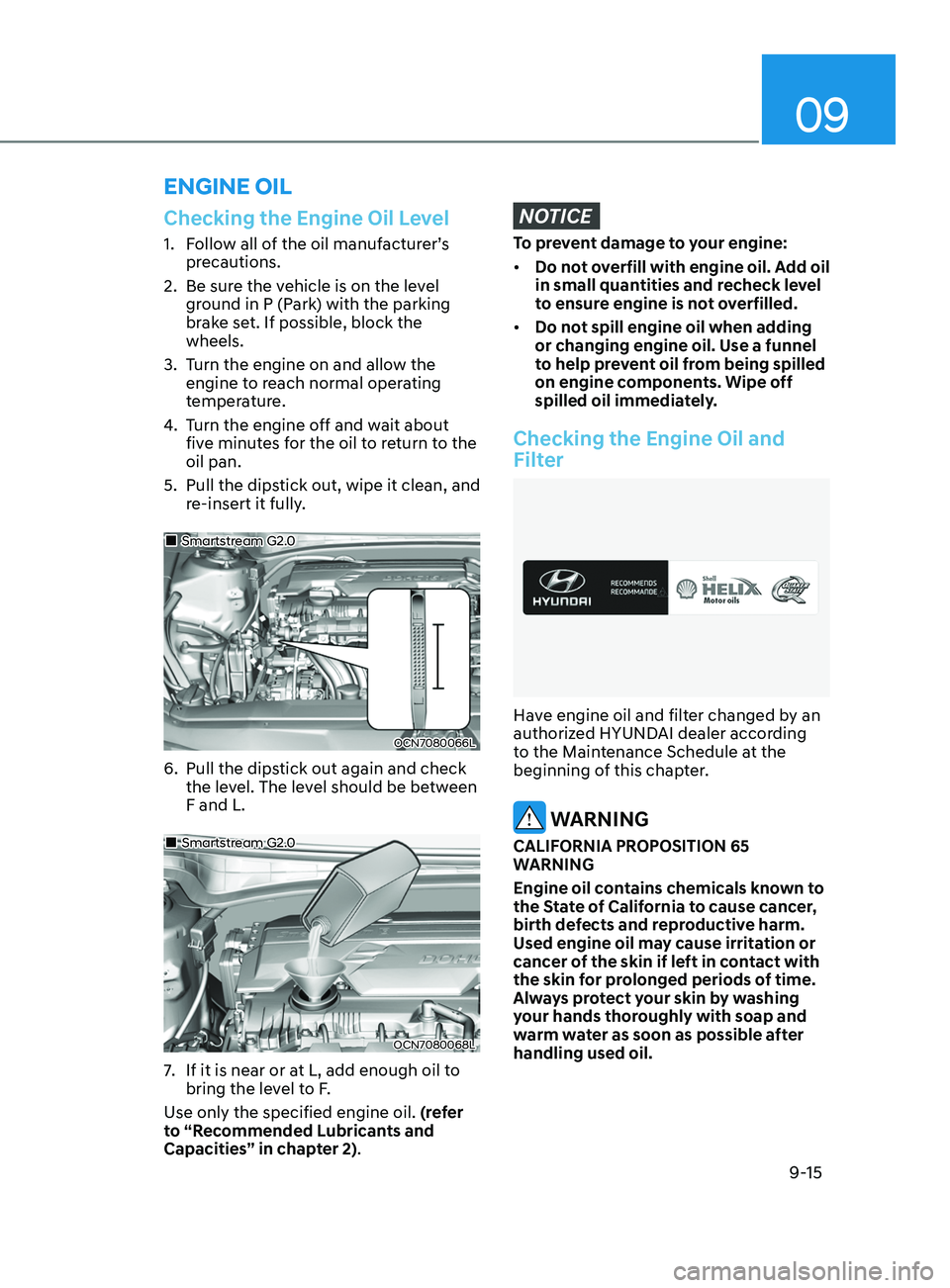
Pull the dipstick out, wipe it clean, and
r
e-insert it fully.
OCN7080066L
„„Smartstream G2.0
6. Pull the dipstick out again and check
the le vel. The level should be between
F and L.
OCN7080068L
„„Smartstream G2.0
7. If it is near or at L, add enough oil t o
bring the level to F.
Use only the specified engine oil. (refer
to “Recommended Lubricants and
Capacities” in chapter 2).
NOTICE
To prevent damage to your engine:
• Do not overfill with engine oil. Add oil
in small quantities and recheck level
to ensure engine is not overfilled.
• Do not spill engine oil when adding
or changing engine oil. Use a funnel
to help prevent oil from being spilled
on engine components. Wipe off
spilled oil immediately.
Checking the Engine Oil and
Filter
Have engine oil and filter changed by an
authorized HYUNDAI dealer according
to the Maintenance Schedule at the
beginning of this chapter.
WARNING
CALIFORNIA PROPOSITION 65
WARNING
Engine oil contains chemicals known to
the State of California to cause cancer,
birth defects and reproductive harm.
Used engine oil may cause irritation or
cancer of the skin if left in contact with
the skin for prolonged periods of time.
Always protect your skin by washing
your hands thoroughly with soap and
warm water as soon as possible after
handling used oil.
EnginE oil
Page 546 of 570

Maintenance
9-60
WARNING
After washing the vehicle, test the
brakes while driving slowly to see
if they have been affected by water
before getting on the road. If braking
performance is impaired, dry the
brakes by applying them lightly while
maintaining a slow forward speed.
NOTICE
• Do not use strong soap, chemical
detergents or hot water, and do not
wash the vehicle in direct sunlight
or when the body of the vehicle is
warm.
• Be careful when washing the side
windows of your vehicle.
Especially, with high-pressure water,
water may leak through the windows
and wet the interior.
• To prevent damage to the plastic
parts, do not clean with chemical
solvents or strong detergents.ODN8A089039
NOTICE
• Water washing in the engine
compartment including high
pressure water washing may cause
the failure of electrical circuits
located in the engine compartment.
• Never allow water or other liquids
to come in contact with electrical/
electronic components inside the
vehicle as this may damage them.
NOTICE
Matte paint finish vehicle (if equipped)
Automatic car wash which uses rotating
brushes should not be used as this can
damage the surface of your vehicle. A
steam cleaner which washes the vehicle
surface at high temperature may cause
oil to adhere and leave stains that is
difficult to remove.
Use a soft cloth (e.g. microfiber towel
or sponge) when washing your vehicle
and dry with a microfiber towel. When
you hand wash your vehicle, you should
not use a cleaner that finishes with wax.
If the vehicle surface is too dirty (sand,
dirt, dust, contaminant, etc.), clean the
surface with water before washing the
car.
Page 552 of 570
Maintenance
9-66
Leather (if equipped)
• Features of seat leather
- Lea
ther is made from the outer skin
of an animal, which goes through a
special process to be available for
use. Since it is a natural product,
each part differs in thickness or
density.
Wrinkles may appear as a natural
result of stretching and shrinking
depending on the temperature and
humidity.
- The seat is made o
f stretchable
fabric to improve comfort.
- The parts contacting the body ar
e
curved and the side supporting
area is high which provides driving
comfort and stability.
- Wrinkles ma
y appear naturally
from usage. It is not a fault of the
products.
CAUTION
• Wrinkles or abrasions which appear
naturally from usage are not covered
by warranty.
• Belts with metallic accessories,
zippers or keys inside the back
pocket may damage the seat fabric.
• Make sure not to wet the seat. It may
change the nature of natural leather.
• Jeans or clothes which could bleach
may contaminate the surface of the
seat covering fabric. •
Caring for the leather seats
- Vacuum the sea
t periodically to
remove dust and sand on the seat. It
will prevent abrasion or damage of
the leather and maintain its quality.
- Wipe the natur
al leather seat cover
often with dry or soft cloth.
- Use o
f proper leather protector may
prevent abrasion of the cover and
helps maintain the color. Be sure to
read the instructions and consult
a specialist when using leather
coating or protective agent.
- Light color
ed (beige, cream beige)
leather is easily contaminated and
the stain is noticeable. Clean the
seats frequently.
- Av
oid wiping with wet cloth. It may
cause the surface to crack.
• Cleaning the leather seats
- Remo
ve all contaminations
instantly. Refer to instructions below
for removal of each contaminant. - Cosmetic pr oducts (sunscreen,
foundation, etc.)
Apply cleansing cream on a cloth
and wipe the contaminated spot.
Wipe off the cream with a wet cloth
and remove water with a dry cloth.
- Bev
erages (coffee, soft drink, etc.)
Apply a small amount of neutral
detergent and wipe until
contaminations do not smear.
- Oil Remo
ve oil instantly with
absorbable cloth and wipe with
stain remover used only for natural
leather.
- Chewing gum
Har
den the gum with ice and
remove gradually.