radiator cap Hyundai Elantra Touring 2012 Owner's Manual
[x] Cancel search | Manufacturer: HYUNDAI, Model Year: 2012, Model line: Elantra Touring, Model: Hyundai Elantra Touring 2012Pages: 402, PDF Size: 5.49 MB
Page 17 of 402
Your vehicle at a glance
42
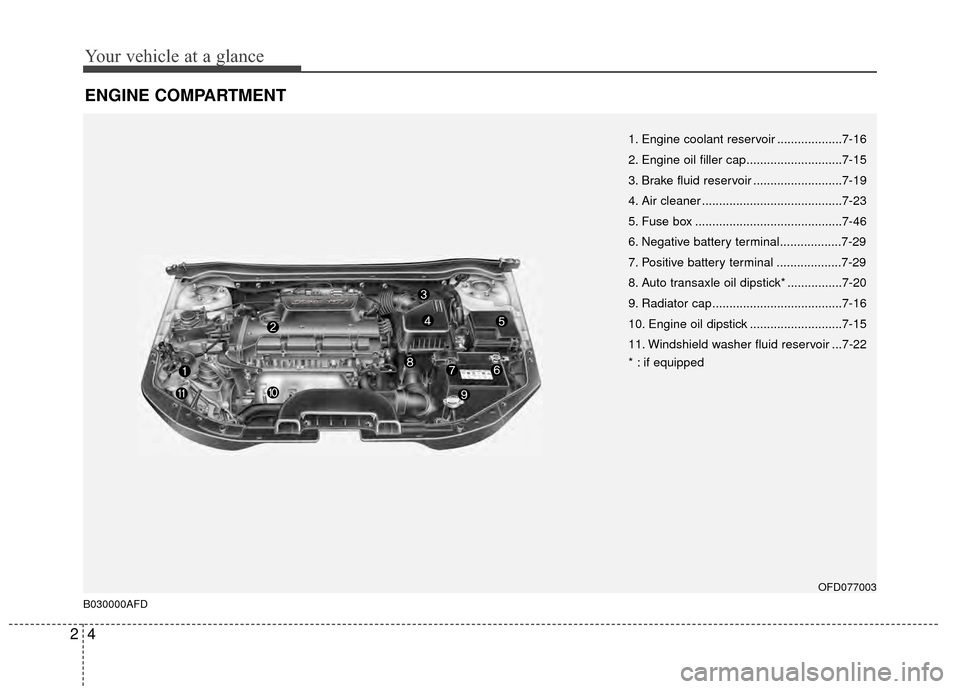
ENGINE COMPARTMENT
OFD077003
1. Engine coolant reservoir ...................7-16
2. Engine oil filler cap............................7-15
3. Brake fluid reservoir ..........................7-19
4. Air cleaner .........................................7-23
5. Fuse box ...........................................7-46
6. Negative battery terminal..................7-29
7. Positive battery terminal ...................7-29
8. Auto transaxle oil dipstick* ................7-20
9. Radiator cap......................................7-16
10. Engine oil dipstick ...........................7-15
11. Windshield washer fluid reservoir ...7-22
* : if equipped
B030000AFD
Page 115 of 402
439
Features of your vehicle
D150203AUN
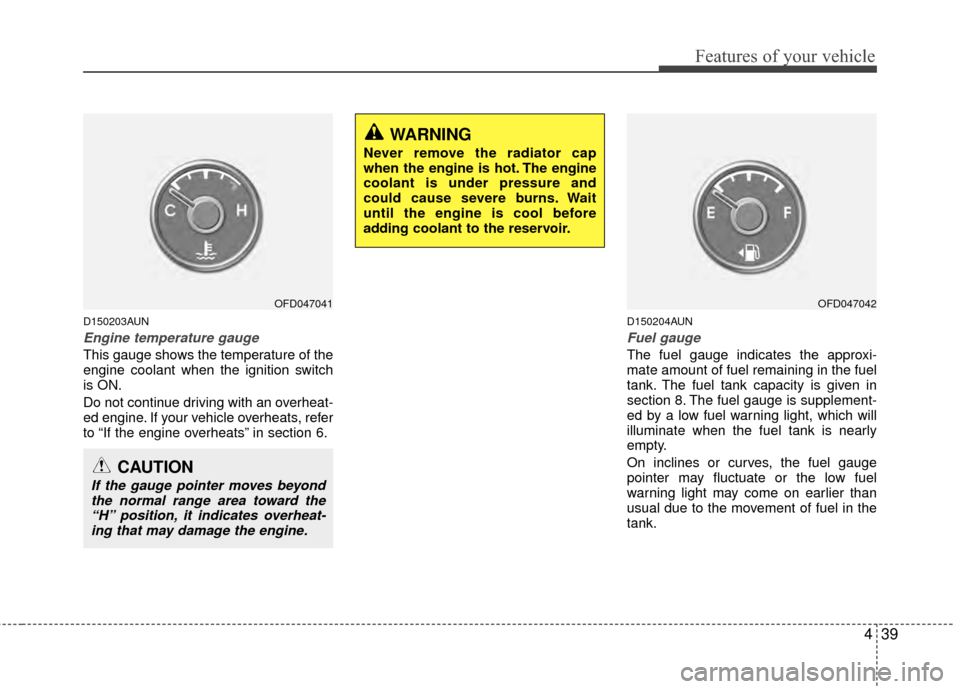
Engine temperature gauge
This gauge shows the temperature of the
engine coolant when the ignition switch
is ON.
Do not continue driving with an overheat-
ed engine. If your vehicle overheats, refer
to “If the engine overheats” in section 6.
D150204AUN
Fuel gauge
The fuel gauge indicates the approxi-
mate amount of fuel remaining in the fuel
tank. The fuel tank capacity is given in
section 8. The fuel gauge is supplement-
ed by a low fuel warning light, which will
illuminate when the fuel tank is nearly
empty.
On inclines or curves, the fuel gauge
pointer may fluctuate or the low fuel
warning light may come on earlier than
usual due to the movement of fuel in the
tank.
CAUTION
If the gauge pointer moves beyondthe normal range area toward the“H” position, it indicates overheat-ing that may damage the engine.
WARNING
Never remove the radiator cap
when the engine is hot. The engine
coolant is under pressure and
could cause severe burns. Wait
until the engine is cool before
adding coolant to the reservoir.
OFD047041OFD047042
Page 297 of 402
What to do in an emergency
66
IF THE ENGINE OVERHEATS
F050000AFD
If your temperature gauge indicates over-
heating, you experience a loss of power,
or hear loud pinging or knocking, the
engine is probably too hot. If this hap-
pens, you should:
1. Pull off the road and stop as soon as itis safe to do so.
2. Place the gear selector lever in P (automatic transaxle) or neutral (man-
ual transaxle) and set the parking
brake. If the air conditioning is on, turn
it off.
3. If engine coolant is running out under the car or steam is coming out from
underneath the hood, stop the engine.
Do not open the hood until the coolant
has stopped running or the steaming
has stopped. If there is no visible loss
of engine coolant and no steam, leave
the engine running and check to be
sure the engine cooling fan is operat-
ing. If the fan is not running, turn the
engine off.
4. Check to see if the water pump drive belt is missing. If it is not missing,
check to see that it is tight. If the drive
belt seems to be satisfactory, check
for coolant leaking from the radiator,
hoses or under the car. (If the air con-
ditioning had been in use, it is normal
for cold water to be draining from it
when you stop). 5. If the water pump drive belt is broken
or engine coolant is leaking out, stop
the engine immediately and call the
nearest authorized HYUNDAI dealer
for assistance. 6. If you cannot find the cause of the
overheating, wait until the engine tem-
perature has returned to normal. Then,
if coolant has been lost, carefully add
coolant to the reservoir to bring the
fluid level in the reservoir up to the
halfway mark.
7. Proceed with caution, keeping alert for further signs of overheating. If over-
heating happens again, call an author-
ized HYUNDAI dealer for assistance.
CAUTION
Serious loss of coolant indicates
there is a leak in the cooling systemand this should be checked as soonas possible by an authorizedHYUNDAI dealer.
WARNING
While the engine is running, keep
hair, hands and clothing away from
moving parts such as the fan and
drive belts to prevent injury.
WARNING
Do not remove the radiator cap
when the engine is hot. This may
result in coolant being blown out of
the opening and cause serious
burns.
Page 317 of 402
Maintenance
27
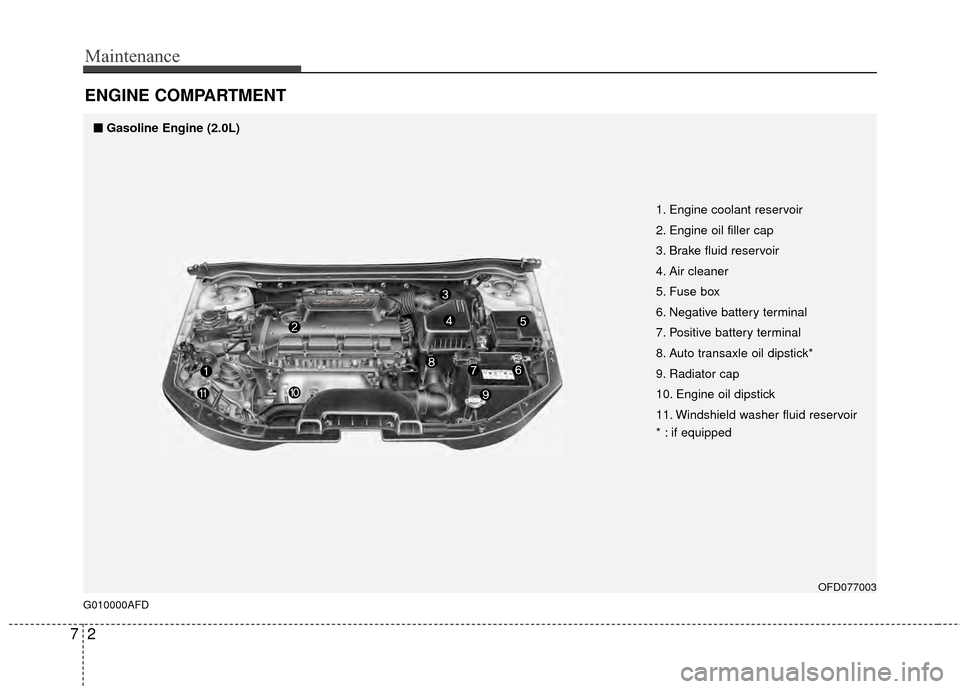
ENGINE COMPARTMENT
OFD077003
G010000AFD
1. Engine coolant reservoir
2. Engine oil filler cap
3. Brake fluid reservoir
4. Air cleaner
5. Fuse box
6. Negative battery terminal
7. Positive battery terminal
8. Auto transaxle oil dipstick*
9. Radiator cap
10. Engine oil dipstick
11. Windshield washer fluid reservoir
* : if equipped
■ ■
Gasoline Engine (2.0L)
Page 328 of 402
713
Maintenance
G050500AUN
Timing belt
Inspect all parts related to the timing belt
for damage and deformation. Replace
any damaged parts immediately.
G050600AUN
Vapor hose and fuel filler cap
The vapor hose and fuel filler cap should
be inspected at those intervals specified
in the maintenance schedule. Make sure
that a new vapor hose or fuel filler cap is
correctly replaced.
G050700AUN
Vacuum crankcase ventilation
hoses
Inspect the surface of hoses for evidence
of heat and/or mechanical damage. Hard
and brittle rubber, cracking, tears, cuts,
abrasions, and excessive swelling indi-
cate deterioration. Particular attention
should be paid to examine those hose
surfaces nearest to high heat sources,
such as the exhaust manifold.
Inspect the hose routing to assure that
the hoses do not come in contact with
any heat source, sharp edges or moving
component which might cause heat dam-
age or mechanical wear. Inspect all hose
connections, such as clamps and cou-
plings, to make sure they are secure, and
that no leaks are present. Hoses should
be replaced immediately if there is any
evidence of deterioration or damage.
G050800AFD
Air cleaner filter
A Genuine HYUNDAI air cleaner filter is
recommended when the filter is
replaced.
G050900AUN
Spark plugs
Make sure to install new spark plugs of
the correct heat range.
G051000AFD
Valve clearance
Inspect excessive valve noise and/or
engine vibration and adjust if necessary.
An authorized HYUNDAI dealer should
perform the operation.
G051100AUN
Cooling system
Check the cooling system parts, such as
radiator, coolant reservoir, hoses and
connections for leakage and damage.
Replace any damaged parts.
G051200AUN
Coolant
The coolant should be changed at the
intervals specified in the maintenance
schedule.
Page 330 of 402
715
Maintenance
ENGINE OIL
G060100AUN
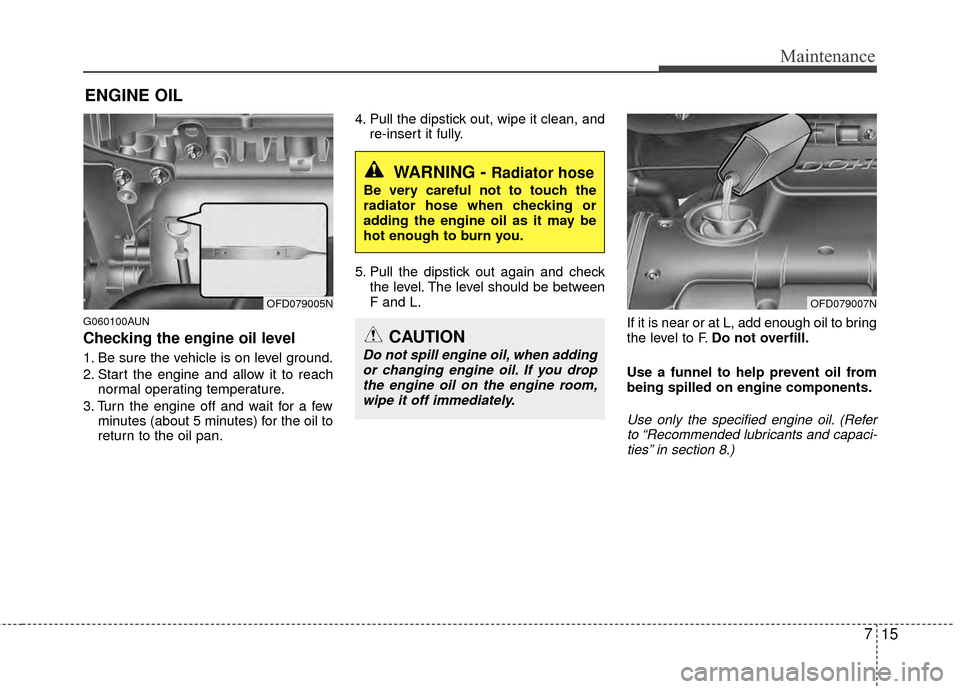
Checking the engine oil level
1. Be sure the vehicle is on level ground.
2. Start the engine and allow it to reachnormal operating temperature.
3. Turn the engine off and wait for a few minutes (about 5 minutes) for the oil to
return to the oil pan. 4. Pull the dipstick out, wipe it clean, and
re-insert it fully.
5. Pull the dipstick out again and check the level. The level should be between
F and L.
If it is near or at L, add enough oil to bring
the level to F.Do not overfill.
Use a funnel to help prevent oil from
being spilled on engine components.
Use only the specified engine oil. (Refer to “Recommended lubricants and capaci-ties” in section 8.)
WARNING - Radiator hose
Be very careful not to touch the
radiator hose when checking or
adding the engine oil as it may be
hot enough to burn you.
OFD079005NOFD079007N
CAUTION
Do not spill engine oil, when addingor changing engine oil. If you drop the engine oil on the engine room,wipe it off immediately.
Page 331 of 402
Maintenance
16
7
ENGINE COOLANT
G060200AFD-EU
Changing the engine oil and filter
Have engine oil and filter changed by an
authorized HYUNDAI dealer according to
the Maintenance Schedule at the begin-
ning of this section.
G070000AFD
The high-pressure cooling system has a
reservoir filled with year-round antifreeze
coolant. The reservoir is filled at the fac-
tory.
Check the antifreeze protection and
coolant concentration level at least once
a year, at the beginning of the winter sea-
son, and before traveling to a colder cli-
mate.
G070100AFD
Checking the coolant level
WARNING
Removing radiator
cap
Never attempt to remove the radi-
ator cap while the engine is oper-
ating or hot. Doing so might lead
to cooling system and engine
damage and could result in seri-
ous personal injury from escap-
ing hot coolant or steam.
(Continued)CALIFORNIA PROPOSI-
TION 65 WARNING
Engine oil contains chemicals
known to the State of California to
cause cancer, birth defects and
reproductive harm. Used engine oil
may cause irritation or cancer of
the skin if left in contact with the
skin for prolonged periods of time.
Always protect your skin by wash-
ing your hands thoroughly with
soap and warm water as soon as
possible after handling used oil.
(Continued)
Turn the engine off and wait until
it cools down. Use extreme care
when removing the radiator cap.
Wrap a thick towel around it, and
turn it counterclockwise slowly to
the first stop. Step back while the
pressure is released from the
cooling system. When you are
sure all the pressure has been
released, press down on the cap,
using a thick towel, and continue
turning counterclockwise to
remove it.
Even if the engine is not operat- ing, do not remove the radiator
cap or the drain plug while the
engine and radiator are hot. Hot
coolant and steam may still blow
out under pressure, causing seri-
ous injury.
Page 333 of 402
Maintenance
18
7
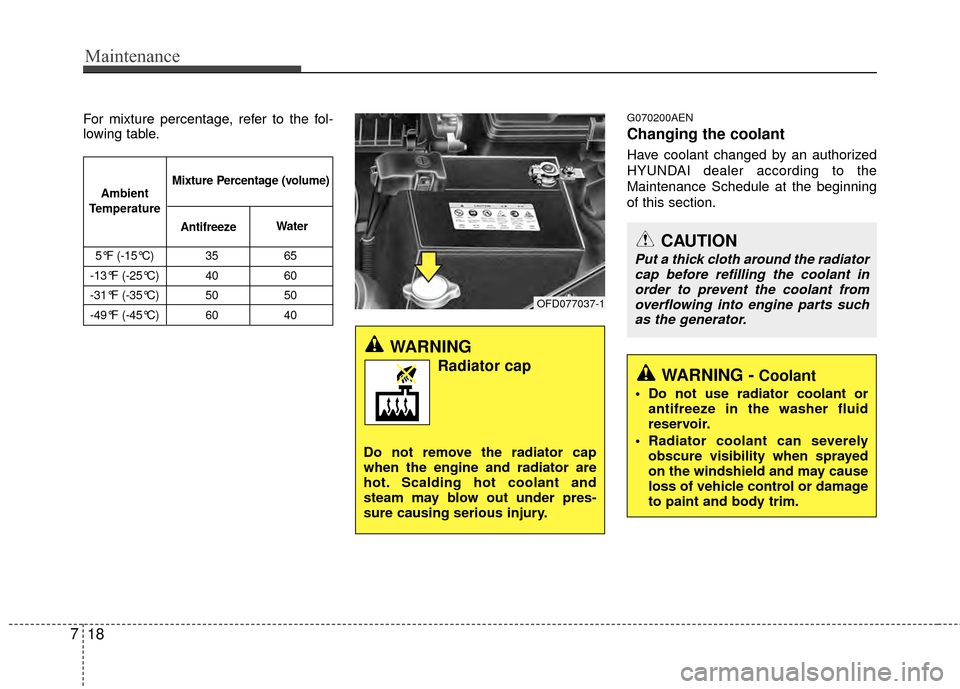
For mixture percentage, refer to the fol-
lowing table.G070200AEN
Changing the coolant
Have coolant changed by an authorized
HYUNDAI dealer according to the
Maintenance Schedule at the beginning
of this section.
WARNING
Radiator cap
Do not remove the radiator cap
when the engine and radiator are
hot. Scalding hot coolant and
steam may blow out under pres-
sure causing serious injury.
CAUTION
Put a thick cloth around the radiator
cap before refilling the coolant in order to prevent the coolant fromoverflowing into engine parts suchas the generator.
WARNING -Coolant
Do not use radiator coolant or antifreeze in the washer fluid
reservoir.
Radiator coolant can severely obscure visibility when sprayed
on the windshield and may cause
loss of vehicle control or damage
to paint and body trim.
OFD077037-1
5°F (-15°C) 35 65
-13°F (-25°C) 40 60
-31°F (-35°C) 50 50
-49°F (-45°C) 60 40
Ambient
Temperature Mixture Percentage (volume)
Antifreeze Water
Page 336 of 402
721
Maintenance
✽
✽NOTICE
“C” (COLD) range is for reference only
and should NOT be used to determine
transaxle fluid level.
✽ ✽NOTICE
New automatic transaxle fluid should be
red. The red dye is added so the assem-
bly plant can identify it as automatic
transaxle fluid and distinguish it from
engine oil or antifreeze. The red dye,
which is not an indicator of fluid quali-
ty, is not permanent. As the vehicle is
driven, the automatic transaxle fluid
will begin to look darker. The color may
eventually appear light brown.
Therefore, have an authorized
HYUNDAI dealer change the automatic
transaxle fluid according to the
Scheduled Maintenance at the begin-
ning of this section.
Use only the specified automatic
transaxle fluid. (Refer to “Recommended
lubricants and capacities” in section 8.)
G100200AFD
Changing the automatic transaxle
fluid
Have automatic transaxle fluid changed
by an authorized HYUNDAI dealer
according to the Maintenance Schedule
at the beginning of this section.
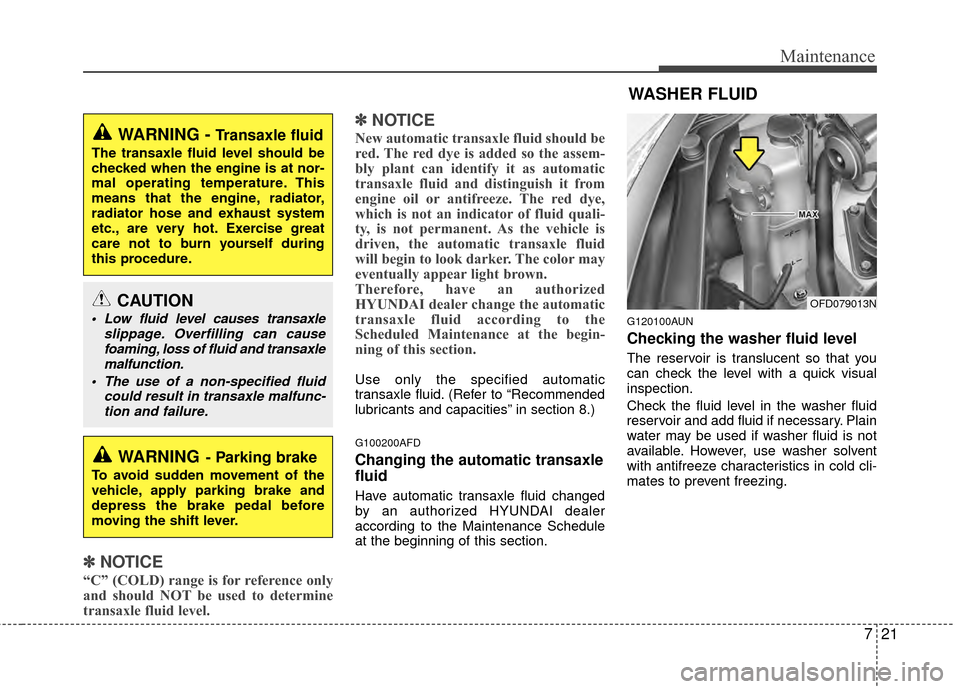
G120100AUN
Checking the washer fluid level
The reservoir is translucent so that you
can check the level with a quick visual
inspection.
Check the fluid level in the washer fluid
reservoir and add fluid if necessary. Plain
water may be used if washer fluid is not
available. However, use washer solvent
with antifreeze characteristics in cold cli-
mates to prevent freezing.
WARNING - Transaxle fluid
The transaxle fluid level should be
checked when the engine is at nor-
mal operating temperature. This
means that the engine, radiator,
radiator hose and exhaust system
etc., are very hot. Exercise great
care not to burn yourself during
this procedure.
WARNING- Parking brake
To avoid sudden movement of the
vehicle, apply parking brake and
depress the brake pedal before
moving the shift lever.
CAUTION
Low fluid level causes transaxle
slippage. Overfilling can causefoaming, loss of fluid and transaxlemalfunction.
The use of a non-specified fluid could result in transaxle malfunc-tion and failure.
WASHER FLUID
OFD079013N
Page 387 of 402
Specifications, Consumer information, Reporting safety defects
48
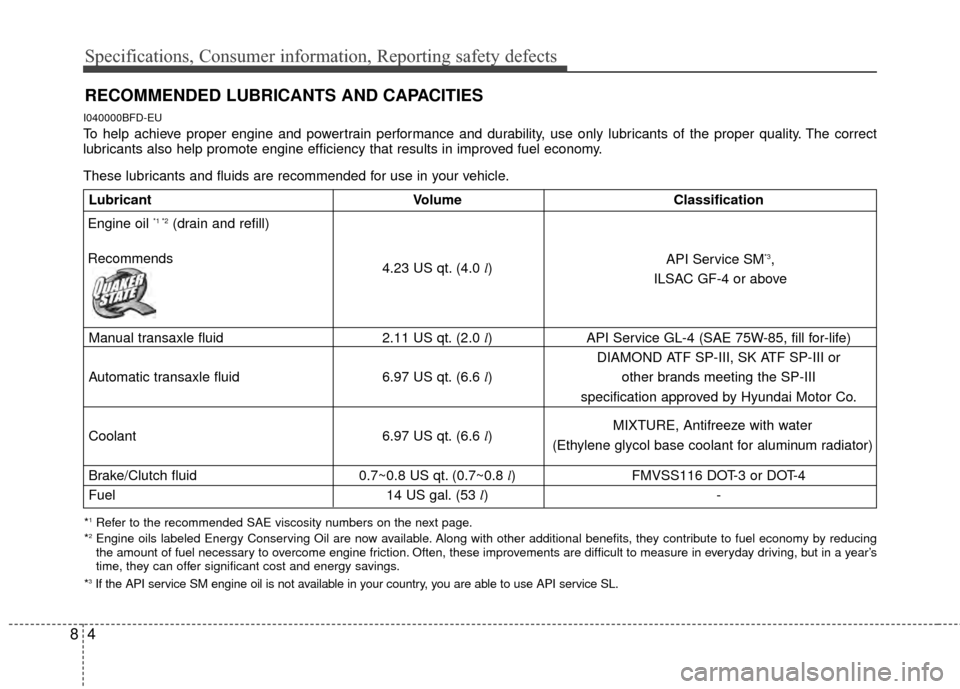
RECOMMENDED LUBRICANTS AND CAPACITIES
I040000BFD-EU
To help achieve proper engine and powertrain performance and durability, use only lubricants of the proper quality. The correct
lubricants also help promote engine efficiency that results in improved fuel economy.
These lubricants and fluids are recommended for use in your vehicle.
*1Refer to the recommended SAE viscosity numbers on the next page.
*2Engine oils labeled Energy Conserving Oil are now available. Along with other additional benefits, they contribute to fuel econo my by reducing
the amount of fuel necessary to overcome engine friction. Often, these improvements are difficult to measure in everyday driving, but in a year’s
time, they can offer significant cost and energy savings.
*
3If the API service SM engine oil is not available in your country, you are able to use API service SL.
Lubricant Volume Classification
4.23 US qt. (4.0 l)
Manual transaxle fluid 2.11 US qt. (2.0 l)API Service GL-4 (SAE 75W-85, fill for-life)
DIAMOND ATF SP-III, SK ATF SP-III or
Automatic transaxle fluid 6.97 US qt. (6.6 l)other brands meeting the SP-III
specification approved by Hyundai Motor Co.
Coolant 6.97 US qt. (6.6 l)
Brake/Clutch fluid 0.7~0.8 US qt. (0.7~0.8 l) FMVSS116 DOT-3 or DOT-4
Fuel 14 US gal. (53 l)-
Engine oil *1 *2(drain and refill)
Recommends API Service SM
*3,
ILSAC GF-4 or above
MIXTURE, Antifreeze with water
(Ethylene glycol base coolant for aluminum radiator)