brake fluid HYUNDAI ENTOURAGE 2007 User Guide
[x] Cancel search | Manufacturer: HYUNDAI, Model Year: 2007, Model line: ENTOURAGE, Model: HYUNDAI ENTOURAGE 2007Pages: 398, PDF Size: 8.03 MB
Page 324 of 398
Maintenance10 6At least once a year: Clean body and door drain holes.
Lubricate door hinges and checks, and
hood hinges.
Lubricate door and hood locks and
latches.
Lubricate door rubber weatherstrips.
Check the air conditioning system
before the warm weather season.
Check the power steering fluid level.
Inspect and lubricate automatic
transaxle linkage and controls.
Clean battery and terminals.
Check the brake fluid level.
Owner maintenance precautions Improper or incomplete service may
result in problems. This section gives
instructions only for the maintenance
items that are easy to perform.
As explained earlier in this section, sev-
eral procedures can be done only by an
Authorized Hyundai Dealer with special
tools.
Improper owner maintenance during
the warranty period may affect war-
ranty coverage. For details, read the
separate Hyundai Owner’s Handbook
& Warranty Information booklet pro-
vided with the vehicle. If you're unsure
about any servicing or maintenance
procedure, have it done by an
Authorized Hyundai Dealer.
WARNING
- Maintenance
work
Performing maintenance work on
a vehicle can be dangerous. You
can be seriously injured while per-
forming some maintenance pro-
cedures. If you lack sufficient
knowledge and experience or the
proper tools and equipment to do
the work, have it done by an
Authorized Hyundai Dealer.
Working under the hood with the
engine running is dangerous. It
becomes even more dangerous
when you wear jewelry or loose
clothing. These can become
entangled in moving parts and
result in injury. Always remove all
loose or hanging clothing and all
jewelry before working on the
engine.
Page 325 of 398
611
Maintenance
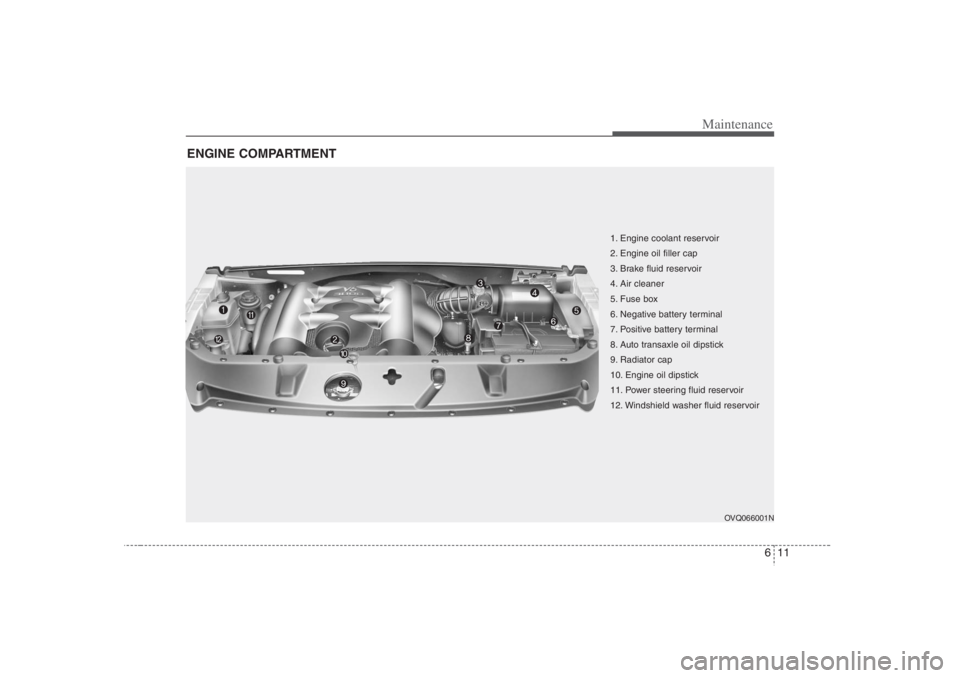
ENGINE COMPARTMENT
OVQ066001N
1. Engine coolant reservoir
2. Engine oil filler cap
3. Brake fluid reservoir
4. Air cleaner
5. Fuse box
6. Negative battery terminal
7. Positive battery terminal
8. Auto transaxle oil dipstick
9. Radiator cap
10. Engine oil dipstick
11. Power steering fluid reservoir
12. Windshield washer fluid reservoir
Page 331 of 398
617
Maintenance
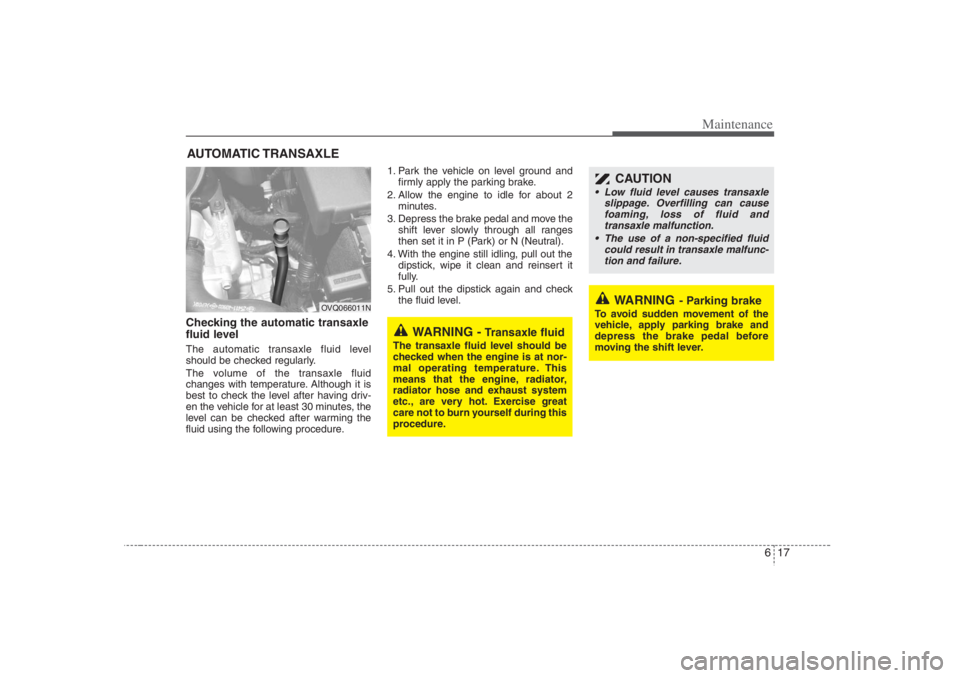
AUTOMATIC TRANSAXLEChecking the automatic transaxle
fluid level The automatic transaxle fluid level
should be checked regularly.
The volume of the transaxle fluid
changes with temperature. Although it is
best to check the level after having driv-
en the vehicle for at least 30 minutes, the
level can be checked after warming the
fluid using the following procedure.1. Park the vehicle on level ground and
firmly apply the parking brake.
2. Allow the engine to idle for about 2
minutes.
3. Depress the brake pedal and move the
shift lever slowly through all ranges
then set it in P (Park) or N (Neutral).
4. With the engine still idling, pull out the
dipstick, wipe it clean and reinsert it
fully.
5. Pull out the dipstick again and check
the fluid level.
WARNING -
Transaxle fluid
The transaxle fluid level should be
checked when the engine is at nor-
mal operating temperature. This
means that the engine, radiator,
radiator hose and exhaust system
etc., are very hot. Exercise great
care not to burn yourself during this
procedure.
WARNING
- Parking brake
To avoid sudden movement of the
vehicle, apply parking brake and
depress the brake pedal before
moving the shift lever.
CAUTION
Low fluid level causes transaxle
slippage. Overfilling can cause
foaming, loss of fluid and
transaxle malfunction.
The use of a non-specified fluid
could result in transaxle malfunc-
tion and failure.
OVQ066011N
Page 333 of 398
619
Maintenance
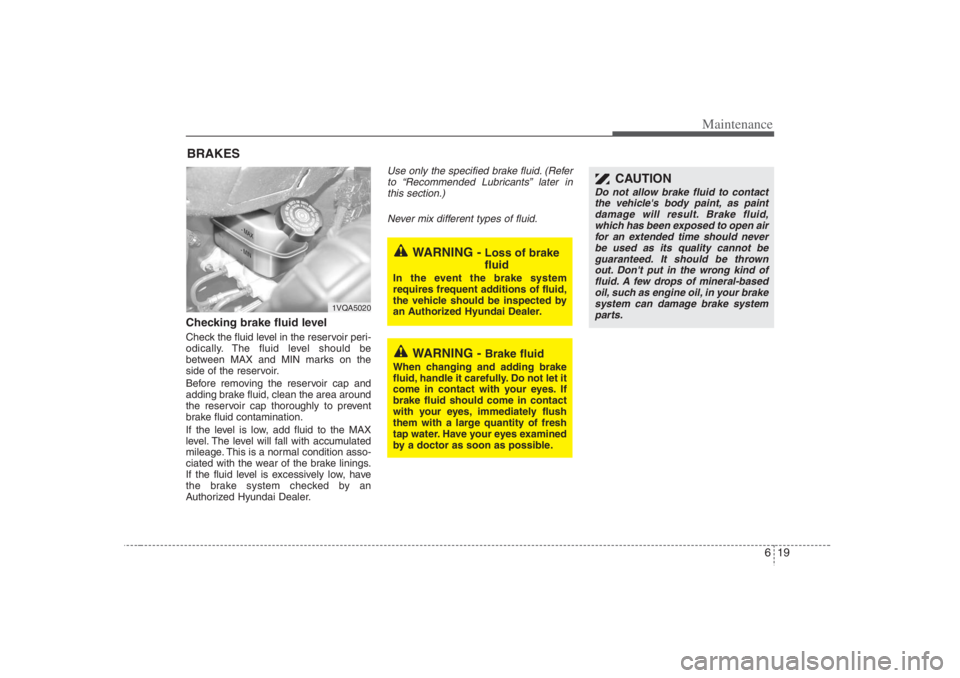
BRAKESChecking brake fluid level Check the fluid level in the reservoir peri-
odically. The fluid level should be
between MAX and MIN marks on the
side of the reservoir.
Before removing the reservoir cap and
adding brake fluid, clean the area around
the reservoir cap thoroughly to prevent
brake fluid contamination.
If the level is low, add fluid to the MAX
level. The level will fall with accumulated
mileage. This is a normal condition asso-
ciated with the wear of the brake linings.
If the fluid level is excessively low, have
the brake system checked by an
Authorized Hyundai Dealer.
Use only the specified brake fluid. (Refer
to “Recommended Lubricants” later in
this section.)
Never mix different types of fluid.
WARNING -
Brake fluid
When changing and adding brake
fluid, handle it carefully. Do not let it
come in contact with your eyes. If
brake fluid should come in contact
with your eyes, immediately flush
them with a large quantity of fresh
tap water. Have your eyes examined
by a doctor as soon as possible.
WARNING -
Loss of brake
fluid
In the event the brake system
requires frequent additions of fluid,
the vehicle should be inspected by
an Authorized Hyundai Dealer.
1VQA5020
CAUTION
Do not allow brake fluid to contact
the vehicle's body paint, as paint
damage will result. Brake fluid,
which has been exposed to open air
for an extended time should never
be used as its quality cannot be
guaranteed. It should be thrown
out. Don't put in the wrong kind of
fluid. A few drops of mineral-based
oil, such as engine oil, in your brake
system can damage brake system
parts.
Page 373 of 398
659
Maintenance
LUBRICANT
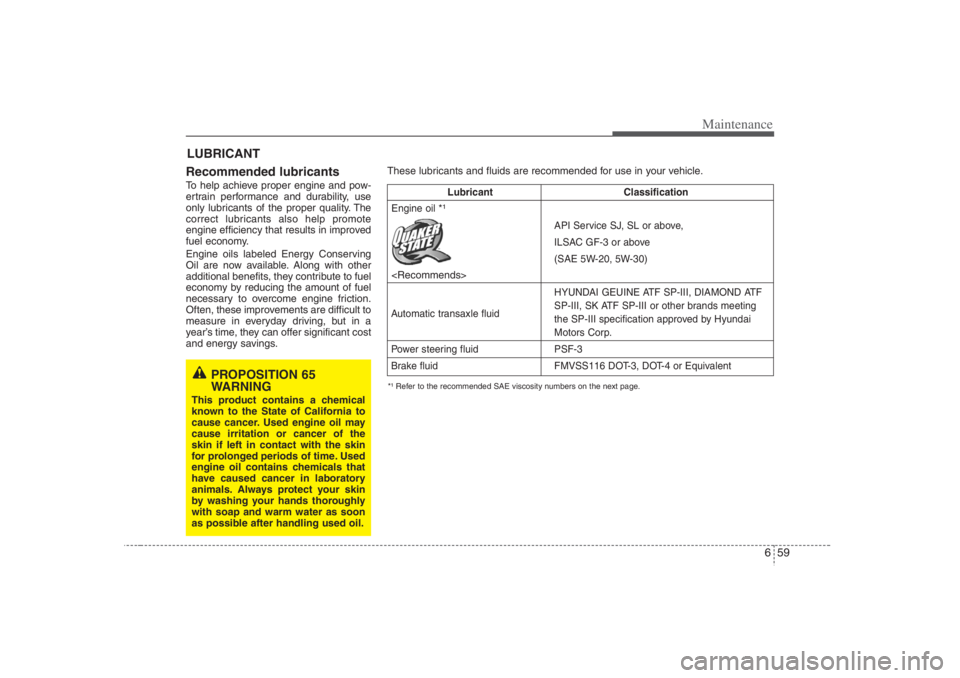
Recommended lubricants To help achieve proper engine and pow-
ertrain performance and durability, use
only lubricants of the proper quality. The
correct lubricants also help promote
engine efficiency that results in improved
fuel economy.
Engine oils labeled Energy Conserving
Oil are now available. Along with other
additional benefits, they contribute to fuel
economy by reducing the amount of fuel
necessary to overcome engine friction.
Often, these improvements are difficult to
measure in everyday driving, but in a
year’s time, they can offer significant cost
and energy savings.
These lubricants and fluids are recommended for use in your vehicle.*¹ Refer to the recommended SAE viscosity numbers on the next page.
Lubricant Classification
API Service SJ, SL or above,
ILSAC GF-3 or above
(SAE 5W-20, 5W-30)
HYUNDAI GEUINE ATF SP-III, DIAMOND ATF
Automatic transaxle fluidSP-III, SK ATF SP-III or other brands meeting
the SP-III specification approved by Hyundai
Motors Corp.
Power steering fluid PSF-3
Brake fluid FMVSS116 DOT-3, DOT-4 or Equivalent
Engine oil
*¹
PROPOSITION 65
WARNING
This product contains a chemical
known to the State of California to
cause cancer. Used engine oil may
cause irritation or cancer of the
skin if left in contact with the skin
for prolonged periods of time. Used
engine oil contains chemicals that
have caused cancer in laboratory
animals. Always protect your skin
by washing your hands thoroughly
with soap and warm water as soon
as possible after handling used oil.
Page 390 of 398
83
Specifications
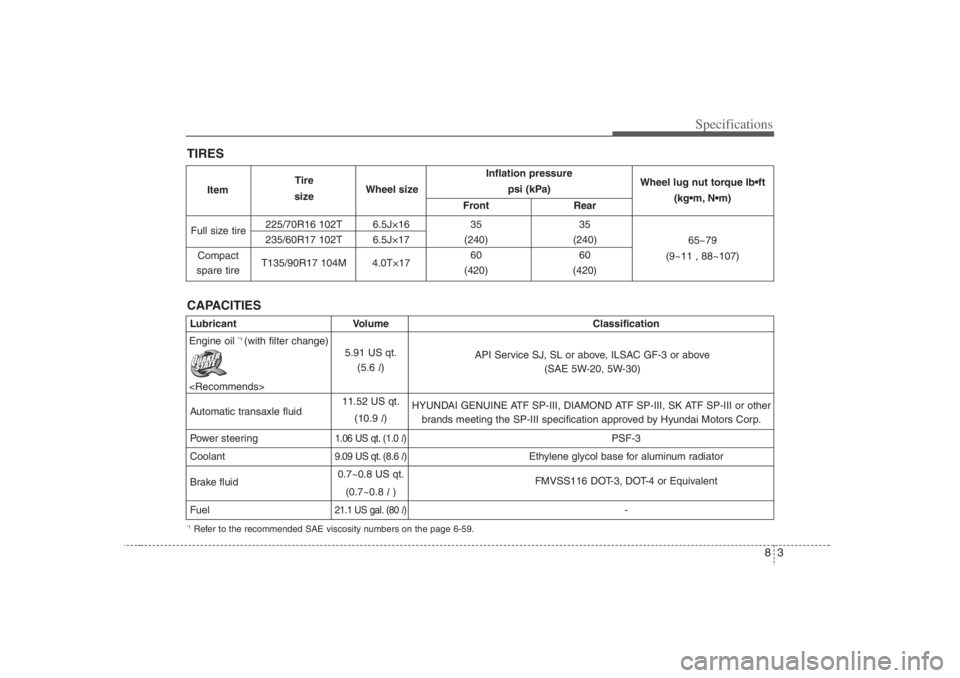
Inflation pressure
psi (kPa)
Front Rear
225/70R16 102T 6.5J×16 35 35
235/60R17 102T 6.5J×17 (240) (240)
T135/90R17 104M 4.0T×1760 60
(420) (420)
Full size tire
Compact
spare tireWheel lug nut torque lb•ft
(kgm, Nm)
65~79
(9~11 , 88~107)TIRES
ItemTire
sizeWheel size
CAPACITIESLubricant Volume Classification
5.91 US qt.
(5.6 l)
Automatic transaxle fluid11.52 US qt.
(10.9 l)
Power steering
1.06 US qt. (1.0 l)
PSF-3
Coolant
9.09 US qt. (8.6 l)
Ethylene glycol base for aluminum radiator
Brake fluid0.7~0.8 US qt.
FMVSS116 DOT-3, DOT-4 or Equivalent
(0.7~0.8 l)
Fuel
21.1 US gal. (80 l)
-
Engine oil
*1 (with filter change)
(SAE 5W-20, 5W-30)
HYUNDAI GENUINE ATF SP-III, DIAMOND ATF SP-III, SK ATF SP-III or other
brands meeting the SP-III specification approved by Hyundai Motors Corp.
*1Refer to the recommended SAE viscosity numbers on the page 6-59.