engine oil HYUNDAI ENTOURAGE 2007 Owner's Manual
[x] Cancel search | Manufacturer: HYUNDAI, Model Year: 2007, Model line: ENTOURAGE, Model: HYUNDAI ENTOURAGE 2007Pages: 398, PDF Size: 8.03 MB
Page 335 of 398
621
Maintenance
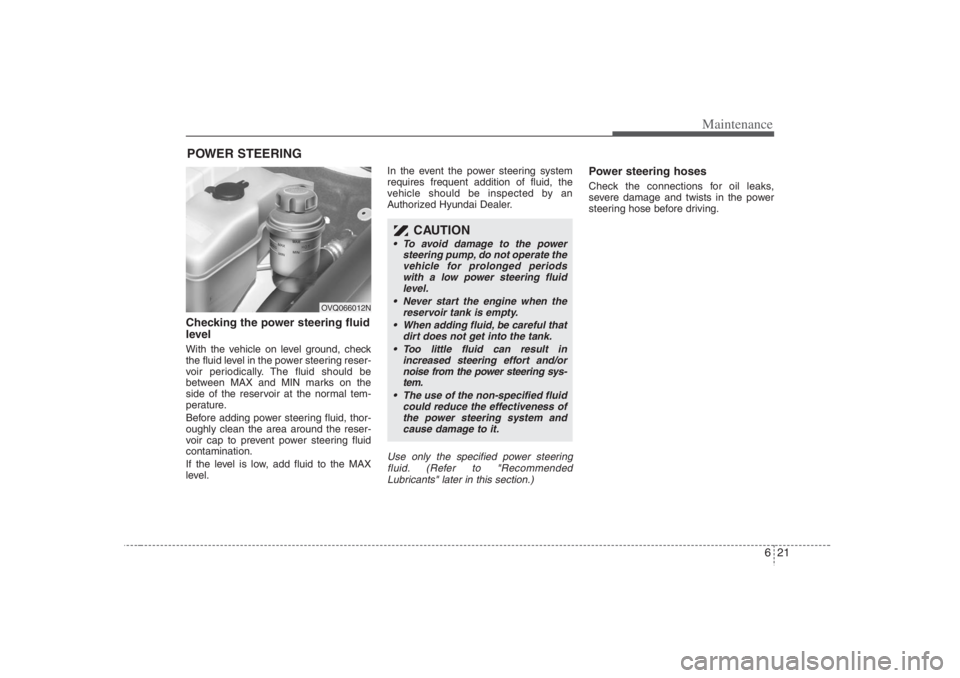
POWER STEERING Checking the power steering fluid
level With the vehicle on level ground, check
the fluid level in the power steering reser-
voir periodically. The fluid should be
between MAX and MIN marks on the
side of the reservoir at the normal tem-
perature.
Before adding power steering fluid, thor-
oughly clean the area around the reser-
voir cap to prevent power steering fluid
contamination.
If the level is low, add fluid to the MAX
level.In the event the power steering system
requires frequent addition of fluid, the
vehicle should be inspected by an
Authorized Hyundai Dealer.
Use only the specified power steering
fluid. (Refer to "Recommended
Lubricants" later in this section.)
Power steering hosesCheck the connections for oil leaks,
severe damage and twists in the power
steering hose before driving.
CAUTION
To avoid damage to the power
steering pump, do not operate the
vehicle for prolonged periods
with a low power steering fluid
level.
Never start the engine when the
reservoir tank is empty.
When adding fluid, be careful that
dirt does not get into the tank.
Too little fluid can result in
increased steering effort and/or
noise from the power steering sys-
tem.
The use of the non-specified fluid
could reduce the effectiveness of
the power steering system and
cause damage to it.
OVQ066012N
Page 346 of 398
Maintenance32 6
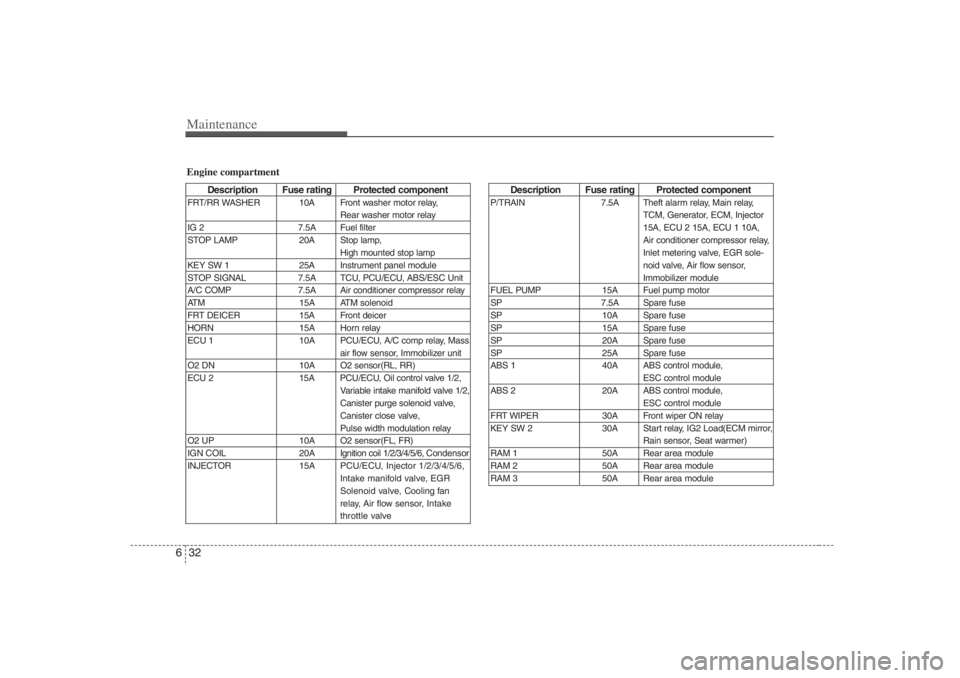
Description Fuse rating Protected component
P/TRAIN 7.5A Theft alarm relay, Main relay,
TCM, Generator, ECM, Injector
15A, ECU 2 15A, ECU 1 10A,
Air conditioner compressor relay,
Inlet metering valve, EGR sole-
noid valve, Air flow sensor,
Immobilizer module
FUEL PUMP 15A Fuel pump motor
SP 7.5A Spare fuse
SP 10A Spare fuse
SP 15A Spare fuse
SP 20A Spare fuse
SP 25A Spare fuse
ABS 1 40A ABS control module,
ESC control module
ABS 2 20A ABS control module,
ESC control module
FRT WIPER 30A Front wiper ON relay
KEY SW 2 30A Start relay, IG2 Load(ECM mirror,
Rain sensor, Seat warmer)
RAM 1 50A Rear area module
RAM 2 50A Rear area module
RAM 3 50A Rear area module
Engine compartment
Description Fuse rating Protected component
FRT/RR WASHER 10A Front washer motor relay,
Rear washer motor relay
IG 2 7.5A Fuel filter
STOP LAMP 20A Stop lamp,
High mounted stop lamp
KEY SW 1 25A Instrument panel module
STOP SIGNAL 7.5A TCU, PCU/ECU, ABS/ESC Unit
A/C COMP 7.5A Air conditioner compressor relay
ATM 15A ATM solenoid
FRT DEICER 15A Front deicer
HORN 15A Horn relay
ECU 1 10A PCU/ECU, A/C comp relay, Mass
air flow sensor, Immobilizer unit
O2 DN 10A O2 sensor(RL, RR)
ECU 2 15A PCU/ECU, Oil control valve 1/2,
Variable intake manifold valve 1/2,
Canister purge solenoid valve,
Canister close valve,
Pulse width modulation relay
O2 UP 10A O2 sensor(FL, FR)
IGN COIL 20AIgnition coil 1/2/3/4/5/6, Condensor
INJECTOR 15APCU/ECU, Injector 1/2/3/4/5/6,
Intake manifold valve, EGR
Solenoid valve, Cooling fan
relay, Air flow sensor,Intake
throttle valve
Page 350 of 398
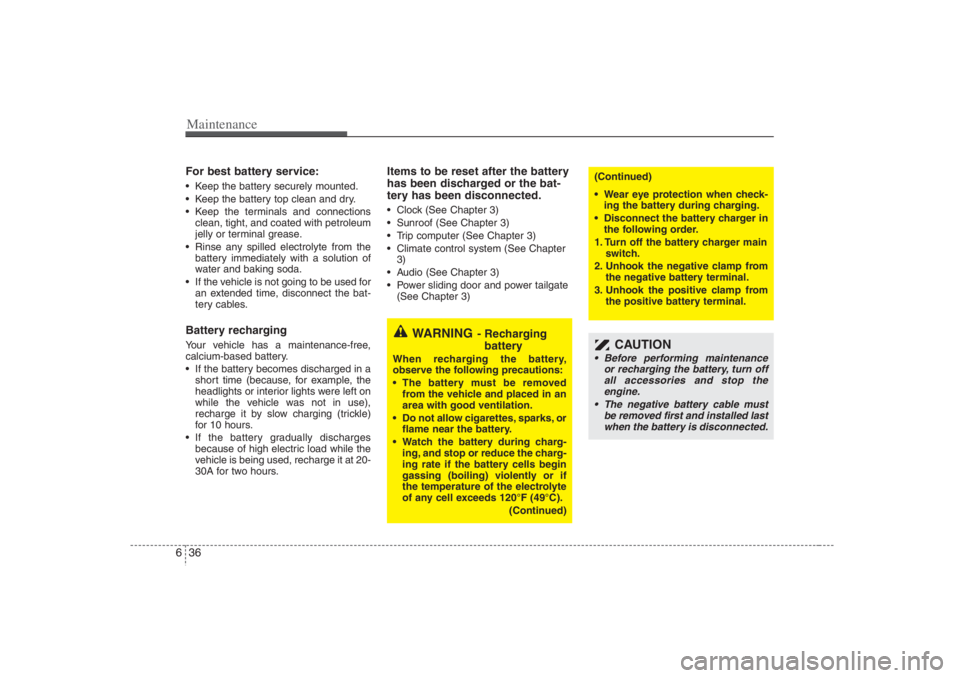
Maintenance36 6For best battery service: Keep the battery securely mounted.
Keep the battery top clean and dry.
Keep the terminals and connections
clean, tight, and coated with petroleum
jelly or terminal grease.
Rinse any spilled electrolyte from the
battery immediately with a solution of
water and baking soda.
If the vehicle is not going to be used for
an extended time, disconnect the bat-
tery cables.Battery recharging Your vehicle has a maintenance-free,
calcium-based battery.
If the battery becomes discharged in a
short time (because, for example, the
headlights or interior lights were left on
while the vehicle was not in use),
recharge it by slow charging (trickle)
for 10 hours.
If the battery gradually discharges
because of high electric load while the
vehicle is being used, recharge it at 20-
30A for two hours.
Items to be reset after the battery
has been discharged or the bat-
tery has been disconnected. Clock (See Chapter 3)
Sunroof (See Chapter 3)
Trip computer (See Chapter 3)
Climate control system (See Chapter
3)
Audio (See Chapter 3)
Power sliding door and power tailgate
(See Chapter 3)
CAUTION
Before performing maintenance
or recharging the battery, turn off
all accessories and stop the
engine.
The negative battery cable must
be removed first and installed last
when the battery is disconnected.
WARNING
- Recharging
battery
When recharging the battery,
observe the following precautions:
The battery must be removed
from the vehicle and placed in an
area with good ventilation.
Do not allow cigarettes, sparks, or
flame near the battery.
Watch the battery during charg-
ing, and stop or reduce the charg-
ing rate if the battery cells begin
gassing (boiling) violently or if
the temperature of the electrolyte
of any cell exceeds 120°F (49°C).
(Continued)
(Continued)
Wear eye protection when check-
ing the battery during charging.
Disconnect the battery charger in
the following order.
1. Turn off the battery charger main
switch.
2. Unhook the negative clamp from
the negative battery terminal.
3. Unhook the positive clamp from
the positive battery terminal.
Page 373 of 398
659
Maintenance
LUBRICANT
Recommended lubricants To help achieve proper engine and pow-
ertrain performance and durability, use
only lubricants of the proper quality. The
correct lubricants also help promote
engine efficiency that results in improved
fuel economy.
Engine oils labeled Energy Conserving
Oil are now available. Along with other
additional benefits, they contribute to fuel
economy by reducing the amount of fuel
necessary to overcome engine friction.
Often, these improvements are difficult to
measure in everyday driving, but in a
year’s time, they can offer significant cost
and energy savings.
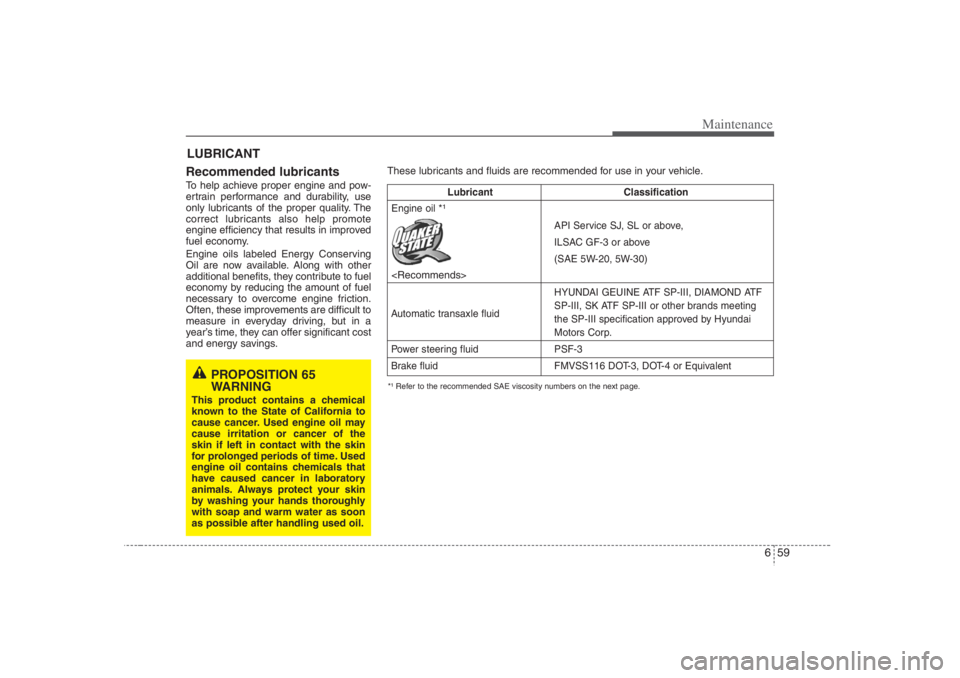
These lubricants and fluids are recommended for use in your vehicle.*¹ Refer to the recommended SAE viscosity numbers on the next page.
Lubricant Classification
API Service SJ, SL or above,
ILSAC GF-3 or above
(SAE 5W-20, 5W-30)
HYUNDAI GEUINE ATF SP-III, DIAMOND ATF
Automatic transaxle fluidSP-III, SK ATF SP-III or other brands meeting
the SP-III specification approved by Hyundai
Motors Corp.
Power steering fluid PSF-3
Brake fluid FMVSS116 DOT-3, DOT-4 or Equivalent
Engine oil
*¹
PROPOSITION 65
WARNING
This product contains a chemical
known to the State of California to
cause cancer. Used engine oil may
cause irritation or cancer of the
skin if left in contact with the skin
for prolonged periods of time. Used
engine oil contains chemicals that
have caused cancer in laboratory
animals. Always protect your skin
by washing your hands thoroughly
with soap and warm water as soon
as possible after handling used oil.
Page 374 of 398
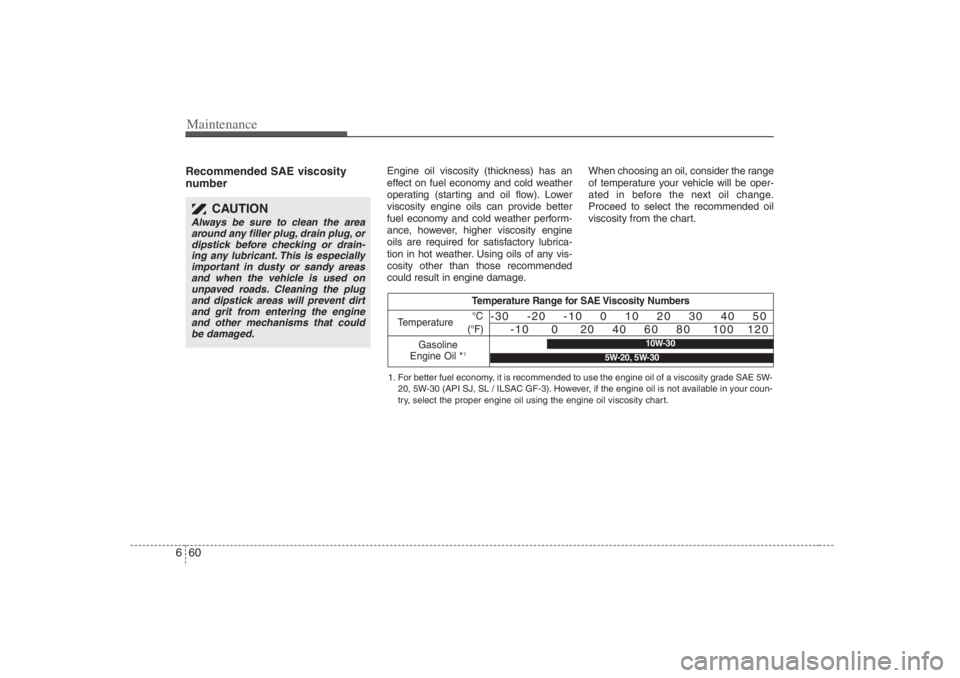
Maintenance60 6Recommended SAE viscosity
number
Engine oil viscosity (thickness) has an
effect on fuel economy and cold weather
operating (starting and oil flow). Lower
viscosity engine oils can provide better
fuel economy and cold weather perform-
ance, however, higher viscosity engine
oils are required for satisfactory lubrica-
tion in hot weather. Using oils of any vis-
cosity other than those recommended
could result in engine damage.When choosing an oil, consider the range
of temperature your vehicle will be oper-
ated in before the next oil change.
Proceed to select the recommended oil
viscosity from the chart.
Temperature Range for SAE Viscosity Numbers
Temperature
Gasoline
Engine Oil *
1°C
(°F)
-30 -20 -10 0 10 20 30 40 50
-10 0 20 40 60 80 100 120
1. For better fuel economy, it is recommended to use the engine oil of a viscosity grade SAE 5W-
20, 5W-30 (API SJ, SL / ILSAC GF-3). However, if the engine oil is not available in your coun-
try, select the proper engine oil using the engine oil viscosity chart.
10W-30
5W-20, 5W-30
CAUTION
Always be sure to clean the area
around any filler plug, drain plug, or
dipstick before checking or drain-
ing any lubricant. This is especially
important in dusty or sandy areas
and when the vehicle is used on
unpaved roads. Cleaning the plug
and dipstick areas will prevent dirt
and grit from entering the engine
and other mechanisms that could
be damaged.
Page 390 of 398
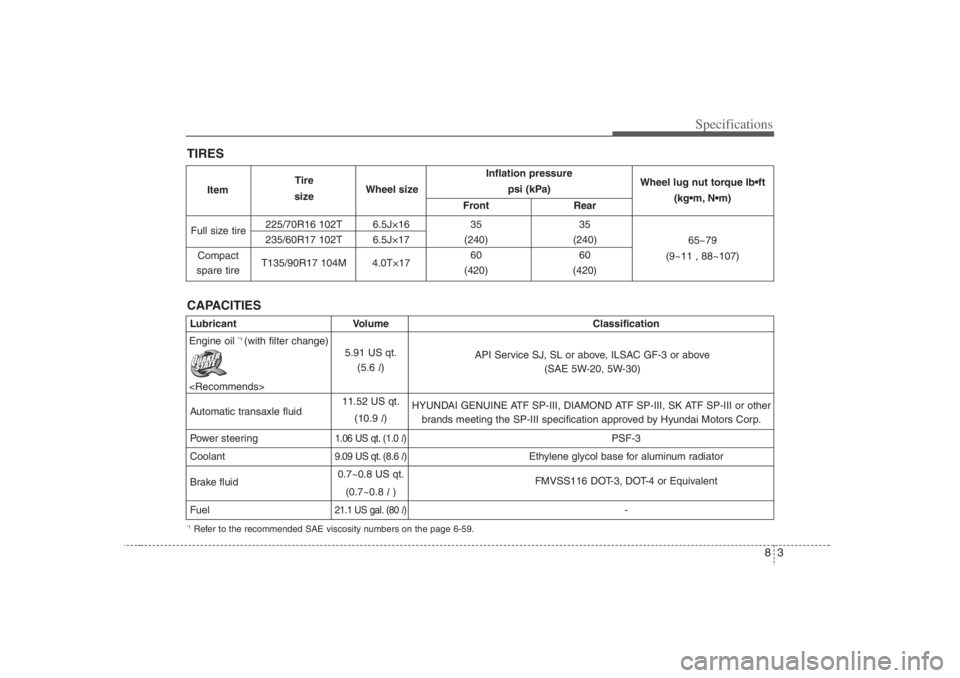
83
Specifications
Inflation pressure
psi (kPa)
Front Rear
225/70R16 102T 6.5J×16 35 35
235/60R17 102T 6.5J×17 (240) (240)
T135/90R17 104M 4.0T×1760 60
(420) (420)
Full size tire
Compact
spare tireWheel lug nut torque lb•ft
(kgm, Nm)
65~79
(9~11 , 88~107)TIRES
ItemTire
sizeWheel size
CAPACITIESLubricant Volume Classification
5.91 US qt.
(5.6 l)
Automatic transaxle fluid11.52 US qt.
(10.9 l)
Power steering
1.06 US qt. (1.0 l)
PSF-3
Coolant
9.09 US qt. (8.6 l)
Ethylene glycol base for aluminum radiator
Brake fluid0.7~0.8 US qt.
FMVSS116 DOT-3, DOT-4 or Equivalent
(0.7~0.8 l)
Fuel
21.1 US gal. (80 l)
-
Engine oil
*1 (with filter change)
(SAE 5W-20, 5W-30)
HYUNDAI GENUINE ATF SP-III, DIAMOND ATF SP-III, SK ATF SP-III or other
brands meeting the SP-III specification approved by Hyundai Motors Corp.
*1Refer to the recommended SAE viscosity numbers on the page 6-59.
Page 393 of 398
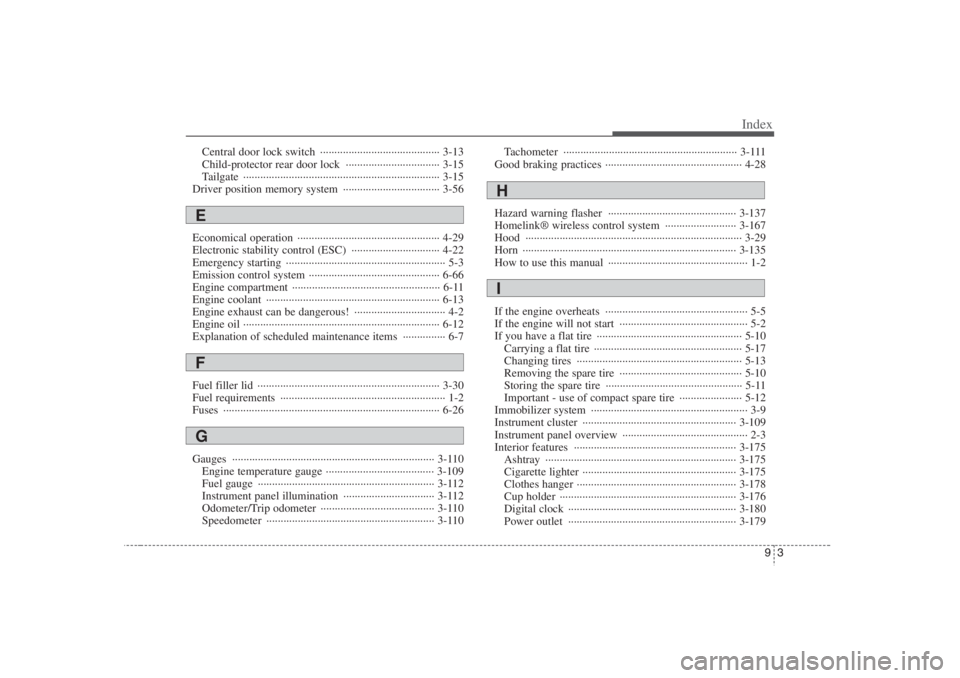
93
Index
Central door lock switch ·········································· 3-13
Child-protector rear door lock ································· 3-15
Tailgate ····································································· 3-15
Driver position memory system ·································· 3-56
Economical operation ·················································· 4-29
Electronic stability control (ESC) ······························· 4-22
Emergency starting ························································ 5-3
Emission control system ·············································· 6-66
Engine compartment ···················································· 6-11
Engine coolant ····························································· 6-13
Engine exhaust can be dangerous! ································ 4-2
Engine oil ····································································· 6-12
Explanation of scheduled maintenance items ··············· 6-7
Fuel filler lid ································································ 3-30
Fuel requirements ·························································· 1-2
Fuses ············································································ 6-26
Gauges ······································································· 3-110
Engine temperature gauge ······································ 3-109
Fuel gauge ······························································ 3-112
Instrument panel illumination ································ 3-112
Odometer/Trip odometer ········································ 3-110
Speedometer ··························································· 3-110Tachometer ····························································· 3-111
Good braking practices ················································ 4-28
Hazard warning flasher ············································· 3-137
Homelink® wireless control system ························· 3-167
Hood ············································································ 3-29
Horn ··········································································· 3-135
How to use this manual ················································· 1-2
If the engine overheats ·················································· 5-5
If the engine will not start ············································· 5-2
If you have a flat tire ··················································· 5-10
Carrying a flat tire ···················································· 5-17
Changing tires ·························································· 5-13
Removing the spare tire ··········································· 5-10
Storing the spare tire ················································ 5-11
Important - use of compact spare tire ······················ 5-12
Immobilizer system ······················································· 3-9
Instrument cluster ······················································ 3-109
Instrument panel overview ············································ 2-3
Interior features ························································· 3-175
Ashtray ··································································· 3-175
Cigarette lighter ······················································ 3-175
Clothes hanger ························································ 3-178
Cup holder ······························································ 3-176
Digital clock ··························································· 3-180
Power outlet ··························································· 3-179EFG
HI