warning light HYUNDAI ENTOURAGE 2007 Owner's Manual
[x] Cancel search | Manufacturer: HYUNDAI, Model Year: 2007, Model line: ENTOURAGE, Model: HYUNDAI ENTOURAGE 2007Pages: 398, PDF Size: 8.03 MB
Page 97 of 398
381
Features of your vehicle
WARNING
Always use seat belts and child
restraints – every trip, every time,
everyone! Air bags inflate with con-
siderable force and in the blink of
an eye. Seat belts help keep occu-
pants in proper position to obtain
maximum benefit from the air bag.
Even with advanced air bags,
improperly and unbelted occupants
can be severely injured when the air
bag inflates. Always follow the pre-
cautions about seat belts, air bags
and occupant safety contained in
this manual.
To reduce the chance of serious or
fatal injuries and receive the maxi-
mum safety benefit from your
restraint system:
Never place a child in any child or
booster seat in the front seat (see
child restraints 3-71).
ABC – Always Buckle Children in
the back seat. It is the safest
place for children of any age to
ride.
Front and side impact air bags
can injure occupants improperly
positioned in the front seats.
(Continued)
(Continued)
Move your seat as far back as
practical from the front air bags,
while still maintaining control of
the vehicle.
Never sit or lean unnecessarily
close to the front or side air bags
Never lean against the door or
center console – always sit in an
upright position.
Do not allow a passenger to ride
in the front seat when the “PAS-
SENGER AIR BAG OFF” indicator
is illuminated, because the air
bag will not deploy in the event of
a moderate or severe frontal
crash.
Never place objects over or near
any air bag module (front or side
impact air bags), because these
objects can injure passengers in
a crash.
Never place covers, blankets or
aftermarket seat warmers on the
passenger seat as these may
interfere with the occupant classi-
fication system.
(Continued)
(Continued)
Do not tamper or disconnect SRS
wiring or other components.
Injuries could result from inadver-
tent deployment or failure of the
air bag to deploy in a crash.
If the SRS air bag warning light
(see page 3-119) remains illumi-
nated while the vehicle is being
driven, have an authorized
Hyundai dealer inspect the air
bag system as soon as possible.
Air bags can only be used once –
have an authorized Hyundai deal-
er replace the air bag immediately
after deployment.
The SRS is designed to deploy
the front air bags only when an
impact is sufficiently severe and
when the impact angle is less
than 30° from the forward longitu-
dinal axis of the vehicle. The front
air bags will not deploy in side,
rear or rollover impacts.
Additionally, the air bags will only
deploy once. Seat belts must be
worn at all times.
(Continued)
Page 99 of 398
383
Features of your vehicle
SRS components and functionsThe SRS consists of the following com-
ponents:
1. Front Impact Sensors
2. "PASSENGER AIR BAG OFF"
Indicator (Front passenger's seat only)
3. SRS "AIR BAG" warning light
4. Knee Bolster
5. Passenger's Air bag Module
6. Driver's Air bag Module
7. SRS Control Module (SRSCM)
8. Occupant Classification System
(Front passenger's seat only)
9. Driver's Seat Track Position Sensor
10. Driver's and Front Passenger's Seat
Belt Buckle Sensors
11. Side Impact Sensors
12. Retractor Pre-tensioner Assemblies
13. Side Impact Air bag Modules
14. Curtain Air bag ModulesThe SRSCM continually monitors all ele-
ments while the ignition is "ON" to deter-
mine if a frontal or near-frontal impact is
severe enough to require air bag deploy-
ment or pre-tensioner seat belt deploy-
ment.
The SRS "AIR BAG" warning light on the
instrument panel will illuminate for about
6 seconds after the ignition key is turned
to the "ON" position or after the engine is
started, after which the "AIR BAG" warn-
ing light should go out.
(Continued)
For maximum safety protection in
all types of crashes, all occupants
including the driver should
always wear their seat belts
whether or not an air bag is also
provided at their seating position
to minimize the risk of severe
injury or death in the event of a
crash. Do not sit or lean unneces-
sarily close to the air bag while
the vehicle is in motion.
Sitting improperly or out of posi-
tion can result in serious or fatal
injury in a crash. All occupants
should sit upright with the seat
back in an upright position, cen-
tered on the seat cushion with
their seat belt on, legs comfort-
ably extended and their feet on
the floor until the vehicle is
parked and the ignition key is
removed.
The SRS air bag system must
deploy very rapidly to provide
protection in a crash. If an occu-
pant is out of position because of
not wearing a seat belt, the air
bag may forcefully contact the
occupant causing serious or fatal
injuries.
Page 102 of 398
Features of your vehicle86 3
Occupant classification systemYour vehicle is equipped with an occu-
pant classification system in the front
passenger's seat.
The occupant classification system is
designed to detect the presence of a
properly-seated front passenger and
determine if the passenger's front air bag
should be enabled (may inflate) or not.
The driver's front air bag is not affected
or controlled by the occupant classifica-
tion system.If the front passenger seat is occupied by
a person that the system determines to
be of adult size, and he/she sits properly
(sitting upright with the seatback in an
upright position, centered on the seat
cushion with their seat belt on, legs com-
fortably extended and their feet on the
floor), the "PASSENGER AIR BAG OFF"
indicator will be turned off and the front
passenger's air bag will be able to inflate,
if necessary, in frontal crashes.
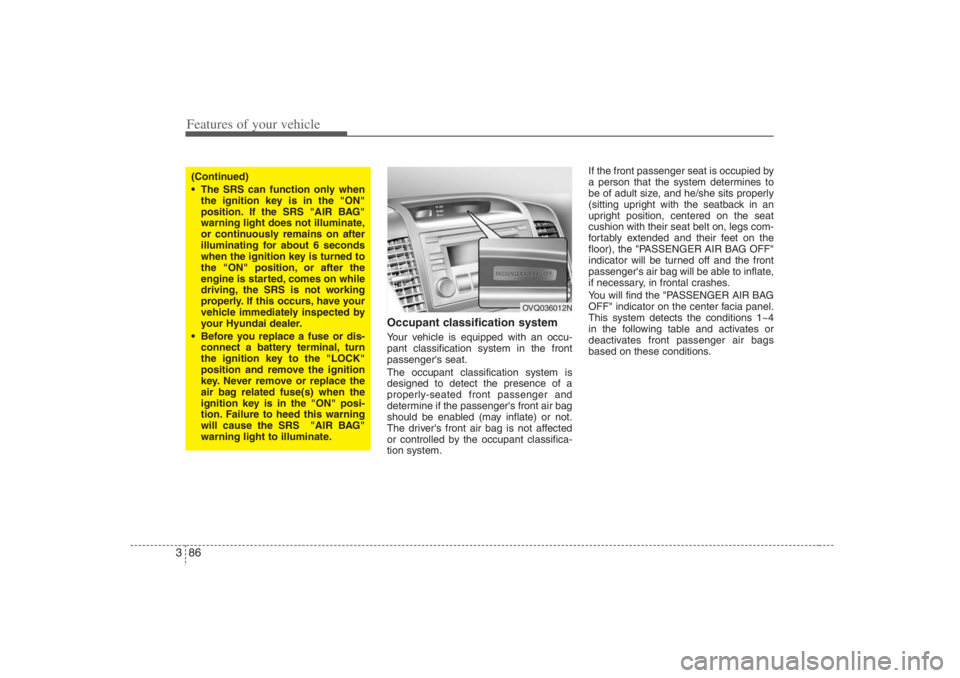
You will find the "PASSENGER AIR BAG
OFF" indicator on the center facia panel.
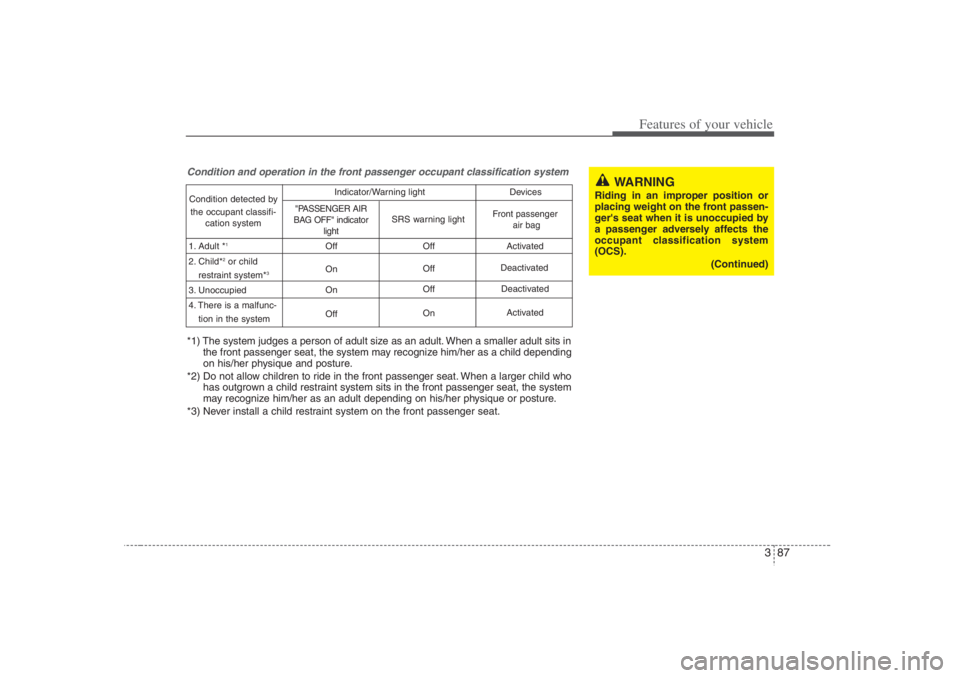
This system detects the conditions 1~4
in the following table and activates or
deactivates front passenger air bags
based on these conditions.
(Continued)
The SRS can function only when
the ignition key is in the "ON"
position. If the SRS "AIR BAG"
warning light does not illuminate,
or continuously remains on after
illuminating for about 6 seconds
when the ignition key is turned to
the "ON" position, or after the
engine is started, comes on while
driving, the SRS is not working
properly. If this occurs, have your
vehicle immediately inspected by
your Hyundai dealer.
Before you replace a fuse or dis-
connect a battery terminal, turn
the ignition key to the "LOCK"
position and remove the ignition
key. Never remove or replace the
air bag related fuse(s) when the
ignition key is in the "ON" posi-
tion. Failure to heed this warning
will cause the SRS "AIR BAG"
warning light to illuminate.
OVQ036012N
Page 103 of 398
387
Features of your vehicle
Condition and operation in the front passenger occupant classification systemCondition detected by
the occupant classifi-
cation system
1. Adult *
1
2. Child*
2or child
restraint system*
3
3. Unoccupied
4. There is a malfunc-
tion in the systemOff
On
On
OffOff
Off
Off
OnActivated
Deactivated
Activated
"PASSENGER AIR
BAG OFF" indicator
light
SRS warning light
Front passenger
air bag Deactivated Indicator/Warning light Devices
*1) The system judges a person of adult size as an adult. When a smaller adult sits in
the front passenger seat, the system may recognize him/her as a child depending
on his/her physique and posture.
*2) Do not allow children to ride in the front passenger seat. When a larger child who
has outgrown a child restraint system sits in the front passenger seat, the system
may recognize him/her as an adult depending on his/her physique or posture.
*3) Never install a child restraint system on the front passenger seat.
WARNING
Riding in an improper position or
placing weight on the front passen-
ger's seat when it is unoccupied by
a passenger adversely affects the
occupant classification system
(OCS).
(Continued)
Page 106 of 398
Features of your vehicle90 3
CAUTION
If the occupant classification sys-
tem is not working properly, the
SRS air bag warning light on the
instrument panel will illuminate
because the passenger's front air
bags are connected with the occu-
pant classification system. If there
is a malfunction of the occupant
classification system, the "PAS-
SENGER AIR BAG OFF" indicator
will not illuminate and the passen-
ger's front air bags will inflate in
frontal impact crashes even if there
is no occupant in the front passen-
ger's seat. If the SRS air bag warn-
ing light does not illuminate when
the ignition key is turned to the
"ON" position, remains illuminated
after approximately 6 seconds
when the ignition key is turned to
the "ON" position, or if it illuminates
while the vehicle is being driven,
have an authorized Hyundai dealer
inspect the occupant classification
system and the SRS air bag system
as soon as possible.
(Continued)
If you change the weight on the
front passenger seat just after sit-
in or restart of the engine, the
"PASSENGER AIR BAG OFF"
indicator may be turned on or off
for a few seconds, disabling or
enabling the passenger air bags.
After the initial stage of about 30
seconds, the "PASSENGER AIR
BAG OFF" indicator will not tog-
gle.
Do not modify or replace the front
passenger seat. Don't place any-
thing on or attach anything such
as a blanket or after market seat
heater to the front passenger
seat. This can adversely affect the
occupant classification system.
Do not sit on sharp objects such
as tools when occupying the front
passenger seat. This can adverse-
ly affect the occupant classifica-
tion system.
Do not use accessory seat covers
on the front seats.
(Continued)
WARNING
Even though your vehicle is
equipped with the occupation
classification system, never
install a child restraint system in
the front passenger's seat. A
deploying air bag can forcefully
strike a child resulting in serious
injuries or death. Any child under
13 years of age should ride in the
rear seat. Children too large for
child restraints should use the
available lap/shoulder belts. No
matter what type of crash, chil-
dren of all ages are safer when
restrained in the rear seat.
If the "PASSENGER AIR BAG
OFF" indicator is illuminated
when the front passenger's seat
is occupied by an adult and
he/she sits properly (sitting
upright with the seatback in an
upright position, centered on the
seat cushion with their seat belt
on, legs comfortably extended
and their feet on the floor), have
that person sit in the rear seat.
(Continued)
Page 110 of 398
Features of your vehicle94 3SRS CareThe SRS is virtually maintenance-free
and so there are no parts you can safely
service by yourself. If the SRS "AIR BAG"
warning light does not illuminate, or con-
tinuously remains on, have your vehicle
immediately inspected by your Hyundai
dealer.
Any work on the SRS system, such as
removing, installing, repairing, or any
work on the steering wheel must be per-
formed by a qualified Hyundai technician.
Improper handling of the SRS system
may result in serious personal injury.
WARNING
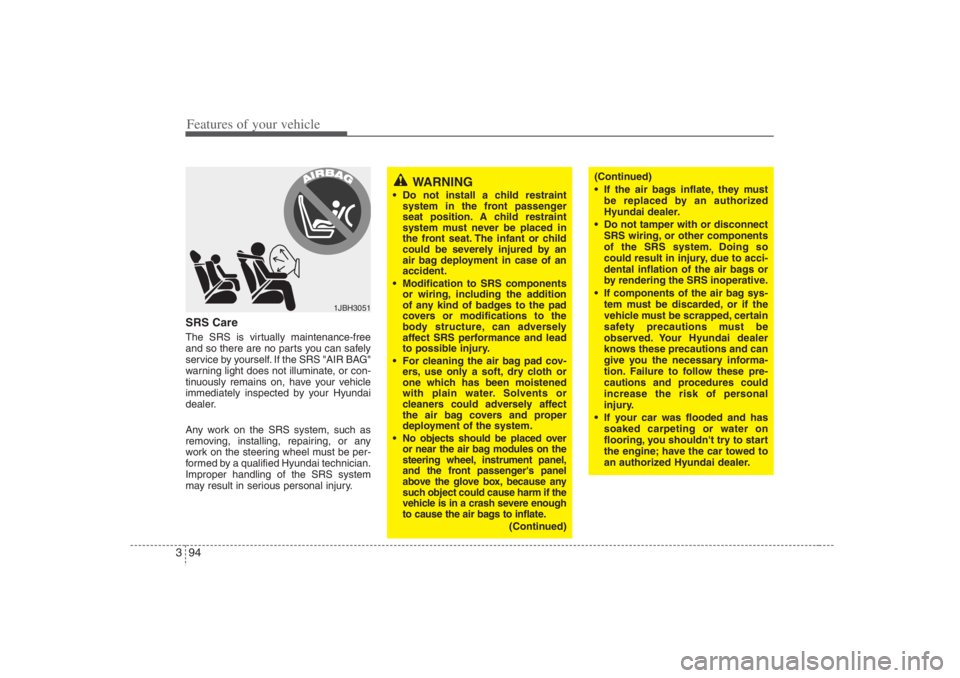
Do not install a child restraint
system in the front passenger
seat position. A child restraint
system must never be placed in
the front seat. The infant or child
could be severely injured by an
air bag deployment in case of an
accident.
Modification to SRS components
or wiring, including the addition
of any kind of badges to the pad
covers or modifications to the
body structure, can adversely
affect SRS performance and lead
to possible injury.
For cleaning the air bag pad cov-
ers, use only a soft, dry cloth or
one which has been moistened
with plain water. Solvents or
cleaners could adversely affect
the air bag covers and proper
deployment of the system.
No objects should be placed over
or near the air bag modules on the
steering wheel, instrument panel,
and the front passenger's panel
above the glove box, because any
such object could cause harm if the
vehicle is in a crash severe enough
to cause the air bags to inflate.
(Continued)
1JBH3051
(Continued)
If the air bags inflate, they must
be replaced by an authorized
Hyundai dealer.
Do not tamper with or disconnect
SRS wiring, or other components
of the SRS system. Doing so
could result in injury, due to acci-
dental inflation of the air bags or
by rendering the SRS inoperative.
If components of the air bag sys-
tem must be discarded, or if the
vehicle must be scrapped, certain
safety precautions must be
observed. Your Hyundai dealer
knows these precautions and can
give you the necessary informa-
tion. Failure to follow these pre-
cautions and procedures could
increase the risk of personal
injury.
If your car was flooded and has
soaked carpeting or water on
flooring, you shouldn't try to start
the engine; have the car towed to
an authorized Hyundai dealer.
Page 119 of 398
3 103
Features of your vehicle
Tilt steering A tilt steering wheel allows you to adjust
the steering wheel before you drive. You
can also raise it to the highest level to
give your legs more room when you exit
and enter the vehicle.
The steering wheel should be positioned
so that it is comfortable for you to drive,
while permitting you to see the instru-
ment panel warning lights and gauges.
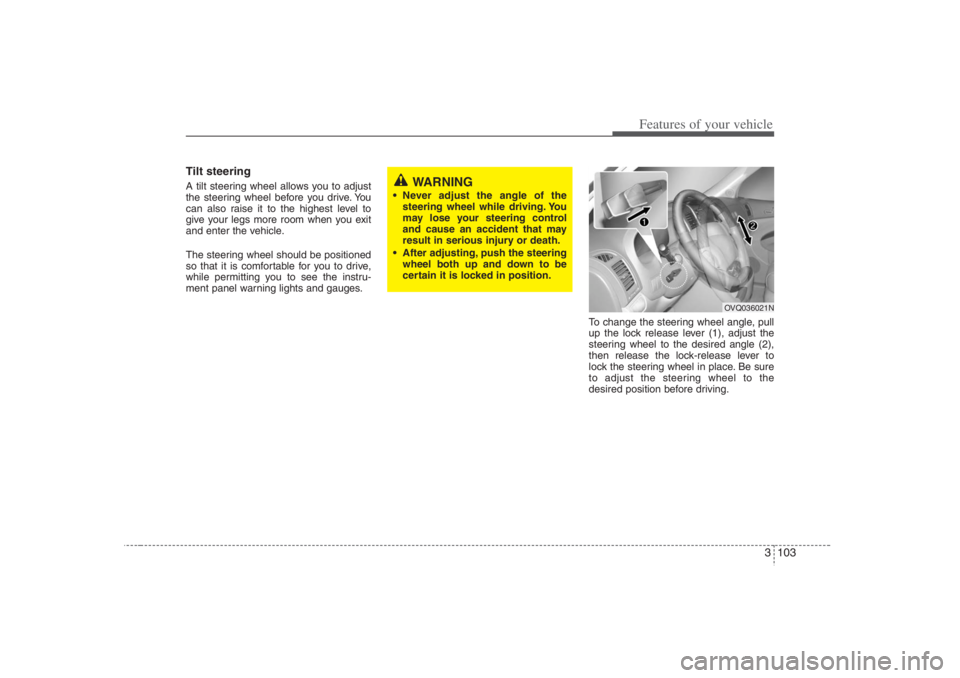
To change the steering wheel angle, pull
up the lock release lever (1), adjust the
steering wheel to the desired angle (2),
then release the lock-release lever to
lock the steering wheel in place. Be sure
to adjust the steering wheel to the
desired position before driving.
WARNING
Never adjust the angle of the
steering wheel while driving. You
may lose your steering control
and cause an accident that may
result in serious injury or death.
After adjusting, push the steering
wheel both up and down to be
certain it is locked in position.
OVQ036021N
Page 123 of 398
3 107
Features of your vehicle
Day/night rearview mirror Adjust the rearview mirror to center on
the view through the rear window. Make
this adjustment before you start driving.
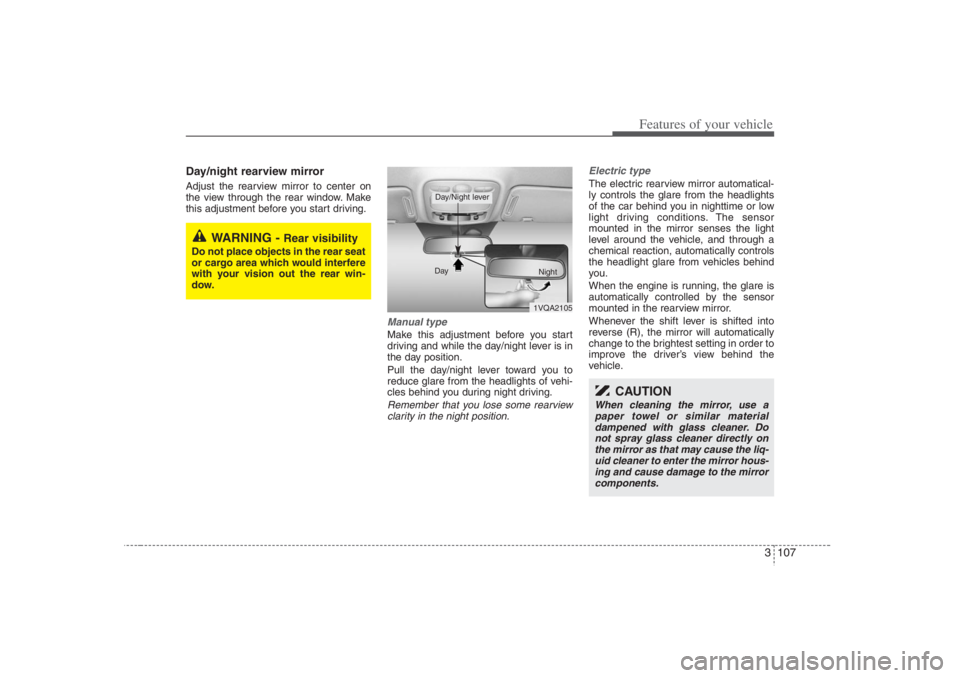
Manual type Make this adjustment before you start
driving and while the day/night lever is in
the day position.
Pull the day/night lever toward you to
reduce glare from the headlights of vehi-
cles behind you during night driving.Remember that you lose some rearview
clarity in the night position.Electric type
The electric rearview mirror automatical-
ly controls the glare from the headlights
of the car behind you in nighttime or low
light driving conditions. The sensor
mounted in the mirror senses the light
level around the vehicle, and through a
chemical reaction, automatically controls
the headlight glare from vehicles behind
you.
When the engine is running, the glare is
automatically controlled by the sensor
mounted in the rearview mirror.
Whenever the shift lever is shifted into
reverse (R), the mirror will automatically
change to the brightest setting in order to
improve the driver’s view behind the
vehicle.
WARNING -
Rear visibility
Do not place objects in the rear seat
or cargo area which would interfere
with your vision out the rear win-
dow.
1VQA2105 Day
Night
Day/Night lever
CAUTION
When cleaning the mirror, use a
paper towel or similar material
dampened with glass cleaner. Do
not spray glass cleaner directly on
the mirror as that may cause the liq-
uid cleaner to enter the mirror hous-
ing and cause damage to the mirror
components.
Page 124 of 398
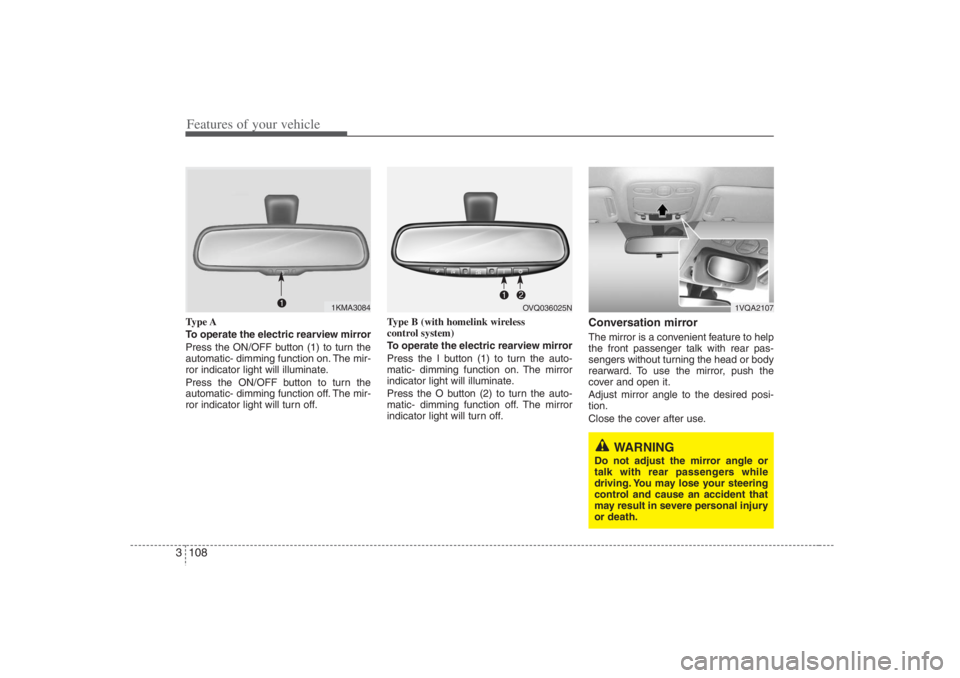
Features of your vehicle108 3Type A
To operate the electric rearview mirror
Press the ON/OFF button (1) to turn the
automatic- dimming function on. The mir-
ror indicator light will illuminate.
Press the ON/OFF button to turn the
automatic- dimming function off. The mir-
ror indicator light will turn off.Type B (with homelink wireless
control system)
To operate the electric rearview mirror
Press the I button (1) to turn the auto-
matic- dimming function on. The mirror
indicator light will illuminate.
Press the O button (2) to turn the auto-
matic- dimming function off. The mirror
indicator light will turn off.
Conversation mirrorThe mirror is a convenient feature to help
the front passenger talk with rear pas-
sengers without turning the head or body
rearward. To use the mirror, push the
cover and open it.
Adjust mirror angle to the desired posi-
tion.
Close the cover after use.
1KMA3084
1VQA2107
WARNING
Do not adjust the mirror angle or
talk with rear passengers while
driving. You may lose your steering
control and cause an accident that
may result in severe personal injury
or death.
OVQ036025N
Page 125 of 398
3 109
Features of your vehicle
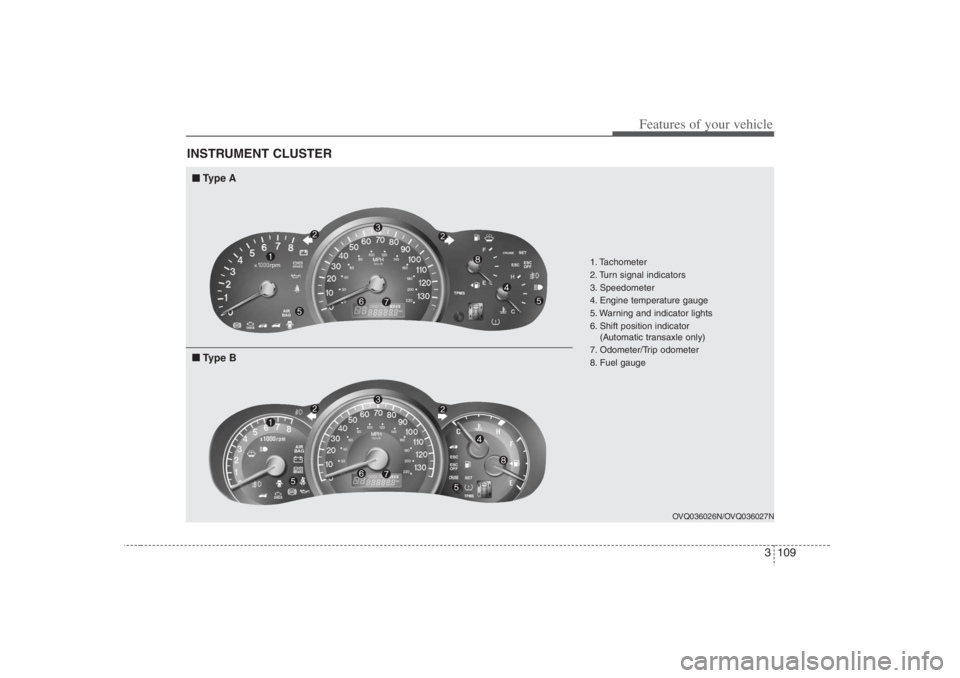
INSTRUMENT CLUSTER
1. Tachometer
2. Turn signal indicators
3. Speedometer
4. Engine temperature gauge
5. Warning and indicator lights
6. Shift position indicator
(Automatic transaxle only)
7. Odometer/Trip odometer
8. Fuel gauge
OVQ036026N/OVQ036027N
■ ■
Type A■ ■
Type B