service HYUNDAI ENTOURAGE 2007 Owner's Guide
[x] Cancel search | Manufacturer: HYUNDAI, Model Year: 2007, Model line: ENTOURAGE, Model: HYUNDAI ENTOURAGE 2007Pages: 398, PDF Size: 8.03 MB
Page 350 of 398
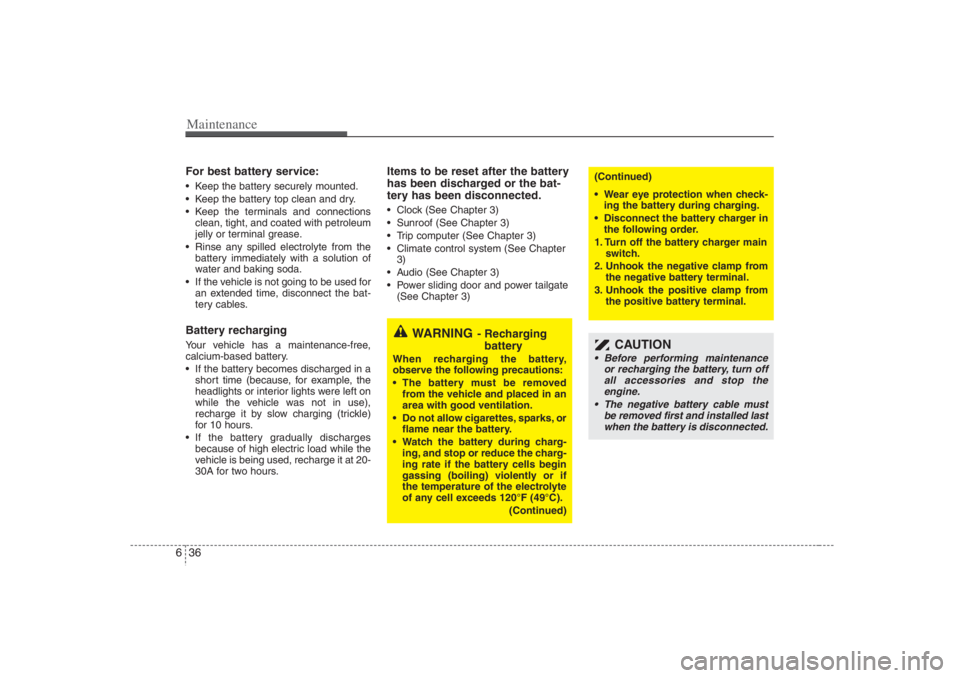
Maintenance36 6For best battery service: Keep the battery securely mounted.
Keep the battery top clean and dry.
Keep the terminals and connections
clean, tight, and coated with petroleum
jelly or terminal grease.
Rinse any spilled electrolyte from the
battery immediately with a solution of
water and baking soda.
If the vehicle is not going to be used for
an extended time, disconnect the bat-
tery cables.Battery recharging Your vehicle has a maintenance-free,
calcium-based battery.
If the battery becomes discharged in a
short time (because, for example, the
headlights or interior lights were left on
while the vehicle was not in use),
recharge it by slow charging (trickle)
for 10 hours.
If the battery gradually discharges
because of high electric load while the
vehicle is being used, recharge it at 20-
30A for two hours.
Items to be reset after the battery
has been discharged or the bat-
tery has been disconnected. Clock (See Chapter 3)
Sunroof (See Chapter 3)
Trip computer (See Chapter 3)
Climate control system (See Chapter
3)
Audio (See Chapter 3)
Power sliding door and power tailgate
(See Chapter 3)
CAUTION
Before performing maintenance
or recharging the battery, turn off
all accessories and stop the
engine.
The negative battery cable must
be removed first and installed last
when the battery is disconnected.
WARNING
- Recharging
battery
When recharging the battery,
observe the following precautions:
The battery must be removed
from the vehicle and placed in an
area with good ventilation.
Do not allow cigarettes, sparks, or
flame near the battery.
Watch the battery during charg-
ing, and stop or reduce the charg-
ing rate if the battery cells begin
gassing (boiling) violently or if
the temperature of the electrolyte
of any cell exceeds 120°F (49°C).
(Continued)
(Continued)
Wear eye protection when check-
ing the battery during charging.
Disconnect the battery charger in
the following order.
1. Turn off the battery charger main
switch.
2. Unhook the negative clamp from
the negative battery terminal.
3. Unhook the positive clamp from
the positive battery terminal.
Page 360 of 398
Maintenance46 64. Tire ply composition and mate-
rialThe number of layers or plies of rub-
ber-coated fabric are in the tire. Tire
manufacturers also must indicate the
materials in the tire, which include
steel, nylon, polyester, and others.
The letter "R" means radial ply con-
struction; the letter "D" means diago-
nal or bias ply construction; and the
letter "B" means belted-bias ply con-
struction.
5. Maximum permissible inflation
pressureThis number is the greatest amount
of air pressure that should be put in
the tire. Do not exceed the maximum
permissible inflation pressure. Refer
to the Tire and Loading Information
label for recommended inflation
pressure.6. Maximum load ratingThis number indicates the maximum
load in kilograms and pounds that
can be carried by the tire. When
replacing the tires on the vehicle,
always use a tire that has the same
load rating as the factory installed
tire.7. Uniform tire quality grading The following information relates to
the tire grading system developed by
the National Highway Traffic Safety
Administration (NHTSA) for grading
tires by tread wear, traction and tem-
perature performance.Tread wear
The tread wear grade is a compara-
tive rating based on the wear rate of
the tire when tested under controlled
conditions on a specified govern-
ment test course. For example, a tire
graded 150 would wear one-and-a-
half times as well on the government
course as a tire graded 100.
The relative performance of tires
depends upon the actual conditions
of their use. However, performance
may differ from the norm because of
variations in driving habits, service
practices and differences in road
characteristics and climate.
These grades are molded on the
side-walls of passenger vehicle tires.
The tires available as standard or
optional equipment on Hyundai vehi-
cles may vary with respect to grade.
WARNING -
Tire age
A tire more than 6 years old may
sustain separation of cord lay-
ers inside the tire. Tire failure to
separation of cord, can cause
accidents resulting in severe
injuries or death.
Make sure to check the manu-
facturing date of the tire and
replace it within 6 years of that
date.
Page 371 of 398
657
Maintenance
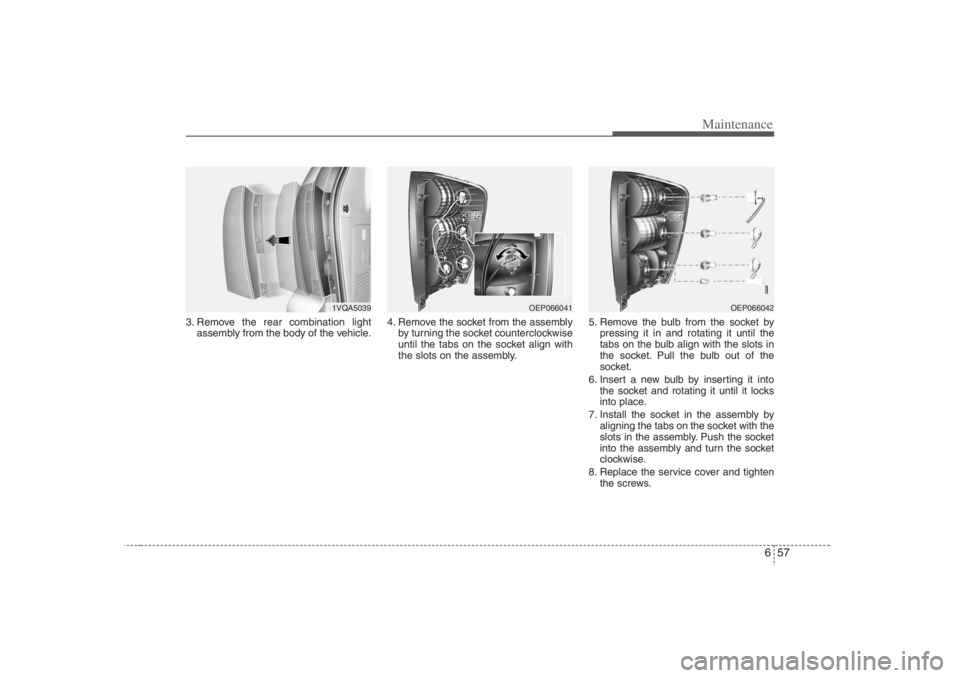
3. Remove the rear combination light
assembly from the body of the vehicle.4. Remove the socket from the assembly
by turning the socket counterclockwise
until the tabs on the socket align with
the slots on the assembly.5. Remove the bulb from the socket by
pressing it in and rotating it until the
tabs on the bulb align with the slots in
the socket. Pull the bulb out of the
socket.
6. Insert a new bulb by inserting it into
the socket and rotating it until it locks
into place.
7. Install the socket in the assembly by
aligning the tabs on the socket with the
slots in the assembly. Push the socket
into the assembly and turn the socket
clockwise.
8. Replace the service cover and tighten
the screws.
1VQA5039
OEP066041
OEP066042
Page 373 of 398
659
Maintenance
LUBRICANT
Recommended lubricants To help achieve proper engine and pow-
ertrain performance and durability, use
only lubricants of the proper quality. The
correct lubricants also help promote
engine efficiency that results in improved
fuel economy.
Engine oils labeled Energy Conserving
Oil are now available. Along with other
additional benefits, they contribute to fuel
economy by reducing the amount of fuel
necessary to overcome engine friction.
Often, these improvements are difficult to
measure in everyday driving, but in a
year’s time, they can offer significant cost
and energy savings.
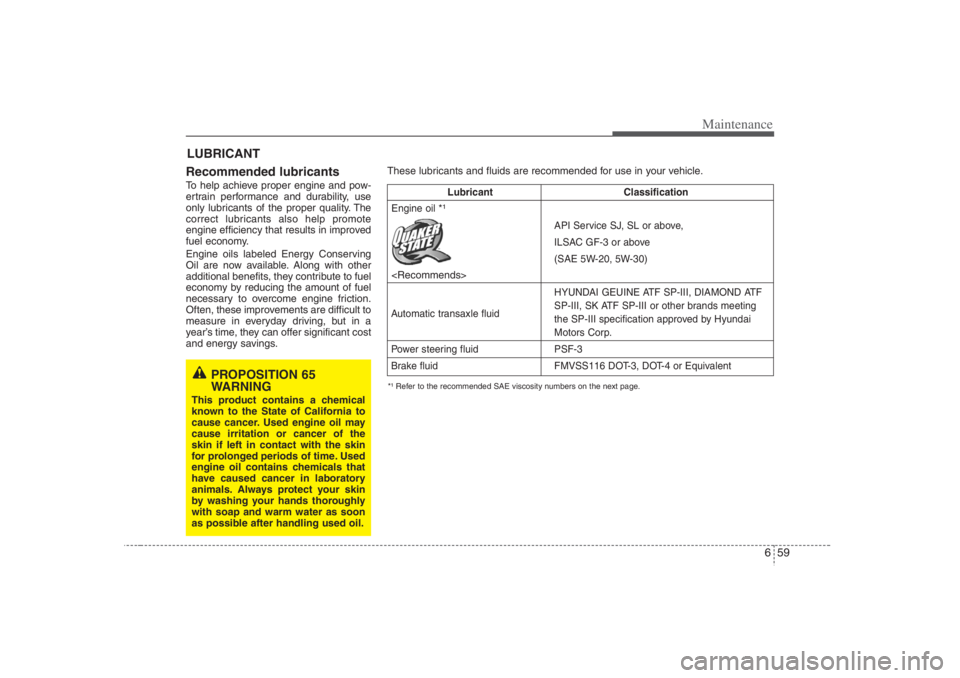
These lubricants and fluids are recommended for use in your vehicle.*¹ Refer to the recommended SAE viscosity numbers on the next page.
Lubricant Classification
API Service SJ, SL or above,
ILSAC GF-3 or above
(SAE 5W-20, 5W-30)
HYUNDAI GEUINE ATF SP-III, DIAMOND ATF
Automatic transaxle fluidSP-III, SK ATF SP-III or other brands meeting
the SP-III specification approved by Hyundai
Motors Corp.
Power steering fluid PSF-3
Brake fluid FMVSS116 DOT-3, DOT-4 or Equivalent
Engine oil
*¹
PROPOSITION 65
WARNING
This product contains a chemical
known to the State of California to
cause cancer. Used engine oil may
cause irritation or cancer of the
skin if left in contact with the skin
for prolonged periods of time. Used
engine oil contains chemicals that
have caused cancer in laboratory
animals. Always protect your skin
by washing your hands thoroughly
with soap and warm water as soon
as possible after handling used oil.
Page 390 of 398
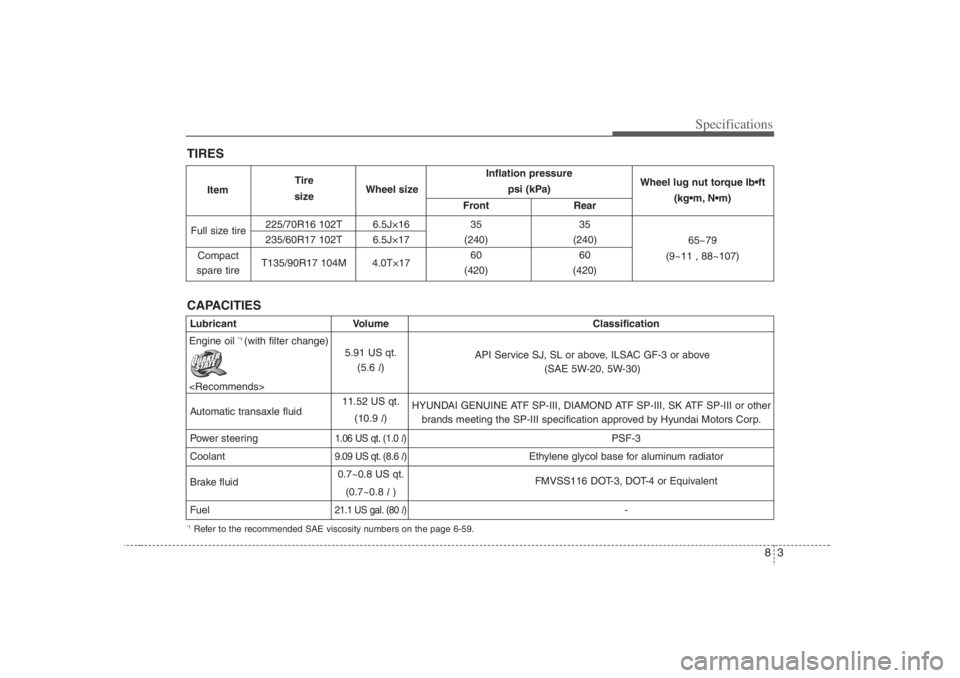
83
Specifications
Inflation pressure
psi (kPa)
Front Rear
225/70R16 102T 6.5J×16 35 35
235/60R17 102T 6.5J×17 (240) (240)
T135/90R17 104M 4.0T×1760 60
(420) (420)
Full size tire
Compact
spare tireWheel lug nut torque lb•ft
(kgm, Nm)
65~79
(9~11 , 88~107)TIRES
ItemTire
sizeWheel size
CAPACITIESLubricant Volume Classification
5.91 US qt.
(5.6 l)
Automatic transaxle fluid11.52 US qt.
(10.9 l)
Power steering
1.06 US qt. (1.0 l)
PSF-3
Coolant
9.09 US qt. (8.6 l)
Ethylene glycol base for aluminum radiator
Brake fluid0.7~0.8 US qt.
FMVSS116 DOT-3, DOT-4 or Equivalent
(0.7~0.8 l)
Fuel
21.1 US gal. (80 l)
-
Engine oil
*1 (with filter change)
(SAE 5W-20, 5W-30)
HYUNDAI GENUINE ATF SP-III, DIAMOND ATF SP-III, SK ATF SP-III or other
brands meeting the SP-III specification approved by Hyundai Motors Corp.
*1Refer to the recommended SAE viscosity numbers on the page 6-59.
Page 394 of 398
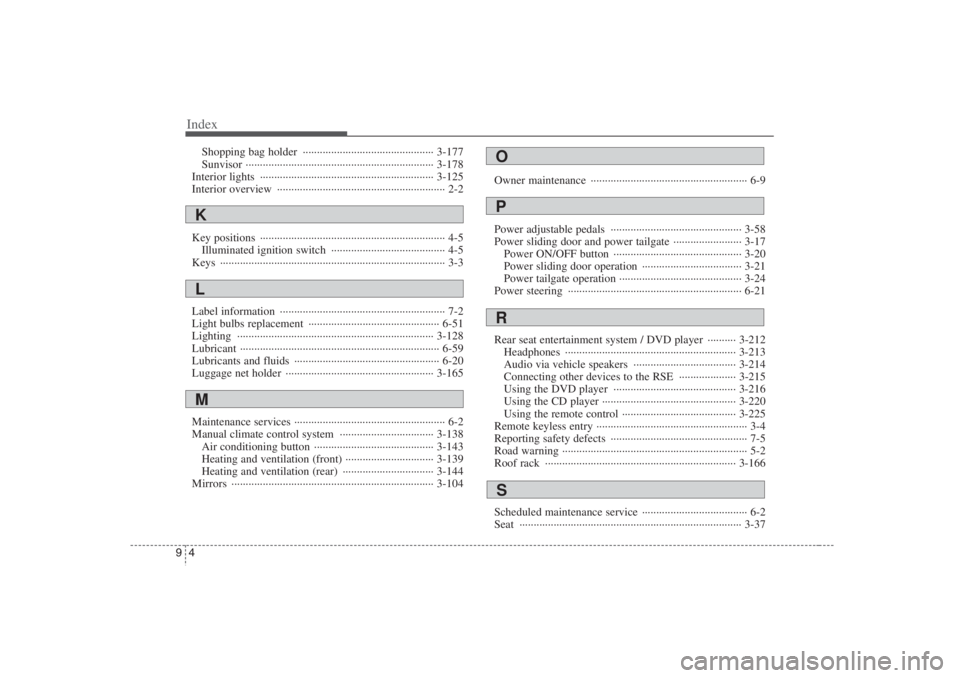
Index4 9
Shopping bag holder ·············································· 3-177
Sunvisor ·································································· 3-178
Interior lights ····························································· 3-125
Interior overview ··························································· 2-2
Key positions ································································· 4-5
Illuminated ignition switch ········································ 4-5
Keys ··············································································· 3-3
Label information ·························································· 7-2
Light bulbs replacement ·············································· 6-51
Lighting ····································································· 3-128
Lubricant ······································································ 6-59
Lubricants and fluids ··················································· 6-20
Luggage net holder ···················································· 3-165
Maintenance services ····················································· 6-2
Manual climate control system ································· 3-138
Air conditioning button ·········································· 3-143
Heating and ventilation (front) ······························· 3-139
Heating and ventilation (rear) ································ 3-144
Mirrors ······································································· 3-104Owner maintenance ······················································· 6-9
Power adjustable pedals ·············································· 3-58
Power sliding door and power tailgate ························ 3-17
Power ON/OFF button ············································· 3-20
Power sliding door operation ··································· 3-21
Power tailgate operation ··········································· 3-24
Power steering ····························································· 6-21
Rear seat entertainment system / DVD player ·········· 3-212
Headphones ···························································· 3-213
Audio via vehicle speakers ···································· 3-214
Connecting other devices to the RSE ···················· 3-215
Using the DVD player ··········································· 3-216
Using the CD player ··············································· 3-220
Using the remote control ········································ 3-225
Remote keyless entry ····················································· 3-4
Reporting safety defects ················································ 7-5
Road warning ································································· 5-2
Roof rack ··································································· 3-166
Scheduled maintenance service ····································· 6-2
Seat ·············································································· 3-37M
SOPR
KL