warning HYUNDAI ENTOURAGE 2008 Owners Manual
[x] Cancel search | Manufacturer: HYUNDAI, Model Year: 2008, Model line: ENTOURAGE, Model: HYUNDAI ENTOURAGE 2008Pages: 393, PDF Size: 8.78 MB
Page 350 of 393
641
Maintenance
Disc brake pads should be inspected
for wear whenever tires are rotated.Rotate radial tires that have an
asymmetric tread pattern only
from front to rear and not from
right to left.
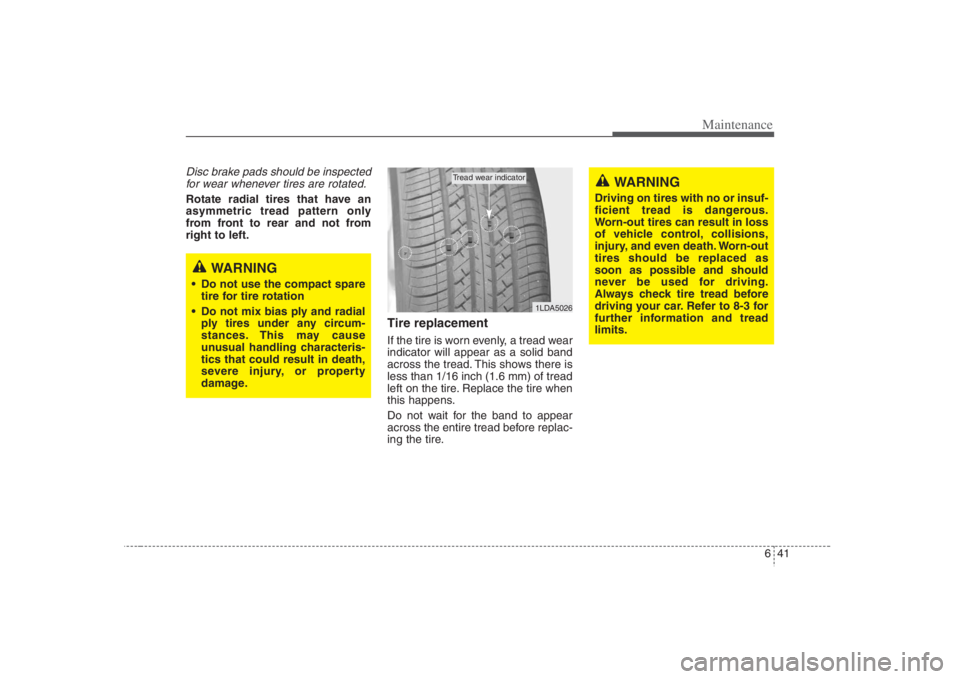
Tire replacementIf the tire is worn evenly, a tread wear
indicator will appear as a solid band
across the tread. This shows there is
less than 1/16 inch (1.6 mm) of tread
left on the tire. Replace the tire when
this happens.
Do not wait for the band to appear
across the entire tread before replac-
ing the tire.
WARNING
Do not use the compact spare
tire for tire rotation
Do not mix bias ply and radial
ply tires under any circum-
stances. This may cause
unusual handling characteris-
tics that could result in death,
severe injury, or property
damage.
WARNING
Driving on tires with no or insuf-
ficient tread is dangerous.
Worn-out tires can result in loss
of vehicle control, collisions,
injury, and even death. Worn-out
tires should be replaced as
soon as possible and should
never be used for driving.
Always check tire tread before
driving your car. Refer to 8-3 for
further information and tread
limits.
1LDA5026
Tread wear indicator
Page 351 of 393
Maintenance42 6Compact spare tire replace-
mentA compact spare tire has a shorter
tread life than a regular size tire.
Replace it when you can see the
tread wear indicator bars on the tire.
The replacement compact spare tire
should be the same size and design
tire as the one provided with your
new Hyundai and should be mount-
ed on the same compact spare tire
wheel. The compact spare tire is not
designed to be mounted on a regular
size wheel, and the compact spare
tire wheel is not designed for mount-
ing a regular size tire.
Wheel replacement When replacing the metal wheels for
any reason, make sure the new
wheels are equivalent to the original
factory units in diameter, rim width
and offset.
Wheel alignment and tire
balance The wheels on your vehicle were
aligned and balanced carefully at the
factory to give you the longest tire life
and best overall performance.
In most cases, you will not need to
have your wheels aligned again.
However, if you notice unusual tire
wear or your vehicle pulling one way
or the other, the alignment may need
to be reset.
If you notice your vehicle vibrating
when driving on a smooth road, your
wheels may need to be rebalanced.
WARNING
A wheel that is not the correct
size may adversely affect wheel
and bearing life, braking and
stopping abilities, handling char-
acteristics, ground clearance,
body-to-tire clearance, snow
chain clearance, speedometer
calibration, headlight aim and
bumper height.
Page 352 of 393
643
Maintenance
WARNING -
Replacing
tires
To reduce the chance or serious
or fatal injuries from an accident
caused by tire failure or loss of
vehicle control:
Replace tires that are worn,
show uneven wear, or are
damaged. Worn tires can
cause loss of braking effec-
tiveness, steering control, and
traction.
Do not drive your vehicle with
too little or too much pressure
in your tires. This can lead to
uneven wear and tire failure.
When replacing tires, never
mix radial and bias-ply tires
on the same car. You must
replace all tires (including the
spare) if moving from radial to
bias-ply tires.
(Continued)
(Continued)
Using tires and wheel other
than the recommended sizes
could cause unusual handling
characteristics and poor vehi-
cle control, resulting in a seri-
ous accident.
Wheels that do not meet
Hyundai's specifications may
fit poorly and result in damage
to the vehicle or unusual han-
dling and poor vehicle control.
CAUTION
Improper wheel weights can
damage your vehicle's alu-
minum wheels. Use only
approved wheel weights.
Page 355 of 393
Maintenance46 64. Tire ply composition and mate-
rialThe number of layers or plies of rub-
ber-coated fabric are in the tire. Tire
manufacturers also must indicate the
materials in the tire, which include
steel, nylon, polyester, and others.
The letter "R" means radial ply con-
struction; the letter "D" means diago-
nal or bias ply construction; and the
letter "B" means belted-bias ply con-
struction.
5. Maximum permissible inflation
pressureThis number is the greatest amount
of air pressure that should be put in
the tire. Do not exceed the maximum
permissible inflation pressure. Refer
to the Tire and Loading Information
label for recommended inflation
pressure.6. Maximum load ratingThis number indicates the maximum
load in kilograms and pounds that
can be carried by the tire. When
replacing the tires on the vehicle,
always use a tire that has the same
load rating as the factory installed
tire.7. Uniform tire quality grading The following information relates to
the tire grading system developed by
the National Highway Traffic Safety
Administration (NHTSA) for grading
tires by tread wear, traction and tem-
perature performance.Tread wear
The tread wear grade is a compara-
tive rating based on the wear rate of
the tire when tested under controlled
conditions on a specified govern-
ment test course. For example, a tire
graded 150 would wear one-and-a-
half times as well on the government
course as a tire graded 100.
The relative performance of tires
depends upon the actual conditions
of their use. However, performance
may differ from the norm because of
variations in driving habits, service
practices and differences in road
characteristics and climate.
These grades are molded on the
side-walls of passenger vehicle tires.
The tires available as standard or
optional equipment on Hyundai vehi-
cles may vary with respect to grade.
WARNING -
Tire age
Tires degrade over time, even
when they are not being used.
Regardless of the remaining
tread, it is recommended that
tires generally be replaced after
six (6) years of normal service.
Heat caused by hot climates or
frequent high loading conditions
can accelerate the aging
process. Failure to follow this
warning can result in sudden tire
failure, which could lead to a
loss of control and an accident
involving serious injury or death.
Page 356 of 393
647
Maintenance
Traction - AA, A, B & C
The traction grades, from highest to
lowest, are AA, A, B and C. The
grades represent the tires ability to
stop on wet pavement as measured
under controlled conditions on spec-
ified government test surfaces of
asphalt and concrete. A tire marked
C may have poor traction perform-
ance.
Temperature -A, B & C
The temperature grades are A (the
highest), B and C. The grades repre-
sent the tire’s resistance to the gen-
eration of heat and its ability to dissi-
pate heat when tested under con-
trolled conditions on a specified
indoor laboratory test wheel.
Sustained high temperature can
cause the material of the tire to degen-
erate and reduce tire life, and exces-
sive temperature can lead to sudden
tire failure. Grade C corresponds to a
level of performance which all passen-
ger vehicle tires must meet under the
Federal Motor Vehicle Safety
Standard No. 109. Grades A and B
represent higher levels of perform-
ance on the laboratory test wheel than
the minimum required by the law.
Tire terminology and defini-
tionsAir Pressure: The amount of air
inside the tire pressing outward on
the tire. Air pressure is expressed in
pounds per square inch (psi) or kilo-
pascal (kPa).
Accessory Weight: This means the
combined weight of optional acces-
sories. Some examples of optional
accessories are, automatic transmis-
sion, power seats, and air condition-
ing.
Aspect Ratio: The relationship of a
tire's height to its width.
Belt:A rubber coated layer of cords
that is located between the plies and
the tread. Cords may be made from
steel or other reinforcing materials.
Bead: The tire bead contains steel
wires wrapped by steel cords that
hold the tire onto the rim.
Bias Ply Tire: A pneumatic tire in
which the plies are laid at alternate
angles less than 90 degrees to the
centerline of the tread.
WARNING
- Tire
temperature
The temperature grade for this
tire is established for a tire that
is properly inflated and not
overloaded. Excessive speed,
underinflation, or excessive
loading, either separately or in
combination, can cause heat
build-up and possible sudden
tire failure. This can cause loss
of vehicle control and serious
injury or death.
Page 359 of 393
Maintenance50 6Snow tiresIf you equip your car with snow tires,
they should be the same size and
have the same load capacity as the
original tires. Snow tires should be
installed on all four wheels; other-
wise, poor handling may result.
Snow tires should carry 4 psi (28
kPa) more air pressure than the
pressure recommended for the stan-
dard tires on the tire label on the dri-
ver's side of the center pillar, or up to
the maximum pressure shown on the
tire sidewall, whichever is less.
Do not drive faster than 75 mph (120
km/h) when your car is equipped with
snow tires.Tire chainsTire chains, if necessary, should be
installed on the drive wheels (front
wheel).
Be sure that the chains are installed
in accordance with the manufactur-
er's instructions.
To minimize tire and chain wear, do
not continue to use tire chains when
they are no longer needed.
WARNING
- Snow or ice
When driving on roads cov-
ered with snow or ice, drive at
less than 20 mph (30 km/h).
Use the SAE “S” class or wire
chains.
If you have noise caused by
chains contacting the body,
retighten the chain to avoid
contact with the vehicle body.
To prevent body damage,
retighten the chains after driv-
ing 0.3~0.6 miles.
Do not use tire chains on vehi-
cles equipped with aluminum
wheels. In unavoidable cir-
cumstance, use a wire type
chain.
Use wire chains less than
15mm to prevent damage to
the chain’s connection.
CAUTION
If you hear noise caused by
chains contacting the body,
retighten the chain to avoid
contact with the vehicle body.
To prevent body damage,
retighten the chains after driv-
ing 0.3 ~ 0.6 miles (0.5 ~ 1.0 km).
Page 360 of 393
651
Maintenance
LIGHT BULBS REPLACEMENT Use only the bulbs of the specified
wattage.
✽ ✽
NOTICEAfter driving in heavy rain or washing,
headlight and taillight lenses could
appear frosty. This condition is caused by
the temperature difference between the
lamp inside and outside. This is similar
to the condensation on your windows
inside your vehicle during the rain and
doesn’t indicate a problem with your
vehicle. If the water leaks into the lamp
bulb circuitry, have the vehicle checked
by an Authorized Hyundai Dealer.
WARNING
- Working on
the lights
Prior to working on the light, firmly
apply the parking brake, ensure that
the ignition switch is turned to the
“LOCK” position and turn off the
lights to avoid sudden movement of
the vehicle and burning your fin-
gers or receiving an electric shock.
CAUTION
Be sure to replace the burned-out
bulb with one of the same wattage
rating. Otherwise, it may cause
damage to the fuse or electric
wiring system.
CAUTION
If you don’t have necessary tools,
the correct bulbs and the expertise,
consult an Authorized Hyundai
Dealer. In many cases, it is difficult
to replace vehicle light bulbs
because other parts of the vehicle
must be removed before you can
get to the bulb. This is especially
true if you have to remove the head-
light assembly to
get to the bulb(s).
Removing/installing
the headlight
assembly can result in damage to
the vehicle.
Page 361 of 393
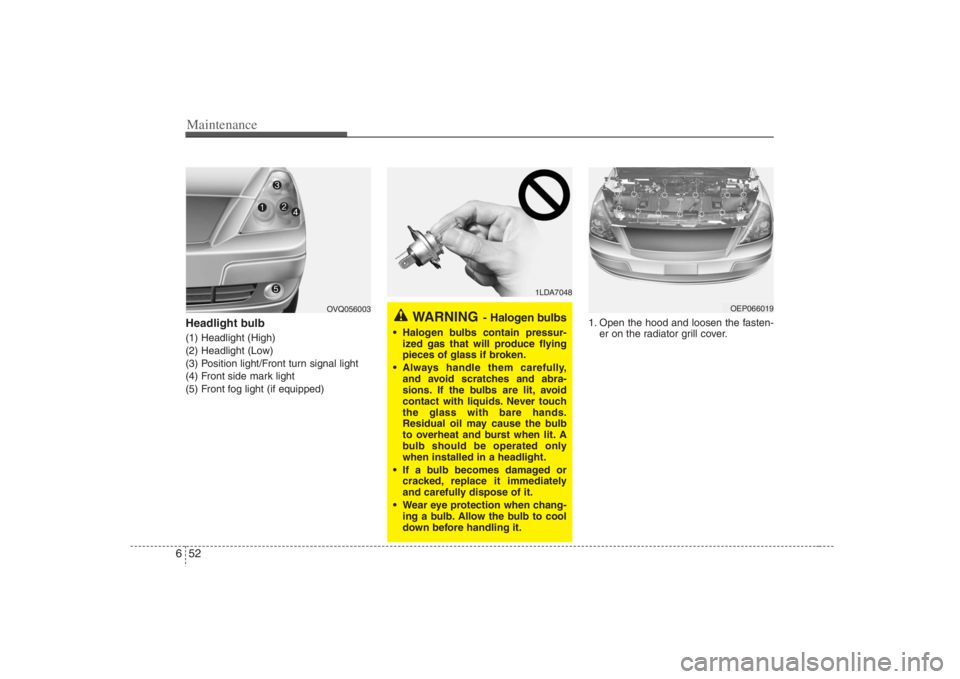
Maintenance52 6Headlight bulb (1) Headlight (High)
(2) Headlight (Low)
(3) Position light/Front turn signal light
(4) Front side mark light
(5) Front fog light (if equipped)1. Open the hood and loosen the fasten-
er on the radiator grill cover.
1LDA7048
WARNING
- Halogen bulbs
Halogen bulbs contain pressur-
ized gas that will produce flying
pieces of glass if broken.
Always handle them carefully,
and avoid scratches and abra-
sions. If the bulbs are lit, avoid
contact with liquids. Never touch
the glass with bare hands.
Residual oil may cause the bulb
to overheat and burst when lit. A
bulb should be operated only
when installed in a headlight.
If a bulb becomes damaged or
cracked, replace it immediately
and carefully dispose of it.
Wear eye protection when chang-
ing a bulb. Allow the bulb to cool
down before handling it.
OEP066019
OVQ056003
Page 364 of 393
655
Maintenance
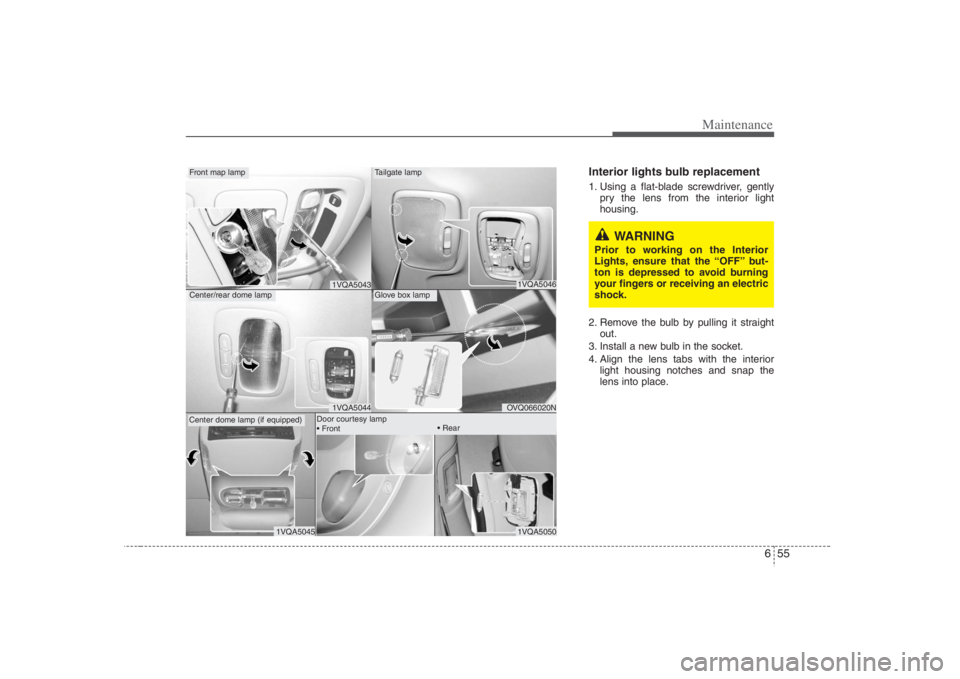
Interior lights bulb replacement1. Using a flat-blade screwdriver, gently
pry the lens from the interior light
housing.
2. Remove the bulb by pulling it straight
out.
3. Install a new bulb in the socket.
4. Align the lens tabs with the interior
light housing notches and snap the
lens into place.
1VQA5046OVQ066020N
Tailgate lampGlove box lamp
1VQA50431VQA5044
Front map lampCenter/rear dome lampCenter dome lamp (if equipped)
1VQA5050
1VQA5045
Door courtesy lamp
WARNING
Prior to working on the Interior
Lights, ensure that the “OFF” but-
ton is depressed to avoid burning
your fingers or receiving an electric
shock.
Page 368 of 393
659
Maintenance
LUBRICANT
Recommended lubricants To help achieve proper engine and pow-
ertrain performance and durability, use
only lubricants of the proper quality. The
correct lubricants also help promote
engine efficiency that results in improved
fuel economy.
Engine oils labeled Energy Conserving
Oil are now available. Along with other
additional benefits, they contribute to fuel
economy by reducing the amount of fuel
necessary to overcome engine friction.
Often, these improvements are difficult to
measure in everyday driving, but in a
year’s time, they can offer significant cost
and energy savings.
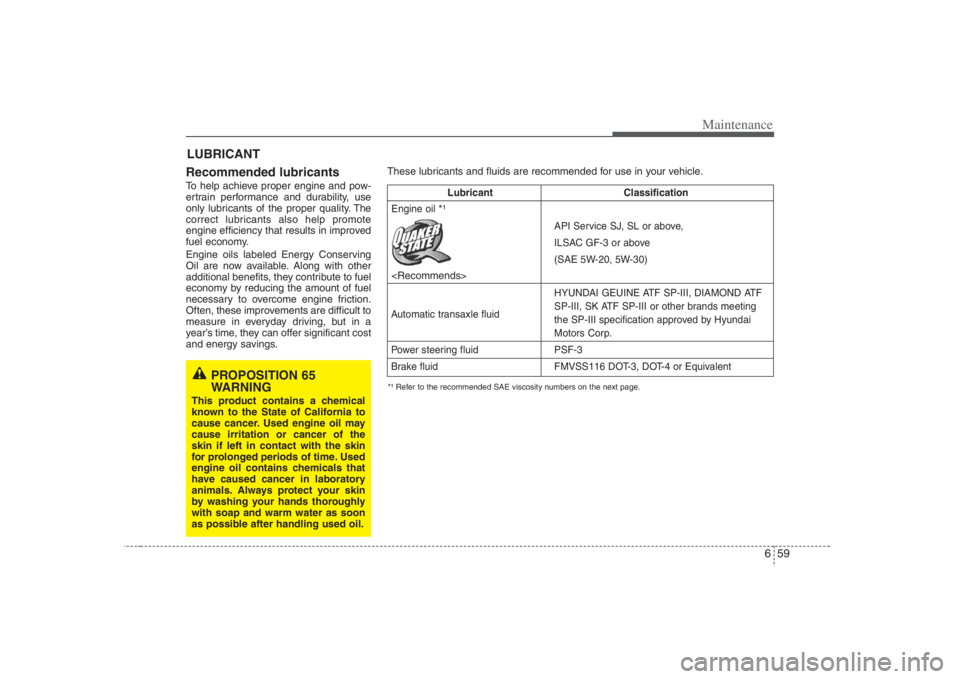
These lubricants and fluids are recommended for use in your vehicle.*¹ Refer to the recommended SAE viscosity numbers on the next page.
Lubricant Classification
API Service SJ, SL or above,
ILSAC GF-3 or above
(SAE 5W-20, 5W-30)
HYUNDAI GEUINE ATF SP-III, DIAMOND ATF
Automatic transaxle fluidSP-III, SK ATF SP-III or other brands meeting
the SP-III specification approved by Hyundai
Motors Corp.
Power steering fluid PSF-3
Brake fluid FMVSS116 DOT-3, DOT-4 or Equivalent
Engine oil
*¹
PROPOSITION 65
WARNING
This product contains a chemical
known to the State of California to
cause cancer. Used engine oil may
cause irritation or cancer of the
skin if left in contact with the skin
for prolonged periods of time. Used
engine oil contains chemicals that
have caused cancer in laboratory
animals. Always protect your skin
by washing your hands thoroughly
with soap and warm water as soon
as possible after handling used oil.