light HYUNDAI ENTOURAGE 2008 Owner's Manual
[x] Cancel search | Manufacturer: HYUNDAI, Model Year: 2008, Model line: ENTOURAGE, Model: HYUNDAI ENTOURAGE 2008Pages: 393, PDF Size: 8.78 MB
Page 76 of 393
Features of your vehicle60 3✽
✽
NOTICESmall children are best protected from
injury in an accident when properly
restrained in the rear seat by a child
restraint system that meets the require-
ments of the Federal Motor Vehicle
Safety Standards. Before buying any
child restraint system, make sure that it
has a label certifying that it meets
Federal Motor Vehicle Safety Standard
213. The restraint must be appropriate
for your child's height and weight.
Check the label on the child restraint for
this information. See page 3-71.
Larger childrenChildren who are too large for child
restraint systems should always occupy
the rear seat and use the available
lap/shoulder belts. The lap portion should
be fastened snug on the hips and as low
as possible. Check belt fit periodically. A
child's squirming could put the belt out of
position. Children are afforded the most
safety in the event of an accident when
they are restrained by a proper restraint
system in the rear seat. If a larger child
(over age 13) must be seated in the front
seat, the child should be securely
restrained by the available lap/shoulder
belt and the seat should be placed in the
rearmost position. Children under the
age of 13 should be restrained securely
in the rear seat. NEVER place a child
under the age of 13 in the front seat.
NEVER place a rear facing child seat in
the front seat of a vehicle.
If the shoulder belt portion slightly touch-
es the child’s neck or face, try placing the
child closer to the center of the vehicle. If
the shoulder belt still touches their face
or neck they need to be returned to a
child restraint system. In addition, after-
market devices are available from inde-
pendent manufacturers which help pull
the shoulder belt down and away from
the child’s face or neck.
Pregnant womenThe use of a seat belt is recommended
for pregnant women to lessen the chance
of injury in an accident. When a seat belt
is used, the lap belt portion should be
placed as low and snugly as possible on
the hips, not across the abdomen. For
specific recommendations, consult a
physician.Injured personA seat belt should be used when an
injured person is being transported.
When this is necessary, you should con-
sult a physician for recommendations.One person per beltTwo people (including children) should
never attempt to use a single seat belt.
This could increase the severity of
injuries in case of an accident.
WARNING
Every person in your vehicle needs
to be properly restrained at all
times, including infants and chil-
dren. Never hold a child in your
arms or lap when riding in a vehicle.
The violent forces created during a
crash will tear the child from your
arms and throw the child against
the interior. Always use a child
restraint appropriate for your
child's height and weight, see page
3-71.
WARNING
- Shoulder belts
on small children
Never allow a shoulder belt to be
in contact with a child’s neck or
face while the vehicle is in
motion.
If safety belts are not properly
worn and adjusted on children,
there is a risk of death or serious
injury.
Page 79 of 393
363
Features of your vehicle
✽ ✽
NOTICEIf the driver's safety belt is not fastened
when the key is turned ON or if it is dis-
connected after the key is turned ON,
the safety belt warning light will blink
until the belt is fastened.
If the driver's safety belt is not fastened
when the key is turned ON or if it is
unfastened after the key is ON, the safe-
ty belt warning chime will sound for
approximately 6 seconds.
Seat belts - Front passenger and
rear seat 3-point system with
combination locking retractorTo fasten your belt Combination retractor type seat belts are
installed in the rear seat positions to help
accommodate the installation of child
restraint systems. Although a combina-
tion retractor is also installed in the front
passenger seat position, Hyundai strong-
ly recommends that children always be
seated in the rear seat. NEVER place
any infant restraint system in the front
seat of the vehicle.
This type of seat belt combines the fea-
tures of both an emergency locking
retractor seat belt and an automatic lock-
ing retractor seat belt. To fasten your seat
belt, pull it out of the retractor and insert
the metal tab into the buckle. There will
be an audible "click" when the tab locks
into the buckle. When not securing a
child restraint, the seat belt operates in
the same way as the driver's seat belt
(Emergency Locking Retractor Type). It
automatically adjusts to the proper length
only after the lap belt portion of the seat
belt is adjusted manually so that it fits
snugly around your hips.When the seat belt is fully extended from
the retractor to allow the installation of a
child restraint system, the seat belt oper-
ation changes to allow the belt to retract,
but not to extend (Automatic Locking
Retractor Type). See page 3-75.
✽ ✽
NOTICEAlthough the combination retractor
provides the same level of protection for
seated passengers in either emergency
or automatic locking modes, it is recom-
mended that seated passengers use the
emergency locking feature for improved
convenience. The automatic locking
function is intended to facilitate child
restraint installation. To convert from
the automatic locking feature to the
emergency locking operation mode,
allow the unbuckled seat belt to fully
retract.
WARNING
For maximum restraint system
protection, the seat belts must
always be used whenever the car
is moving.
Seat belts are most effective
when seatbacks are in the upright
position.
(Continued)
Page 84 of 393
Features of your vehicle68 3Pre-tensioner seat belt Your Hyundai vehicle is equipped with
driver's and front passenger's pre-ten-
sioner seat belts. The purpose of the pre-
tensioner is to make sure that the seat
belts fit tightly against the occupant's
body in certain frontal collisions. The pre-
tensioner seat belts can be activated
alone or, where the frontal collision is
severe enough, together with the air
bags.When the vehicle stops suddenly, or if
the occupant tries to lean forward too
quickly, the seat belt retractor will lock
into position. In certain frontal collisions,
the pre-tensioner will activate and pull
the seat belt into tighter contact against
the occupant's body.
If the system senses excessive seat belt
tension on the driver or passenger's seat
belt when the pre-tensioner activates, the
load limiter inside the pre-tensioner will
release some of the pressure on the
affected seat belt.
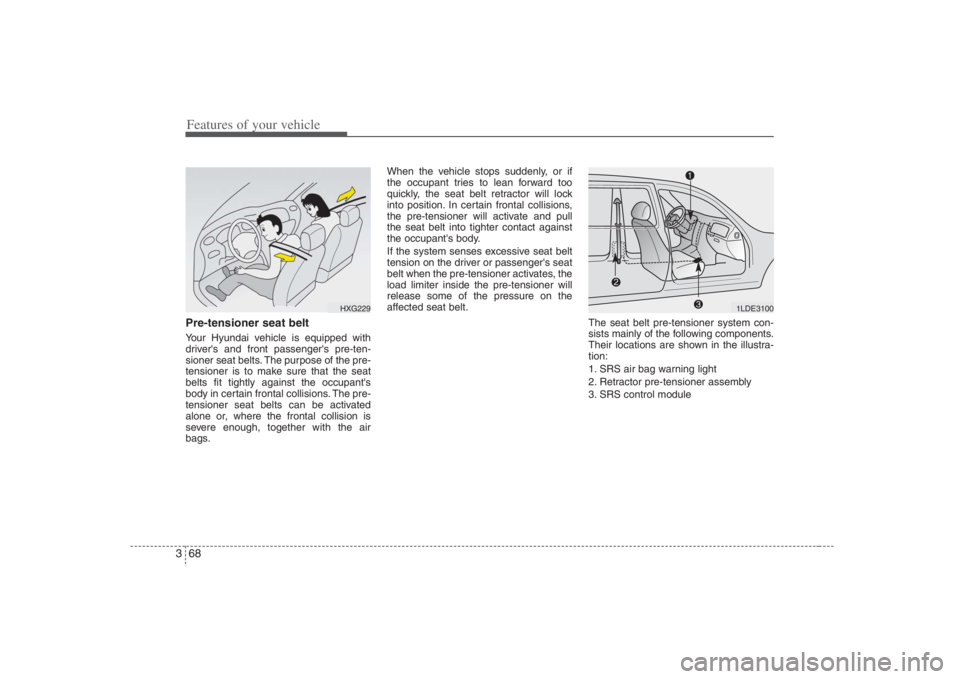
The seat belt pre-tensioner system con-
sists mainly of the following components.
Their locations are shown in the illustra-
tion:
1. SRS air bag warning light
2. Retractor pre-tensioner assembly
3. SRS control module
HXG229
1LDE3100
Page 85 of 393
369
Features of your vehicle
✽ ✽
NOTICE• Both the driver's and front passen-
ger's pre-tensioner seat belts will be
activated in certain frontal collisions.
The pre-tensioner seat belts can be
activated alone or, where the frontal
collision is severe enough, together
with the air bags.
The pre-tensioners will not be activat-
ed if the seat belts are not being worn
at the time of the collision.
• When the pre-tensioner seat belts are
activated, a loud noise may be heard
and fine dust, which may appear to be
smoke, may be visible in the passenger
compartment. These are normal oper-
ating conditions and are not haz-
ardous.
• Although it is harmless, the fine dust
may cause skin irritation and should
not be breathed for prolonged peri-
ods. Wash all exposed skin areas thor-
oughly after an accident in which the
pre-tensioner seat belts were activat-
ed.
CAUTION
Because the sensor that activates
the SRS air bag is connected with
the pre-tensioner seat belt, the
SRS air bag warning light on
the instrument panel will illumi-
nate for approximately 6 seconds
after the ignition key has been
turned to the "ON" position, and
then it should turn off.
If the pre-tensioner seat belt is not
working properly, this warning
light will illuminate even if there is
no malfunction of the SRS air bag.
If the SRS air bag warning light
does not illuminate when the igni-
tion key is turned to "ON", or if it
blinks for a second and remains
illuminated after illuminating for
approximately 6 seconds, or if it
illuminates while the vehicle is
being driven, please have an
authorized Hyundai dealer inspect
the pre-tensioner seat belt or SRS
air bag system as soon as possi-
ble.
AIR
BAG
WARNING
To obtain maximum benefit from a
pre-tensioner seat belt:
1. The seatbelt must be work cor-
rectly and adjusted to the proper
position (see pages 3-59). Please
read and follow all of the impor-
tant information and precautions
about your vehicle’s occupant
safety features – including seat
belts and advanced air bags –
that are provided in this manual.
2. Be sure you and your passengers
always wear seat belts and wear
them properly.
Page 88 of 393
Features of your vehicle72 3
Using a child restraint systemFor small children and babies, the use of
a child seat or infant seat is required. This
child seat or infant seat should be of
appropriate size for the child and should
be installed in accordance with the man-
ufacturer's instructions. It is further
required that the seat be placed in the
vehicle's rear seat.
(Continued)
Never leave children unattended
in a vehicle – not even for a short
time. The car can heat up very
quickly, resulting in serious
injuries to children inside. Even
very young children may inadver-
tently cause the vehicle to move,
entangle themselves in the win-
dows, or lock themselves or oth-
ers inside the vehicle.
Never allow two children, or any
two persons, to use the same seat
belt.
Children often squirm and reposi-
tion themselves improperly.
Never let a child ride with the
shoulder belt under their arm or
behind their back. Always prop-
erly position and secure children
in rear seat.
Never allow a child to stand-up or
kneel on the seat or floorboard of
a moving vehicle. During a colli-
sion or sudden stop, the child can
be violently thrown against the
vehicles interior, resulting in seri-
ous injury.
(Continued)
(Continued)
Never use an infant carrier or a
child safety seat that "hooks"
over a seatback, it may not pro-
vide adequate security in an acci-
dent.
Seat belts can become very hot,
especially when the car is parked
in direct sunlight. Always check
seat belt buckles before fastening
them over a child.
Always store or secure a child
seat, even when it is not in use.
During a collision or sudden stop,
the child seat could be thrown
inside the vehicle.
Page 96 of 393
Features of your vehicle80 3
✽
✽
NOTICE• Be sure to read information about the
SRS on the labels provided on the sun
visor and in the glove box.
• Advanced air bags are combined with
pre-tensioner seat belts to help pro-
vide enhanced occupant protection in
frontal crashes. Front air bags are not
intended to deploy in collisions in
which sufficient protection can be
provided by the pre-tensioner seat
belt.
• If you are considering modification of
your vehicle due to a disability, please
contact the Hyundai Customer
Assistance Center at 1-800-633-5151.
CAUTION
If a seat track position sensor or an
occupant classification system is
not working properly, the SRS air
bag warning light on the instru-
ment panel will illuminate because
the SRS air bag warning light is
connected with the seat track posi-
tion sensor and the occupant clas-
sification system. If the SRS air bag
warning light does not illuminate
when the ignition key is turned to
the "ON" position, remains illumi-
nated after approximately 6 sec-
onds when the ignition key is
turned to the "ON" position, or if it
illuminates while the vehicle is
being driven, have an authorized
Hyundai dealer inspect the
advanced SRS air bag system as
soon as possible.
AIR
BAG
WARNING
Modification to the seat structure
can adversely affect the seat
track position sensor and cause
the air bag to deploy at a different
level than should be provided.
Do not place any objects under-
neath the front seats as they
could damage the seat track posi-
tion sensor or interfere with the
occupant classification system.
Do not place any objects that may
cause magnetic fields near the
front seat. These may cause a
malfunction of the seat track
position sensor.
Page 97 of 393
381
Features of your vehicle
WARNING
Always use seat belts and child
restraints – every trip, every time,
everyone! Air bags inflate with con-
siderable force and in the blink of
an eye. Seat belts help keep occu-
pants in proper position to obtain
maximum benefit from the air bag.
Even with advanced air bags,
improperly and unbelted occupants
can be severely injured when the air
bag inflates. Always follow the pre-
cautions about seat belts, air bags
and occupant safety contained in
this manual.
To reduce the chance of serious or
fatal injuries and receive the maxi-
mum safety benefit from your
restraint system:
Never place a child in any child or
booster seat in the front seat (see
child restraints 3-71).
ABC – Always Buckle Children in
the back seat. It is the safest
place for children of any age to
ride.
Front and side impact air bags
can injure occupants improperly
positioned in the front seats.
(Continued)
(Continued)
Move your seat as far back as
practical from the front air bags,
while still maintaining control of
the vehicle.
Never sit or lean unnecessarily
close to the front or side air bags
Never lean against the door or
center console – always sit in an
upright position.
Do not allow a passenger to ride
in the front seat when the “PAS-
SENGER AIR BAG OFF” indicator
is illuminated, because the air
bag will not deploy in the event of
a moderate or severe frontal
crash.
Never place objects over or near
any air bag module (front or side
impact air bags), because these
objects can injure passengers in
a crash.
Never place covers, blankets or
aftermarket seat warmers on the
passenger seat as these may
interfere with the occupant classi-
fication system.
(Continued)
(Continued)
Do not tamper or disconnect SRS
wiring or other components.
Injuries could result from inadver-
tent deployment or failure of the
air bag to deploy in a crash.
If the SRS air bag warning light
(see page 3-119) remains illumi-
nated while the vehicle is being
driven, have an authorized
Hyundai dealer inspect the air
bag system as soon as possible.
Air bags can only be used once –
have an authorized Hyundai deal-
er replace the air bag immediately
after deployment.
The SRS is designed to deploy
the front air bags only when an
impact is sufficiently severe and
when the impact angle is less
than 30° from the forward longitu-
dinal axis of the vehicle. The front
air bags will not deploy in side,
rear or rollover impacts.
Additionally, the air bags will only
deploy once. Seat belts must be
worn at all times.
(Continued)
Page 99 of 393
383
Features of your vehicle
SRS components and functionsThe SRS consists of the following com-
ponents:
1. Front Impact Sensors
2. "PASSENGER AIR BAG OFF"
Indicator (Front passenger's seat only)
3. SRS "AIR BAG" warning light
4. Knee Bolster
5. Passenger's Air bag Module
6. Driver's Air bag Module
7. SRS Control Module (SRSCM)
8. Occupant Classification System
(Front passenger's seat only)
9. Driver's Seat Track Position Sensor
10. Driver's and Front Passenger's Seat
Belt Buckle Sensors
11. Side Impact Sensors
12. Retractor Pre-tensioner Assemblies
13. Side Impact Air bag Modules
14. Curtain Air bag ModulesThe SRSCM continually monitors all ele-
ments while the ignition is "ON" to deter-
mine if a frontal or near-frontal impact is
severe enough to require air bag deploy-
ment or pre-tensioner seat belt deploy-
ment.
The SRS "AIR BAG" warning light on the
instrument panel will illuminate for about
6 seconds after the ignition key is turned
to the "ON" position or after the engine is
started, after which the "AIR BAG" warn-
ing light should go out.
(Continued)
For maximum safety protection in
all types of crashes, all occupants
including the driver should
always wear their seat belts
whether or not an air bag is also
provided at their seating position
to minimize the risk of severe
injury or death in the event of a
crash. Do not sit or lean unneces-
sarily close to the air bag while
the vehicle is in motion.
Sitting improperly or out of posi-
tion can result in serious or fatal
injury in a crash. All occupants
should sit upright with the seat
back in an upright position, cen-
tered on the seat cushion with
their seat belt on, legs comfort-
ably extended and their feet on
the floor until the vehicle is
parked and the ignition key is
removed.
The SRS air bag system must
deploy very rapidly to provide
protection in a crash. If an occu-
pant is out of position because of
not wearing a seat belt, the air
bag may forcefully contact the
occupant causing serious or fatal
injuries.
Page 102 of 393
Features of your vehicle86 3
Occupant classification systemYour vehicle is equipped with an occu-
pant classification system in the front
passenger's seat.
The occupant classification system is
designed to detect the presence of a
properly-seated front passenger and
determine if the passenger's front air bag
should be enabled (may inflate) or not.
The driver's front air bag is not affected
or controlled by the occupant classifica-
tion system.If the front passenger seat is occupied by
a person that the system determines to
be of adult size, and he/she sits properly
(sitting upright with the seatback in an
upright position, centered on the seat
cushion with their seat belt on, legs com-
fortably extended and their feet on the
floor), the "PASSENGER AIR BAG OFF"
indicator will be turned off and the front
passenger's air bag will be able to inflate,
if necessary, in frontal crashes.
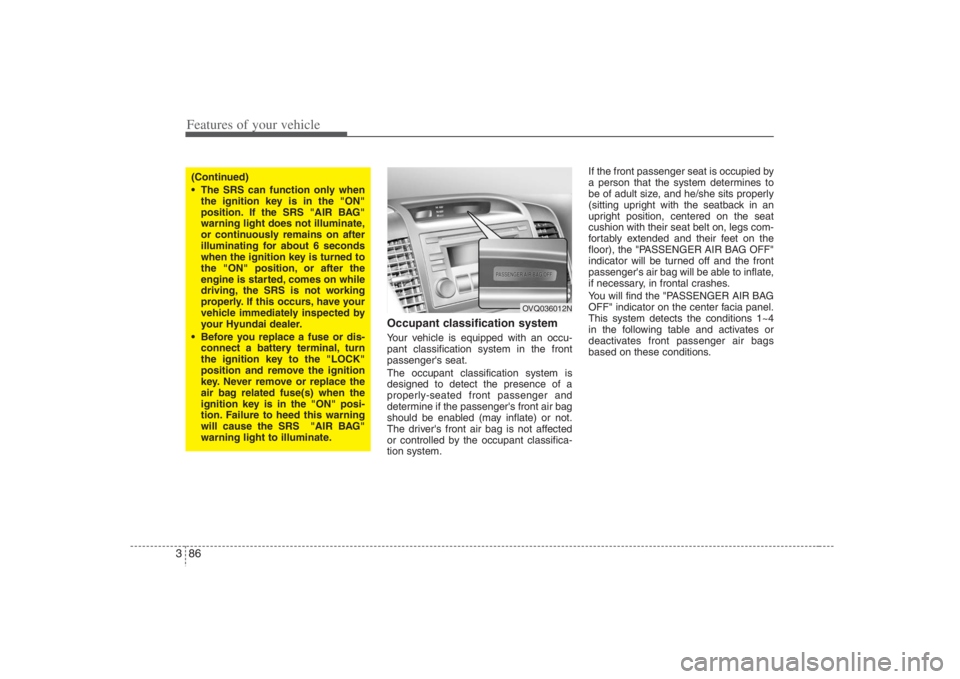
You will find the "PASSENGER AIR BAG
OFF" indicator on the center facia panel.
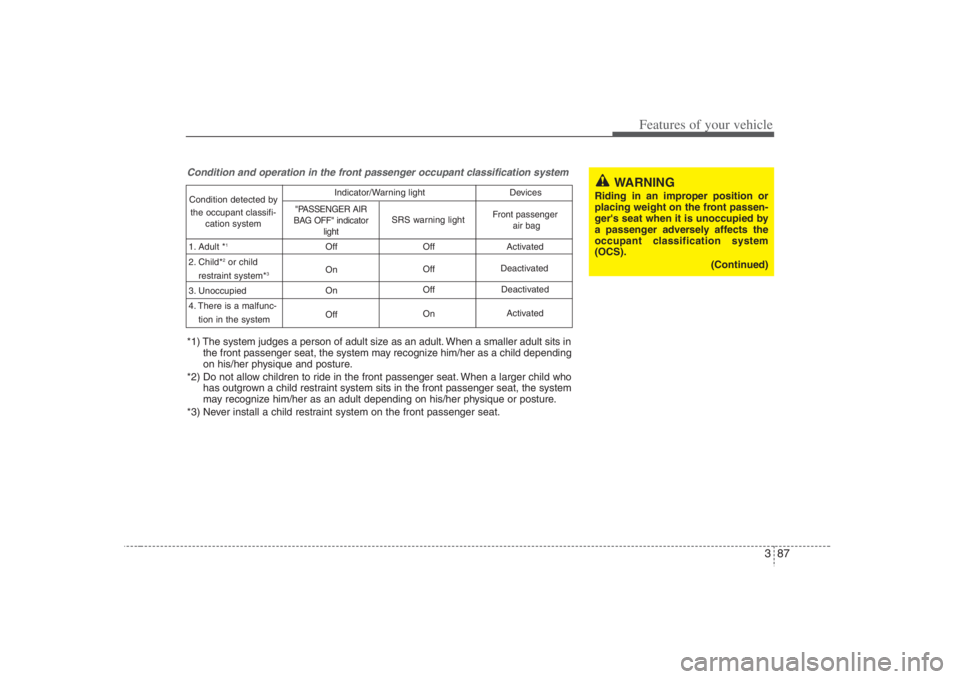
This system detects the conditions 1~4
in the following table and activates or
deactivates front passenger air bags
based on these conditions.
(Continued)
The SRS can function only when
the ignition key is in the "ON"
position. If the SRS "AIR BAG"
warning light does not illuminate,
or continuously remains on after
illuminating for about 6 seconds
when the ignition key is turned to
the "ON" position, or after the
engine is started, comes on while
driving, the SRS is not working
properly. If this occurs, have your
vehicle immediately inspected by
your Hyundai dealer.
Before you replace a fuse or dis-
connect a battery terminal, turn
the ignition key to the "LOCK"
position and remove the ignition
key. Never remove or replace the
air bag related fuse(s) when the
ignition key is in the "ON" posi-
tion. Failure to heed this warning
will cause the SRS "AIR BAG"
warning light to illuminate.
OVQ036012N
Page 103 of 393
387
Features of your vehicle
Condition and operation in the front passenger occupant classification systemCondition detected by
the occupant classifi-
cation system
1. Adult *
1
2. Child*
2or child
restraint system*
3
3. Unoccupied
4. There is a malfunc-
tion in the systemOff
On
On
OffOff
Off
Off
OnActivated
Deactivated
Activated
"PASSENGER AIR
BAG OFF" indicator
light
SRS warning light
Front passenger
air bag Deactivated Indicator/Warning light Devices
*1) The system judges a person of adult size as an adult. When a smaller adult sits in
the front passenger seat, the system may recognize him/her as a child depending
on his/her physique and posture.
*2) Do not allow children to ride in the front passenger seat. When a larger child who
has outgrown a child restraint system sits in the front passenger seat, the system
may recognize him/her as an adult depending on his/her physique or posture.
*3) Never install a child restraint system on the front passenger seat.
WARNING
Riding in an improper position or
placing weight on the front passen-
ger's seat when it is unoccupied by
a passenger adversely affects the
occupant classification system
(OCS).
(Continued)