lock HYUNDAI ENTOURAGE 2008 Owners Manual
[x] Cancel search | Manufacturer: HYUNDAI, Model Year: 2008, Model line: ENTOURAGE, Model: HYUNDAI ENTOURAGE 2008Pages: 393, PDF Size: 8.78 MB
Page 12 of 393
13
Introduction
Use of MTBEHyundai recommends that fuels contain-
ing MTBE (Methyl Tertiary Butyl Ether)
over 15.0% vol. (Oxygen Content 2.7%
weight) should not be used in your
Hyundai.
Fuel containing MTBE over 15.0% vol.
(Oxygen Content 2.7% weight) may
reduce vehicle performance and produce
vapor lock or hard starting.Do Not Use MethanolFuels containing methanol (wood alco-
hol) should not be used in your Hyundai.
This type of fuel can reduce vehicle per-
formance and damage components of
the fuel system.
Gasolines for Cleaner AirTo help contribute to cleaner air, Hyundai
recommends that you use gasolines
treated with detergent additives, which
help prevent deposit formation in the
engine. These gasolines will help the
engine run cleaner and enhance per-
formance of the Emission Control
System.Operation in Foreign CountriesIf you are going to drive your Hyundai in
another country, be sure to:
Observe all regulations regarding reg-
istration and insurance.
Determine that acceptable fuel is avail-
able.
During the First 1,200 Miles (2,000
Km)No formal "break-in" procedure is
required with your new Hyundai.
However, you can contribute to the eco-
nomical operation and durability of your
Hyundai by observing the following rec-
ommendations during the first 1,200
miles (2,000 km).
Don't drive faster than 55 MPH (88
km/h).
While driving, keep your engine speed
(rpm, or revolutions per minute)
between 2,000 rpm and 4,000 rpm.
Use moderate acceleration. Don't start
quickly or depress the accelerator
pedal fully.
For the first 200 miles (300 km), try to
avoid hard stops.
Whether going fast or slow, vary your
speed from time to time.
Don't let the engine idle longer than 3
minutes at one time.
Don't tow a trailer during the first 1,200
miles (2,000 km) of operation.
CAUTION
Your Hyundai's New Vehicle Limited
Warranty may not cover damage to
the fuel system and any perform-
ance problems that are caused by
the use of fuels containing
methanol or fuels containing MTBE
(Methyl Tertiary Butyl Ether) over
15.0% vol. (Oxygen Content 2.7%
weight.)
VEHICLE BREAK-IN PROCESS
Page 13 of 393
Introduction4 1Your Hyundai vehicle is equipped with
many high technology, electronically
controlled systems that help to
ensure your vehicle operates properly
and provides the performance that
you expect. These systems utilize
computers to monitor the operation of
various systems and components and
help to control their operation. These
computerized system operations are
wide-ranging and involve components
to reduce emissions, to continuously
evaluate the readiness of the airbag
and seat belt pretensioner systems, to
determine when the airbag and seat
belt pre-tensioner systems should be
deployed and then to activate the
deployment, and if equipped, to oper-
ate anti-lock braking, traction control
and electrical stability control to
assist the driver to control the vehicle
in difficult driving situations. These
systems electronically store informa-
tion that is useful to service techni-
cians when they need to diagnose and
repair these systems.Additional information is stored only
when a crash occurs that results in
the deployment of the airbags or seat
belt pre-tensioners. This type of data
storage is done by devices called
event data recorders(EDR).
After a crash event, the airbag and
seat belt pre-tensioner computer sys-
tem, known as the Supplemental
Restraint System Control Module
(SRSCM) or Airbag Control Unit
(ACU), may record some information
about the condition of the vehicle and
how it was being operated. This infor-
mation consists of data related to seat
belt usage and if there was diagnostic
information in the airbag or seat belt
systems at the time that a crash
occurred, and if the ACU sensed that a
crash of sufficient severity occurred
to require seat belt pre-tensioner or
airbag deployment.To retrieve this information, special
equipment is needed and access to
the vehicle or the device that stores
the data is required. Hyundai will not
access information about a crash
event or share it with others except:
in response to an official request of
police or similar government office,
or
with the consent of the vehicle
owner or, if the vehicle is leased,
with the consent of the lessee, or
as part of Hyundai’s defense of liti-
gation, or
as required by law.VEHICLE DATA COLLECTION AND EVENT DATA RECORDERS
Page 15 of 393
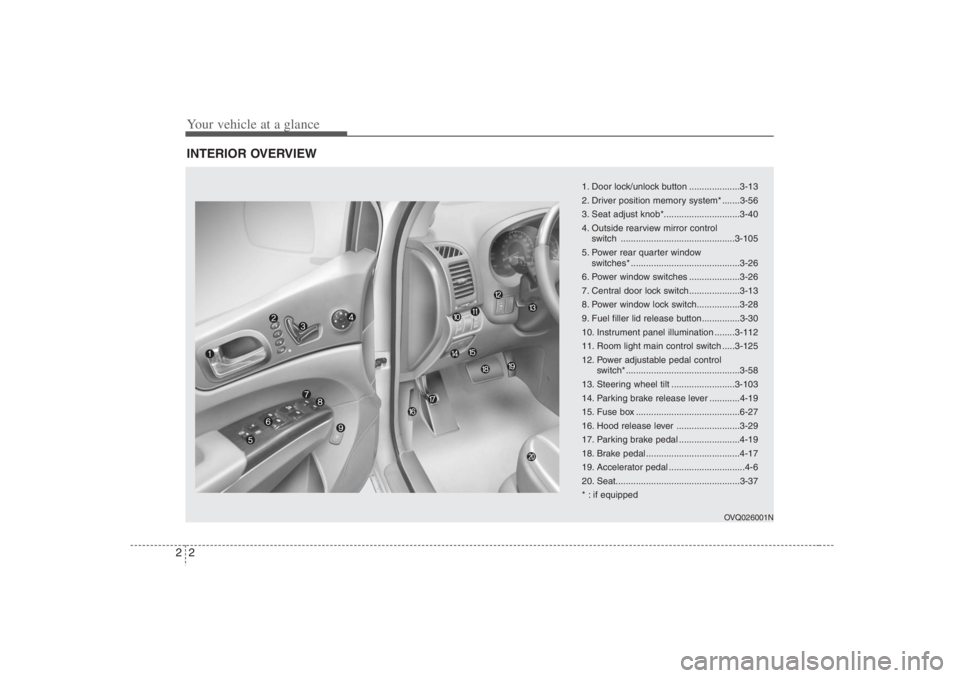
Your vehicle at a glance2 2INTERIOR OVERVIEW
OVQ026001N
1. Door lock/unlock button ....................3-13
2. Driver position memory system* .......3-56
3. Seat adjust knob*..............................3-40
4. Outside rearview mirror control
switch .............................................3-105
5. Power rear quarter window
switches* ...........................................3-26
6. Power window switches ....................3-26
7. Central door lock switch....................3-13
8. Power window lock switch.................3-28
9. Fuel filler lid release button...............3-30
10. Instrument panel illumination ........3-112
11. Room light main control switch .....3-125
12. Power adjustable pedal control
switch*.............................................3-58
13. Steering wheel tilt .........................3-103
14. Parking brake release lever ............4-19
15. Fuse box .........................................6-27
16. Hood release lever .........................3-29
17. Parking brake pedal ........................4-19
18. Brake pedal .....................................4-17
19. Accelerator pedal ..............................4-6
20. Seat.................................................3-37
* : if equipped
Page 16 of 393
23
Your vehicle at a glance
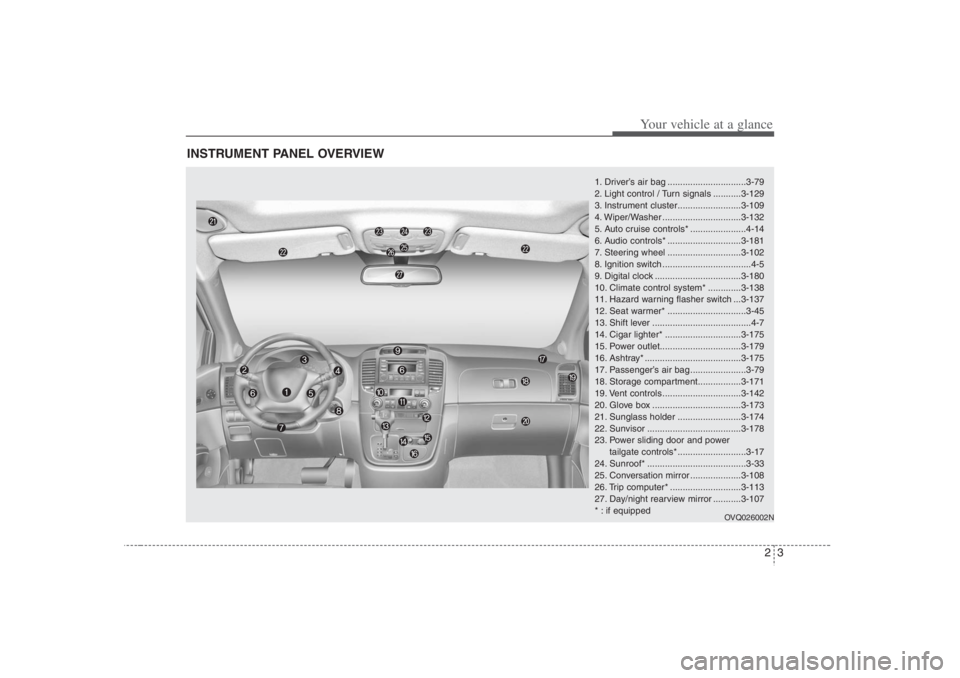
INSTRUMENT PANEL OVERVIEW
1. Driver’s air bag ...............................3-79
2. Light control / Turn signals ...........3-129
3. Instrument cluster.........................3-109
4. Wiper/Washer ...............................3-132
5. Auto cruise controls* ......................4-14
6. Audio controls* .............................3-181
7. Steering wheel .............................3-102
8. Ignition switch ...................................4-5
9. Digital clock ..................................3-180
10. Climate control system* .............3-138
11. Hazard warning flasher switch ...3-137
12. Seat warmer* ...............................3-45
13. Shift lever .......................................4-7
14. Cigar lighter* ..............................3-175
15. Power outlet................................3-179
16. Ashtray* ......................................3-175
17. Passenger’s air bag ......................3-79
18. Storage compartment.................3-171
19. Vent controls ...............................3-142
20. Glove box ...................................3-173
21. Sunglass holder .........................3-174
22. Sunvisor .....................................3-178
23. Power sliding door and power
tailgate controls* ...........................3-17
24. Sunroof* .......................................3-33
25. Conversation mirror ....................3-108
26. Trip computer* ............................3-113
27. Day/night rearview mirror ...........3-107
* : if equipped
OVQ026002N
Page 17 of 393
3
Keys / 3-3
Remote keyless entry / 3-4
Theft-alarm system / 3-7
Immobilizer system / 3-9
Door locks / 3-11
Power sliding door and power tailgate / 3-17
Window / 3-26
Hood / 3-29
Fuel filler lid / 3-30
Sunroof / 3-33
Seat / 3-37
Driver position memory system / 3-57
Power adjustable pedals / 3-59
Seat belts / 3-59
Child restraint system / 3-71
Air bags-advanced restraint system / 3-78
Steering wheel / 3-102
Mirrors / 3-104
Instrument cluster / 3-109
Gauges / 3-110
Trip computer / 3-113
Warnings and indicators / 3-119
Features of your vehicle
Page 19 of 393
33
Features of your vehicle
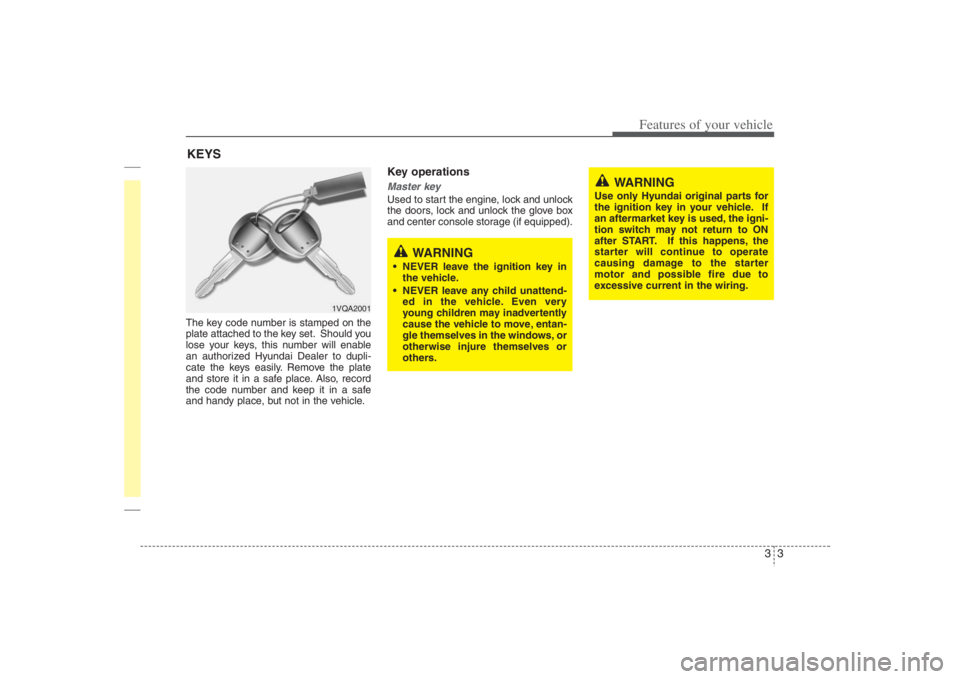
The key code number is stamped on the
plate attached to the key set. Should you
lose your keys, this number will enable
an authorized Hyundai Dealer to dupli-
cate the keys easily. Remove the plate
and store it in a safe place. Also, record
the code number and keep it in a safe
and handy place, but not in the vehicle.
Key operationsMaster keyUsed to start the engine, lock and unlock
the doors, lock and unlock the glove box
and center console storage (if equipped).
KEYS
WARNING
• NEVER leave the ignition key in
the vehicle.
NEVER leave any child unattend-
ed in the vehicle. Even very
young children may inadvertently
cause the vehicle to move, entan-
gle themselves in the windows, or
otherwise injure themselves or
others.
1VQA2001
WARNING
Use only Hyundai original parts for
the ignition key in your vehicle. If
an aftermarket key is used, the igni-
tion switch may not return to ON
after START. If this happens, the
starter will continue to operate
causing damage to the starter
motor and possible fire due to
excessive current in the wiring.
Page 20 of 393
Features of your vehicle4 3
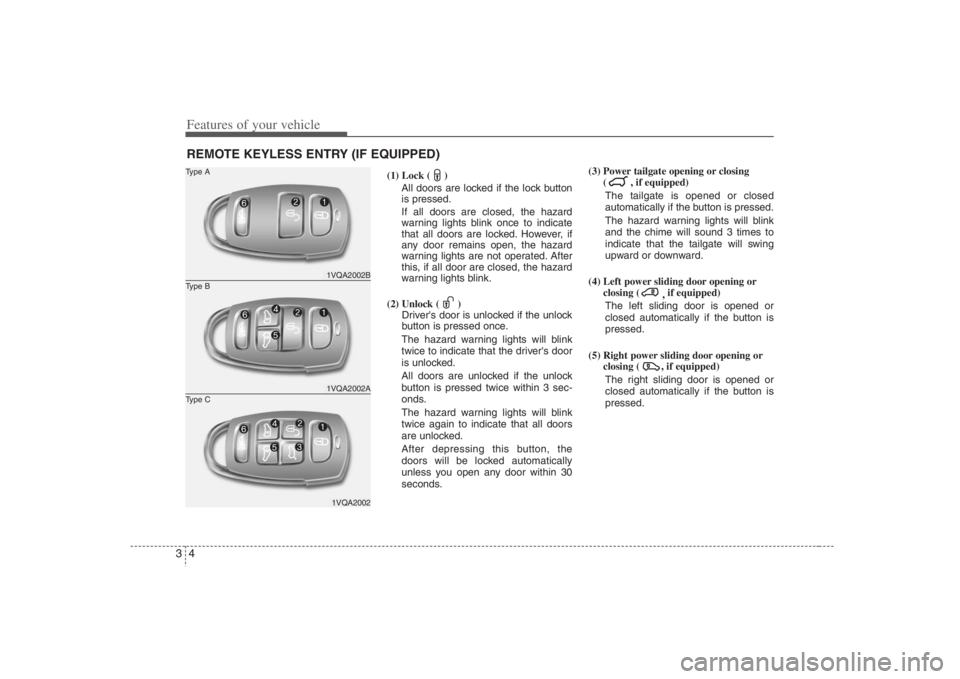
(1) Lock ( )
All doors are locked if the lock button
is pressed.
If all doors are closed, the hazard
warning lights blink once to indicate
that all doors are locked. However, if
any door remains open, the hazard
warning lights are not operated. After
this, if all door are closed, the hazard
warning lights blink.
(2) Unlock ( )
Driver's door is unlocked if the unlock
button is pressed once.
The hazard warning lights will blink
twice to indicate that the driver's door
is unlocked.
All doors are unlocked if the unlock
button is pressed twice within 3 sec-
onds.
The hazard warning lights will blink
twice again to indicate that all doors
are unlocked.
After depressing this button, the
doors will be locked automatically
unless you open any door within 30
seconds.(3) Power tailgate opening or closing
( , if equipped)
The tailgate is opened or closed
automatically if the button is pressed.
The hazard warning lights will blink
and the chime will sound 3 times to
indicate that the tailgate will swing
upward or downward.
(4) Left power sliding door opening or
closing (
, if equipped)
The left sliding door is opened or
closed automatically if the button is
pressed.
(5) Right power sliding door opening or
closing ( , if equipped)
The right sliding door is opened or
closed automatically if the button is
pressed.
REMOTE KEYLESS ENTRY (IF EQUIPPED)
1VQA2002B1VQA2002A1VQA2002
Type B Type A
Type C
Page 21 of 393
35
Features of your vehicle
✽ ✽
NOTICEThe power sliding door and power tail-
gate are not opened by pressing the cor-
responding button on the transmitter
directly when all power sliding doors
and power tailgate are locked and
closed. To open the power sliding door
or power tailgate from outside vehicle,
press the unlock button twice within 3
seconds first and press corresponding
power sliding door or power tailgate
opening button.(6) Alarm ( )
The horn sounds and hazard warning
lights flash for about 27 seconds if
this button is pressed. To stop the
horn and lights, press any button on
the transmitter.
✽ ✽
NOTICEThe transmitter will not work if any of
following occur:
• The ignition key is in ignition switch.
• You exceed the operating distance
limit (about 90 feet [30 m]).
• The battery in the transmitter is
weak.
• Other vehicles or objects may be
blocking the signal.
• The weather is extremely cold.
• The transmitter is close to a radio
transmitter such as a radio station or
an airport which can interfere with
normal operation of the transmitter.
When the transmitter does not work
correctly, open and close the door with
the ignition key. If you have a problem
with the transmitter, contact an author-
ized Hyundai Dealer.
Operational distance may vary depend-
ing upon the area the transmitter is used
in. For example, if the vehicle is parked
near police stations, government and
public offices, broadcasting stations, mil-
itary installations, airports, or transmit-
ting towers, etc.
CAUTION
The power doors can be operated
when the engine is not running.
However, the power doors consume
large amounts of vehicle electric
power. To prevent the battery from
being discharged, do not operate
them consecutively (more than
approximately 10 times).
CAUTION
Keep the transmitter away from
water or any liquid. If the keyless
entry system is inoperative due to
exposure to water or liquids, it will
not be covered by your manufactur-
er vehicle warranty.
Page 23 of 393
37
Features of your vehicle
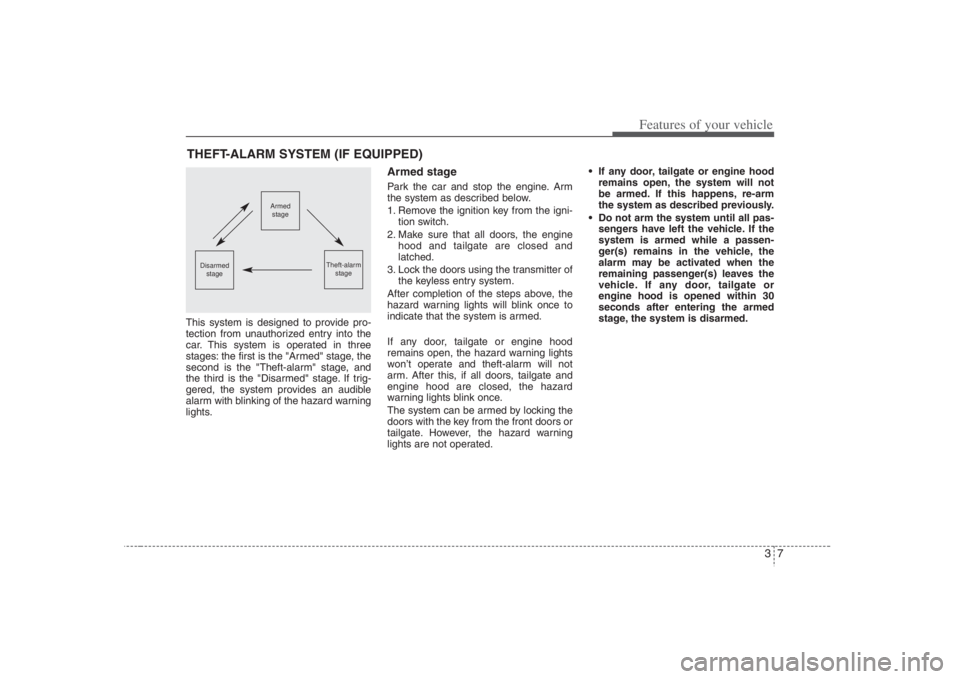
This system is designed to provide pro-
tection from unauthorized entry into the
car. This system is operated in three
stages: the first is the "Armed" stage, the
second is the "Theft-alarm" stage, and
the third is the "Disarmed" stage. If trig-
gered, the system provides an audible
alarm with blinking of the hazard warning
lights.
Armed stagePark the car and stop the engine. Arm
the system as described below.
1. Remove the ignition key from the igni-
tion switch.
2. Make sure that all doors, the engine
hood and tailgate are closed and
latched.
3. Lock the doors using the transmitter of
the keyless entry system.
After completion of the steps above, the
hazard warning lights will blink once to
indicate that the system is armed.
If any door, tailgate or engine hood
remains open, the hazard warning lights
won’t operate and theft-alarm will not
arm. After this, if all doors, tailgate and
engine hood are closed, the hazard
warning lights blink once.
The system can be armed by locking the
doors with the key from the front doors or
tailgate. However, the hazard warning
lights are not operated. If any door, tailgate or engine hood
remains open, the system will not
be armed. If this happens, re-arm
the system as described previously.
Do not arm the system until all pas-
sengers have left the vehicle. If the
system is armed while a passen-
ger(s) remains in the vehicle, the
alarm may be activated when the
remaining passenger(s) leaves the
vehicle. If any door, tailgate or
engine hood is opened within 30
seconds after entering the armed
stage, the system is disarmed.
THEFT-ALARM SYSTEM (IF EQUIPPED)
Armed
stage
Theft-alarm
stage
Disarmed
stage
Page 24 of 393
Features of your vehicle8 3Theft-alarm stageThe alarm will be activated if any of the
following occurs while the system is
armed.
A front or rear door is opened without
using the ignition key or transmitter.
The tailgate is opened without using
the ignition key or transmitter.
The engine hood is opened.
The siren will sound and the hazard
warning lights will blink continuously for
27 seconds, and repeat the alarm 3
times unless the system is disarmed. To
turn off the system, unlock the doors with
the ignition key or transmitter.✽ ✽
NOTICEAvoid trying to start the engine while
the alarm is activated. The vehicle start-
ing motor is disabled during the theft-
alarm stage.
Disarmed stageThe system will be disarmed when the
doors are unlocked by depressing the
unlock button on the transmitter or
unlocked with the ignition key.
After depressing unlock button, the haz-
ard warning lights will blink twice to indi-
cate that the system is disarmed.
After depressing unlock button, if any
door is not opened within 30 seconds,
the system will be rearmed.
If the system is not disarmed with the
ignition key or transmitter, insert the key
in the ignition switch, turn the key to the
ON position and wait for 30 seconds.
Then the system will be disarmed.Your vehicle is equipped with an elec-
tronic engine immobilizer system to
reduce the risk of unauthorized vehicle
use.
Your immobilizer system is comprised of
a small transponder in the ignition key,
and antenna coil in the key cylinder and
Immobilizer Control Unit (or Smartra
Unit).
With this system, whenever you insert
your ignition key into the ignition switch
and turn it to ON, the antenna coil in the
ignition switch receives a signal from the
transponder in the ignition key and then
sends the signal to the ECU (Engine
Control Unit).
The ECU checks the signal whether the
ignition key is valid.
If the key is determined to be valid, the
engine will start.
If the key is determined to be invalid, the
engine will not start.
IMMOBILIZER SYSTEM
(IF EQUIPPED)