transmission Hyundai Equus 2010 User Guide
[x] Cancel search | Manufacturer: HYUNDAI, Model Year: 2010, Model line: Equus, Model: Hyundai Equus 2010Pages: 374, PDF Size: 41.29 MB
Page 231 of 374
527
Driving your vehicle
Don't coast down hills with the vehicleout of gear. This is extremely haz-
ardous. Keep the car in gear at all
times, use the brakes to slow down,
then shift to a lower gear so that
engine braking will help you maintain a
safe speed.
Don't "ride" the brake pedal. Resting your foot on the brake pedal while driv-ing can be dangerous because it can
result in the brakes overheating and
losing their effectiveness. It also
increases the wear of the brake com-
ponents.
If a tire goes flat while you are driving, apply the brakes gently and keep the
car pointed straight ahead while you
slow down. When you are moving
slowly enough for it to be safe to do so,
pull off the road and stop in a safe
place. If your vehicle is equipped with an
automatic transmission, don't let your
car creep forward. To avoid creeping
forward, keep your foot firmly on the
brake pedal when the car is stopped.
Be caution when parking on a hill. Firmly engage the parking brake and
place the shift lever in P. If your vehicle
is facing downhill, turn the front wheels
into the curb to help keep the vehicle
from rolling. If your vehicle is facing
uphill, turn the front wheels away from
the curb to help keep the vehicle from
rolling. If there is no curb or if it is
required by other conditions to keep
the vehicle from rolling, block the
wheels. Under some conditions your parking
brake can freeze in the engaged posi-
tion. This is most likely to happen when
there is an accumulation of snow or ice
around or near the rear brakes or if the
brakes are wet. If there is a risk that the
parking brake may freeze, apply it only
temporarily while y ou put the shift lever
in P and block the rear wheels so the
car cannot roll. Then release the park-
ing brake.
Do not hold the vehicle on the upgrade with the accelerator pedal. This can
cause the transmission to overheat.
Always use the brake pedal or parking
brake.
Page 258 of 374
Driving your vehicle
54
5
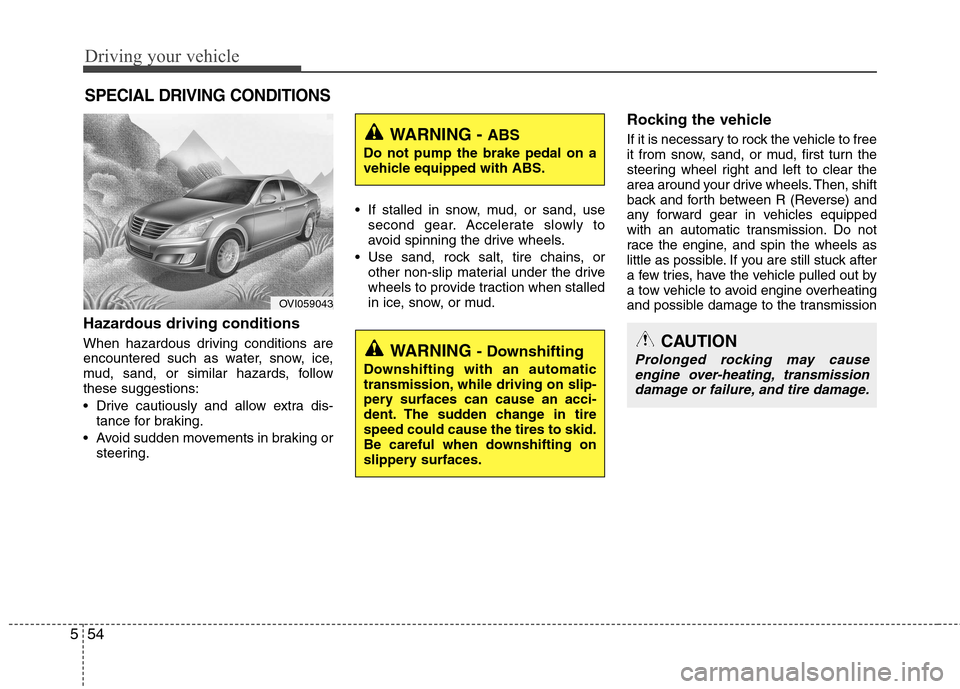
Hazardous driving conditions
When hazardous driving conditions are
encountered such as water, snow, ice,
mud, sand, or similar hazards, followthese suggestions:
Drive cautiously and allow extra dis-
tance for braking.
Avoid sudden movements in braking or steering. If stalled in snow, mud, or sand, use
second gear. Accelerate slowly to
avoid spinning the drive wheels.
Use sand, rock salt, tire chains, or other non-slip material under the drive
wheels to provide traction when stalled
in ice, snow, or mud. Rocking the vehicle
If it is necessary to rock the vehicle to free
it from snow, sand, or mud, first turn the
steering wheel right and left to clear the
area around your drive wheels. Then, shift
back and forth between R (Reverse) and
any forward gear in vehicles equipped
with an automatic transmission. Do not
race the engine, and spin the wheels as
little as possible. If you are still stuck after
a few tries, have the vehicle pulled out by
a tow vehicle to avoid engine overheating
and possible damage to the transmission
SPECIAL DRIVING CONDITIONS
OVI059043
WARNING -
ABS
Do not pump the brake pedal on a
vehicle equipped with ABS.
WARNING - Downshifting
Downshifting with an automatic
transmission, while driving on slip-
pery surfaces can cause an acci-
dent. The sudden change in tirespeed could cause the tires to skid.
Be careful when downshifting on
slippery surfaces.CAUTION
Prolonged rocking may cause engine over-heating, transmission
damage or failure, and tire damage.
Page 286 of 374
619
What to do in an emergency
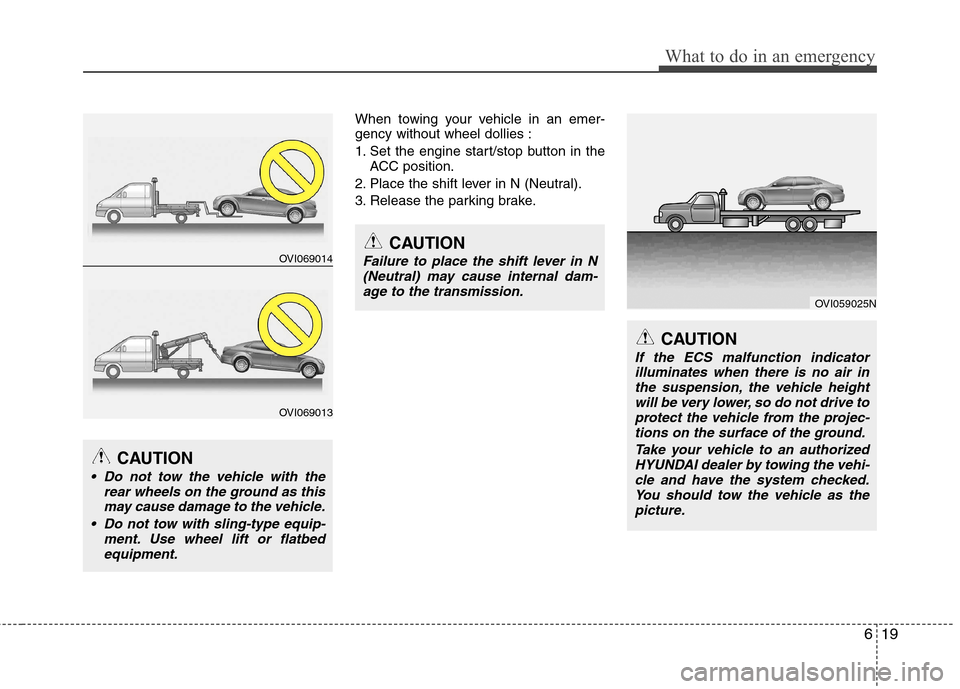
When towing your vehicle in an emer- gency without wheel dollies :
1. Set the engine start/stop button in theACC position.
2. Place the shift lever in N (Neutral).
3. Release the parking brake.
OVI069014
OVI069013
CAUTION
Do not tow the vehicle with the rear wheels on the ground as thismay cause damage to the vehicle.
Do not tow with sling-type equip- ment. Use wheel lift or flatbedequipment.
CAUTION
Failure to place the shift lever in N
(Neutral) may cause internal dam-age to the transmission.
CAUTION
If the ECS malfunction indicator
illuminates when there is no air inthe suspension, the vehicle height will be very lower, so do not drive toprotect the vehicle from the projec-
tions on the surface of the ground.
Take your vehicle to an authorizedHYUNDAI dealer by towing the vehi-cle and have the system checked. You should tow the vehicle as the
picture.
OVI059025N
Page 289 of 374
What to do in an emergency
22
6
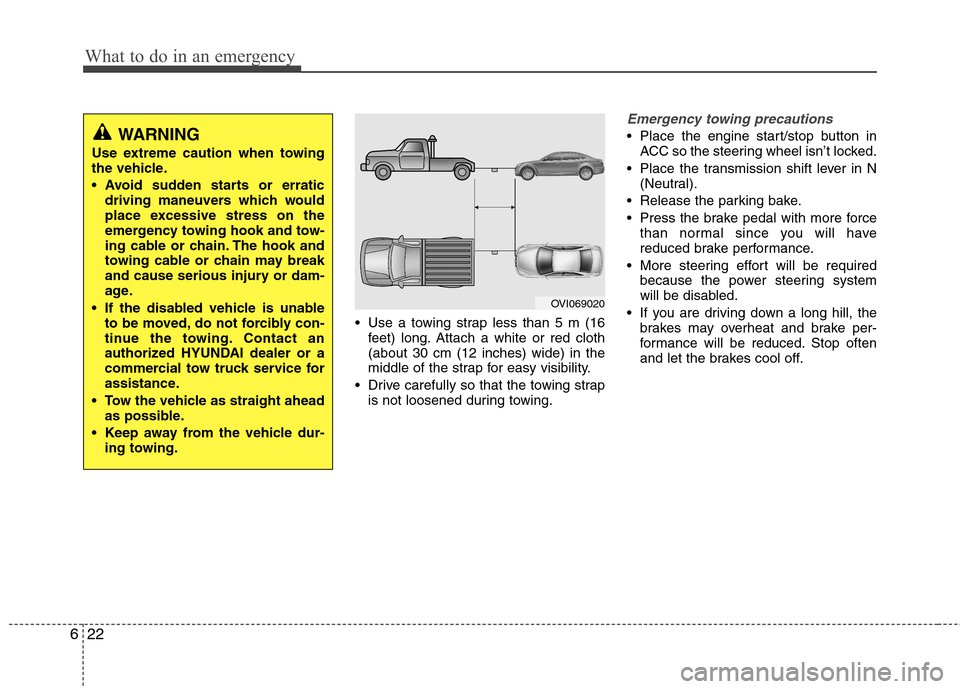
Use a towing strap less than 5 m (16
feet) long. Attach a white or red cloth (about 30 cm (12 inches) wide) in the
middle of the strap for easy visibility.
Drive carefully so that the towing strap is not loosened during towing.
Emergency towing precautions
Place the engine start/stop button inACC so the steering wheel isn’t locked.
Place the transmission shift lever in N (Neutral).
Release the parking bake.
Press the brake pedal with more force than normal since you will have
reduced brake performance.
More steering effort will be required because the power steering system
will be disabled.
If you are driving down a long hill, the brakes may overheat and brake per-
formance will be reduced. Stop often
and let the brakes cool off.WARNING
Use extreme caution when towing
the vehicle.
driving maneuvers which would
place excessive stress on the
emergency towing hook and tow-
ing cable or chain. The hook and
towing cable or chain may break
and cause serious injury or dam-
age.
If the disabled vehicle is unable to be moved, do not forcibly con-
tinue the towing. Contact an
authorized HYUNDAI dealer or a
commercial tow truck service for
assistance.
Tow the vehicle as straight ahead as possible.
Keep away from the vehicle dur- ing towing.
OVI069020
Page 290 of 374
623
What to do in an emergency
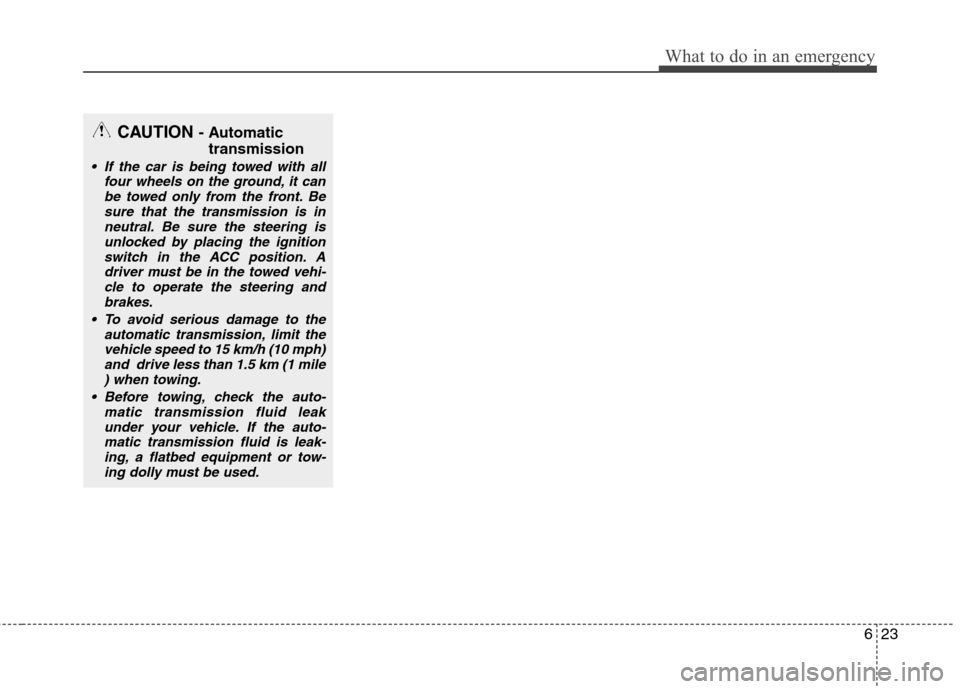
CAUTION - Automatic
transmission
If the car is being towed with all four wheels on the ground, it can
be towed only from the front. Besure that the transmission is inneutral. Be sure the steering is unlocked by placing the ignition
switch in the ACC position. Adriver must be in the towed vehi-cle to operate the steering and
brakes.
To avoid serious damage to the automatic transmission, limit thevehicle speed to 15 km/h (10 mph)and drive less than 1.5 km (1 mile
) when towing.
Before towing, check the auto- matic transmission fluid leakunder your vehicle. If the auto- matic transmission fluid is leak-
ing, a flatbed equipment or tow-ing dolly must be used.
Page 297 of 374
Maintenance
6
7
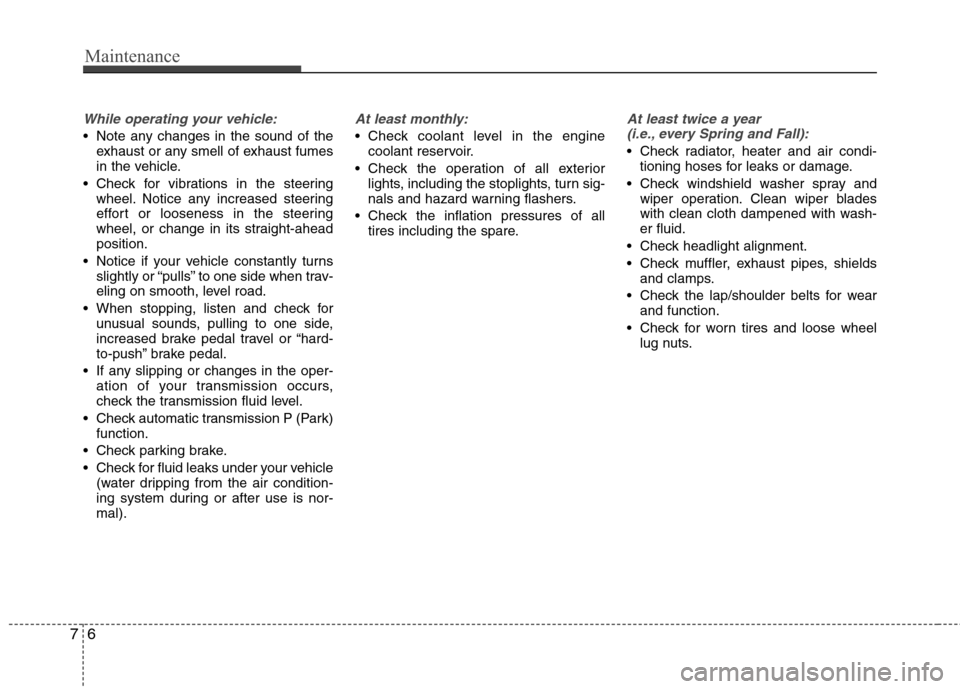
While operating your vehicle:
Note any changes in the sound of the
exhaust or any smell of exhaust fumes
in the vehicle.
Check for vibrations in the steering wheel. Notice any increased steering
effort or looseness in the steering
wheel, or change in its straight-aheadposition.
Notice if your vehicle constantly turns slightly or “pulls” to one side when trav-
eling on smooth, level road.
When stopping, listen and check for unusual sounds, pulling to one side,
increased brake pedal travel or “hard-
to-push” brake pedal.
If any slipping or changes in the oper- ation of your transmission occurs,
check the transmission fluid level.
Check automatic transmission P (Park) function.
Check parking brake.
Check for fluid leaks under your vehicle (water dripping from the air condition-
ing system during or after use is nor-mal).
At least monthly:
Check coolant level in the enginecoolant reservoir.
Check the operation of all exterior lights, including the stoplights, turn sig-
nals and hazard warning flashers.
Check the inflation pressures of all tires including the spare.
At least twice a year
(i.e., every Spring and Fall):
Check radiator, heater and air condi- tioning hoses for leaks or damage.
Check windshield washer spray and wiper operation. Clean wiper blades
with clean cloth dampened with wash-er fluid.
Check headlight alignment.
Check muffler, exhaust pipes, shields and clamps.
Check the lap/shoulder belts for wear and function.
Check for worn tires and loose wheel lug nuts.
Page 302 of 374
711
Maintenance
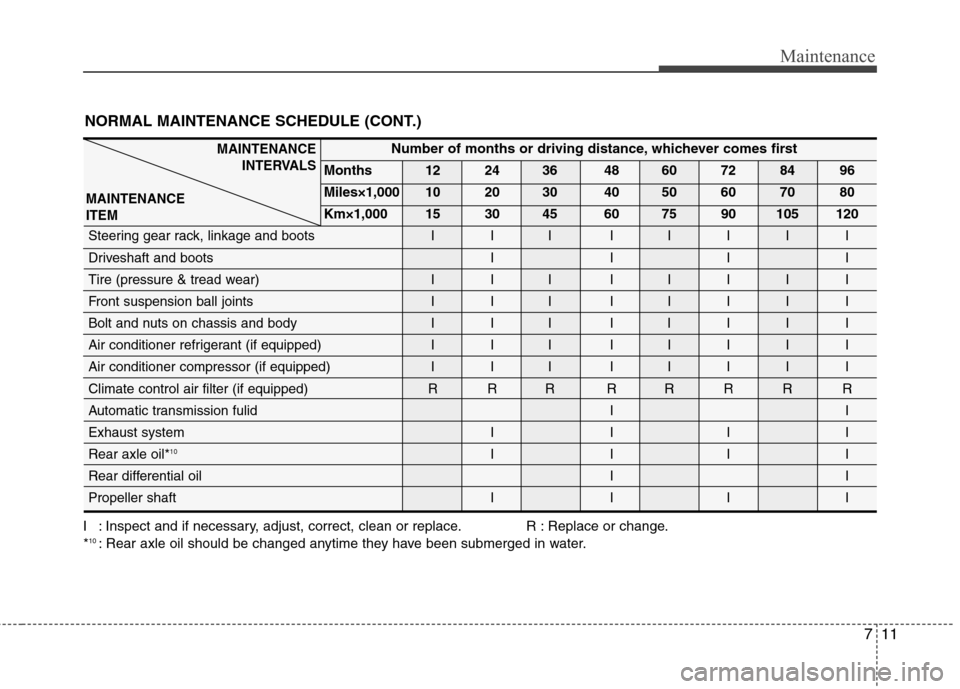
NORMAL MAINTENANCE SCHEDULE (CONT.)
I : Inspect and if necessary, adjust, correct, clean or replace. R : Replace or change. *10
: Rear axle oil should be changed anytime they have been submerged in water.
Number of months or driving distance, whichever comes first
Months 12 24 36 48 60 72 84 96
Miles×1,000 10 20 30 40 50 60 70 80
Km×1,000 15 30 45 60 75 90 105 120
Steering gear rack, linkage and boots I I I I I I I I
Driveshaft and boots I I I I
Tire (pressure & tread wear) I I I I I I I I
Front suspension ball joints I I I I I I I I
Bolt and nuts on chassis and body I I I I I I I I
Air conditioner refrigerant (if equipped) I I I I I I I I
Air conditioner compressor (if equipped) I I I I I I I I
Climate control air filter (if equipped) R R R R R R R R
Automatic transmission fulid II
Exhaust system I I I I
Rear axle oil* 10
IIII
Rear differential oil II
Propeller shaft
IIII
MAINTENANCE INTERVALS
MAINTENANCE ITEM
Page 303 of 374
Maintenance
12
7
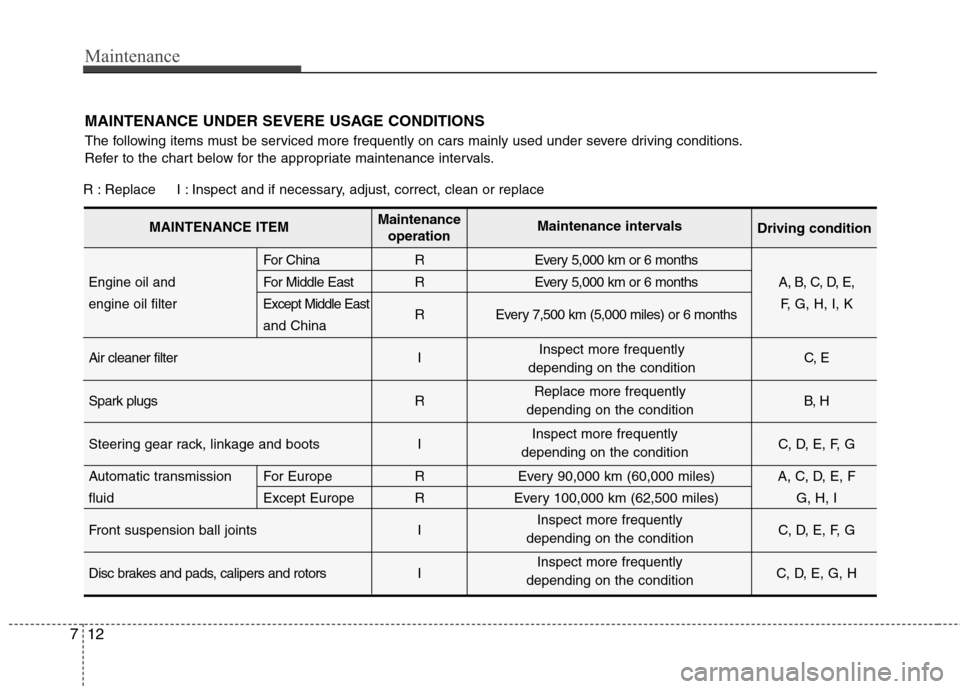
MAINTENANCE UNDER SEVERE USAGE CONDITIONS
The following items must be serviced more frequently on cars mainly used under severe driving conditions.
Refer to the chart below for the appropriate maintenance intervals.
R : Replace I : Inspect and if necessary, adjust, correct, clean or replace
For China R Every 5,000 km or 6 months
Engine oil andFor Middle East R Every 5,000 km or 6 months A, B, C, D, E,
engine oil filterExcept Middle EastR Every 7,500 km (5,000 miles) or 6 months F, G, H, I, K
and China
Air cleaner filter I C, E
Spark plugs R B, H
Steering gear rack, linkage and boots I C, D, E, F, G
Automatic transmission For Europe R Every 90,000 km (60,000 miles) A, C, D, E, F
fluid Except Europe R Every 100,000 km (62,500 miles) G, H, I
Front suspension ball joints I C, D, E, F, G
Disc brakes and pads, calipers and rotors I C, D, E, G, H
MAINTENANCE ITEMMaintenance
operation Maintenance intervals
Driving condition
Inspect more frequently
depending on the condition
Inspect more frequently
depending on the condition Replace more frequently
depending on the condition
Inspect more frequently
depending on the condition Inspect more frequently
depending on the condition
Page 307 of 374
Maintenance
16
7
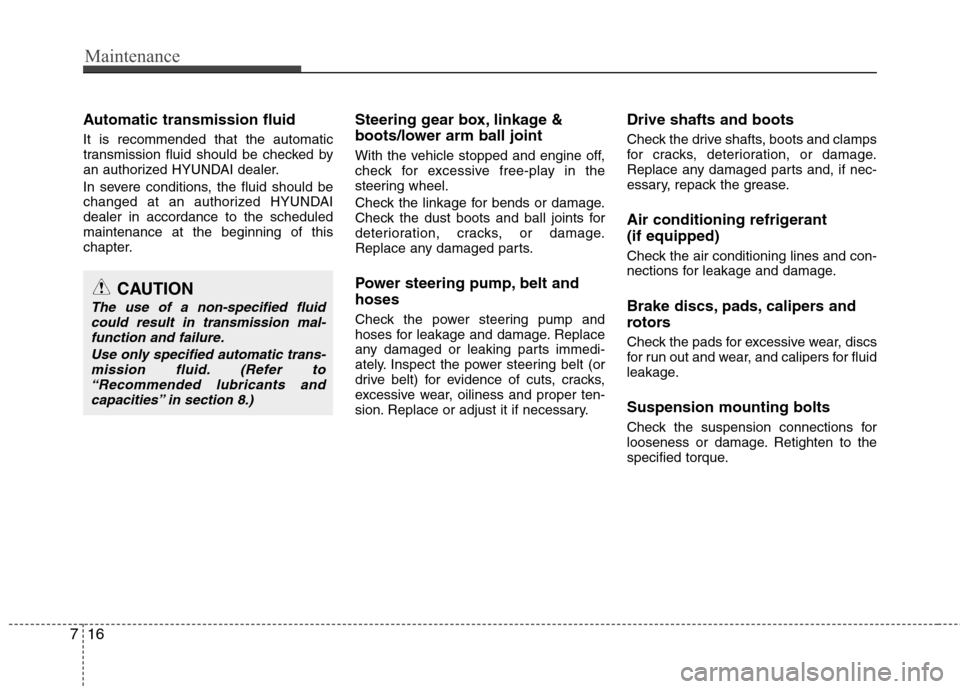
Automatic transmission fluid It is recommended that the automatic
transmission fluid should be checked by
an authorized HYUNDAI dealer.
In severe conditions, the fluid should be
changed at an authorized HYUNDAIdealer in accordance to the scheduledmaintenance at the beginning of this
chapter. Steering gear box, linkage &
boots/lower arm ball joint
With the vehicle stopped and engine off,
check for excessive free-play in the
steering wheel.
Check the linkage for bends or damage.
Check the dust boots and ball joints for
deterioration, cracks, or damage.
Replace any damaged parts.
Power steering pump, belt and hoses
Check the power steering pump and
hoses for leakage and damage. Replace
any damaged or leaking parts immedi-
ately. Inspect the power steering belt (or
drive belt) for evidence of cuts, cracks,
excessive wear, oiliness and proper ten-
sion. Replace or adjust it if necessary.Drive shafts and boots
Check the drive shafts, boots and clamps
for cracks, deterioration, or damage.
Replace any damaged parts and, if nec-
essary, repack the grease.
Air conditioning refrigerant (if equipped)
Check the air conditioning lines and con-
nections for leakage and damage.
Brake discs, pads, calipers and
rotors
Check the pads for excessive wear, discs
for run out and wear, and calipers for fluid
leakage. Suspension mounting bolts
Check the suspension connections for
looseness or damage. Retighten to the
specified torque.
CAUTION
The use of a non-specified fluid
could result in transmission mal-function and failure.
Use only specified automatic trans-mission fluid. (Refer to
“Recommended lubricants andcapacities” in section 8.)
Page 344 of 374
753
Maintenance
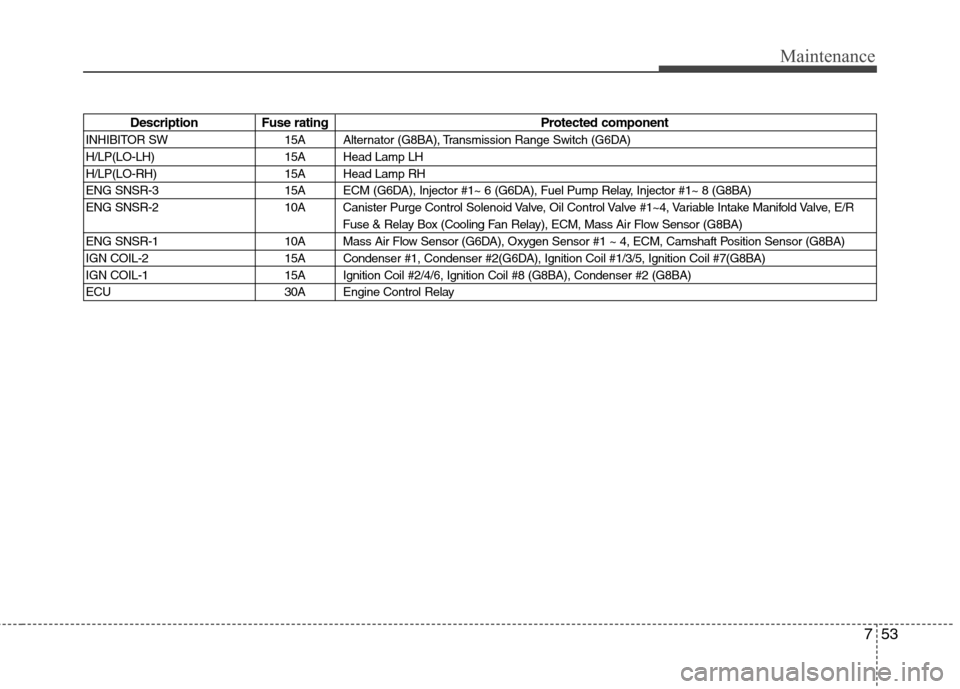
Description Fuse rating Protected component
INHIBITOR SW 15A Alternator (G8BA), Transmission Range Switch (G6DA)
H/LP(LO-LH) 15A Head Lamp LH
H/LP(LO-RH) 15A Head Lamp RH
ENG SNSR-3 15A ECM (G6DA), Injector #1~ 6 (G6DA), Fuel Pump Relay, Injector #1~ 8 (G8BA)
ENG SNSR-2 10A Canister Purge Control Solenoid Valve, Oil Control Valve #1~4, Variable Intake Manifold Valve, E/R Fuse & Relay Box (Cooling Fan Relay), ECM, Mass Air Flow Sensor (G8BA)
ENG SNSR-1 10A Mass Air Flow Sensor (G6DA), Oxygen Sensor #1 ~ 4, ECM, Camshaft Position Sensor (G8BA)
IGN COIL-2 15A Condenser #1, Condenser #2(G6DA), Ignition Coil #1/3/5, Ignition Coil #7(G8BA)
IGN COIL-1 15A Ignition Coil #2/4/6, Ignition Coil #8 (G8BA), Condenser #2 (G8BA)
ECU 30A Engine Control Relay