trunk Hyundai Equus 2010 Owner's Guide
[x] Cancel search | Manufacturer: HYUNDAI, Model Year: 2010, Model line: Equus, Model: Hyundai Equus 2010Pages: 374, PDF Size: 41.29 MB
Page 167 of 374
489
Features of your vehicle
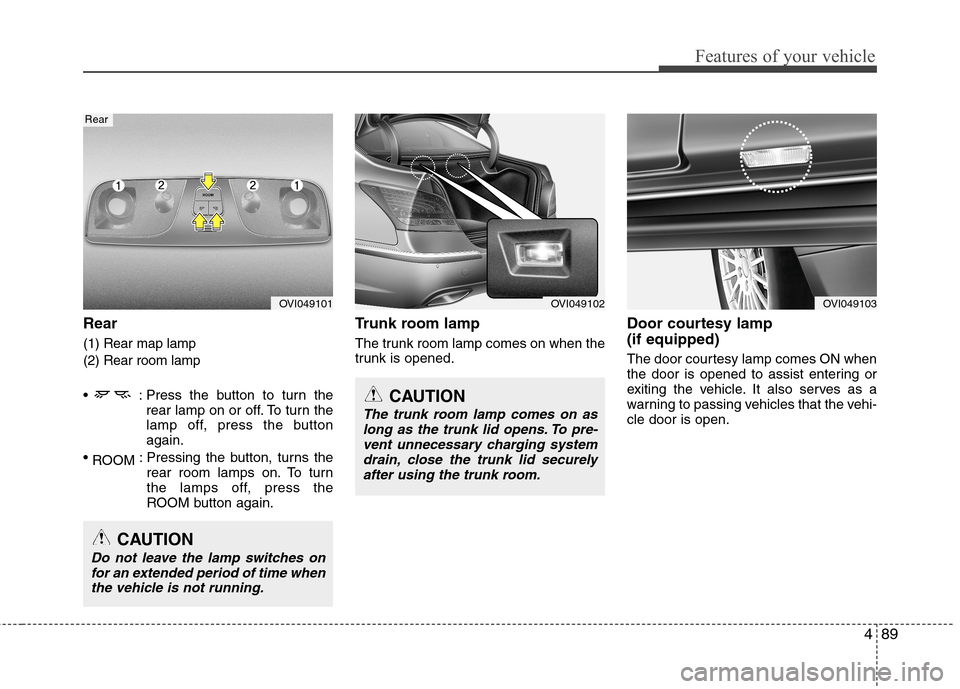
Rear
(1) Rear map lamp (2) Rear room lamp
: Press the button to turn therear lamp on or off. To turn the
lamp off, press the buttonagain.
ROOM : Pressing the button, turns the
rear room lamps on. To turn
the lamps off, press the
ROOM button again. Trunk room lamp
The trunk room lamp comes on when the
trunk is opened.
Door courtesy lamp (if equipped)
The door courtesy lamp comes ON when
the door is opened to assist entering or
exiting the vehicle. It also serves as a
warning to passing vehicles that the vehi-cle door is open.
OVI049102
CAUTION
Do not leave the lamp switches on
for an extended period of time whenthe vehicle is not running.
OVI049101
Rear
CAUTION
The trunk room lamp comes on aslong as the trunk lid opens. To pre-vent unnecessary charging systemdrain, close the trunk lid securely
after using the trunk room.
OVI049103
Page 190 of 374
Features of your vehicle
112
4
OVI049189
OVI049190
CAUTION
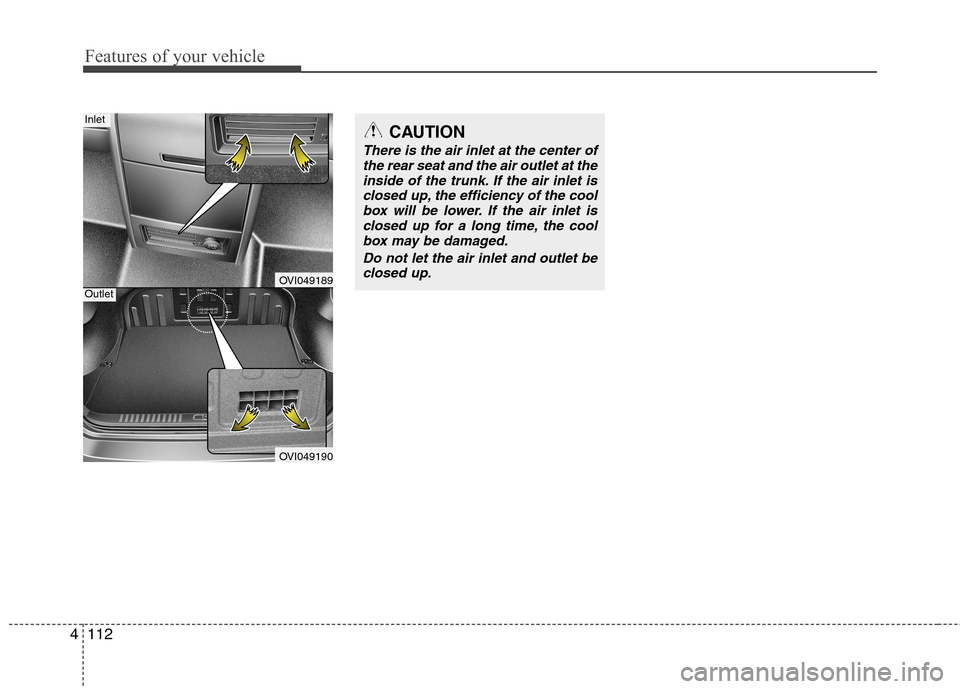
There is the air inlet at the center of
the rear seat and the air outlet at the
inside of the trunk. If the air inlet isclosed up, the efficiency of the coolbox will be lower. If the air inlet is closed up for a long time, the cool
box may be damaged.
Do not let the air inlet and outlet beclosed up.
Inlet
Outlet
Page 206 of 374
Driving your vehicle
2
5
WARNING - ENGINE EXHAUST CAN BE DANGEROUS!
Engine exhaust fumes can be extremely dangerous. If, at any time, you smell exhaust fumes inside the vehicle, open the win-
dows immediately.
• Do not inhale exhaust fumes.
Exhaust fumes contain carbon monoxide, a colorless, odorless gas that can cause unconsciousness and death by asphyxia- tion.
The exhaust system should be checked whenever the vehicle is raised to change the oil or for any other purpose. If you hear
a change in the sound of the exhaust or if you drive over something that strikes the underneath side of the car, have the
exhaust system checked as soon as possible by an authorized HYUNDAI dealer.
Letting the engine idle in your garage, even with the garage door open, is a hazardous practice. Never run the engine in your
garage any longer than it takes to start the engine and back the car out.
If it is necessary to idle the engine for a prolonged period with people inside the car, be sure to do so only in an open area
with the air intake set at "Fresh" and fan operating at one of the higher speeds so fresh air is drawn into the interior.
If you must drive with the trunk lid open because you are carrying objects that make this necessary:
1. Close all windows.
2. Open side vents.
3. Set the air intake control at "Fresh", the air flow control at "Floor" or "Face" and the fan at one of the higher speeds.
To assure proper operation of the ventilation system, be sure the ventilation air intakes located just in front of the windshie ld are
kept clear of snow, ice, leaves or other obstructions.
Page 222 of 374
Driving your vehicle
18
5
Emergency braking
If there is a problem with the brake pedal
while driving, emergency braking is pos-
sible by pressing the EPB switch. Braking
is possible only when you press the EPB
switch.
✽✽
NOTICE
During emergency braking by the EPB,
the parking brake warning light blinks
to indicate that the system is operating.EPB emergency release
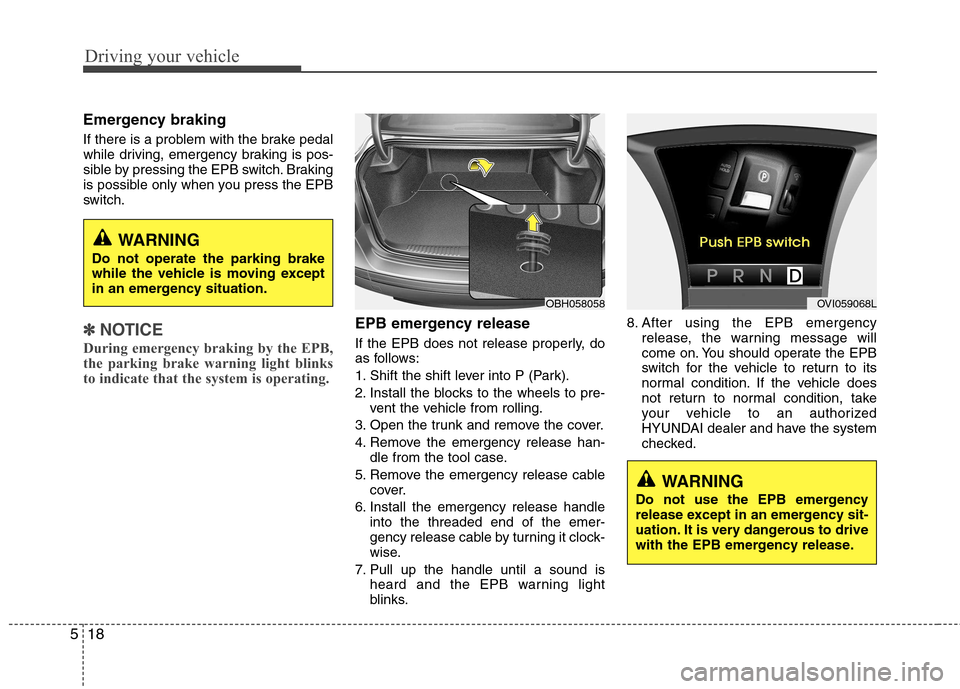
If the EPB does not release properly, do
as follows:
1. Shift the shift lever into P (Park).
2. Install the blocks to the wheels to pre- vent the vehicle from rolling.
3. Open the trunk and remove the cover.
4. Remove the emergency release han- dle from the tool case.
5. Remove the emergency release cable cover.
6. Install the emergency release handle into the threaded end of the emer-
gency release cable by turning it clock-
wise.
7. Pull up the handle until a sound is heard and the EPB warning light
blinks. 8. After using the EPB emergency
release, the warning message will
come on. You should operate the EPB
switch for the vehicle to return to its
normal condition. If the vehicle does
not return to normal condition, take
your vehicle to an authorized
HYUNDAI dealer and have the system
checked.
OBH058058
WARNING
Do not operate the parking brake
while the vehicle is moving except
in an emergency situation.
WARNING
Do not use the EPB emergency
release except in an emergency sit-
uation. It is very dangerous to drive
with the EPB emergency release.
OVI059068L
Page 224 of 374
Driving your vehicle
20
5
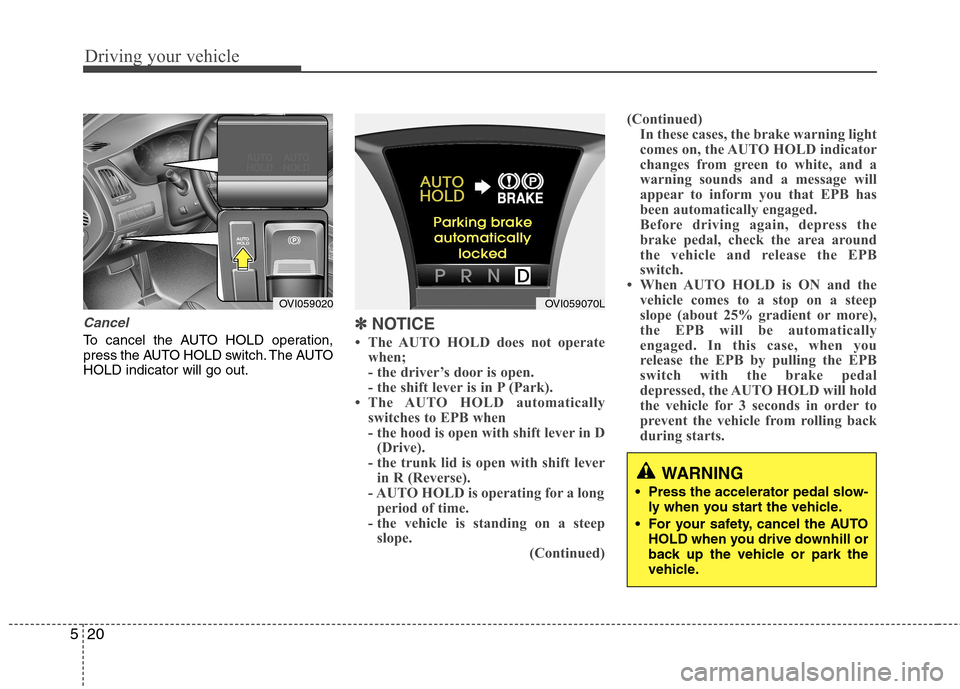
Cancel
To cancel the AUTO HOLD operation,
press the AUTO HOLD switch. The AUTOHOLD indicator will go out.✽✽
NOTICE
The AUTO HOLD does not operate when;
- the driver’s door is open.
- the shift lever is in P (Park).
The AUTO HOLD automatically
switches to EPB when
- the hood is open with shift lever in D(Drive).
- the trunk lid is open with shift lever
in R (Reverse).
- AUTO HOLD is operating for a long
period of time.
- the vehicle is standing on a steep
slope. (Continued)(Continued)
In these cases, the brake warning light
comes on, the AUTO HOLD indicator
changes from green to white, and a
warning sounds and a message will
appear to inform you that EPB has
been automatically engaged.
Before driving again, depress the
brake pedal, check the area around
the vehicle and release the EPB
switch.
When AUTO HOLD is ON and the vehicle comes to a stop on a steep
slope (about 25% gradient or more),
the EPB will be automatically
engaged. In this case, when you
release the EPB by pulling the EPB
switch with the brake pedal
depressed, the AUTO HOLD will hold
the vehicle for 3 seconds in order to
prevent the vehicle from rolling back
during starts.
OVI059020OVI059070L
WARNING
Press the accelerator pedal slow- ly when you start the vehicle.
For your safety, cancel the AUTO HOLD when you drive downhill or
back up the vehicle or park the
vehicle.
Page 225 of 374

521
Driving your vehicle
Anti-lock brake system (ABS)The ABS continuously senses the speed
of the wheels. If the wheels are going to
lock, the ABS system repeatedly modu-
lates the hydraulic brake pressure to the
wheels.
When you apply your brakes under con-
ditions which may lock the wheels, you
may hear a “tik-tik’’ sound from the
brakes, or feel a corresponding sensation
in the brake pedal. This is normal and it
means your ABS is active.
In order to obtain the maximum benefit
from your ABS in an emergency situa-
tion, do not attempt to modulate your
brake pressure and do not try to pump
your brakes. Press your brake pedal as
hard as possible or as hard as the situa-
tion allow the ABS to control the force
being delivered to the brakes.
WARNING
ABS (or ESP) will not prevent acci-
dents due to improper or danger-
ous driving maneuvers. Even
though vehicle control is improved
during emergency braking, always
maintain a safe distance between
you and objects ahead. Vehicle
speeds should always be reduced
during extreme road conditions.
The braking distance for vehicle
equipped with an anti-lock braking
system (or Electronic Stability
Program system) may be longer
than for those without it in the fol-
lowing road conditions.
During these conditions the vehicle should be driven at reducedspeeds:
Rough, gravel or snow-covered roads.
With tire chains installed.
On roads where the road surface is pitted or has different surface height.
The safety features of an ABS (or
ESP) equipped vehicle should not
be tested by high speed driving or
cornering. This could endanger the
safety of yourself or others.
CAUTION
If there is a malfunction with the dri- ver’s door, hood or trunk open
detection system, the AUTO HOLDmay not work properly.
Take your vehicle to an authorizedHYUNDAI dealer and have the sys-
tem checked.
Page 249 of 374
545
Driving your vehicle
A vehicle ahead cannot be recognized
correctly by the sensor if any of followingoccurs:
- When the vehicle is pointing upwardsdue to overloading in the trunk
- While the steering wheel is operating
- When driving to one side of the lane
- When driving on narrow lanes or on curves
Apply the brakes or accelerator pedal if
necessary.(Continued)
The smart cruise control system is not a substitute for safe driving
practices but a convenience
function only. It is the responsi-
bility of the driver to always
check the speed and the distance
to the vehicle ahead.
Always be aware of the selected speed and vehicle to vehicle dis-
tance.
Always maintain sufficient brak- ing distance and decelerate your
vehicle by applying the brakes if
necessary.
As the smart cruise control sys- tem may not recognize complex
driving situations, always payattention to driving conditions
and control your vehicle speed.
For safe operation, carefully read and follow the instructions in this
manual before use.WARNING
The vehicle cannot be stopped by using the smart cruise control system.
If an emergency stop is neces-
sary, you must apply the brakes.
Keep a safe distance according to road conditions and vehicle
speed. If the vehicle to vehicle
distance is too close during a
high-speed driving, it may causea serious collision.
The smart cruise control system can not recognize a stopped
vehicle, pedestrians or an
oncoming vehicle. Always look
ahead cautiously to prevent
unexpected and sudden situa-
tions from occurring.
In front of you, vehicles moving with a frequent lane change may
cause a delay in the system's
reaction or may cause the system
to react to a vehicle actually in an
adjacent lane. Always look ahead
cautiously to prevent unexpected
and sudden situations fromoccurring.
(Continued)
CAUTION
The smart cruise control systemmay not operate temporarily due to electrical interference.
Page 271 of 374
What to do in an emergency
4
6
EMERGENCY STARTING
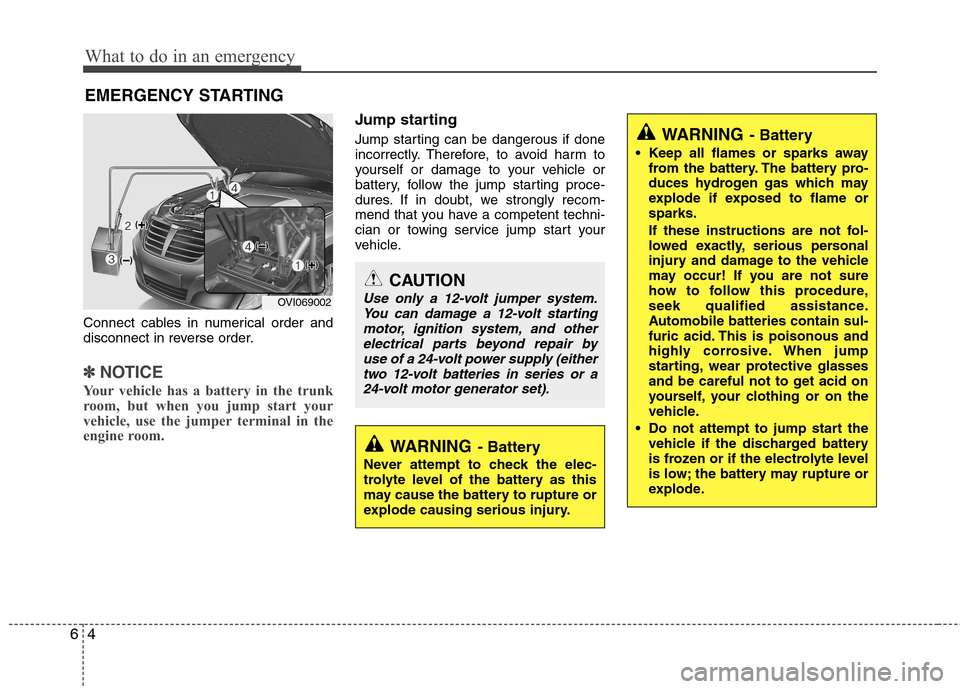
Connect cables in numerical order and
disconnect in reverse order.
✽✽ NOTICE
Your vehicle has a battery in the trunk
room, but when you jump start your
vehicle, use the jumper terminal in the
engine room.
Jump starting
Jump starting can be dangerous if done
incorrectly. Therefore, to avoid harm to
yourself or damage to your vehicle or
battery, follow the jump starting proce-
dures. If in doubt, we strongly recom-
mend that you have a competent techni-
cian or towing service jump start your
vehicle.
CAUTION
Use only a 12-volt jumper system. You can damage a 12-volt startingmotor, ignition system, and otherelectrical parts beyond repair byuse of a 24-volt power supply (either
two 12-volt batteries in series or a 24-volt motor generator set).
WARNING - Battery
• Keep all flames or sparks away from the battery. The battery pro-
duces hydrogen gas which may
explode if exposed to flame orsparks.
If these instructions are not fol-
lowed exactly, serious personal
injury and damage to the vehicle
may occur! If you are not sure
how to follow this procedure,
seek qualified assistance.
Automobile batteries contain sul-
furic acid. This is poisonous and
highly corrosive. When jump
starting, wear protective glasses
and be careful not to get acid on
yourself, your clothing or on the
vehicle.
Do not attempt to jump start the vehicle if the discharged battery
is frozen or if the electrolyte level
is low; the battery may rupture or
explode.
WARNING - Battery
Never attempt to check the elec-
trolyte level of the battery as this
may cause the battery to rupture or
explode causing serious injury.
OVI069002
Page 287 of 374
What to do in an emergency
20
6
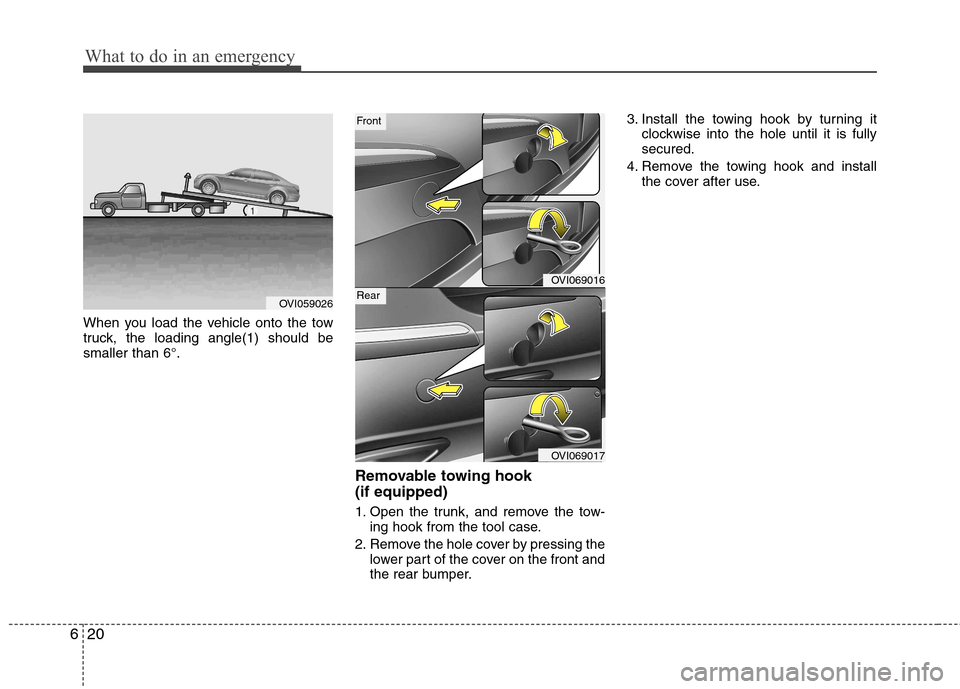
When you load the vehicle onto the tow
truck, the loading angle(1) should besmaller than 6°.
Removable towing hook (if equipped)
1. Open the trunk, and remove the tow-ing hook from the tool case.
2. Remove the hole cover by pressing the lower part of the cover on the front and
the rear bumper. 3. Install the towing hook by turning it
clockwise into the hole until it is fullysecured.
4. Remove the towing hook and install the cover after use.
OVI069016
OVI069017
OVI059026
Front
Rear
Page 321 of 374
Maintenance
30
7
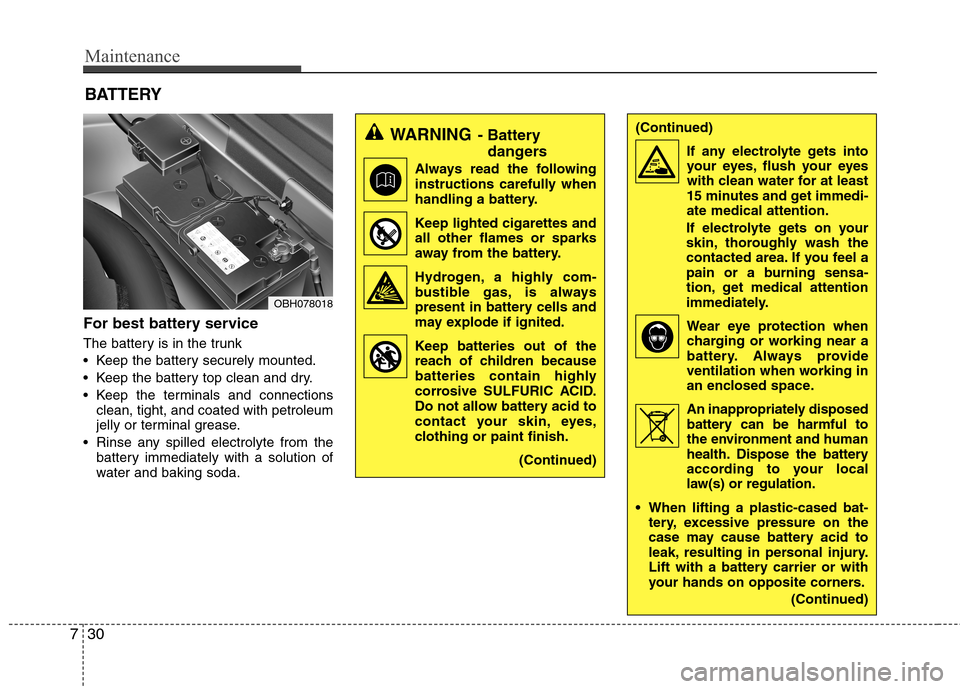
For best battery service
The battery is in the trunk
Keep the battery securely mounted.
Keep the battery top clean and dry.
Keep the terminals and connections
clean, tight, and coated with petroleum
jelly or terminal grease.
Rinse any spilled electrolyte from the battery immediately with a solution of
water and baking soda.
BATTERY
OBH078018
WARNING
- Battery
dangers
Always read the following
instructions carefully when
handling a battery.
Keep lighted cigarettes and all other flames or sparks
away from the battery.
Hydrogen, a highly com- bustible gas, is always
present in battery cells and
may explode if ignited.
Keep batteries out of the reach of children because
batteries contain highly
corrosive SULFURIC ACID.
Do not allow battery acid to
contact your skin, eyes,
clothing or paint finish.
(Continued)(Continued)If any electrolyte gets intoyour eyes, flush your eyes
with clean water for at least
15 minutes and get immedi-ate medical attention.
If electrolyte gets on your
skin, thoroughly wash the
contacted area. If you feel a
pain or a burning sensa-
tion, get medical attention
immediately.
Wear eye protection whencharging or working near a
battery. Always provide
ventilation when working in
an enclosed space.
An inappropriately disposed battery can be harmful to
the environment and human
health. Dispose the battery
according to your local
law(s) or regulation.
When lifting a plastic-cased bat- tery, excessive pressure on the
case may cause battery acid to
leak, resulting in personal injury.
Lift with a battery carrier or with
your hands on opposite corners.
(Continued)