belt Hyundai Equus 2010 Service Manual
[x] Cancel search | Manufacturer: HYUNDAI, Model Year: 2010, Model line: Equus, Model: Hyundai Equus 2010Pages: 374, PDF Size: 41.29 MB
Page 216 of 374
Driving your vehicle
12
5
Good driving practices
Never move the shift lever from P
(Park) or N (Neutral) to any other posi-
tion with the accelerator pedaldepressed.
Never move the shift lever into P (Park) when the vehicle is in motion.
Be sure the vehicle is completely stopped before you attempt to shift into
R (Reverse) or D (Drive).
Never take the vehicle out of gear and coast down a hill. This may be
extremely hazardous. Always leave the
vehicle in gear when moving.
Do not "ride" the brakes. This can cause them to overheat and malfunc-
tion. Instead, when you are driving
down a long hill, slow down and shift to
a lower gear. When you do this, engine
braking will help slow the vehicle.
Slow down before shifting to a lower gear. Otherwise, the lower gear maynot be engaged. Always use the parking brake. Do not
depend on placing the transmission in
P (Park) to keep the vehicle from mov-ing.
Exercise extreme caution when driving on a slippery surface. Be especially
careful when braking, accelerating or
shifting gears. On a slippery surface,
an abrupt change in vehicle speed can
cause the drive wheels to lose traction
and the vehicle to go out of control.
Optimum vehicle performance and economy is obtained by smoothly
depressing and releasing the accelera-tor pedal.
WARNING
Always buckle-up! In a collision, an unbelted occupant is signifi-
cantly more likely to be seriously
injured or killed than a properlybelted occupant.
Avoid high speeds when corner- ing or turning.
Do not make quick steering wheel movements, such as sharp
lane changes or fast, sharp turns.
The risk of rollover is greatly increased if you lose control of
your vehicle at highway speeds.
Lossing control often occurs if two or more wheels drop off the
roadway and the driver over-
steers to reenter the roadway.
In the event your vehicle leaves the roadway, do not steer sharply.
Instead, slow down before pulling
back into the travel lanes.
Never exceed posted speed lim- its.
Page 251 of 374
547
Driving your vehicle
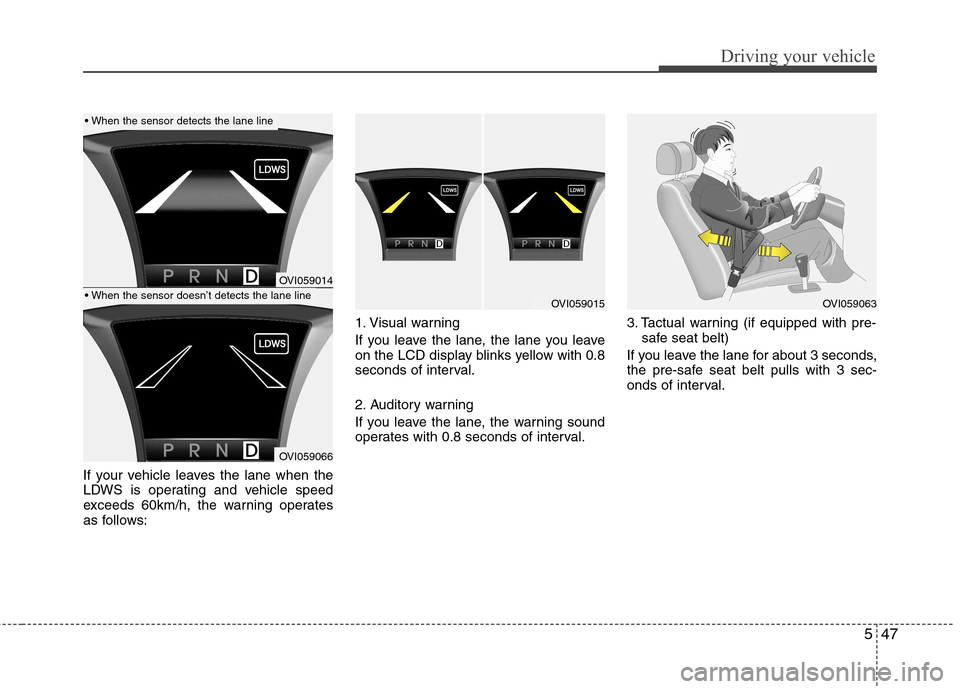
If your vehicle leaves the lane when the
LDWS is operating and vehicle speed
exceeds 60km/h, the warning operates
as follows:1. Visual warning
If you leave the lane, the lane you leave
on the LCD display blinks yellow with 0.8
seconds of interval.
2. Auditory warning
If you leave the lane, the warning sound
operates with 0.8 seconds of interval.
3. Tactual warning (if equipped with pre-
safe seat belt)
If you leave the lane for about 3 seconds,
the pre-safe seat belt pulls with 3 sec-
onds of interval.
OVI059014
OVI059066
OVI059015OVI059063
Page 253 of 374
549
Driving your vehicle
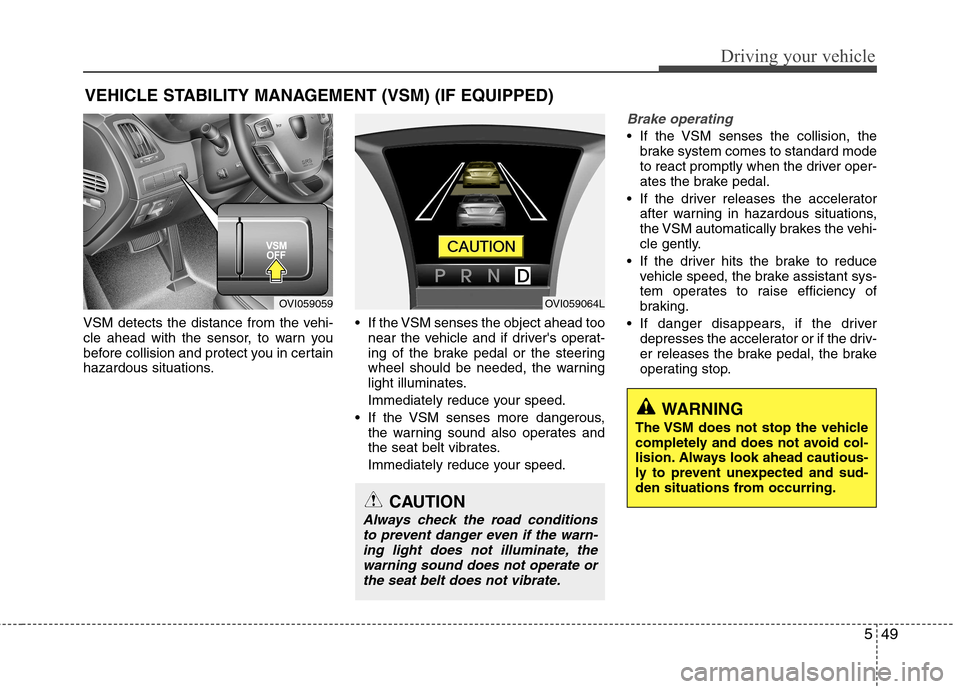
VSM detects the distance from the vehi-
cle ahead with the sensor, to warn you
before collision and protect you in certain
hazardous situations. If the VSM senses the object ahead too
near the vehicle and if driver's operat-
ing of the brake pedal or the steering
wheel should be needed, the warning
light illuminates.
Immediately reduce your speed.
If the VSM senses more dangerous, the warning sound also operates and
the seat belt vibrates.
Immediately reduce your speed.
Brake operating
If the VSM senses the collision, thebrake system comes to standard mode
to react promptly when the driver oper-
ates the brake pedal.
If the driver releases the accelerator after warning in hazardous situations,
the VSM automatically brakes the vehi-
cle gently.
If the driver hits the brake to reduce vehicle speed, the brake assistant sys-
tem operates to raise efficiency of
braking.
If danger disappears, if the driver depresses the accelerator or if the driv-
er releases the brake pedal, the brake
operating stop.
VEHICLE STABILITY MANAGEMENT (VSM) (IF EQUIPPED)
CAUTION
Always check the road conditions
to prevent danger even if the warn-ing light does not illuminate, the
warning sound does not operate or the seat belt does not vibrate.
OVI059059OVI059064L
WARNING
The VSM does not stop the vehicle
completely and does not avoid col-
lision. Always look ahead cautious-
ly to prevent unexpected and sud-
den situations from occurring.
Page 254 of 374
Driving your vehicle
50
5
Seat belt operating
The seat belt tightens when the vehicle senses a collision.
To cancel the VSM
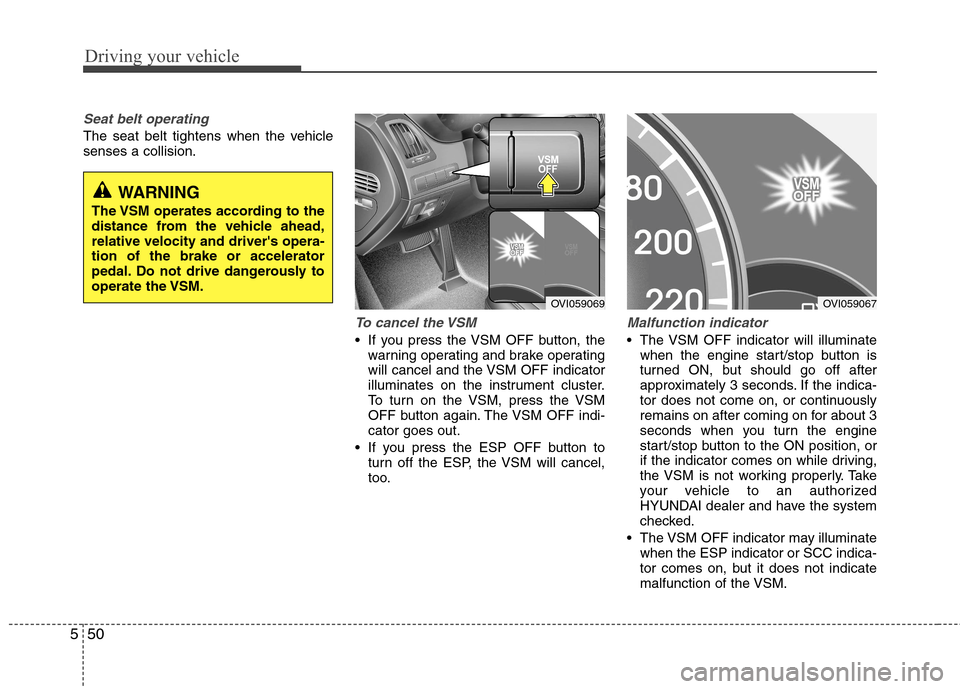
If you press the VSM OFF button, the
warning operating and brake operating
will cancel and the VSM OFF indicator
illuminates on the instrument cluster.
To turn on the VSM, press the VSM
OFF button again. The VSM OFF indi-cator goes out.
If you press the ESP OFF button to turn off the ESP, the VSM will cancel,
too.
Malfunction indicator
The VSM OFF indicator will illuminatewhen the engine start/stop button is
turned ON, but should go off after
approximately 3 seconds. If the indica-
tor does not come on, or continuously
remains on after coming on for about 3
seconds when you turn the engine
start/stop button to the ON position, or
if the indicator comes on while driving,
the VSM is not working properly. Take
your vehicle to an authorized
HYUNDAI dealer and have the system
checked.
The VSM OFF indicator may illuminate when the ESP indicator or SCC indica-
tor comes on, but it does not indicate
malfunction of the VSM.
WARNING
The VSM operates according to the
distance from the vehicle ahead,relative velocity and driver's opera-tion of the brake or accelerator
pedal. Do not drive dangerously to
operate the VSM.
OVI059069OVI059067
Page 261 of 374
557
Driving your vehicle
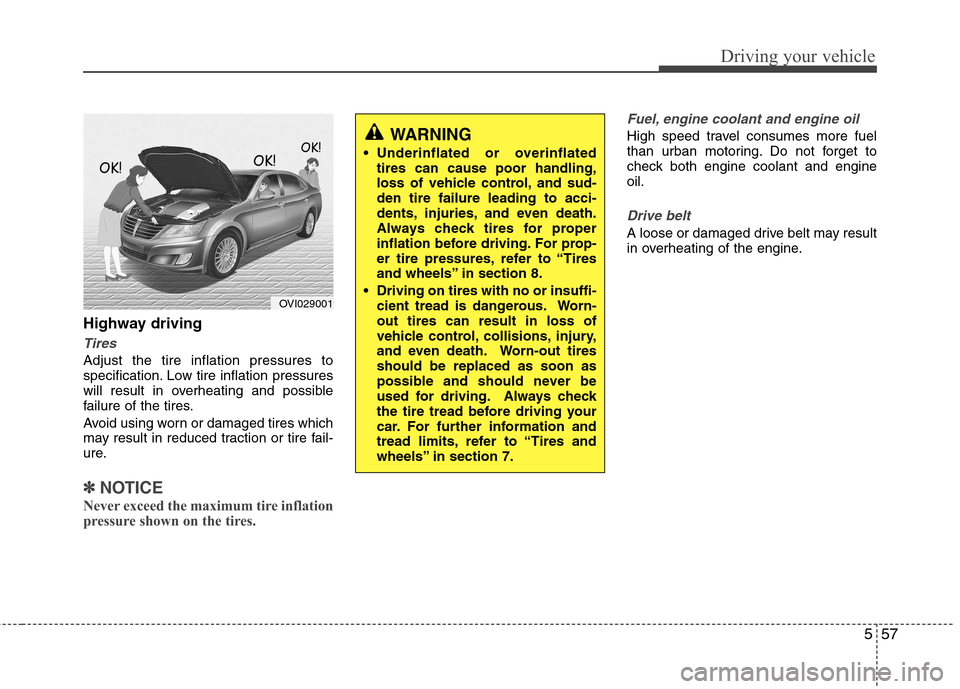
Highway driving
Tires
Adjust the tire inflation pressures to
specification. Low tire inflation pressures
will result in overheating and possible
failure of the tires.
Avoid using worn or damaged tires which
may result in reduced traction or tire fail-
ure.
✽✽NOTICE
Never exceed the maximum tire inflation
pressure shown on the tires.
Fuel, engine coolant and engine oil
High speed travel consumes more fuel
than urban motoring. Do not forget to
check both engine coolant and engineoil.
Drive belt
A loose or damaged drive belt may result
in overheating of the engine.
WARNING
Underinflated or overinflated tires can cause poor handling,
loss of vehicle control, and sud-den tire failure leading to acci-
dents, injuries, and even death.
Always check tires for proper
inflation before driving. For prop-
er tire pressures, refer to “Tires
and wheels” in section 8.
Driving on tires with no or insuffi- cient tread is dangerous. Worn-out tires can result in loss of
vehicle control, collisions, injury,
and even death. Worn-out tiresshould be replaced as soon as
possible and should never be
used for driving. Always check
the tire tread before driving your
car. For further information and
tread limits, refer to “Tires and
wheels” in section 7.
OVI029001
Page 273 of 374
What to do in an emergency
6
6
IF THE ENGINE OVERHEATS
If your temperature gauge indicates over-
heating, you experience a loss of power,
or hear loud pinging or knocking, the
engine is probably too hot. If this hap-
pens, you should:
1. Pull off the road and stop as soon as it is safe to do so.
2. Place the shift lever in P and set the parking brake. If the air conditioning is
on, turn it off.
3. If engine coolant is running out under the vehicle or steam is coming out
from the hood, stop the engine. Do notopen the hood until the coolant has
stopped running or the steaming has
stopped. If there is no visible loss of
engine coolant and no steam, leave
the engine running and check to be
sure the engine cooling fan is operat-
ing. If the fan is not running, turn the
engine off. 4. Check to see if the water pump drive
belt is missing. If it is not missing,
check to see that it is tight. If the drive
belt seems to be satisfactory, check for
coolant leaking from the radiator,
hoses or under the vehicle. (If the air
conditioning had been in use, it is nor-
mal for cold water to be draining from
it when you stop).
5. If the water pump drive belt is broken or engine coolant is leaking out, stop the engine immediately and call the
nearest authorized HYUNDAI dealer
for assistance. 6. If you cannot find the cause of the
overheating, wait until the engine tem-
perature has returned to normal. Then,if coolant has been lost, carefully add
coolant to the reservoir to bring the
fluid level in the reservoir up to the
halfway mark.
7. Proceed with caution, keeping alert for further signs of overheating. If over-heating happens again, call an author-
ized HYUNDAI dealer for assistance.
WARNING
While the engine is running, keep
hair, hands and clothing away from
moving parts such as the fan and
drive belts to prevent injury.
WARNING
Do not remove the radiator cap
when the engine is hot. This can
allow coolant to be blown out of the
opening and cause serious burns.
CAUTION
Serious loss of coolant indicates there is a leak in the cooling systemand this should be checked as soonas possible by an authorized HYUNDAI dealer.
Page 297 of 374
Maintenance
6
7
While operating your vehicle:
Note any changes in the sound of the
exhaust or any smell of exhaust fumes
in the vehicle.
Check for vibrations in the steering wheel. Notice any increased steering
effort or looseness in the steering
wheel, or change in its straight-aheadposition.
Notice if your vehicle constantly turns slightly or “pulls” to one side when trav-
eling on smooth, level road.
When stopping, listen and check for unusual sounds, pulling to one side,
increased brake pedal travel or “hard-
to-push” brake pedal.
If any slipping or changes in the oper- ation of your transmission occurs,
check the transmission fluid level.
Check automatic transmission P (Park) function.
Check parking brake.
Check for fluid leaks under your vehicle (water dripping from the air condition-
ing system during or after use is nor-mal).
At least monthly:
Check coolant level in the enginecoolant reservoir.
Check the operation of all exterior lights, including the stoplights, turn sig-
nals and hazard warning flashers.
Check the inflation pressures of all tires including the spare.
At least twice a year
(i.e., every Spring and Fall):
Check radiator, heater and air condi- tioning hoses for leaks or damage.
Check windshield washer spray and wiper operation. Clean wiper blades
with clean cloth dampened with wash-er fluid.
Check headlight alignment.
Check muffler, exhaust pipes, shields and clamps.
Check the lap/shoulder belts for wear and function.
Check for worn tires and loose wheel lug nuts.
Page 299 of 374
Maintenance
8
7
I : Inspect and if necessary, adjust, correct, clean or replace.
R : Replace or change.* 1
: Adjust alternator and power steering (and water pump drive belt) and air conditioner drive belt (if equipped).
Inspect and if necessary correct or replace.
* 2
: Check the engine oil level and leak every 500 km (350 miles) or before starting a long trip.
* 3
: Driving in summer season temperature over 40°C (104°F - SAUDI, UAE, OMAN, KUWAIT, BAHRAIN, QATAR, IRAN,YEMEN
ETC) or driving over 170 km/h (106 mile/h) must conform the severe driving condition.
* 4
: For your convenience, it can be replaced prior to it's interval when you do maintenance of other items.
MAINTENANCE
INTERVALS
MAINTENANCE ITEMNumber of months or driving distance, whichever comes first
Months 12 24 36 48 60 72 84 96
Miles×1,000 10 20 30 40 50 60 70 80
Km×1,000 15 30 45 60 75 90 105 120
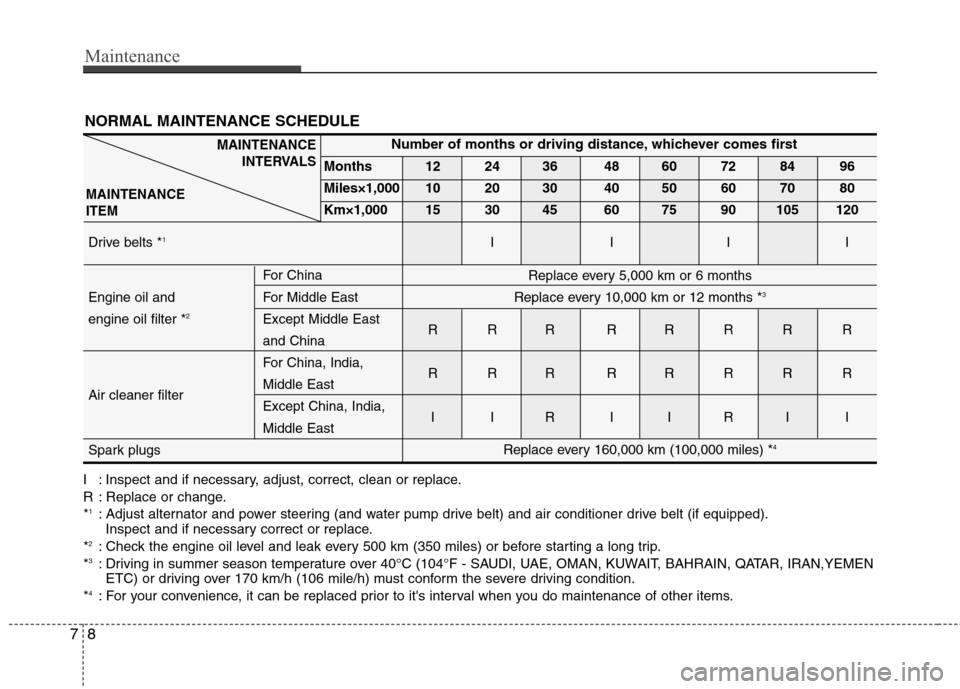
Drive belts * 1
IIII
For China
Engine oil and For Middle Eastengine oil filter * 2
Except Middle East
RRR RRRRR
and China
For China, India, RRR RRRRR
Air cleaner filter Middle EastExcept China, India,
IIRIIRII
Middle East
Spark plugs
Replace every 160,000 km (100,000 miles) * 4
Replace every 5,000 km or 6 months
Replace every 10,000 km or 12 months * 3
NORMAL MAINTENANCE SCHEDULE
Page 300 of 374
79
Maintenance
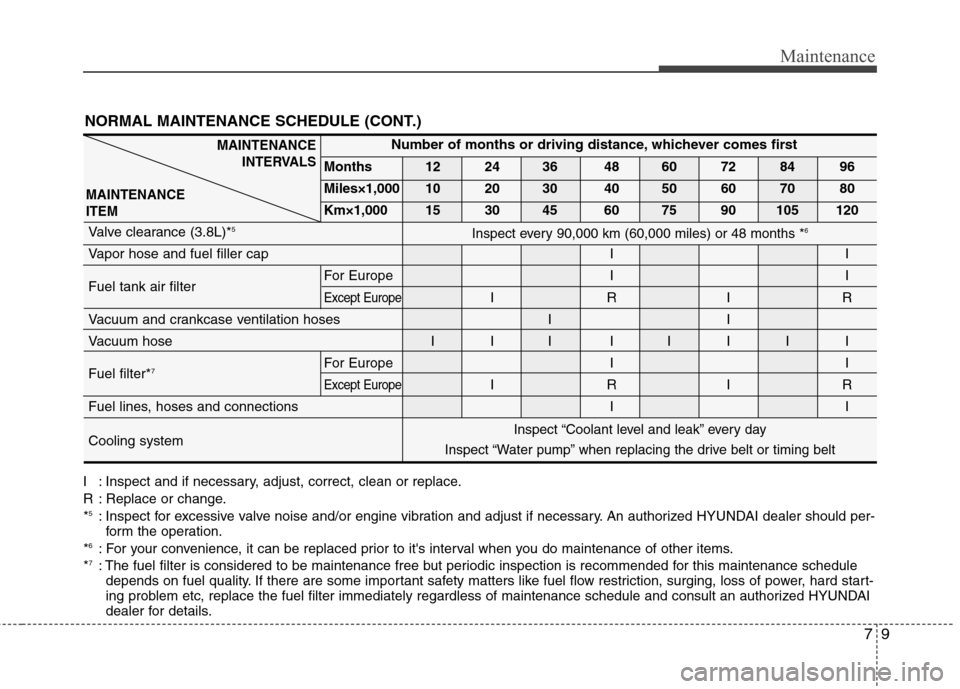
NORMAL MAINTENANCE SCHEDULE (CONT.)
MAINTENANCEINTERVALS
MAINTENANCE ITEMNumber of months or driving distance, whichever comes first
Months 12 24 36 48 60 72 84 96
Miles×1,000 10 20 30 40 50 60 70 80
Km×1,000 15 30 45 60 75 90 105 120
Valve clearance (3.8L)* 5
Vapor hose and fuel filler cap II
Fuel tank air filter For Europe I
I
Except EuropeIRIR
Vacuum and crankcase ventilation hoses I I
Vacuum hose I I I I I I I I
Fuel filter* 7 For Europe I
I
Except EuropeIRIR
Fuel lines, hoses and connections II
Cooling system
Inspect every 90,000 km (60,000 miles) or 48 months * 6
Inspect “Coolant level and leak” every day
Inspect “Water pump” when replacing the drive belt or timing belt
I : Inspect and if necessary, adjust, correct, clean or replace.
R : Replace or change.* 5
: Inspect for excessive valve noise and/or engine vibration and adjust if necessary. An authorized HYUNDAI dealer should per-
form the operation.
* 6
: For your convenience, it can be replaced prior to it's interval when you do maintenance of other items.
* 7
: The fuel filter is considered to be maintenance free but periodic inspection is recommended for this maintenance schedule
depends on fuel quality. If there are some important safety matters like fuel flow restriction, surging, loss of power, hard sta rt-
ing problem etc, replace the fuel filter immediately regardless of maintenance schedule and consult an authorized HYUNDAI
dealer for details.
Page 305 of 374
Maintenance
14
7
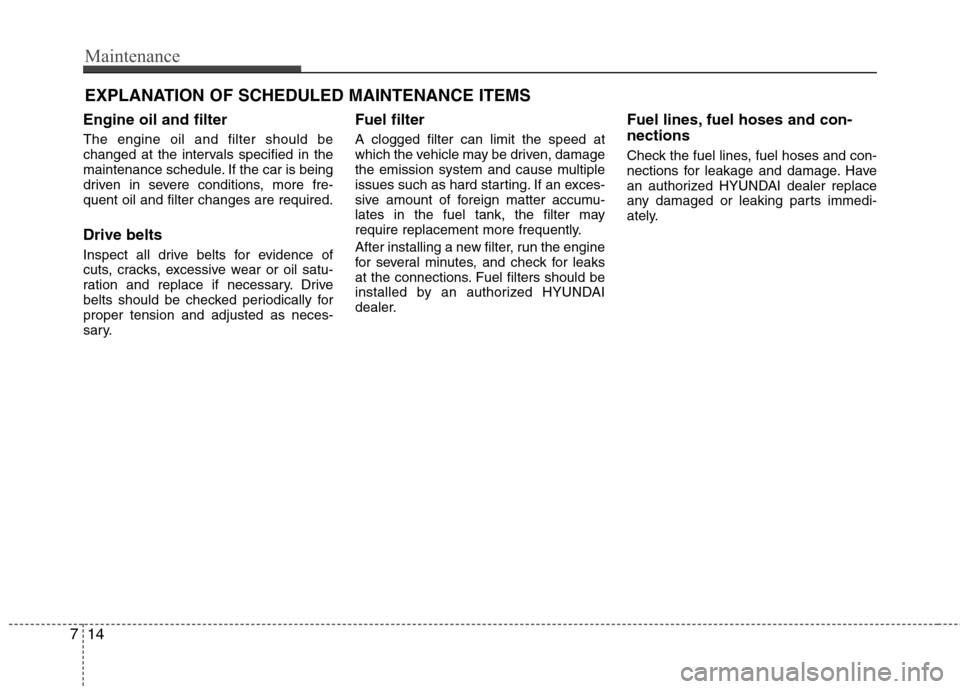
EXPLANATION OF SCHEDULED MAINTENANCE ITEMS
Engine oil and filter The engine oil and filter should be
changed at the intervals specified in the
maintenance schedule. If the car is being
driven in severe conditions, more fre-quent oil and filter changes are required. Drive belts
Inspect all drive belts for evidence of
cuts, cracks, excessive wear or oil satu-
ration and replace if necessary. Drive
belts should be checked periodically forproper tension and adjusted as neces-
sary. Fuel filter A clogged filter can limit the speed at
which the vehicle may be driven, damage
the emission system and cause multiple
issues such as hard starting. If an exces-
sive amount of foreign matter accumu-
lates in the fuel tank, the filter may
require replacement more frequently.
After installing a new filter, run the engine
for several minutes, and check for leaks
at the connections. Fuel filters should be
installed by an authorized HYUNDAI
dealer.
Fuel lines, fuel hoses and con- nections
Check the fuel lines, fuel hoses and con-
nections for leakage and damage. Have
an authorized HYUNDAI dealer replace
any damaged or leaking parts immedi-
ately.