check engine Hyundai Equus 2010 Manual PDF
[x] Cancel search | Manufacturer: HYUNDAI, Model Year: 2010, Model line: Equus, Model: Hyundai Equus 2010Pages: 374, PDF Size: 41.29 MB
Page 342 of 374
751
Maintenance
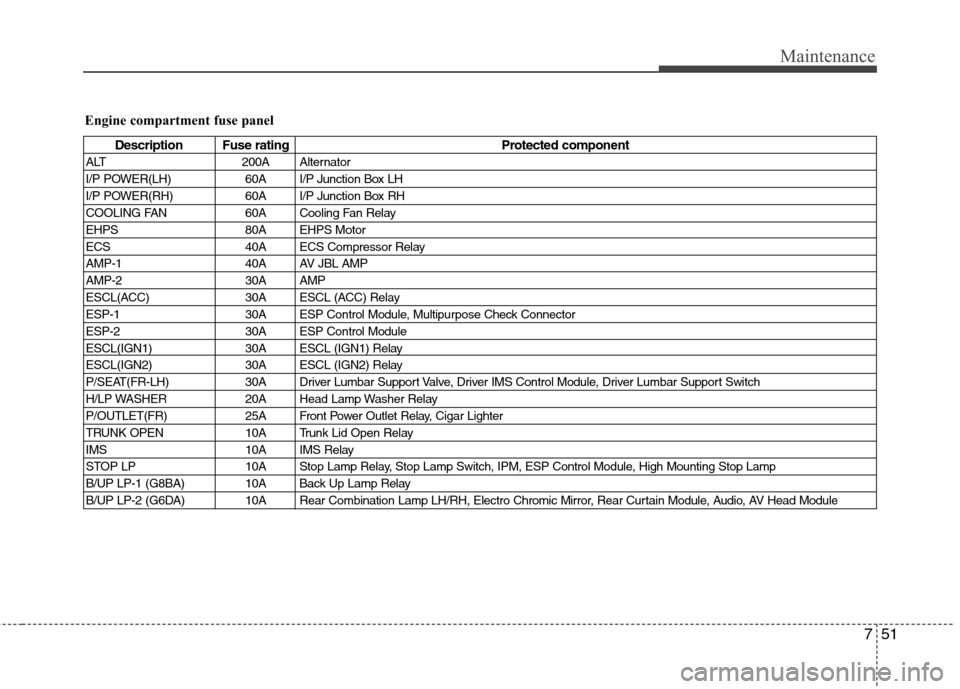
Engine compartment fuse panel
Description Fuse rating Protected component
ALT 200A Alternator
I/P POWER(LH) 60A I/P Junction Box LH
I/P POWER(RH) 60A I/P Junction Box RH
COOLING FAN 60A Cooling Fan Relay
EHPS 80A EHPS Motor
ECS 40A ECS Compressor Relay
AMP-1 40A AV JBL AMP
AMP-2 30A AMP
ESCL(ACC) 30A ESCL (ACC) Relay
ESP-1 30A ESP Control Module, Multipurpose Check Connector
ESP-2 30A ESP Control Module
ESCL(IGN1) 30A ESCL (IGN1) Relay
ESCL(IGN2) 30A ESCL (IGN2) Relay
P/SEAT(FR-LH) 30A Driver Lumbar Support Valve, Driver IMS Control Module, Driver Lumbar Support Switch
H/LP WASHER 20A Head Lamp Washer Relay
P/OUTLET(FR) 25A Front Power Outlet Relay, Cigar Lighter
TRUNK OPEN 10A Trunk Lid Open Relay
IMS 10A IMS Relay
STOP LP 10A Stop Lamp Relay, Stop Lamp Switch, IPM, ESP Control Module, High Mounting Stop Lamp
B/UP LP-1 (G8BA) 10A Back Up Lamp Relay
B/UP LP-2 (G6DA) 10A Rear Combination Lamp LH/RH, Electro Chromic Mirror, Rear Curtain Module, Audio, AV Head Module
Page 343 of 374
Maintenance
52
7
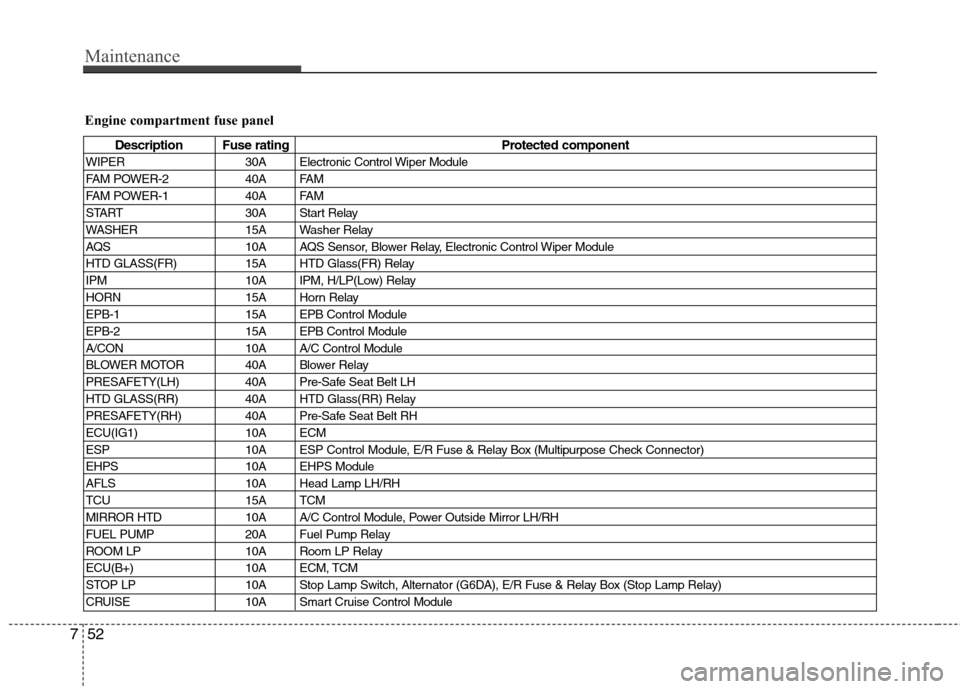
Engine compartment fuse panel
Description Fuse rating Protected component
WIPER 30A Electronic Control Wiper Module
FAM POWER-2 40A FAM
FAM POWER-1 40A FAM
START 30A Start Relay
WASHER 15A Washer Relay
AQS 10A AQS Sensor, Blower Relay, Electronic Control Wiper Module
HTD GLASS(FR) 15A HTD Glass(FR) Relay
IPM 10A IPM, H/LP(Low) Relay
HORN 15A Horn Relay
EPB-1 15A EPB Control Module
EPB-2 15A EPB Control Module
A/CON 10A A/C Control Module
BLOWER MOTOR 40A Blower Relay
PRESAFETY(LH) 40A Pre-Safe Seat Belt LH
HTD GLASS(RR) 40A HTD Glass(RR) Relay
PRESAFETY(RH) 40A Pre-Safe Seat Belt RH
ECU(IG1) 10A ECM
ESP 10A ESP Control Module, E/R Fuse & Relay Box (Multipurpose Check Connector)
EHPS 10A EHPS Module
AFLS 10A Head Lamp LH/RH
TCU 15A TCM
MIRROR HTD 10A A/C Control Module, Power Outside Mirror LH/RH
FUEL PUMP 20A Fuel Pump Relay
ROOM LP 10A Room LP Relay
ECU(B+) 10A ECM, TCM
STOP LP 10A Stop Lamp Switch, Alternator (G6DA), E/R Fuse & Relay Box (Stop Lamp Relay)
CRUISE 10A Smart Cruise Control Module
Page 362 of 374
771
Maintenance
Canister
Fuel vapors generated inside the fuel tank are absorbed and stored in the
onboard canister. When the engine is
running, the fuel vapors absorbed in the
canister are drawn into the surge tank
through the purge control solenoid valve.
Purge Control Solenoid Valve (PCSV)
The purge control solenoid valve is con-
trolled by the Engine Control Module
(ECM); when the engine coolant temper-
ature is low during idling, the PCSV clos-
es so that evaporated fuel is not taken
into the engine. After the engine warms-
up during ordinary driving, the PCSV
opens to introduce evaporated fuel to the
engine.3. Exhaust emission control
system
The Exhaust Emission Control System is
a highly effective system which controls
exhaust emissions while maintaining
good vehicle performance.
Vehicle modifications
This vehicle should not be modified.
Modification of your vehicle could affect
its performance, safety or durability and
may even violate governmental safety
and emissions regulations.
In addition, damage or performance
problems resulting from any modification
may not be covered under warranty.
Engine exhaust gas precautions (car- bon monoxide)
Carbon monoxide can be present with other exhaust fumes. Therefore, if you
smell exhaust fumes of any kind inside
your vehicle, have it inspected and
repaired immediately. If you ever sus-
pect exhaust fumes are coming into
your vehicle, drive it only with all the
windows fully open. Have your vehicle
checked and repaired immediately.
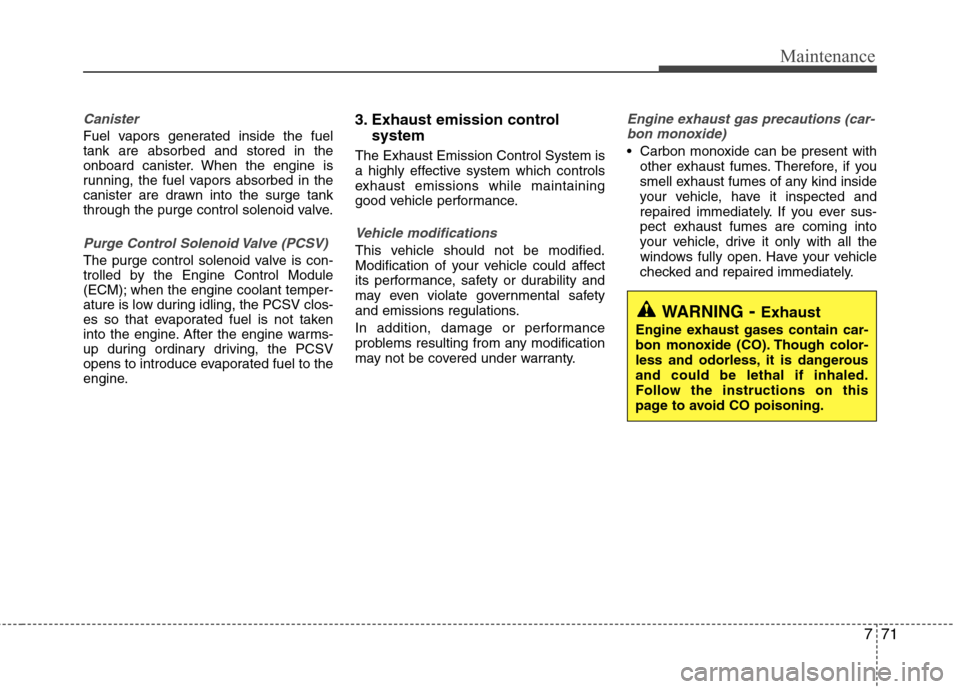
WARNING - Exhaust
Engine exhaust gases contain car-
bon monoxide (CO). Though color-
less and odorless, it is dangerousand could be lethal if inhaled.
Follow the instructions on this
page to avoid CO poisoning.
Page 368 of 374
85
Specifications & Consumer information
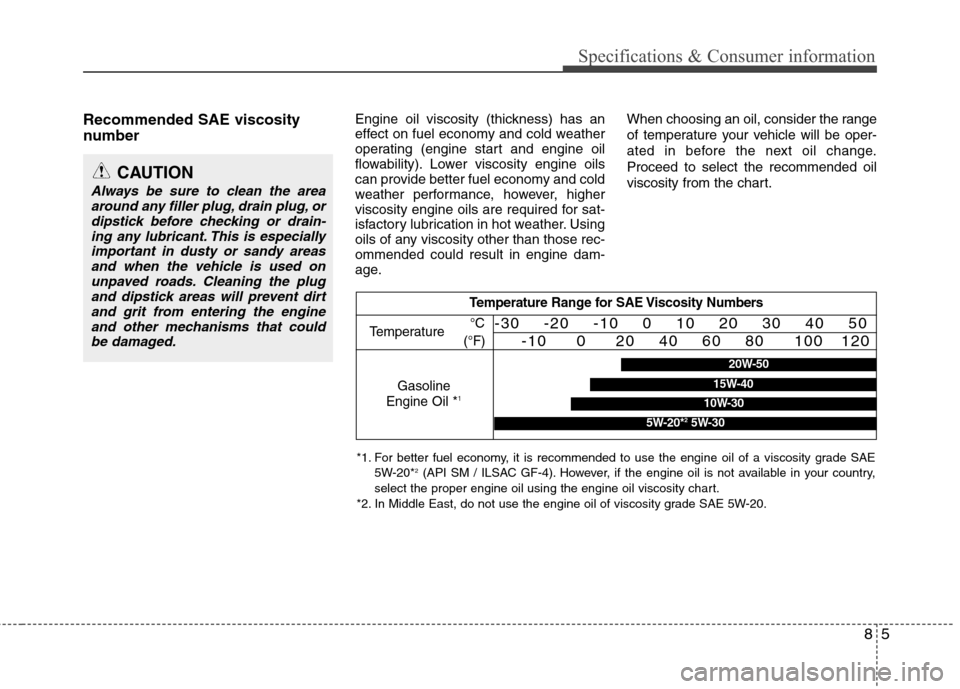
Recommended SAE viscosity
number Engine oil viscosity (thickness) has an
effect on fuel economy and cold weather
operating (engine start and engine oil
flowability). Lower viscosity engine oils
can provide better fuel economy and cold
weather performance, however, higher
viscosity engine oils are required for sat-
isfactory lubrication in hot weather. Using
oils of any viscosity other than those rec-ommended could result in engine dam-
age.When choosing an oil, consider the range
of temperature your vehicle will be oper-
ated in before the next oil change.Proceed to select the recommended oil
viscosity from the chart.
CAUTION
Always be sure to clean the area
around any filler plug, drain plug, ordipstick before checking or drain-
ing any lubricant. This is especially important in dusty or sandy areasand when the vehicle is used onunpaved roads. Cleaning the plug
and dipstick areas will prevent dirtand grit from entering the engine and other mechanisms that couldbe damaged.
Temperature Range for SAE Viscosity Numbers
Temperature
Gasoline
Engine Oil * 1°C
(°F)-30 -20 -10 0 10 20 30 40 50 -10 0 20 40 60 80 100 120
*1. For better fuel economy, it is recommended to use the engine oil of a viscosity grade SAE5W-20* 2
(API SM / ILSAC GF-4). However, if the engine oil is not available in your country,
select the proper engine oil using the engine oil viscosity chart.
*2. In Middle East, do not use the engine oil of viscosity grade SAE 5W-20.
20W-50
10W-30
15W-40
5W-20* 2
5W-30