trailer Hyundai Equus 2010 Owner's Manual
[x] Cancel search | Manufacturer: HYUNDAI, Model Year: 2010, Model line: Equus, Model: Hyundai Equus 2010Pages: 374, PDF Size: 41.29 MB
Page 11 of 374
Introduction
4
1
Do not use methanol
Fuels containing methanol (wood alco-
hol) should not be used in your vehicle.
This type of fuel can reduce vehicle per-
formance and damage components ofthe fuel system.
Gasolines for cleaner air
To help contribute to cleaner air,
HYUNDAI recommends that you usegasolines treated with detergent addi-
tives, which help prevent deposit forma-
tion in the engine. These gasolines will
help the engine run cleaner and enhance
performance of the Emission ControlSystem.
Operation in foreign countries
If you are going to drive your vehicle in
another country, be sure to:
Observe all regulations regarding reg-
istration and insurance.
Determine that acceptable fuel is avail- able. No special break-in period is needed. By
following a few simple precautions for the
first 1,000 km (600 miles) you may add to
the performance, economy and life of
your vehicle.
Do not race the engine.
While driving, keep your engine speed
(rpm, or revolutions per minute)
between 2,000 rpm and 4,000 rpm.
Do not maintain a single speed for long
periods of time, either fast or slow.
Varying engine speed is needed to
properly break-in the engine.
Avoid hard stops, except in emergen- cies, to allow the brakes to seat prop-
erly.
Don't let the engine idle longer than 3
minutes at one time.
Don't tow a trailer during the first 2,000 km (1,200 miles) of operation.
VEHICLE BREAK-IN PROCESS
Page 205 of 374
5
Before driving / 5-3
Engine start/stop button / 5-4
Starting the engine / 5-6
Automatic transmission / 5-8
Brake system / 5-14
Electronic controlled suspension (ECS) / 5-28
Cruise control system / 5-32
Smart cruise control system / 5-36
Lane departure warning system / 5-46
Vehicle stability management (VSM) / 5-49
Economical operation / 5-52
Special driving conditions / 5-54
Winter driving / 5-58
Vehicle weight / 5-62
Trailer towing / 5-63
Driving your vehicle
Page 248 of 374
Driving your vehicle
44
5
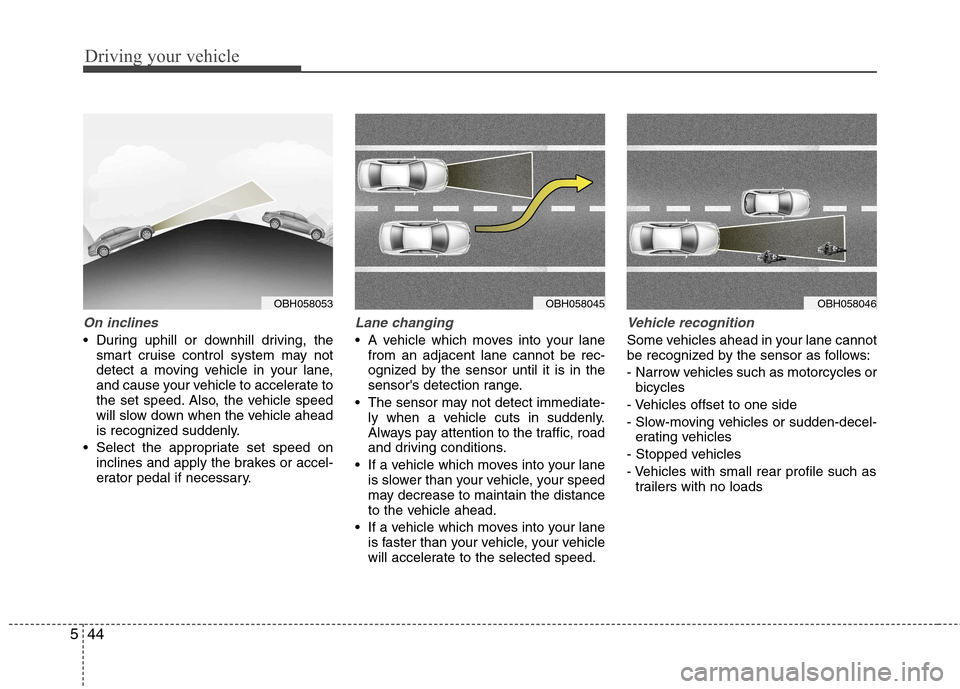
On inclines
During uphill or downhill driving, the
smart cruise control system may not
detect a moving vehicle in your lane,
and cause your vehicle to accelerate to
the set speed. Also, the vehicle speed
will slow down when the vehicle ahead
is recognized suddenly.
Select the appropriate set speed on inclines and apply the brakes or accel-
erator pedal if necessary.
Lane changing
A vehicle which moves into your lanefrom an adjacent lane cannot be rec-
ognized by the sensor until it is in the
sensor's detection range.
The sensor may not detect immediate- ly when a vehicle cuts in suddenly.
Always pay attention to the traffic, road
and driving conditions.
If a vehicle which moves into your lane is slower than your vehicle, your speed
may decrease to maintain the distance
to the vehicle ahead.
If a vehicle which moves into your lane is faster than your vehicle, your vehicle
will accelerate to the selected speed.
Vehicle recognition
Some vehicles ahead in your lane cannot
be recognized by the sensor as follows:
- Narrow vehicles such as motorcycles orbicycles
- Vehicles offset to one side
- Slow-moving vehicles or sudden-decel- erating vehicles
- Stopped vehicles
- Vehicles with small rear profile such as trailers with no loads
OBH058046OBH058045OBH058053
Page 267 of 374
563
Driving your vehicle
E140000ABH
We do not recommend using this
vehicle for trailer towing.TRAILER TOWING
Page 304 of 374
713
Maintenance
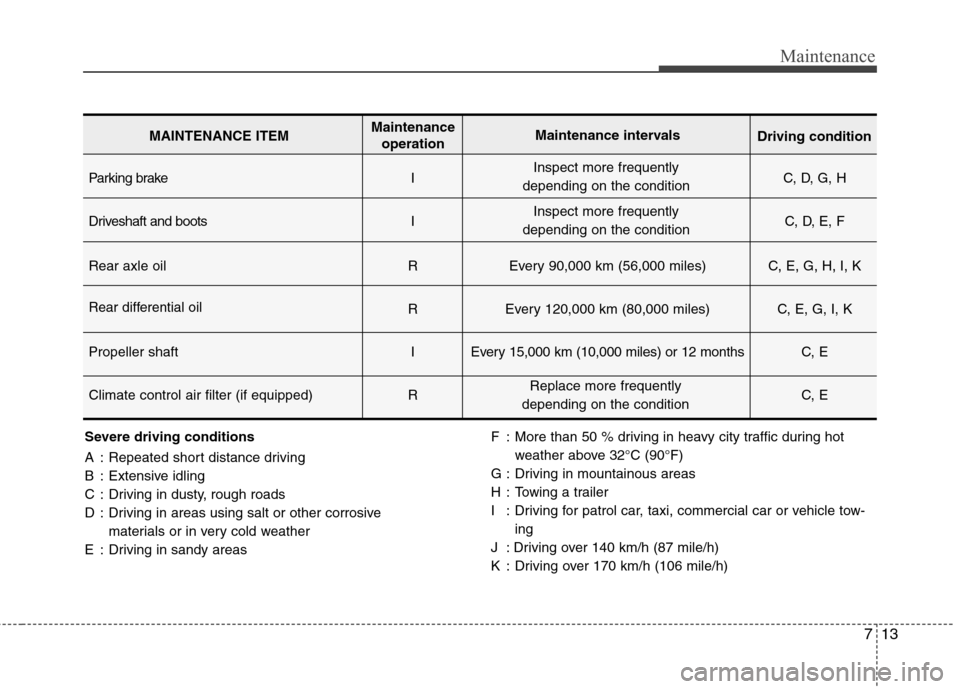
Severe driving conditions
A : Repeated short distance driving
B : Extensive idling
C : Driving in dusty, rough roads
D : Driving in areas using salt or other corrosive materials or in very cold weather
E : Driving in sandy areas F : More than 50 % driving in heavy city traffic during hot
weather above 32°C (90°F)
G : Driving in mountainous areas
H : Towing a trailer
I : Driving for patrol car, taxi, commercial car or vehicle tow- ing
J : Driving over 140 km/h (87 mile/h)
K : Driving over 170 km/h (106 mile/h)
Parking brake I C, D, G, H
Driveshaft and boots I C, D, E, F
Rear axle oil R Every 90,000 km (56,000 miles) C, E, G, H, I, K
Rear differential oilR Every 120,000 km (80,000 miles) C, E, G, I, K
Propeller shaft I
Every 15,000 km (10,000 miles) or 12 monthsC, E
Climate control air filter (if equipped) R C, E
MAINTENANCE ITEMMaintenance
operation Maintenance intervals
Driving condition
Inspect more frequently
depending on the condition
Inspect more frequently
depending on the condition
Replace more frequently
depending on the condition
Page 374 of 374
Index
4
I
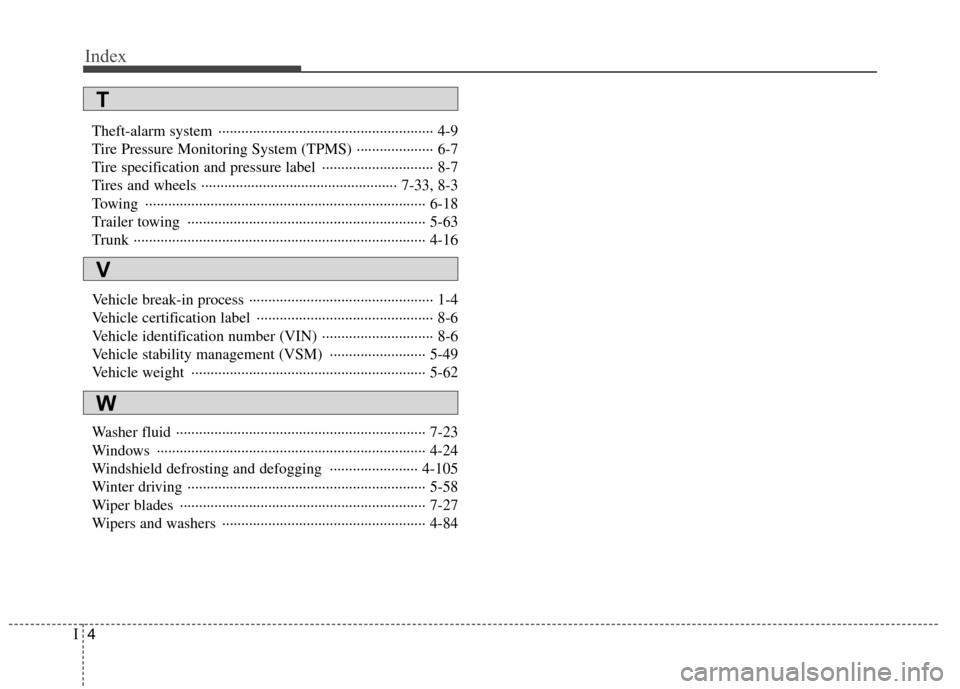
Theft-alarm system ························································ 4-9
Tire Pressure Monitoring System (TPMS) ···················· 6-7
Tire specification and pressure label ····························· 8-7
Tires and wheels ··················································· 7-33, 8-3
Towing ········································································· 6-18
Trailer towing ······························································ 5-63
Trunk ············································································ 4-16
Vehicle break-in process ················································ 1-4
Vehicle certification label ·············································· 8-6
Vehicle identification number (VIN) ····························· 8-6
Vehicle stability management (VSM) ························· 5-49
Vehicle weight ····························································· 5-62
Washer fluid ································································· 7-23
Windows ······································································ 4-24
Windshield defrosting and defogging ······················· 4-105
Winter driving ······························································ 5-58
Wiper blades ································································ 7-27
Wipers and washers ····················································· 4-84
V
W
T