623
What to do in an emergency
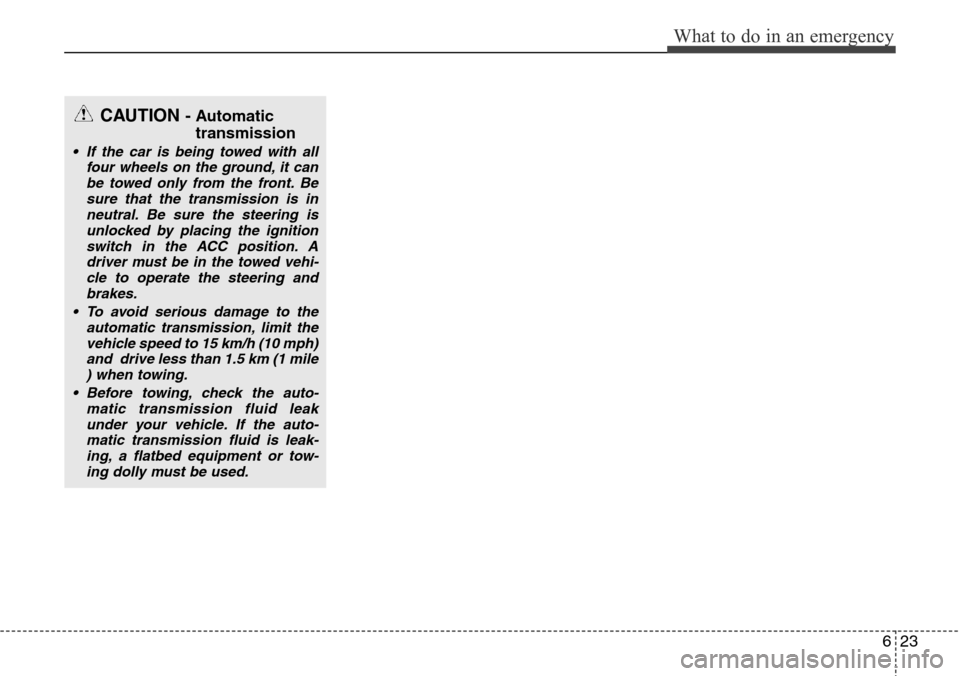
CAUTION - Automatic
transmission
• If the car is being towed with all
four wheels on the ground, it can
be towed only from the front. Be
sure that the transmission is in
neutral. Be sure the steering is
unlocked by placing the ignition
switch in the ACC position. A
driver must be in the towed vehi-
cle to operate the steering and
brakes.
• To avoid serious damage to the
automatic transmission, limit the
vehicle speed to 15 km/h (10 mph)
and drive less than 1.5 km (1 mile
) when towing.
• Before towing, check the auto-
matic transmission fluid leak
under your vehicle. If the auto-
matic transmission fluid is leak-
ing, a flatbed equipment or tow-
ing dolly must be used.
Maintenance
14 7
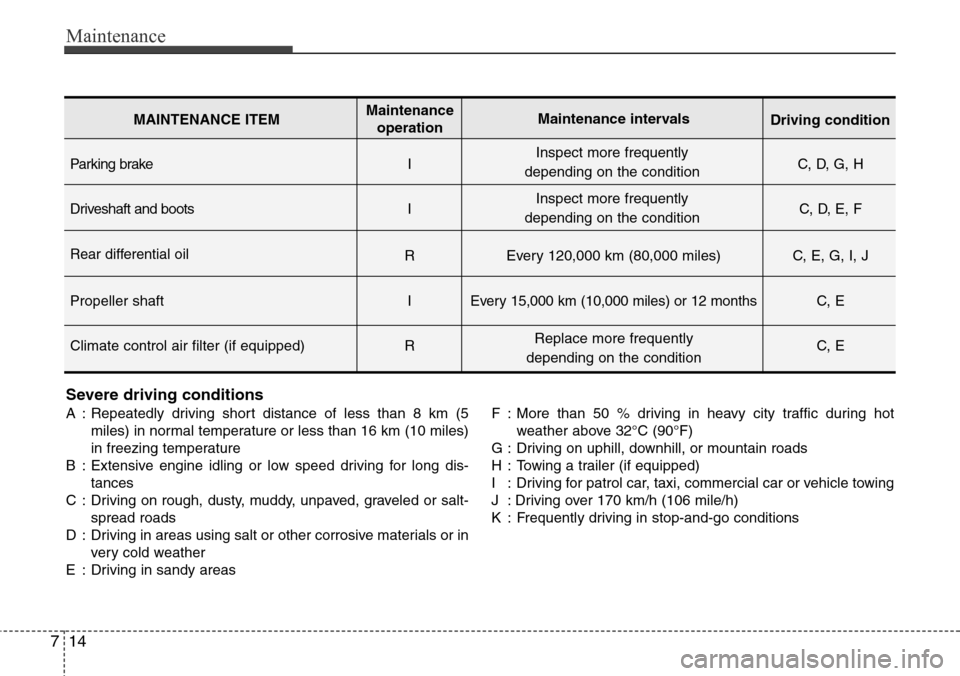
Parking brake I C, D, G, H
Driveshaft and boots I C, D, E, F
Rear differential oilR Every 120,000 km (80,000 miles) C, E, G, I, J
Propeller shaft I
Every 15,000 km (10,000 miles) or 12 monthsC, E
Climate control air filter (if equipped) R C, E
MAINTENANCE ITEMMaintenance
operationMaintenance intervals
Driving condition
Inspect more frequently
depending on the condition
Inspect more frequently
depending on the condition
Replace more frequently
depending on the condition
Severe driving conditions
A : Repeatedly driving short distance of less than 8 km (5
miles) in normal temperature or less than 16 km (10 miles)
in freezing temperature
B : Extensive engine idling or low speed driving for long dis-
tances
C : Driving on rough, dusty, muddy, unpaved, graveled or salt-
spread roads
D : Driving in areas using salt or other corrosive materials or in
very cold weather
E : Driving in sandy areasF : More than 50 % driving in heavy city traffic during hot
weather above 32°C (90°F)
G : Driving on uphill, downhill, or mountain roads
H : Towing a trailer (if equipped)
I : Driving for patrol car, taxi, commercial car or vehicle towing
J : Driving over 170 km/h (106 mile/h)
K : Frequently driving in stop-and-go conditions