belt Hyundai Equus 2012 Workshop Manual
[x] Cancel search | Manufacturer: HYUNDAI, Model Year: 2012, Model line: Equus, Model: Hyundai Equus 2012Pages: 385, PDF Size: 10.67 MB
Page 311 of 385
79
Maintenance
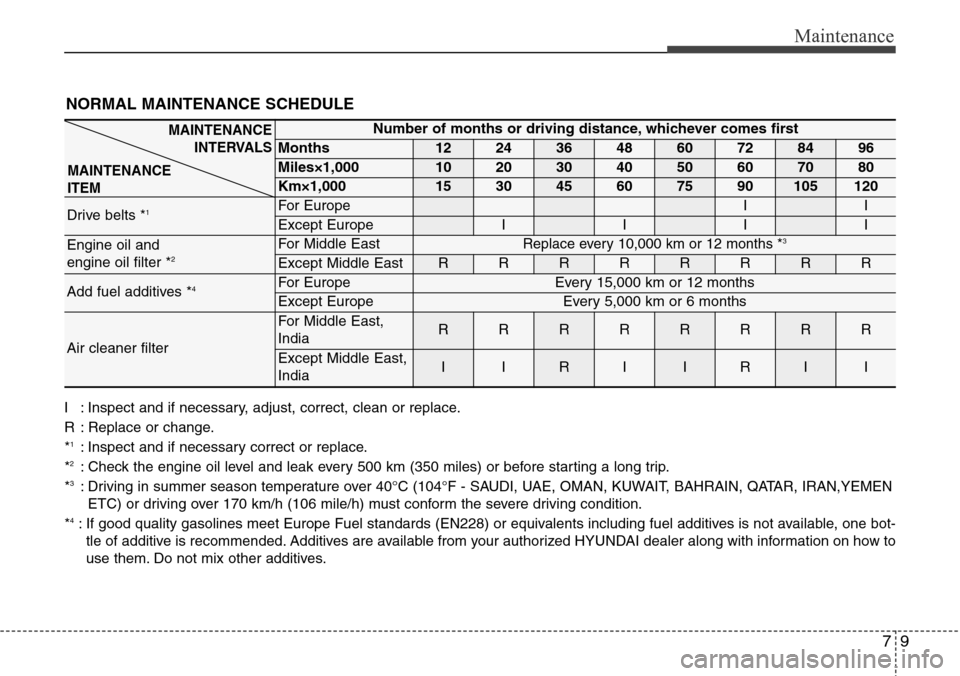
NORMAL MAINTENANCE SCHEDULE
I : Inspect and if necessary, adjust, correct, clean or replace.
R : Replace or change.
*
1: Inspect and if necessary correct or replace.
*2: Check the engine oil level and leak every 500 km (350 miles) or before starting a long trip.
*3: Driving in summer season temperature over 40°C (104°F - SAUDI, UAE, OMAN, KUWAIT, BAHRAIN, QATAR, IRAN,YEMEN
ETC) or driving over 170 km/h (106 mile/h) must conform the severe driving condition.
*
4: If good quality gasolines meet Europe Fuel standards (EN228) or equivalents including fuel additives is not available, one bot-
tle of additive is recommended. Additives are available from your authorized HYUNDAI dealer along with information on how to
use them. Do not mix other additives.
Number of months or driving distance, whichever comes first
Months1224364860728496
Miles×1,0001020304050607080
Km×1,000153045607590105120
Drive belts *1For EuropeII
Except EuropeIIII
Engine oil and
engine oil filter *2For Middle EastReplace every 10,000 km or 12 months *3
Except Middle EastRRRRRRRR
Add fuel additives *4For EuropeEvery 15,000 km or 12 months
Except EuropeEvery 5,000 km or 6 months
Air cleaner filter
For Middle East,
IndiaRRRRRRRR
Except Middle East,
IndiaIIRIIRII
MAINTENANCE
INTERVALS
MAINTENANCE
ITEM
Page 312 of 385
Maintenance
10 7
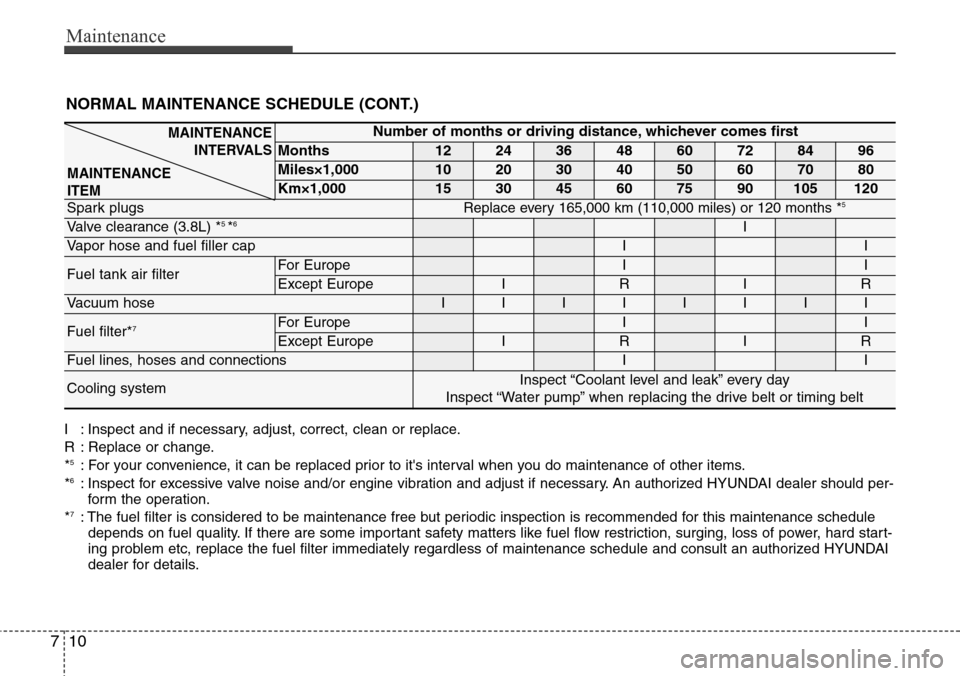
NORMAL MAINTENANCE SCHEDULE (CONT.)
I : Inspect and if necessary, adjust, correct, clean or replace.
R : Replace or change.
*
5: For your convenience, it can be replaced prior to it's interval when you do maintenance of other items.
*6: Inspect for excessive valve noise and/or engine vibration and adjust if necessary. An authorized HYUNDAI dealer should per-
form the operation.
*
7: The fuel filter is considered to be maintenance free but periodic inspection is recommended for this maintenance schedule
depends on fuel quality. If there are some important safety matters like fuel flow restriction, surging, loss of power, hard start-
ing problem etc, replace the fuel filter immediately regardless of maintenance schedule and consult an authorized HYUNDAI
dealer for details.
Number of months or driving distance, whichever comes first
Months1224364860728496
Miles×1,0001020304050607080
Km×1,000153045607590105120
Spark plugsReplace every 165,000 km (110,000 miles) or 120 months *5
Valve clearance (3.8L) *5 *6I
Vapor hose and fuel filler capII
Fuel tank air filterFor EuropeII
Except EuropeIRIR
Vacuum hoseIIIIIIII
Fuel filter*7For EuropeII
Except EuropeIRIR
Fuel lines, hoses and connectionsII
Cooling systemInspect “Coolant level and leak” every day
Inspect “Water pump” when replacing the drive belt or timing belt
MAINTENANCE
INTERVALS
MAINTENANCE
ITEM
Page 317 of 385
715
Maintenance
EXPLANATION OF SCHEDULED MAINTENANCE ITEMS
Engine oil and filter
The engine oil and filter should be
changed at the intervals specified in the
maintenance schedule. If the car is being
driven in severe conditions, more fre-
quent oil and filter changes are required.
Drive belts
Inspect all drive belts for evidence of
cuts, cracks, excessive wear or oil satu-
ration and replace if necessary.
Fuel filter
A clogged filter can limit the speed at
which the vehicle may be driven, damage
the emission system and cause multiple
issues such as hard starting. If an exces-
sive amount of foreign matter accumu-
lates in the fuel tank, the filter may
require replacement more frequently.
After installing a new filter, run the engine
for several minutes, and check for leaks
at the connections. Fuel filters should be
installed by an authorized HYUNDAI
dealer.
Fuel lines, fuel hoses and con-
nections
Check the fuel lines, fuel hoses and con-
nections for leakage and damage. Have
an authorized HYUNDAI dealer replace
any damaged or leaking parts immedi-
ately.
Vapor hose and fuel filler cap
The vapor hose and fuel filler cap should
be inspected at those intervals specified
in the maintenance schedule. Make sure
that a new vapor hose or fuel filler cap is
correctly replaced.
Vacuum crankcase ventilation
hoses (if equipped)
Inspect the surface of hoses for evidence
of heat and/or mechanical damage. Hard
and brittle rubber, cracking, tears, cuts,
abrasions, and excessive swelling indi-
cate deterioration. Particular attention
should be paid to examine those hose
surfaces nearest to high heat sources,
such as the exhaust manifold.
Inspect the hose routing to assure that
the hoses do not come in contact with
any heat source, sharp edges or moving
component which might cause heat dam-
age or mechanical wear. Inspect all hose
connections, such as clamps and cou-
plings, to make sure they are secure, and
that no leaks are present. Hoses should
be replaced immediately if there is any
evidence of deterioration or damage.
Page 319 of 385
717
Maintenance
Brake hoses and lines
Visually check for proper installation,
chafing, cracks, deterioration and any
leakage. Replace any deteriorated or
damaged parts immediately.
Brake fluid
Check brake fluid level in the brake fluid
reservoir. The level should be between
“MIN” and “MAX” marks on the side of
the reservoir. Use only hydraulic brake
fluid conforming to DOT 3 or DOT 4
specification.
Steering gear box, linkage &
boots/lower arm ball joint
With the vehicle stopped and engine off,
check for excessive free-play in the
steering wheel.
Check the linkage for bends or damage.
Check the dust boots and ball joints for
deterioration, cracks, or damage.
Replace any damaged parts.
Power steering pump, belt and
hoses
Check the power steering pump and
hoses for leakage and damage. Replace
any damaged or leaking parts immedi-
ately. Inspect the power steering belt (or
drive belt) for evidence of cuts, cracks,
excessive wear, oiliness and proper ten-
sion. Replace or adjust it if necessary.
Drive shafts and boots
Check the drive shafts, boots and clamps
for cracks, deterioration, or damage.
Replace any damaged parts and, if nec-
essary, repack the grease.
Air conditioning refrigerant
(if equipped)
Check the air conditioning lines and con-
nections for leakage and damage.
Brake discs, pads, calipers and
rotors
Check the pads for excessive wear, discs
for run out and wear, and calipers for fluid
leakage.
For more information on checking the
pads or lining wear limit, refer to the
Hyundai web site.
(http://brakeman
ual.hmc.co.kr)
Suspension mounting bolts
Check the suspension connections for
looseness or damage. Retighten to the
specified torque.
Page 346 of 385
Maintenance
44 7
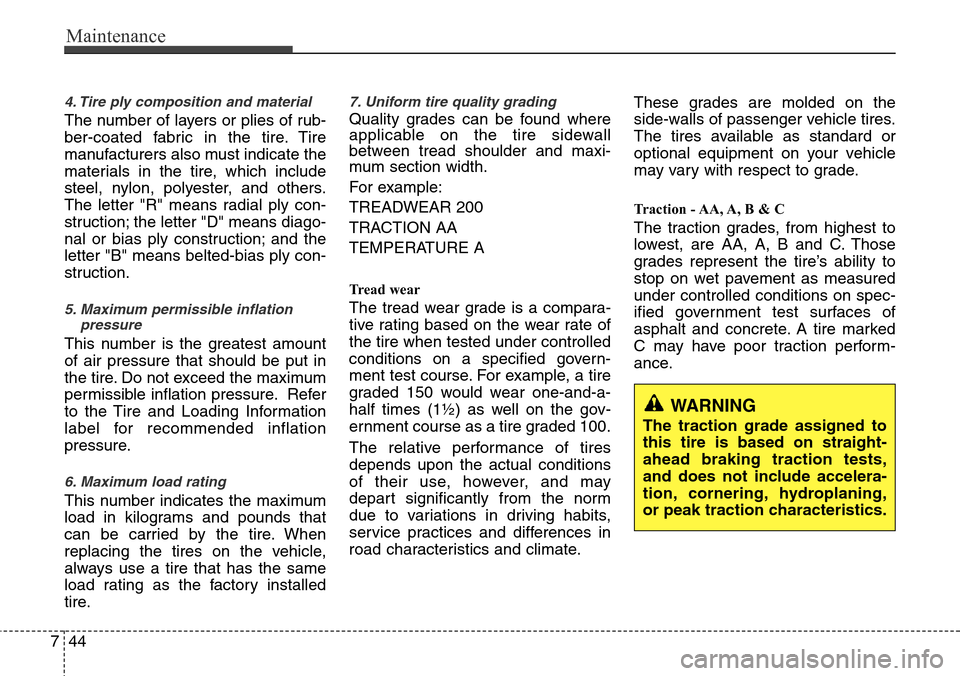
4. Tire ply composition and material
The number of layers or plies of rub-
ber-coated fabric in the tire. Tire
manufacturers also must indicate the
materials in the tire, which include
steel, nylon, polyester, and others.
The letter "R" means radial ply con-
struction; the letter "D" means diago-
nal or bias ply construction; and the
letter "B" means belted-bias ply con-
struction.
5. Maximum permissible inflation
pressure
This number is the greatest amount
of air pressure that should be put in
the tire. Do not exceed the maximum
permissible inflation pressure. Refer
to the Tire and Loading Information
label for recommended inflation
pressure.
6. Maximum load rating
This number indicates the maximum
load in kilograms and pounds that
can be carried by the tire. When
replacing the tires on the vehicle,
always use a tire that has the same
load rating as the factory installed
tire.
7. Uniform tire quality grading
Quality grades can be found where
applicable on the tire sidewall
between tread shoulder and maxi-
mum section width.
For example:
TREADWEAR 200
TRACTION AA
TEMPERATURE A
Tread wear
The tread wear grade is a compara-
tive rating based on the wear rate of
the tire when tested under controlled
conditions on a specified govern-
ment test course. For example, a tire
graded 150 would wear one-and-a-
half times (1½) as well on the gov-
ernment course as a tire graded 100.
The relative performance of tires
depends upon the actual conditions
of their use, however, and may
depart significantly from the norm
due to variations in driving habits,
service practices and differences in
road characteristics and climate.These grades are molded on the
side-walls of passenger vehicle tires.
The tires available as standard or
optional equipment on your vehicle
may vary with respect to grade.
Traction - AA, A, B & C
The traction grades, from highest to
lowest, are AA, A, B and C. Those
grades represent the tire’s ability to
stop on wet pavement as measured
under controlled conditions on spec-
ified government test surfaces of
asphalt and concrete. A tire marked
C may have poor traction perform-
ance.
WARNING
The traction grade assigned to
this tire is based on straight-
ahead braking traction tests,
and does not include accelera-
tion, cornering, hydroplaning,
or peak traction characteristics.
Page 353 of 385
751
Maintenance
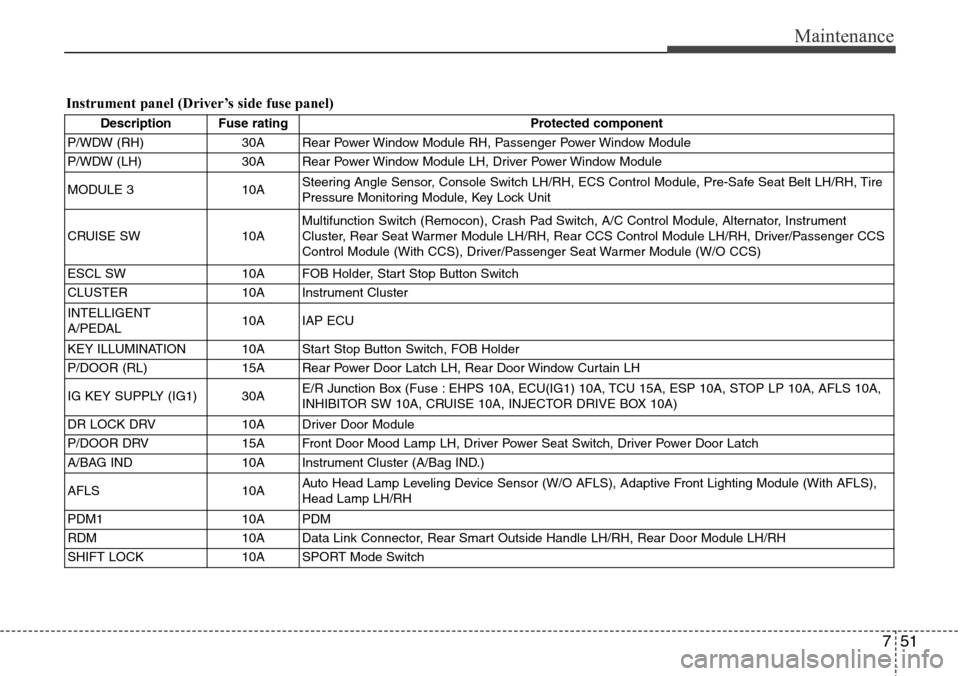
Instrument panel (Driver’s side fuse panel)
Description Fuse rating Protected component
P/WDW (RH) 30A Rear Power Window Module RH, Passenger Power Window Module
P/WDW (LH) 30A Rear Power Window Module LH, Driver Power Window Module
MODULE 3 10ASteering Angle Sensor, Console Switch LH/RH, ECS Control Module, Pre-Safe Seat Belt LH/RH, Tire
Pressure Monitoring Module, Key Lock Unit
CRUISE SW 10AMultifunction Switch (Remocon), Crash Pad Switch, A/C Control Module, Alternator, Instrument
Cluster, Rear Seat Warmer Module LH/RH, Rear CCS Control Module LH/RH, Driver/Passenger CCS
Control Module (With CCS), Driver/Passenger Seat Warmer Module (W/O CCS)
ESCL SW 10A FOB Holder, Start Stop Button Switch
CLUSTER 10A Instrument Cluster
INTELLIGENT
A/PEDAL10A IAP ECU
KEY ILLUMINATION 10A Start Stop Button Switch, FOB Holder
P/DOOR (RL) 15A Rear Power Door Latch LH, Rear Door Window Curtain LH
IG KEY SUPPLY (IG1) 30AE/R Junction Box (Fuse : EHPS 10A, ECU(IG1) 10A, TCU 15A, ESP 10A, STOP LP 10A, AFLS 10A,
INHIBITOR SW 10A, CRUISE 10A, INJECTOR DRIVE BOX 10A)
DR LOCK DRV 10A Driver Door Module
P/DOOR DRV 15A Front Door Mood Lamp LH, Driver Power Seat Switch, Driver Power Door Latch
A/BAG IND 10A Instrument Cluster (A/Bag IND.)
AFLS 10AAuto Head Lamp Leveling Device Sensor (W/O AFLS), Adaptive Front Lighting Module (With AFLS),
Head Lamp LH/RH
PDM1 10A PDM
RDM 10A Data Link Connector, Rear Smart Outside Handle LH/RH, Rear Door Module LH/RH
SHIFT LOCK 10A SPORT Mode Switch
Page 357 of 385
755
Maintenance
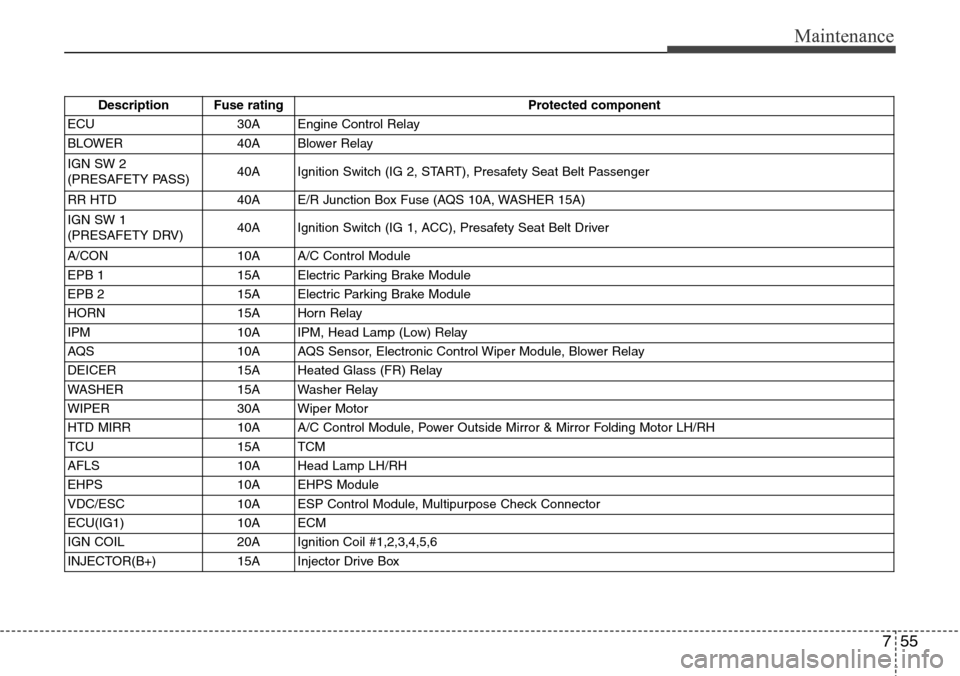
Description Fuse rating Protected component
ECU 30A Engine Control Relay
BLOWER 40A Blower Relay
IGN SW 2
(PRESAFETY PASS)40A Ignition Switch (IG 2, START), Presafety Seat Belt Passenger
RR HTD 40A E/R Junction Box Fuse (AQS 10A, WASHER 15A)
IGN SW 1
(PRESAFETY DRV)40A Ignition Switch (IG 1, ACC), Presafety Seat Belt Driver
A/CON 10A A/C Control Module
EPB 1 15A Electric Parking Brake Module
EPB 2 15A Electric Parking Brake Module
HORN 15A Horn Relay
IPM 10A IPM, Head Lamp (Low) Relay
AQS 10A AQS Sensor, Electronic Control Wiper Module, Blower Relay
DEICER 15A Heated Glass (FR) Relay
WASHER 15A Washer Relay
WIPER 30A Wiper Motor
HTD MIRR 10A A/C Control Module, Power Outside Mirror & Mirror Folding Motor LH/RH
TCU 15A TCM
AFLS 10A Head Lamp LH/RH
EHPS 10A EHPS Module
VDC/ESC 10A ESP Control Module, Multipurpose Check Connector
ECU(IG1) 10A ECM
IGN COIL 20A Ignition Coil #1,2,3,4,5,6
INJECTOR(B+) 15A Injector Drive Box
Page 374 of 385
Maintenance
72 7
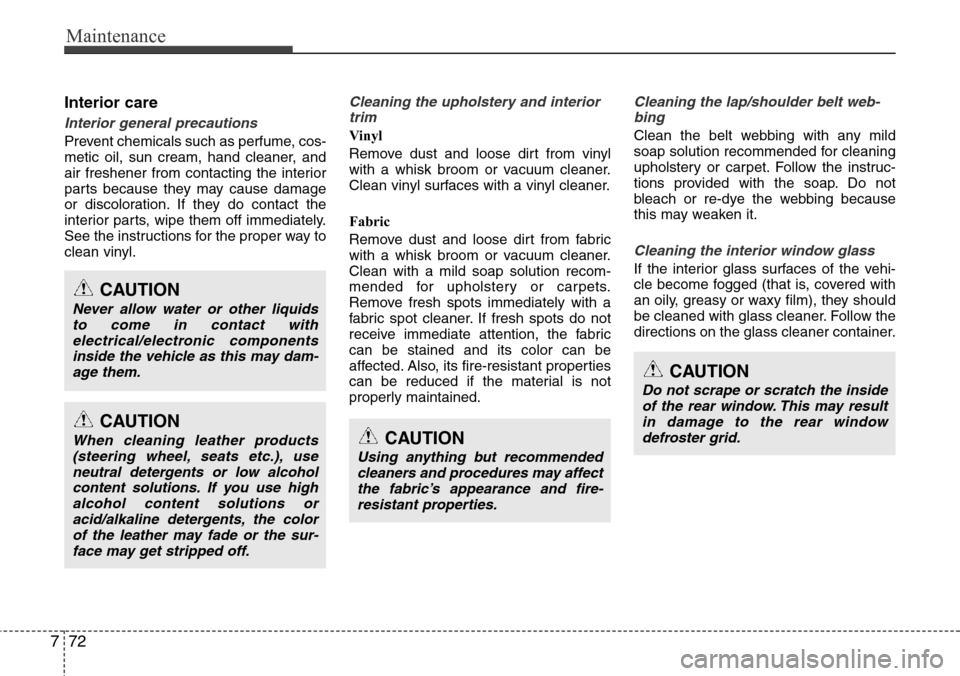
Interior care
Interior general precautions
Prevent chemicals such as perfume, cos-
metic oil, sun cream, hand cleaner, and
air freshener from contacting the interior
parts because they may cause damage
or discoloration. If they do contact the
interior parts, wipe them off immediately.
See the instructions for the proper way to
clean vinyl.
Cleaning the upholstery and interior
trim
Vinyl
Remove dust and loose dirt from vinyl
with a whisk broom or vacuum cleaner.
Clean vinyl surfaces with a vinyl cleaner.
Fabric
Remove dust and loose dirt from fabric
with a whisk broom or vacuum cleaner.
Clean with a mild soap solution recom-
mended for upholstery or carpets.
Remove fresh spots immediately with a
fabric spot cleaner. If fresh spots do not
receive immediate attention, the fabric
can be stained and its color can be
affected. Also, its fire-resistant properties
can be reduced if the material is not
properly maintained.
Cleaning the lap/shoulder belt web-
bing
Clean the belt webbing with any mild
soap solution recommended for cleaning
upholstery or carpet. Follow the instruc-
tions provided with the soap. Do not
bleach or re-dye the webbing because
this may weaken it.
Cleaning the interior window glass
If the interior glass surfaces of the vehi-
cle become fogged (that is, covered with
an oily, greasy or waxy film), they should
be cleaned with glass cleaner. Follow the
directions on the glass cleaner container.
CAUTION
Never allow water or other liquids
to come in contact with
electrical/electronic components
inside the vehicle as this may dam-
age them.
CAUTION
Using anything but recommended
cleaners and procedures may affect
the fabric’s appearance and fire-
resistant properties.
CAUTION
When cleaning leather products
(steering wheel, seats etc.), use
neutral detergents or low alcohol
content solutions. If you use high
alcohol content solutions or
acid/alkaline detergents, the color
of the leather may fade or the sur-
face may get stripped off.
CAUTION
Do not scrape or scratch the inside
of the rear window. This may result
in damage to the rear window
defroster grid.