power steering fluid Hyundai Equus 2012 Owner's Manual
[x] Cancel search | Manufacturer: HYUNDAI, Model Year: 2012, Model line: Equus, Model: Hyundai Equus 2012Pages: 385, PDF Size: 10.67 MB
Page 17 of 385
Your vehicle at a glance
4 2
ENGINE COMPARTMENT
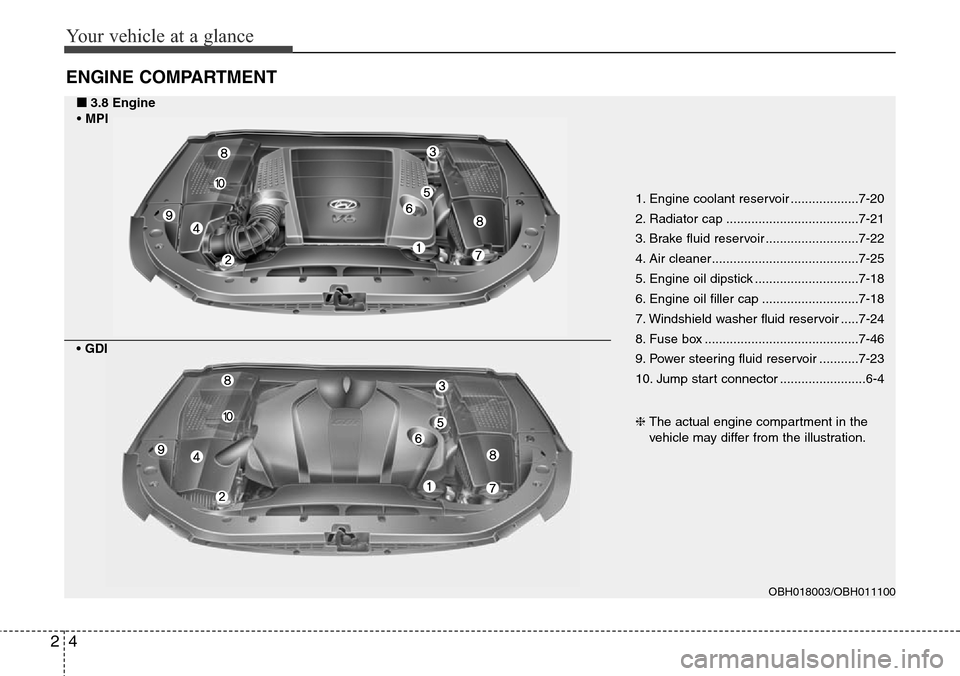
1. Engine coolant reservoir ...................7-20
2. Radiator cap .....................................7-21
3. Brake fluid reservoir ..........................7-22
4. Air cleaner.........................................7-25
5. Engine oil dipstick .............................7-18
6. Engine oil filler cap ...........................7-18
7. Windshield washer fluid reservoir .....7-24
8. Fuse box ...........................................7-46
9. Power steering fluid reservoir ...........7-23
10. Jump start connector ........................6-4
❈The actual engine compartment in the
vehicle may differ from the illustration.
OBH018003/OBH011100
■■3.8 Engine
• MPI
• GDI
Page 18 of 385
25
Your vehicle at a glance
OVI079001
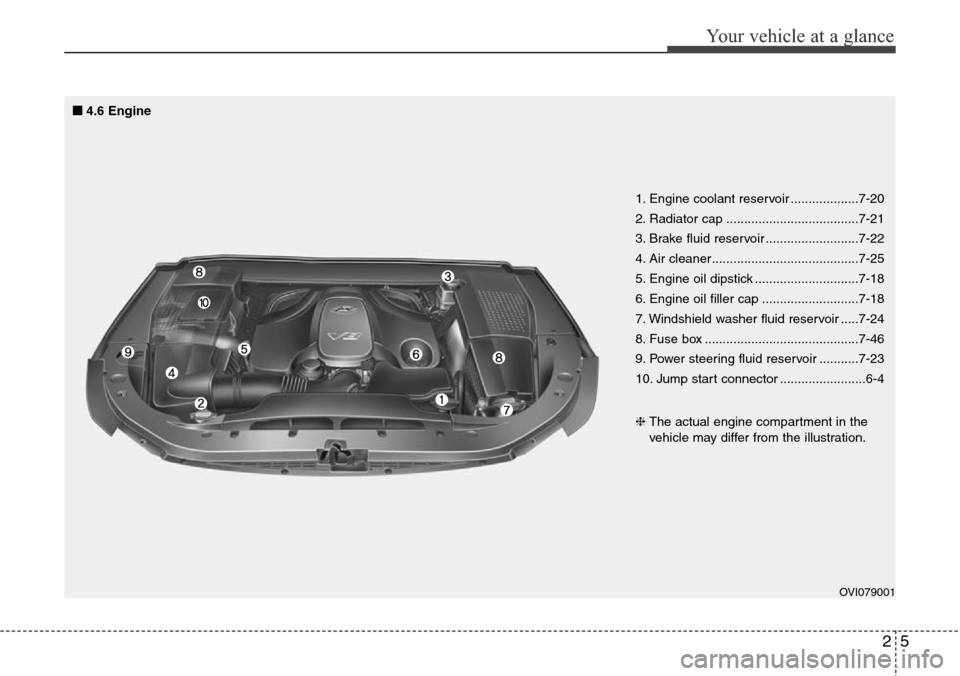
1. Engine coolant reservoir ...................7-20
2. Radiator cap .....................................7-21
3. Brake fluid reservoir ..........................7-22
4. Air cleaner.........................................7-25
5. Engine oil dipstick .............................7-18
6. Engine oil filler cap ...........................7-18
7. Windshield washer fluid reservoir .....7-24
8. Fuse box ...........................................7-46
9. Power steering fluid reservoir ...........7-23
10. Jump start connector ........................6-4
❈The actual engine compartment in the
vehicle may differ from the illustration.
■4.6 Engine
Page 19 of 385
Your vehicle at a glance
6 2
OBH011101
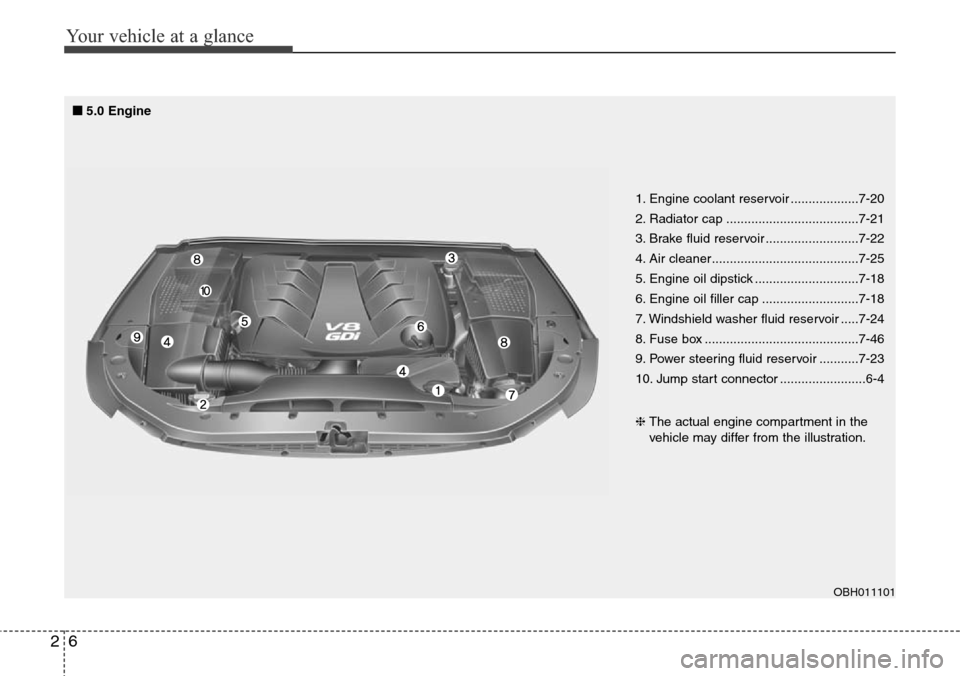
1. Engine coolant reservoir ...................7-20
2. Radiator cap .....................................7-21
3. Brake fluid reservoir ..........................7-22
4. Air cleaner.........................................7-25
5. Engine oil dipstick .............................7-18
6. Engine oil filler cap ...........................7-18
7. Windshield washer fluid reservoir .....7-24
8. Fuse box ...........................................7-46
9. Power steering fluid reservoir ...........7-23
10. Jump start connector ........................6-4
❈The actual engine compartment in the
vehicle may differ from the illustration.
■5.0 Engine
Page 122 of 385
Features of your vehicle
40 4
✽NOTICE
If the power steering drive belt breaks
or if the power steering pump malfunc-
tions, the steering effort will greatly
increase.
✽NOTICE
If the vehicle is parked for extended
periods outside in cold weather
(below -10°C/14°F), the power steering
may require increased effort when the
engine is first started. This is caused by
increased fluid viscosity due to the cold
weather and does not indicate a mal-
function.
When this happens, increase the engine
RPM by depressing accelerator until the
RPM reaches 1,500 rpm then release or
let the engine idle for two or three min-
utes to warm up the fluid.
Tilt steering
Tilt steering allows you to adjust the
steering wheel before you drive. You can
also raise it to give your legs more room
when you exit and enter the vehicle.
The steering wheel should be positioned
so that it is comfortable for you to drive,
while permitting you to see the instru-
ment panel warning lights and gauges.
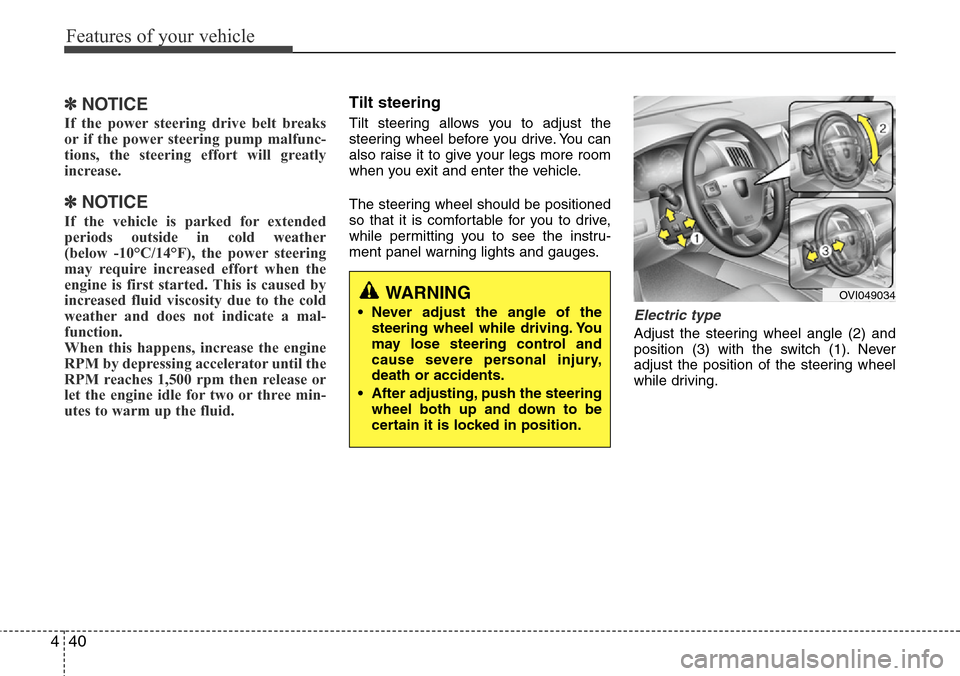
Electric type
Adjust the steering wheel angle (2) and
position (3) with the switch (1). Never
adjust the position of the steering wheel
while driving.
WARNING
• Never adjust the angle of the
steering wheel while driving. You
may lose steering control and
cause severe personal injury,
death or accidents.
• After adjusting, push the steering
wheel both up and down to be
certain it is locked in position.
OVI049034
Page 303 of 385
7
Engine compartment / 7-2
Maintenance services / 7-5
Owner maintenance / 7-6
Scheduled maintenance service / 7-8
Explanation of scheduled maintenance items / 7-15
Engine oil / 7-18
Engine coolant / 7-19
Brake fluid / 7-22
Power steering fluid / 7-23
Washer fluid / 7-24
Air cleaner / 7-25
Climate control air filter / 7-28
Wiper blades / 7-30
Battery / 7-33
Tires and wheels / 7-36
Fuses / 7-46
Light bulbs / 7-57
Appearance care / 7-67
Emission control system / 7-73
Maintenance
Page 304 of 385
Maintenance
2 7
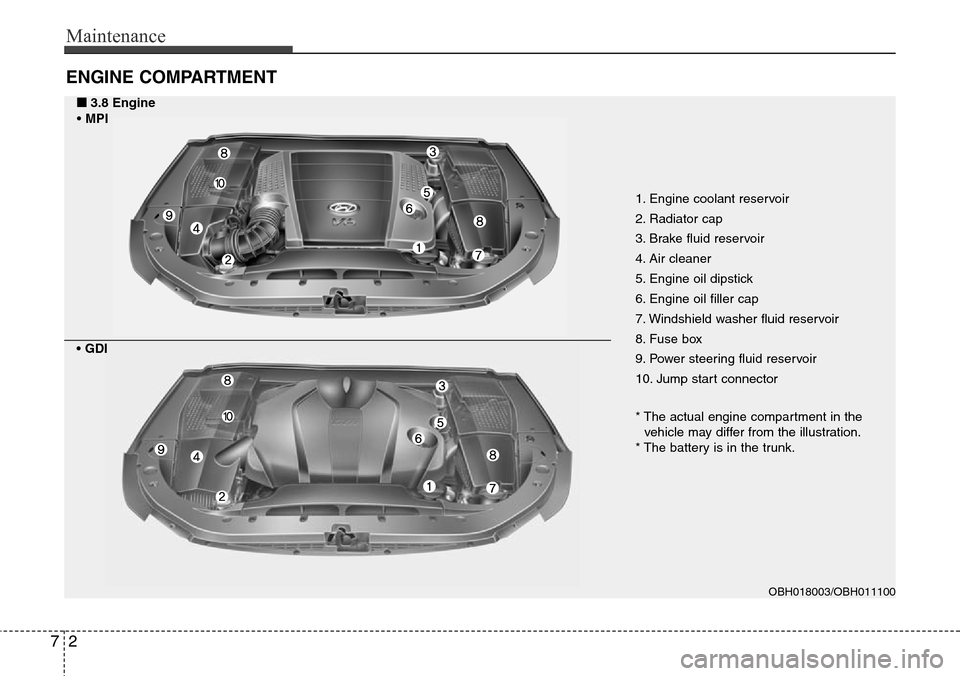
ENGINE COMPARTMENT
1. Engine coolant reservoir
2. Radiator cap
3. Brake fluid reservoir
4. Air cleaner
5. Engine oil dipstick
6. Engine oil filler cap
7. Windshield washer fluid reservoir
8. Fuse box
9. Power steering fluid reservoir
10. Jump start connector
* The actual engine compartment in the
vehicle may differ from the illustration.
* The battery is in the trunk.
OBH018003/OBH011100
■■3.8 Engine
• MPI
• GDI
Page 305 of 385
73
Maintenance
OVI079001
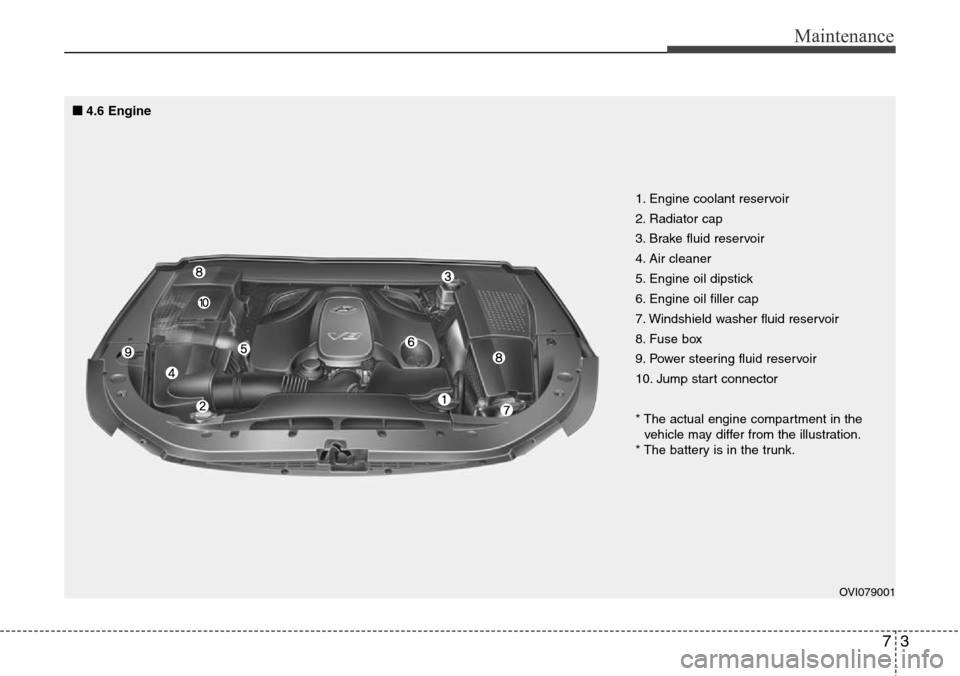
1. Engine coolant reservoir
2. Radiator cap
3. Brake fluid reservoir
4. Air cleaner
5. Engine oil dipstick
6. Engine oil filler cap
7. Windshield washer fluid reservoir
8. Fuse box
9. Power steering fluid reservoir
10. Jump start connector
* The actual engine compartment in the
vehicle may differ from the illustration.
* The battery is in the trunk.
■4.6 Engine
Page 306 of 385
Maintenance
4 7
OBH011101
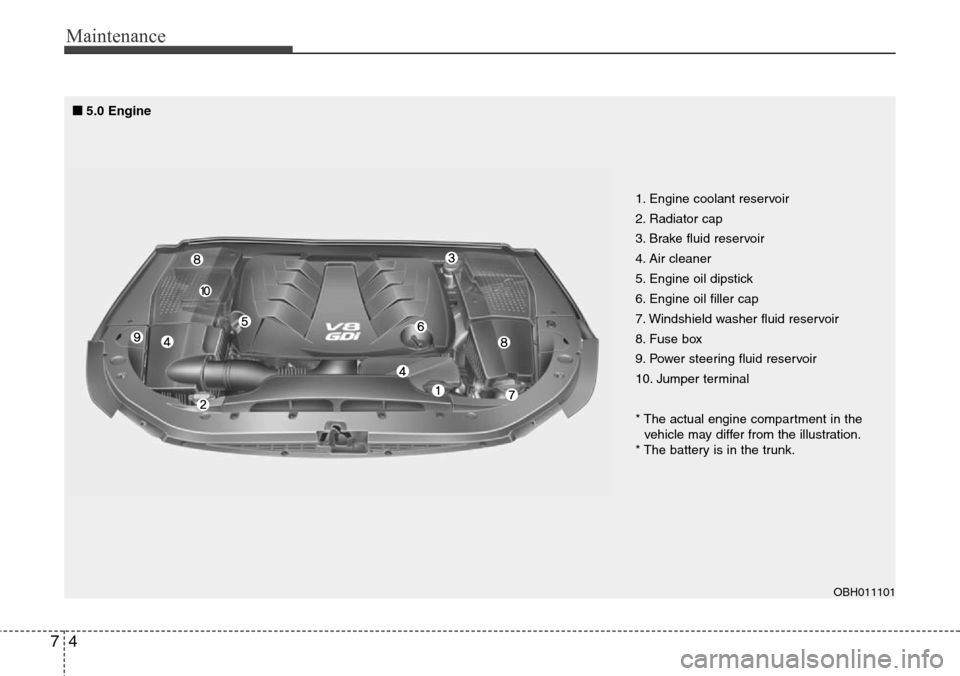
1. Engine coolant reservoir
2. Radiator cap
3. Brake fluid reservoir
4. Air cleaner
5. Engine oil dipstick
6. Engine oil filler cap
7. Windshield washer fluid reservoir
8. Fuse box
9. Power steering fluid reservoir
10. Jumper terminal
* The actual engine compartment in the
vehicle may differ from the illustration.
* The battery is in the trunk.
■5.0 Engine
Page 310 of 385
Maintenance
8 7
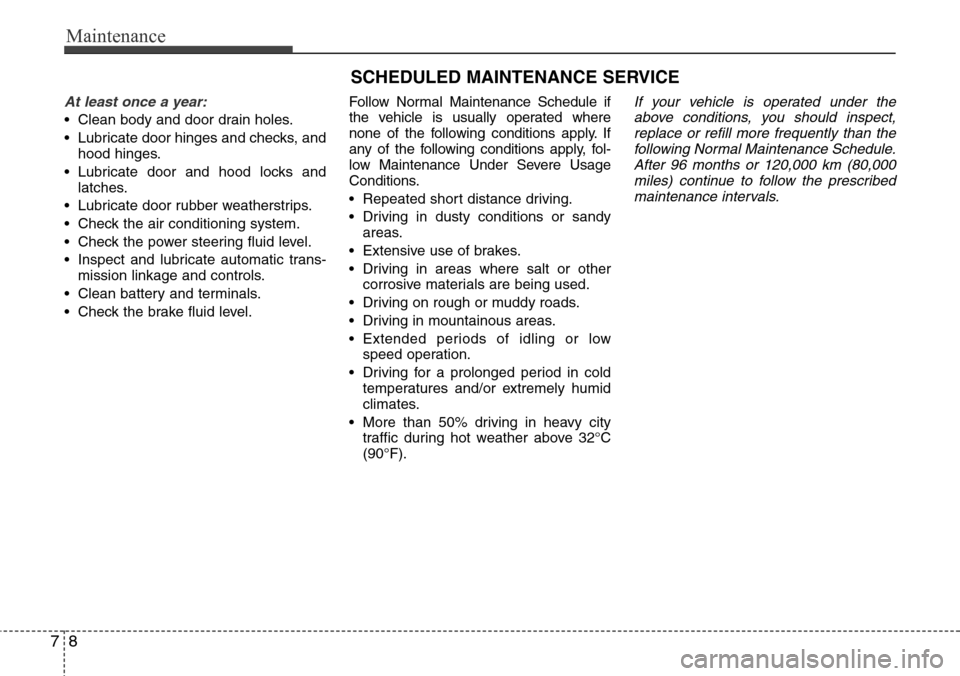
SCHEDULED MAINTENANCE SERVICE
At least once a year:
• Clean body and door drain holes.
• Lubricate door hinges and checks, and
hood hinges.
• Lubricate door and hood locks and
latches.
• Lubricate door rubber weatherstrips.
• Check the air conditioning system.
• Check the power steering fluid level.
• Inspect and lubricate automatic trans-
mission linkage and controls.
• Clean battery and terminals.
• Check the brake fluid level.Follow Normal Maintenance Schedule if
the vehicle is usually operated where
none of the following conditions apply. If
any of the following conditions apply, fol-
low Maintenance Under Severe Usage
Conditions.
• Repeated short distance driving.
• Driving in dusty conditions or sandy
areas.
• Extensive use of brakes.
• Driving in areas where salt or other
corrosive materials are being used.
• Driving on rough or muddy roads.
• Driving in mountainous areas.
• Extended periods of idling or low
speed operation.
• Driving for a prolonged period in cold
temperatures and/or extremely humid
climates.
• More than 50% driving in heavy city
traffic during hot weather above 32°C
(90°F).
If your vehicle is operated under the
above conditions, you should inspect,
replace or refill more frequently than the
following Normal Maintenance Schedule.
After 96 months or 120,000 km (80,000
miles) continue to follow the prescribed
maintenance intervals.
Page 313 of 385
711
Maintenance
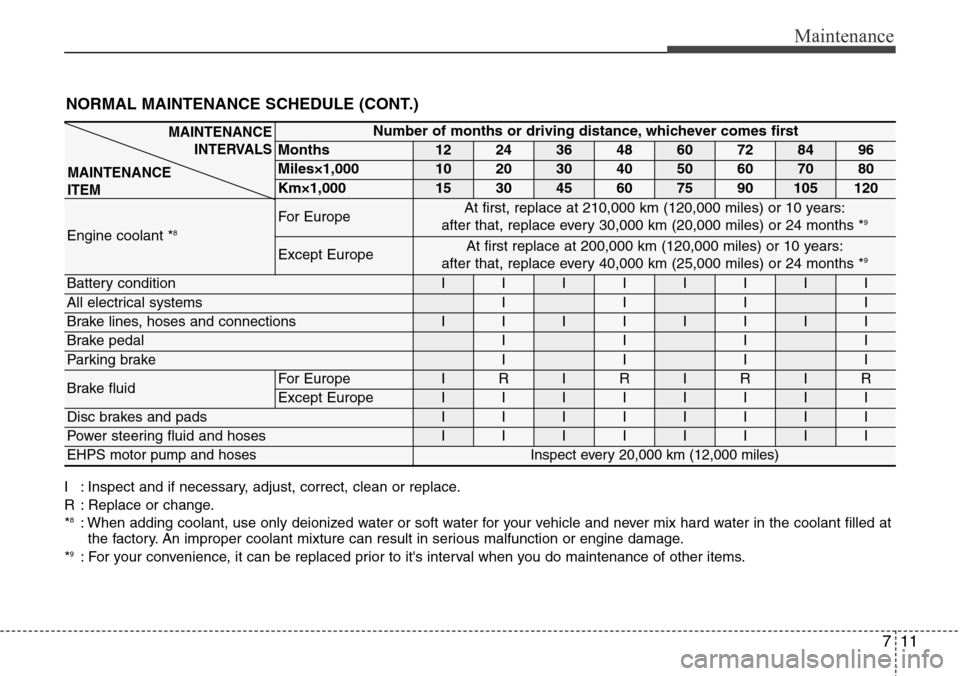
NORMAL MAINTENANCE SCHEDULE (CONT.)
I : Inspect and if necessary, adjust, correct, clean or replace.
R : Replace or change.
*
8: When adding coolant, use only deionized water or soft water for your vehicle and never mix hard water in the coolant filled at
the factory. An improper coolant mixture can result in serious malfunction or engine damage.
*
9: For your convenience, it can be replaced prior to it's interval when you do maintenance of other items.
Number of months or driving distance, whichever comes first
Months1224364860728496
Miles×1,0001020304050607080
Km×1,000153045607590105120
Engine coolant *8For EuropeAt first, replace at 210,000 km (120,000 miles) or 10 years:
after that, replace every 30,000 km (20,000 miles) or 24 months *9
Except EuropeAt first replace at 200,000 km (120,000 miles) or 10 years:
after that, replace every 40,000 km (25,000 miles) or 24 months *9
Battery conditionIIIIIIII
All electrical systemsIIII
Brake lines, hoses and connectionsIIIIIIII
Brake pedalIIII
Parking brakeIIII
Brake fluidFor EuropeIRIRIRIR
Except EuropeIIIIIIII
Disc brakes and padsIIIIIIII
Power steering fluid and hosesIIIIIIII
EHPS motor pump and hoses Inspect every 20,000 km (12,000 miles)
MAINTENANCE
INTERVALS
MAINTENANCE
ITEM