seats Hyundai Equus 2013 User Guide
[x] Cancel search | Manufacturer: HYUNDAI, Model Year: 2013, Model line: Equus, Model: Hyundai Equus 2013Pages: 479, PDF Size: 10.15 MB
Page 39 of 479
Safety features of your vehicle
20 3
Headrest
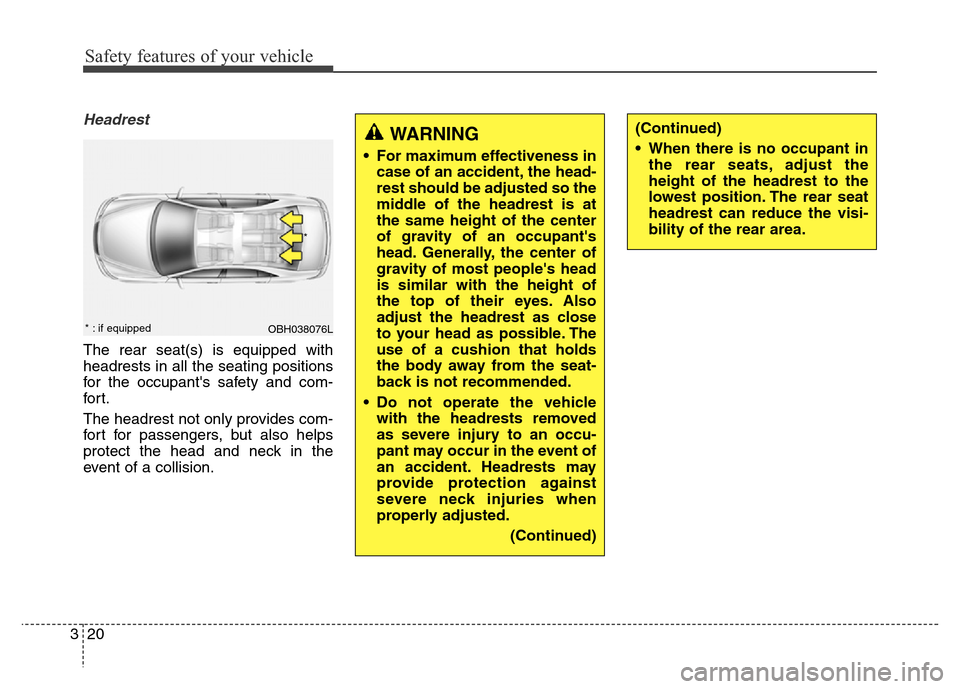
The rear seat(s) is equipped with
headrests in all the seating positions
for the occupant's safety and com-
for t.
The headrest not only provides com-
fort for passengers, but also helps
protect the head and neck in the
event of a collision.
OBH038076L * : if equipped*
WARNING
• For maximum effectiveness in
case of an accident, the head-
rest should be adjusted so the
middle of the headrest is at
the same height of the center
of gravity of an occupant's
head. Generally, the center of
gravity of most people's head
is similar with the height of
the top of their eyes. Also
adjust the headrest as close
to your head as possible. The
use of a cushion that holds
the body away from the seat-
back is not recommended.
• Do not operate the vehicle
with the headrests removed
as severe injury to an occu-
pant may occur in the event of
an accident. Headrests may
provide protection against
severe neck injuries when
properly adjusted.
(Continued)
(Continued)
• When there is no occupant in
the rear seats, adjust the
height of the headrest to the
lowest position. The rear seat
headrest can reduce the visi-
bility of the rear area.
Page 43 of 479
Safety features of your vehicle
24 3
Seat warmer (if equipped)
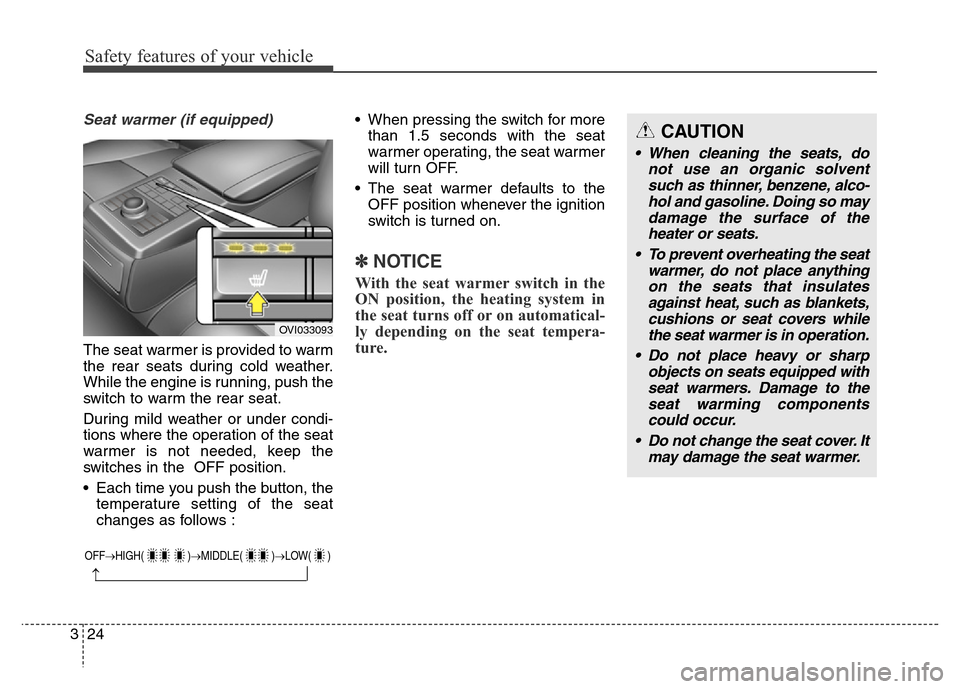
The seat warmer is provided to warm
the rear seats during cold weather.
While the engine is running, push the
switch to warm the rear seat.
During mild weather or under condi-
tions where the operation of the seat
warmer is not needed, keep the
switches in the OFF position.
• Each time you push the button, the
temperature setting of the seat
changes as follows :• When pressing the switch for more
than 1.5 seconds with the seat
warmer operating, the seat warmer
will turn OFF.
• The seat warmer defaults to the
OFF position whenever the ignition
switch is turned on.
✽NOTICE
With the seat warmer switch in the
ON position, the heating system in
the seat turns off or on automatical-
ly depending on the seat tempera-
ture.
OFF→HIGH( )→MIDDLE( )→LOW( )
→
OVI033093
CAUTION
• When cleaning the seats, do
not use an organic solvent
such as thinner, benzene, alco-
hol and gasoline. Doing so may
damage the surface of the
heater or seats.
• To prevent overheating the seat
warmer, do not place anything
on the seats that insulates
against heat, such as blankets,
cushions or seat covers while
the seat warmer is in operation.
• Do not place heavy or sharp
objects on seats equipped with
seat warmers. Damage to the
seat warming components
could occur.
• Do not change the seat cover. It
may damage the seat warmer.
Page 44 of 479
325
Safety features of your vehicle
Climate control system seat
(if equipped)
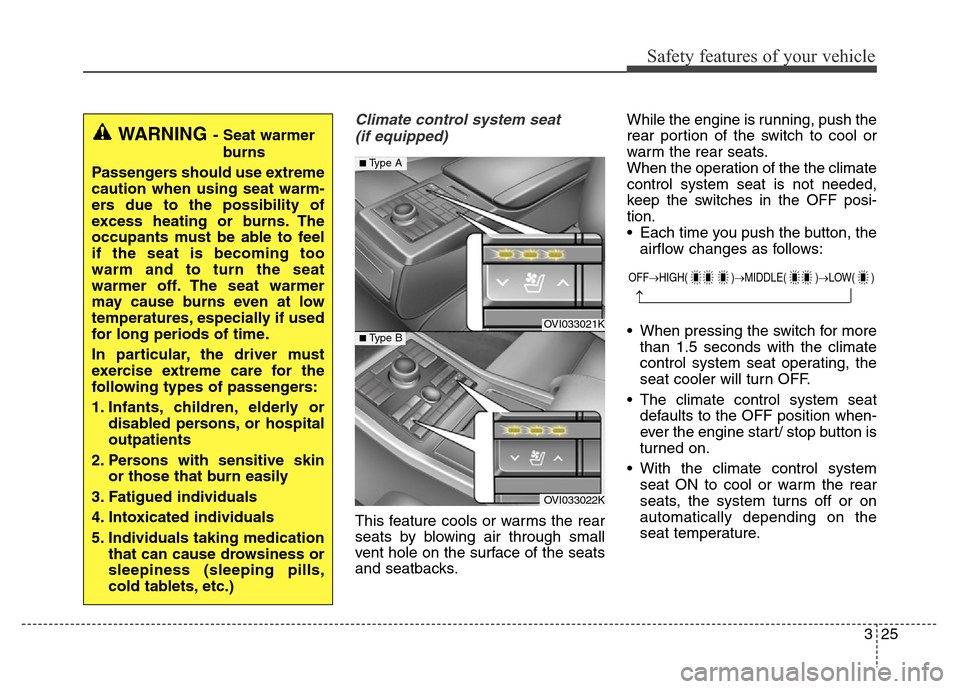
This feature cools or warms the rear
seats by blowing air through small
vent hole on the surface of the seats
and seatbacks.While the engine is running, push the
rear portion of the switch to cool or
warm the rear seats.
When the operation of the the climate
control system seat is not needed,
keep the switches in the OFF posi-
tion.
• Each time you push the button, the
airflow changes as follows:
• When pressing the switch for more
than 1.5 seconds with the climate
control system seat operating, the
seat cooler will turn OFF.
• The climate control system seat
defaults to the OFF position when-
ever the engine start/ stop button is
turned on.
• With the climate control system
seat ON to cool or warm the rear
seats, the system turns off or on
automatically depending on the
seat temperature.
WARNING- Seat warmer
burns
Passengers should use extreme
caution when using seat warm-
ers due to the possibility of
excess heating or burns. The
occupants must be able to feel
if the seat is becoming too
warm and to turn the seat
warmer off. The seat warmer
may cause burns even at low
temperatures, especially if used
for long periods of time.
In particular, the driver must
exercise extreme care for the
following types of passengers:
1. Infants, children, elderly or
disabled persons, or hospital
outpatients
2. Persons with sensitive skin
or those that burn easily
3. Fatigued individuals
4. Intoxicated individuals
5. Individuals taking medication
that can cause drowsiness or
sleepiness (sleeping pills,
cold tablets, etc.)
OVI033021K
OVI033022K
■Type A
■ Type B
OFF→HIGH( )→MIDDLE( )→LOW( )
→
Page 45 of 479
Safety features of your vehicle
26 3
CAUTION
• The climate control system
seat is a supplementary cool-
ing and warming system. Use
the climate control seat when
the climate control system is
on. Using the climate control
seat for prolonged periods of
time with the climate control
system off could cause the cli-
mate control seat perform-
ance to be reduced.
• When cleaning the seats, do
not use an organic solvent
such as thinner, benzene,
alcohol and gasoline. Doing
so may damage the surface of
the seats.
• Do not spill liquid such as
water or beverages on the sur-
face of the front seats and
seatbacks, or the air vent
holes may be blocked and pre-
vented from working properly.
(Continued)
(Continued)
• Do not place materials such
as plastic bags or newspapers
under the seats. The air vent
may not work properly as the
air intake can be blocked.
• Do not change the seat cover. It
may damage the climate control
system seat.
• When the air vent does not
operate, restart the vehicle. If
there is no change, we recom-
mend that the system be
inspected by an authorized
HYUNDAI dealer.
Page 56 of 479
337
Safety features of your vehicle
Seat belt precautionsInfant or small child
You should be aware of the specific
requirements in your country. Child
and/or infant seats must be properly
placed and installed in the rear seat.
For more information about the use
of these restraints, refer to “Child
restraint system” in this section.
✽NOTICE
Small children are best protected
from injury in an accident when
properly restrained in the rear seat
by a child restraint system that
meets the requirements of the Safety
Standards of your country. Before
buying any child restraint system,
make sure that it has a label certify-
ing that it meets Safety Standards of
your country. The restraint must be
appropriate for your child's height
and weight. Check the label on the
child restraint for this information.
Refer to “Child restraint system” in
this section.
WARNING
All occupants of the vehicle
must wear their seat belts at all
times. Seat belts and child
restraints reduce the risk of
serious or fatal injuries for all
occupants in the event of a col-
lision or sudden stop. Without a
seat belt, occupants could be
shifted too close to a deploying
air bag, strike the interior struc-
ture or be thrown from the vehi-
cle. Properly worn seat belts
greatly reduce these hazards.
Always follow the precautions
about seat belts, air bags and
occupant seating contained in
this manual.
WARNING
Every person in your vehicle
needs to be properly restrained
at all times, including infants
and children. Never hold a child
in your arms or lap when riding
in a vehicle. The violent forces
created during a crash will tear
the child from your arms and
throw the child against the inte-
rior. Always use a child restraint
appropriate for your child's
height and weight.
Page 58 of 479
339
Safety features of your vehicle
Do not lie down
To reduce the chance of injuries in
the event of an accident and to
achieve maximum effectiveness of
the restraint system, all passengers
should be sitting up and the front and
rear seats should be in an upright
position when the car is moving. A
seat belt cannot provide proper pro-
tection if the person is lying down in
the rear seat or if the front and rear
seats are in a reclined position.
Care of seat belts
Seat belt systems should never be
disassembled or modified. In addi-
tion, care should be taken to assure
that seat belts and belt hardware are
not damaged by seat hinges, doors
or other abuse.
Periodic inspection
All seat belts should be inspected
periodically for wear or damage of
any kind. Any damaged parts should
be replaced as soon as possible.
Keep belts clean and dry
Seat belts should be kept clean and
dry. If belts become dirty, they can be
cleaned by using a mild soap solu-
tion and warm water. Bleach, dye,
strong detergents or abrasives
should not be used because they
may damage and weaken the fabric.
When to replace seat belts
Entire in-use seat belt assembly or
assemblies should be replaced if the
vehicle has been involved in an acci-
dent. This should be done even if no
damage is visible. We recommend
that you consult an authorized
HYUNDAI dealer.
WARNING
Riding with a reclined seatback
increases your chance of seri-
ous or fatal injuries in the event
of a collision or sudden stop.
The protection of your restraint
system (seat belts and air bags)
is greatly reduced by reclining
your seat. Seat belts must be
snug against your hips and
chest to work properly.
(Continued)
(Continued)
The more the seatback is
reclined, the greater the chance
that an occupant's hips will
slide under the lap belt causing
serious internal injuries or the
occupant's neck could strike
the shoulder belt. Drivers and
passengers should always sit
well back in their seats, proper-
ly belted, and with the seat-
backs upright.
Page 59 of 479
Safety features of your vehicle
40 3
CHILD RESTRAINT SYSTEM
Children riding in the car should sit in
the rear seat and must always be
properly restrained to minimize the
risk of injury in an accident, sudden
stop or sudden maneuver. According
to accident statistics, children are
safer when properly restrained in the
rear seats than in the front seat.
Larger children not in a child restraint
should use one of the seat belts pro-
vided.
You should be aware of the specific
requirements in your country. Child
and/or infant safety seats must be
properly placed and installed in the
rear seat. You must use a commer-
cially available child restraint system
that meets the requirements of the
Safety Standards of your country.
Child restraint systems are designed
to be secured in vehicle seats by lap
belts or the lap belt portion of a
lap/shoulder belt, or by a tether
anchor and/or ISOFIX anchors (if
equipped).Children could be injured or killed in
a crash if their restraints are not
properly secured. For small children
and babies, a child seat or infant seat
must be used. Before buying a par-
ticular child restraint system, make
sure it fits your car seat and seat
belts, and fits your child. Follow all
the instructions provided by the man-
ufacturer when installing the child
restraint system.
WARNING
• A child restraint system must
be placed in the rear seat.
Never install a child or infant
seat on the front passenger's
seat. Should an accident
occur and cause the passen-
ger-side air bag to deploy, it
could severely injure or kill an
infant or child seated in an
infant or child seat. Thus only
use a child restraint in the
rear seat of your vehicle.
(Continued)
(Continued)
• A seat belt or child restraint
system can become very hot
if it is left in a closed vehicle
on a sunny day, even if the
outside temperature does not
feel hot. Be sure to check the
seat cover and buckles before
placing a child there.
• When the child restraint sys-
tem is not in use, store it in
the luggage area or fasten it
with a seat belt so that it will
not be thrown forward in the
case of a sudden stop or an
accident.
• Children may be seriously
injured or killed by an inflating
air bag. All children, even
those too large for child
restraints, must ride in the
rear seat.
Page 61 of 479
Safety features of your vehicle
42 3
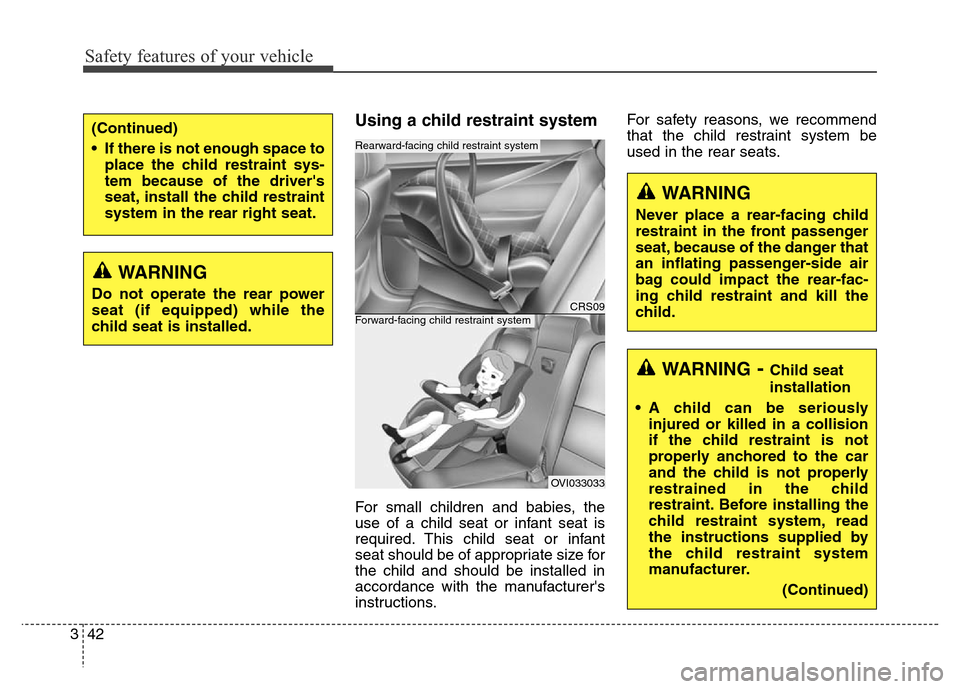
Using a child restraint system
For small children and babies, the
use of a child seat or infant seat is
required. This child seat or infant
seat should be of appropriate size for
the child and should be installed in
accordance with the manufacturer's
instructions.For safety reasons, we recommend
that the child restraint system be
used in the rear seats.
CRS09
OVI033033
Forward-facing child restraint system
Rearward-facing child restraint system
WARNING
Do not operate the rear power
seat (if equipped) while the
child seat is installed.
WARNING
Never place a rear-facing child
restraint in the front passenger
seat, because of the danger that
an inflating passenger-side air
bag could impact the rear-fac-
ing child restraint and kill the
child.
(Continued)
• If there is not enough space to
place the child restraint sys-
tem because of the driver's
seat, install the child restraint
system in the rear right seat.
WARNING- Child seat
installation
• A child can be seriously
injured or killed in a collision
if the child restraint is not
properly anchored to the car
and the child is not properly
restrained in the child
restraint. Before installing the
child restraint system, read
the instructions supplied by
the child restraint system
manufacturer.
(Continued)
Page 62 of 479
343
Safety features of your vehicle
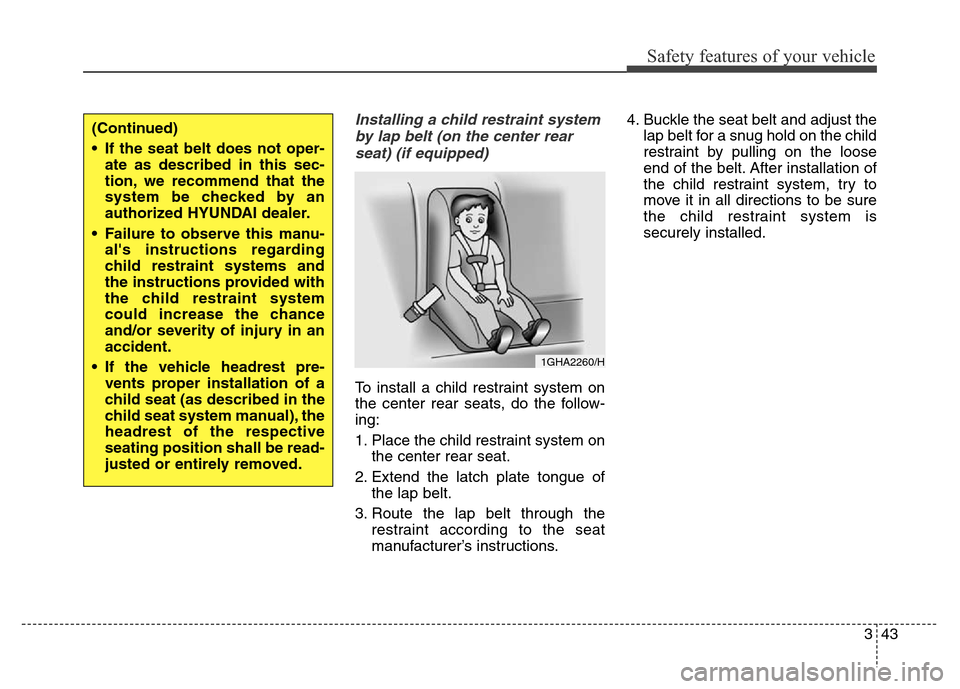
Installing a child restraint system
by lap belt (on the center rear
seat) (if equipped)
To install a child restraint system on
the center rear seats, do the follow-
ing:
1. Place the child restraint system on
the center rear seat.
2. Extend the latch plate tongue of
the lap belt.
3. Route the lap belt through the
restraint according to the seat
manufacturer’s instructions.4. Buckle the seat belt and adjust the
lap belt for a snug hold on the child
restraint by pulling on the loose
end of the belt. After installation of
the child restraint system, try to
move it in all directions to be sure
the child restraint system is
securely installed.
1GHA2260/H
(Continued)
• If the seat belt does not oper-
ate as described in this sec-
tion, we recommend that the
system be checked by an
authorized HYUNDAI dealer.
• Failure to observe this manu-
al's instructions regarding
child restraint systems and
the instructions provided with
the child restraint system
could increase the chance
and/or severity of injury in an
accident.
• If the vehicle headrest pre-
vents proper installation of a
child seat (as described in the
child seat system manual), the
headrest of the respective
seating position shall be read-
justed or entirely removed.
Page 63 of 479
Safety features of your vehicle
44 3
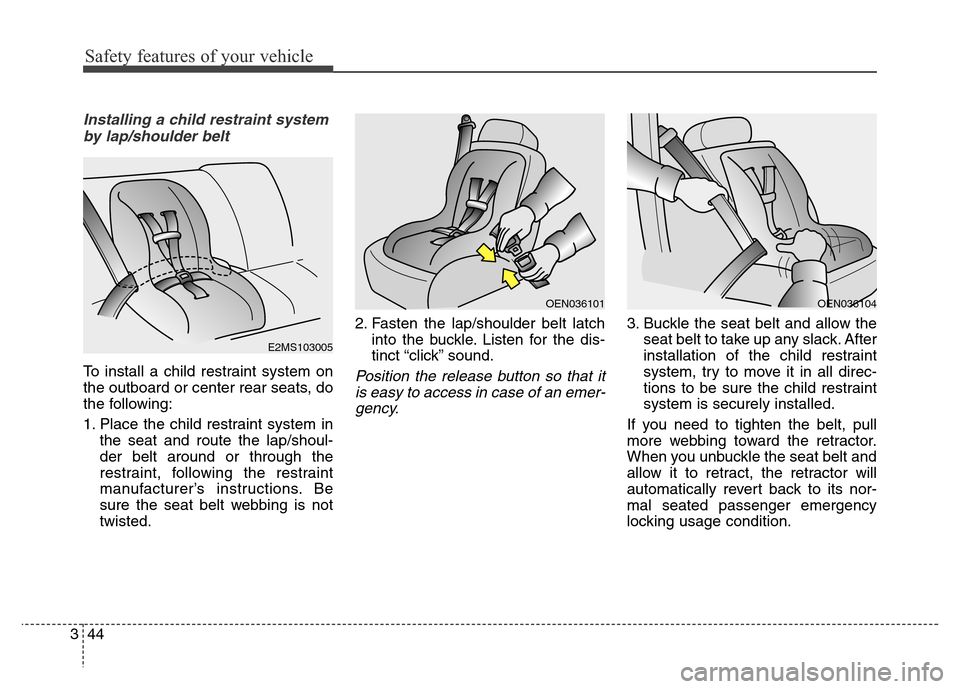
Installing a child restraint system
by lap/shoulder belt
To install a child restraint system on
the outboard or center rear seats, do
the following:
1. Place the child restraint system in
the seat and route the lap/shoul-
der belt around or through the
restraint, following the restraint
manufacturer’s instructions. Be
sure the seat belt webbing is not
twisted.2. Fasten the lap/shoulder belt latch
into the buckle. Listen for the dis-
tinct “click” sound.Position the release button so that it
is easy to access in case of an emer-
gency.
3. Buckle the seat belt and allow the
seat belt to take up any slack. After
installation of the child restraint
system, try to move it in all direc-
tions to be sure the child restraint
system is securely installed.
If you need to tighten the belt, pull
more webbing toward the retractor.
When you unbuckle the seat belt and
allow it to retract, the retractor will
automatically revert back to its nor-
mal seated passenger emergency
locking usage condition.
OEN036101OEN036104
E2MS103005