child seat Hyundai Equus 2013 Owner's Guide
[x] Cancel search | Manufacturer: HYUNDAI, Model Year: 2013, Model line: Equus, Model: Hyundai Equus 2013Pages: 479, PDF Size: 10.15 MB
Page 71 of 479
Safety features of your vehicle
52 3
Noise and smoke
When the air bags inflate, they make
a loud noise and they leave smoke
and powder in the air inside of the
vehicle. This is normal and is a result
of the ignition of the air bag inflator.
After the air bag inflates, you may
feel substantial discomfort in breath-
ing due to the contact of your chest
with both the seat belt and the air
bag, as well as from breathing the
smoke and powder.Open your
doors and/or windows as soon as
possible after impact in order to
reduce discomfort and prevent
prolonged exposure to the smoke
and powder.
Though the smoke and powder are
non-toxic, they may cause irritation
to the skin (eyes, nose and throat,
etc). If this is the case, wash and
rinse with cold water immediately
and consult a doctor if the symptom
persists.
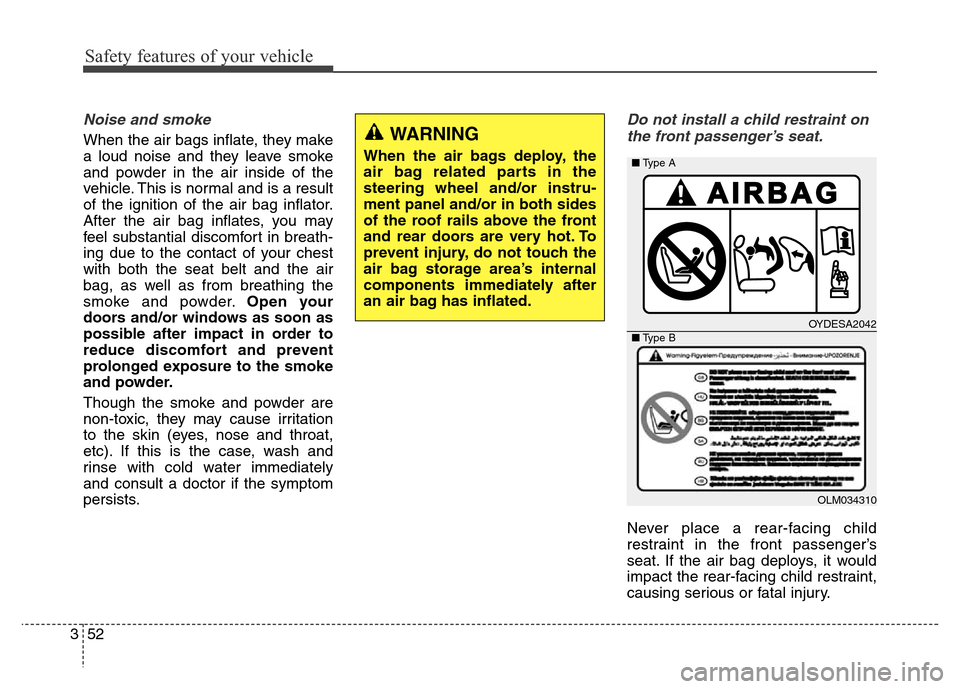
Do not install a child restraint on
the front passenger’s seat.
Never place a rear-facing child
restraint in the front passenger’s
seat. If the air bag deploys, it would
impact the rear-facing child restraint,
causing serious or fatal injury.
WARNING
When the air bags deploy, the
air bag related parts in the
steering wheel and/or instru-
ment panel and/or in both sides
of the roof rails above the front
and rear doors are very hot. To
prevent injury, do not touch the
air bag storage area’s internal
components immediately after
an air bag has inflated.
OYDESA2042
OLM034310 ■Type A
■Type B
Page 72 of 479
353
Safety features of your vehicle
In addition, do not place front-facing
child restraints in the front passen-
ger’s seat either. If the front passen-
ger air bag inflates, it could cause
serious or fatal injuries to the child.Air bag warning light
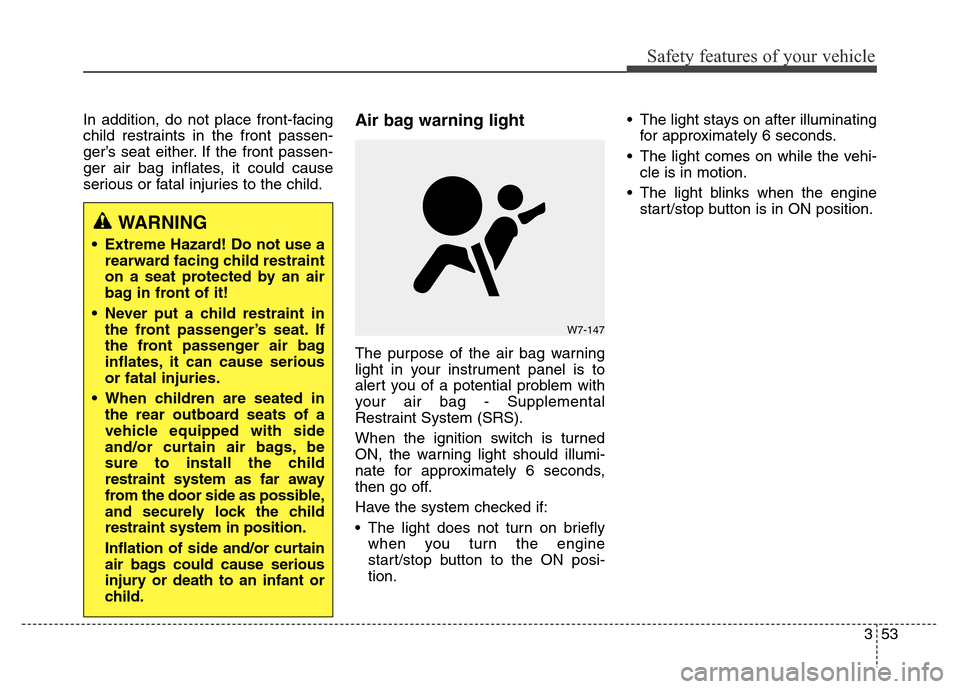
The purpose of the air bag warning
light in your instrument panel is to
alert you of a potential problem with
your air bag - Supplemental
Restraint System (SRS).
When the ignition switch is turned
ON, the warning light should illumi-
nate for approximately 6 seconds,
then go off.
Have the system checked if:
• The light does not turn on briefly
when you turn the engine
start/stop button to the ON posi-
tion.• The light stays on after illuminating
for approximately 6 seconds.
• The light comes on while the vehi-
cle is in motion.
• The light blinks when the engine
start/stop button is in ON position.
WARNING
• Extreme Hazard! Do not use a
rearward facing child restraint
on a seat protected by an air
bag in front of it!
• Never put a child restraint in
the front passenger’s seat. If
the front passenger air bag
inflates, it can cause serious
or fatal injuries.
• When children are seated in
the rear outboard seats of a
vehicle equipped with side
and/or curtain air bags, be
sure to install the child
restraint system as far away
from the door side as possible,
and securely lock the child
restraint system in position.
Inflation of side and/or curtain
air bags could cause serious
injury or death to an infant or
child.
W7-147
Page 77 of 479
Safety features of your vehicle
58 3
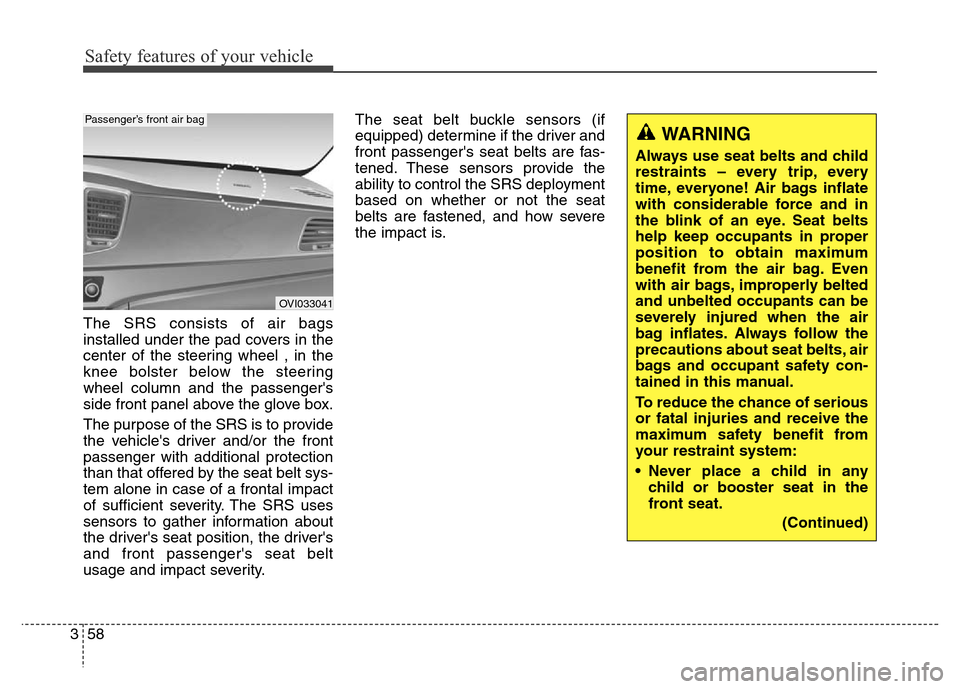
The SRS consists of air bags
installed under the pad covers in the
center of the steering wheel , in the
knee bolster below the steering
wheel column and the passenger's
side front panel above the glove box.
The purpose of the SRS is to provide
the vehicle's driver and/or the front
passenger with additional protection
than that offered by the seat belt sys-
tem alone in case of a frontal impact
of sufficient severity. The SRS uses
sensors to gather information about
the driver's seat position, the driver's
and front passenger's seat belt
usage and impact severity.The seat belt buckle sensors (if
equipped) determine if the driver and
front passenger's seat belts are fas-
tened. These sensors provide the
ability to control the SRS deployment
based on whether or not the seat
belts are fastened, and how severe
the impact is.
OVI033041
Passenger’s front air bag
WARNING
Always use seat belts and child
restraints – every trip, every
time, everyone! Air bags inflate
with considerable force and in
the blink of an eye. Seat belts
help keep occupants in proper
position to obtain maximum
benefit from the air bag. Even
with air bags, improperly belted
and unbelted occupants can be
severely injured when the air
bag inflates. Always follow the
precautions about seat belts, air
bags and occupant safety con-
tained in this manual.
To reduce the chance of serious
or fatal injuries and receive the
maximum safety benefit from
your restraint system:
• Never place a child in any
child or booster seat in the
front seat.
(Continued)
Page 78 of 479
359
Safety features of your vehicle
(Continued)
• No objects should be placed
over or near the air bag mod-
ules on the steering wheel,
instrument panel, driver’s side
knee bolster, and the front
passenger's panel above the
glove box, because any such
object could cause harm if the
vehicle is in a crash severe
enough to cause the air bags
to deploy.
• Do not tamper with or discon-
nect SRS wiring or other com-
ponents of the SRS system.
Doing so could result in injury,
due to accidental deployment
of the air bags or by rendering
the SRS inoperative.
• If the SRS air bag warning
light “ ”remains illuminat-
ed while the vehicle is being
driven, we recommend that
the system be replaced by an
authorized HYUNDAI dealer.
(Continued)(Continued)
• ABC – Always Buckle
Children in the back seat. It is
the safest place for children of
any age to ride.
• Front and side impact air bags
can injure occupants improp-
erly positioned.
• Move your seat as far back as
practical from the front air
bags, while still maintaining
control of the vehicle.
• You and your passengers
should never sit or lean
unnecessarily close to the air
bags. Improperly positioned
drivers and passengers can
be severely injured by inflat-
ing air bags.
• Never lean against the door or
center console – always sit in
an upright position.
(Continued)(Continued)
• Air bags can only be used
once - we recommend that the
system be replaced by an
authorized HYUNDAI dealer.
• The SRS is designed to deploy
the front air bags only when an
impact is sufficiently severe
and when the impact angle is
less than 30° from the forward
longitudinal axis of the vehi-
cle. Additionally, the air bags
will only deploy once. Seat
belts must be worn at all times.
• Front air bags are not intended
to deploy in side-impact, rear-
impact or rollover crashes. In
addition, front air bags will not
deploy in frontal crashes
below the deployment thresh-
old.
• A child restraint system must
never be placed in the front
seat. The infant or child could
be severely injured or killed by
an air bag deployment in case
of an accident.
(Continued)
Page 79 of 479
Safety features of your vehicle
60 3
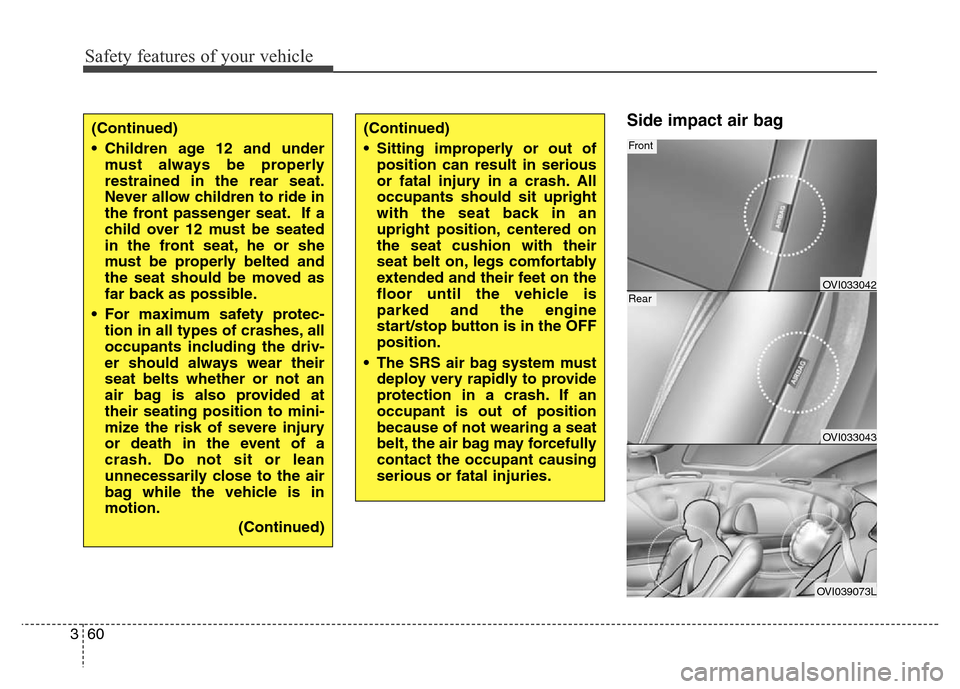
Side impact air bag (Continued)
• Children age 12 and under
must always be properly
restrained in the rear seat.
Never allow children to ride in
the front passenger seat. If a
child over 12 must be seated
in the front seat, he or she
must be properly belted and
the seat should be moved as
far back as possible.
• For maximum safety protec-
tion in all types of crashes, all
occupants including the driv-
er should always wear their
seat belts whether or not an
air bag is also provided at
their seating position to mini-
mize the risk of severe injury
or death in the event of a
crash. Do not sit or lean
unnecessarily close to the air
bag while the vehicle is in
motion.
(Continued)(Continued)
• Sitting improperly or out of
position can result in serious
or fatal injury in a crash. All
occupants should sit upright
with the seat back in an
upright position, centered on
the seat cushion with their
seat belt on, legs comfortably
extended and their feet on the
floor until the vehicle is
parked and the engine
start/stop button is in the OFF
position.
• The SRS air bag system must
deploy very rapidly to provide
protection in a crash. If an
occupant is out of position
because of not wearing a seat
belt, the air bag may forcefully
contact the occupant causing
serious or fatal injuries.
OVI033042
OVI033043
OVI039073L
Front
Rear
Page 81 of 479
Safety features of your vehicle
62 3
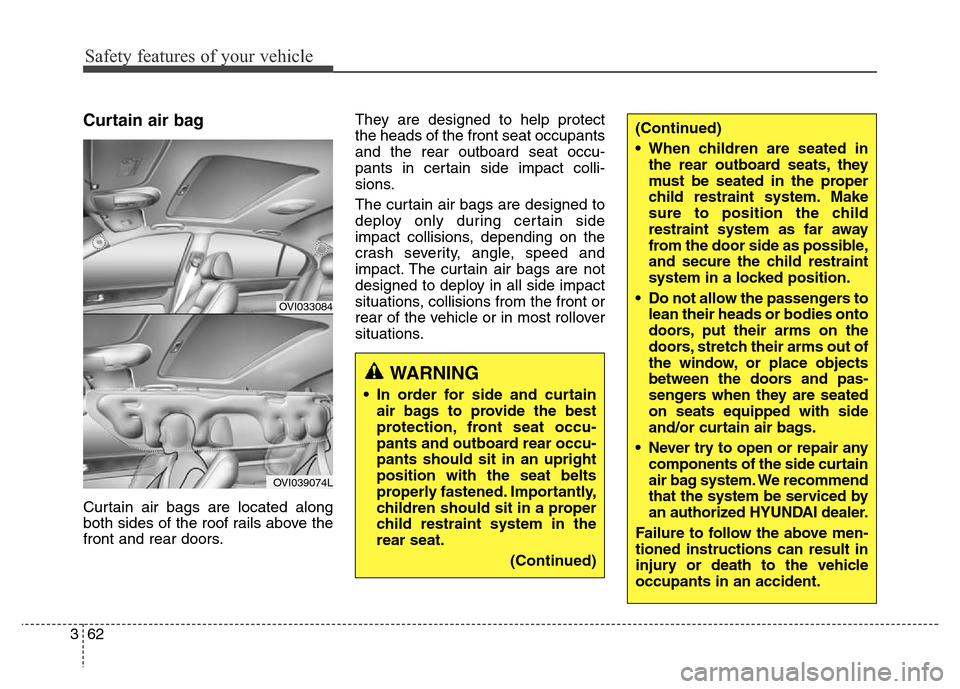
Curtain air bag
Curtain air bags are located along
both sides of the roof rails above the
front and rear doors.They are designed to help protect
the heads of the front seat occupants
and the rear outboard seat occu-
pants in certain side impact colli-
sions.
The curtain air bags are designed to
deploy only during certain side
impact collisions, depending on the
crash severity, angle, speed and
impact. The curtain air bags are not
designed to deploy in all side impact
situations, collisions from the front or
rear of the vehicle or in most rollover
situations.
WARNING
• In order for side and curtain
air bags to provide the best
protection, front seat occu-
pants and outboard rear occu-
pants should sit in an upright
position with the seat belts
properly fastened. Importantly,
children should sit in a proper
child restraint system in the
rear seat.
(Continued)
OVI033084
OVI039074L
(Continued)
• When children are seated in
the rear outboard seats, they
must be seated in the proper
child restraint system. Make
sure to position the child
restraint system as far away
from the door side as possible,
and secure the child restraint
system in a locked position.
• Do not allow the passengers to
lean their heads or bodies onto
doors, put their arms on the
doors, stretch their arms out of
the window, or place objects
between the doors and pas-
sengers when they are seated
on seats equipped with side
and/or curtain air bags.
• Never try to open or repair any
components of the side curtain
air bag system. We recommend
that the system be serviced by
an authorized HYUNDAI dealer.
Failure to follow the above men-
tioned instructions can result in
injury or death to the vehicle
occupants in an accident.
Page 88 of 479
369
Safety features of your vehicle
Additional safety precautions
• All occupants should sit upright, fully
back in their seats with their seat
belts on and their feet on the floor.
•Passengers should not move out
of or change seats while the vehi-
cle is moving.A passenger who is
not wearing a seat belt during a
crash or emergency stop can be
thrown against the inside of the vehi-
cle, against other occupants, or out
of the vehicle.
•Each seat belt is designed to
restrain one occupant.If more
than one person uses the same seat
belt, they could be seriously injured
or killed in a collision.
•Do not use any accessories on
seat belts.Devices claiming to
improve occupant comfort or reposi-
tion the seat belt can reduce the pro-
tection provided by the seat belt and
increase the chance of serious
injury in a crash.
•Passengers should not place
hard or sharp objects between
themselves and the air bags.
Carrying hard or sharp objects on
your lap or in your mouth can result
in injuries if an air bag inflates.•Keep occupants away from the
air bag covers.All occupants
should sit upright, fully back in their
seats with their seat belts on and
their feet on the floor. If occupants
are too close to the air bag covers,
they could be injured if the air bags
inflate.
•Do not attach or place objects on
or near the air bag covers.Any
object attached to or placed on the
front or side air bag covers could
interfere with the proper operation of
the air bags.
•Do not modify the front seats.
Modification of the front seats could
interfere with the operation of the
supplemental restraint system sens-
ing components or side air bags.
•Do not place items under the
front seats.Placing items under
the front seats could interfere with
the operation of the supplemental
restraint system sensing compo-
nents and wiring harnesses.•Never hold an infant or child on
your lap.The infant or child could
be seriously injured or killed in the
event of a crash. All infants and chil-
dren should be properly restrained
in appropriate child safety seats or
seat belts in the rear seat.
WARNING
• Sitting improperly or out of
position can cause occupants
to be shifted too close to a
deploying air bag, strike the
interior structure or be thrown
from the vehicle resulting in
serious injury or death.
• Always sit upright with the
seatback in an upright posi-
tion, centered on the seat
cushion with your seat belt
on, legs comfortably extended
and your feet on the floor.
Page 269 of 479
Driving your vehicle
12 5
For smooth operation, depress the
brake pedal when shifting from N
(Neutral) to a forward or reverse
gear.Transmission ranges
When ignition switch is off, cluster
and knob (transaxle lever) display
the shift lever position for 30 sec-
onds.
WARNING- Automatic
transmis-
sion
• Always check the surrounding
areas near your vehicle for
people, especially children,
before shifting a car into D
(Drive) or R (Reverse).
• Before leaving the driver’s
seat, always make sure the
shift lever is in the P (Park)
position; then set the parking
brake fully and shut the
engine off. Unexpected and
sudden vehicle movement
can occur if these precautions
are not followed in the order
identified.
• Do not use the engine brake
(shifting from a high gear to
lower gear) rapidly on slip-
pery roads. The vehicle may
slip causing an accident.
CAUTION
• To avoid damage to your
transmission, do not acceler-
ate the engine in R (Reverse)
or any forward gear position
with the brakes on.
• When stopped on an incline,
do not hold the vehicle sta-
tionary with engine power.
Use the service brake or the
parking brake.
• Do not shift from N (Neutral)
or P (Park) into D (Drive), or R
(Reverse) when the engine is
above idle speed.