brakes Hyundai Equus 2013 Owner's Guide
[x] Cancel search | Manufacturer: HYUNDAI, Model Year: 2013, Model line: Equus, Model: Hyundai Equus 2013Pages: 479, PDF Size: 10.15 MB
Page 384 of 479
629
What to do in an emergency
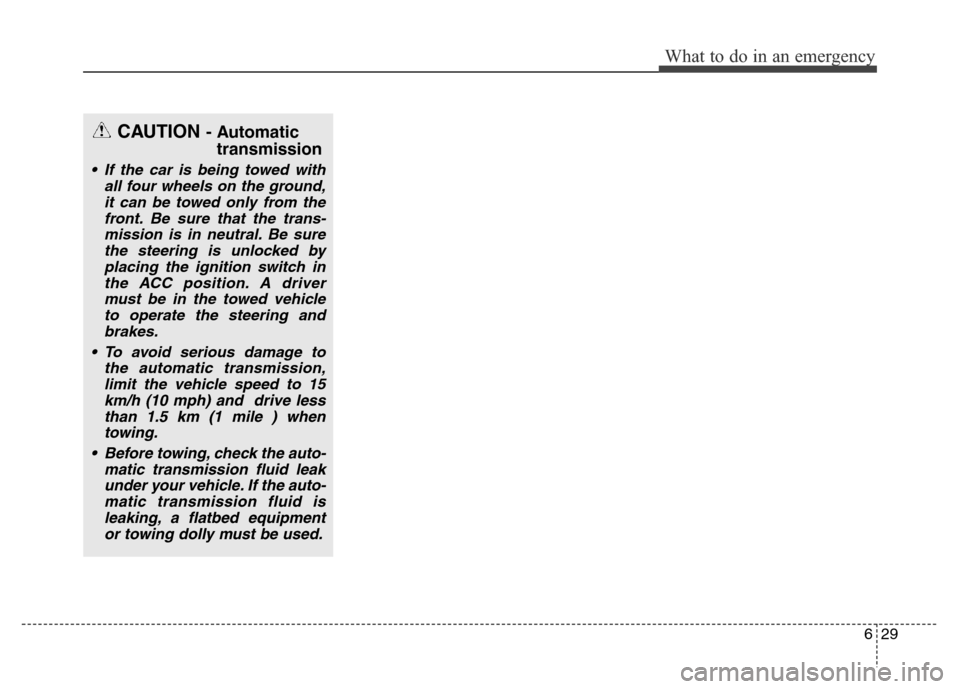
CAUTION - Automatic
transmission
• If the car is being towed with
all four wheels on the ground,
it can be towed only from the
front. Be sure that the trans-
mission is in neutral. Be sure
the steering is unlocked by
placing the ignition switch in
the ACC position. A driver
must be in the towed vehicle
to operate the steering and
brakes.
• To avoid serious damage to
the automatic transmission,
limit the vehicle speed to 15
km/h (10 mph) and drive less
than 1.5 km (1 mile ) when
towing.
• Before towing, check the auto-
matic transmission fluid leak
under your vehicle. If the auto-
matic transmission fluid is
leaking, a flatbed equipment
or towing dolly must be used.
Page 394 of 479
79
Maintenance
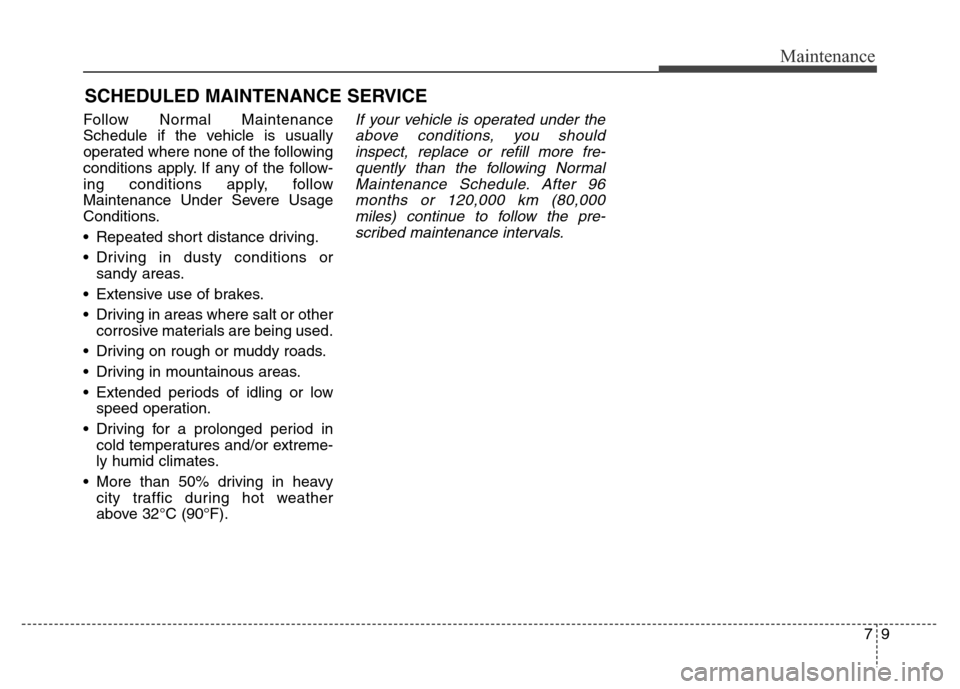
SCHEDULED MAINTENANCE SERVICE
Follow Normal Maintenance
Schedule if the vehicle is usually
operated where none of the following
conditions apply. If any of the follow-
ing conditions apply, follow
Maintenance Under Severe Usage
Conditions.
• Repeated short distance driving.
• Driving in dusty conditions or
sandy areas.
• Extensive use of brakes.
• Driving in areas where salt or other
corrosive materials are being used.
• Driving on rough or muddy roads.
• Driving in mountainous areas.
• Extended periods of idling or low
speed operation.
• Driving for a prolonged period in
cold temperatures and/or extreme-
ly humid climates.
• More than 50% driving in heavy
city traffic during hot weather
above 32°C (90°F).If your vehicle is operated under the
above conditions, you should
inspect, replace or refill more fre-
quently than the following Normal
Maintenance Schedule. After 96
months or 120,000 km (80,000
miles) continue to follow the pre-
scribed maintenance intervals.
Page 397 of 479
Maintenance
12 7
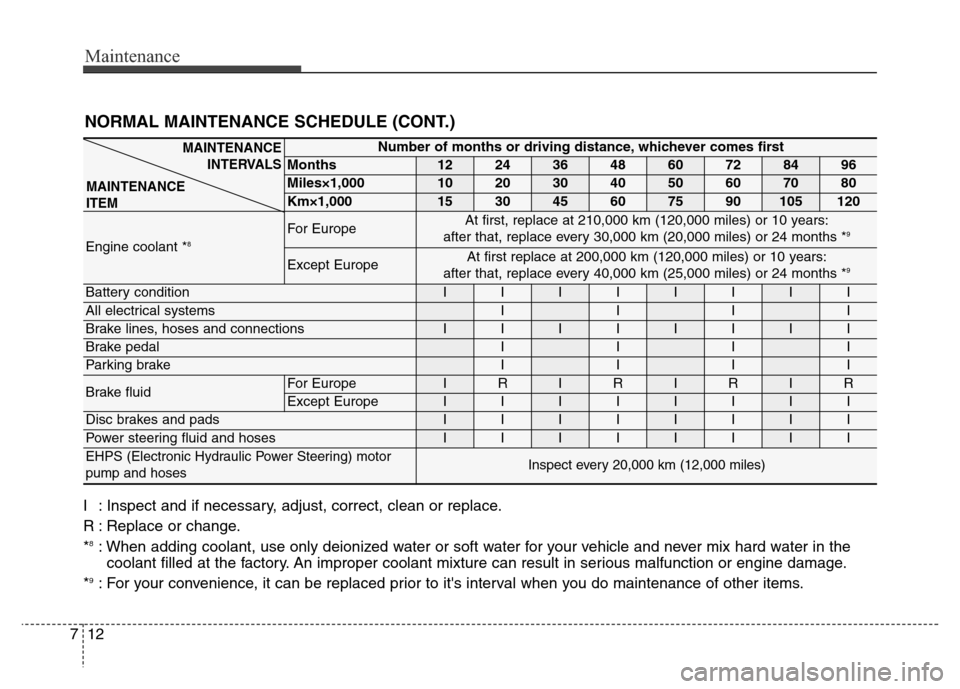
NORMAL MAINTENANCE SCHEDULE (CONT.)
I : Inspect and if necessary, adjust, correct, clean or replace.
R : Replace or change.
*
8: When adding coolant, use only deionized water or soft water for your vehicle and never mix hard water in the
coolant filled at the factory. An improper coolant mixture can result in serious malfunction or engine damage.
*
9: For your convenience, it can be replaced prior to it's interval when you do maintenance of other items.
Number of months or driving distance, whichever comes first
Months1224364860728496
Miles×1,0001020304050607080
Km×1,000153045607590105120
Engine coolant *8For EuropeAt first, replace at 210,000 km (120,000 miles) or 10 years:
after that, replace every 30,000 km (20,000 miles) or 24 months *9
Except EuropeAt first replace at 200,000 km (120,000 miles) or 10 years:
after that, replace every 40,000 km (25,000 miles) or 24 months *9
Battery conditionIIIIIIII
All electrical systemsIIII
Brake lines, hoses and connectionsIIIIIIII
Brake pedalIIII
Parking brakeIIII
Brake fluidFor EuropeIRIRIRIR
Except EuropeIIIIIIII
Disc brakes and padsIIIIIIII
Power steering fluid and hosesIIIIIIII
EHPS (Electronic Hydraulic Power Steering) motor
pump and hoses Inspect every 20,000 km (12,000 miles)
MAINTENANCE
INTERVALS
MAINTENANCE
ITEM
Page 399 of 479
Maintenance
14 7
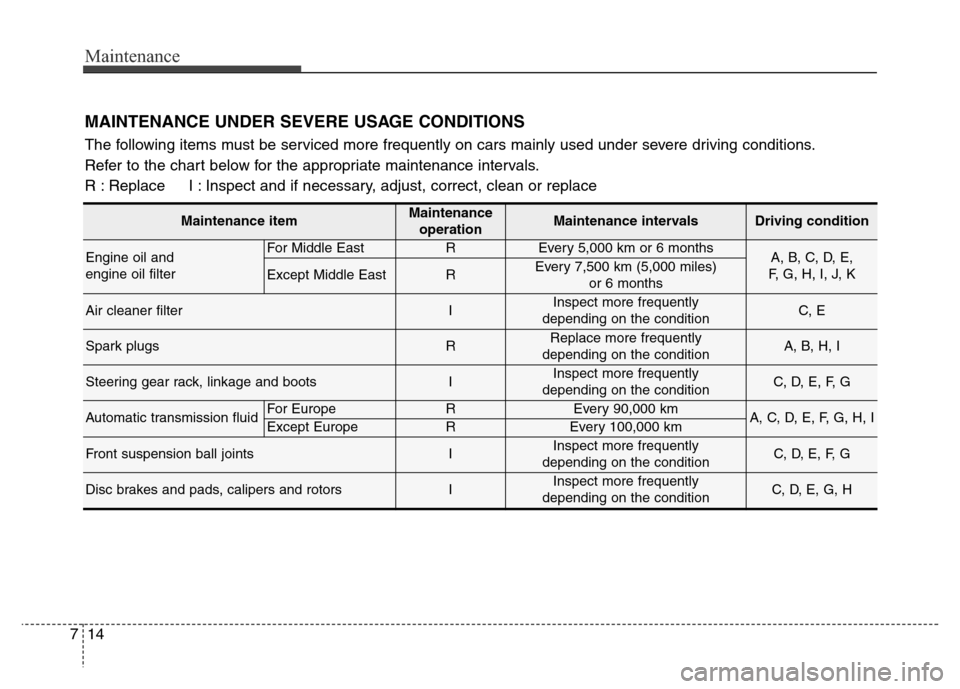
Maintenance itemMaintenance
operationMaintenance intervalsDriving condition
Engine oil and
engine oil filterFor Middle EastREvery 5,000 km or 6 monthsA, B, C, D, E,
F, G, H, I, J, K
Except Middle EastREvery 7,500 km (5,000 miles)
or 6 months
Air cleaner filterIInspect more frequently
depending on the conditionC, E
Spark plugs RReplace more frequently
depending on the conditionA, B, H, I
Steering gear rack, linkage and bootsIInspect more frequently
depending on the conditionC, D, E, F, G
Automatic transmission fluidFor EuropeREvery 90,000 kmA, C, D, E, F, G, H, IExcept EuropeREvery 100,000 km
Front suspension ball jointsIInspect more frequently
depending on the conditionC, D, E, F, G
Disc brakes and pads, calipers and rotorsIInspect more frequently
depending on the conditionC, D, E, G, H
MAINTENANCE UNDER SEVERE USAGE CONDITIONS
The following items must be serviced more frequently on cars mainly used under severe driving conditions.
Refer to the chart below for the appropriate maintenance intervals.
R : Replace I : Inspect and if necessary, adjust, correct, clean or replace
Page 460 of 479
775
Maintenance
Exterior care
Exterior general caution
It is very important to follow the label
directions when using any chemical
cleaner or polish. Read all warning
and caution statements that appear
on the label.
Finish maintenance
Washing
To help protect your vehicle’s finish
from rust and deterioration, wash it
thoroughly and frequently at least
once a month with lukewarm or cold
water.
If you use your vehicle for off-road
driving, you should wash it after each
off-road trip. Pay special attention to
the removal of any accumulation of
salt, dirt, mud, and other foreign
materials. Make sure the drain holes
in the lower edges of the doors and
rocker panels are kept clear and
clean.
Insects, tar, tree sap, bird droppings,
industrial pollution and similar
deposits can damage your vehicle’s
finish if not removed immediately.Even prompt washing with plain
water may not completely remove all
these deposits. A mild soap, safe for
use on painted surfaces, may be
used.
After washing, rinse the vehicle thor-
oughly with lukewarm or cold water.
Do not allow soap to dry on the fin-
ish.
APPEARANCE CARE
CAUTION
• Do not use strong soap, chem-
ical detergents or hot water,
and do not wash the vehicle in
direct sunlight or when the
body of the vehicle is warm.
• Be careful when washing the
side windows of your vehicle.
Especially, with high-pressure
water, water may leak through
the windows and wet the inte-
rior.
• To prevent damage to the
plastic parts and lamps, do
not clean with chemical sol-
vents or strong detergents.
WARNING - Wet brakes
After washing the vehicle, test
the brakes while driving slowly
to see if they have been affected
by water. If braking performance
is impaired, dry the brakes by
applying them lightly while
maintaining a slow forward
speed.
Page 463 of 479
Maintenance
78 7
Aluminum wheel maintenance
The aluminum wheels are coated
with a clear protective finish.
• Do not use any abrasive cleaner,
polishing compound, solvent, or
wire brushes on aluminum wheels.
They may scratch or damage the
finish.
• Clean the wheel when it has
cooled.
• Use only a mild soap or neutral
detergent, and rinse thoroughly
with water. Also, be sure to clean
the wheels after driving on salted
roads. This helps prevent corrosion.
• Avoid washing the wheels with
high-speed car wash brushes.
• Do not use any alkaline or acid
detergent. It may damage and cor-
rode the aluminum wheels coated
with a clear protective finish.
Corrosion protection
Protecting your vehicle from corro-
sion
By using the most advanced design
and construction practices to combat
corrosion, we produces cars of the
highest quality. However, this is only
part of the job. To achieve the long-
term corrosion resistance your vehi-
cle can deliver, the owner's coopera-
tion and assistance is also required.
Common causes of corrosion
The most common causes of corro-
sion on your car are:
• Road salt, dirt and moisture that is
allowed to accumulate underneath
the vehicle.
• Removal of paint or protective
coatings by stones, gravel, abra-
sion or minor scrapes and dents
which leave unprotected metal
exposed to corrosion.WARNING
After washing the vehicle, test
the brakes while driving slowly
to see if they have been affected
by water. If braking performance
is impaired, dry the brakes by
applying them lightly while
maintaining a slow forward
speed.