belt Hyundai Equus 2013 Repair Manual
[x] Cancel search | Manufacturer: HYUNDAI, Model Year: 2013, Model line: Equus, Model: Hyundai Equus 2013Pages: 479, PDF Size: 10.15 MB
Page 403 of 479
Maintenance
18 7
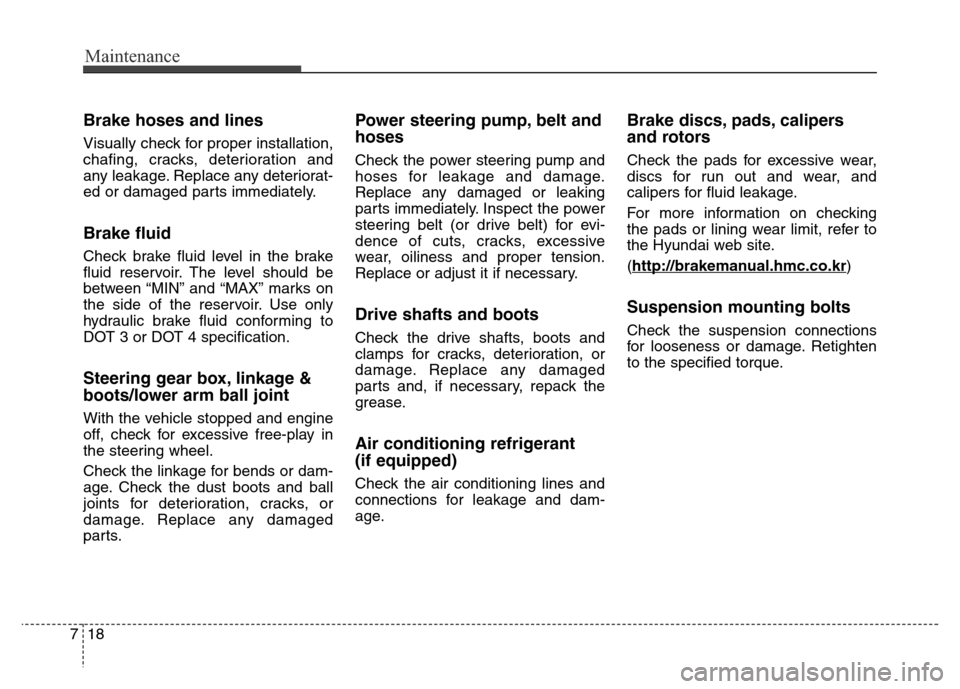
Brake hoses and lines
Visually check for proper installation,
chafing, cracks, deterioration and
any leakage. Replace any deteriorat-
ed or damaged parts immediately.
Brake fluid
Check brake fluid level in the brake
fluid reservoir. The level should be
between “MIN” and “MAX” marks on
the side of the reservoir. Use only
hydraulic brake fluid conforming to
DOT 3 or DOT 4 specification.
Steering gear box, linkage &
boots/lower arm ball joint
With the vehicle stopped and engine
off, check for excessive free-play in
the steering wheel.
Check the linkage for bends or dam-
age. Check the dust boots and ball
joints for deterioration, cracks, or
damage. Replace any damaged
parts.
Power steering pump, belt and
hoses
Check the power steering pump and
hoses for leakage and damage.
Replace any damaged or leaking
parts immediately. Inspect the power
steering belt (or drive belt) for evi-
dence of cuts, cracks, excessive
wear, oiliness and proper tension.
Replace or adjust it if necessary.
Drive shafts and boots
Check the drive shafts, boots and
clamps for cracks, deterioration, or
damage. Replace any damaged
parts and, if necessary, repack the
grease.
Air conditioning refrigerant
(if equipped)
Check the air conditioning lines and
connections for leakage and dam-
age.
Brake discs, pads, calipers
and rotors
Check the pads for excessive wear,
discs for run out and wear, and
calipers for fluid leakage.
For more information on checking
the pads or lining wear limit, refer to
the Hyundai web site.
(http://brakeman
ual.hmc.co.kr)
Suspension mounting bolts
Check the suspension connections
for looseness or damage. Retighten
to the specified torque.
Page 431 of 479
Maintenance
46 7
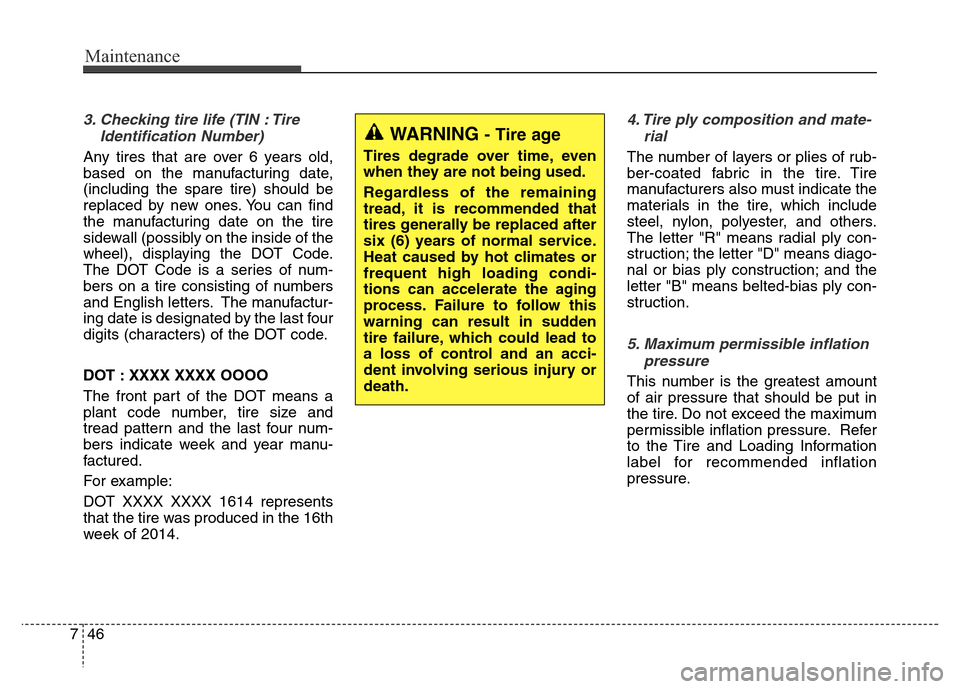
3. Checking tire life (TIN : Tire
Identification Number)
Any tires that are over 6 years old,
based on the manufacturing date,
(including the spare tire) should be
replaced by new ones. You can find
the manufacturing date on the tire
sidewall (possibly on the inside of the
wheel), displaying the DOT Code.
The DOT Code is a series of num-
bers on a tire consisting of numbers
and English letters. The manufactur-
ing date is designated by the last four
digits (characters) of the DOT code.
DOT : XXXX XXXX OOOO
The front part of the DOT means a
plant code number, tire size and
tread pattern and the last four num-
bers indicate week and year manu-
factured.
For example:
DOT XXXX XXXX 1614 represents
that the tire was produced in the 16th
week of 2014.
4. Tire ply composition and mate-
rial
The number of layers or plies of rub-
ber-coated fabric in the tire. Tire
manufacturers also must indicate the
materials in the tire, which include
steel, nylon, polyester, and others.
The letter "R" means radial ply con-
struction; the letter "D" means diago-
nal or bias ply construction; and the
letter "B" means belted-bias ply con-
struction.
5. Maximum permissible inflation
pressure
This number is the greatest amount
of air pressure that should be put in
the tire. Do not exceed the maximum
permissible inflation pressure. Refer
to the Tire and Loading Information
label for recommended inflation
pressure.
WARNING - Tire age
Tires degrade over time, even
when they are not being used.
Regardless of the remaining
tread, it is recommended that
tires generally be replaced after
six (6) years of normal service.
Heat caused by hot climates or
frequent high loading condi-
tions can accelerate the aging
process. Failure to follow this
warning can result in sudden
tire failure, which could lead to
a loss of control and an acci-
dent involving serious injury or
death.
Page 440 of 479
755
Maintenance
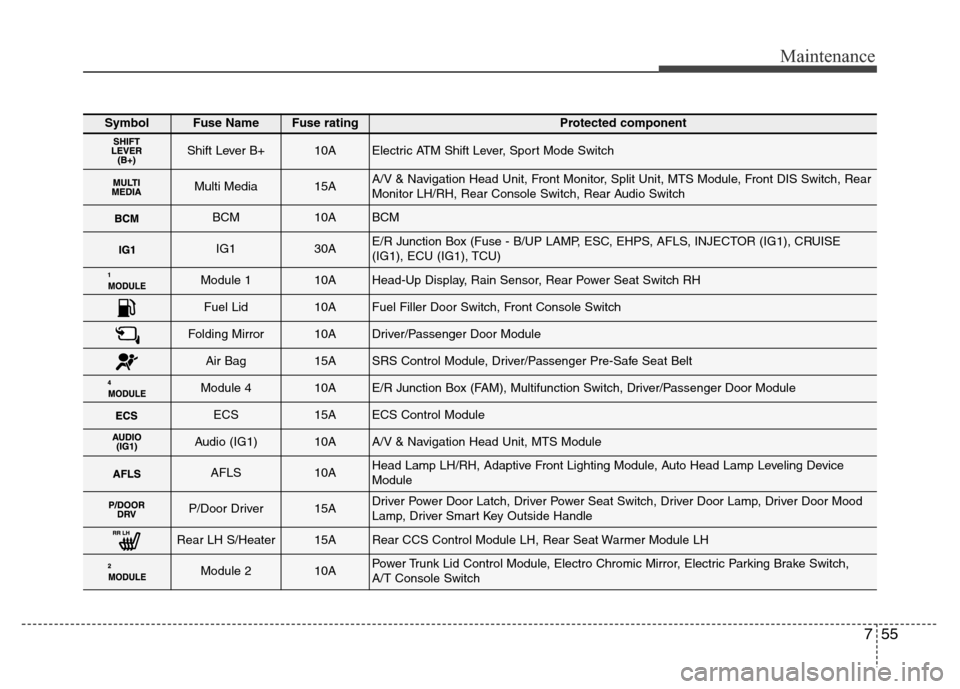
SymbolFuse NameFuse ratingProtected component
Shift Lever B+10AElectric ATM Shift Lever, Sport Mode Switch
Multi Media15AA/V & Navigation Head Unit, Front Monitor, Split Unit, MTS Module, Front DIS Switch, Rear
Monitor LH/RH, Rear Console Switch, Rear Audio Switch
BCM10ABCM
IG130AE/R Junction Box (Fuse - B/UP LAMP, ESC, EHPS, AFLS, INJECTOR (IG1), CRUISE
(IG1), ECU (IG1), TCU)
Module 110AHead-Up Display, Rain Sensor, Rear Power Seat Switch RH
Fuel Lid10AFuel Filler Door Switch, Front Console Switch
Folding Mirror10ADriver/Passenger Door Module
Air Bag15ASRS Control Module, Driver/Passenger Pre-Safe Seat Belt
Module 410AE/R Junction Box (FAM), Multifunction Switch, Driver/Passenger Door Module
ECS15AECS Control Module
Audio (IG1)10AA/V & Navigation Head Unit, MTS Module
AFLS10AHead Lamp LH/RH, Adaptive Front Lighting Module, Auto Head Lamp Leveling Device
Module
P/Door Driver15ADriver Power Door Latch, Driver Power Seat Switch, Driver Door Lamp, Driver Door Mood
Lamp, Driver Smart Key Outside Handle
Rear LH S/Heater15ARear CCS Control Module LH, Rear Seat Warmer Module LH
Module 210APower Trunk Lid Control Module, Electro Chromic Mirror, Electric Parking Brake Switch,
A/T Console Switch
Page 448 of 479
763
Maintenance
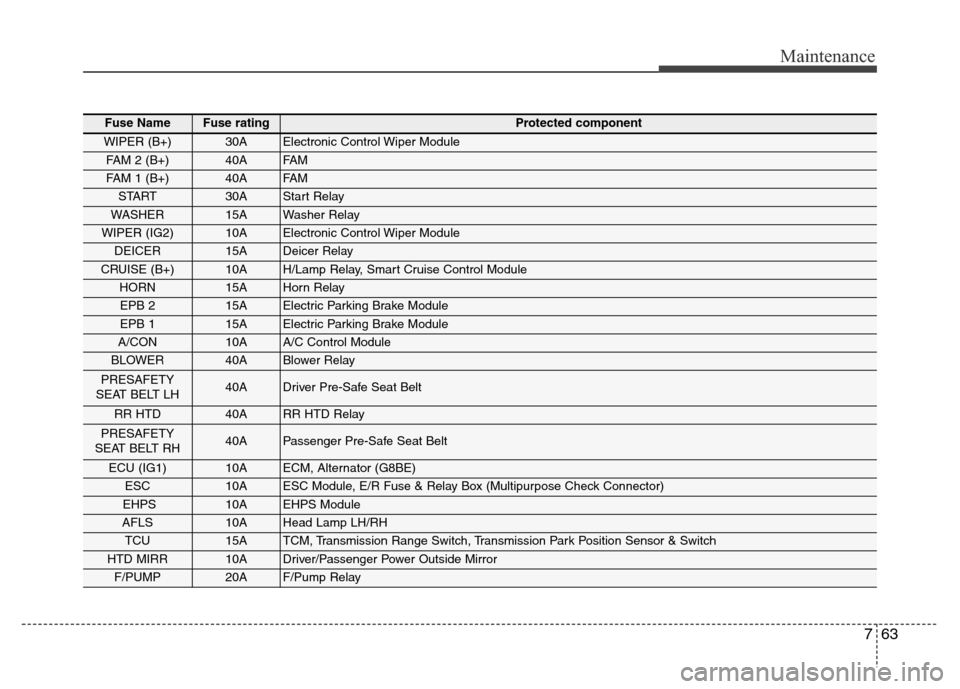
Fuse NameFuse ratingProtected component
WIPER (B+)30AElectronic Control Wiper Module
FAM 2 (B+)40AFA M
FAM 1 (B+)40AFA M
START30AStart Relay
WASHER15AWasher Relay
WIPER (IG2)10AElectronic Control Wiper Module
DEICER15ADeicer Relay
CRUISE (B+)10AH/Lamp Relay, Smart Cruise Control Module
HORN15AHorn Relay
EPB 215AElectric Parking Brake Module
EPB 115AElectric Parking Brake Module
A/CON10AA/C Control Module
BLOWER40ABlower Relay
PRESAFETY
SEAT BELT LH40ADriver Pre-Safe Seat Belt
RR HTD40ARR HTD Relay
PRESAFETY
SEAT BELT RH40APassenger Pre-Safe Seat Belt
ECU (IG1)10AECM, Alternator (G8BE)
ESC10AESC Module, E/R Fuse & Relay Box (Multipurpose Check Connector)
EHPS10AEHPS Module
AFLS10AHead Lamp LH/RH
TCU15ATCM, Transmission Range Switch, Transmission Park Position Sensor & Switch
HTD MIRR10ADriver/Passenger Power Outside Mirror
F/PUMP20AF/Pump Relay
Page 466 of 479
781
Maintenance
Cleaning the upholstery and inte-
rior trim
Vinyl
Remove dust and loose dirt from
vinyl with a whisk broom or vacuum
cleaner. Clean vinyl surfaces with a
vinyl cleaner.
Fabric
Remove dust and loose dirt from fab-
ric with a whisk broom or vacuum
cleaner. Clean with a mild soap solu-
tion recommended for upholstery or
carpets. Remove fresh spots imme-
diately with a fabric spot cleaner. If
fresh spots do not receive immediate
attention, the fabric can be stained
and its color can be affected. Also, its
fire-resistant properties can be
reduced if the material is not proper-
ly maintained.
Cleaning the lap/shoulder belt
webbing
Clean the belt webbing with any mild
soap solution recommended for
cleaning upholstery or carpet. Follow
the instructions provided with the
soap. Do not bleach or re-dye the
webbing because this may weaken
it.
Cleaning the interior window
glass
If the interior glass surfaces of the
vehicle become fogged (that is, cov-
ered with an oily, greasy or waxy
film), they should be cleaned with
glass cleaner. Follow the directions
on the glass cleaner container.
CAUTION
When cleaning leather products
(steering wheel, seats etc.), use
neutral detergents or low alco-
hol content solutions. If you use
high alcohol content solutions
or acid/alkaline detergents, the
color of the leather may fade or
the surface may get stripped off.
CAUTION
Using anything but recommend-
ed cleaners and procedures
may affect the fabric’s appear-
ance and fire-resistant proper-
ties.
CAUTION
Do not scrape or scratch the
inside of the rear window. This
may result in damage to the rear
window defroster grid.