stop start Hyundai Equus 2016 Owners Manual
[x] Cancel search | Manufacturer: HYUNDAI, Model Year: 2016, Model line: Equus, Model: Hyundai Equus 2016Pages: 477, PDF Size: 16.25 MB
Page 354 of 477
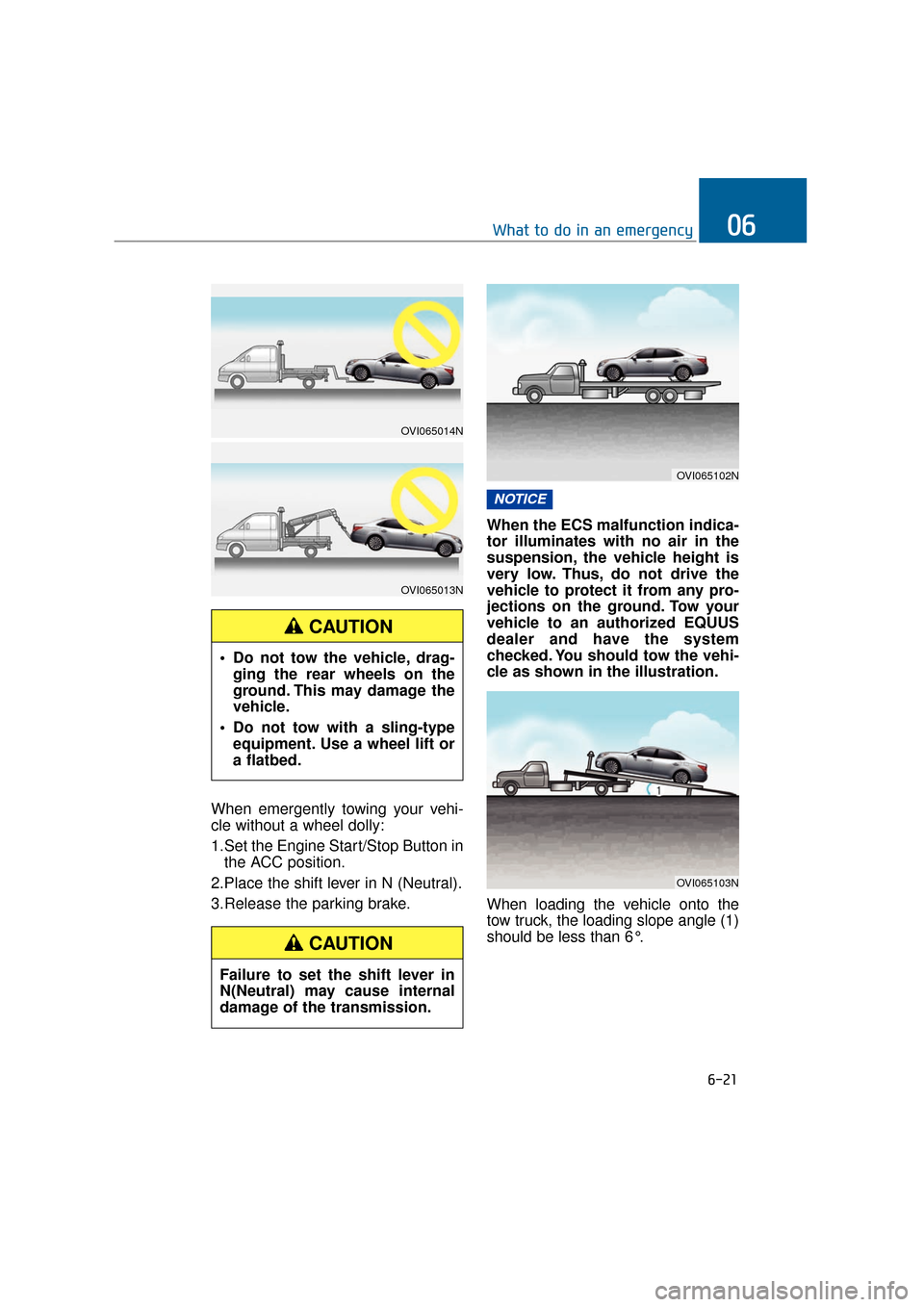
When emergently towing your vehi-
cle without a wheel dolly:
1.Set the Engine Start/Stop Button inthe ACC position.
2.Place the shift lever in N (Neutral).
3.Release the parking brake. When the ECS malfunction indica-
tor illuminates with no air in the
suspension, the vehicle height is
very low. Thus, do not drive the
vehicle to protect it from any pro-
jections on the ground. Tow your
vehicle to an authorized EQUUS
dealer and have the system
checked. You should tow the vehi-
cle as shown in the illustration.
When loading the vehicle onto the
tow truck, the loading slope angle (1)
should be less than 6°.
NOTICE
6-21
What to do in an emergency06
Do not tow the vehicle, drag-
ging the rear wheels on the
ground. This may damage the
vehicle.
Do not tow with a sling-type equipment. Use a wheel lift or
a flatbed.
CAUTION
Failure to set the shift lever in
N(Neutral) may cause internal
damage of the transmission.
CAUTION
OVI065102N
OVI065103N
OVI065014N
OVI065013N
Page 357 of 477
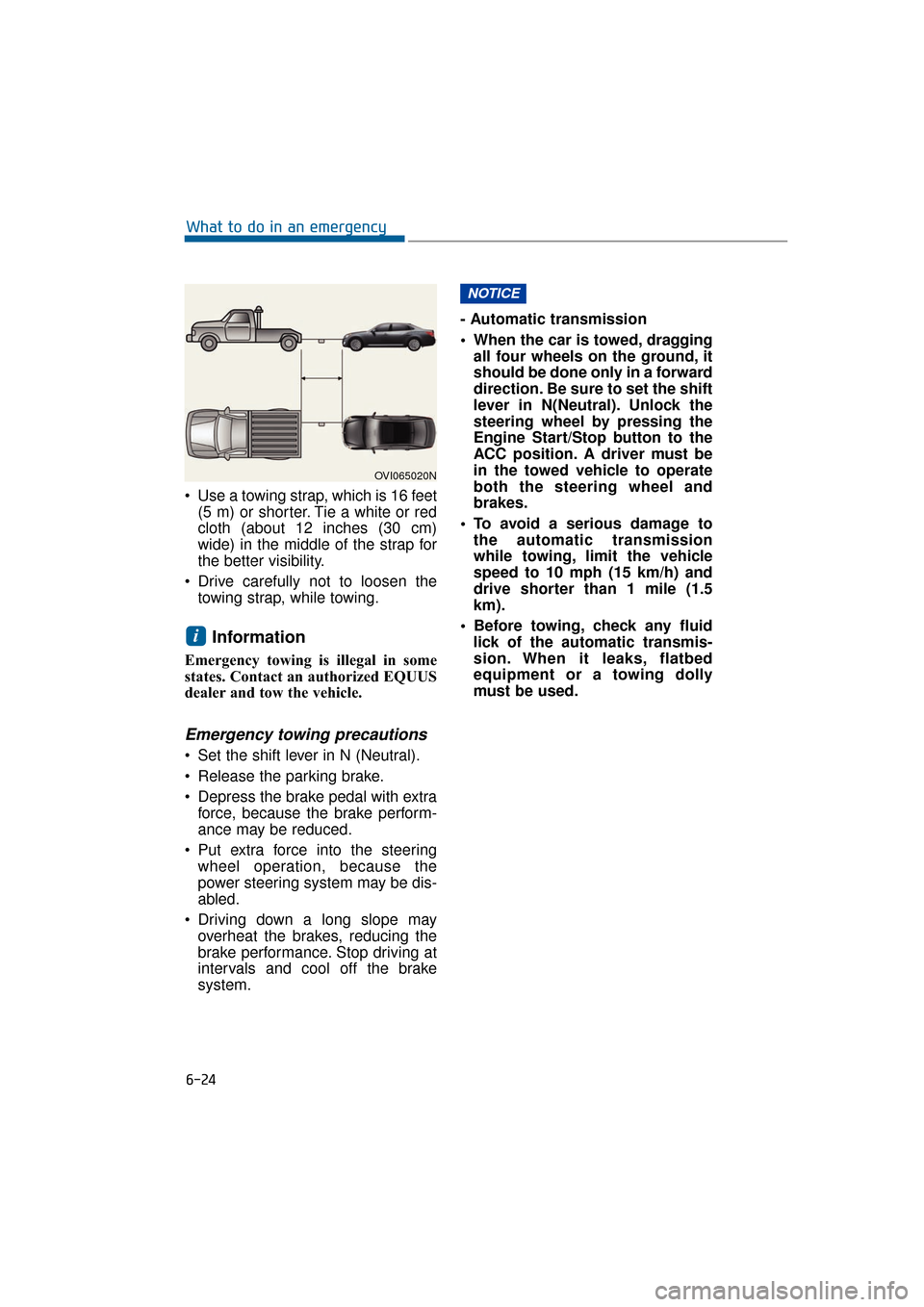
Use a towing strap, which is 16 feet(5 m) or shorter. Tie a white or red
cloth (about 12 inches (30 cm)
wide) in the middle of the strap for
the better visibility.
Drive carefully not to loosen the towing strap, while towing.
Information
Emergency towing is illegal in some
states. Contact an authorized EQUUS
dealer and tow the vehicle.
Emergency towing precautions
Set the shift lever in N (Neutral).
Release the parking brake.
Depress the brake pedal with extraforce, because the brake perform-
ance may be reduced.
Put extra force into the steering wheel operation, because the
power steering system may be dis-
abled.
Driving down a long slope may overheat the brakes, reducing the
brake performance. Stop driving at
intervals and cool off the brake
system. - Automatic transmission
When the car is towed, dragging
all four wheels on the ground, it
should be done only in a forward
direction. Be sure to set the shift
lever in N(Neutral). Unlock the
steering wheel by pressing the
Engine Start/Stop button to the
ACC position. A driver must be
in the towed vehicle to operate
both the steering wheel and
brakes.
To avoid a serious damage to the automatic transmission
while towing, limit the vehicle
speed to 10 mph (15 km/h) and
drive shorter than 1 mile (1.5
km).
Before towing, check any fluid lick of the automatic transmis-
sion. When it leaks, flatbed
equipment or a towing dolly
must be used.
NOTICE
i
6-24
What to do in an emergency
OVI065020N
Page 379 of 477
7-22
Maintenance
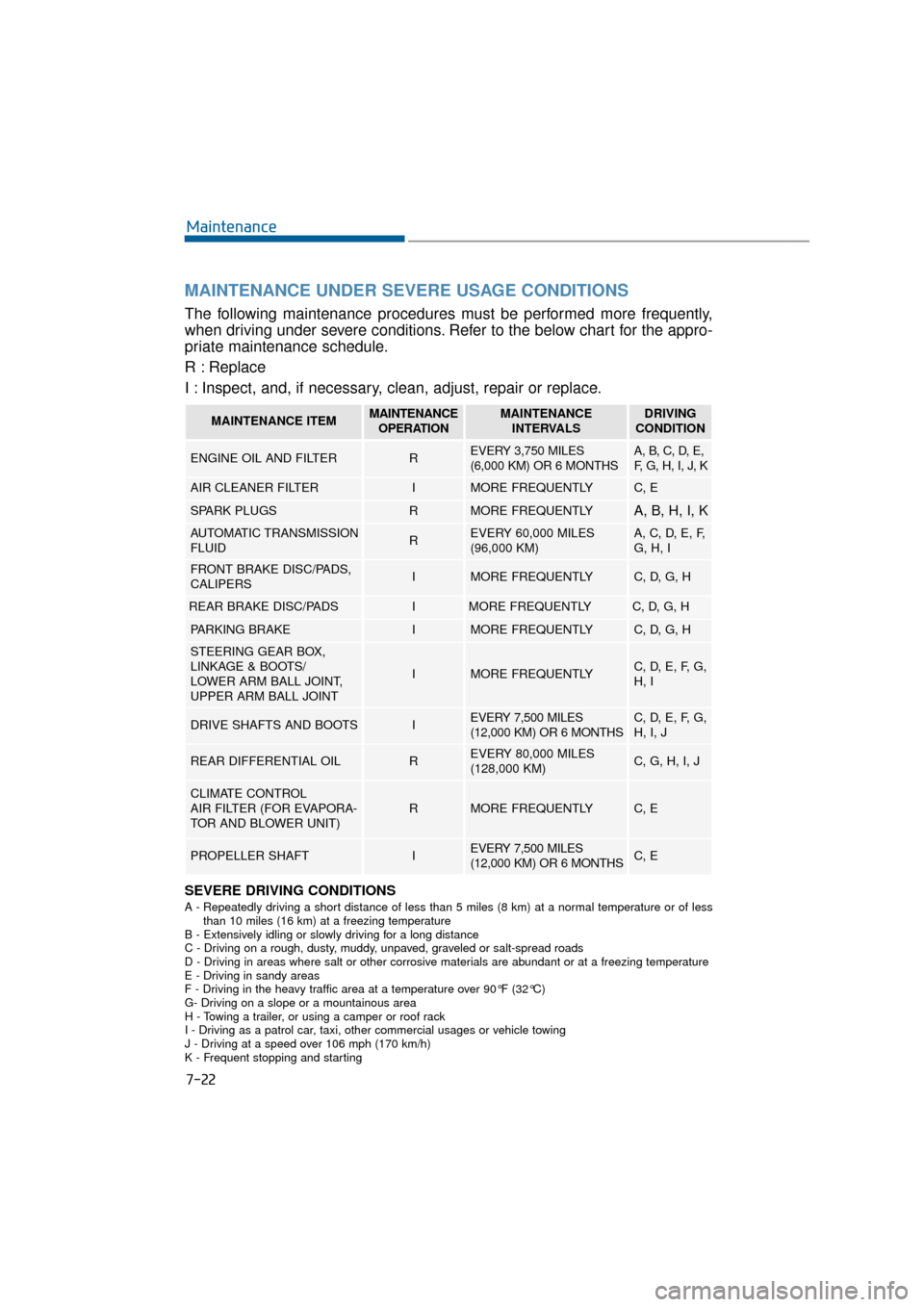
MAINTENANCE UNDER SEVERE USAGE CONDITIONS
The following maintenance procedures must be performed more frequently,
when driving under severe conditions. Refer to the below chart for the appro-
priate maintenance schedule.
R : Replace
I : Inspect, and, if necessary, clean, adjust, repair or replace.
SEVERE DRIVING CONDITIONS
A - Repeatedly driving a short distance of less than 5 miles (8 km) at a normal temperature or of lessthan 10 miles (16 km) at a freezing temperature
B - Extensively idling or slowly driving for a long distance
C - Driving on a rough, dusty, muddy, unpaved, graveled or salt-spread roads
D - Driving in areas where salt or other corrosive materials are abundant or at a freezing temperature
E - Driving in sandy areas
F - Driving in the heavy traffic area at a temperature over 90°F (32°C)
G- Driving on a slope or a mountainous area
H - Towing a trailer, or using a camper or roof rack
I - Driving as a patrol car, taxi, other commercial usages or vehicle towing
J - Driving at a speed over 106 mph (170 km/h)
K - Frequent stopping and starting
MAINTENANCE ITEMMAINTENANCE
OPERATIONMAINTENANCE INTERVALSDRIVING
CONDITION
ENGINE OIL AND FILTERREVERY 3,750 MILES
(6,000 KM) OR 6 MONTHSA, B, C, D, E,
F, G, H, I, J, K
AIR CLEANER FILTERIMORE FREQUENTLYC, E
SPARK PLUGSRMORE FREQUENTLYA, B, H, I, K
AUTOMATIC TRANSMISSION
FLUIDREVERY 60,000 MILES
(96,000 KM) A, C, D, E, F,
G, H, I
FRONT BRAKE DISC/PADS,
CALIPERSIMORE FREQUENTLYC, D, G, H
REAR BRAKE DISC/PADSIMORE FREQUENTLYC, D, G, H
PARKING BRAKEIMORE FREQUENTLYC, D, G, H
STEERING GEAR BOX,
LINKAGE & BOOTS/
LOWER ARM BALL JOINT,
UPPER ARM BALL JOINT
IMORE FREQUENTLYC, D, E, F, G,
H, I
DRIVE SHAFTS AND BOOTSIEVERY 7,500 MILES
(12,000 KM) OR 6 MONTHSC, D, E, F, G,
H, I, J
REAR DIFFERENTIAL OILREVERY 80,000 MILES
(128,000 KM)C, G, H, I, J
CLIMATE CONTROL
AIR FILTER (FOR EVAPORA-
TOR AND BLOWER UNIT)RMORE FREQUENTLYC, E
PROPELLER SHAFTIEVERY 7,500 MILES
(12,000 KM) OR 6 MONTHSC, E
Page 381 of 477
7-24
Maintenance
The use of an unauthorized fluid
may result in transmission mal-
function and failure. Use only the
authorized automatic transmis-
sion fluid. (Refer to “Recommended
lubricants and capacities” in the
chapter 8.)
Brake hoses and lines
Confirm the proper installation, and
check for any frictions, cracks, dete-
rioration and leakage. If necessary,
immediately replace any deteriorated
or damaged parts.
Brake fluid
Check the brake fluid level. The level
should be between “MIN” and “MAX”
marks on the reservoir. Use only the
hydraulic brake fluid, which meet the
requirements of the DOT3/DOT4
specifications.
Brake discs, pads, calipers
and rotors
Check the pads and the disc for any
excessive wear-out, and inspect
calipers for any fluid leakage.
Exhaust pipe and muffler
Inspect the exhaust pipes, muffler
and hangers for any cracks, deterio-
rations, or damages. Start the
engine, and listen carefully for any
gas leaking noise. If necessary, tight-
en connections or replace the dam-
aged parts.
Suspension mounting bolts
Check the suspension connections
for any looseness or damage. If nec-
essary, retighten the bolt to the spec-
ified torque.
Steering gear box, linkage &
boots/lower arm ball joint
After stopping the vehicle and turn-
ing off the engine, confirm the steer-
ing locking (tightening).
Check the bends for any linkage or
damage. Check the dust boots and
ball joints for any deterioration,
cracks, or damage. If necessary,
replace the damaged parts.
Power steering pump, belt and
hoses
Check the power steering pump and
hoses for any leakage or damage. If
necessary, immediately replace any
damaged or leaking parts. Inspect
the power steering belt (or drive belt)
for any cuts, cracks, excessive wear-
out, oil saturation or looseness. If
necessary, replace or adjust the
damaged part.
Drive shafts and boots
Check the drive shafts, boots and
clamps for any cracks, deterioration,
or damage. If necessary, replace or
grease the damaged part.
Air conditioning refrigerant
Check the air conditioning lines and
connections for any leakage or dam-
age.
NOTICE
Page 398 of 477
7-41
Maintenance07
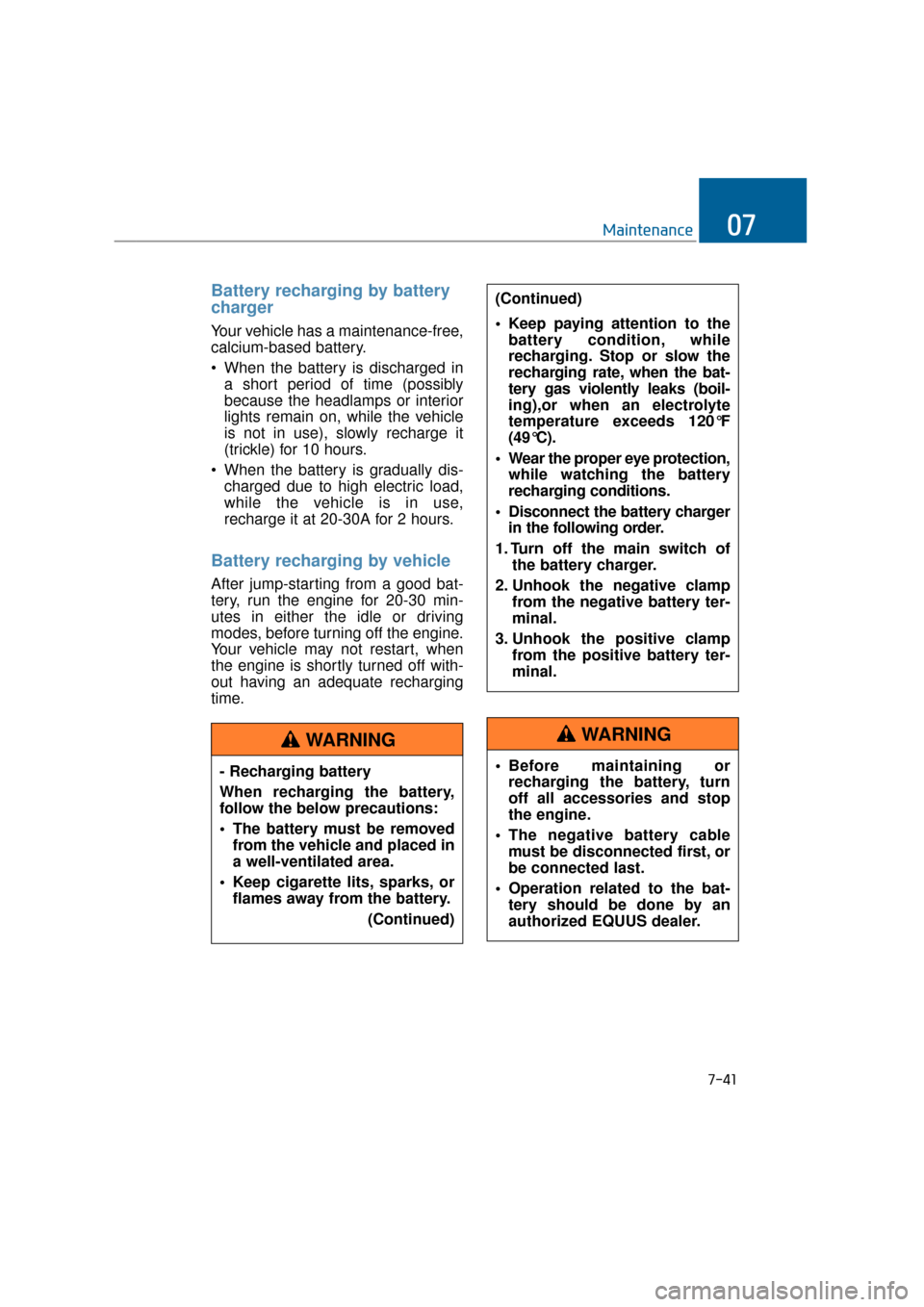
Battery recharging by battery
charger
Your vehicle has a maintenance-free,
calcium-based battery.
When the battery is discharged ina short period of time (possibly
because the headlamps or interior
lights remain on, while the vehicle
is not in use), slowly recharge it
(trickle) for 10 hours.
When the battery is gradually dis- charged due to high electric load,
while the vehicle is in use,
recharge it at 20-30A for 2 hours.
Battery recharging by vehicle
After jump-starting from a good bat-
tery, run the engine for 20-30 min-
utes in either the idle or driving
modes, before turning off the engine.
Your vehicle may not restart, when
the engine is shortly turned off with-
out having an adequate recharging
time.
- Recharging battery
When recharging the battery,
follow the below precautions:
The battery must be removed from the vehicle and placed in
a well-ventilated area.
Keep cigarette lits, sparks, or flames away from the battery.
(Continued)
(Continued)
Keep paying attention to thebattery condition, while
recharging. Stop or slow the
recharging rate, when the bat-
tery gas violently leaks (boil-
ing),or when an electrolyte
temperature exceeds 120°F
(49°C).
Wear the proper eye protection, while watching the battery
recharging conditions.
Disconnect the battery charger in the following order.
1. Turn off the main switch of the battery charger.
2. Unhook the negative clamp from the negative battery ter-
minal.
3. Unhook the positive clamp from the positive battery ter-
minal.
WARNING
Before maintaining orrecharging the battery, turn
off all accessories and stop
the engine.
The negative battery cable must be disconnected first, or
be connected last.
Operation related to the bat- tery should be done by an
authorized EQUUS dealer.
WARNING
Page 419 of 477
7-62
Maintenance
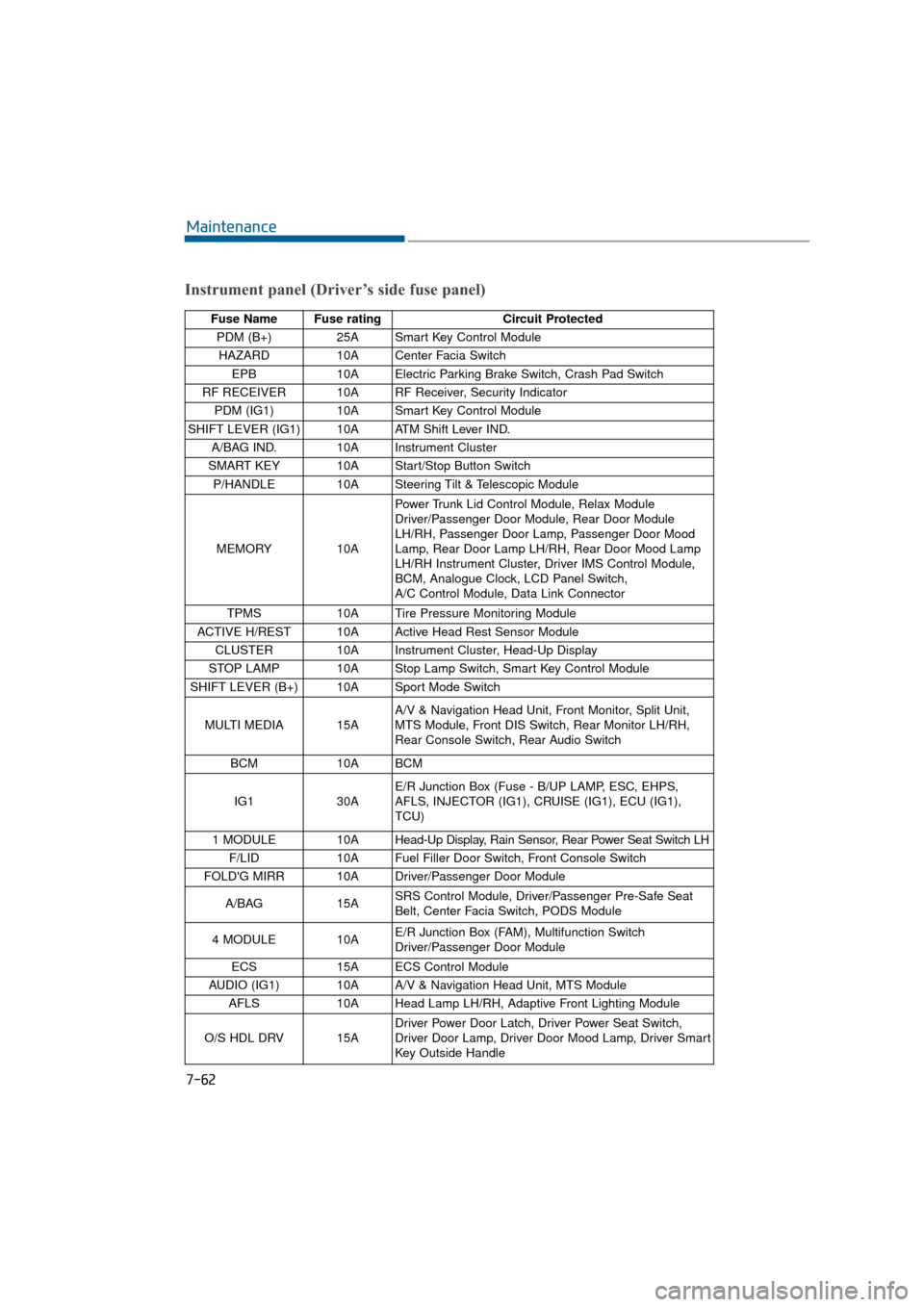
Instrument panel (Driver’s side fuse panel)
Fuse Name Fuse ratingCircuit Protected
PDM (B+) 25A Smart Key Control Module
HAZARD 10A Center Facia Switch
EPB 10A Electric Parking Brake Switch, Crash Pad Switch
RF RECEIVER 10A RF Receiver, Security Indicator PDM (IG1) 10A Smart Key Control Module
SHIFT LEVER (IG1) 10A ATM Shift Lever IND. A/BAG IND. 10A Instrument Cluster
SMART KEY 10A Start/Stop Button Switch P/HANDLE 10A Steering Tilt & Telescopic Module
MEMORY 10APower Trunk Lid Control Module, Relax Module
Driver/Passenger Door Module, Rear Door Module
LH/RH, Passenger Door Lamp, Passenger Door Mood
Lamp, Rear Door Lamp LH/RH, Rear Door Mood Lamp
LH/RH Instrument Cluster, Driver IMS Control Module,
BCM, Analogue Clock, LCD Panel Switch,
A/C Control Module, Data Link Connector
TPMS 10A Tire Pressure Monitoring Module
ACTIVE H/REST 10A Active Head Rest Sensor Module CLUSTER 10A Instrument Cluster, Head-Up Display
STOP LAMP 10A Stop Lamp Switch, Smart Key Control Module
SHIFT LEVER (B+) 10A Sport Mode Switch
MULTI MEDIA 15A A/V & Navigation Head Unit, Front Monitor, Split Unit,
MTS Module, Front DIS Switch, Rear Monitor LH/RH,
Rear Console Switch, Rear Audio Switch
BCM 10A BCM
IG1 30AE/R Junction Box (Fuse - B/UP LAMP, ESC, EHPS,
AFLS, INJECTOR (IG1), CRUISE (IG1), ECU (IG1),
TCU)
1 MODULE 10A Head-Up Display, Rain Sensor, Rear Power Seat Switch LH
F/LID 10A Fuel Filler Door Switch, Front Console Switch
FOLD'G MIRR 10A Driver/Passenger Door Module
A/BAG 15ASRS Control Module, Driver/Passenger Pre-Safe Seat
Belt, Center Facia Switch, PODS Module
4 MODULE 10A E/R Junction Box (FAM), Multifunction Switch
Driver/Passenger Door Module
ECS 15A ECS Control Module
AUDIO (IG1) 10A A/V & Navigation Head Unit, MTS Module AFLS 10A Head Lamp LH/RH, Adaptive Front Lighting Module
O/S HDL DRV 15A Driver Power Door Latch, Driver Power Seat Switch,
Driver Door Lamp, Driver Door Mood Lamp, Driver Smart
Key Outside Handle
Page 448 of 477
7-91
Maintenance07
Do not operate the engine in con-fined or closed areas (such as
garages) any more than what is
necessary to move the vehicle in or
out of the area.
When the vehicle is stopped in an open area, with the engine running,
for more than a short period of time,
adjust the ventilation system (as
needed) to draw the outside air into
the vehicle.
Never sit inside a parked or stopped vehicle for any extended period of
time, while the engine is running.
When the engine stalls or fails to start, excessive attempts to restart
the engine may damage the emis-
sion control system.
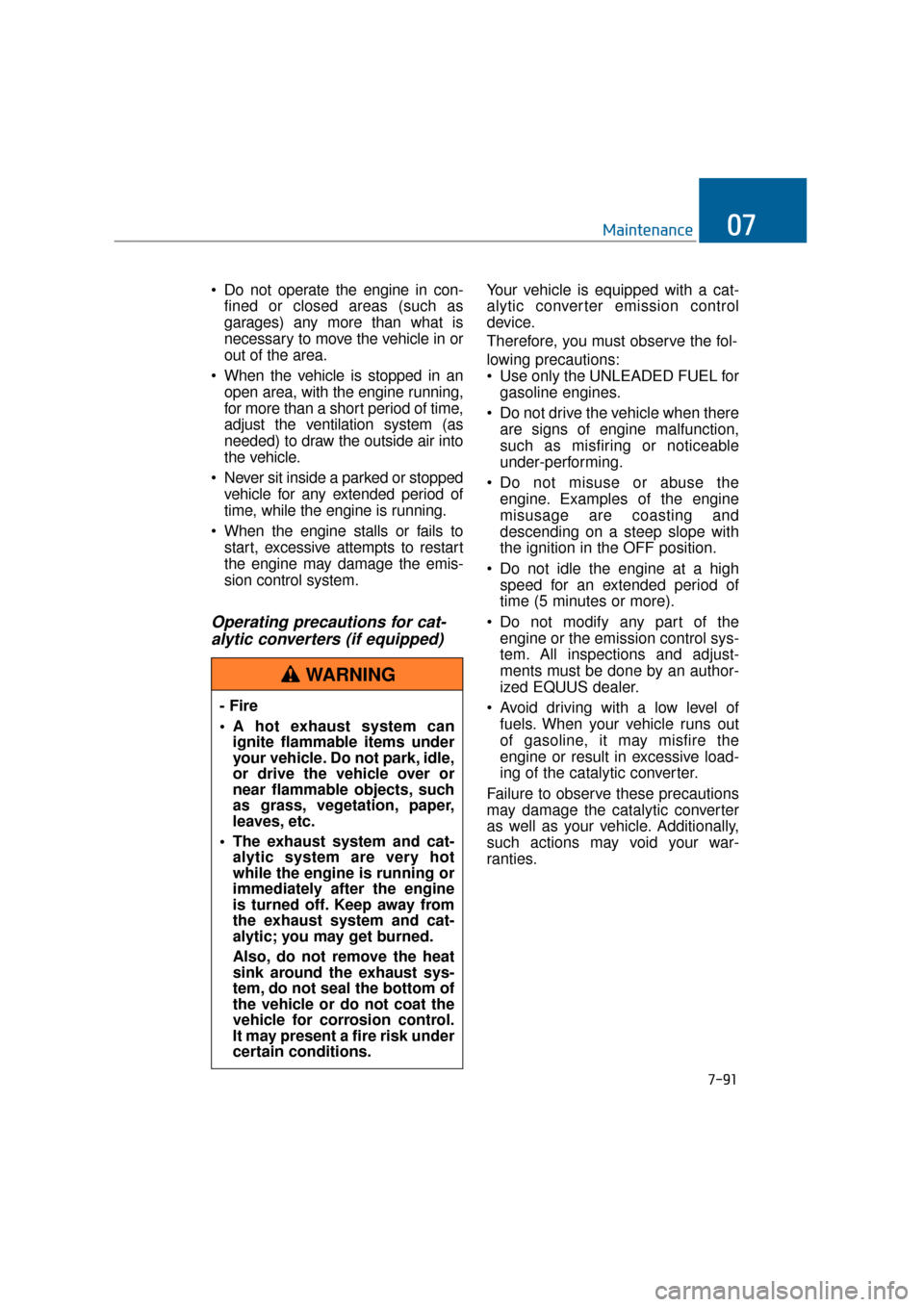
Operating precautions for cat-alytic converters (if equipped)
Your vehicle is equipped with a cat-
alytic converter emission control
device.
Therefore, you must observe the fol-
lowing precautions:
Use only the UNLEADED FUEL for
gasoline engines.
Do not drive the vehicle when there are signs of engine malfunction,
such as misfiring or noticeable
under-performing.
Do not misuse or abuse the engine. Examples of the engine
misusage are coasting and
descending on a steep slope with
the ignition in the OFF position.
Do not idle the engine at a high speed for an extended period of
time (5 minutes or more).
Do not modify any part of the engine or the emission control sys-
tem. All inspections and adjust-
ments must be done by an author-
ized EQUUS dealer.
Avoid driving with a low level of fuels. When your vehicle runs out
of gasoline, it may misfire the
engine or result in excessive load-
ing of the catalytic converter.
Failure to observe these precautions
may damage the catalytic converter
as well as your vehicle. Additionally,
such actions may void your war-
ranties.
- Fire
A hot exhaust system can
ignite flammable items under
your vehicle. Do not park, idle,
or drive the vehicle over or
near flammable objects, such
as grass, vegetation, paper,
leaves, etc.
The exhaust system and cat- alytic system are very hot
while the engine is running or
immediately after the engine
is turned off. Keep away from
the exhaust system and cat-
alytic; you may get burned.
Also, do not remove the heat
sink around the exhaust sys-
tem, do not seal the bottom of
the vehicle or do not coat the
vehicle for corrosion control.
It may present a fire risk under
certain conditions.
WARNING
Page 461 of 477

Automatic climate control system ....................................................................3-12\
33 zone control ........................................................................\
....................3-126
Air conditioning ........................................................................\
.................3-133
Air conditioning refrigerant .......................................................................3\
-137
Air intake control ........................................................................\
...............3-131
Air quality system (AQS)..............................................\
.............................3-132
Automatic heating and air conditioning .....................................................3-124
Climate control air filter ........................................................................\
.....3-136
Climate information screen selection .........................................................3-134
Fan speed control ........................................................................\
...............3-133
Manual heating and air conditioning .........................................................3-126
Mode selection ........................................................................\
...................3-127
OFF mode........................................................................\
...........................3-134
Temperature control ........................................................................\
...........3-130
Automatic transmission ........................................................................\
...............5-11 Shift lock override ........................................................................\
................5-15
Shift lock system ........................................................................\
..................5-14
Sports mode ........................................................................\
..........................5-13
Automatic Transmission shift indicator ..............................................................3-68
Aux, USB and iPod® port ........................................................................\
........3-153
Bag hanger ........................................................................\
................................3-150
Battery ........................................................................\
.........................................7-39
Battery replacement Card key ........................................................................\
...............................3-12
Smart key........................................................................\
..............................3-12
Battery saver function ........................................................................\
...............3-109
Before driving ........................................................................\
...............................5-5
Blind spot detection system (BSD).....................................................................5-5\
8
Brake fluid........................................................................\
...................................7-30
Brake system ........................................................................\
...............................5-17 Anti-lock brake system (ABS) .....................................................................5-2\
6
Auto hold ........................................................................\
..............................5-23
Electric parking brake (EPB) .......................................................................5\
-19
Electronic stability control (ESC) ................................................................5-28
Hill-start assist control (HAC) .....................................................................5-3\
2
Power brakes ........................................................................\
........................5-17
Bulb replacement ........................................................................\
........................7-69
Bulb wattage............................................................\
..............................................8-2
Button start/stop, see engine start/stop button ......................................................5-7
I-3
IndexI
B
Page 464 of 477

Emission control system ........................................................................\
.............7-89Crankcase emission control system .............................................................7-89
Evaporative emission control system ...........................................................7-89
Exhaust emission control system .................................................................7-90
Engine compartment ........................................................................\
.....................1-6
Engine compartment fuse........................................................................\
............7-59
Engine coolant........................................................................\
.............................7-27
Engine coolant temperature gauge ......................................................................3-\
66
Engine number ........................................................................\
..............................8-7
Engine oil ........................................................................\
....................................7-25
Engine overheating......................................................\
..........................................6-6
Engine start/stop button ........................................................................\
................5-7
Evaporative emission control system..................................................................7-89
Exhaust emission control system ........................................................................\
7-90
Explanation of scheduled maintenance items .....................................................7-23
Exterior care ........................................................................\
................................7-83
Exterior overview (Front) ........................................................................\
.............1-2
Exterior overview (Rear) ........................................................................\
..............1-3
Flat tire ........................................................................\
.......................................6-12 Changing tires ........................................................................\
......................6-13
Compact spare tire........................................................................\
................6-17
Jack and tools ........................................................................\
.......................6-12
Removing and storing the spare tire ............................................................6-13
Floor mat anchor(s) ........................................................................\
...................3-150
Fluid Brake fluid ........................................................................\
............................7-30
Power steering fluid ........................................................................\
.............7-31
Washer fluid ........................................................................\
.........................7-32
Fog light ........................................................................\
...................................3-113
Front seat adjustment ........................................................................\
....................2-4
Fuel Economy ........................................................................\
.............................3-87
Fuel filler lid........................................................................\
................................3-34
Fuel gauge ........................................................................\
...................................3-67
Fuel requirements.......................................................\
...........................................F-8
Fuse switch ........................................................................\
..................................7-58
I-6
Index
F