headlamp Hyundai Equus 2016 User Guide
[x] Cancel search | Manufacturer: HYUNDAI, Model Year: 2016, Model line: Equus, Model: Hyundai Equus 2016Pages: 477, PDF Size: 16.25 MB
Page 207 of 477
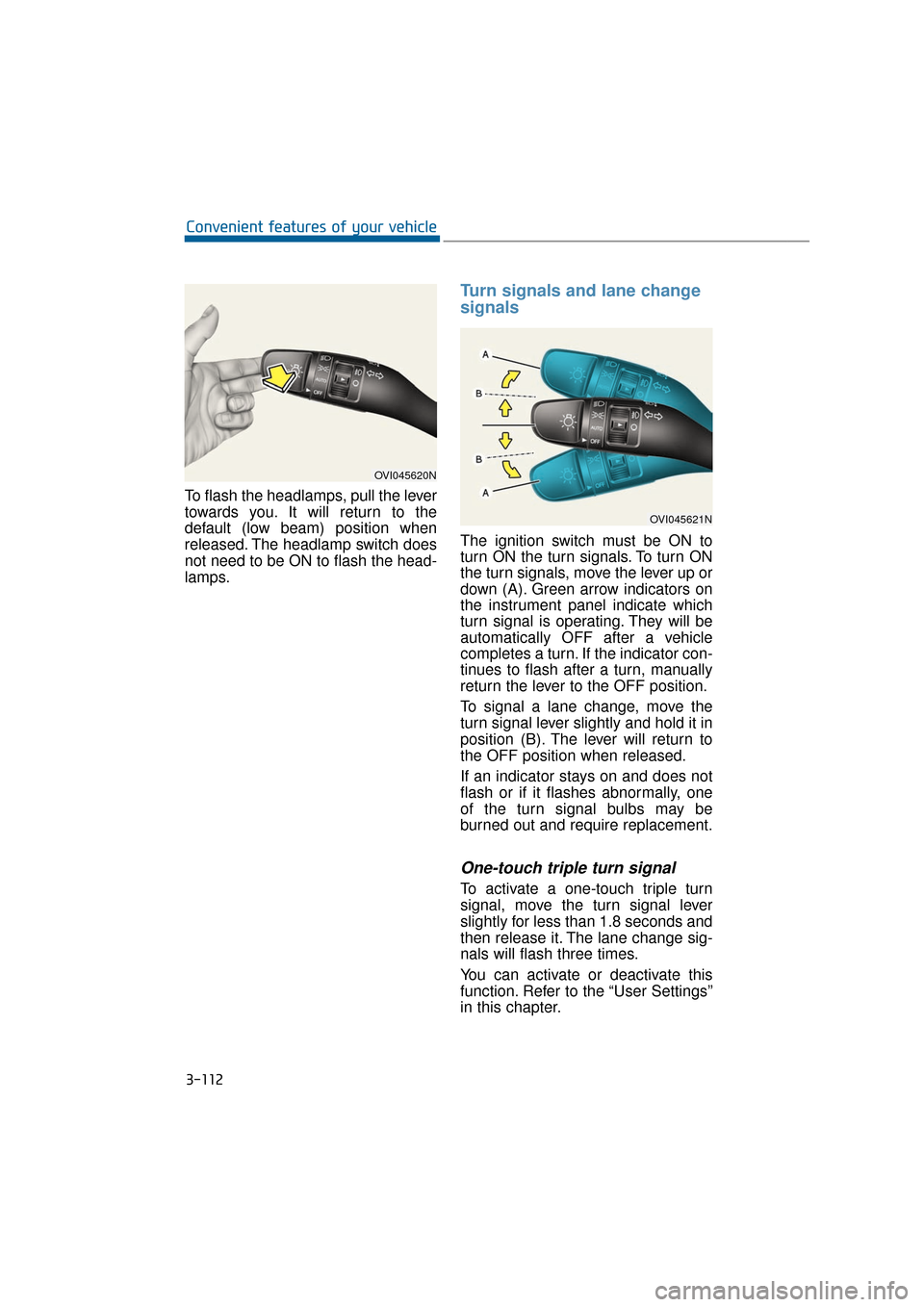
To flash the headlamps, pull the lever
towards you. It will return to the
default (low beam) position when
released. The headlamp switch does
not need to be ON to flash the head-
lamps.
Turn signals and lane change
signals
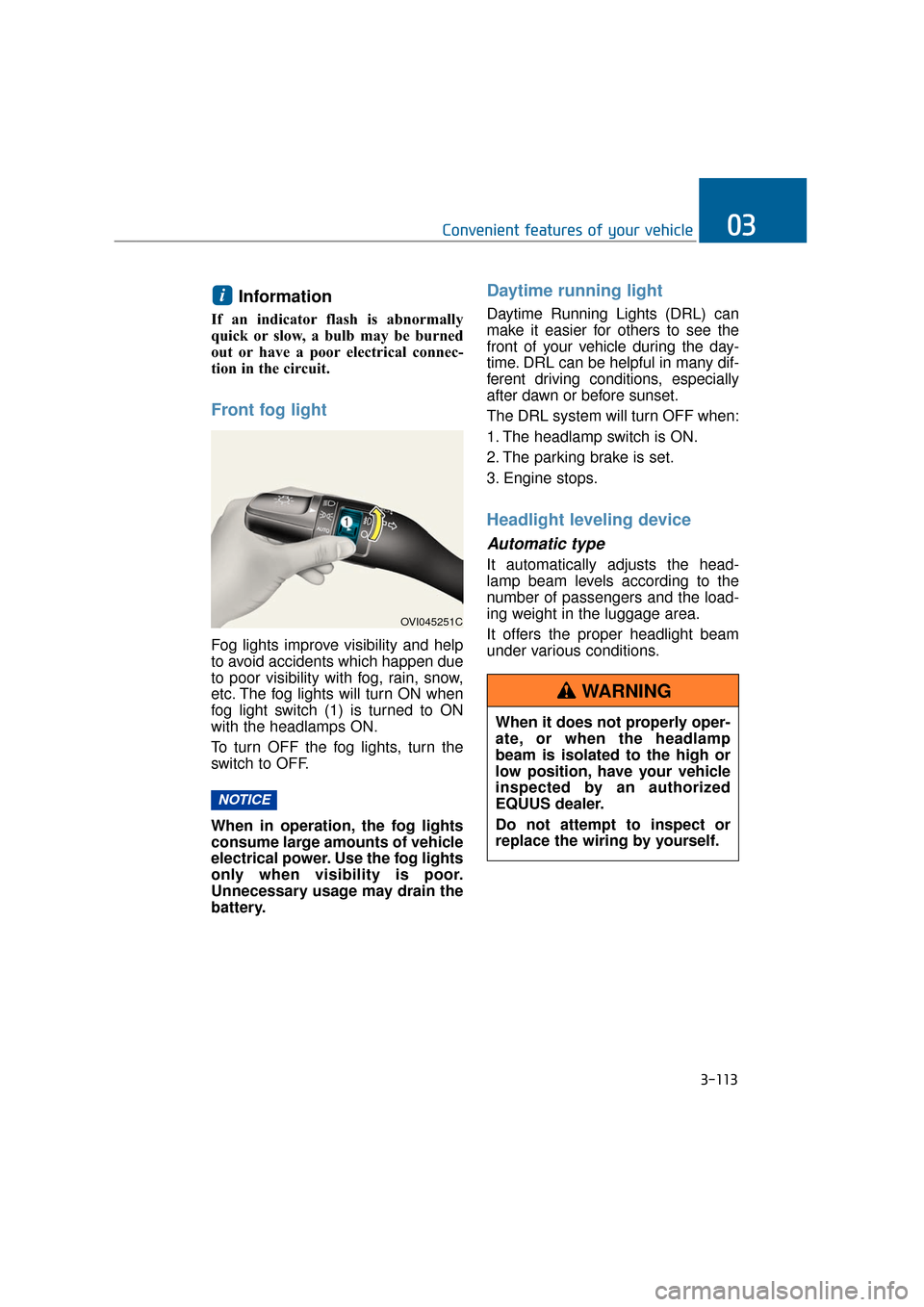
The ignition switch must be ON to
turn ON the turn signals. To turn ON
the turn signals, move the lever up or
down (A). Green arrow indicators on
the instrument panel indicate which
turn signal is operating. They will be
automatically OFF after a vehicle
completes a turn. If the indicator con-
tinues to flash after a turn, manually
return the lever to the OFF position.
To signal a lane change, move the
turn signal lever slightly and hold it in
position (B). The lever will return to
the OFF position when released.
If an indicator stays on and does not
flash or if it flashes abnormally, one
of the turn signal bulbs may be
burned out and require replacement.
One-touch triple turn signal
To activate a one-touch triple turn
signal, move the turn signal lever
slightly for less than 1.8 seconds and
then release it. The lane change sig-
nals will flash three times.
You can activate or deactivate this
function. Refer to the “User Settings”
in this chapter.
3-112
Convenient features of your vehicle
OVI045620N
OVI045621N
Page 208 of 477
Information
If an indicator flash is abnormally
quick or slow, a bulb may be burned
out or have a poor electrical connec-
tion in the circuit.
Front fog light
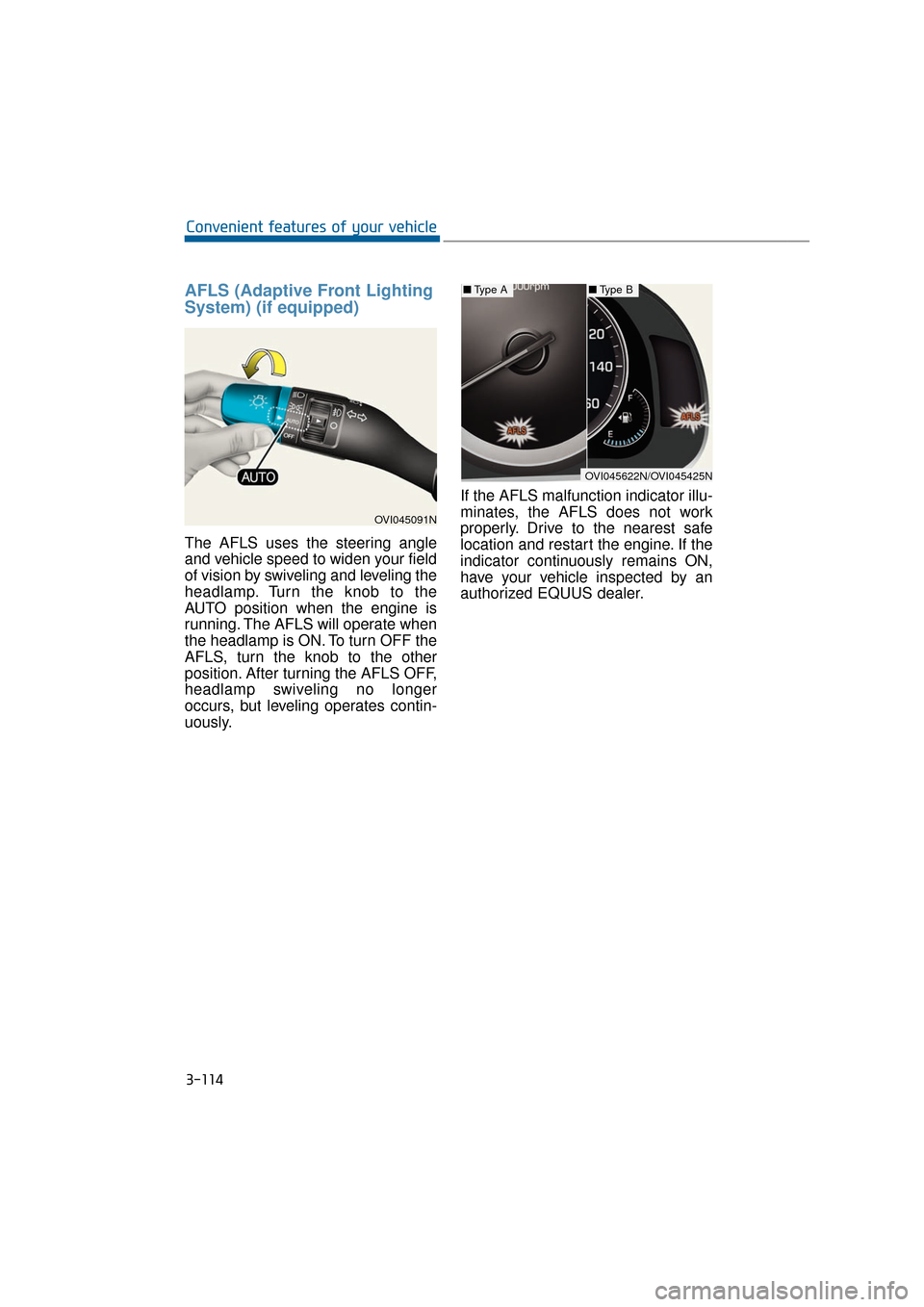
Fog lights improve visibility and help
to avoid accidents which happen due
to poor visibility with fog, rain, snow,
etc. The fog lights will turn ON when
fog light switch (1) is turned to ON
with the headlamps ON.
To turn OFF the fog lights, turn the
switch to OFF.
When in operation, the fog lights
consume large amounts of vehicle
electrical power. Use the fog lights
only when visibility is poor.
Unnecessary usage may drain the
battery.
Daytime running light
Daytime Running Lights (DRL) can
make it easier for others to see the
front of your vehicle during the day-
time. DRL can be helpful in many dif-
ferent driving conditions, especially
after dawn or before sunset.
The DRL system will turn OFF when:
1. The headlamp switch is ON.
2. The parking brake is set.
3. Engine stops.
Headlight leveling device
Automatic type
It automatically adjusts the head-
lamp beam levels according to the
number of passengers and the load-
ing weight in the luggage area.
It offers the proper headlight beam
under various conditions.
NOTICE
i
3-113
Convenient features of your vehicle03
OVI045251C
When it does not properly oper-
ate, or when the headlamp
beam is isolated to the high or
low position, have your vehicle
inspected by an authorized
EQUUS dealer.
Do not attempt to inspect or
replace the wiring by yourself.
WARNING
Page 209 of 477
AFLS (Adaptive Front Lighting
System) (if equipped)
The AFLS uses the steering angle
and vehicle speed to widen your field
of vision by swiveling and leveling the
headlamp. Turn the knob to the
AUTO position when the engine is
running. The AFLS will operate when
the headlamp is ON. To turn OFF the
AFLS, turn the knob to the other
position. After turning the AFLS OFF,
headlamp swiveling no longer
occurs, but leveling operates contin-
uously.If the AFLS malfunction indicator illu-
minates, the AFLS does not work
properly. Drive to the nearest safe
location and restart the engine. If the
indicator continuously remains ON,
have your vehicle inspected by an
authorized EQUUS dealer.
3-114
Convenient features of your vehicle
OVI045091N
■
Type A■Type B
OVI045622N/OVI045425N
Page 216 of 477
Puddle lamp
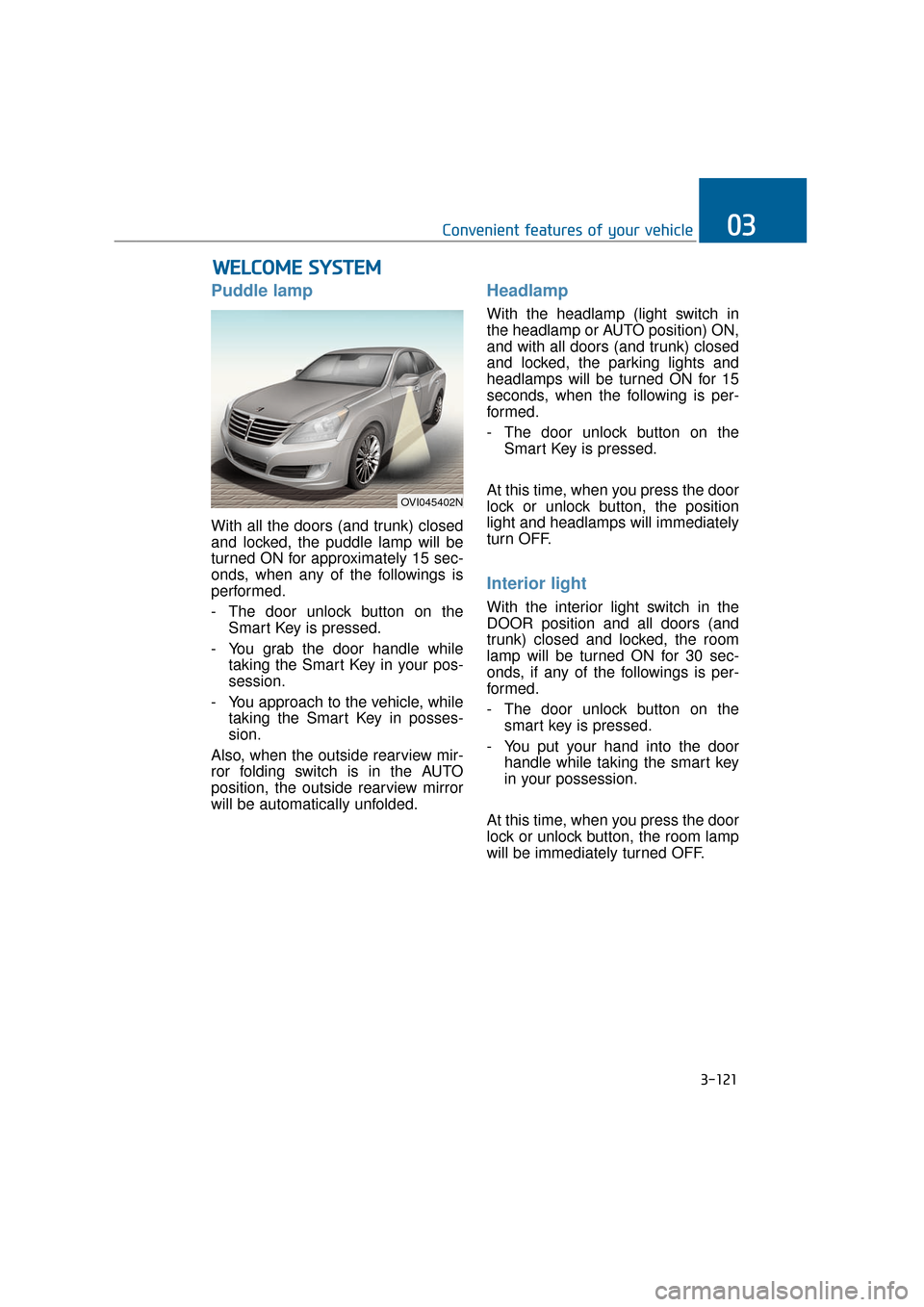
With all the doors (and trunk) closed
and locked, the puddle lamp will be
turned ON for approximately 15 sec-
onds, when any of the followings is
performed.
- The door unlock button on theSmart Key is pressed.
- You grab the door handle while taking the Smart Key in your pos-
session.
- You approach to the vehicle, while taking the Smart Key in posses-
sion.
Also, when the outside rearview mir-
ror folding switch is in the AUTO
position, the outside rearview mirror
will be automatically unfolded.
Headlamp
With the headlamp (light switch in
the headlamp or AUTO position) ON,
and with all doors (and trunk) closed
and locked, the parking lights and
headlamps will be turned ON for 15
seconds, when the following is per-
formed.
- The door unlock button on the Smart Key is pressed.
At this time, when you press the door
lock or unlock button, the position
light and headlamps will immediately
turn OFF.
Interior light
With the interior light switch in the
DOOR position and all doors (and
trunk) closed and locked, the room
lamp will be turned ON for 30 sec-
onds, if any of the followings is per-
formed.
- The door unlock button on the smart key is pressed.
- You put your hand into the door handle while taking the smart key
in your possession.
At this time, when you press the door
lock or unlock button, the room lamp
will be immediately turned OFF.
W W E
EL
LC
C O
O M
M E
E
S
S Y
Y S
ST
T E
EM
M
3-121
Convenient features of your vehicle03
OVI045402N
Page 305 of 477
DRIVER'S ATTENTION
The driver must be cautious in the
below situations, because the sys-
tem may not assist the driver nor
work properly.
The lane is not visible due tosnow, rain, stain, puddles or oth-
ers.
The exterior brightness sudden- ly changes, such as driving
through a tunnel.
The headlamp is turned OFF or weak in the night time or in a
tunnel.
It is difficult to distinguish the lane mark colors from the road.
The vehicle drives on a steep slope or a curve.
Lights, such as sunlight, street- light or lights from other vehi-
cles, reflect from the water on
the road.
The lens or windshield is stained with foreign substances.
The sensor cannot detect the lane lines because of fog, heavy
rain or heavy snow.
The surrounding temperature of the inside rear view mirror is
extremely high due to direct
sunlight.
The lane is very wide or narrow.
The lane mark is damaged or indistinct.
The shadow of median strips cast on the lane marks.
There are similar marks to lane marks.
There is a boundary structure.
The distance from a vehicle in front is very short. So, its driving
hides the lane marks in front.
(Continued)(Continued)
The vehicle is violently shaken.
The number of lane marks
increases or decreases, or the
lane marks cross each other in a
complicated manner.
Something is placed on the dashboard.
The vehicle drives against sun- light.
The vehicle drives in a construc- tion area.
There are more than two lane marks.
The lane marks are hard to be distinguished due to dust or
grease in a tunnel.
The lane marks are hard to be distinguished after raining at
night.
The lane marks are hard to be distinguished due to dust.
5-54
Driving your vehicle
Page 320 of 477
5-69
Driving your vehicle05
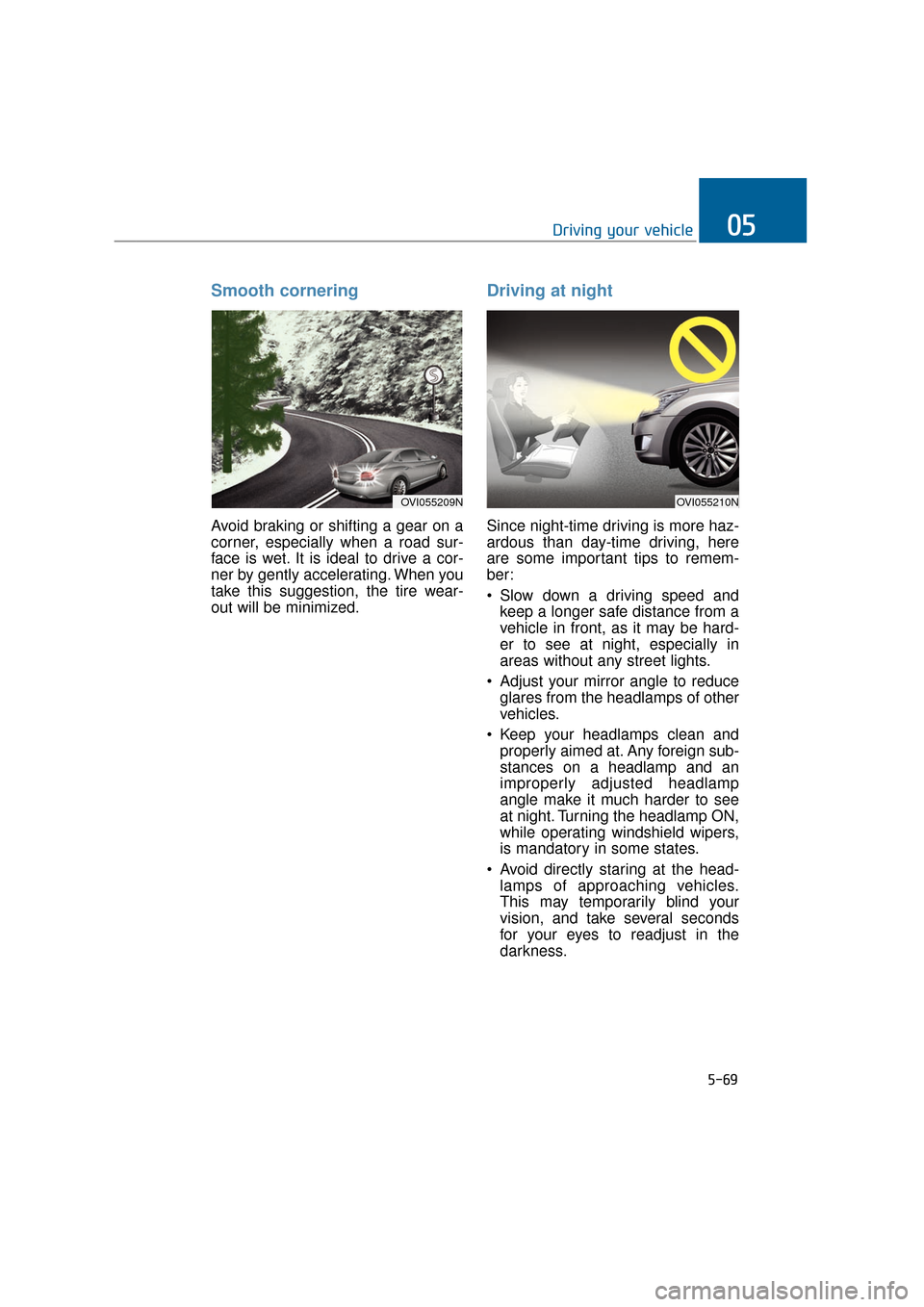
Smooth cornering
Avoid braking or shifting a gear on a
corner, especially when a road sur-
face is wet. It is ideal to drive a cor-
ner by gently accelerating. When you
take this suggestion, the tire wear-
out will be minimized.
Driving at night
Since night-time driving is more haz-
ardous than day-time driving, here
are some important tips to remem-
ber:
Slow down a driving speed andkeep a longer safe distance from a
vehicle in front, as it may be hard-
er to see at night, especially in
areas without any street lights.
Adjust your mirror angle to reduce glares from the headlamps of other
vehicles.
Keep your headlamps clean and properly aimed at. Any foreign sub-
stances on a headlamp and an
improperly adjusted headlamp
angle make it much harder to see
at night. Turning the headlamp ON,
while operating windshield wipers,
is mandatory in some states.
Avoid directly staring at the head- lamps of approaching vehicles.
This may temporarily blind your
vision, and take several seconds
for your eyes to readjust in the
darkness.
OVI055209NOVI055210N
Page 321 of 477
5-70
Driving your vehicle
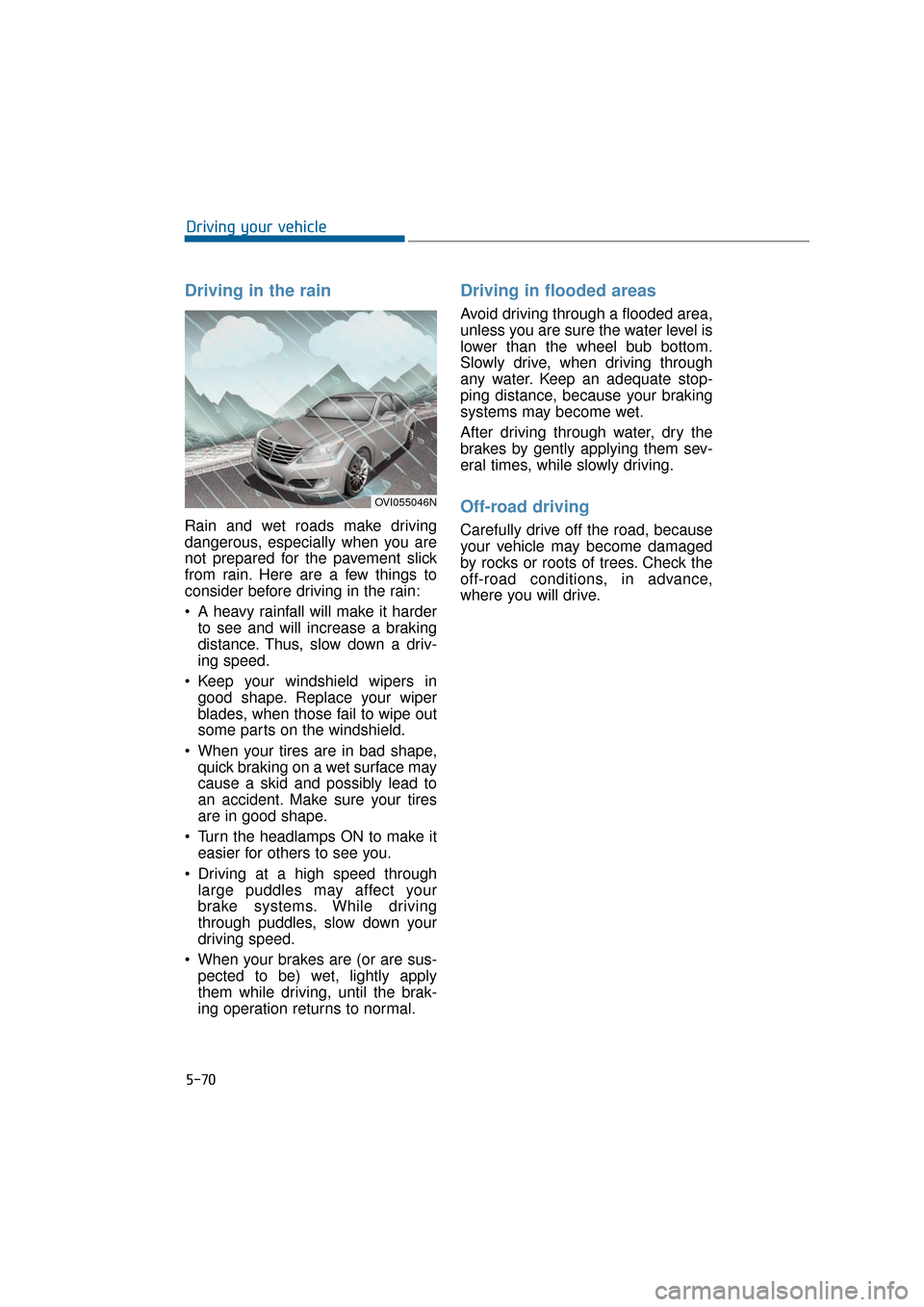
Driving in the rain
Rain and wet roads make driving
dangerous, especially when you are
not prepared for the pavement slick
from rain. Here are a few things to
consider before driving in the rain:
A heavy rainfall will make it harderto see and will increase a braking
distance. Thus, slow down a driv-
ing speed.
Keep your windshield wipers in good shape. Replace your wiper
blades, when those fail to wipe out
some parts on the windshield.
When your tires are in bad shape, quick braking on a wet surface may
cause a skid and possibly lead to
an accident. Make sure your tires
are in good shape.
Turn the headlamps ON to make it easier for others to see you.
Driving at a high speed through large puddles may affect your
brake systems. While driving
through puddles, slow down your
driving speed.
When your brakes are (or are sus- pected to be) wet, lightly apply
them while driving, until the brak-
ing operation returns to normal.
Driving in flooded areas
Avoid driving through a flooded area,
unless you are sure the water level is
lower than the wheel bub bottom.
Slowly drive, when driving through
any water. Keep an adequate stop-
ping distance, because your braking
systems may become wet.
After driving through water, dry the
brakes by gently applying them sev-
eral times, while slowly driving.
Off-road driving
Carefully drive off the road, because
your vehicle may become damaged
by rocks or roots of trees. Check the
off-road conditions, in advance,
where you will drive.
OVI055046N
Page 398 of 477
7-41
Maintenance07
Battery recharging by battery
charger
Your vehicle has a maintenance-free,
calcium-based battery.
When the battery is discharged ina short period of time (possibly
because the headlamps or interior
lights remain on, while the vehicle
is not in use), slowly recharge it
(trickle) for 10 hours.
When the battery is gradually dis- charged due to high electric load,
while the vehicle is in use,
recharge it at 20-30A for 2 hours.
Battery recharging by vehicle
After jump-starting from a good bat-
tery, run the engine for 20-30 min-
utes in either the idle or driving
modes, before turning off the engine.
Your vehicle may not restart, when
the engine is shortly turned off with-
out having an adequate recharging
time.
- Recharging battery
When recharging the battery,
follow the below precautions:
The battery must be removed from the vehicle and placed in
a well-ventilated area.
Keep cigarette lits, sparks, or flames away from the battery.
(Continued)
(Continued)
Keep paying attention to thebattery condition, while
recharging. Stop or slow the
recharging rate, when the bat-
tery gas violently leaks (boil-
ing),or when an electrolyte
temperature exceeds 120°F
(49°C).
Wear the proper eye protection, while watching the battery
recharging conditions.
Disconnect the battery charger in the following order.
1. Turn off the main switch of the battery charger.
2. Unhook the negative clamp from the negative battery ter-
minal.
3. Unhook the positive clamp from the positive battery ter-
minal.
WARNING
Before maintaining orrecharging the battery, turn
off all accessories and stop
the engine.
The negative battery cable must be disconnected first, or
be connected last.
Operation related to the bat- tery should be done by an
authorized EQUUS dealer.
WARNING
Page 404 of 477
7-47
Maintenance07
Compact spare tire replacement
A compact spare tire has a shorter
tread life than a regular one. Replace
it, when a tread wear indicator is
found. A compact spare tire should
be replaced with the one in the same
size as the original one, and should
be installed over a tire wheel of the
same compact size. A compact
spare tire is not designed to be
installed over a wheel of the regular
size, and a compact spare wheel is
not designed for a tire of the regular
size.
Wheel replacement
When replacing the metal wheels for
any reason, make sure the new
wheels are equivalent to the original
wheel in terms of diameter, rim width
and offset.
Information
The front tire size is different from the
rear one. While rotating tire positions,
check the size of the tires and wheels.
Information
A wheel in the different size may
adversely affect the wheel bearing,
braking, stopping, handling, ground
clearance, body-to-tire clearance,
snow-chain clearance, speedometer,
odometer, headlamp angle and
bumper height.
Tire traction
Tire traction may decrease when
driving with worn-out or improperly-
inflated tires on a slippery surface.
Tires should be replaced, when a
tread wear indicator appears. Slow
down the driving speed to lower the
risk of losing the vehicle control,
when it rains or snows, or when your
vehicle drives on a icy surface.
i
i
The compact spare tire is for
emergency use only. Do not
operate your vehicle on this
compact spare at a speed over
50 mph (80 km/h). The original
tire should be immediately
repaired or replaced to avoid a
spare-tire failure and a possible
personal injury or death.
WARNING
Page 415 of 477
7-58
Maintenance
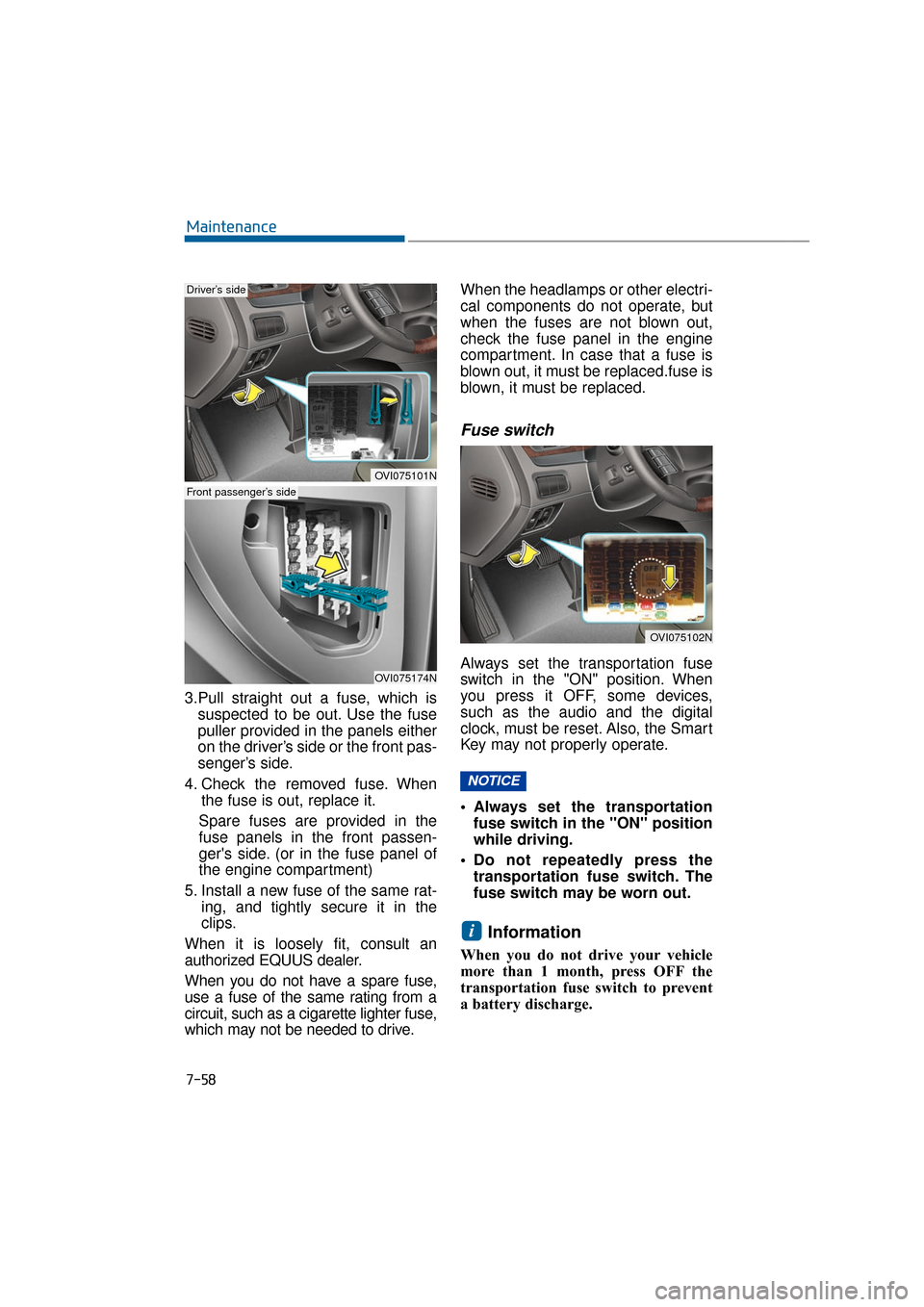
3.Pull straight out a fuse, which is suspected to be out. Use the fuse
puller provided in the panels either
on the driver’s side or the front pas-
senger’s side.
4. Check the removed fuse. When the fuse is out, replace it.
Spare fuses are provided in the
fuse panels in the front passen-
ger's side. (or in the fuse panel of
the engine compartment)
5. Install a new fuse of the same rat- ing, and tightly secure it in the
clips.
When it is loosely fit, consult an
authorized EQUUS dealer.
When you do not have a spare fuse,
use a fuse of the same rating from a
circuit, such as a cigarette lighter fuse,
which may not be needed to drive. When the headlamps or other electri-
cal components do not operate, but
when the fuses are not blown out,
check the fuse panel in the engine
compartment. In case that a fuse is
blown out, it must be replaced.fuse is
blown, it must be replaced.
Fuse switch
Always set the transportation fuse
switch in the "ON" position. When
you press it OFF, some devices,
such as the audio and the digital
clock, must be reset. Also, the Smart
Key may not properly operate.
Always set the transportation
fuse switch in the "ON" position
while driving.
Do not repeatedly press the transportation fuse switch. The
fuse switch may be worn out.
Information
When you do not drive your vehicle
more than 1 month, press OFF the
transportation fuse switch to prevent
a battery discharge.
i
NOTICE
OVI075101N
Driver’s side
OVI075174N
Front passenger’s side
OVI075102N