check engine light Hyundai Equus 2016 Owner's Guide
[x] Cancel search | Manufacturer: HYUNDAI, Model Year: 2016, Model line: Equus, Model: Hyundai Equus 2016Pages: 477, PDF Size: 16.25 MB
Page 316 of 477
5-65
Driving your vehicle05
Your vehicle's fuel economy depends
mainly on your driving style such as
where you drive and when you drive.
Each of these factors affects your
fuel economy (how many miles/kilo-
meters you can drive with a
gallon/liter of fuel). To drive your vehi-
cle as economically as possible, fol-
low the below driving suggestions.
These will help you save in both the
fuel and repair expenses:
Drive smoothly. Accelerate at amoderate rate. Do not make
"jackrabbit" starts or full-throttle
shifts. Maintain a steady cruising
speed. Do not race between stop-
lights. Try to adjust your speed in
accordance with other traffic to
avoid unnecessary speed
changes. Avoid heavy traffic when-
ever possible. Always maintain a
safe distance from a vehicle in
front to avoid unnecessary braking.
This also reduces brake wear-out.
Drive at a moderate speed. The faster you drive, the more fuel your
vehicle uses. Driving at a moderate
speed, in the highest gear appro-
priate for the driving conditions
especially on the highway, is one of
the most effective ways to reduce
fuel consumption.
Do not "ride" the brake pedal. This can increase fuel consumption and
also wear out the brake compo-
nents. In addition, resting your foot
on the brake pedal, while driving,
may overheat the brake, reducing
breaking effects and possibly lead-
ing a serious consequence.
Check your tire conditions. Keep them inflated to the recommended
pressure level. Under or over infla-
tion will unnecessarily tire wear-
out. Check the tire pressures at
least once a month. Make sure that the wheels are cor-
rectly aligned. Hitting a curb or
driving too fast on uneven surfaces
may distort the wheel alignment.
Poor alignment causes faster tire
wear-out and may also result in
other problems as well as greater
fuel consumption.
Keep your vehicle in good condi- tion. For the better fuel economy
and the cheaper maintenance
expenses, maintain your vehicle in
accordance with the maintenance
schedule in the chapter 7. When
you drive your vehicle in harsh con-
ditions, more frequent mainte-
nance is required (refer to the
chapter 7 for further information).
Keep your vehicle clean. Your vehi- cle should be kept clean and away
from any corrosive substances. It is
especially important that mud, dirt,
ice and others are not daubed
under the vehicle. This extra weight
may increase the fuel consumption
and also cause corrosion.
Avoid a heavy loading. Do not carry unnecessary weight in your
vehicle. It will improve your fuel
economy.
Do not let the engine idle longer than necessary. When you wait
(not in traffic), turn OFF the engine.
Then restart the engine, when you
are ready to go.
Remember that your vehicle does not require the engine warm-up for
a long time. After turning On the
engine, run the engine for 10 to 20
seconds, before shifting the gear.
In cold weather, however, your
engine needs a slightly longer
warm-up period.
E EC
CO
O N
NO
O M
M I
IC
C A
A L
L
O
O P
PE
ER
R A
A T
TI
IO
O N
N
Page 326 of 477
5-75
Driving your vehicle05
To prevent the locks from
frozen
To prevent the locks from being
frozen, spray authorized de-icing
fluid or glycerin into key openings.
When a lock opening is already cov-
ered with ice, spray authorized de-
icing fluid on the ice to remove it.
When an internal part of a lock
freezes, try to thaw it with a heated
key. Carefully use the heated key to
avoid an injury.
Use authorized window-wash-
er anti-freezer solution in sys-
tem
To prevent the window washer from
being frozen, add authorized win-
dow-washer anti-freeze solution, as
instructed on the window-washer
container. Window-washer anti-
freeze solution is available from an
authorized EQUUS dealer, and so
are the most auto parts outlets. Do
not use engine coolant or other types
of anti-freezer solution, because
these may damage the vehicle paint.
Do not let your parking brake
freeze
Under some conditions, your parking
brake may freeze in the engaged
position. This is most likely to hap-
pen, when there is an accumulation
of snow or ice around/near the rear
brakes, or when the brakes are wet.
When there is the risk that your park-
ing brake may freeze, temporarily
apply it after locating the shift lever in
P(Park). Also, block the rear wheels
in advance, so the vehicle may not
roll. Then, release the parking brake.
Do not let ice and snow accu-
mulate underneath
Under some conditions, snow and
ice may build up under the fenders
and interfere with the steering. When
driving in such conditions during the
severe winter, you should check
underneath the vehicle on a regular
basis to assure that moving the front
wheels and the steering components
is unobstructed.
Carry emergency equipment
In accordance with weather condi-
tions, you should carry appropriate
emergency equipment, while driving.
Some of the items you may want to
carry include tire chains, tow straps,
chains, flashlight, emergency flares,
sand, a shovel, jumper cables, a win-
dow scraper, gloves, ground cloth,
coveralls and a blanket.
Do not place objects or materi-
als in the engine compartment
Putting objects or materials in the
engine compartment may cause an
engine failure or combustion,
because those may block the engine
cooling. The manufacturer is not
responsible for the damage caused
by such placement.
Page 336 of 477
If engine stalls while driving
1.Gradually reduce your drivingspeed while driving straight ahead.
Cautiously drive off the road to a
safe place.
2.Press the emergency hazard flash- er.
3.Try to re-start the engine again. When your vehicle does not re-
start, contact an authorized
EQUUS dealer for the qualified
assistance.When the engine does not
revolve, or slowly revolves
1.Make sure that the shift lever is inN(Neutral) or P (Park), and the
emergency brake is set.
2.Check that the battery connections are clean and tight.
3.Turn ON the interior light. When the light dims or goes out upon operat-
ing the starter, the battery is dis-
charged.
4.Check that the starter connections are securely tightened.
5.Do not push or pull the vehicle to start it. Follow instructions provided
in "Jump starting".
When the engine normally
revolves, but does not start
1.Check the fuel level.
2.With the Engine Start/Stop Buttonin the OFF position, check all con-
nectors of the ignition coils and the
spark plugs. Reconnect any dis-
connected or loose parts.
3.If the engine still does not start, contact an authorized EQUUS
dealer for the qualified assistance
6-3
What to do in an emergency06
I IF
F
T
T H
H E
E
E
E N
N G
GI
IN
N E
E
W
W I
IL
L L
L
N
N O
O T
T
S
S T
T A
A R
RT
T
When the engine does not start,
do not push or pull the car to
start it. This may result in a col-
lision or cause other damage.
CAUTION
Page 341 of 477
Always check the TPMS malfunction
telltale after replacing one or more
tires or wheels on your vehicle to
ensure that the replacement or alter-
nate tires and wheels allow the TPMS
to continue to function properly.
Information
If any of the followings happens, we
recommend that the system be
checked by an authorized EQUUS
dealer.
1. The low tire pressure telltale/TPMSmalfunction indicator does not illu-
minate for 3 seconds when the igni-
tion switch is turned ON or engine is
running.
2. The TPMS malfunction indicator remains ON after flashing for
approximately 1 minute.
3. The Low tire pressure position tell- tale remains ON.
Low tire pressure tell-
tale
Low tire pres-
sure position
telltale
When the TPMS malfunction indica-
tor illuminates with a warning mes-
sage on the LCD display, one or
more of your tires are significantly
under-inflated. The low tire pressure
position telltale pinpoints which tire is
significantly under-inflated with the
illumination of the corresponding
position light.
When the low tire pressure telltale
illuminates, immediately decrease
your driving speed, avoid hard cor-
nering and prepare for a longer stop-
ping distance. You should immediate-
ly stop the vehicle and check your
tires. Inflate the tires to the proper
pressure as indicated on the vehi-
cle’s placard or tire inflation pressure
label, which is on the right lower part
of the driver’s door sill.
When you cannot reach to a service
station, or when the tire cannot keep
the inflated air inside, replace the
under-inflated tire with the spare tire.
Until you repair or replace the under-
inflated tire, the low tire pressure tell-
tale remains ON, and the TPMS mal-
function indicator also remains ON
after 1-minute flashing (when the
vehicle is driven for approximately 20
minutes at a speed above 15.5 mph
(25 km/h)).
i
6-8
What to do in an emergency
OVI045740
Page 364 of 477
The following lists are about the vehi-
cle inspection and maintenance that
should be performed by the owner or
an authorized EQUUS dealer, as
indicated. This will ensure your safety
and dependable driving.
Any adverse conditions should imme-
diately be checked by your EQUUS
dealer.
These Owner Maintenance Checklists
are mostly uncovered by your vehicle
warranties. Thus, you may charges
you for expenses of labor, parts or
lubricants.
Owner's maintenance sched-
ule
While refueling:
Check the engine oil level.
Check coolant level in coolantreservoir.
Check the windshield washer fluid level.
Check for any low or under-inflated tires.
While driving:
Check for any changes in theexhaust sounds or the smells.
Check for any steering wheel vibra- tion. Check whether you feel more
tightness or looseness of the steer-
ing wheel.
Check for any slight tilting, or “pulls” to one side, while driving on
a flat surface.
Check for any unusual sounds, tilt- ing, a braking distance, or “hard-to-
push” brake pedal while stopping.
Check the transmission fluid level upon experiencing a skid or a sud-
den transmission gear change.
Check the P(Park) function of the auto transmission.
Check the parking brake.
Check for any fluid leak (water dripping from the A/C while or after
the normal driving).
At least once a month:
Check the coolant level in theengine coolant reservoir.
Check the operation of all exterior lights, such as the stoplights, turn
signals and hazard warning flash-
ers.
Check the inflation pressures of all tires including the spare.
O OW
W N
NE
ER
R '
'S
S
M
M A
AI
IN
N T
TE
EN
N A
AN
N C
CE
E
7-7
Maintenance07
Carefully check your engine
coolant level, when the engine
is hot. The hot coolant or steam
may blow out under pressure.
This may cause a skin burn or
other serious injuries.
WARNING
Page 413 of 477
7-56
Maintenance
A vehicle’s electrical system is pro-
tected from a possible electrical
overloading damage by fuses.
This vehicle has 4 fuse panels - two
on the driver’s side, another on the
panel bolster of the passenger's
side, and the other in the engine
compartment.
When any of your lights, acces-
sories, or controls does not operate,
check the appropriate circuit fuse.
When a fuse is out, some elements
may melt inside.
When the electrical system does not
operate, check the fuse panel on the
driver's side first.
Before replacing the fuse, disconnect
the negative battery cable. Always
replace it with a fuse of the same rat-
ing. When the newly-replaced fuse
blows, there may be an electrical
problem. Avoid using any pertinent
systems. Immediately consult an
authorized EQUUS dealer.
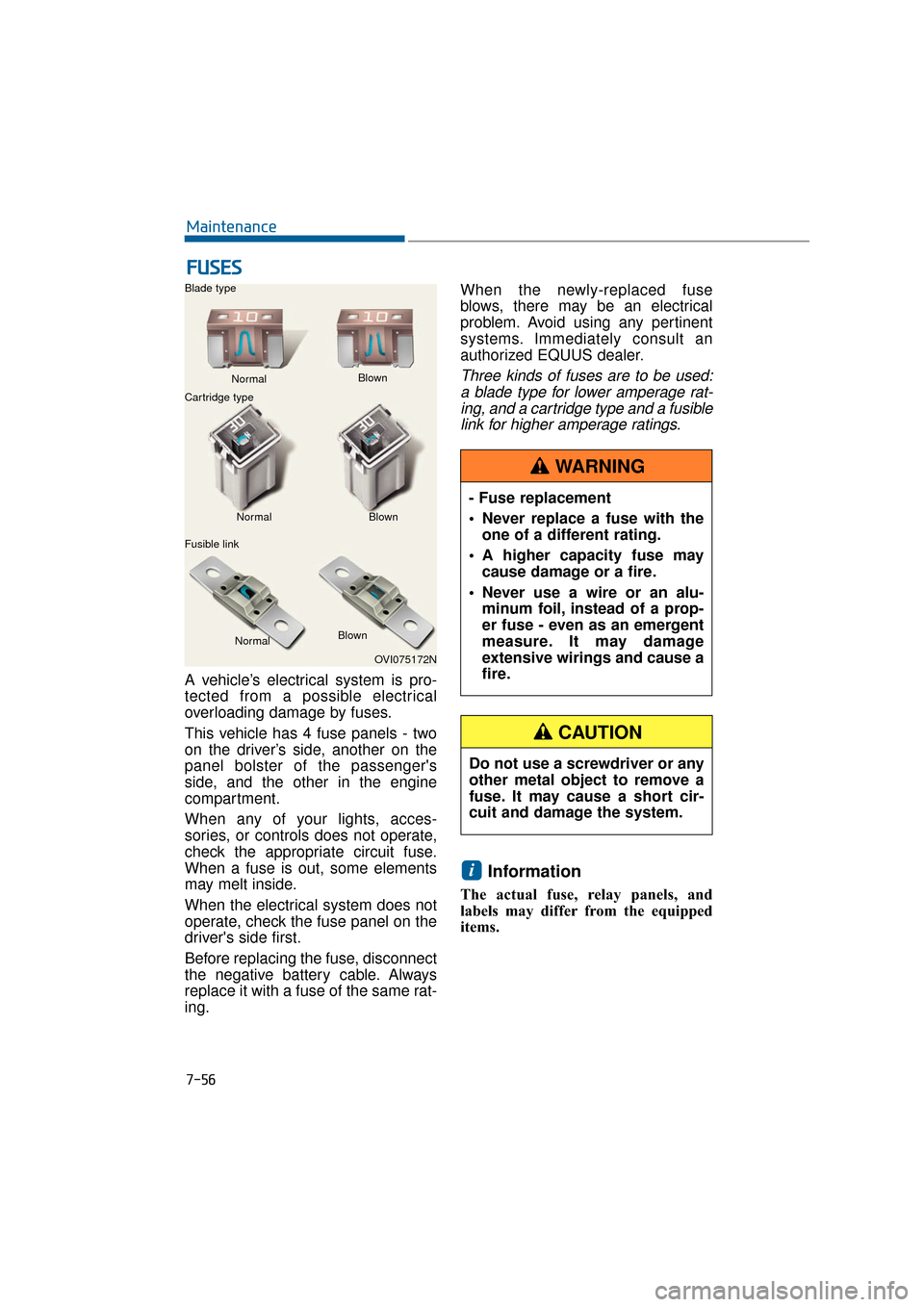
Three kinds of fuses are to be used:
a blade type for lower amperage rat-ing, and a cartridge type and a fusiblelink for higher amperage ratings.
Information
The actual fuse, relay panels, and
labels may differ from the equipped
items.
i
F F U
U S
SE
E S
S
OVI075172N
Normal
Normal
Blade type
Cartridge type
Fusible link Blown
Blown
Normal Blown
- Fuse replacement
Never replace a fuse with the
one of a different rating.
A higher capacity fuse may cause damage or a fire.
Never use a wire or an alu- minum foil, instead of a prop-
er fuse - even as an emergent
measure. It may damage
extensive wirings and cause a
fire.
WARNING
Do not use a screwdriver or any
other metal object to remove a
fuse. It may cause a short cir-
cuit and damage the system.
CAUTION
Page 415 of 477
7-58
Maintenance
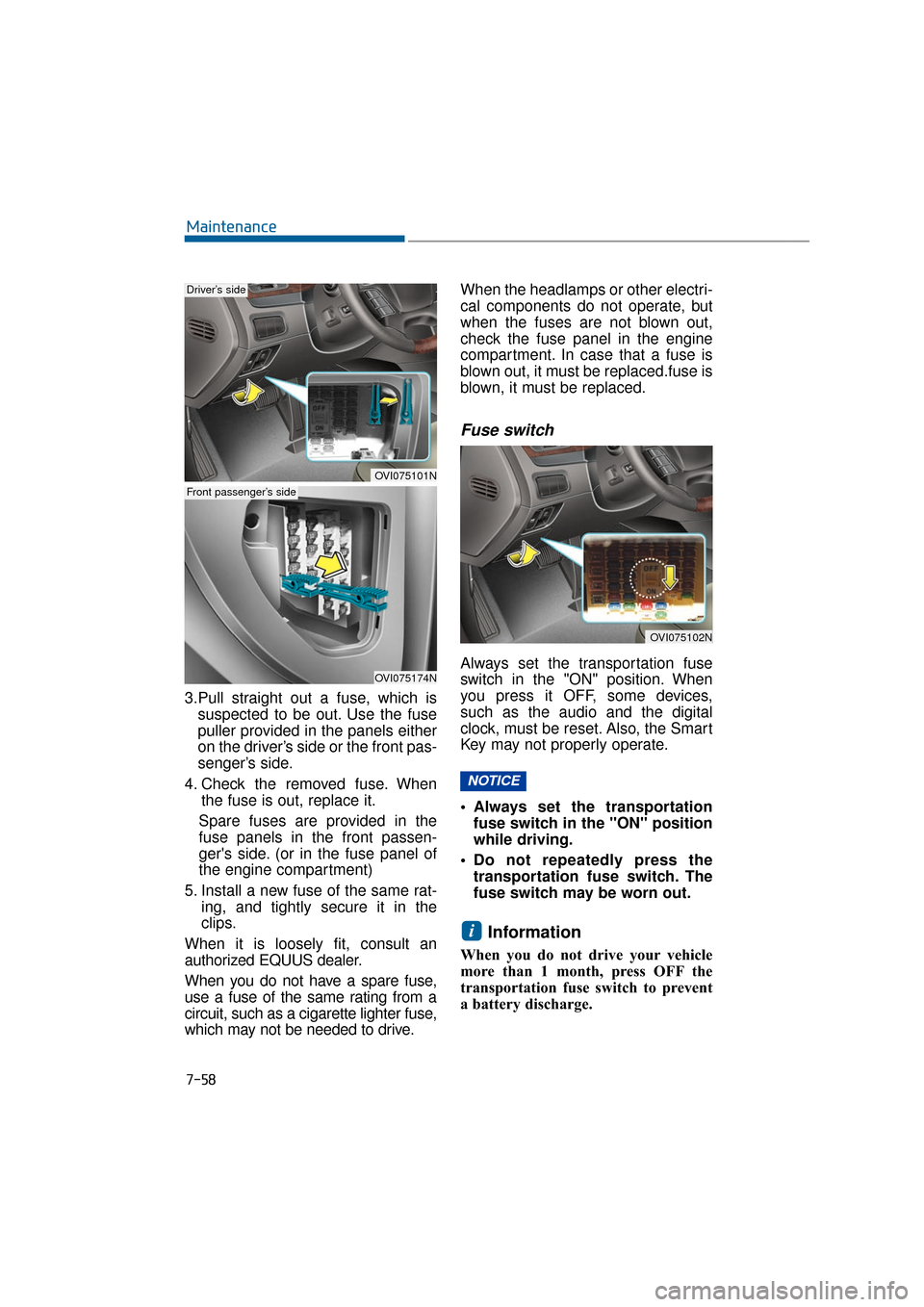
3.Pull straight out a fuse, which is suspected to be out. Use the fuse
puller provided in the panels either
on the driver’s side or the front pas-
senger’s side.
4. Check the removed fuse. When the fuse is out, replace it.
Spare fuses are provided in the
fuse panels in the front passen-
ger's side. (or in the fuse panel of
the engine compartment)
5. Install a new fuse of the same rat- ing, and tightly secure it in the
clips.
When it is loosely fit, consult an
authorized EQUUS dealer.
When you do not have a spare fuse,
use a fuse of the same rating from a
circuit, such as a cigarette lighter fuse,
which may not be needed to drive. When the headlamps or other electri-
cal components do not operate, but
when the fuses are not blown out,
check the fuse panel in the engine
compartment. In case that a fuse is
blown out, it must be replaced.fuse is
blown, it must be replaced.
Fuse switch
Always set the transportation fuse
switch in the "ON" position. When
you press it OFF, some devices,
such as the audio and the digital
clock, must be reset. Also, the Smart
Key may not properly operate.
Always set the transportation
fuse switch in the "ON" position
while driving.
Do not repeatedly press the transportation fuse switch. The
fuse switch may be worn out.
Information
When you do not drive your vehicle
more than 1 month, press OFF the
transportation fuse switch to prevent
a battery discharge.
i
NOTICE
OVI075101N
Driver’s side
OVI075174N
Front passenger’s side
OVI075102N