Drive Belt Hyundai Equus 2016 Owner's Manual
[x] Cancel search | Manufacturer: HYUNDAI, Model Year: 2016, Model line: Equus, Model: Hyundai Equus 2016Pages: 477, PDF Size: 16.25 MB
Page 12 of 477
Introduction
V
VE
EH
H I
IC
C L
LE
E
D
D A
A T
TA
A
C
C O
O L
LL
LE
E C
CT
T I
IO
O N
N
A
A N
N D
D
E
E V
V E
EN
N T
T
D
D A
A T
TA
A
R
R E
EC
CO
O R
RD
D E
ER
R S
S
This vehicle is equipped with an
event data recorder (EDR). The
main purpose of an EDR is to
record, in certain crash or near
crash-like situations, such as an
air bag deployment or hitting a
road obstacle, data that will assist
in understanding how a vehicle's
systems performed. The EDR is
designed to record data related to
vehicle dynamics and safety sys-
tems for a short period of time,
typically 30 seconds or less. The
EDR in this vehicle is designed to
record such data as:
How various systems in your
vehicle were operating;
Whether or not the driver and passenger safety belts were
buckled/fastened;
How far (if at all) the driver was depressing the accelerator
and/or brake pedal; and,
How fast the vehicle was travel- ing.
These data can help provide a bet-
ter understanding of the circum-
stances in which crashes and
injuries occur. NOTE: EDR data
are recorded by your vehicle only
if a non-trivial crash situation
occurs; no data are recorded by
the EDR under normal driving
conditions and no personal data
(e.g., name, gender, age, and crash
location) are recorded. However,
other parties, such as law enforce-
ment, could combine the EDR data
with the type of personally identi-
fying data routinely acquired dur-
ing a crash investigation. To read data recorded by an EDR,
special equipment is required, and
access to the vehicle or the EDR is
needed. In addition to the vehicle
manufacturer, other parties, such
as law enforcement, that have the
special equipment, can read the
information if they have access to
the vehicle or the EDR.
F12
Page 14 of 477
F14
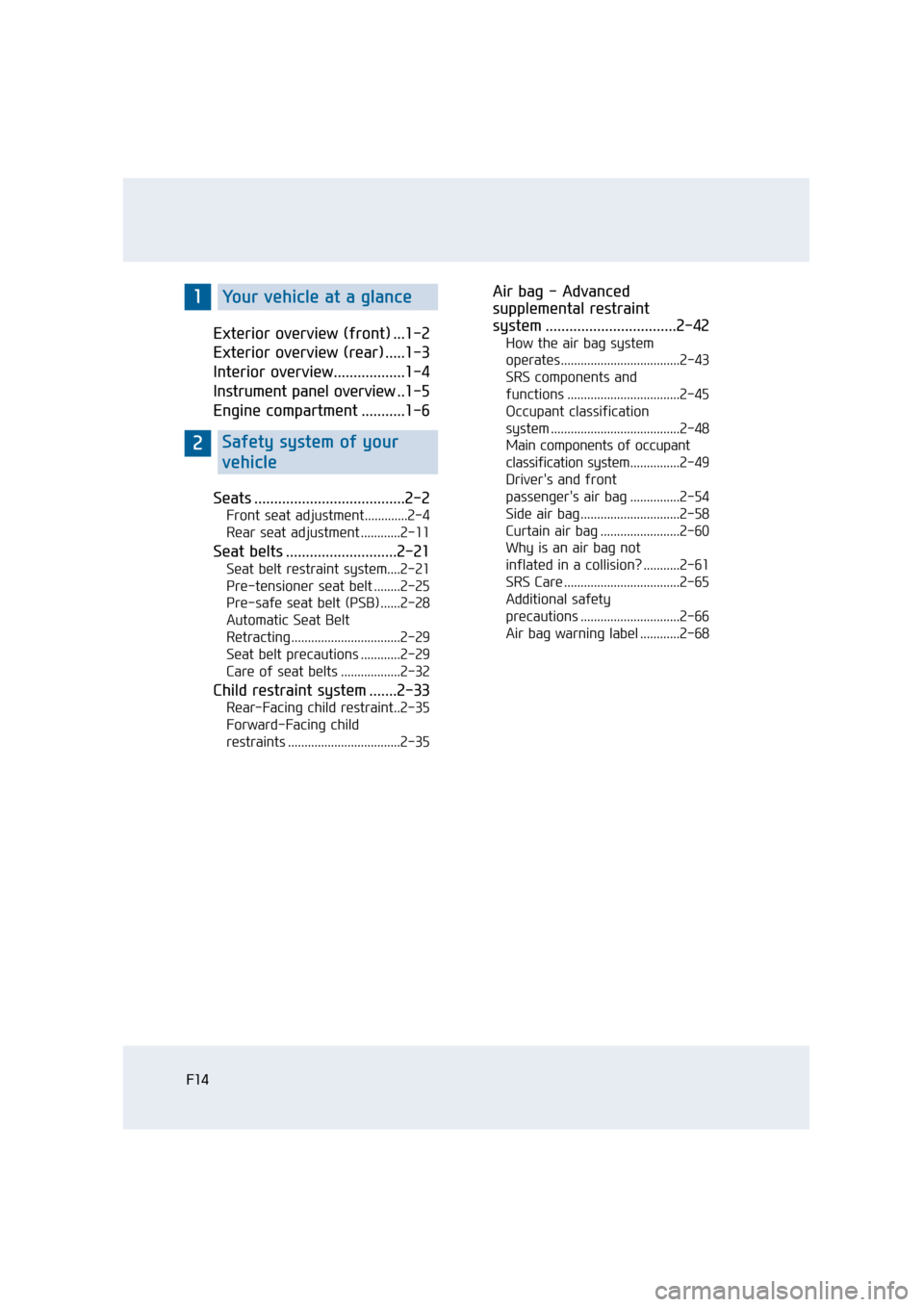
Exterior overview (front) ...1-2
Exterior overview (rear) .....1-3
Interior overview..................1-4
Instrument panel overview ..1-5
Engine compartment ...........1-6
Seats ......................................2-2
Front seat adjustment.............2-4
Rear seat adjustment ............2-11
Seat belts ............................2-21
Seat belt restraint system....2-21
Pre-tensioner seat belt ........2-25
Pre-safe seat belt (PSB) ......2-28
Automatic Seat Belt
Retracting .................................2-29
Seat belt precautions ............2-29
Care of seat belts ..................2-32
Child restraint system .......2-33
Rear-Facing child restraint..2-35
Forward-Facing child
restraints ..................................2-35
Air bag - Advanced
supplemental restraint
system .................................2-42
How the air bag system
operates....................................2-43
SRS components and
functions ..................................2-45
Occupant classification
system .......................................2-48
Main components of occupant
classification system ...............2-49
Driver's and front
passenger's air bag ...............2-54
Side air bag ..............................2-58
Curtain air bag ........................2-60
Why is an air bag not
inflated in a collision? ...........2-61
SRS Care ...................................2-65
Additional safety
precautions ..............................2-66
Air bag warning label ............2-68
1Your vehicle at a glance
2Safety system of your
vehicle
Page 28 of 477

Safety system of your vehicle
Seats ........................................................................\
2-2
Front seat adjustment......................................................2-4
Rear seat adjustment .....................................................2-11
Seat belts ..............................................................2-21
Seat belt restraint system ............................................2-21
Pre-tensioner seat belt .................................................2-25
Pre-safe seat belt (PSB) ...............................................2-28
Automatic Seat Belt Retracting ...................................2-29
Seat belt precautions .....................................................2-29
Care of seat belts ...........................................................2-32
Child restraint system .........................................2-33
Rear-Facing child restraint...........................................2-35
Forward-Facing child restraints..................................2-35
Air bag - Advanced supplemental
restraint system ...................................................2-42
How the air bag system operates ..............................2-43
SRS components and functions ..................................2-45
Occupant classification system ...................................2-48
Main components of occupant classification
system ........................................................................\
........2-49
Driver's and front passenger's air bag .....................2-54
Side air bag .....................................................................2-5\
8
Curtain air bag .................................................................2-60
Why is an air bag not inflated in a collision?..........2-61
SRS Care ........................................................................\
....2-65
Additional safety precautions ......................................2-66
Air bag warning label .....................................................2-68
Page 30 of 477
2-3
Safety system of your vehicle02
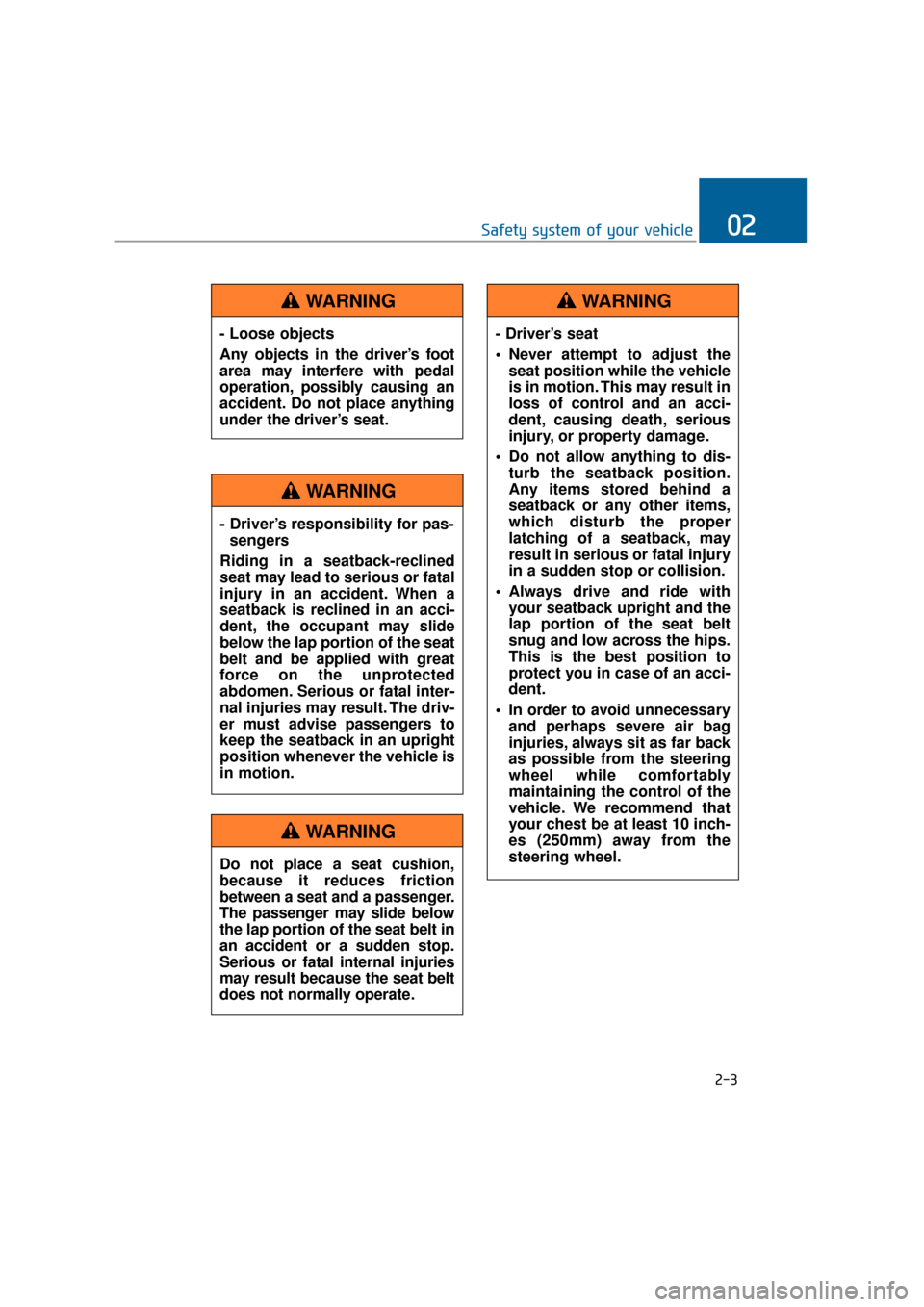
- Loose objects
Any objects in the driver’s foot
area may interfere with pedal
operation, possibly causing an
accident. Do not place anything
under the driver’s seat.
WARNING
- Driver’s responsibility for pas-sengers
Riding in a seatback-reclined
seat may lead to serious or fatal
injury in an accident. When a
seatback is reclined in an acci-
dent, the occupant may slide
below the lap portion of the seat
belt and be applied with great
force on the unprotected
abdomen. Serious or fatal inter-
nal injuries may result. The driv-
er must advise passengers to
keep the seatback in an upright
position whenever the vehicle is
in motion.
WARNING
Do not place a seat cushion,
because it reduces friction
between a seat and a passenger.
The passenger may slide below
the lap portion of the seat belt in
an accident or a sudden stop.
Serious or fatal internal injuries
may result because the seat belt
does not normally operate.
WARNING
- Driver’s seat
Never attempt to adjust the seat position while the vehicle
is in motion. This may result in
loss of control and an acci-
dent, causing death, serious
injury, or property damage.
Do not allow anything to dis- turb the seatback position.
Any items stored behind a
seatback or any other items,
which disturb the proper
latching of a seatback, may
result in serious or fatal injury
in a sudden stop or collision.
Always drive and ride with your seatback upright and the
lap portion of the seat belt
snug and low across the hips.
This is the best position to
protect you in case of an acci-
dent.
In order to avoid unnecessary and perhaps severe air bag
injuries, always sit as far back
as possible from the steering
wheel while comfortably
maintaining the control of the
vehicle. We recommend that
your chest be at least 10 inch-
es (250mm) away from the
steering wheel.
WARNING
Page 49 of 477
Seat belt warning (for driver’s seat)
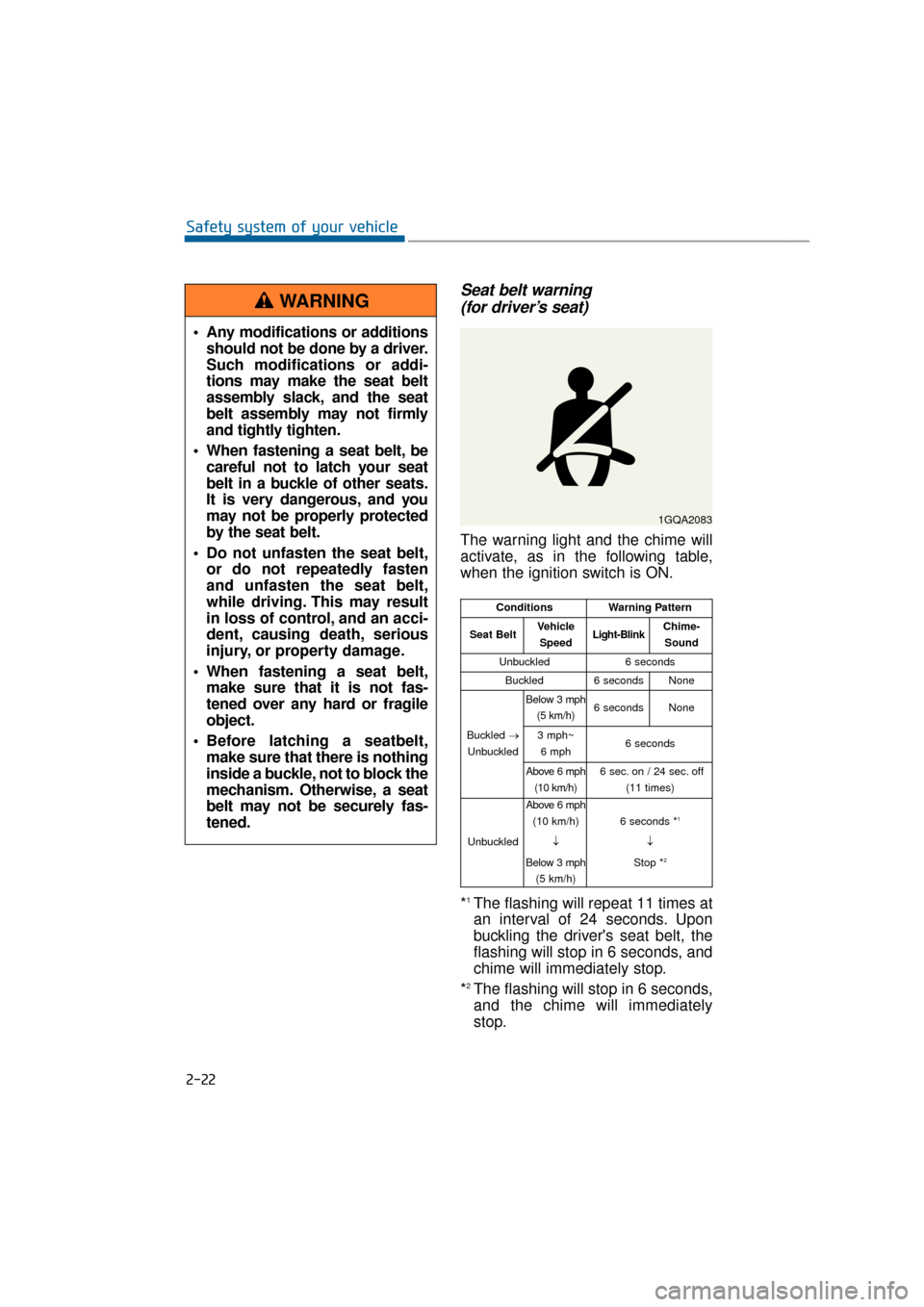
The warning light and the chime will
activate, as in the following table,
when the ignition switch is ON.
*
1The flashing will repeat 11 times at
an interval of 24 seconds. Upon
buckling the driver's seat belt, the
flashing will stop in 6 seconds, and
chime will immediately stop.
*
2The flashing will stop in 6 seconds,
and the chime will immediately
stop.
2-22
Safety system of your vehicle
Any modifications or additions should not be done by a driver.
Such modifications or addi-
tions may make the seat belt
assembly slack, and the seat
belt assembly may not firmly
and tightly tighten.
When fastening a seat belt, be careful not to latch your seat
belt in a buckle of other seats.
It is very dangerous, and you
may not be properly protected
by the seat belt.
Do not unfasten the seat belt, or do not repeatedly fasten
and unfasten the seat belt,
while driving. This may result
in loss of control, and an acci-
dent, causing death, serious
injury, or property damage.
When fastening a seat belt, make sure that it is not fas-
tened over any hard or fragile
object.
Before latching a seatbelt, make sure that there is nothing
inside a buckle, not to block the
mechanism. Otherwise, a seat
belt may not be securely fas-
tened.
WARNING
1GQA2083
ConditionsWarning Pattern
Seat BeltVehicle
SpeedLight-BlinkChime-Sound
Unbuckled6 seconds
Buckled6 secondsNone
Buckled →
Unbuckled
Below 3 mph (5 km/h)6 secondsNone
3 mph~6 mph6 seconds
Above 6 mph (10 km/h)6 sec. on / 24 sec. off (11 times)
Unbuckled
Above 6 mph(10 km/h)
↓
Below 3 mph (5 km/h)
6 seconds *1
↓
Stop *
2
Page 50 of 477
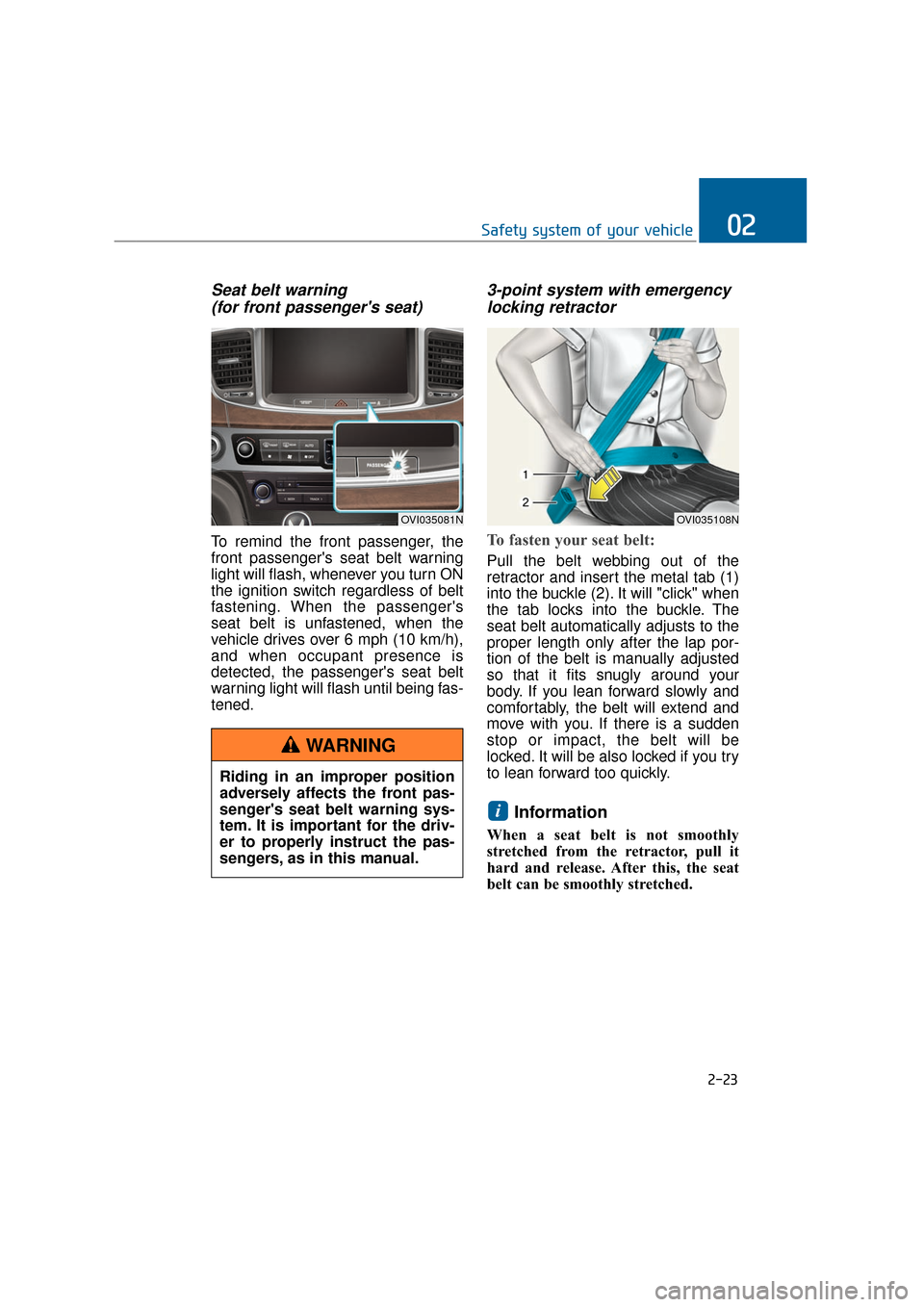
Seat belt warning (for front passenger's seat)
To remind the front passenger, the
front passenger's seat belt warning
light will flash, whenever you turn ON
the ignition switch regardless of belt
fastening. When the passenger's
seat belt is unfastened, when the
vehicle drives over 6 mph (10 km/h),
and when occupant presence is
detected, the passenger's seat belt
warning light will flash until being fas-
tened.
3-point system with emergencylocking retractor
To fasten your seat belt:
Pull the belt webbing out of the
retractor and insert the metal tab (1)
into the buckle (2). It will "click" when
the tab locks into the buckle. The
seat belt automatically adjusts to the
proper length only after the lap por-
tion of the belt is manually adjusted
so that it fits snugly around your
body. If you lean forward slowly and
comfortably, the belt will extend and
move with you. If there is a sudden
stop or impact, the belt will be
locked. It will be also locked if you try
to lean forward too quickly.
Information
When a seat belt is not smoothly
stretched from the retractor, pull it
hard and release. After this, the seat
belt can be smoothly stretched.
i
2-23
Safety system of your vehicle02
OVI035081N
Riding in an improper position
adversely affects the front pas-
senger's seat belt warning sys-
tem. It is important for the driv-
er to properly instruct the pas-
sengers, as in this manual.
WARNING
OVI035108N
Page 51 of 477

Height adjustment
The anchor height for the shoulder
portion of the belt can be adjusted to
one of the 4 positions for your greatest
comfort and safety.
The anchor height should be adjusted,
so the shoulder portion is fastened
over your chest and midway over the
shoulder nearest the door, not over
your neck.
To adjust the anchor height, rise up or
lower down the adjuster.
To rise up the adjuster, pull it up (1). To
lower it down, push it down (3) while
pressing the height adjuster button (2).
Release the button to lock the anchor
height. Attempt to slide up or down the
adjuster to confirm its locking.
2-24
Safety system of your vehicle
OVI035109N
Front seat
Make sure that the shoulderbelt anchor is securely locked
at an appropriate height.
Never fasten the shoulder
portion of the belt over your
neck or face. Improper fasten-
ing may cause serious injury
in an accident.
(Continued)
WARNING
(Continued)
Failure to replace a seat beltassembly after an accident
may put you in danger,
because the damaged seat
belt will not provide protec-
tion in the event of another
collision, leading to personal
injury or death. Immediately
replace your seat belts after
an accident.
The lap portion of a seat belt
should be fastened as low as
possible and snugly across your
hips, not on your waist. When
the lap belt is fastened too high
on your waist, it may increase
injury risk in the event of a colli-
sion. Both arms should not be
under or over the belt. Rather,
one should be over and the
other under, as shown in the
illustration.
The seat belt should not be fas-
tened under the driver's left arm,
or the front passenger's right
arm.
WARNING
OVI035110N
Page 52 of 477
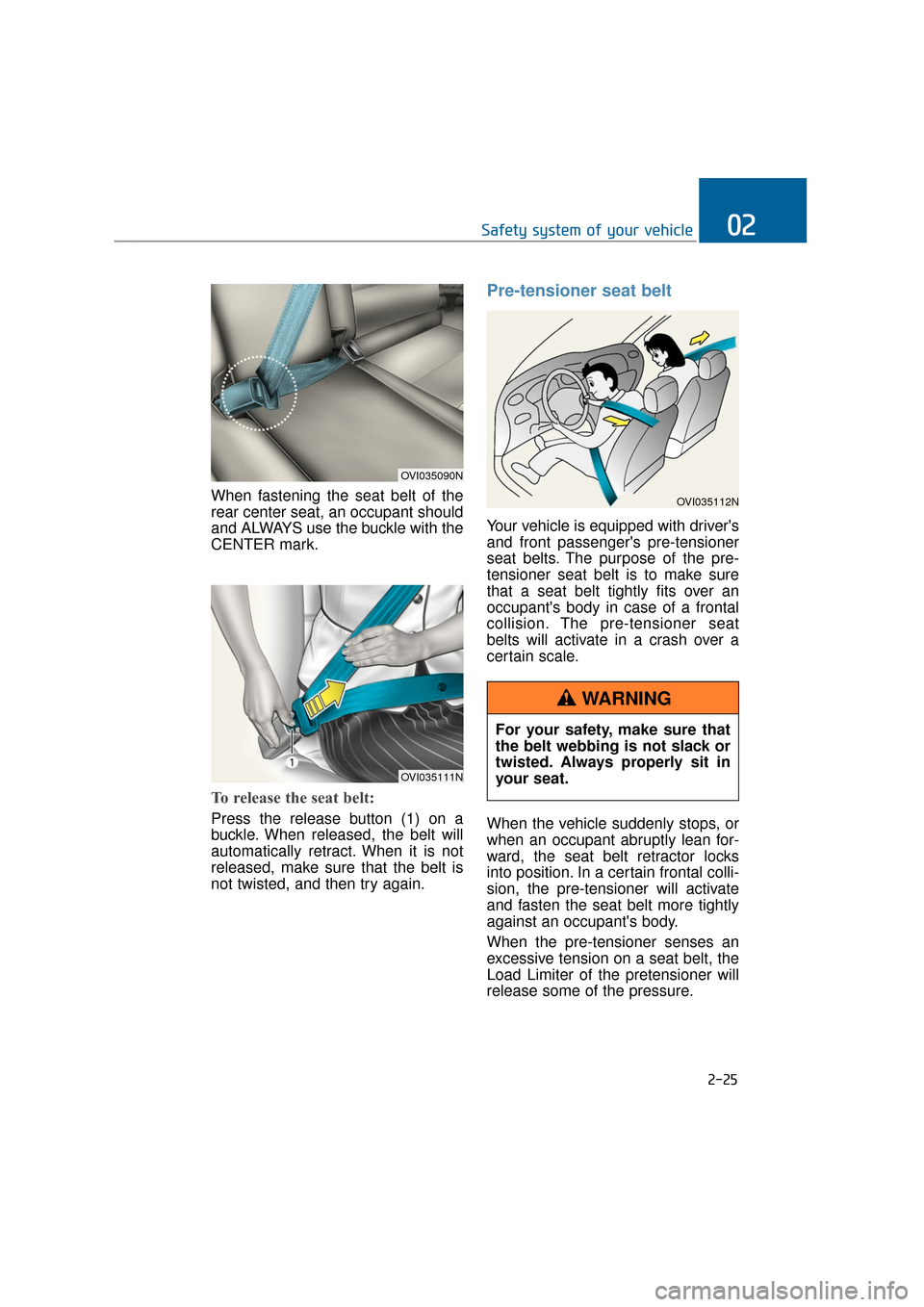
When fastening the seat belt of the
rear center seat, an occupant should
and ALWAYS use the buckle with the
CENTER mark.
To release the seat belt:
Press the release button (1) on a
buckle. When released, the belt will
automatically retract. When it is not
released, make sure that the belt is
not twisted, and then try again.
Pre-tensioner seat belt
Your vehicle is equipped with driver's
and front passenger's pre-tensioner
seat belts. The purpose of the pre-
tensioner seat belt is to make sure
that a seat belt tightly fits over an
occupant's body in case of a frontal
collision. The pre-tensioner seat
belts will activate in a crash over a
certain scale.
When the vehicle suddenly stops, or
when an occupant abruptly lean for-
ward, the seat belt retractor locks
into position. In a certain frontal colli-
sion, the pre-tensioner will activate
and fasten the seat belt more tightly
against an occupant's body.
When the pre-tensioner senses an
excessive tension on a seat belt, the
Load Limiter of the pretensioner will
release some of the pressure.
2-25
Safety system of your vehicle02
OVI035112N
OVI035111N
OVI035090N
For your safety, make sure that
the belt webbing is not slack or
twisted. Always properly sit in
your seat.
WARNING
Page 53 of 477
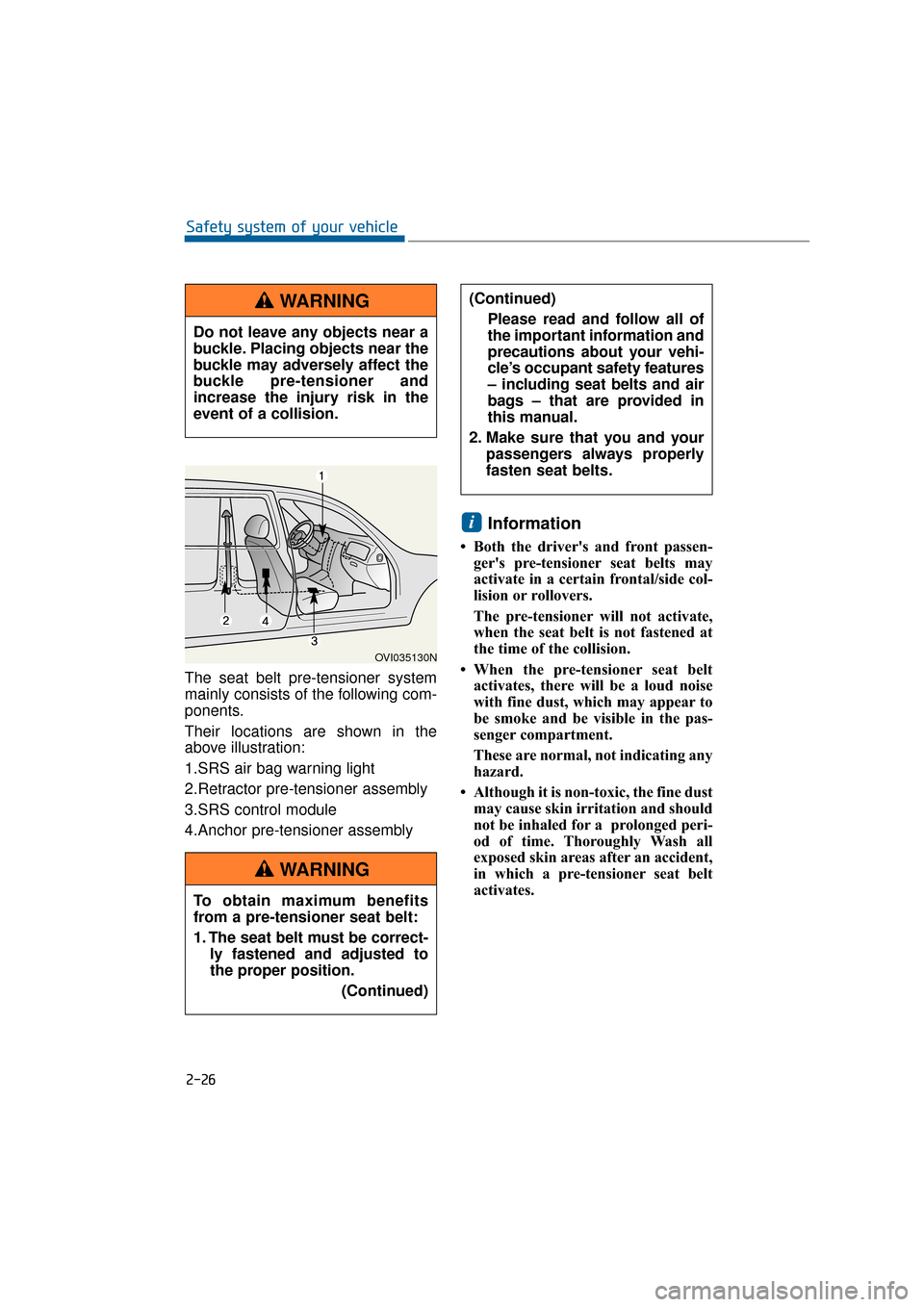
The seat belt pre-tensioner system
mainly consists of the following com-
ponents.
Their locations are shown in the
above illustration:
1.SRS air bag warning light
2.Retractor pre-tensioner assembly
3.SRS control module
4.Anchor pre-tensioner assembly
Information
• Both the driver's and front passen-ger's pre-tensioner seat belts may
activate in a certain frontal/side col-
lision or rollovers.
The pre-tensioner will not activate,
when the seat belt is not fastened at
the time of the collision.
• When the pre-tensioner seat belt activates, there will be a loud noise
with fine dust, which may appear to
be smoke and be visible in the pas-
senger compartment.
These are normal, not indicating any
hazard.
• Although it is non-toxic, the fine dust may cause skin irritation and should
not be inhaled for a prolonged peri-
od of time. Thoroughly Wash all
exposed skin areas after an accident,
in which a pre-tensioner seat belt
activates.
i
2-26
Safety system of your vehicle
To obtain maximum benefits
from a pre-tensioner seat belt:
1. The seat belt must be correct- ly fastened and adjusted to
the proper position.
(Continued)
(Continued)Please read and follow all of
the important information and
precautions about your vehi-
cle’s occupant safety features
– including seat belts and air
bags – that are provided in
this manual.
2. Make sure that you and your passengers always properly
fasten seat belts.
WARNING
Do not leave any objects near a
buckle. Placing objects near the
buckle may adversely affect the
buckle pre-tensioner and
increase the injury risk in the
event of a collision.
WARNING
OVI035130N
Page 59 of 477

Do not lie down
To reduce the chance of injury in the
event of an accident and to achieve
maximum effects of the restraint sys-
tem, all passengers should seat in an
upright position in front and rear
seats when the vehicle is in motion.
Proper protection cannot be provid-
ed, when an occupant lies on rear
seats, or when a seat is reclined.
Care of seat belts
Seat belt systems should never be
disassembled or modified. In addi-
tion, care should be taken not to
damage seat belts or belt assem-
blies by seat hinges, doors or other
abuse.
Periodic inspection
All seat belts should be checked on a
regular basis for any wear-out or
damage. Any damaged parts should
be replaced as soon as possible.
Keep belts clean and dry
Seat belts should be kept clean and
dry. When belts become dirty, clean
them with mild soap and warm water.
Bleach, dye, strong detergents or
abrasives should not be used,
because they may damage and
weaken the fabric.
When to replace seat belts
An entire seat belt assembly should
be replaced after an accident. This
should be done, even when no dam-
age is visible. Consult an authorized
EQUUS dealer for additional ques-
tions about the seat belt operation.
2-32
Safety system of your vehicleRiding with a reclined seatback
increases your chance of seri-
ous or fatal injuries in the event
of a collision or sudden stop.
The protection of your restraint
system (seat belts and air bags)
increasingly reduces, when
your seat is reclined. A seat belt
must be snug against your hips
and chest to properly operate.
The more a seatback is
reclined, the greater the chance
that an occupant's hips will
slide under the lap portion of a
seat belt, causing serious inter-
nal injury or hard pressure on
the occupant's neck from the
shoulder portion of a seat belt.
Drivers and passengers should
always sit well back in their
seats, be properly belted, and
put their seatbacks upright.
DANGER