roof Hyundai Equus 2016 Owner's Manual
[x] Cancel search | Manufacturer: HYUNDAI, Model Year: 2016, Model line: Equus, Model: Hyundai Equus 2016Pages: 477, PDF Size: 16.25 MB
Page 15 of 477
Smart key ..............................3-6
Locking ........................................3-7
Unlocking ....................................3-7
Trunk Unlocking ........................3-8
Panic Button ..............................3-8
Start-Up ......................................3-8
Mechanical Key.........................3-9
Loss of a Smart Key..............3-10
Smart key precautions..........3-10
Record your key number .....3-10
Immobilizer system ................3-10
Restrictions in Handling
Keys ...........................................3-11
Battery Replacement.............3-12
Theft-Alarm system ..........3-13
Door locks ...........................3-14
Operating Door Locks From
Outside the Vehicle ................3-14
Power Door Latch ..................3-15
Operating Door Locks From
Inside the Vehicle ...................3-15
Auto Door Lock/Unlock
Features....................................3-17
Child-Protector Rear Door
Locks .........................................3-17
Trunk....................................3-18
Non-Powered Trunk ..............3-18
Power Trunk ............................3-19
To Reset the Power Trunk ...3-22
Trunk Lid Control Button......3-22
Emergency Trunk Safety
Release......................................3-23
Smart Trunk .............................3-24
Windows ..............................3-28
Power Windows ......................3-29
Hood.....................................3-33
Opening the Hood .................3-33
Closing the Hood ....................3-33
Fuel filler lid .......................3-34
Opening the Fuel Filler Lid ..3-34
Closing the Fuel Filler Lid ....3-34
Sunroof ...............................3-37
Sliding the Sunroof ................3-37
Tilting the Sunroof ................3-38
Resetting the Sunroof ..........3-39
Sunshade ..................................3-39
Driver position memory
system .................................3-40
Storing the Position
Memory ....................................3-40
Recalling the Position
Memory ....................................3-41
Easy Access Function ...........3-41
Steering wheel ...................3-42
Electronic Hydraulic Power
Steering (EHPS) ......................3-42
Tilt Steering/
Telescope Steering.................3-42
Heated Steering Wheel .........3-43
Horn ...........................................3-43
Mirrors.................................3-44
Interior rearview mirrors ......3-44
Electric chromic mirror (ECM)
with HomeLink
®system and
compass .........................3-44, 3-51
Outside rearview mirror .......3-58
Reverse Parking Aid
Function ....................................3-61
Instrument cluster..............3-62
Instrument Cluster Control...3-64
LCD Display Control ...............3-64
Gauges ......................................3-65
F15
3Convenient features of
your vehicle
Page 22 of 477
Your vehicle at a glance
Exterior overview (front) .....................................1-2
: Towing hook, Hood, Front windshield wiper blades, Sunroof, Outside rearview mirror, Door locks,
Tires and wheels, Headlamps, Front fog light
Exterior overview (rear) .......................................1-3
: Glass antenna and Defroster, High mounted stop light, Trunk, Rear combination light, Rearview camera,
Parking assist system, Towing hook, Fuel filler lid,
Door locks, Window
Interior overview ....................................................1-4
: Inside door handle, Driver's seat control, Driver position memory system button, Power window switch,
Outside rearview mirror control, Fuel-filler lid opener,
Trunk lid release switch or power trunk main control
switch, Seats, Steering wheel, etc...
Instrument panel overview ...................................1-5
: Instrument cluster, Lighting control lever, Wiper and washer control lever, Engine Start/Stop Button,
Climate control system, Vehicle height control but-
ton, etc...
Engine compartment .............................................1-6
: Engine coolant reservoir, Air cleaner, Engine oil fillercap, Windshield washer fluid reservoir, Fuse box,
Jump start connector, etc...
Page 23 of 477
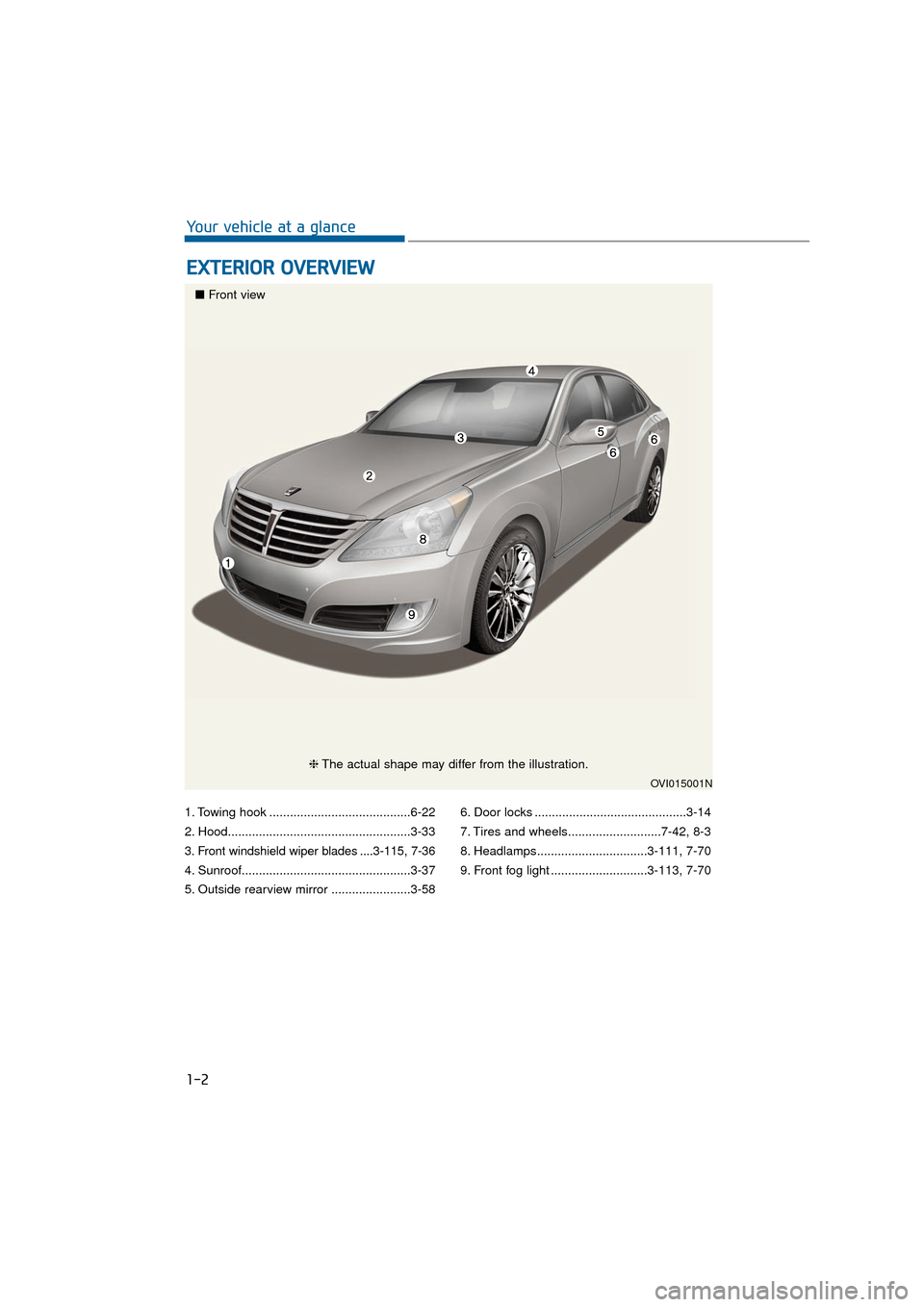
1. Towing hook .........................................6-22
2. Hood.....................................................3-33
3. Front windshield wiper blades ....3-115, 7-36
4. Sunroof.................................................3-37
5. Outside rearview mirror .......................3-586. Door locks ............................................3-14
7. Tires and wheels...........................7-42, 8-3
8. Headlamps................................3-111, 7-70
9. Front fog light ............................3-113, 7-70
E E
X
X T
TE
ER
R I
IO
O R
R
O
O V
VE
ER
R V
V I
IE
E W
W
1-2
Your vehicle at a glance
OVI015001N
■ Front view
❈The actual shape may differ from the illustration.
Page 71 of 477
Noise and smoke
When the air bags inflate, they pro-
duce not only a loud noise, but also
smoke and powder inside the vehi-
cle. This is normal and is a result of
the ignition of the air bag inflator.
After the air bag inflates, you may
feel substantial discomfort, while
breathing due to the contact of your
chest with both the seat belt and the
air bag, as well as from inhaled
smoke and powder.Open your
doors and windows as soon as
possible after air bag deployment
in order to reduce your discomfort
and prevent prolonged exposure
to the smoke and powder.
Though the smoke and powder are
non-toxic, they may cause skin irrita-
tion (i.e. eyes, nose and throat). In
this case, immediately wash your
skin with cold water and consult a
doctor if the symptom persists.
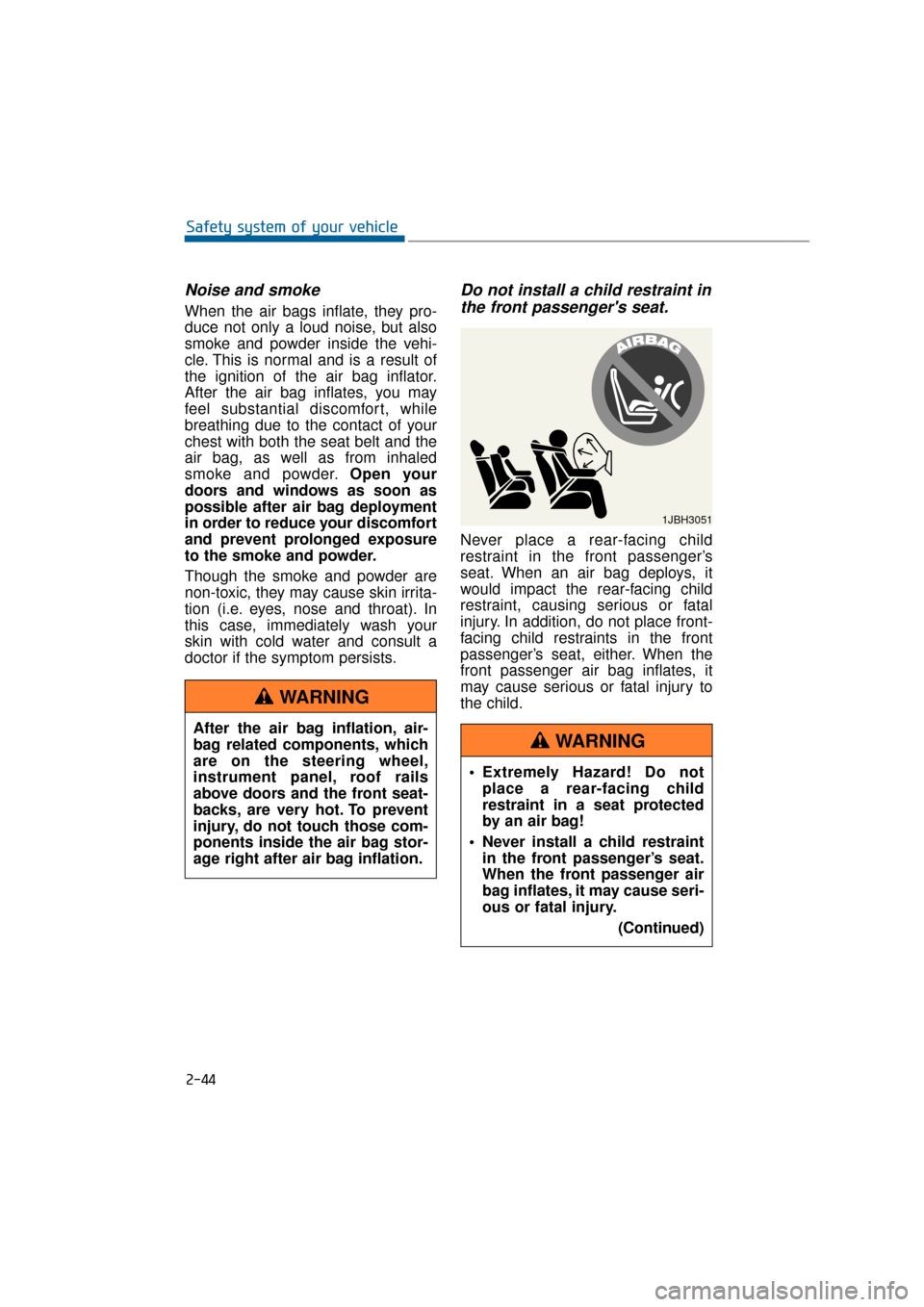
Do not install a child restraint in the front passenger's seat.
Never place a rear-facing child
restraint in the front passenger’s
seat. When an air bag deploys, it
would impact the rear-facing child
restraint, causing serious or fatal
injury. In addition, do not place front-
facing child restraints in the front
passenger’s seat, either. When the
front passenger air bag inflates, it
may cause serious or fatal injury to
the child.
2-44
Safety system of your vehicle
After the air bag inflation, air-
bag related components, which
are on the steering wheel,
instrument panel, roof rails
above doors and the front seat-
backs, are very hot. To prevent
injury, do not touch those com-
ponents inside the air bag stor-
age right after air bag inflation.
WARNING
1JBH3051
Extremely Hazard! Do not place a rear-facing child
restraint in a seat protected
by an air bag!
Never install a child restraint in the front passenger’s seat.
When the front passenger air
bag inflates, it may cause seri-
ous or fatal injury.
(Continued)
WARNING
Page 87 of 477
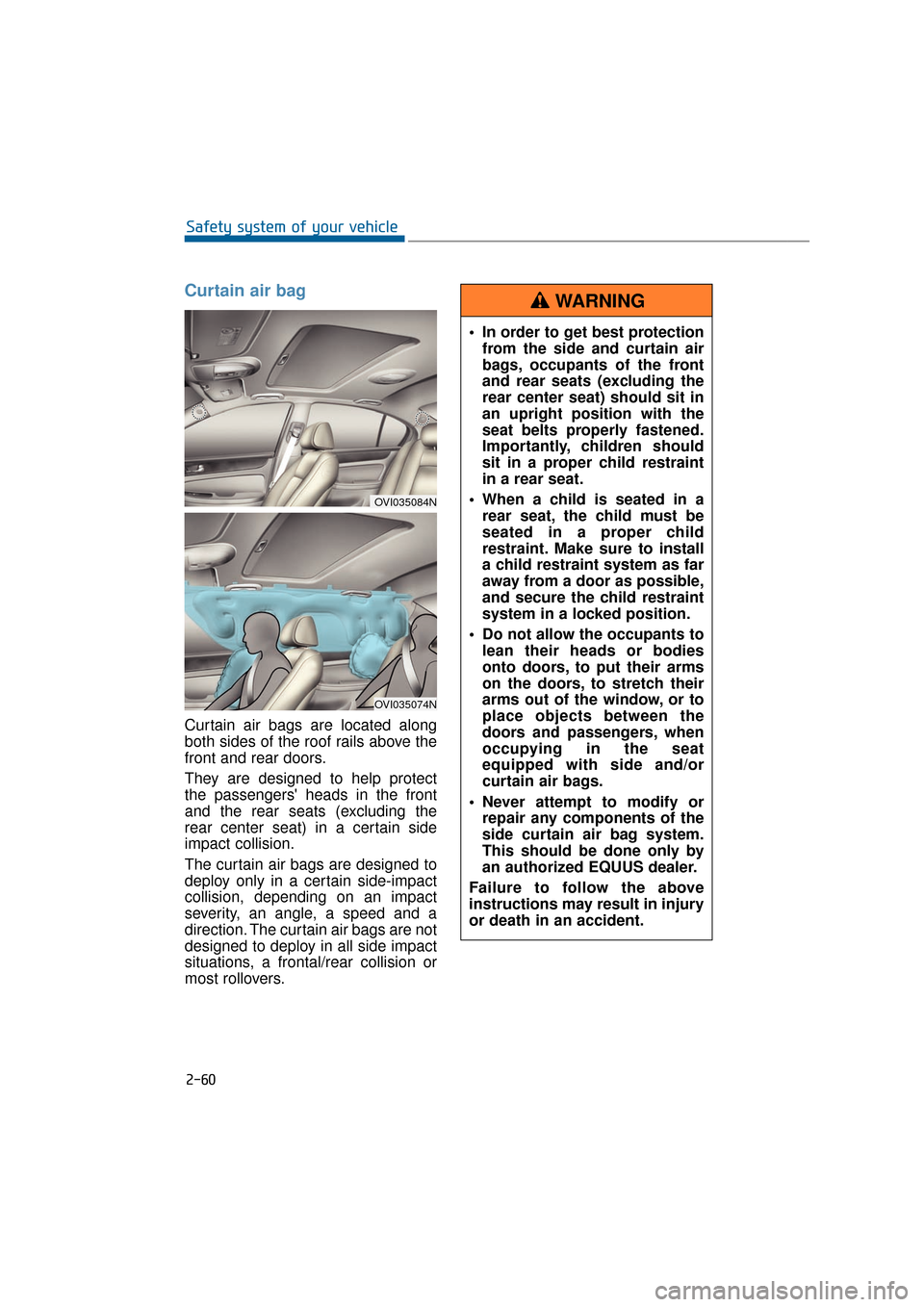
Curtain air bag
Curtain air bags are located along
both sides of the roof rails above the
front and rear doors.
They are designed to help protect
the passengers' heads in the front
and the rear seats (excluding the
rear center seat) in a certain side
impact collision.
The curtain air bags are designed to
deploy only in a certain side-impact
collision, depending on an impact
severity, an angle, a speed and a
direction. The curtain air bags are not
designed to deploy in all side impact
situations, a frontal/rear collision or
most rollovers.
2-60
Safety system of your vehicle
OVI035084N
OVI035074N
In order to get best protectionfrom the side and curtain air
bags, occupants of the front
and rear seats (excluding the
rear center seat) should sit in
an upright position with the
seat belts properly fastened.
Importantly, children should
sit in a proper child restraint
in a rear seat.
When a child is seated in a rear seat, the child must be
seated in a proper child
restraint. Make sure to install
a child restraint system as far
away from a door as possible,
and secure the child restraint
system in a locked position.
Do not allow the occupants to lean their heads or bodies
onto doors, to put their arms
on the doors, to stretch their
arms out of the window, or to
place objects between the
doors and passengers, when
occupying in the seat
equipped with side and/or
curtain air bags.
Never attempt to modify or repair any components of the
side curtain air bag system.
This should be done only by
an authorized EQUUS dealer.
Failure to follow the above
instructions may result in injury
or death in an accident.
WARNING
Page 92 of 477
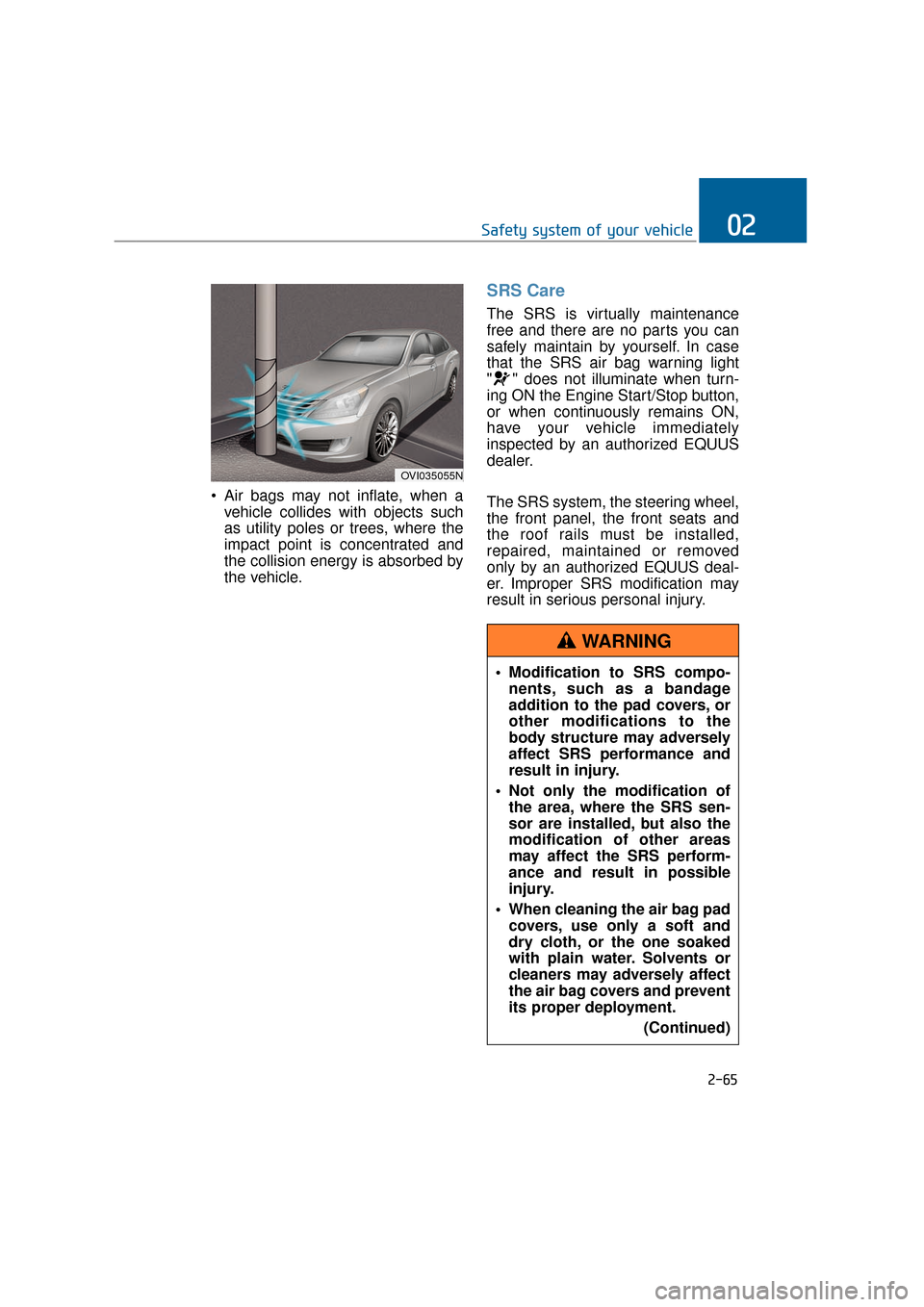
Air bags may not inflate, when avehicle collides with objects such
as utility poles or trees, where the
impact point is concentrated and
the collision energy is absorbed by
the vehicle.
SRS Care
The SRS is virtually maintenance
free and there are no parts you can
safely maintain by yourself. In case
that the SRS air bag warning light
" " does not illuminate when turn-
ing ON the Engine Start/Stop button,
or when continuously remains ON,
have your vehicle immediately
inspected by an authorized EQUUS
dealer.
The SRS system, the steering wheel,
the front panel, the front seats and
the roof rails must be installed,
repaired, maintained or removed
only by an authorized EQUUS deal-
er. Improper SRS modification may
result in serious personal injury.
2-65
Safety system of your vehicle02
OVI035055N
Modification to SRS compo-nents, such as a bandage
addition to the pad covers, or
other modifications to the
body structure may adversely
affect SRS performance and
result in injury.
Not only the modification of the area, where the SRS sen-
sor are installed, but also the
modification of other areas
may affect the SRS perform-
ance and result in possible
injury.
When cleaning the air bag pad covers, use only a soft and
dry cloth, or the one soaked
with plain water. Solvents or
cleaners may adversely affect
the air bag covers and prevent
its proper deployment.
(Continued)
WARNING
Page 97 of 477

Hood.......................................................................3\
-33
Opening the Hood .........................................................3-33
Closing the Hood .............................................................3-33
Fuel filler lid .........................................................3-34
Opening the Fuel Filler Lid ...........................................3-34
Closing the Fuel Filler Lid .............................................3-34
Sunroof..................................................................3-37
Sliding the Sunroof .........................................................3-37
Tilting the Sunroof .........................................................3-38
Resetting the Sunroof ...................................................3-39
Sunshade ........................................................................\
...3-39
Driver position memory system .........................3-40
Storing the Position Memory .......................................3-40
Recalling the Position Memory ...................................3-41
Easy Access Function ....................................................3-41
Steering wheel......................................................3-42
Electronic Hydraulic Power Steering (EHPS) ...........3-42
Tilt Steering/Telescope Steering.................................3-42
Heated Steering Wheel ..................................................3-43
Horn ........................................................................\
............3-43
Mirrors ...................................................................3-44
Interior rearview mirrors ...............................................3-44
Electric chromic mirror (ECM) with HomeLink®
system and compass ...........................................3-44, 3-51
Outside rearview mirror ................................................3-58
Reverse Parking Aid Function......................................3-61
Convenient features of your vehicle
Page 124 of 477
Power Windows
The Engine Start/Stop Button must
be ON, before raising or lowering the
windows.
Each door has a Power Window
switch to control that door's window.
The driver has a Power Window Lock
switch to block the operation of pas-
senger windows. The power windows
even operate for approximately 30
seconds after turning the Engine
Start/Stop Button to the ACC or
LOCK position. However, after open-
ing a front door, the Power Windows
do not operate.
Information
While driving with the rear windows
down or with the sunroof (if equipped)
open (or partially open), your vehicle
may experience noise due to the wind
resistance. This is normal, and the
noise can be reduced or eliminated by
taking the following actions. When the
noise occurs with one or both of the
rear windows down, lower both the
front windows approximately by one
inch. When you experience the noise
with the sunroof open, slightly close
the sunroof to reduce the opening size.
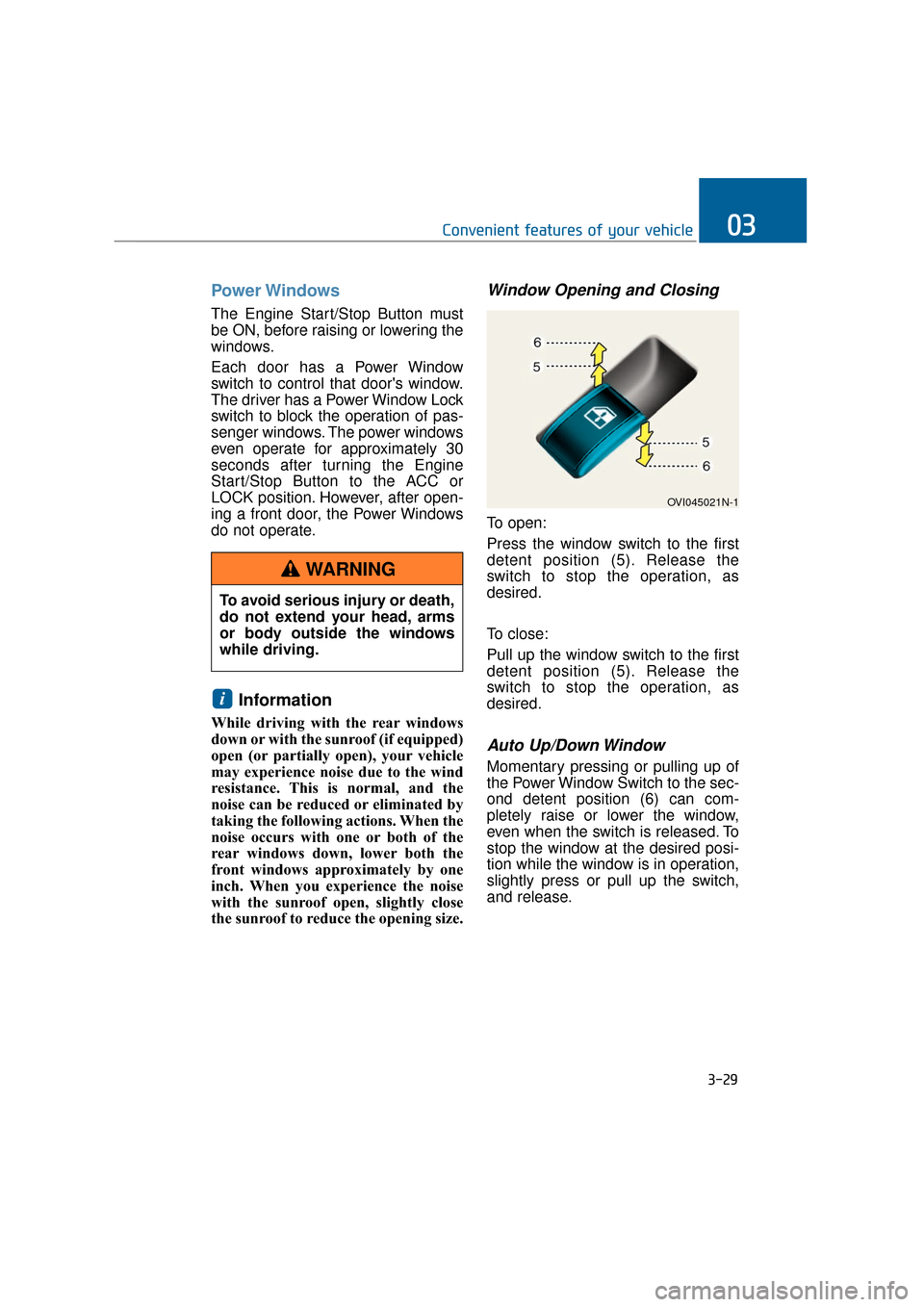
Window Opening and Closing
To open:
Press the window switch to the first
detent position (5). Release the
switch to stop the operation, as
desired.
To close:
Pull up the window switch to the first
detent position (5). Release the
switch to stop the operation, as
desired.
Auto Up/Down Window
Momentary pressing or pulling up of
the Power Window Switch to the sec-
ond detent position (6) can com-
pletely raise or lower the window,
even when the switch is released. To
stop the window at the desired posi-
tion while the window is in operation,
slightly press or pull up the switch,
and release.
i
3-29
Convenient features of your vehicle03
To avoid serious injury or death,
do not extend your head, arms
or body outside the windows
while driving.
WARNING
OVI045021N-1
Page 132 of 477
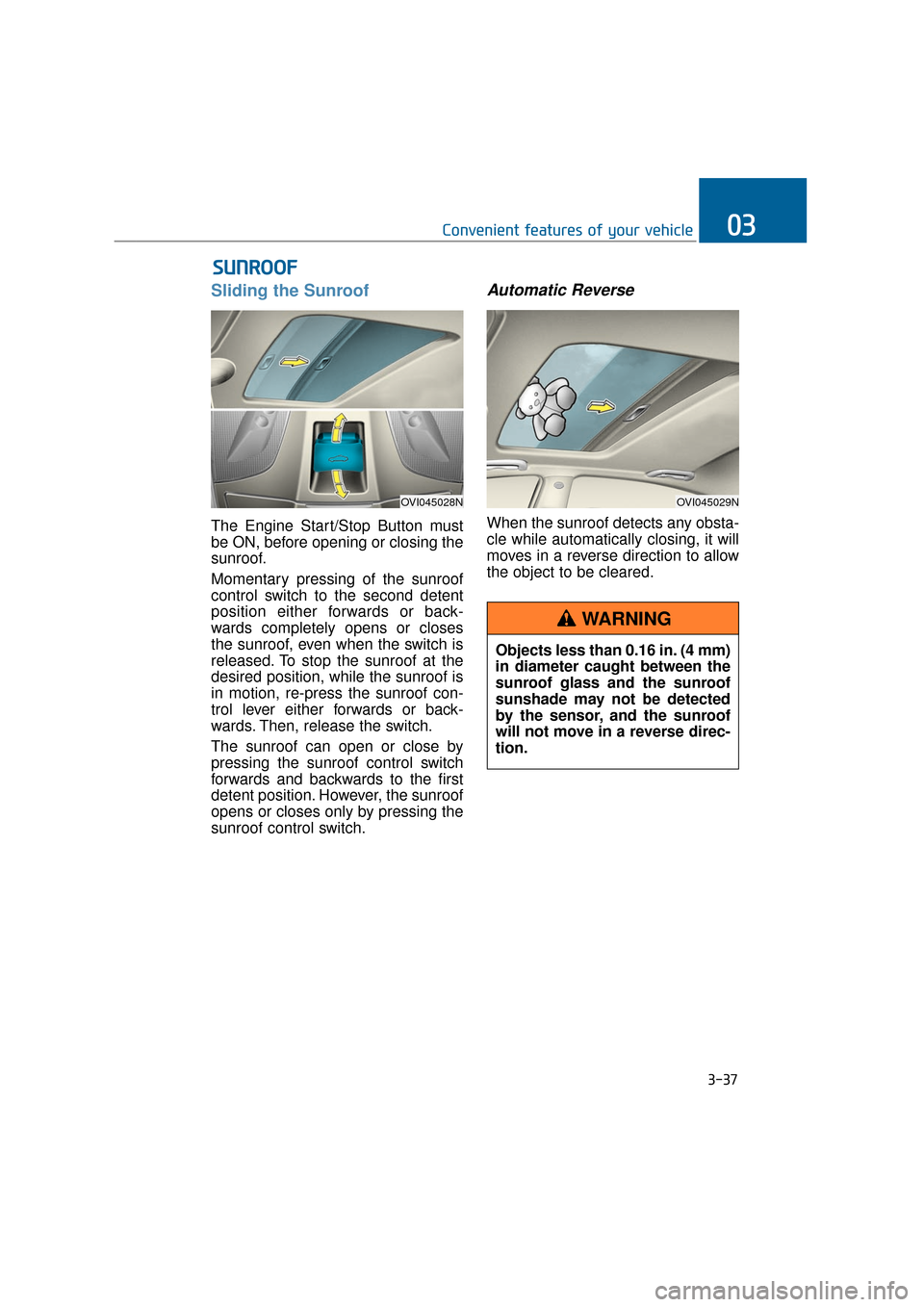
Sliding the Sunroof
The Engine Start/Stop Button must
be ON, before opening or closing the
sunroof.
Momentary pressing of the sunroof
control switch to the second detent
position either forwards or back-
wards completely opens or closes
the sunroof, even when the switch is
released. To stop the sunroof at the
desired position, while the sunroof is
in motion, re-press the sunroof con-
trol lever either forwards or back-
wards. Then, release the switch.
The sunroof can open or close by
pressing the sunroof control switch
forwards and backwards to the first
detent position. However, the sunroof
opens or closes only by pressing the
sunroof control switch.
Automatic Reverse
When the sunroof detects any obsta-
cle while automatically closing, it will
moves in a reverse direction to allow
the object to be cleared.
S SU
U N
NR
RO
O O
OF
F
3-37
Convenient features of your vehicle03
OVI045028NOVI045029N
Objects less than 0.16 in. (4 mm)
in diameter caught between the
sunroof glass and the sunroof
sunshade may not be detected
by the sensor, and the sunroof
will not move in a reverse direc-
tion.
WARNING
Page 133 of 477
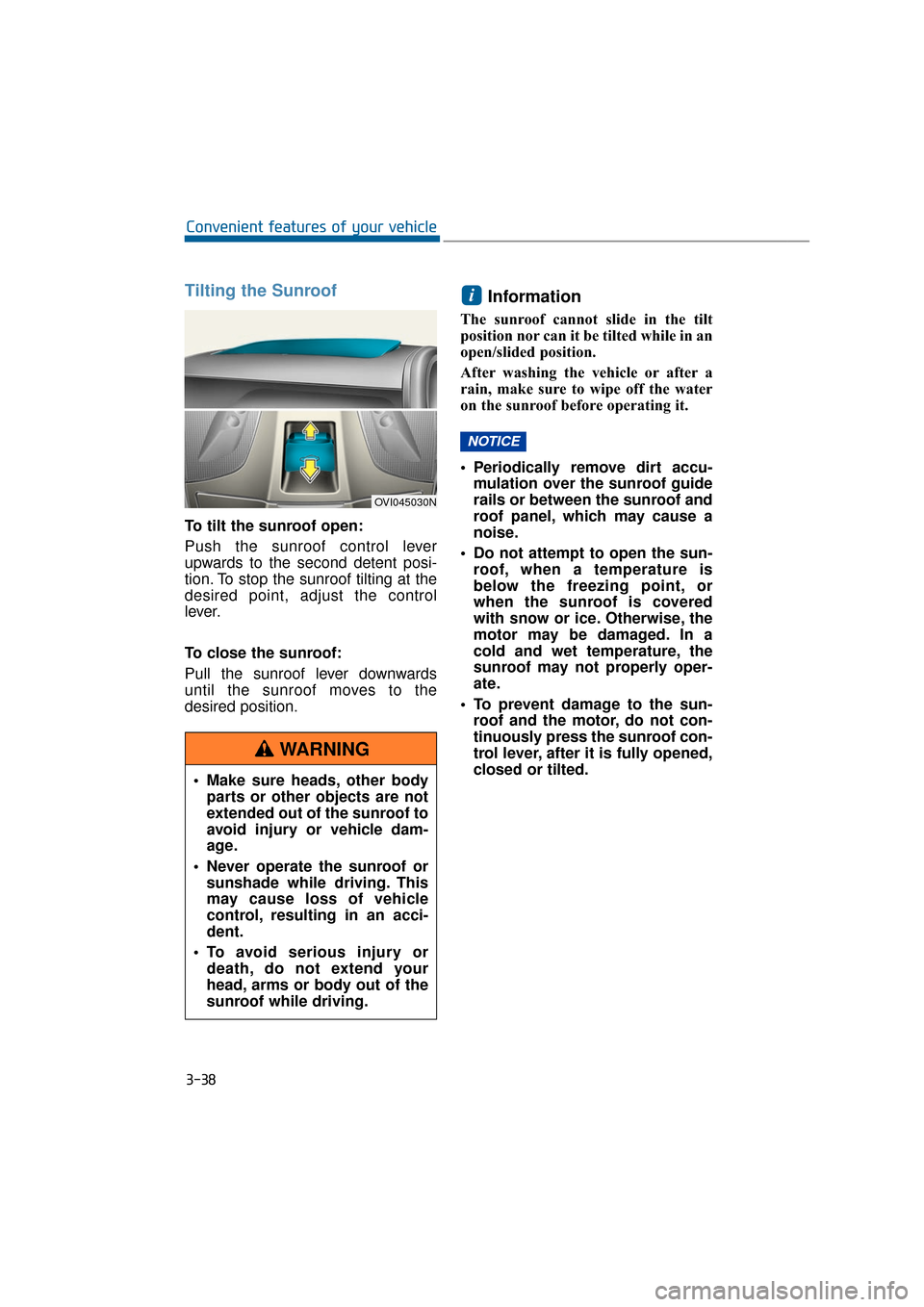
Tilting the Sunroof
To tilt the sunroof open:
Push the sunroof control lever
upwards to the second detent posi-
tion. To stop the sunroof tilting at the
desired point, adjust the control
lever.
To close the sunroof:
Pull the sunroof lever downwards
until the sunroof moves to the
desired position.
Information
The sunroof cannot slide in the tilt
position nor can it be tilted while in an
open/slided position.
After washing the vehicle or after a
rain, make sure to wipe off the water
on the sunroof before operating it.
Periodically remove dirt accu-mulation over the sunroof guide
rails or between the sunroof and
roof panel, which may cause a
noise.
Do not attempt to open the sun- roof, when a temperature is
below the freezing point, or
when the sunroof is covered
with snow or ice. Otherwise, the
motor may be damaged. In a
cold and wet temperature, the
sunroof may not properly oper-
ate.
To prevent damage to the sun- roof and the motor, do not con-
tinuously press the sunroof con-
trol lever, after it is fully opened,
closed or tilted.
NOTICE
i
3-38
Convenient features of your vehicle
OVI045030N
Make sure heads, other bodyparts or other objects are not
extended out of the sunroof to
avoid injury or vehicle dam-
age.
Never operate the sunroof or sunshade while driving. This
may cause loss of vehicle
control, resulting in an acci-
dent.
To avoid serious injury or death, do not extend your
head, arms or body out of the
sunroof while driving.
WARNING