ESP Hyundai Genesis 2010 Service Manual
[x] Cancel search | Manufacturer: HYUNDAI, Model Year: 2010, Model line: Genesis, Model: Hyundai Genesis 2010Pages: 399, PDF Size: 10 MB
Page 369 of 399
Maintenance
54 7
LIGHT BULBS
G220000AEN
Use only the bulbs of the specified
wattage.
✽ ✽
NOTICE
After heavy, driving rain or washing,
headlight and taillight lenses could
appear frosty. This condition is caused by
the temperature difference between the
lamp inside and outside. This is similar
to the condensation on your windows
inside your vehicle during the rain and
doesn’t indicate a problem with your
vehicle. If the water leaks into the lamp
bulb circuitry, have the vehicle checked
by an authorized HYUNDAI dealer.
G220100BBH
Headlight, position light, turn sig-
nal light, side marker light and
front fog light bulb replacement
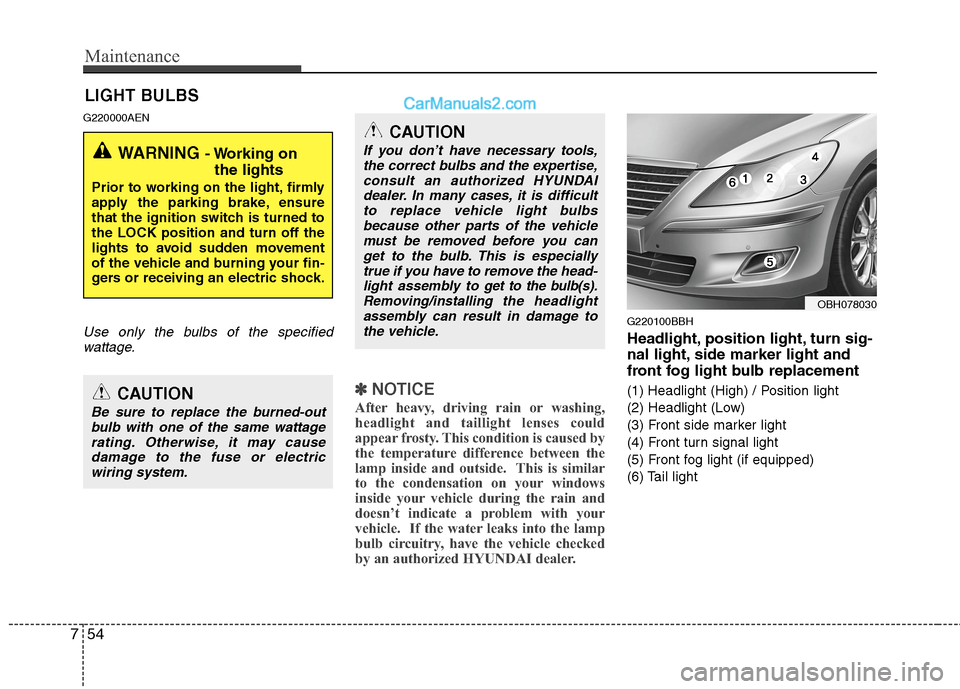
(1) Headlight (High) / Position light
(2) Headlight (Low)
(3) Front side marker light
(4) Front turn signal light
(5) Front fog light (if equipped)
(6) Tail light
WARNING - Working on
the lights
Prior to working on the light, firmly
apply the parking brake, ensure
that the ignition switch is turned to
the LOCK position and turn off the
lights to avoid sudden movement
of the vehicle and burning your fin-
gers or receiving an electric shock.
CAUTION
Be sure to replace the burned-out
bulb with one of the same wattage
rating. Otherwise, it may cause
damage to the fuse or electric
wiring system.
CAUTION
If you don’t have necessary tools,
the correct bulbs and the expertise,
consult an authorized HYUNDAI
dealer. In many cases, it is difficult
to replace vehicle light bulbs
because other parts of the vehicle
must be removed before you can
get to the bulb. This is especially
true if you have to remove the head-
light assembly to
get to the bulb(s).
Removing/installingthe headlight
assembly can result in damage to
the vehicle.OBH078030
Page 374 of 399
759
Maintenance
APPEARANCE CARE
Exterior care
G230101AUN
Exterior general caution
It is very important to follow the label
directions when using any chemical
cleaner or polish. Read all warning and
caution statements that appear on the
label.
G230102ABH
Finish maintenance
Washing
To help protect your vehicle’s finish from
rust and deterioration, wash it thoroughly
and frequently at least once a month with
lukewarm or cold water.
If you use your vehicle for off-road driv-
ing, you should wash it after each off-
road trip. Pay special attention to the
removal of any accumulation of salt, dirt,
mud, and other foreign materials. Make
sure the drain holes in the lower edges of
the doors and rocker panels are kept
clear and clean.
Insects, tar, tree sap, bird droppings,
industrial pollution and similar deposits
can damage your vehicle’s finish if not
removed immediately.
Even prompt washing with plain water
may not completely remove all these
deposits. A mild soap, safe for use on
painted surfaces, may be used.After washing, rinse the vehicle thor-
oughly with lukewarm or cold water. Do
not allow soap to dry on the finish.
CAUTION
Do not use strong soap, chemical
detergents or hot water, and do
not wash the vehicle in direct
sunlight or when the body of the
vehicle is warm.
Be careful when washing the side
windows of your vehicle.
Especially, with high-pressure
water, water may leak through the
windows and wet the interior.
To prevent damage to the plastic
parts, do not clean with chemical
solvents or strong detergents.
WARNING - Wet brakes
After washing the vehicle, test the
brakes while driving slowly to see if
they have been affected by water. If
braking performance is impaired,
dry the brakes by applying them
lightly while maintaining a slow for-
ward speed.
CAUTION
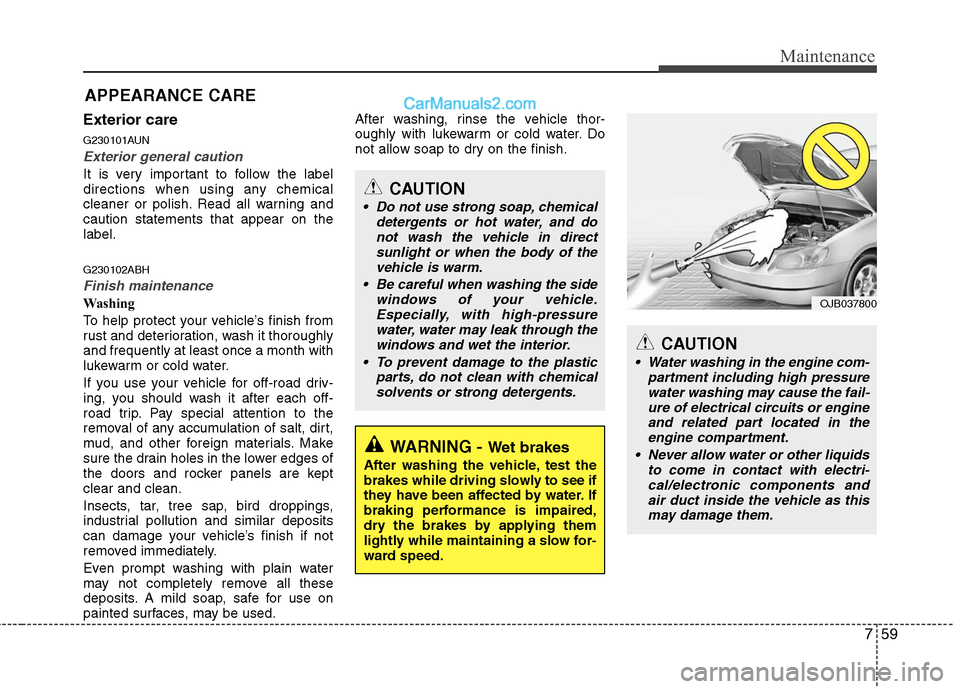
Water washing in the engine com-
partment including high pressure
water washing may cause the fail-
ure of electrical circuits or engine
and related part located in the
engine compartment.
Never allow water or other liquids
to come in contact with electri-
cal/electronic components and
air duct inside the vehicle as this
may damage them.
OJB037800
Page 388 of 399
85
Specifications, Consumer information, Reporting safety defeccts
I040100ABH-EU
Recommended SAE viscosity
number
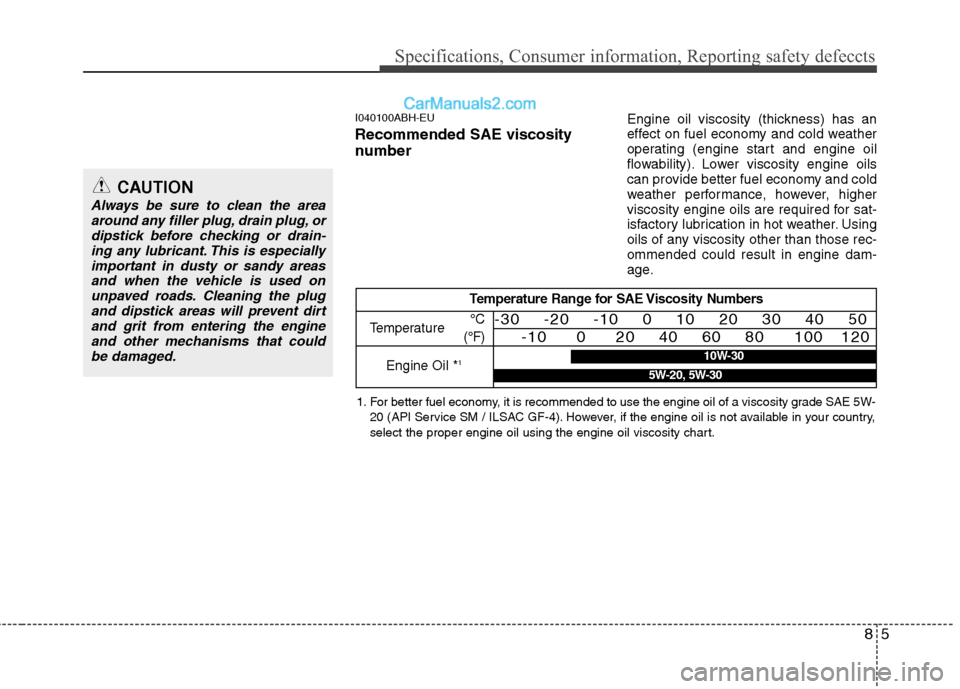
Engine oil viscosity (thickness) has an
effect on fuel economy and cold weather
operating (engine start and engine oil
flowability). Lower viscosity engine oils
can provide better fuel economy and cold
weather performance, however, higher
viscosity engine oils are required for sat-
isfactory lubrication in hot weather. Using
oils of any viscosity other than those rec-
ommended could result in engine dam-
age.
CAUTION
Always be sure to clean the area
around any filler plug, drain plug, or
dipstick before checking or drain-
ing any lubricant. This is especially
important in dusty or sandy areas
and when the vehicle is used on
unpaved roads. Cleaning the plug
and dipstick areas will prevent dirt
and grit from entering the engine
and other mechanisms that could
be damaged.
Temperature Range for SAE Viscosity Numbers
Temperature
Engine Oil *
1
°C
(°F)-30 -20 -10 0 10 20 30 40 50
-10 0 20 40 60 80 100 120
1. For better fuel economy, it is recommended to use the engine oil of a viscosity grade SAE 5W-
20 (API Service SM / ILSAC GF-4). However, if the engine oil is not available in your country,
select the proper engine oil using the engine oil viscosity chart.
10W-30
5W-20, 5W-30
Page 392 of 399

89
Specifications, Consumer information, Reporting safety defeccts
H070000AEN
If you believe that your vehicle has a
defect which could cause a crash or
could cause injury or death, you should
immediately inform the National Highway
Traffic Safety Administration (NHTSA) in
addition to notifying HYUNDAI MOTOR
AMERICA. If NHTSA receives similar
complaints, it may open an investigation,
and if it finds that a safety defect exists in
a group of vehicles, it may order a recall
and remedy campaign. However, NHTSA
cannot become involved in individual
problems between you, your dealer, or
HYUNDAI MOTOR AMERICA.
To contact NHTSA, you may call the
Vehicle Safety Hotline toll-free at 1-888-
327-4236 (TTY: 1-800-424-9153); go to
http://www.safercar.gov; or write to:
Administrator, NHTSA, 1200 New Jersey
Avenue, SE, Washington, DC 20590. You
can also obtain other information about
motor vehicle safety from
http://www.safercar.gov.
H090000AEN
Any claim or dispute you may have relat-
ed to your vehicle's warranty or the duties
contemplated under the warranty, includ-
ing claims related to the refund or partial
refund of your vehicle's purchase price
(excluding personal injury or product lia-
bility claims), shall be resolved by binding
arbitration. Binding arbitration shall be
administered by and through the National
Arbitration Forum (NAF) or the American
Arbitration Association (AAA), under the
Code of Procedure of the entity you
select.
You will not be responsible for paying fil-
ing and hearing fees above $275.00. All
other arbitration costs shall be borne by
Hyundai Motor America. You are not
responsible to pay any of the costs
Hyundai incurs.
This Binding Arbitration Agreement shall
not deprive you of any remedies avail-
able to you under applicable law. The
parties are waiving their right to seek
remedies in court, including the right to a
jury trial.This Binding Arbitration Agreement shall
be governed by and interpreted under
the Federal Arbitration Act, 9 U.S.C. sec-
tions 1-16. Judgment upon any award
may be entered in any court having juris-
diction.
You may revoke this Arbitration
Agreement by (1) written notice or (2)
electronic notice. Written notice must be
delivered (via certified mail) to Hyundai
Motor America, Attn: Consumer Affairs,
10550 Talbert Avenue, P.O. Box 20849,
Fountain Valley, CA 92728-0849.
Electronic notice must be submitted at
the following website address: http://war-
ranty-arbitration.hyundaiUSA.com.
Notice must be received within 90 days
after you purchase your vehicle.
REPORTING SAFETY DEFECTSBINDING ARBITRATION (U.S.A ONLY)