Check engine Hyundai Genesis 2010 Workshop Manual
[x] Cancel search | Manufacturer: HYUNDAI, Model Year: 2010, Model line: Genesis, Model: Hyundai Genesis 2010Pages: 399, PDF Size: 10 MB
Page 332 of 399
717
Maintenance
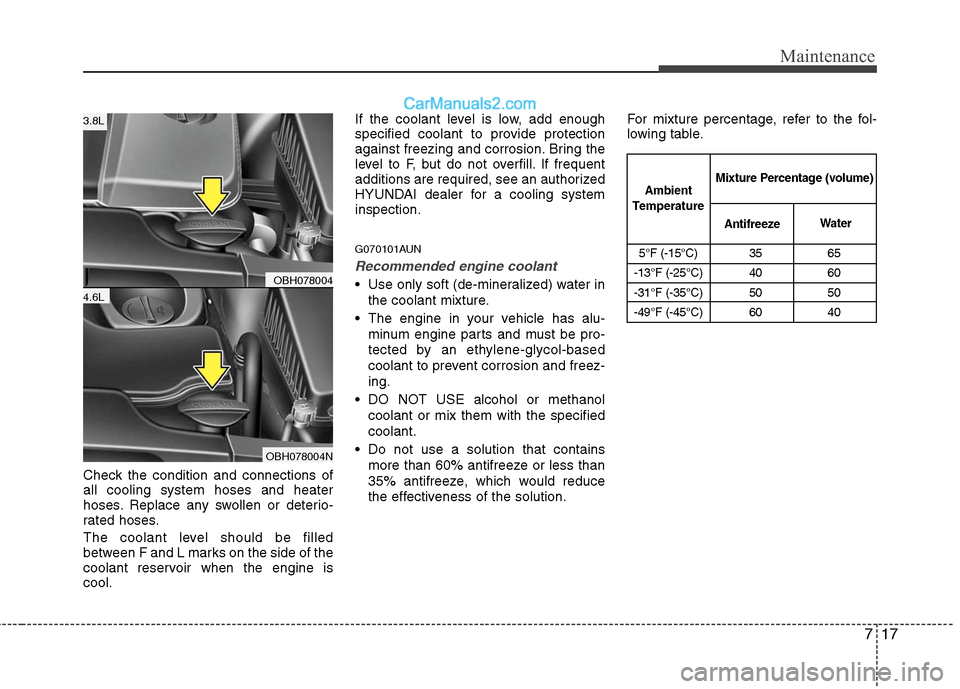
Check the condition and connections of
all cooling system hoses and heater
hoses. Replace any swollen or deterio-
rated hoses.
The coolant level should be filled
between F and L marks on the side of the
coolant reservoir when the engine is
cool.If the coolant level is low, add enough
specified coolant to provide protection
against freezing and corrosion. Bring the
level to F, but do not overfill. If frequent
additions are required, see an authorized
HYUNDAI dealer for a cooling system
inspection.
G070101AUN
Recommended engine coolant
Use only soft (de-mineralized) water in
the coolant mixture.
The engine in your vehicle has alu-
minum engine parts and must be pro-
tected by an ethylene-glycol-based
coolant to prevent corrosion and freez-
ing.
DO NOT USE alcohol or methanol
coolant or mix them with the specified
coolant.
Do not use a solution that contains
more than 60% antifreeze or less than
35% antifreeze, which would reduce
the effectiveness of the solution.For mixture percentage, refer to the fol-
lowing table.
5°F (-15°C) 35 65
-13°F (-25°C) 40 60
-31°F (-35°C) 50 50
-49°F (-45°C) 60 40
Ambient
TemperatureMixture Percentage (volume)
AntifreezeWater
OBH078004
OBH078004N
4.6L
3.8L
Page 334 of 399
719
Maintenance
BRAKE FLUID
G080100AEN
Checking the brake fluid level
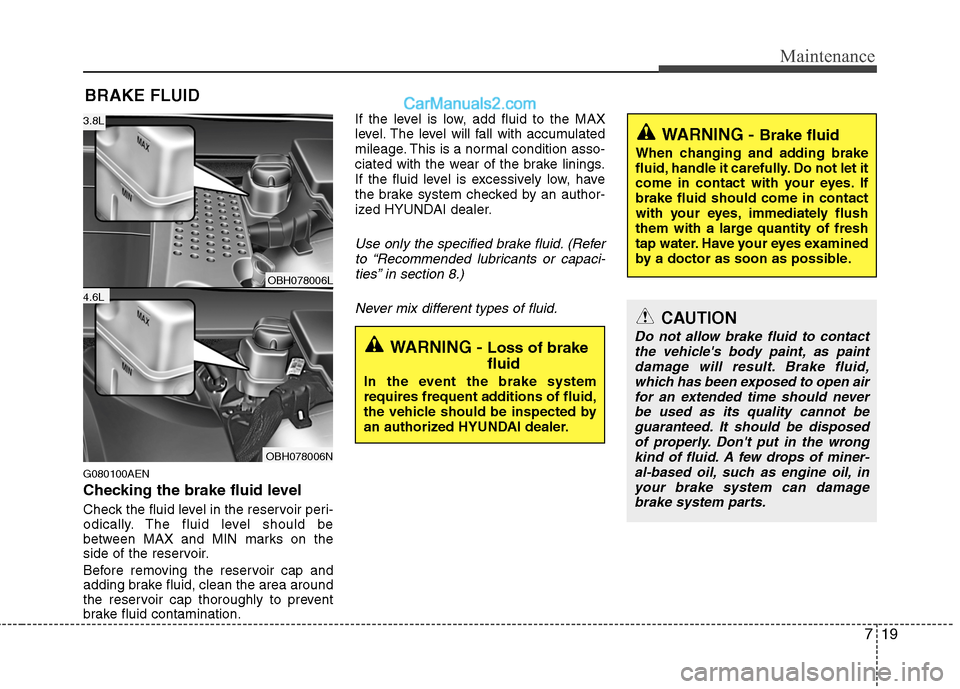
Check the fluid level in the reservoir peri-
odically. The fluid level should be
between MAX and MIN marks on the
side of the reservoir.
Before removing the reservoir cap and
adding brake fluid, clean the area around
the reservoir cap thoroughly to prevent
brake fluid contamination.If the level is low, add fluid to the MAX
level. The level will fall with accumulated
mileage. This is a normal condition asso-
ciated with the wear of the brake linings.
If the fluid level is excessively low, have
the brake system checked by an author-
ized HYUNDAI dealer.
Use only the specified brake fluid. (Refer
to “Recommended lubricants or capaci-
ties” in section 8.)
Never mix different types of fluid.
WARNING - Brake fluid
When changing and adding brake
fluid, handle it carefully. Do not let it
come in contact with your eyes. If
brake fluid should come in contact
with your eyes, immediately flush
them with a large quantity of fresh
tap water. Have your eyes examined
by a doctor as soon as possible.
WARNING - Loss of brake
fluid
In the event the brake system
requires frequent additions of fluid,
the vehicle should be inspected by
an authorized HYUNDAI dealer.
CAUTION
Do not allow brake fluid to contact
the vehicle's body paint, as paint
damage will result. Brake fluid,
which has been exposed to open air
for an extended time should never
be used as its quality cannot be
guaranteed. It should be disposed
of properly. Don't put in the wrong
kind of fluid. A few drops of miner-
al-based oil, such as engine oil, in
your brake system can damage
brake system parts.
OBH078006L
OBH078006N
4.6L
3.8L
Page 335 of 399
Maintenance
20 7
POWER STEERING FLUID
G090100ABH
Checking the power steering fluid
level
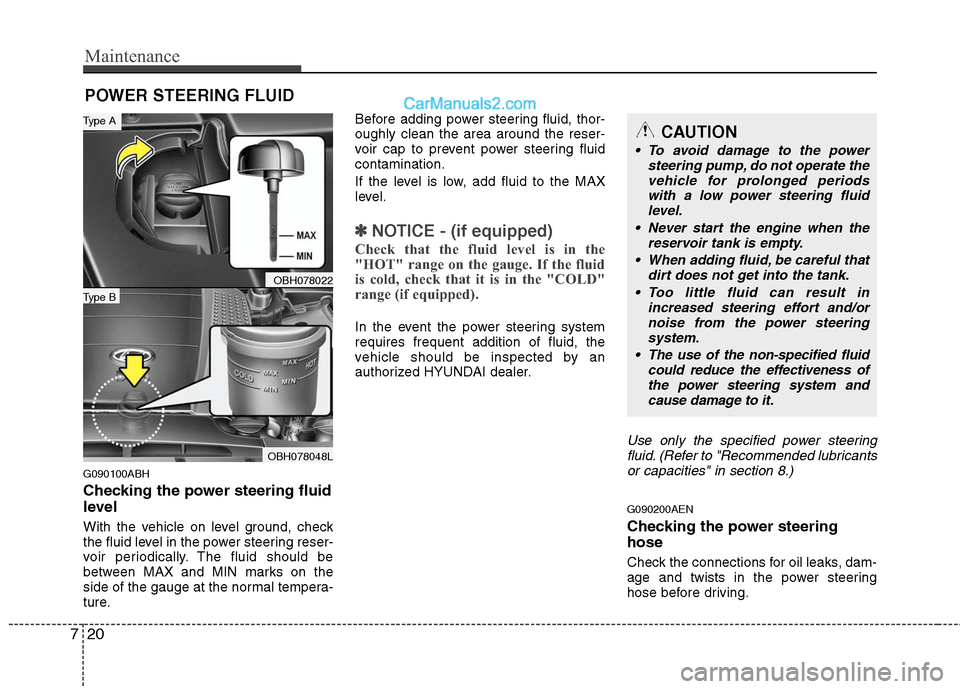
With the vehicle on level ground, check
the fluid level in the power steering reser-
voir periodically. The fluid should be
between MAX and MIN marks on the
side of the gauge at the normal tempera-
ture.Before adding power steering fluid, thor-
oughly clean the area around the reser-
voir cap to prevent power steering fluid
contamination.
If the level is low, add fluid to the MAX
level.
✽ ✽
NOTICE - (if equipped)
Check that the fluid level is in the
"HOT" range on the gauge. If the fluid
is cold, check that it is in the "COLD"
range (if equipped).
In the event the power steering system
requires frequent addition of fluid, the
vehicle should be inspected by an
authorized HYUNDAI dealer.
Use only the specified power steering
fluid. (Refer to "Recommended lubricants
or capacities" in section 8.)
G090200AEN
Checking the power steering
hose
Check the connections for oil leaks, dam-
age and twists in the power steering
hose before driving.
CAUTION
To avoid damage to the power
steering pump, do not operate the
vehicle for prolonged periods
with a low power steering fluid
level.
Never start the engine when the
reservoir tank is empty.
When adding fluid, be careful that
dirt does not get into the tank.
Too little fluid can result in
increased steering effort and/or
noise from the power steering
system.
The use of the non-specified fluid
could reduce the effectiveness of
the power steering system and
cause damage to it.
OBH078022
OBH078048L
Type B
Type A
Page 344 of 399
729
Maintenance
G190200ABH
Battery recharging
Your vehicle has a maintenance-free,
calcium-based battery.
If the battery becomes discharged in a
short time (because, for example, the
headlights or interior lights were left on
while the vehicle was not in use),
recharge it by slow charging (trickle)
for 10 hours.
If the battery gradually discharges
because of high electric load while the
vehicle is being used, recharge it at 20-
30A for two hours.
WARNING- Recharging
battery
When recharging the battery,
observe the following precautions:
The battery must be removed
from the vehicle and placed in an
area with good ventilation.
Do not allow cigarettes, sparks,
or flame near the battery.
Watch the battery during charg-
ing, and stop or reduce the charg-
ing rate if the battery cells begin
gassing (boiling) violently or if
the temperature of the electrolyte
of any cell exceeds 120°F (49°C).
Wear eye protection when check-
ing the battery during charging.
Disconnect the battery charger in
the following order.
1. Turn off the battery charger main
switch.
2. Unhook the negative clamp from
the negative battery terminal.
3. Unhook the positive clamp from
the positive battery terminal.
CALIFORNIA PROPOSI-
TION 65 WARNING
Battery posts, terminals, and relat-
ed accessories contain lead and
lead compounds, chemicals known
to the State of California to cause
cancer, birth defects and reproduc-
tive harm. Batteries also contain
other chemicals known to the State
of California to cause cancer. Wash
hands after handling.
CAUTION
When you don’t use the vehicle
for a long time in the low temper-
ature area, separate the battery
and keep it indoors.
Always charge the battery fully to
prevent the battery case dam-
aged in low temperature area.
(Continued)
The electrical ignition system
works with high voltage. Never
touch these components with the
engine running or the ignition
switched on.
Failure to follow the above warn-
ings can result in serious bodily
injury or death.
Page 359 of 399
Maintenance
44 7
FUSES
G210000ABH-EU
A vehicle’s electrical system is protected
from electrical overload damage by
fuses.This vehicle has 4 fuse panels, two locat-
ed in the driver’s side and passenger’s
side panel bolster, the other in the engine
compartment.
If any of your vehicle’s lights, acces-
sories, or controls do not work, check the
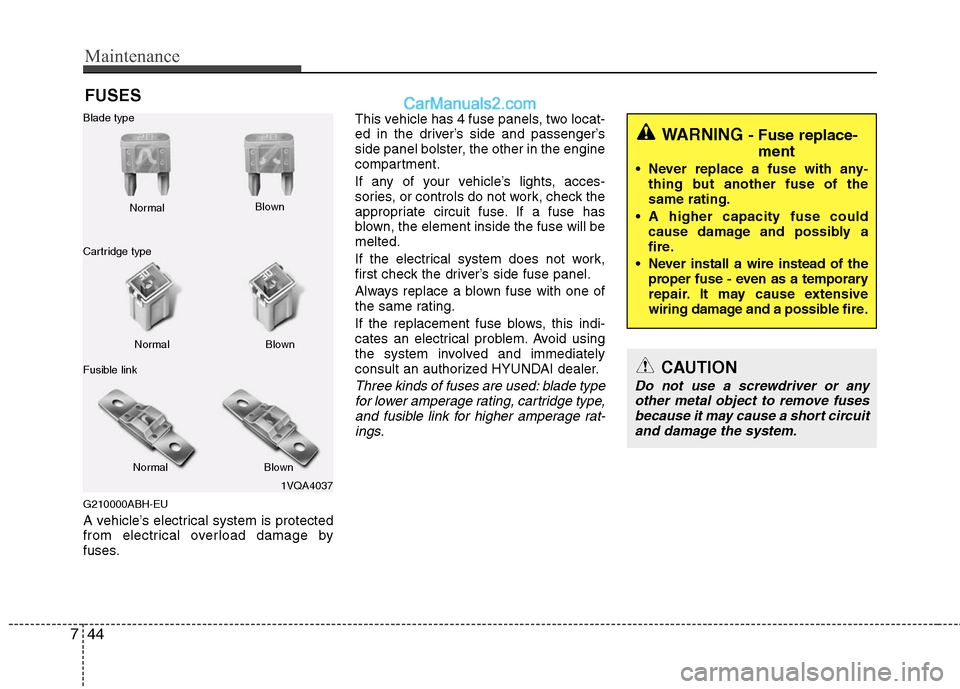
appropriate circuit fuse. If a fuse has
blown, the element inside the fuse will be
melted.
If the electrical system does not work,
first check the driver’s side fuse panel.
Always replace a blown fuse with one of
the same rating.
If the replacement fuse blows, this indi-
cates an electrical problem. Avoid using
the system involved and immediately
consult an authorized HYUNDAI dealer.
Three kinds of fuses are used: blade type
for lower amperage rating, cartridge type,
and fusible link for higher amperage rat-
ings.
1VQA4037 Normal Normal Blade type
Cartridge type
Fusible linkBlown
Blown
Normal Blown
WARNING - Fuse replace-
ment
Never replace a fuse with any-
thing but another fuse of the
same rating.
A higher capacity fuse could
cause damage and possibly a
fire.
Never install a wire instead of the
proper fuse - even as a temporary
repair. It may cause extensive
wiring damage and a possible fire.
CAUTION
Do not use a screwdriver or any
other metal object to remove fuses
because it may cause a short circuit
and damage the system.
Page 360 of 399
745
Maintenance
G210100ABH
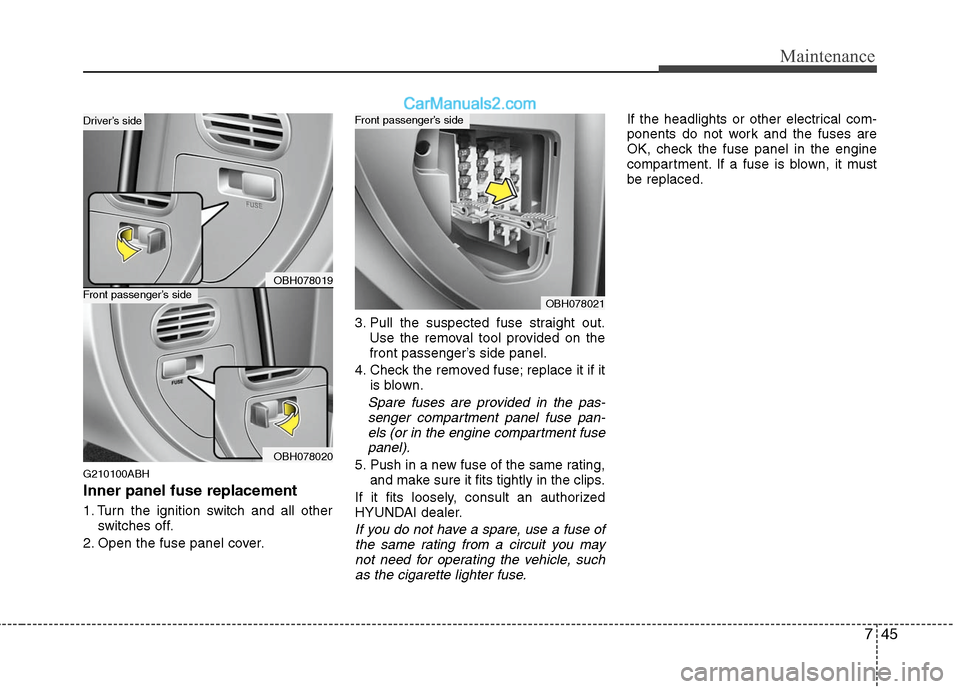
Inner panel fuse replacement
1. Turn the ignition switch and all other
switches off.
2. Open the fuse panel cover.3. Pull the suspected fuse straight out.
Use the removal tool provided on the
front passenger’s side panel.
4. Check the removed fuse; replace it if it
is blown.
Spare fuses are provided in the pas-
senger compartment panel fuse pan-
els (or in the engine compartment fuse
panel).
5. Push in a new fuse of the same rating,
and make sure it fits tightly in the clips.
If it fits loosely, consult an authorized
HYUNDAI dealer.
If you do not have a spare, use a fuse of
the same rating from a circuit you may
not need for operating the vehicle, such
as the cigarette lighter fuse.
If the headlights or other electrical com-
ponents do not work and the fuses are
OK, check the fuse panel in the engine
compartment. If a fuse is blown, it must
be replaced.
OBH078021
OBH078019
OBH078020
Front passenger’s side
Front passenger’s sideDriver’s side
Page 362 of 399
747
Maintenance
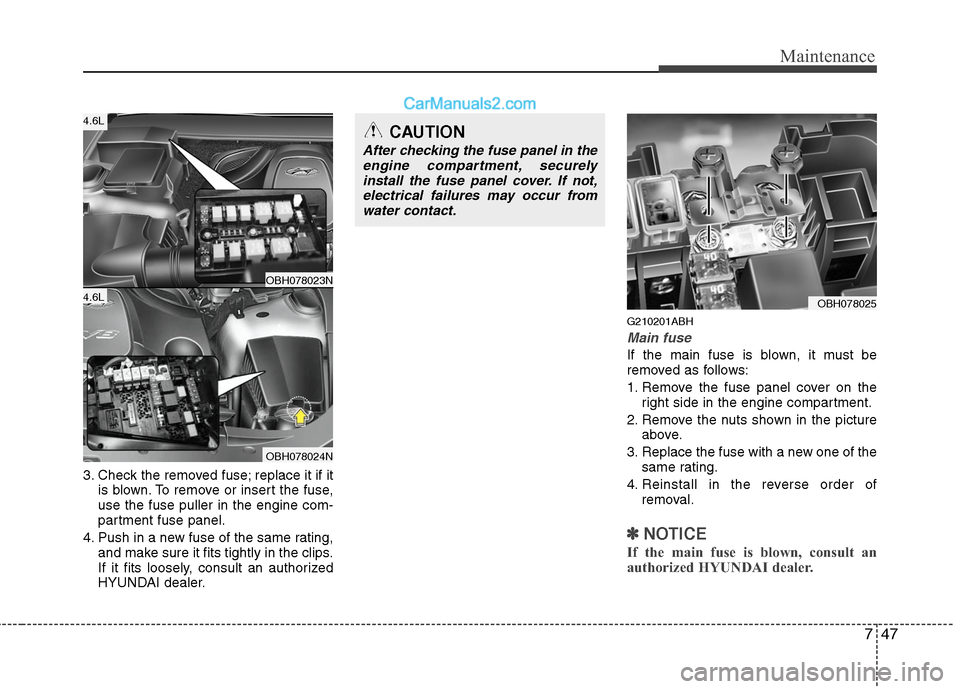
3. Check the removed fuse; replace it if it
is blown. To remove or insert the fuse,
use the fuse puller in the engine com-
partment fuse panel.
4. Push in a new fuse of the same rating,
and make sure it fits tightly in the clips.
If it fits loosely, consult an authorized
HYUNDAI dealer.
G210201ABH
Main fuse
If the main fuse is blown, it must be
removed as follows:
1. Remove the fuse panel cover on the
right side in the engine compartment.
2. Remove the nuts shown in the picture
above.
3. Replace the fuse with a new one of the
same rating.
4. Reinstall in the reverse order of
removal.
✽ ✽
NOTICE
If the main fuse is blown, consult an
authorized HYUNDAI dealer.
CAUTION
After checking the fuse panel in the
engine compartment, securely
install the fuse panel cover. If not,
electrical failures may occur from
water contact.
OBH078025
OBH078023N
OBH078024N
4.6L
4.6L
Page 366 of 399
751
Maintenance
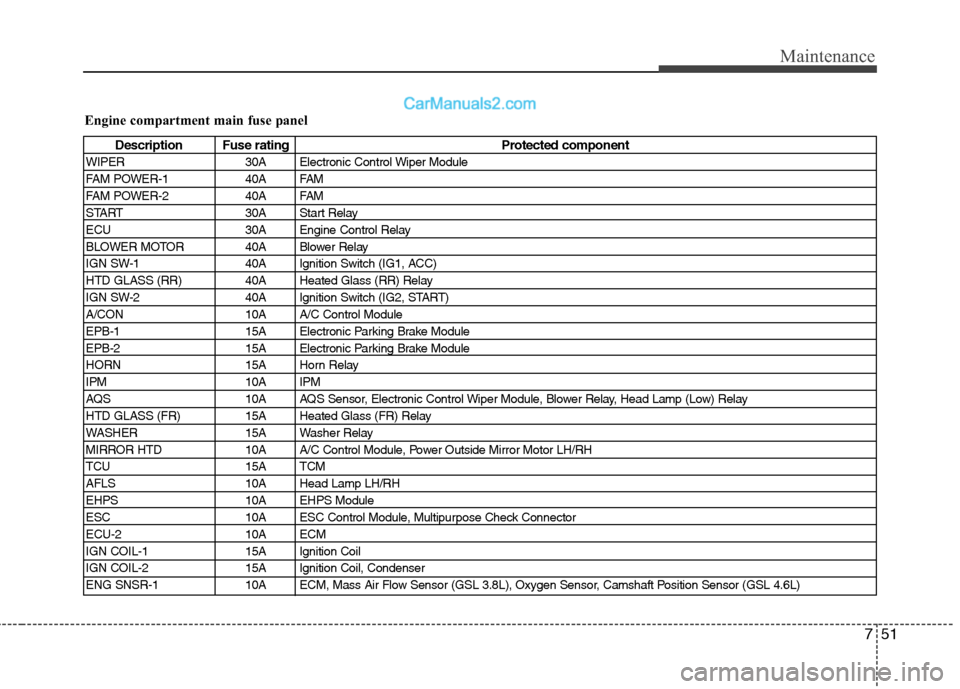
Engine compartment main fuse panel
Description Fuse rating Protected component
WIPER 30A Electronic Control Wiper Module
FAM POWER-1 40A FAM
FAM POWER-2 40A FAM
START 30A Start Relay
ECU 30A Engine Control Relay
BLOWER MOTOR 40A Blower Relay
IGN SW-1 40A Ignition Switch (IG1, ACC)
HTD GLASS (RR) 40A Heated Glass (RR) Relay
IGN SW-2 40A Ignition Switch (IG2, START)
A/CON 10A A/C Control Module
EPB-1 15A Electronic Parking Brake Module
EPB-2 15A Electronic Parking Brake Module
HORN 15A Horn Relay
IPM 10A IPM
AQS 10A AQS Sensor, Electronic Control Wiper Module, Blower Relay, Head Lamp (Low) Relay
HTD GLASS (FR) 15A Heated Glass (FR) Relay
WASHER 15A Washer Relay
MIRROR HTD 10A A/C Control Module, Power Outside Mirror Motor LH/RH
TCU 15A TCM
AFLS 10A Head Lamp LH/RH
EHPS 10A EHPS Module
ESC 10A ESC Control Module, Multipurpose Check Connector
ECU-2 10A ECM
IGN COIL-1 15A Ignition Coil
IGN COIL-2 15A Ignition Coil, Condenser
ENG SNSR-1 10A ECM, Mass Air Flow Sensor (GSL 3.8L), Oxygen Sensor, Camshaft Position Sensor (GSL 4.6L)
Page 368 of 399
753
Maintenance
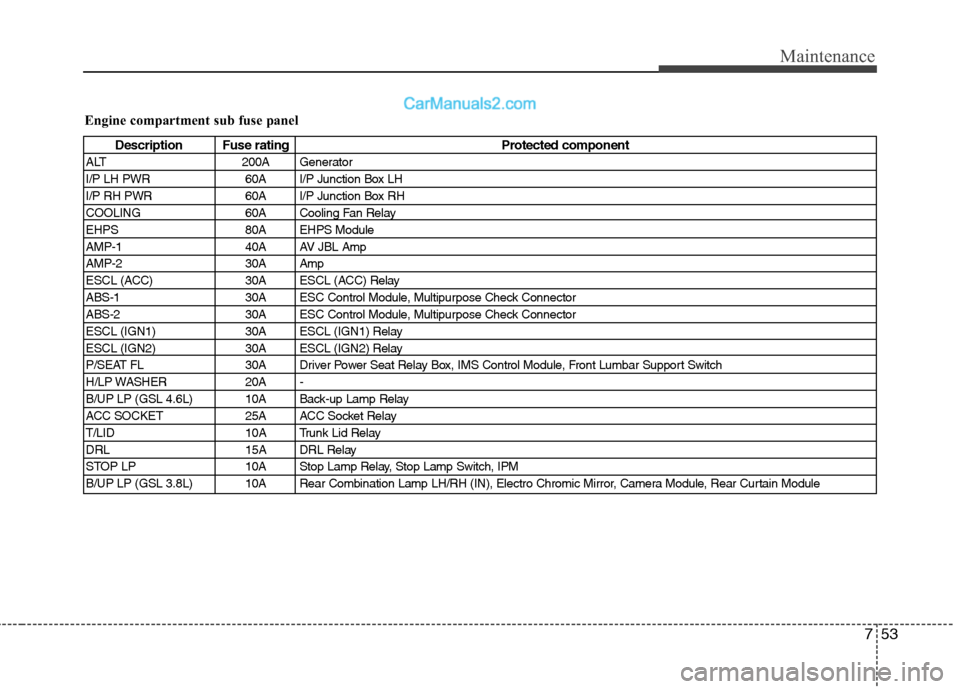
Engine compartment sub fuse panel
Description Fuse rating Protected component
ALT 200A Generator
I/P LH PWR 60A I/P Junction Box LH
I/P RH PWR 60A I/P Junction Box RH
COOLING 60A Cooling Fan Relay
EHPS 80A EHPS Module
AMP-1 40A AV JBL Amp
AMP-2 30A Amp
ESCL (ACC) 30A ESCL (ACC) Relay
ABS-1 30A ESC Control Module, Multipurpose Check Connector
ABS-2 30A ESC Control Module, Multipurpose Check Connector
ESCL (IGN1) 30A ESCL (IGN1) Relay
ESCL (IGN2) 30A ESCL (IGN2) Relay
P/SEAT FL 30A Driver Power Seat Relay Box, IMS Control Module, Front Lumbar Support Switch
H/LP WASHER 20A -
B/UP LP (GSL 4.6L) 10A Back-up Lamp Relay
ACC SOCKET 25A ACC Socket Relay
T/LID 10A Trunk Lid Relay
DRL 15A DRL Relay
STOP LP 10A Stop Lamp Relay, Stop Lamp Switch, IPM
B/UP LP (GSL 3.8L) 10A Rear Combination Lamp LH/RH (IN), Electro Chromic Mirror, Camera Module, Rear Curtain Module
Page 381 of 399
Maintenance
66 7
G270201AUN
Canister
Fuel vapors generated inside the fuel
tank are absorbed and stored in the
onboard canister. When the engine is
running, the fuel vapors absorbed in the
canister are drawn into the surge tank
through the purge control solenoid valve.
G270202AUN
Purge Control Solenoid Valve (PCSV)
The purge control solenoid valve is con-
trolled by the Engine Control Module
(ECM); when the engine coolant temper-
ature is low during idling, the PCSV clos-
es so that evaporated fuel is not taken
into the engine. After the engine warms-
up during ordinary driving, the PCSV
opens to introduce evaporated fuel to the
engine.
G270300AUN
3. Exhaust emission control
system
The Exhaust Emission Control System is
a highly effective system which controls
exhaust emissions while maintaining
good vehicle performance.
G270301AUN
Vehicle modifications
This vehicle should not be modified.
Modification of your vehicle could affect
its performance, safety or durability and
may even violate governmental safety
and emissions regulations.
In addition, damage or performance
problems resulting from any modification
may not be covered under warranty.
G270302AUN-EU
Engine exhaust gas precautions (car-
bon monoxide)
Carbon monoxide can be present with
other exhaust fumes. Therefore, if you
smell exhaust fumes of any kind inside
your vehicle, have it inspected and
repaired immediately. If you ever sus-
pect exhaust fumes are coming into
your vehicle, drive it only with all the
windows fully open. Have your vehicle
checked and repaired immediately.
WARNING- Exhaust
Engine exhaust gases contain car-
bon monoxide (CO). Though color-
less and odorless, it is dangerous
and could be lethal if inhaled.
Follow the instructions on this
page to avoid CO poisoning.
CALIFORNIA PROPOSI-
TION 65 WARNING
Engine exhaust and a wide variety
of automobile components and
parts, including components found
in the interior furnishings in a vehi-
cle, contain or emit chemicals
known to the State of California to
cause cancer and birth defects and
reproductive harm. In addition, cer-
tain fluids contained in vehicles
and certain products of component
wear contain or emit chemicals
known to the State of California to
cause cancer and birth defects or
other reproductive harm.