time Hyundai Genesis 2010 Owner's Manual
[x] Cancel search | Manufacturer: HYUNDAI, Model Year: 2010, Model line: Genesis, Model: Hyundai Genesis 2010Pages: 399, PDF Size: 10 MB
Page 1 of 399
OWNER'S MANUAL
Operation
Maintenance
Specifications
All information in this Owner's Manual is current at the time of publication.
However, Hyundai reserves the right to make changes at any time so that
our policy of continual product improvement may be carried out.
This manual applies to all Hyundai models and includes descriptions and
explanations of optional as well as standard equipment. As a result, you
may find material in this manual that does not apply to your specific vehi-
cle.
Page 12 of 399
15
Introduction
A030000BUN
No special break-in period is needed. By
following a few simple precautions for the
first 600 miles (1,000 km) you may add to
the performance, economy and life of
your vehicle.
Do not race the engine.
While driving, keep your engine speed
(rpm, or revolutions per minute)
between 2,000 rpm and 4,000 rpm.
Do not maintain a single speed for long
periods of time, either fast or slow.
Varying engine speed is needed to
properly break-in the engine.
Avoid hard stops, except in emergen-
cies, to allow the brakes to seat prop-
erly.
Don't let the engine idle longer than 3
minutes at one time.
Don't tow a trailer during the first 1,200
miles (2,000 km) of operation.
VEHICLE BREAK-IN PROCESS
CALIFORNIA PROPOSI-
TION 65 WARNING
Items contained in motor vehicles
or emitted from them are known to
the State of California to cause can-
cer and birth defects or reproduc-
tive harm. These include:
components and materials
ject to heat and wear
In addition, battery posts, terminals
and related accessories contain
lead, lead compounds and other
chemicals known to the State of
California to cause cancer and
reproductive harm.
Page 13 of 399

Introduction
6 1
A040000AFD
This vehicle is equipped with an event
data recorder (EDR). The main pur-
pose of an EDR is to record, in certain
crash or near crash-like situations,
such as an air bag deployment or hit-
ting a road obstacle, data that will
assist in understanding how a vehi-
cle's systems performed. The EDR is
designed to record data related to
vehicle dynamics and safety systems
for a short period of time, typically 30
seconds or less. The EDR in this vehi-
cle is designed to record such data
as:
were operating;
senger safety belts were
buckled/fastened;These data can help provide a better
understanding of the circumstances
in which crashes and injuries occur.
NOTE: EDR data are recorded by your
vehicle only if a nontrivial crash situa-
tion occurs; no data are recorded by
the EDR under normal driving condi-
tions and no personal data (e.g.,
name, gender, age, and crash loca-
tion) are recorded. However, other
parties, such as law enforcement,
could combine the EDR data with the
type of personally identifying data
routinely acquired during a crash
investigation.To read data recorded by an EDR, spe-
cial equipment is required, and
access to the vehicle or the EDR is
needed.
In addition to the vehicle manufacture,
other parties, such as law enforce-
ment, that have the special equip-
ment, can read the information if they
have access to the vehicle or the EDR.
VEHICLE DATA COLLECTION AND EVENT DATA RECORDERS
Page 23 of 399
Safety features of your vehicle
4 3
C010201AUN
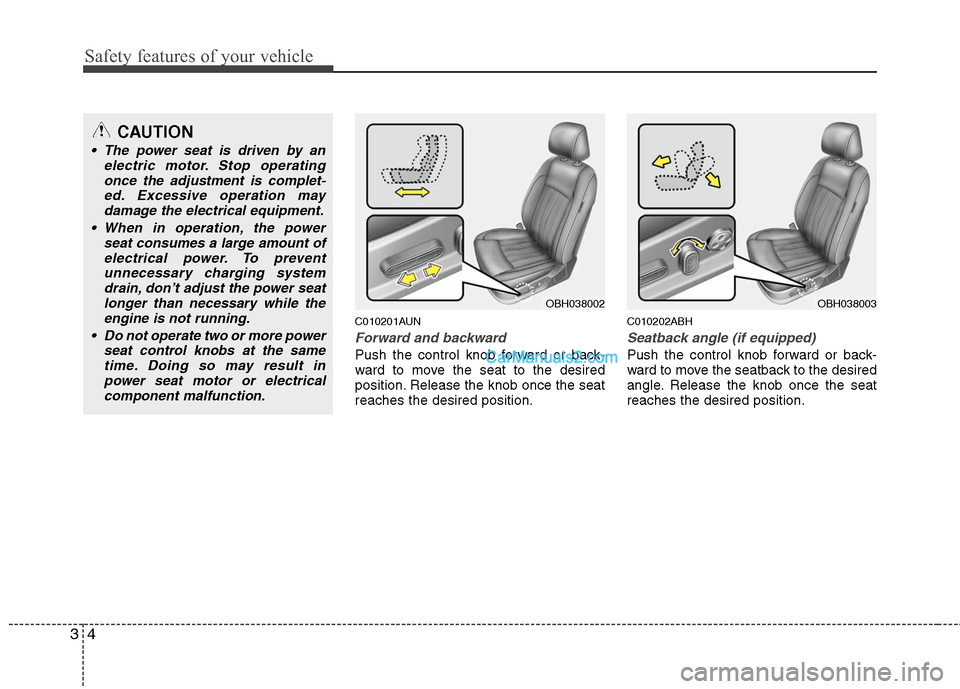
Forward and backward
Push the control knob forward or back-
ward to move the seat to the desired
position. Release the knob once the seat
reaches the desired position.
C010202ABH
Seatback angle (if equipped)
Push the control knob forward or back-
ward to move the seatback to the desired
angle. Release the knob once the seat
reaches the desired position.
CAUTION
The power seat is driven by an
electric motor. Stop operating
once the adjustment is complet-
ed. Excessive operation may
damage the electrical equipment.
When in operation, the power
seat consumes a large amount of
electrical power. To prevent
unnecessary charging system
drain, don’t adjust the power seat
longer than necessary while the
engine is not running.
Do not operate two or more power
seat control knobs at the same
time. Doing so may result in
power seat motor or electrical
component malfunction.
OBH038002OBH038003
Page 27 of 399

Safety features of your vehicle
8 3
Each time you push the button, the
temperature setting of the seat is
changed as follows :
The seat warmer defaults to the OFF
position whenever the ignition switch is
turned on.
✽ ✽
NOTICE
With the seat warmer switch in the ON
position, the heating system in the seat
turns off or on automatically depending
on the seat temperature.
C010109ABH-EU
Climate control seat (if equipped)
The climate control seat is provided to
cool or warm the driver’s seat during hot
or cold weather by blowing air through
small vent holes on the surface of the
seat and seatback. While the engine is
running, push the rear portion of the
switch to cool the driver's seat, and push
the front portion of the switch to warm the
driver’s seat.
When the operation of the climate control
seat is not needed, keep the switch in the
OFF position.
OFF→HIGH( )→MIDDLE( )→LOW( )
→
CAUTION
When cleaning the seats, do not
use an organic solvent such as
thinner, benzene, alcohol and
gasoline. Doing so may damage
the surface of the heater or seats.
To prevent overheating the seat
warmer, do not place blankets,
cushions or seat covers on the
seats while the seat warmer is in
operation.
Do not place heavy or sharp
objects on seats equipped with
seat warmers. Damage to the seat
warming components could occur.
WARNING- Seat warmer
burns
Passengers should use extreme
caution when using seat warmers
due to the possibility of excess
heating or burns. The occupants
must be able to feel if the seat is
becoming too warm and to turn the
seat warmer off. In particular, the
driver must exercise extreme care
for the following types of passen-
gers:
1. Infants, children, elderly or dis-
abled persons, or hospital outpa-
tients
2. Persons with sensitive skin or
those that burn easily
3. Fatigued individuals
4. Intoxicated individuals
5. Individuals taking medication
that can cause drowsiness or
sleepiness (sleeping pills, cold
tablets, etc.)
OBH038009N
Page 28 of 399

39
Safety features of your vehicle
Each time you push the button, the air-
flow is changed as follows:
The climate control seat defaults to the
OFF position whenever the ignition
switch is turned on.CAUTION
The climate control seat is a sup-
plementary cooling/heating sys-
tem. Use the climate control seat
when the climate control system
is on. Using the climate control
seat for prolonged periods of time
with the climate control system
off could cause the climate con-
trol seat performance to impair.
When cleaning the seats, do not
use an organic solvent such as
thinner, benzene, alcohol and
gasoline. Doing so may damage
the surface of the seats.
Do not spill liquid such as water
or beverages on the surface of
the front seats and seatbacks, or
the air vent holes may be blocked
and prevented from working
properly.
Do not place materials such as
plastic bags or newspapers under
the seats. The air vent may not
work properly as the air intake
can be blocked.
When the air vent does not oper-
ate, restart the vehicle. If there is
no change, have your vehicle
inspected by an authorized
HYUNDAI dealer.WARNING
Passengers should use extreme
caution when using the climate
control seat to warm due to the
possibility of excess heating or
burns. The occupants must be able
to feel if the seat is becoming too
warm and to turn the seat warmer
off. In particular, the driver must
exercise extreme care for the fol-
lowing types of passengers:
1. Infants, children, elderly or dis-
abled persons, or hospital outpa-
tients
2. Persons with sensitive skin or
those that burn easily
3. Fatigued individuals
4. Intoxicated individuals
5. Individuals taking medication
that can cause drowsiness or
sleepiness (sleeping pills, cold
tablets, etc.)OFF→HIGH( )→MIDDLE( )→LOW( )
→
Page 34 of 399

315
Safety features of your vehicle
C020101CBH-EU
Seat belt warning (for driver’s seat)
As a reminder to the driver, the seat belt
warning light will blink for approximately
6 seconds each time you turn the ignition
switch ON, regardless of belt fastening.
The warning light will blink again for
approximately 6 seconds when starting
the engine.If the driver's seat belt is not fastened
when the ignition switch is turned on, the
seat belt warning light and chime will
operate for approximately 6 seconds. But
if it is fastened within the 6 seconds, the
warning light will blink till the 6 seconds
and the warning chime will turn off imme-
diately.
If the driver's seat belt is disconnected
after the ignition switch is turned to the
ON position, the seat belt warning light
will turn on for approximately 6 seconds.
But if it is fastened within the 6 seconds,
the warning light will turn off immediately.
If the driver's seat belt is not fastened
when the vehicle speed exceeds 6 mph
(10 km/h), the seat belt warning light and
chime will operate for approximately 11
times with a pattern of 6 seconds on and
24 seconds off until the belt is fastened
or the vehicle speed decreases below 3
mph (5 km/h).
Seat belt warning (for front passen-
ger’s seat)
As a reminder to the front passenger, the
front passenger's seat belt warning light
will blink for approximately 6 seconds
each time you turn the ignition switch ON
regardless of belt fastening. If the pas-
senger's seat belt is unfastened when
the vehicle speed exceeds 6 mph (10
km/h), the passenger's seat belt warning
light will blink for at least 6 seconds until
the belt is fastened.
1GQA2083OBH038071N
Page 39 of 399

Safety features of your vehicle
20 3
✽
✽
NOTICE
• Both the driver's and front passen-
ger's pre-tensioner seat belts may be
activated in certain frontal collisions.
The pre-tensioner seat belts can be
activated where the frontal collision is
severe enough, together with the air
bags.
• When the pre-tensioner seat belts are
activated, a loud noise may be heard
and fine dust, which may appear to be
smoke, may be visible in the passenger
compartment. These are normal oper-
ating conditions and are not haz-
ardous.
• Although it is harmless, the fine dust
may cause skin irritation and should
not be breathed for prolonged peri-
ods. Wash all exposed skin areas thor-
oughly after an accident in which the
pre-tensioner seat belts were activat-
ed.
✽ ✽
NOTICE
Because the sensor that activates the
SRS air bag is connected with the pre-
tensioner seat belt, the SRS air bag
warning light on the instrument
panel will illuminate for approximately
6 seconds after the ignition switch has
been turned to the ON position, and
then it should turn off.
CAUTION
If the pre-tensioner seat belt is not
working properly, this warning light
will illuminate even if there is no
malfunction of the SRS air bag. If
the SRS air bag warning light does
not illuminate when the ignition
switch is turned ON, or if it remains
illuminated after illuminating for
approximately 6 seconds, or if it
illuminates while the vehicle is
being driven, have an authorized
HYUNDAI dealer inspect the pre-
tensioner seat belt and SRS air bag
system as soon as possible.
WARNING
Pre-tensioners are designed to
operate only one time. After acti-
vation, pre-tensioner seat belts
must be replaced. All seat belts,
of any type, should always be
replaced after they have been
worn during a collision.
The pre-tensioner seat belt
assembly mechanisms become
hot during activation. Do not
touch the pre-tensioner seat belt
assemblies for several minutes
after they have been activated.
Do not attempt to inspect or
replace the pre-tensioner seat
belts yourself. This must be done
by an authorized HYUNDAI dealer.
Do not strike the pre-tensioner
seat belt assemblies.
Do not attempt to service or
repair the pre-tensioner seat belt
system in any manner.
(Continued)
Page 40 of 399
321
Safety features of your vehicle
C020300AUN-EU
Seat belt precautions
C020306AUN-EU
Infant or small child
All 50 states have child restraint laws. You
should be aware of the specific require-
ments in your state. Child and/or infant
seats must be properly placed and
installed in the rear seat. For more infor-
mation about the use of these restraints,
refer to “Child restraint system” in this
section.
(Continued)
Improper handling of the pre-ten-
sioner seat belt assemblies, and
failure to heed the warnings not
to strike, modify, inspect, replace,
service or repair the pre-tension-
er seat belt assemblies may lead
to improper operation or inadver-
tent activation and serious injury.
Always wear the seat belts when
driving or riding in a motor vehi-
cle.
If the vehicle or pre-tensioner
seat belt must be discarded, con-
tact an authorized HYUNDAI deal-
er.
WARNING
All occupants of the vehicle must
wear their seat belts at all times.
Seat belts and child restraints
reduce the risk of serious or fatal
injuries for all occupants in the
event of a collision or sudden stop.
Without a seat belt, occupants
could be shifted too close to a
deploying air bag, strike the interior
structure or be thrown from the
vehicle. Properly worn seat belts
greatly reduce these hazards.
Even with advanced air bags,
unbelted occupants can be severe-
ly injured by a deploying air bag.
Always follow the precautions
about seat belts, air bags and occu-
pant seating contained in this man-
ual.
WARNING
Every person in your vehicle needs
to be properly restrained at all
times, including infants and chil-
dren. Never hold a child in your
arms or lap when riding in a vehi-
cle. The violent forces created dur-
ing a crash will tear the child from
your arms and throw the child
against the interior. Always use a
child restraint appropriate for your
child's height and weight.
Page 45 of 399
Safety features of your vehicle
26 3
C030100AEN-EU
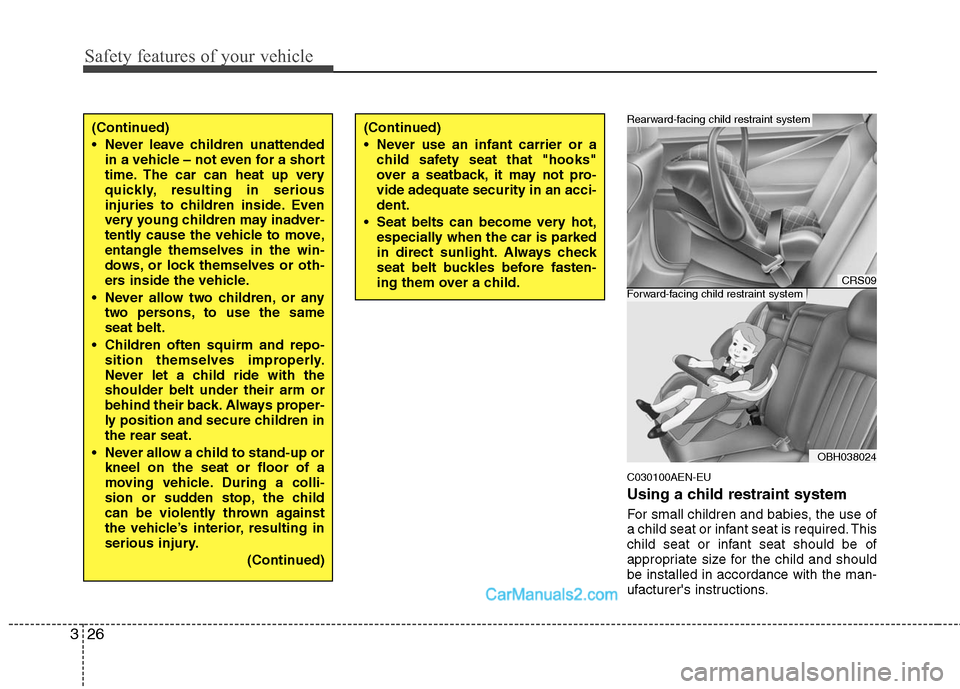
Using a child restraint system
For small children and babies, the use of
a child seat or infant seat is required. This
child seat or infant seat should be of
appropriate size for the child and should
be installed in accordance with the man-
ufacturer's instructions.
(Continued)
Never leave children unattended
in a vehicle – not even for a short
time. The car can heat up very
quickly, resulting in serious
injuries to children inside. Even
very young children may inadver-
tently cause the vehicle to move,
entangle themselves in the win-
dows, or lock themselves or oth-
ers inside the vehicle.
Never allow two children, or any
two persons, to use the same
seat belt.
Children often squirm and repo-
sition themselves improperly.
Never let a child ride with the
shoulder belt under their arm or
behind their back. Always proper-
ly position and secure children in
the rear seat.
Never allow a child to stand-up or
kneel on the seat or floor of a
moving vehicle. During a colli-
sion or sudden stop, the child
can be violently thrown against
the vehicle’s interior, resulting in
serious injury.
(Continued)(Continued)
Never use an infant carrier or a
child safety seat that "hooks"
over a seatback, it may not pro-
vide adequate security in an acci-
dent.
Seat belts can become very hot,
especially when the car is parked
in direct sunlight. Always check
seat belt buckles before fasten-
ing them over a child.
CRS09
OBH038024
Forward-facing child restraint system
Rearward-facing child restraint system