brake Hyundai Genesis 2012 Owner's Manual
[x] Cancel search | Manufacturer: HYUNDAI, Model Year: 2012, Model line: Genesis, Model: Hyundai Genesis 2012Pages: 393, PDF Size: 8.81 MB
Page 380 of 393
Maintenance
62 7
G230105AUN
Underbody maintenance
Corrosive materials used for ice and
snow removal and dust control may col-
lect on the underbody. If these materials
are not removed, accelerated rusting can
occur on underbody parts such as the
fuel lines, frame, floor pan and exhaust
system, even though they have been
treated with rust protection.
Thoroughly flush the vehicle underbody
and wheel openings with lukewarm or
cold water once a month, after off-road
driving and at the end of each winter. Pay
special attention to these areas because
it is difficult to see all the mud and dirt. It
will do more harm than good to wet down
the road grime without removing it. The
lower edges of doors, rocker panels, and
frame members have drain holes that
should not be allowed to clog with dirt;
trapped water in these areas can cause
rusting.
G230106AUN
Aluminum or chrome wheel mainte-
nance
The aluminum or chrome wheels are
coated with a clear protective finish.
• Do not use any abrasive cleaner, pol-
ishing compound, solvent, or wire
brushes on aluminum or chrome
wheels. They may scratch or damage
the finish.
• Clean the wheel when it has cooled.
• Use only a mild soap or neutral deter-
gent, and rinse thoroughly with water.
Also, be sure to clean the wheels after
driving on salted roads. This helps pre-
vent corrosion.
• Avoid washing the wheels with high-
speed car wash brushes.
• Do not use any alkaline or acid deter-
gent. It may damage and corrode the
aluminum or chrome wheels coated
with a clear protective finish.
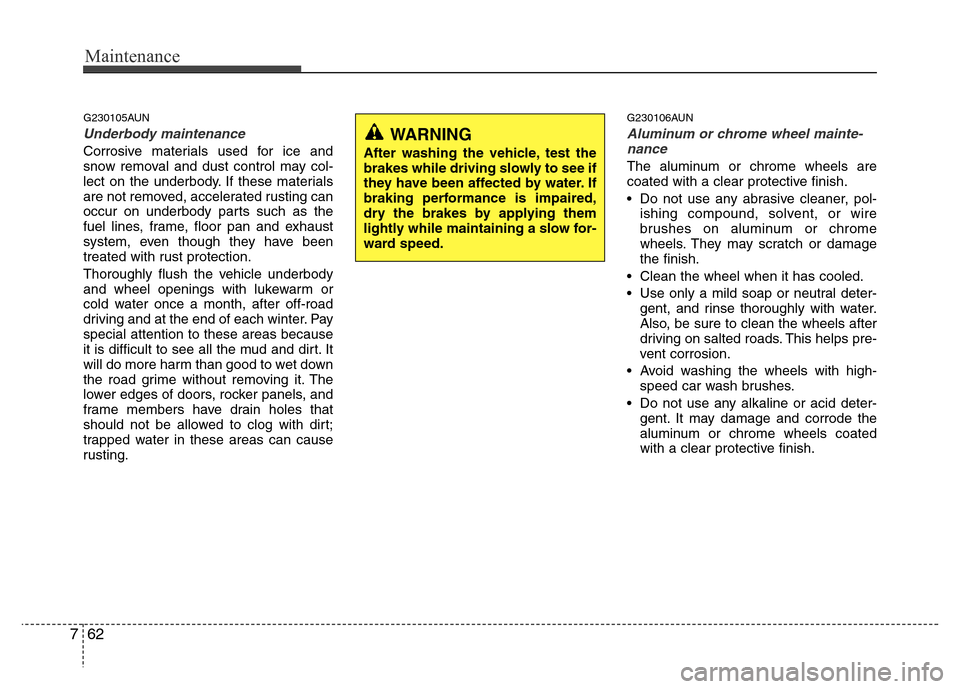
WARNING
After washing the vehicle, test the
brakes while driving slowly to see if
they have been affected by water. If
braking performance is impaired,
dry the brakes by applying them
lightly while maintaining a slow for-
ward speed.
Page 390 of 393
Specifications & Consumer information
4 8
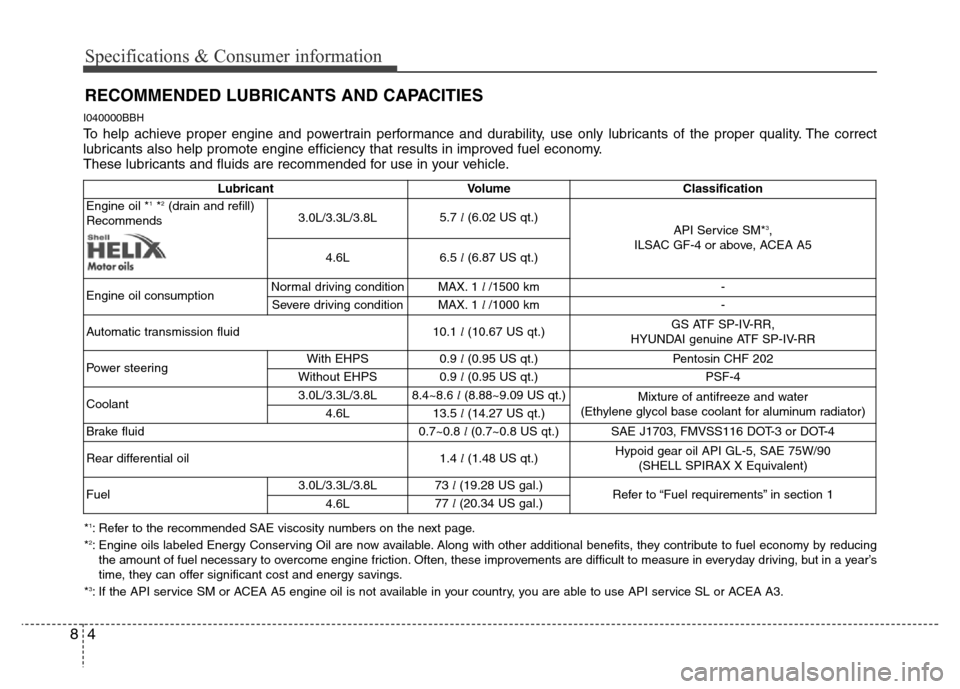
RECOMMENDED LUBRICANTS AND CAPACITIES
I040000BBH
To help achieve proper engine and powertrain performance and durability, use only lubricants of the proper quality. The correct
lubricants also help promote engine efficiency that results in improved fuel economy.
These lubricants and fluids are recommended for use in your vehicle.
*1: Refer to the recommended SAE viscosity numbers on the next page.
*2: Engine oils labeled Energy Conserving Oil are now available. Along with other additional benefits, they contribute to fuel economy by reducing
the amount of fuel necessary to overcome engine friction. Often, these improvements are difficult to measure in everyday driving, but in a year’s
time, they can offer significant cost and energy savings.
*
3: If the API service SM or ACEA A5 engine oil is not available in your country, you are able to use API service SL or ACEA A3.Lubricant Volume Classification
Engine oil *
1*2(drain and refill)
Recommends3.0L/3.3L/3.8L5.7 l(6.02 US qt.)
API Service SM*
3,
ILSAC GF-4 or above, ACEA A5
4.6L6.5 l(6.87 US qt.)
Engine oil consumptionNormal driving conditionMAX. 1l /1500 km-
Severe driving conditionMAX. 1l /1000 km -
Automatic transmission fluid10.1 l(10.67 US qt.)GS ATF SP-IV-RR,
HYUNDAI genuine ATF SP-IV-RR
Power steeringWith EHPS0.9 l(0.95 US qt.)
Pentosin CHF 202
Without EHPS0.9 l(0.95 US qt.)
PSF-4
Coolant3.0L/3.3L/3.8L8.4~8.6 l(8.88~9.09 US qt.)
Mixture of antifreeze and water
(Ethylene glycol base coolant for aluminum radiator)
4.6L13.5 l(14.27 US qt.)
Brake fluid0.7~0.8 l(0.7~0.8 US qt.)
SAE J1703, FMVSS116 DOT-3 or DOT-4
Rear differential oil1.4 l(1.48 US qt.)Hypoid gear oil API GL-5, SAE 75W/90
(SHELL SPIRAX X Equivalent)
Fuel3.0L/3.3L/3.8L73 l(19.28 US gal.)
Refer to “Fuel requirements” in section 1
4.6L77 l(20.34 US gal.)